
St Kinga’s Chapel, Wieliczka Salt Mine
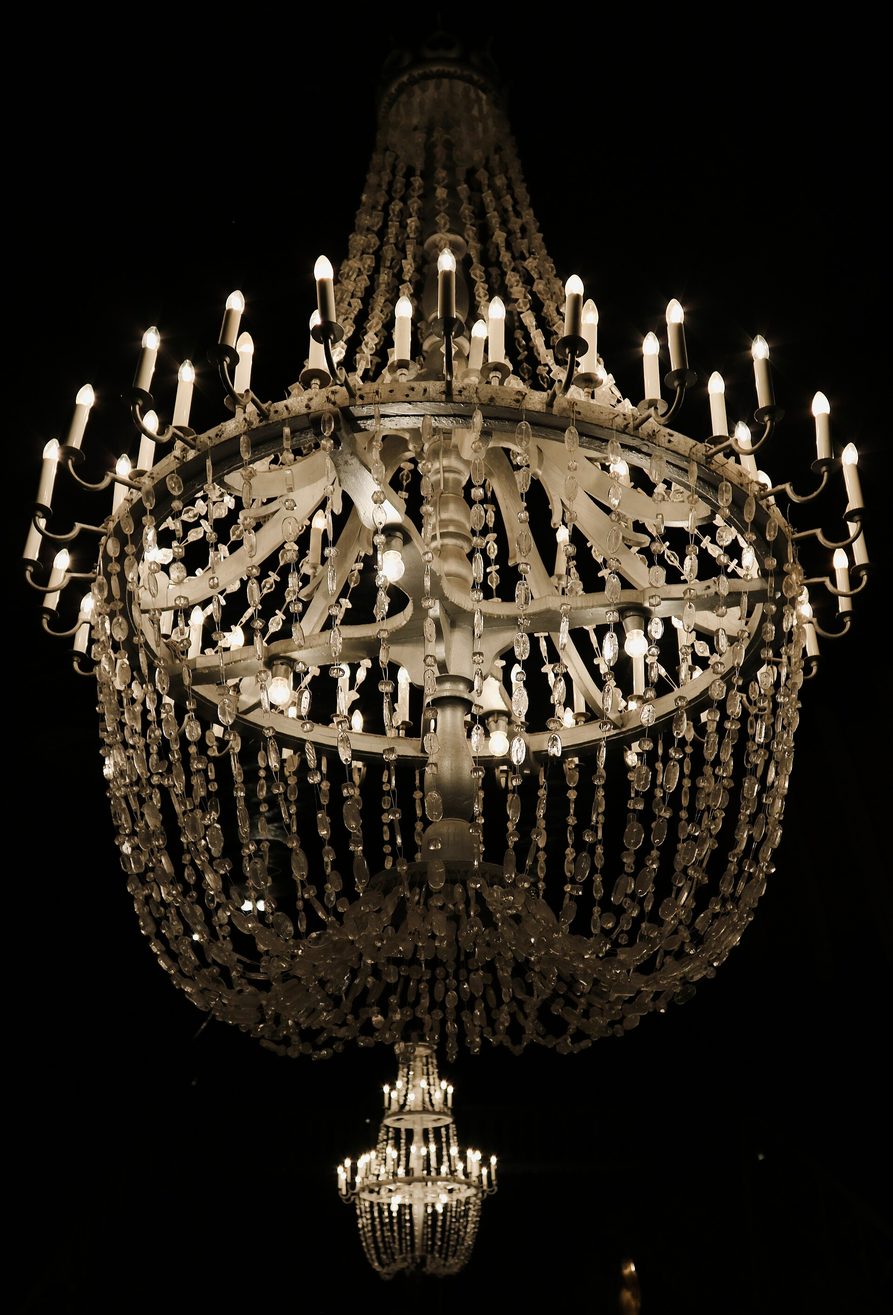
A hundred metres underground, in the salt mine of Wieliczka just outside Kraków, miners spent some seventy years carving a church out of the rock itself. St Kinga’s Chapel has a floor, altars, statues and reliefs of salt, lit by chandeliers hung with salt crystals. It is the high point of the mine’s Tourist Route, a UNESCO World Heritage Site, and a working chapel where Mass is said every Sunday morning.
A church carved in salt
Salt has been mined at Wieliczka since the Middle Ages, and the miners carved chapels where they worked, to pray for protection in a dangerous trade. The chapel is named after St Kinga, the Hungarian princess who married the Polish duke Bolesław the Chaste in the thirteenth century. Legend says she threw her engagement ring into a salt mine in Hungary, and that it turned up in the first lump of salt dug in Poland. Wieliczka tradition places the find here, though the oldest Life of Kinga, written in the early fourteenth century, sets it at nearby Bochnia.
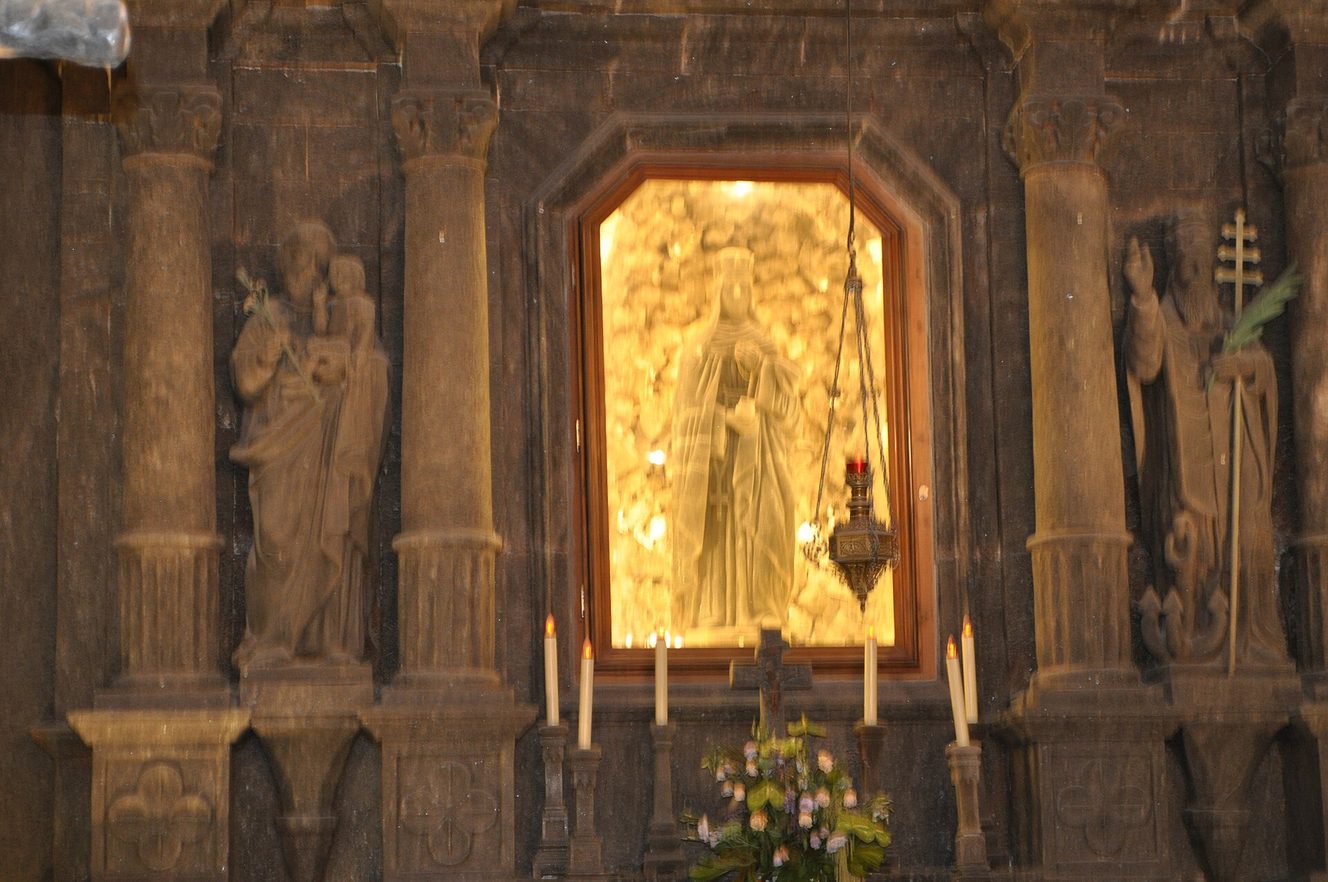
The chapel was hollowed out in 1896, in a chamber left behind when a great block of salt had been mined. Over the next two decades the miner Józef Markowski, a self-taught sculptor, carved its main altar, its pulpit and side altars; his statue of St Kinga has stood in the altar since 1914, and relics of the saint were placed in the altar niche in 1994. His brother Tomasz and, from 1927, Antoni Wyrodek carved the reliefs on the walls, among them a Last Supper after Leonardo, and Wyrodek designed the salt floor. The carving went on into the 1960s, and new work has been added since, including a statue of Pope John Paul II.
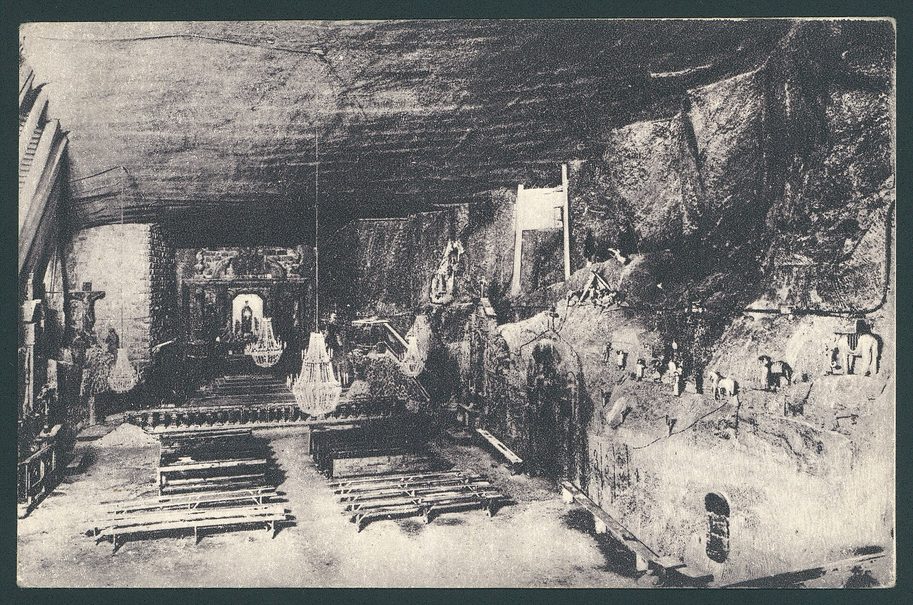
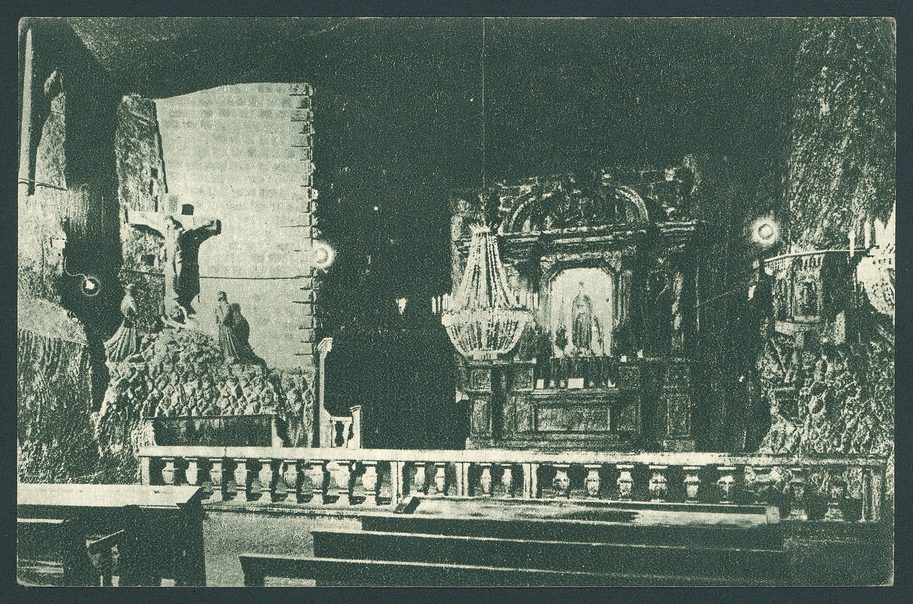
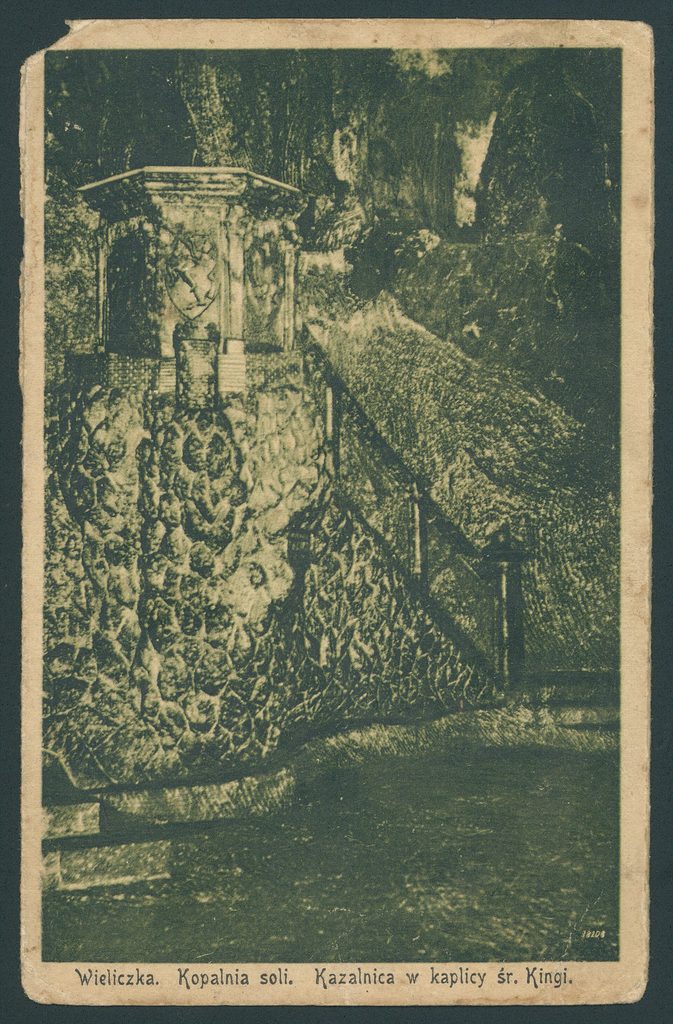
This guide shows the older carvings and the chapel as it appeared on postcards of the early 1920s. The later reliefs, including the famous Last Supper, are still in copyright, so you will have to see them for yourself.
The visitor’s cheat sheet
| Opening hours | Daily; closed 1 January, Easter Sunday, 1 November and 24–25 December. Times vary by day: check the mine’s online calendar |
|---|---|
| Admission | Guided Tourist Route only. 2026, tours in English and other languages: 143 zloty (Jan–Apr, Oct–Dec), 159 (May, Jun, Sep), 169 (Jul–Aug); reduced 121–131; tours in Polish 103–125; under-4s free |
| Booking | Buy online for a guaranteed time; tours in languages other than Polish or English must be booked online |
| The walk | About 3.5 km and 800 steps (380 down at the start); lift back up included |
| Temperature | About 17–18°C underground |
| Sunday Mass | 7.30am in St Kinga’s Chapel; the shaft opens at 7am |
| Getting there | Train SKA1 from Kraków Główny to Wieliczka Rynek-Kopalnia, every 30 minutes, about 25 minutes |
| How long | 2–3 hours underground |
Hours and admission checked against the official site in November 2026. They change; the official site is always the last word.
What to see
The first view
You reach the chapel partway along the Tourist Route and enter at one end, looking down its whole length to the altar, about 54 metres away. The salt walls glitter grey and amber under the chandeliers, and the floor, carved to look like tiles, is a single piece of rock.
The altar and the pulpit
At the far end is Józef Markowski’s main altar, with the statue of St Kinga in its lit central niche. His pulpit and the side altars of the Sacred Heart of Jesus and of Mary are on the side walls.
The reliefs
Along the side walls is a cycle of New Testament scenes in shallow relief: the Flight into Egypt, Jesus in the Temple, the Wedding at Cana, Doubting Thomas and others, most of them by Wyrodek, with the Massacre of the Innocents by Tomasz Markowski. The salt Nativity is on the right-hand wall. Most visitors stop longest at the Last Supper, carved in 1935.
St Anthony’s Chapel
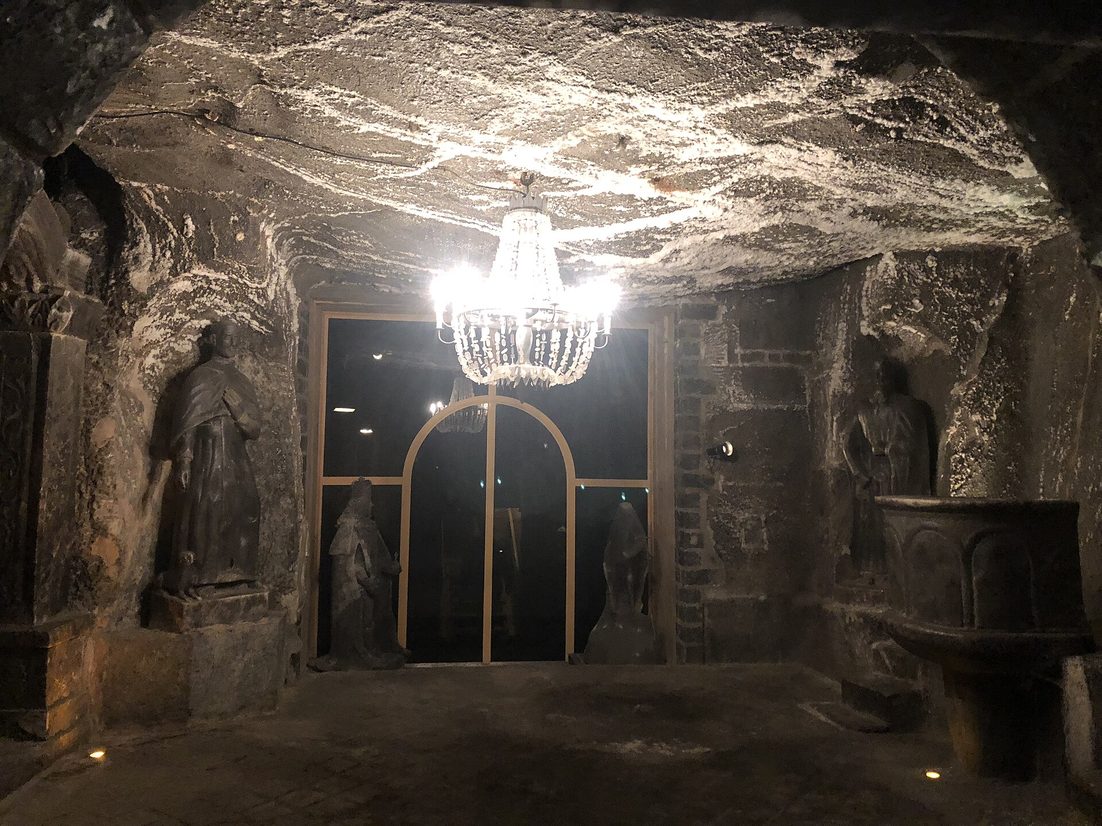
Earlier on the route, St Anthony’s Chapel was carved in green salt in the seventeenth century by unknown miners. It is the oldest surviving chapel in the mine, and its figures have been softened by centuries of damp air.
Visiting the mine
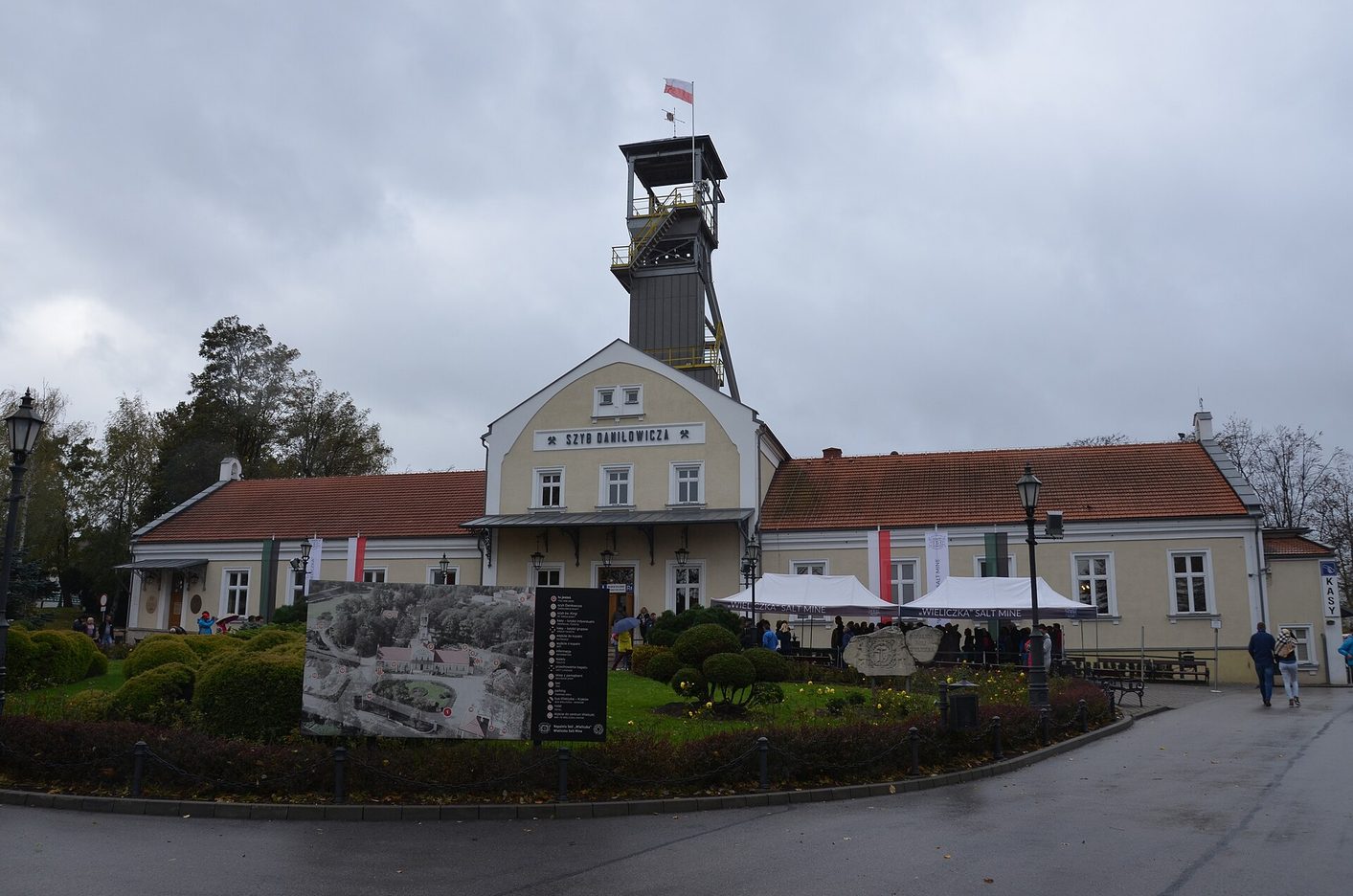
The chapel can only be seen on the mine’s guided Tourist Route. It starts at the Daniłowicz Shaft with about 380 steps down, then winds through chambers, lakes and galleries to a depth of 135 metres, about 3.5 km in all including the museum. The walk takes about two hours, and the underground museum at the end adds another hour if you want it. Everyone comes back up in the miners’ lift. Wear comfortable shoes and bring a layer: it is about 17–18°C below ground all year.
Tours run in Polish, English, German, French, Italian, Russian, Spanish and Ukrainian. English tours run often; other foreign languages less so, and those tickets must be bought online in advance. Large bags and prams must be left at the surface; small folding buggies are allowed, but there is nowhere to leave them underground. Some chambers are adapted for wheelchair users on special tours booked ahead.
Getting there
Wieliczka is about 10 km south-east of Kraków. The easiest way is the SKA1 train from Kraków Główny, the main station, to Wieliczka Rynek-Kopalnia, which runs every 30 minutes and takes about 25 minutes; the mine is a few minutes’ walk from the station. The same line runs from Kraków airport. Bus 304 also runs from near the main station. If you drive, there are car parks by the shaft.
Tours and where to stay
Tickets are sold by the mine for a set time and language. Tours from Kraków that include transport are also widely sold.
These links go to GetYourGuide and Booking.com. This site earns nothing from them at present — they are here because they are the quickest way to check what is actually available.
Don’t miss
- The first view of the chapel From the entrance end.
- St Kinga on the altar Markowski’s statue of 1914.
- The salt chandeliers Crystals of rock salt.
- The Last Supper Carved in salt in 1935.
- St Anthony’s Chapel Seventeenth-century, the oldest.
Insider tips
Go to Sunday Mass. Mass is said in St Kinga’s Chapel every Sunday at 7.30am, and the shaft opens at 7am. It is the one way to see the chapel quietly, as a church rather than a stop on a tour.
Come in the low season. Tickets are cheapest from January to April and from October to December, and the tours are less crowded. In July and August, book a morning or late-afternoon slot.
Common questions
How deep is St Kinga’s Chapel?
About 101 metres below ground. The chapel is some 54 metres long and up to 12 metres high, and everything in it, from the floor to the altar, is carved from the rock salt.
Can you visit the chapel on its own?
Not as a sightseer: the mine can only be visited on a guided tour, and the chapel is part of the Tourist Route. The exception is Sunday Mass at 7.30am, when the shaft opens from 7am for worshippers.
How much does it cost?
In 2026 a guided Tourist Route ticket for a tour in English or another foreign language costs 143 zloty from January to April and October to December, 159 zloty in May, June and September, and 169 zloty in July and August. Tours in Polish are cheaper. Children under 4 go free.
How many steps are there? Is there a lift?
About 800 steps in all, 380 of them on the way down at the start. Everyone comes back up by lift, which is included in the ticket.
Can I take photos?
Yes, for private use. There is no longer a charge for taking photographs.
How cold is it, and how long does it take?
The Tourist Route is at about 17–18°C all year, so bring a light layer. The guided walk takes about two hours; the underground museum at the end adds about an hour more if you choose to see it.
More churches nearby
- St Vitus Cathedral, Prague — Bohemia’s great Gothic cathedral.
- St Stephen’s Cathedral, Vienna — the Steffl and its catacombs.
- Sedlec Ossuary — another unforgettable underground chapel.