
Coventry Cathedral
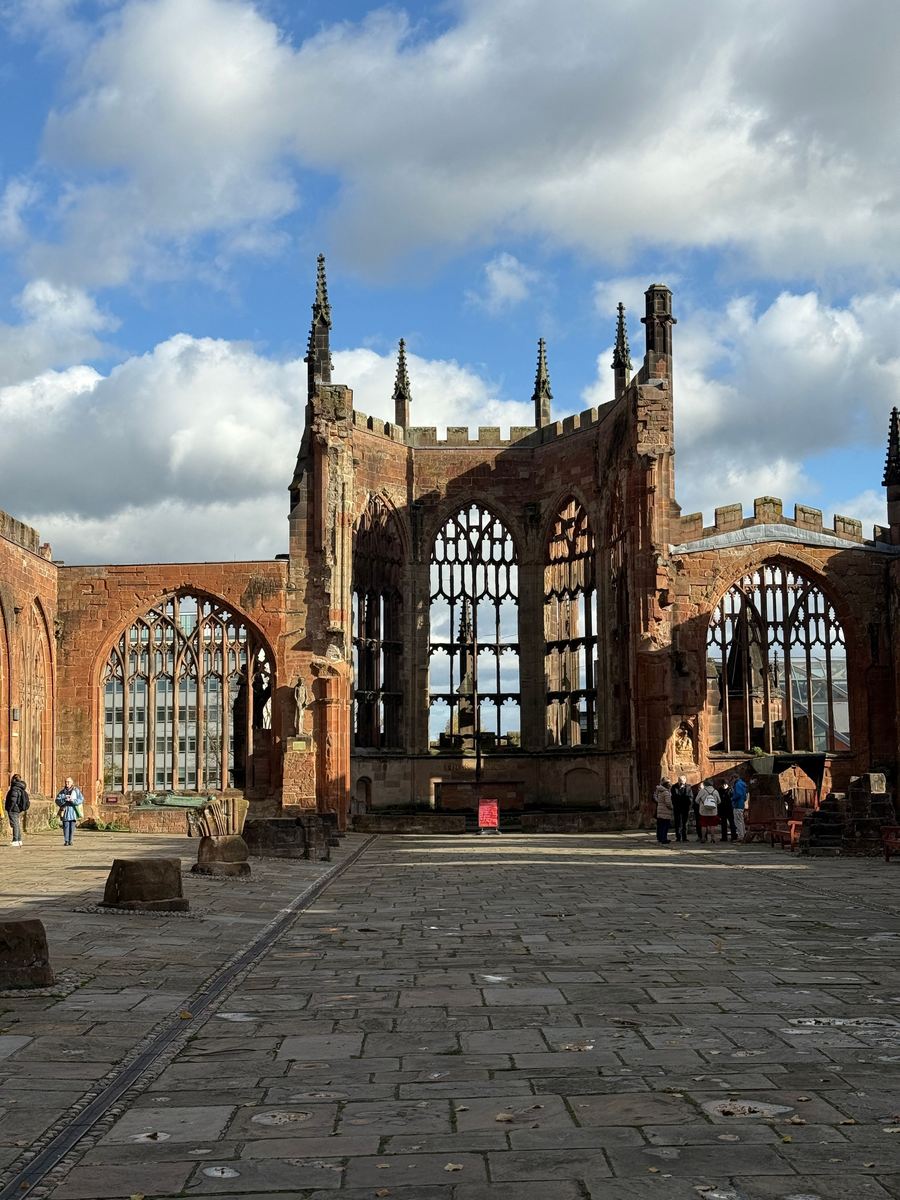
On the night of 14 November 1940, German bombers set Coventry on fire and the cathedral burned with it. The next morning, among the smoking walls, a stonemason tied two charred roof beams together in the shape of a cross, and the provost had two words carved on the wall behind the altar: Father Forgive. Coventry kept its ruins, built a new cathedral beside them, and made reconciliation its life’s work. There is nowhere else in England quite like it.
Three cathedrals in one city
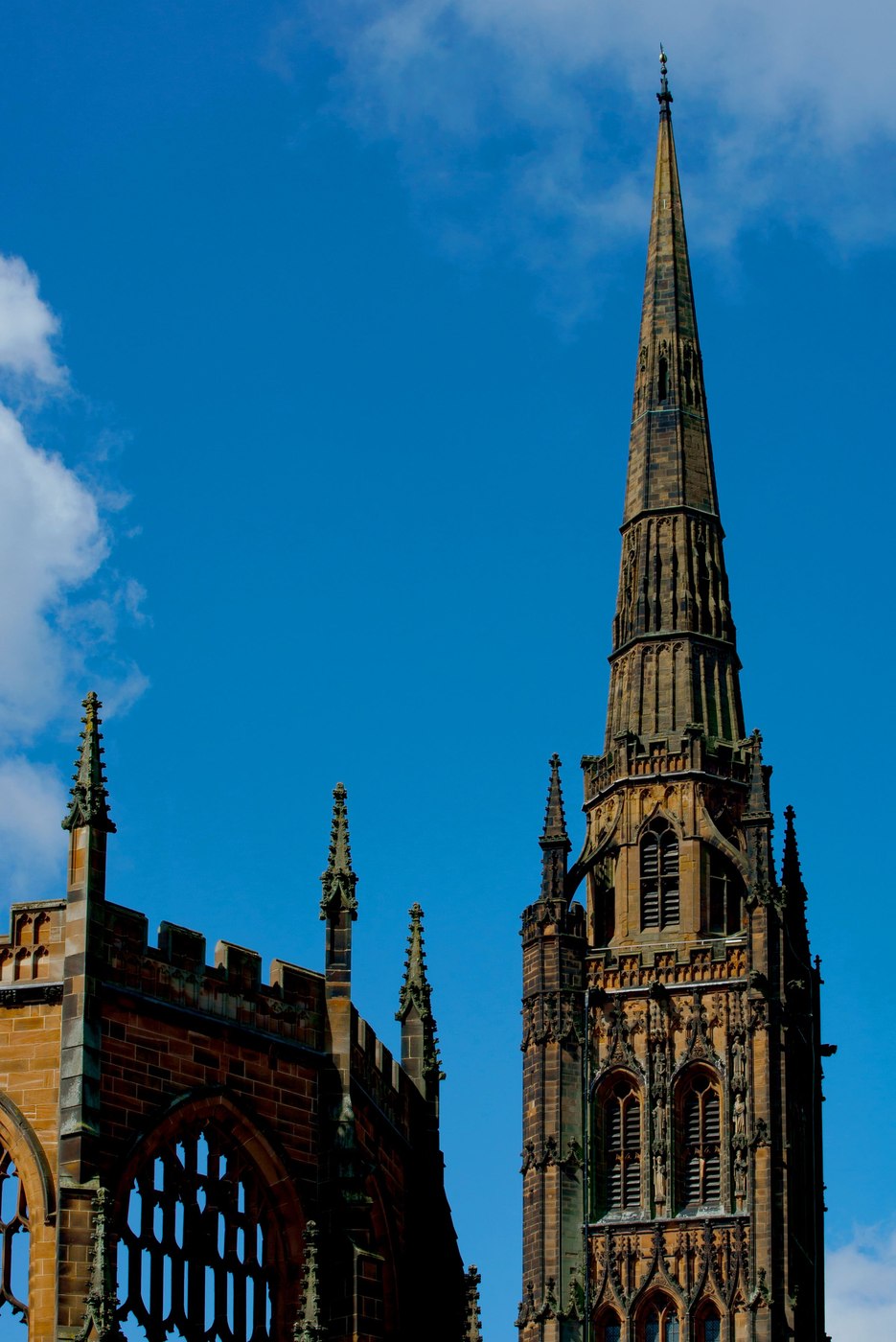
Coventry has had three cathedrals. The first was the church of the Benedictine priory founded in 1043 by Leofric, Earl of Mercia, and his wife Godiva — the Lady Godiva of the legend. It became a cathedral in 1102, and Henry VIII destroyed it in 1539; only foundations survive, a short walk away. The second was St Michael’s, a very large medieval parish church built mostly in the fourteenth and fifteenth centuries, with one of the tallest spires in England. It was made a cathedral in 1918, when the diocese was re-created.
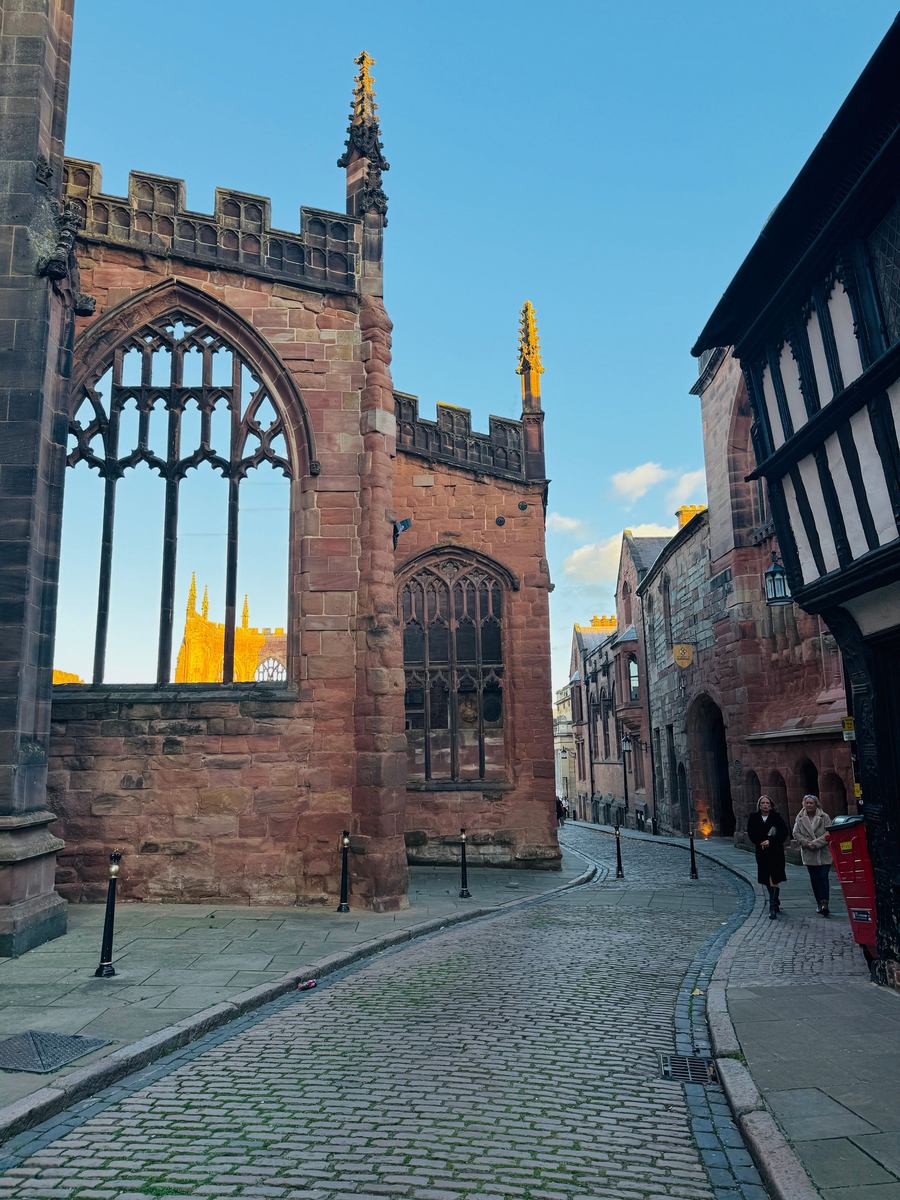
On 14 November 1940, in the raid the Luftwaffe called Operation Moonlight Sonata, hundreds of bombers attacked the city through the night. Incendiary bombs set St Michael’s roof alight, and by morning only the outer walls, the tower and the spire were standing. The provost, Richard Howard, decided almost at once that it should not be rebuilt as it had been, and that the cathedral would answer the destruction with forgiveness rather than revenge.
The third cathedral is the one you visit now. After the war a competition was held for a new building, and in 1951 it was won by Basil Spence. His idea was to keep the ruins as they were and to build the new cathedral at right angles to them, joined by a great porch, so that the old and the new would be seen together. The foundation stone was laid by the Queen in 1956, and the building was consecrated on 25 May 1962. Five days later, Benjamin Britten’s War Requiem, written for the occasion, was performed for the first time inside it.
The visitor's cheat sheet
| Where | Priory Street, Coventry, CV1 5FB, in the city centre |
|---|---|
| Getting there | Coventry station is about 15 minutes’ walk; trains from London Euston take about an hour, and from Birmingham about 20 minutes |
| Opening hours | New cathedral and ruins Mon–Sat 10am–4pm, Sun 12pm–3.30pm. Services and events change the hours often — check the calendar before you travel |
| Admission | Free; a £5 donation per person is suggested. Tower climb about £5 adults, £4 students, £2.50 under-18s. The Blitz Museum is free |
| How long | 1–1.5 hours; 2–2.5 hours with the tower and the Blitz Museum |
| Best time | A weekday at noon for the Litany of Reconciliation, or a weekend to climb the tower |
| Dress code | No formal code; respectful dress as in any working church |
| Photography | Personal photography is welcome; commercial photography needs permission |
Hours and admission checked against the official site in September 2026. They change; the official site is always the last word.
Begin in the ruins. The two buildings are designed as one experience, from destruction to renewal. Walk through the ruins first, then go up the steps to the porch and into the new cathedral. Coming the other way round loses most of the point.
What to see, in the order you meet it
The ruins
The ruins are open to the sky and free to walk into. The outer walls of the medieval church stand to roughly their full height, with the empty tracery of the windows, and the floor is laid out as a quiet garden. At the east end is the Altar of Reconciliation, built of rubble from the fallen church, with the charred cross on it. The original cross, made from roof timbers by the stonemason Jock Forbes, is now kept safe in St Michael’s Hall beneath the new cathedral; the one in the ruins is a replica. Behind it, on the wall of the old sanctuary, are the words Father Forgive. Provost Howard left out the word “them” deliberately.
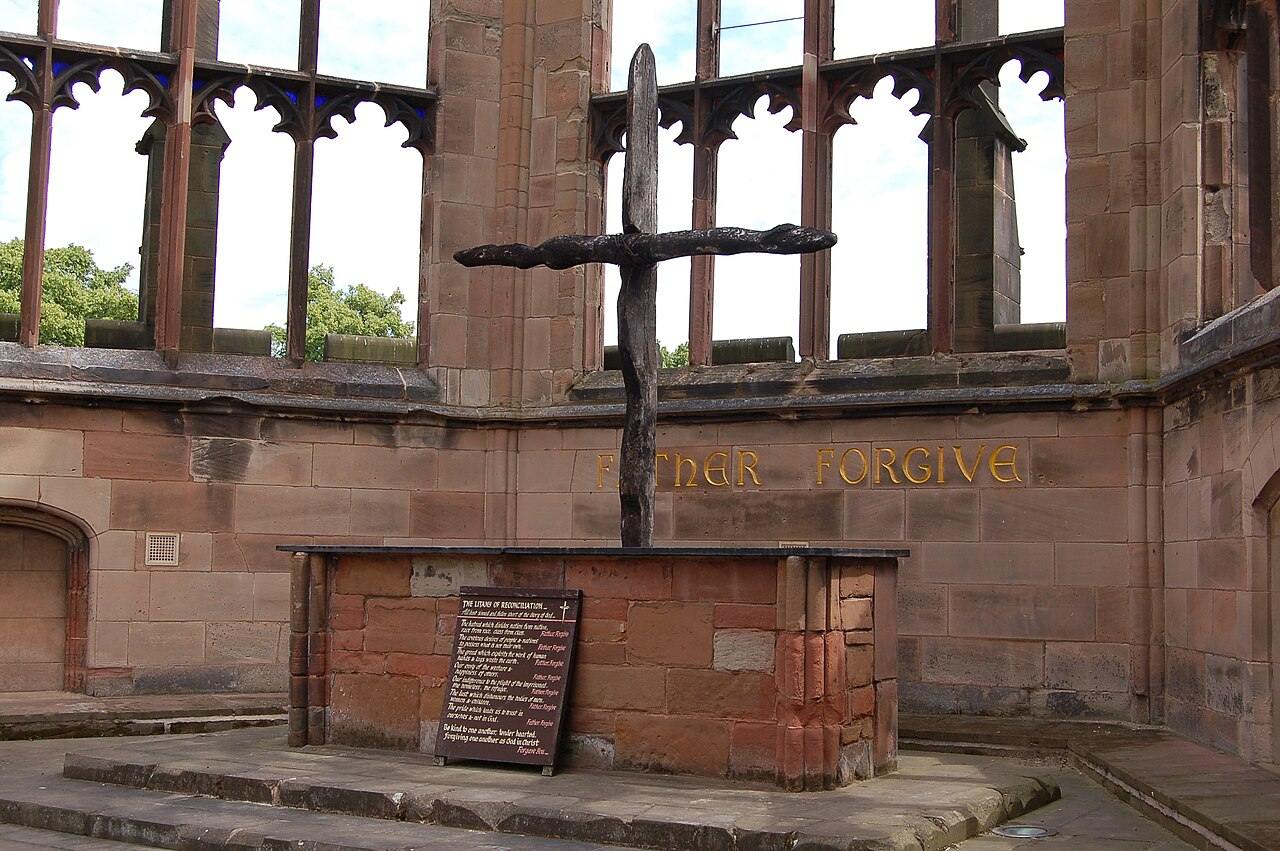
The other great symbol is the Cross of Nails, made in the days after the raid from three large medieval nails from the roof. Crosses of Nails have since been given to hundreds of churches and communities around the world, including in Germany, as part of the cathedral’s reconciliation work. In the ruins, look too for the statue of Reconciliation by Josefina de Vasconcellos, two figures embracing, of which copies stand in Hiroshima, Berlin and Belfast.
Every weekday at noon, the Litany of Reconciliation is prayed in the ruins or in the new cathedral. Its refrain is “Father, forgive”. Anyone is welcome to join, and it takes only a few minutes.
The tower and the Blitz Museum
The tower and spire survived the fire intact, and at weekends you can climb the 180 or so steps to the top for the best view in Coventry. In a corner of the ruins, the Blitz Museum, run by volunteers and free to enter, recreates a wartime classroom and home; it is usually open at weekends in spring and summer.
St Michael and the porch
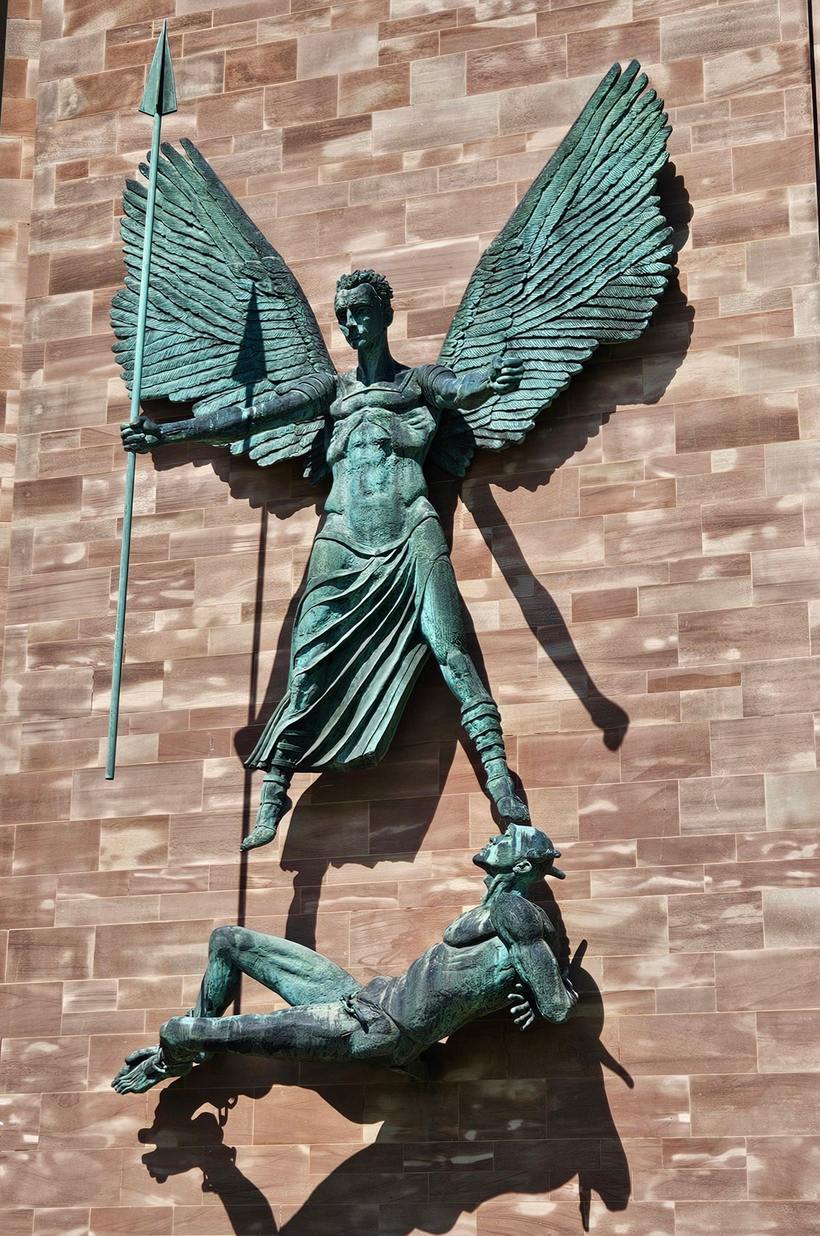
Climb the steps from the ruins and you arrive under the porch that links the two cathedrals. On the wall of the new building, to the right of the entrance, is Jacob Epstein’s great bronze of St Michael triumphant over the Devil, installed in 1960. The archangel stands with spear raised; the Devil lies chained at his feet. It is one of the most famous pieces of public sculpture in Britain.
The west screen
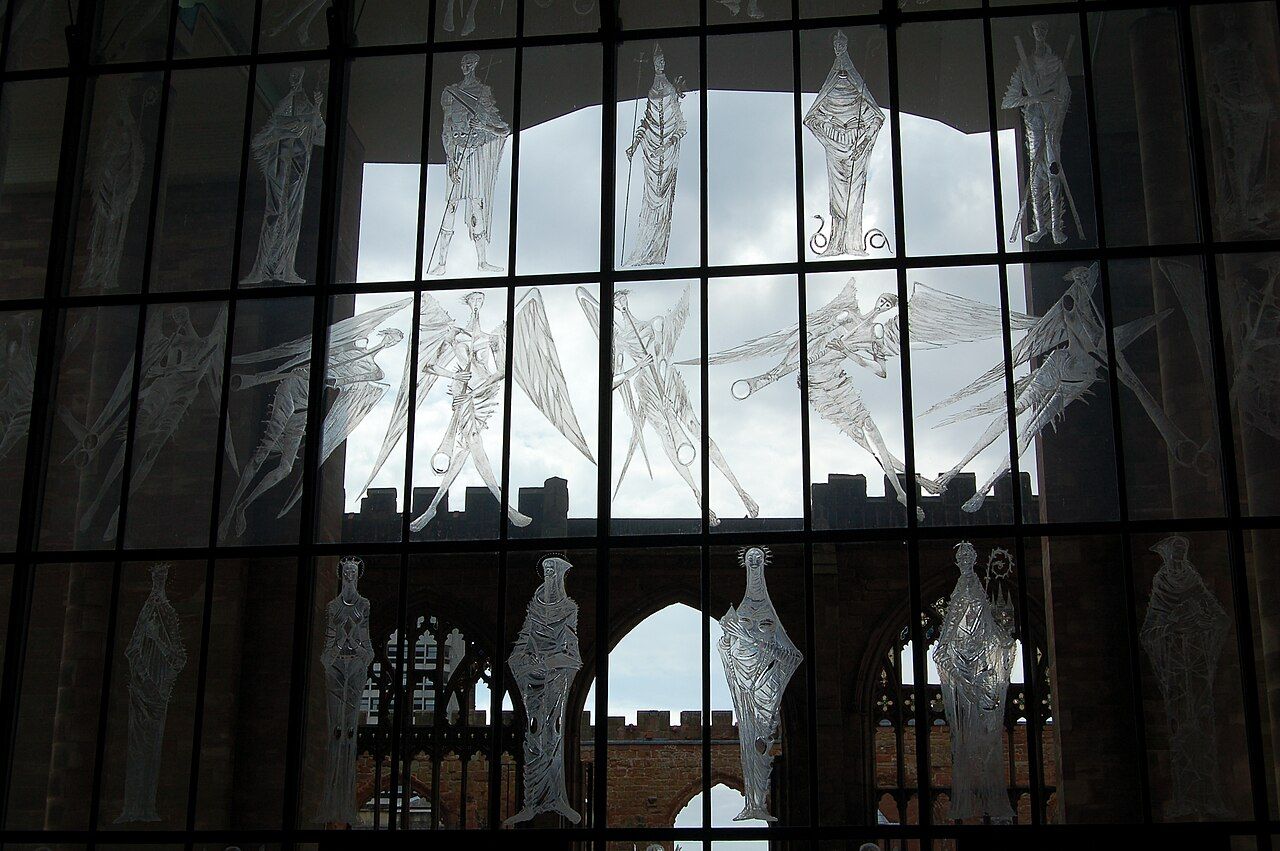
The whole south end of the new cathedral — its ritual west end — is a wall of clear glass, engraved by John Hutton with saints, prophets and angels that seem to float in the air. It means the ruins are always visible from inside the new church, and the new church from the ruins. It is the hinge of the whole design.
The nave and the tapestry
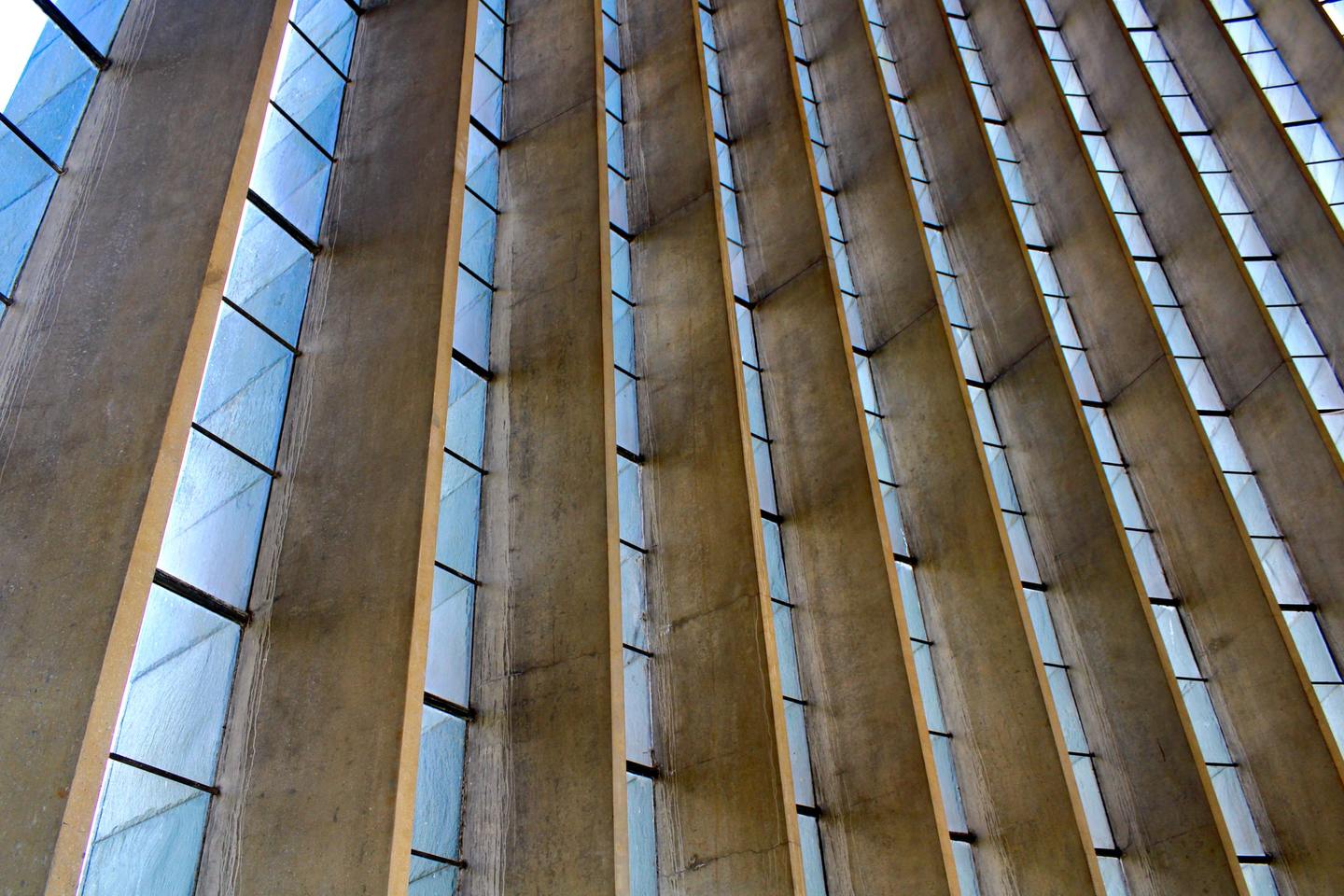
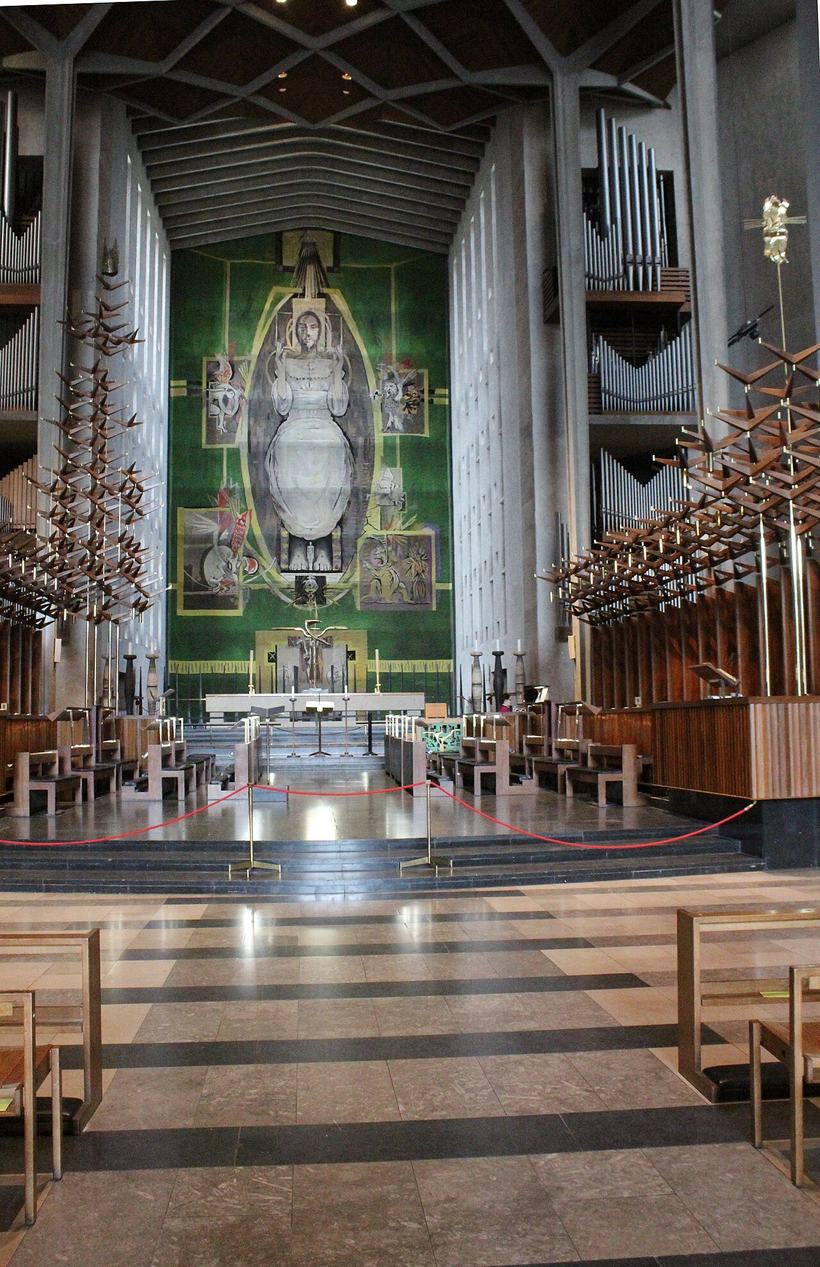
Inside, the nave is tall, pale and light, with slender columns holding up a ribbed canopy. The walls are set in a zigzag, and the tall windows are angled so that they face towards the altar: as you walk up the nave you see very little stained glass, and only when you turn round at the altar does the full colour of the windows appear.
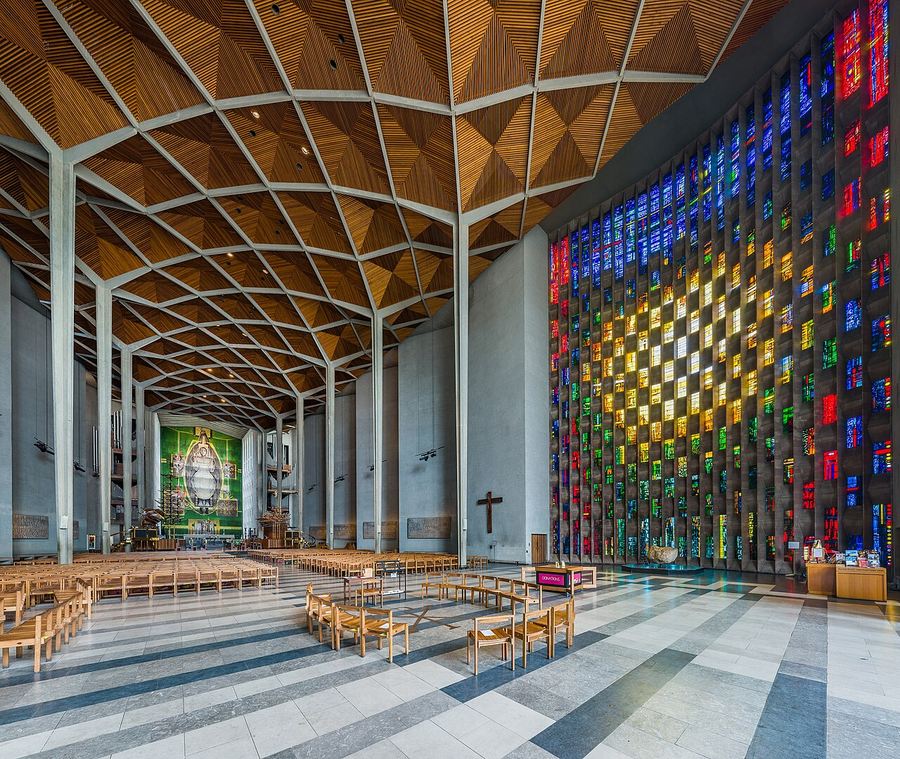
The far end is filled by Graham Sutherland’s tapestry Christ in Glory in the Tetramorph, about 23 metres high and 12 wide, woven in France and at the time the largest tapestry in the world. Christ sits enthroned, with the symbols of the four evangelists around him and, between his feet, a small human figure. Along the walls of the nave are the Tablets of the Word, lettering cut by Ralph Beyer, and near the choir stands Elisabeth Frink’s bronze eagle lectern.
The baptistery window
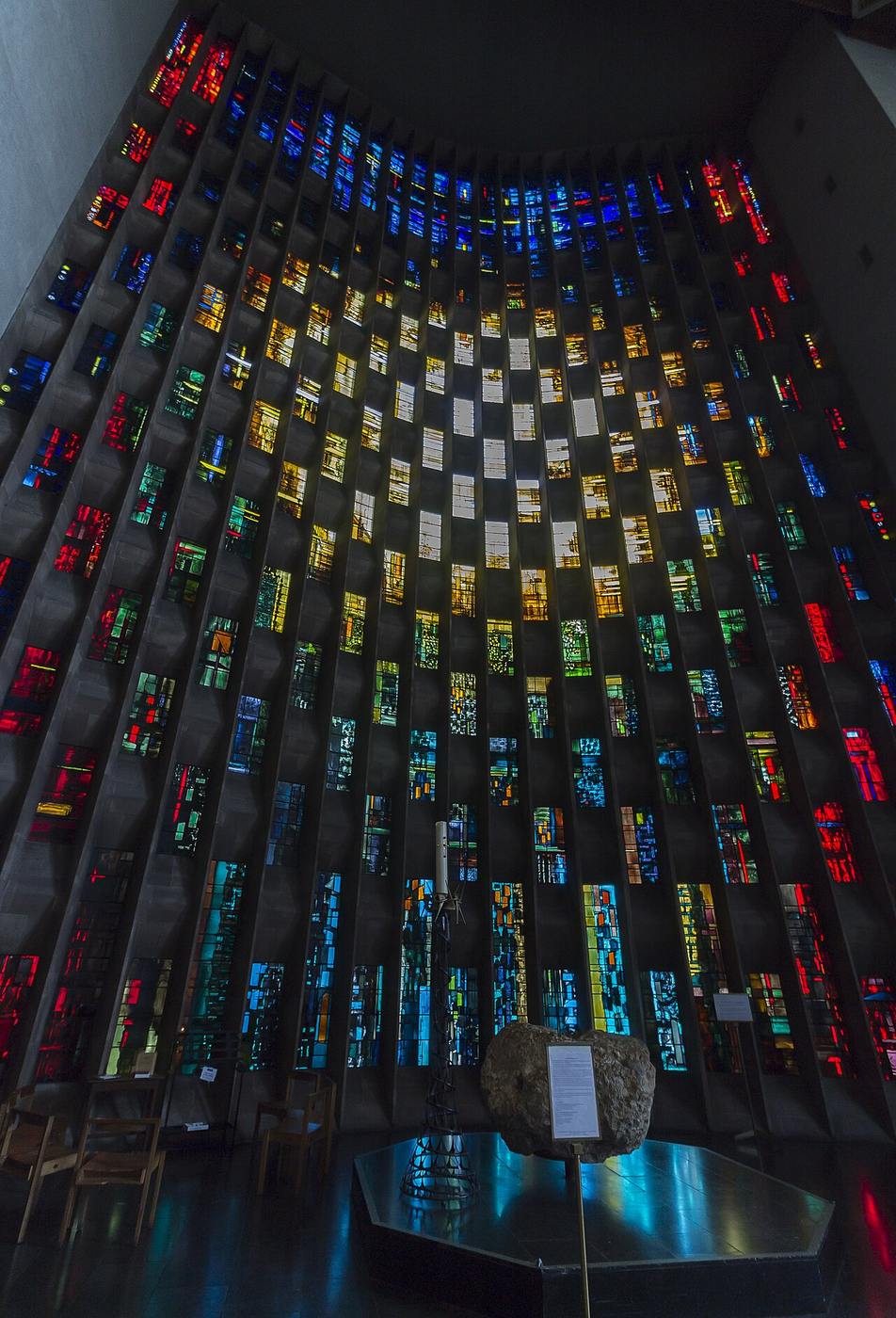
On the right as you enter, the baptistery window fills a curved bay from floor to ceiling. It was designed by John Piper and made by Patrick Reyntiens: 198 panes of abstract coloured glass, darker at the edges and bursting into gold and white light at the centre. In front of it, the font is a rough boulder brought from a hillside near Bethlehem.
The chapels
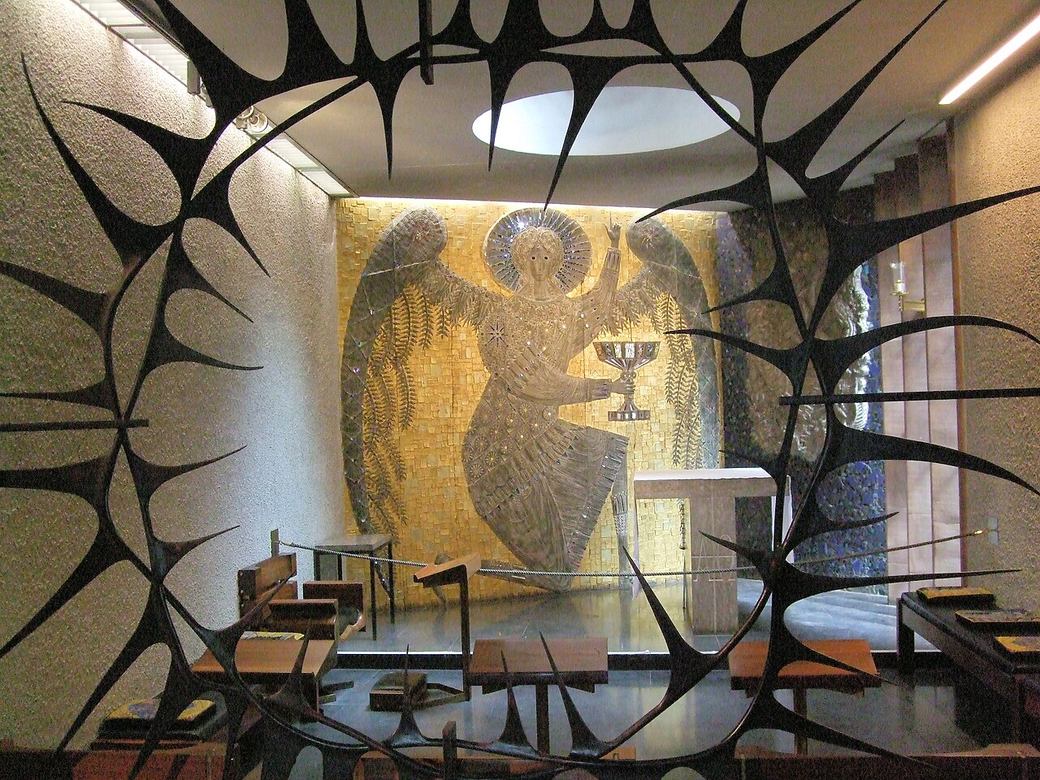
Around the edges of the nave are several chapels. The Chapel of Unity, shaped like a Crusader’s tent, has a floor given by the people of Sweden. The Chapel of Christ the Servant looks out over the city through clear glass. The Chapel of Christ in Gethsemane, the smallest, is seen through a screen in the form of a crown of thorns, with a mosaic of the angel of the agony behind it.
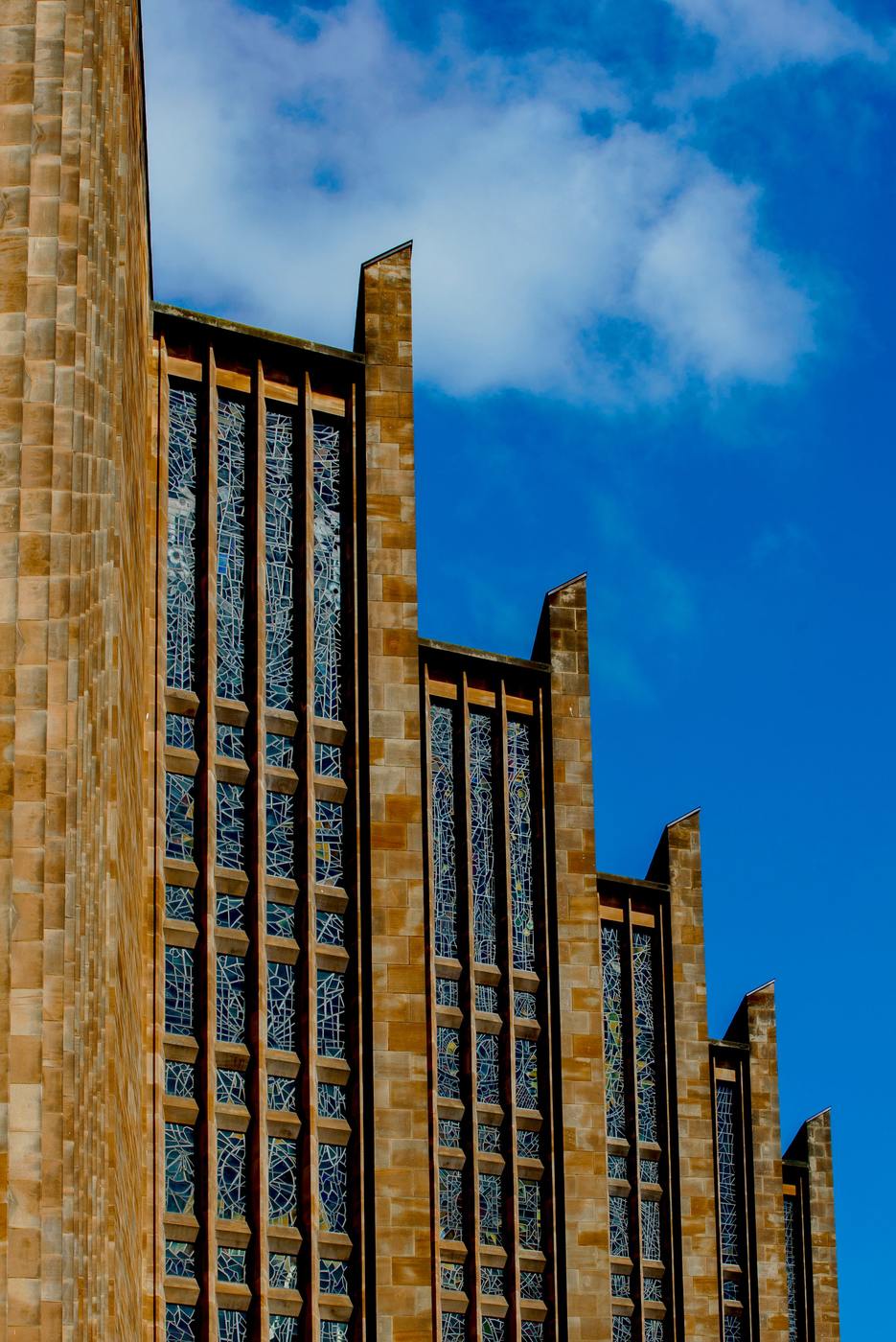
Outside again, look up at the flèche on the roof of the new cathedral. It was lowered into place by helicopter in 1962.
Tickets and tours
No ticket needed, but a guidebook helps
Entry is free and there is no advance booking. Volunteer-led tours are available for groups by arrangement; individual visitors will get a lot from the guidebook sold in the shop, or from the cathedral’s digital guide. The tower climb is paid for at the Tower Shop on the day.
Tour and hotel links go to GetYourGuide and Booking.com. This site earns nothing from them at present — they are here because they are the quickest way to check what is actually available.
Don't miss
- “Father Forgive” On the wall of the ruined sanctuary, behind the charred cross.
- The Litany of Reconciliation Weekdays at noon, a few minutes long, and everyone is welcome.
- Epstein's St Michael The bronze archangel and the chained Devil, beside the steps.
- The west screen Engraved glass saints and angels, with the ruins behind them.
- The Sutherland tapestry About 23 metres of Christ in Glory, once the largest tapestry in the world.
- The baptistery window John Piper’s blaze of light, with a boulder from Bethlehem as the font.
- The view back down the nave Turn round at the altar to see the windows that are hidden as you walk in.
Insider tips
Come at a weekend for the extras. The tower climb and the Blitz Museum open mainly on Saturdays and Sundays. On weekdays, time your visit for the noon Litany.
Coventry is a short train ride from Birmingham and about an hour from London, and the cathedral quarter is compact. Across the road, St Mary’s Guildhall is one of the finest medieval guildhalls in England, and Holy Trinity Church, next to the cathedral, has a medieval Doom painting over its chancel arch.
Evensong and the cathedral’s concerts are worth checking: the building was designed with music in mind, and it was here that the War Requiem was first heard.
Common questions
Is Coventry Cathedral free to visit?
Yes. There is no charge for the ruins or the new cathedral; visitors are asked for a voluntary donation, with £5 per person suggested. The tower climb, at weekends, is ticketed separately at about £5 for adults.
Why are there two cathedrals in Coventry?
The old cathedral, the medieval parish church of St Michael, was destroyed by incendiary bombs on the night of 14 November 1940. Rather than rebuild it or clear the site, the city kept the ruins as a memorial and built a new cathedral beside them, designed by Basil Spence and consecrated on 25 May 1962. The two are joined by a great porch, so you walk from one to the other.
What does “Father Forgive” mean at Coventry?
After the raid, the provost, Richard Howard, had the words “Father Forgive” inscribed on the wall of the ruined sanctuary. He deliberately left out “them”: the prayer was meant to include everyone. It became the foundation of the cathedral’s ministry of reconciliation, and the Litany of Reconciliation is still prayed at noon every weekday in the cathedral.
Can you climb the tower at Coventry Cathedral?
Yes, usually on Saturdays and Sundays from 11am to 3pm, weather permitting. There are around 180 steps, no one under eight can go up, and tickets are bought at the Tower Shop in the ruins.
How long do you need at Coventry Cathedral?
About an hour and a half for the ruins and the new cathedral. Add half an hour for the Blitz Museum and the same again for the tower if they are open.
Where to stay and eat nearby
The cathedral quarter, around Priory Street, Bayley Lane and the university, has cafes and pubs. The Herbert Art Gallery and Museum, next door, has a good café and more on the history of the city.
More English cathedrals
- Liverpool Cathedral — the other great twentieth-century English cathedral, in a very different spirit
- St Paul’s Cathedral — which survived the Blitz that destroyed Coventry’s
- Lincoln Cathedral — the medieval Gothic ideal Coventry’s old church belonged to
See all the cathedrals and churches worth visiting in England →