
Ripon Cathedral
Under the nave of Ripon Cathedral is a small stone room that St Wilfrid built in the 670s, a few years after the Synod of Whitby. It is the oldest built fabric of any English cathedral, older than England itself, and you can still walk into it. Above it stands a church built over four centuries and never quite finished, with a crossing whose arches are half twelfth-century and half Tudor, a set of fifteenth-century carvings that may have given Lewis Carroll a rabbit and a hole, and a west front that is one of the purest pieces of Early English architecture in the country.
Wilfrid, the Vikings and the archbishops
Ripon’s first monastery was given to Wilfrid, a Northumbrian noble turned churchman, in about 660. Wilfrid had been to Rome, and he built at Ripon, as at Hexham, a stone church in the Roman manner, with masons and glaziers brought from the Continent. Of that church only the crypt survives: a barrel-vaulted chamber and its passages, probably made to display relics brought from Rome. Wilfrid died in 710 and was buried here, and Ripon became a place of pilgrimage.
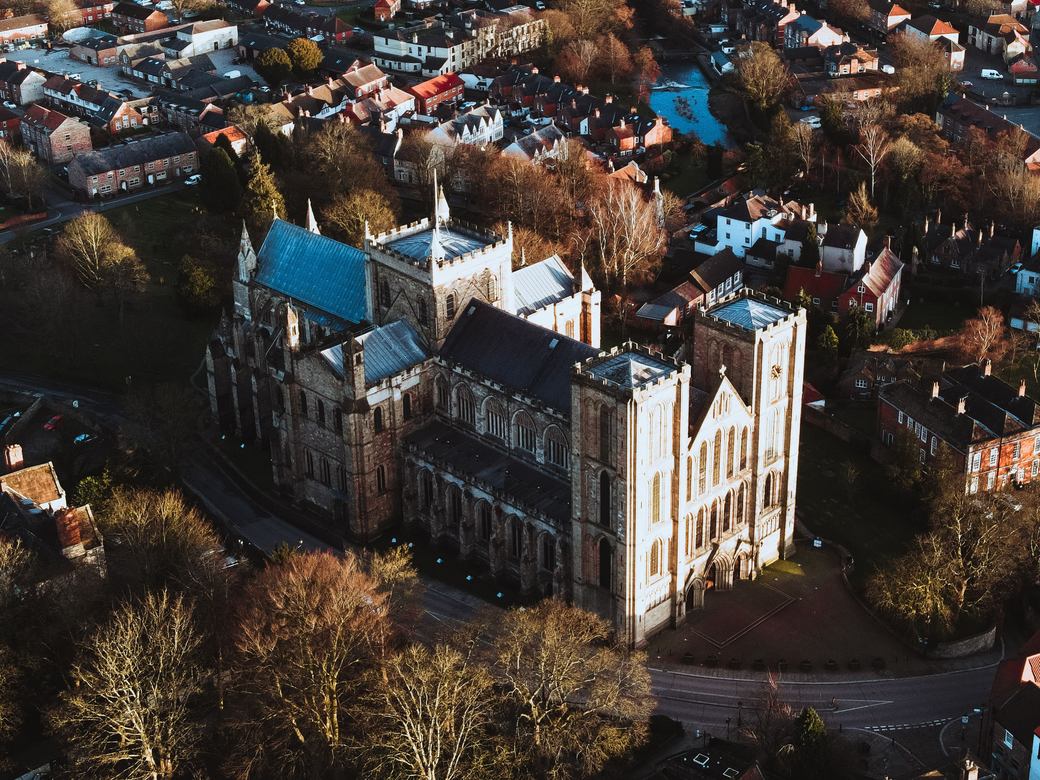
In 948 the English king Eadred, campaigning against the Vikings of York, burned the church. It was rebuilt, and rebuilt again after the Norman Conquest. The church we see was begun in the later twelfth century by Roger de Pont l’Évêque, Archbishop of York, whose builders were among the first in the north to use the pointed arch. The west front followed in the 1220s, the east end was rebuilt at the end of the thirteenth century, and in the early 1500s the nave was pulled down and rebuilt in the Perpendicular style, wider and higher.
For most of its history Ripon was not a cathedral but a minster: a large collegiate church served by canons, under the Archbishop of York. It became a cathedral in 1836, when the Diocese of Ripon was created — the first new English diocese since the Reformation. Since 2014 it has been one of the three cathedrals of the Diocese of Leeds.
The visitor's cheat sheet
| Where | Minster Road, Ripon, North Yorkshire, HG4 1QT, a few minutes’ walk from the Market Square |
|---|---|
| Getting there | No railway station; buses run from Harrogate station, about 30 minutes away. Car parks in the town centre |
| Opening hours | Mon–Sat 8am–6pm; Sun 12pm–5pm. Services and events can close parts of the building — check the cathedral’s website before a special trip |
| Admission | Free; entry is by donation, with £5 suggested. Guided tours are ticketed separately |
| How long | About 1 hour, including the crypt |
| Best time | A weekday morning, then back to the Market Square for the Hornblower at 9pm |
| Dress code | No formal code; respectful dress as in any working church |
| Dogs | Assistance dogs only |
Hours and admission checked against the official site in October 2026. They change; the official site is always the last word.
The oldest, and one of the smallest. Ripon is a city of about 17,000 people, one of the smallest in England, and its cathedral is the reason it is a city at all. The crypt is the oldest built fabric of any English cathedral; Canterbury and Rochester are older foundations, but nothing of their first buildings is left to stand in.
What to see, in the order you meet it
The west front
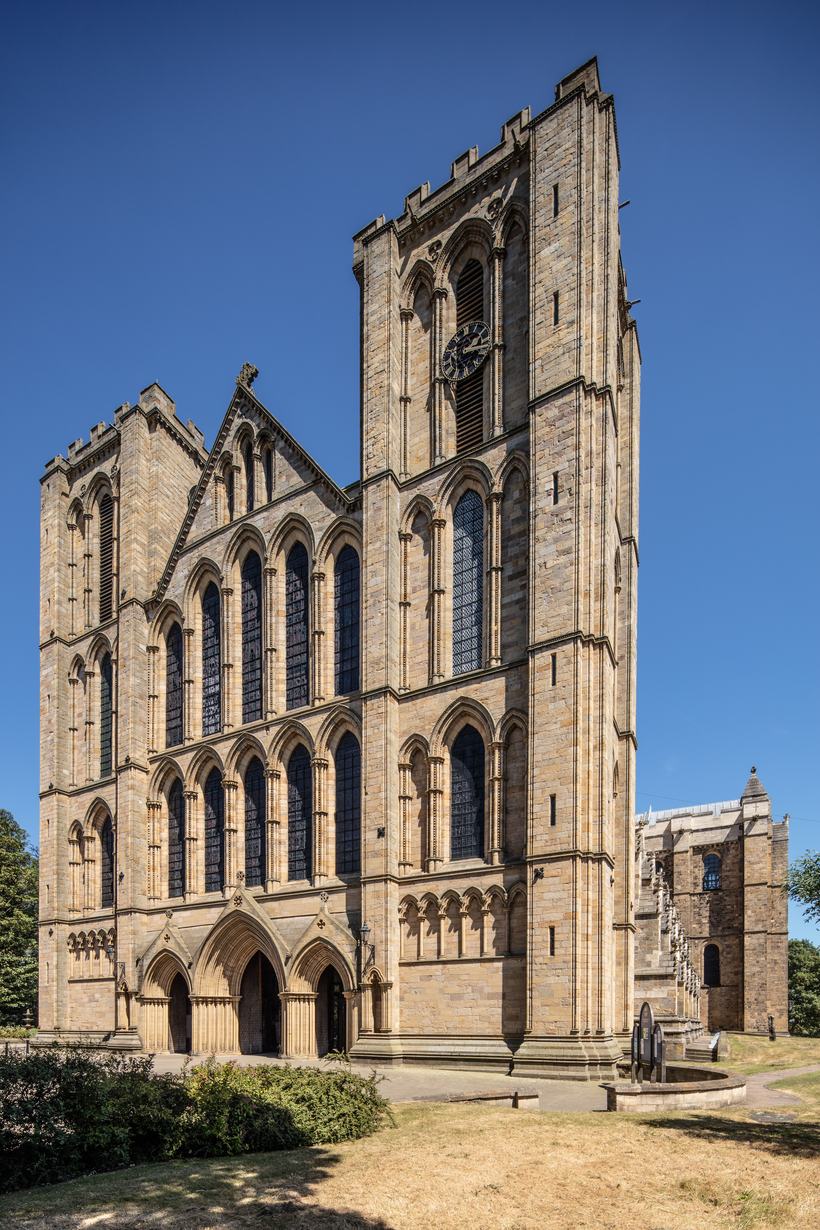
Start outside, on the west side. The west front was built in the 1220s and is a near-perfect example of Early English Gothic: two square towers framing a wall of tall, narrow lancet windows in tiers, with three deep doorways at the bottom. The towers once carried spires, as the central tower did; the central spire fell in 1660 and the two western ones were taken down soon afterwards, which is why Ripon now has the flat-topped silhouette of a Yorkshire church rather than a cathedral of spires.
The crypt
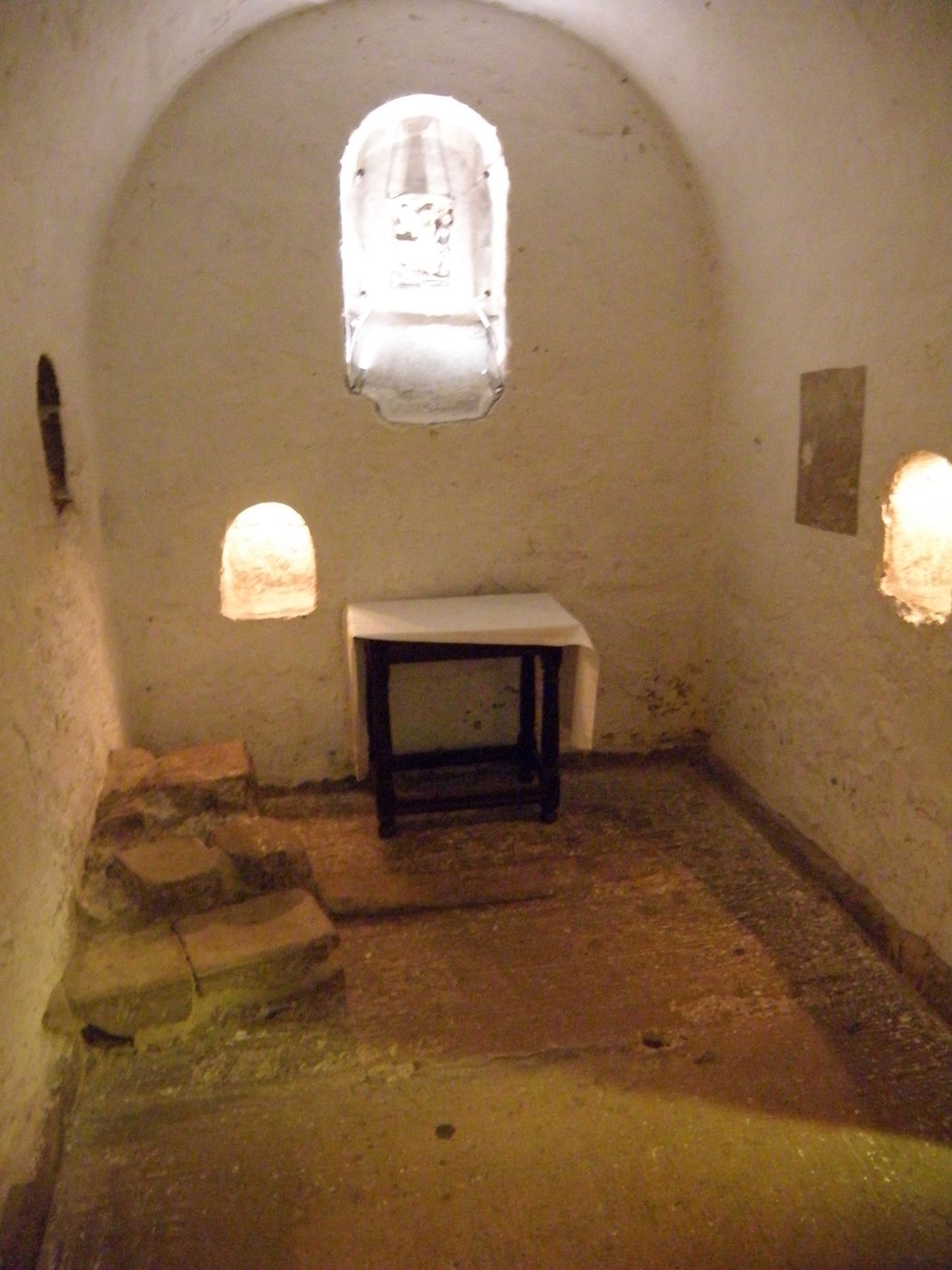
Inside, the stair to the crypt is in the nave, near the crossing. It leads down a narrow passage into a small chamber, roughly 3.4 by 2.3 metres, with a barrel vault and niches in the walls for lamps or relics. This is Wilfrid’s work of the 670s. A narrow opening in one wall is known as St Wilfrid’s Needle; according to a story first written down centuries later, a woman who could squeeze through it proved her virtue. It is a plain room, and that is the point: the people who built it were born less than a century after the first missionaries reached the north.
The nave and the unfinished crossing
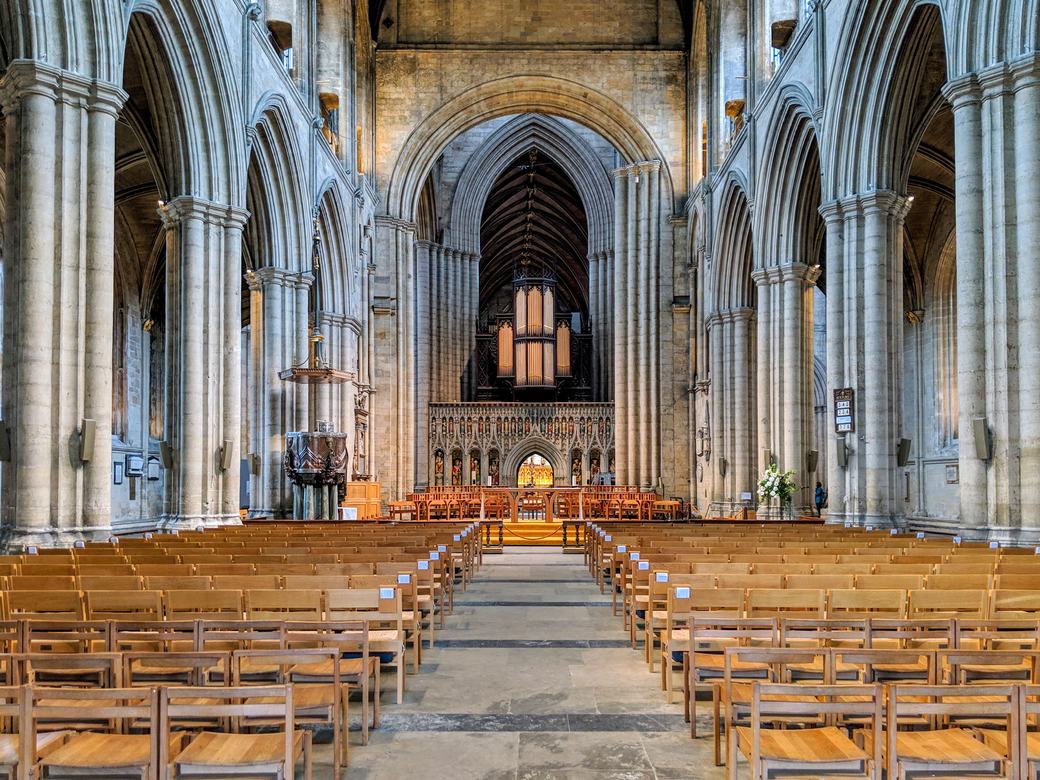
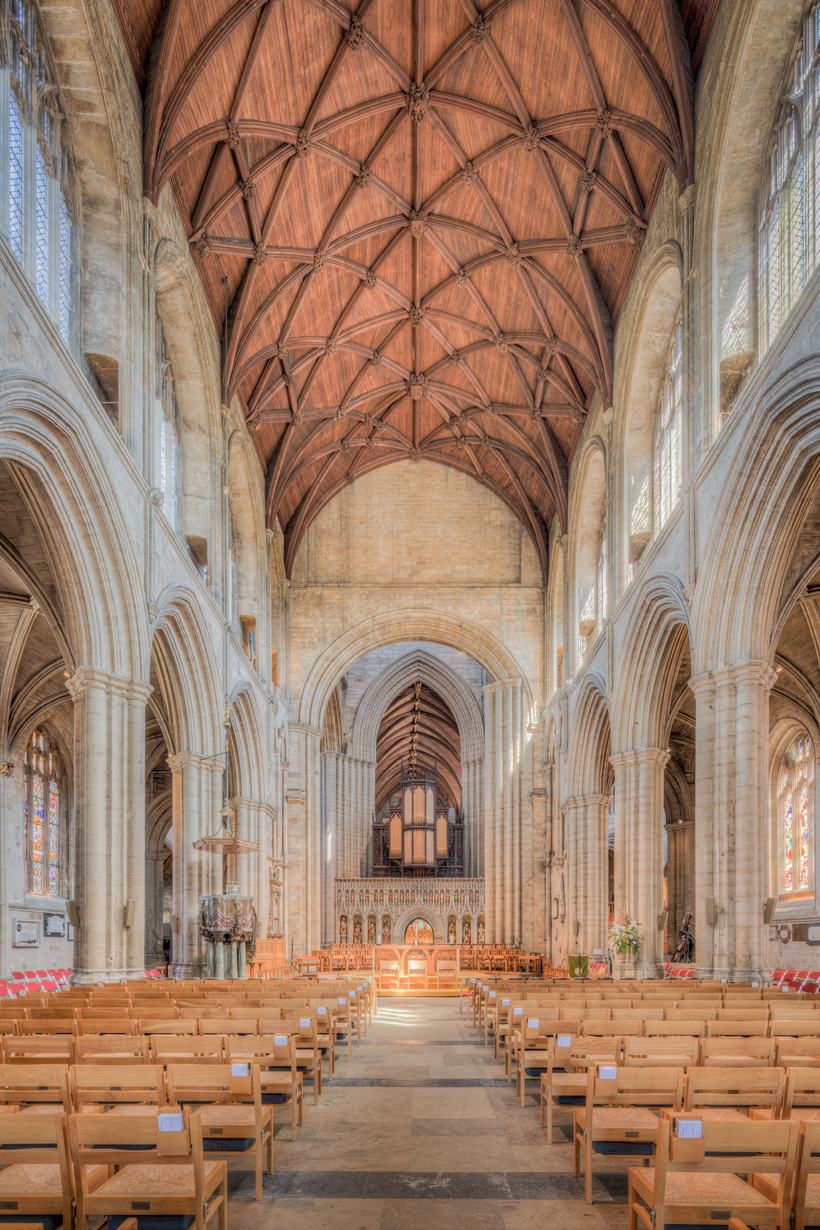
Back upstairs, the nave is the newest part of the medieval church, rebuilt between about 1502 and the 1520s. It is broad and full of light, with a timber vault above. Walk to the crossing and look up at the four great arches under the central tower. The tower partly collapsed in 1450 and its rebuilding began on the south and east sides, with tall Perpendicular arches; the money and the will ran out at the Reformation, and the north and west sides were never redone. The result is a crossing with two styles, three centuries apart, on the same tower. Look for the places where the new Perpendicular work meets the older arches.
The pulpitum
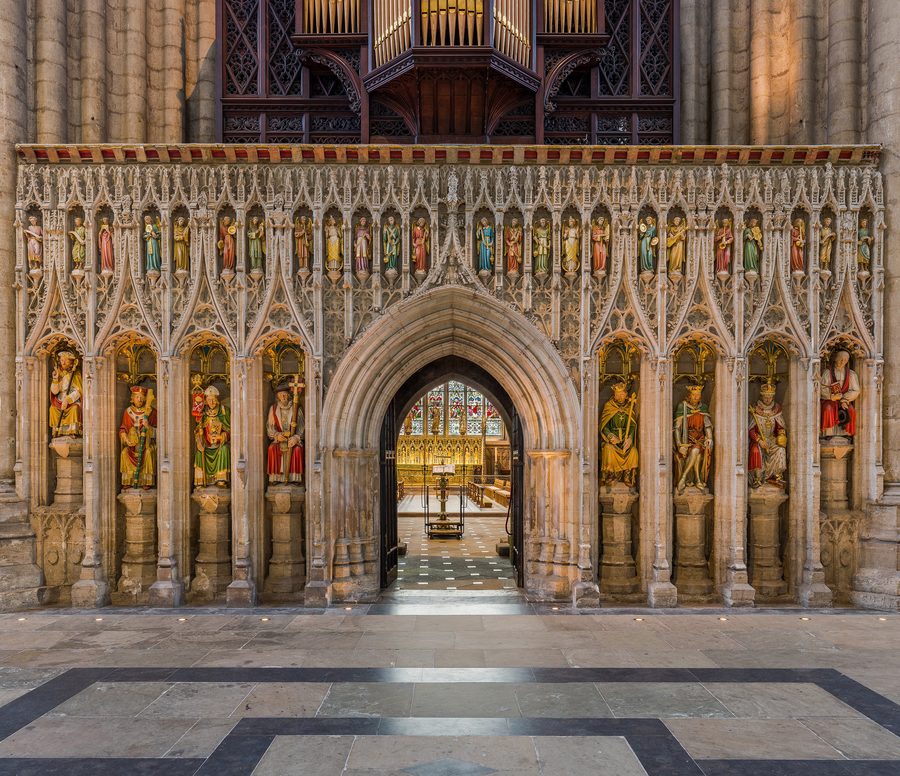
Closing the quire from the nave is the stone pulpitum, built in the fifteenth century, with the organ on top. Its niches stood empty for four hundred years after the Reformation; the figures you see now, kings and saints in a row, were added in the twentieth century.
The quire and the misericords
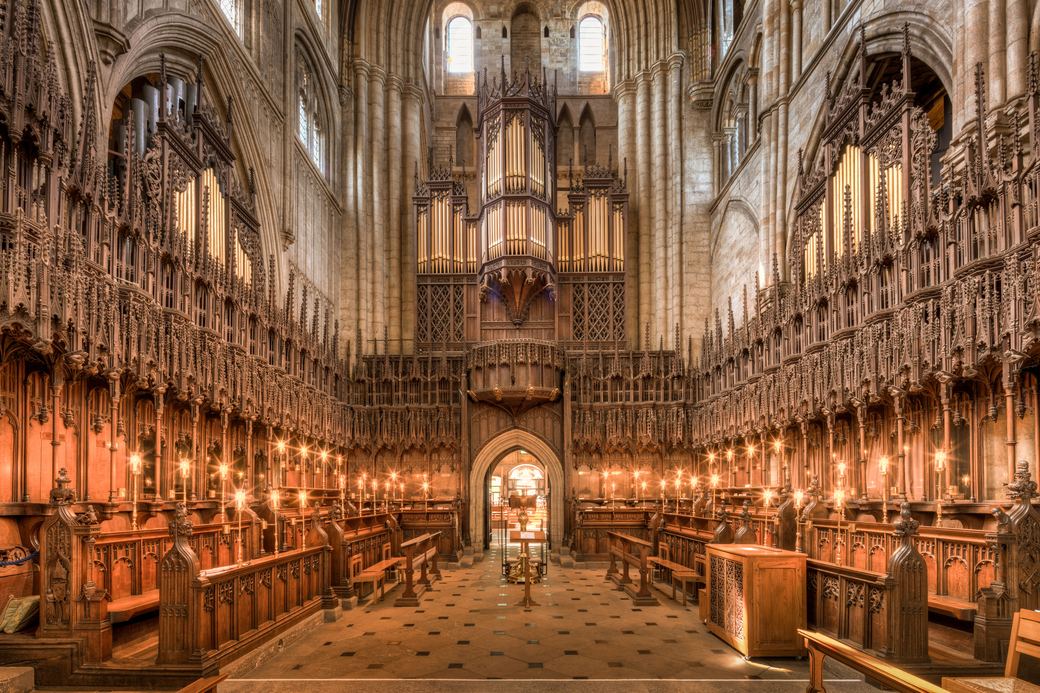
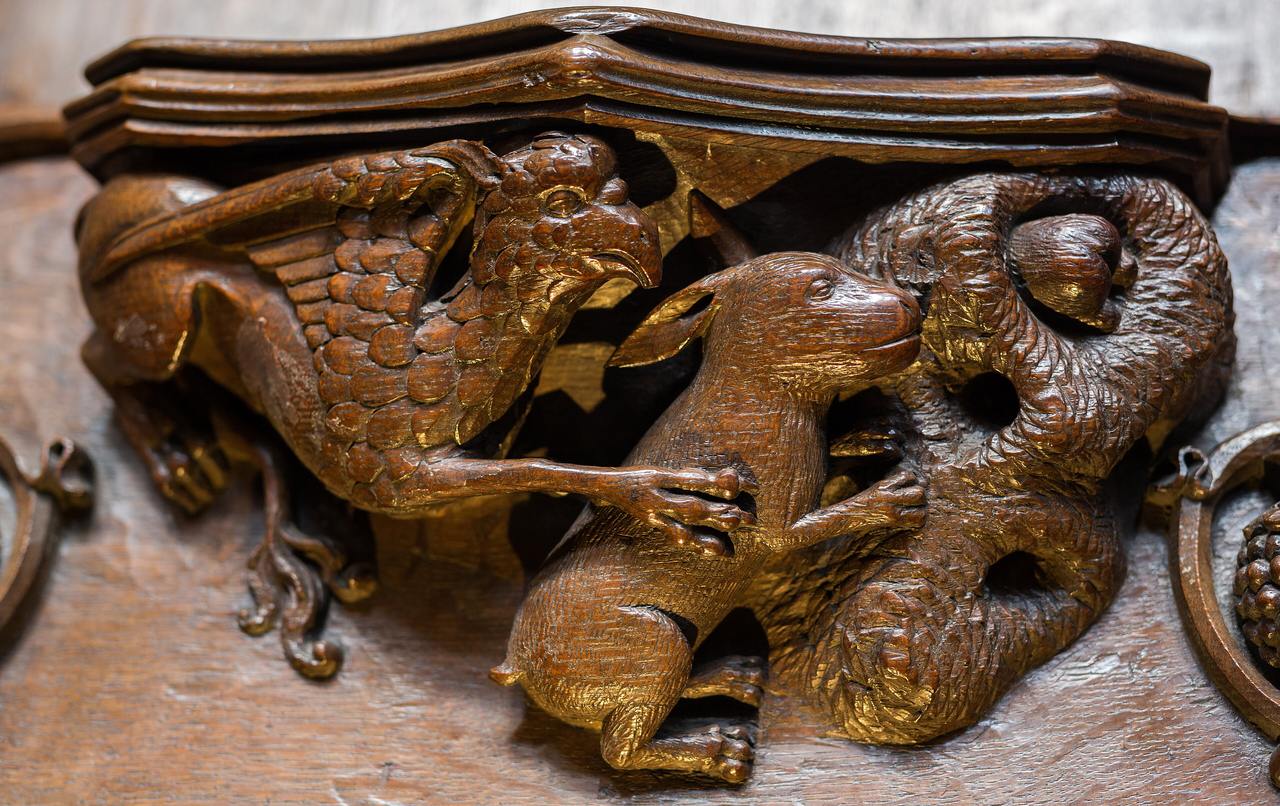
The quire stalls were made between 1489 and 1494 by a group of woodcarvers based in Ripon, whose work is also found at Beverley and Manchester. The tall canopies are spectacular, but the real pleasure is underneath the seats. The misericords — the ledges that gave canons something to lean on during long services — are carved with a bestiary of the medieval imagination: a fox caught by hounds, two dragons fighting, Jonah thrown overboard to the whale.
One of them shows a griffin chasing a rabbit down a hole. Lewis Carroll’s father, Charles Dodgson, was a canon of Ripon from 1852, and the young Charles stayed here with him. Whether the carving gave him the White Rabbit no one can prove, but it is hard to stand in front of it and not think so. Ask a steward to show you: the seats are usually tipped down.
The Library and Treasury
Up a stair from the south quire aisle are the Library and the Treasury. The Treasury shows church silver from Ripon and the parishes around it; the library holds early printed books and manuscripts collected by the canons. There is no lift, and opening can depend on volunteers, so ask at the welcome desk.
Tickets and tours
Free, by donation
There is no admission charge; a donation of £5 is suggested. Guided tours with volunteer guides take in the quire woodwork and the crypt; they are ticketed and run on set dates, mainly in the summer, so check the cathedral’s events page. Groups can book a tour at other times.
The hotel link goes to Booking.com. This site earns nothing from it at present — it is here because it is the quickest way to check what is actually available.
Don't miss
- St Wilfrid's crypt Built in the 670s, and still open to walk into.
- The west front Early English Gothic at its plainest and best.
- The crossing Two twelfth-century arches and two Tudor ones on the same tower.
- The misericords Fifteenth-century carvings under the quire seats, including the griffin and the rabbit.
- The quire canopies The finest work of the Ripon carvers.
- The Hornblower Every night at 9pm in the Market Square.
Insider tips
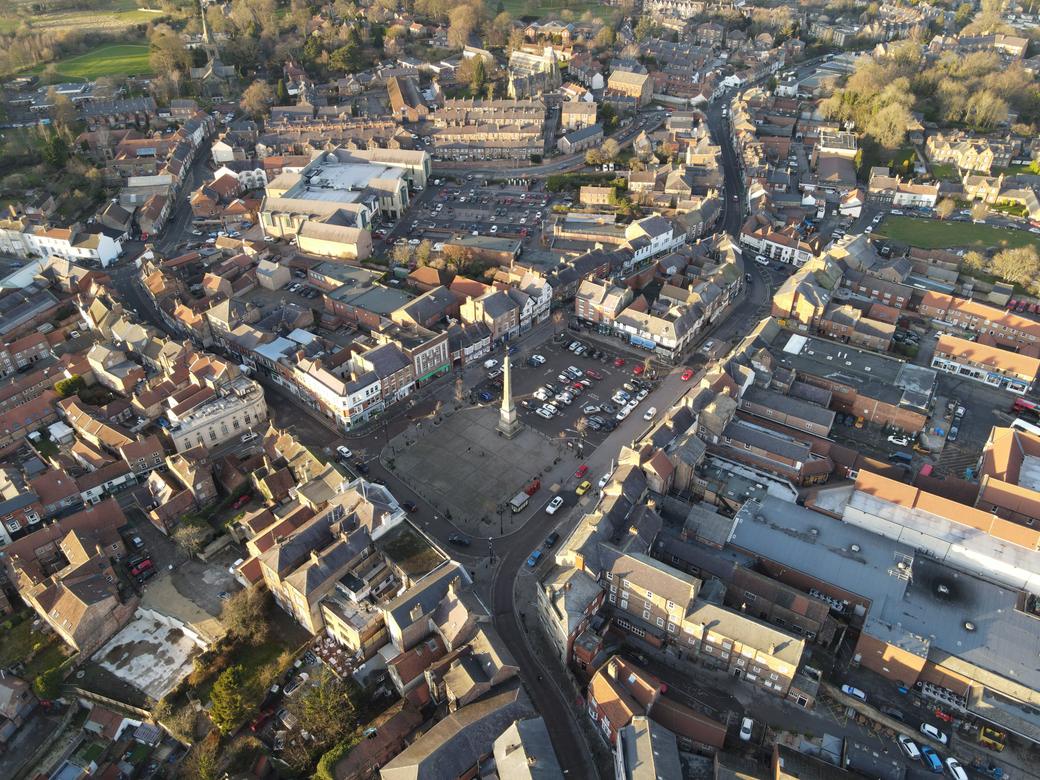
Stay for the Hornblower. Every night at 9pm, in the Market Square a few minutes from the cathedral, the Hornblower sounds a horn at each corner of the obelisk to “set the watch”, a custom the city traces back more than a thousand years. Anyone may watch, and the Hornblower is happy to talk afterwards.
Ripon is four miles from Fountains Abbey, the largest monastic ruin in England, and Studley Royal water garden, a World Heritage Site run by the National Trust. A morning at the cathedral and an afternoon at Fountains make one of the best days out in Yorkshire.
The cathedral is busiest on summer weekends and on race days at Ripon Racecourse. Evensong, sung by the cathedral choir in term time, is the best way to hear the building as it was meant to be heard; the times are on the cathedral’s website.
Common questions
Is Ripon Cathedral free to visit?
Yes. Entry is by donation, with £5 suggested. Guided tours, when they run, are ticketed separately.
How old is Ripon Cathedral?
The crypt beneath the nave was built by St Wilfrid in the 670s and is the oldest built fabric of any English cathedral. The church above it was begun in the twelfth century, with the west front added in the 1220s and the nave rebuilt in the early 1500s. It became a cathedral in 1836.
What is the Lewis Carroll connection at Ripon?
Lewis Carroll’s father, Charles Dodgson, was a canon of Ripon from the 1850s, and the young writer stayed in the city. One of the quire misericords shows a griffin chasing a rabbit down a hole; it is often said to have helped inspire Alice’s Adventures in Wonderland.
Can you go down into the crypt?
Usually, yes. It is reached by a narrow stair and passage from the nave, so it is not suitable for wheelchairs or anyone who finds steps difficult, and it may be closed during services.
How do you get to Ripon Cathedral?
Ripon has had no railway station since 1967. The nearest is Harrogate, about eleven miles away, with frequent buses to Ripon taking about half an hour. The cathedral is a few minutes’ walk from Ripon bus station and the Market Square.
Where to stay and eat nearby
The Market Square and the streets off it have pubs, tearooms and restaurants, all a few minutes from the cathedral. Ripon is small enough to stay in for a night, or to visit from Harrogate, which has a much wider choice of hotels.
More English churches
- York Minster — the mother church of the north, under an hour away
- Beverley Minster — another great Yorkshire minster, with stalls by the same Ripon carvers
- Durham Cathedral — the Norman masterpiece of the north
See all the cathedrals and churches worth visiting in England →