
Notre-Dame de Paris
On 15 April 2019 the world watched Notre-Dame burn. Five and a half years later, on 7 December 2024, it reopened, and the building people now walk into is in some ways more like the medieval cathedral than anything seen for centuries: the stone cleaned back to a pale cream, the glass washed, the spire rebuilt. It is free to enter. The two things visitors get wrong are paying for it — nobody but the cathedral can issue a ticket, and the cathedral does not charge — and assuming the towers are part of the same visit. They are not: they are run by a different body, sold online only, and booked separately.
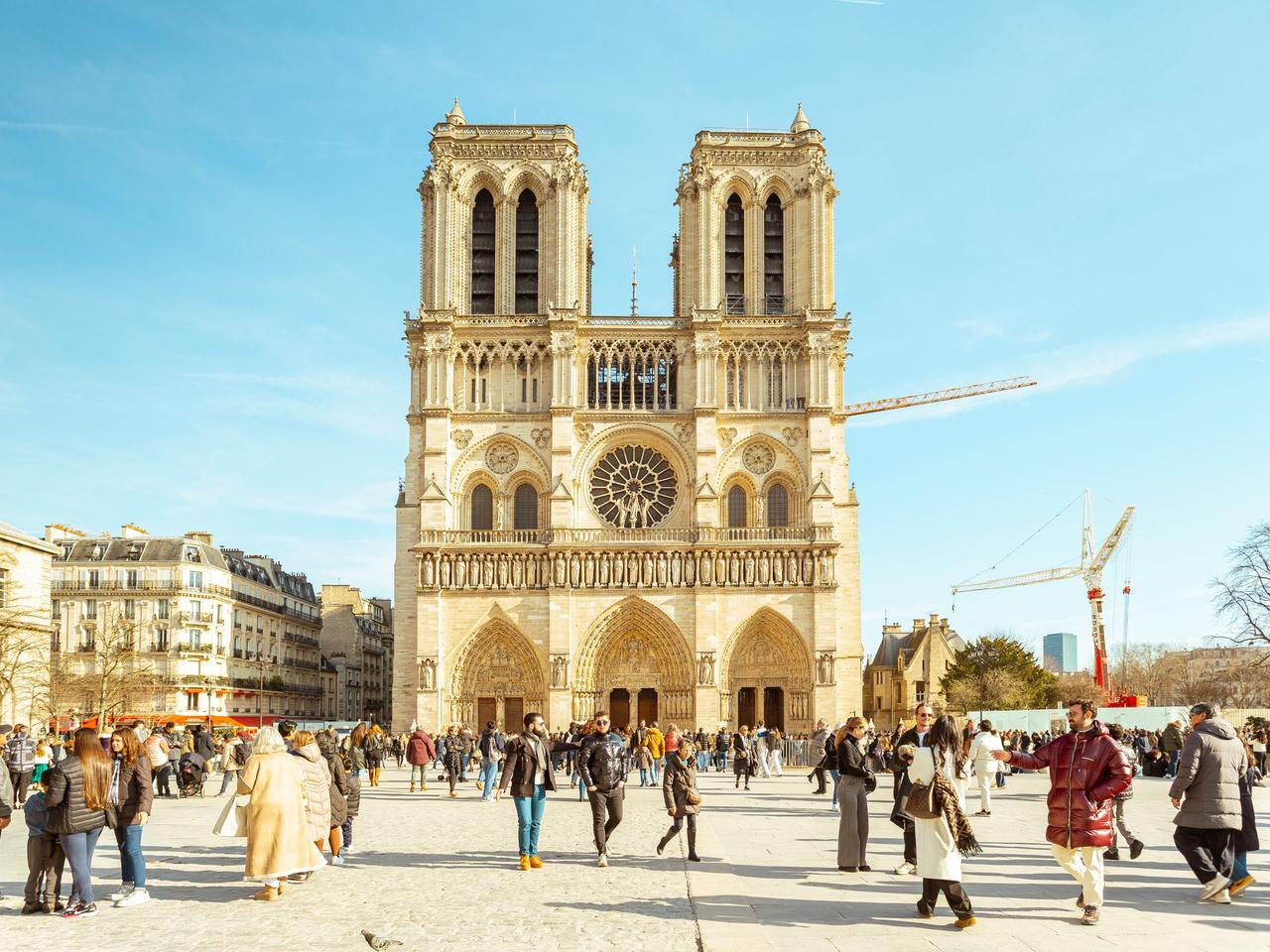
Eight and a half centuries on an island
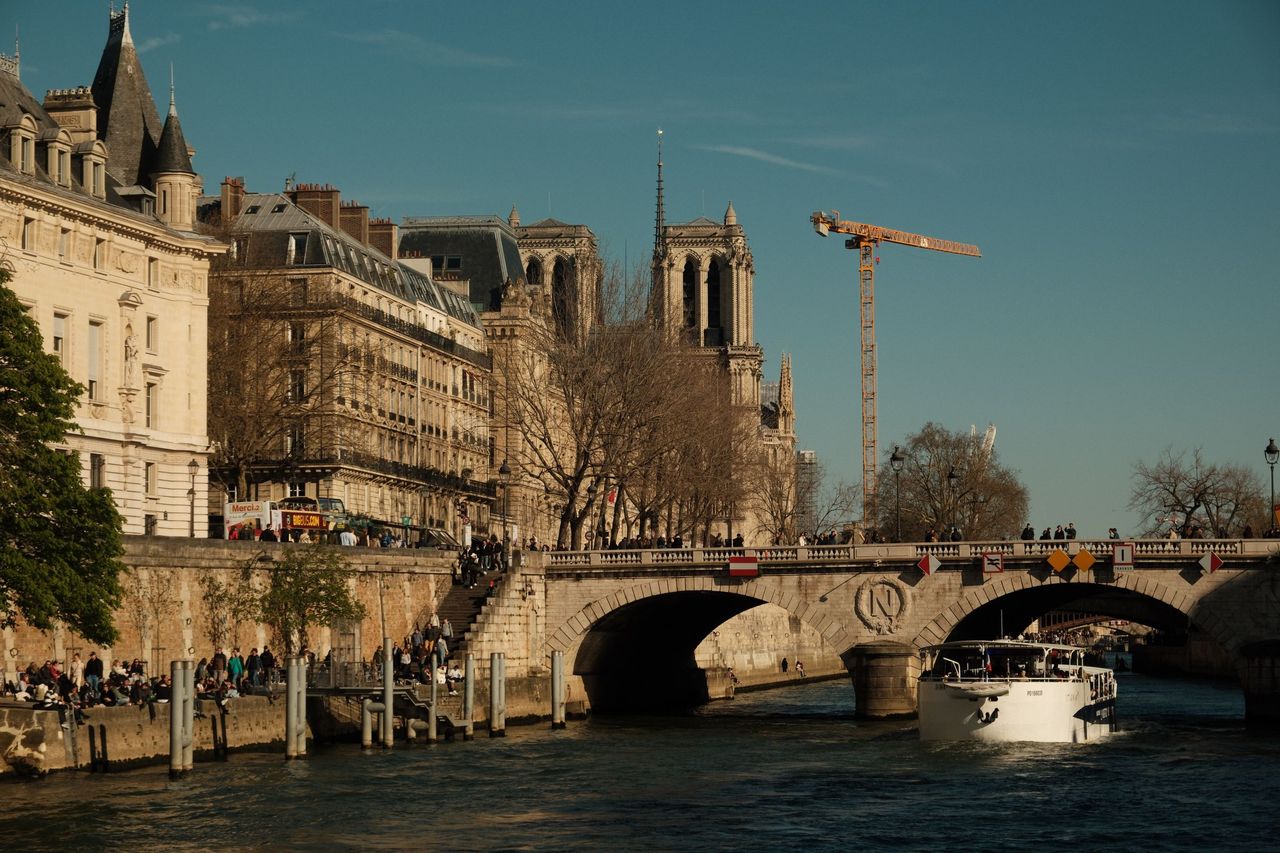
There had been churches on the Île de la Cité since late Roman times. In 1160 Bishop Maurice de Sully decided to replace them with something far larger, in the new Gothic style that had just appeared at the abbey of Saint-Denis. The first stone was laid in 1163, with Pope Alexander III in Paris at the time. The choir was finished by 1182, the nave by the early thirteenth century, the west front by the mid-1240s and its two towers by about 1250. In the 1250s and 1260s the transepts were rebuilt with the two great rose windows, and by around 1260 the cathedral was, in essentials, the building you see.
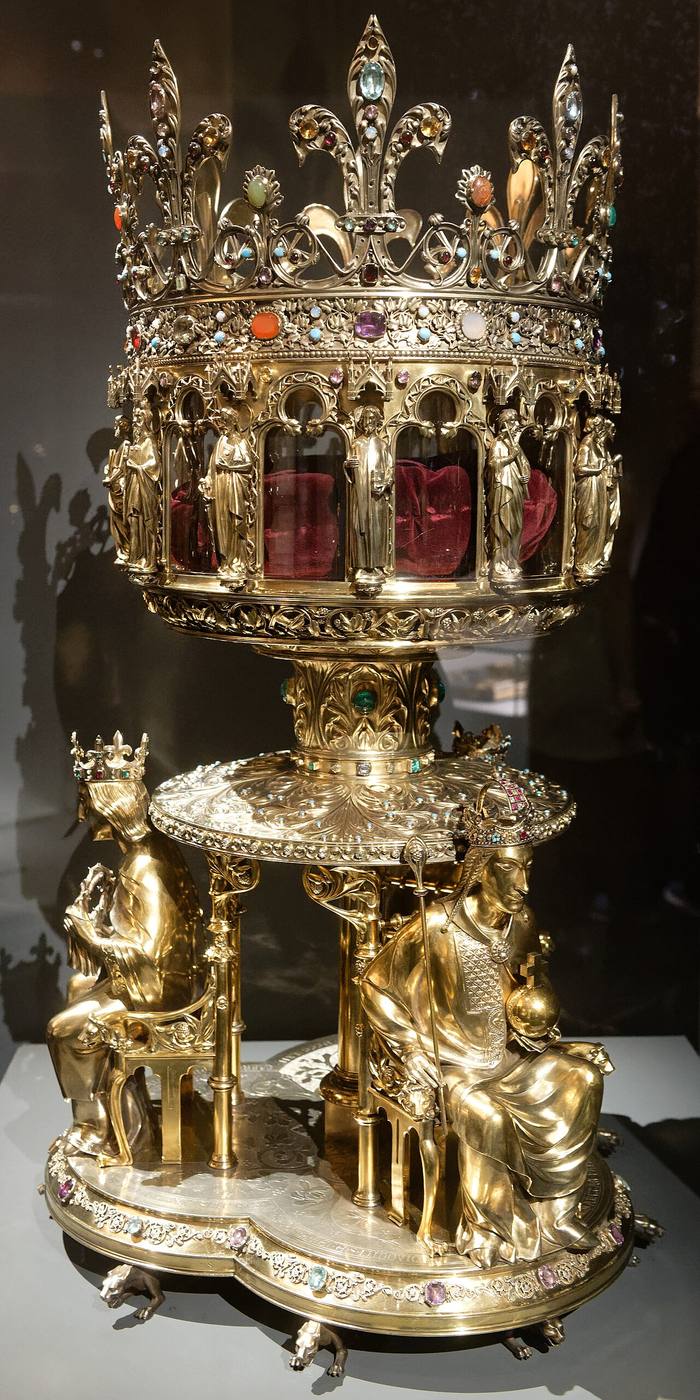
It was also where the kings of France brought their most precious possession. In 1239 Louis IX bought the Crown of Thorns from the Latin emperor of Constantinople, and it was brought to Paris and moved into the Sainte-Chapelle when that was finished, in 1248. It survived the Revolution, and since 1806 it has been kept in the treasury of Notre-Dame.
The visitor’s cheat sheet
| Where | 6 Parvis Notre-Dame – Place Jean-Paul II, 75004 Paris, on the Île de la Cité |
|---|---|
| Opening hours | Monday, Tuesday, Wednesday and Friday 7.50am–7pm; Thursday 7.50am–10pm; Saturday and Sunday 8.15am–7.30pm. Last entry 30 minutes before closing |
| Admission | Free for everyone. A free time slot can be reserved on the official website from two days ahead; there is always a queue for visitors without a reservation |
| Towers | €16 (free for under-18s and EU residents aged 18–25), online only, timed slot compulsory. April–September 9am–11pm, October–March 9am–5.30pm, last entry an hour before closing. 424 steps |
| Crown of Thorns | Shown in its reliquary every Friday, 3pm–6.30pm; veneration in the nave on the first Friday of the month |
| Masses | Weekdays 8am, 12 noon and 6pm; Saturday 8.30am, 12 noon, 6pm; Sunday 8.30am, 10am (Latin), 11.30am and 6pm |
| Security | Bag checks at the entrance; no large luggage. There are no toilets inside |
| How long | An hour inside; add an hour for the towers |
Hours and admission checked against the official site in September 2026. They change; the official site is always the last word.
The cathedral is free, and so is the reservation. You can reserve a time slot on the cathedral’s official website two days ahead, the day before or on the day, which gets you into a shorter queue. Or you can just queue: there is always a line for visitors without a reservation, and it moves. Anyone selling you a “ticket” to the cathedral itself is selling you something the cathedral gives away. The towers are different: €16, booked online in advance, with no sales on site.
Revolution, Hugo and Viollet-le-Duc
The Revolution treated Notre-Dame as the symbol of everything it was overthrowing. In 1793 the twenty-eight kings of Judah on the west front, taken for kings of France, were pulled down and beheaded; the cathedral became a Temple of Reason, and then a warehouse. Many of the heads were found buried in 1977 and are now in the Musée de Cluny. Napoleon handed the building back to the Church and was crowned Emperor in it in 1804, but by the 1830s it was so dilapidated that demolition was discussed.
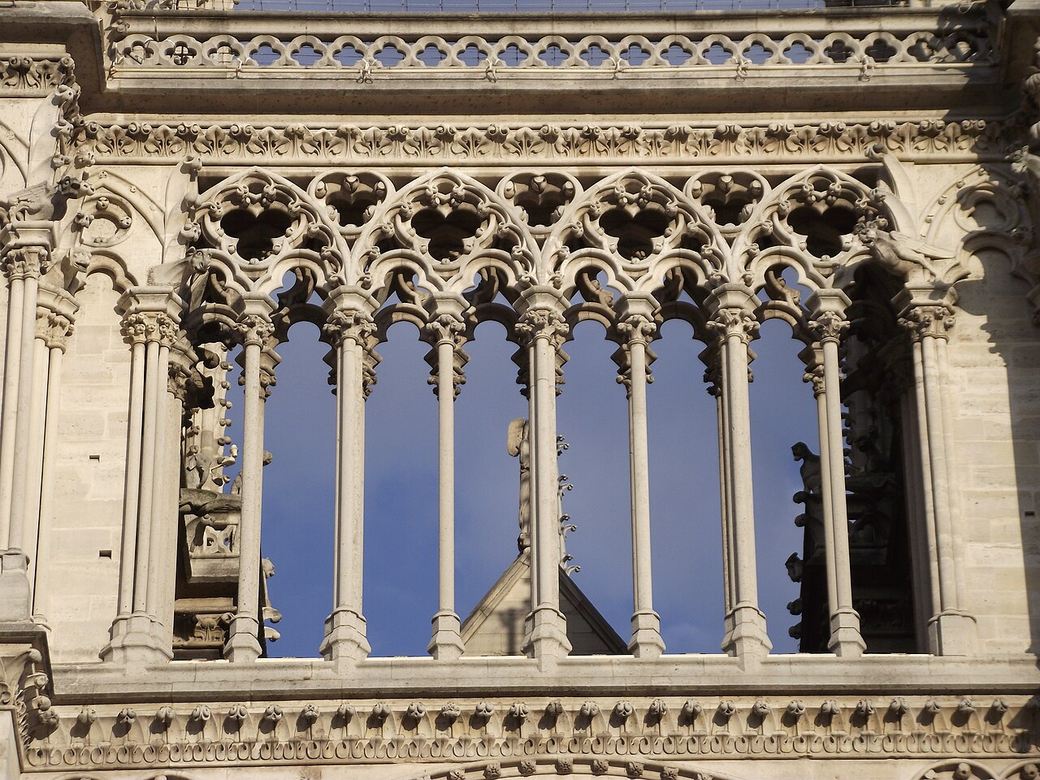
What saved it was a novel. Victor Hugo published Notre-Dame de Paris — The Hunchback of Notre-Dame in English — in 1831, largely to rouse Paris to save the cathedral, and it worked. In 1844 the architects Jean-Baptiste Lassus and Eugène Viollet-le-Duc began a twenty-year restoration. Viollet-le-Duc replaced the lost statues, filled the gallery between the towers with his famous chimeras, and designed a new spire to replace the medieval one taken down in 1786. It was his spire that fell in 2019, and it is his spire that has been rebuilt.
The fire and the reopening
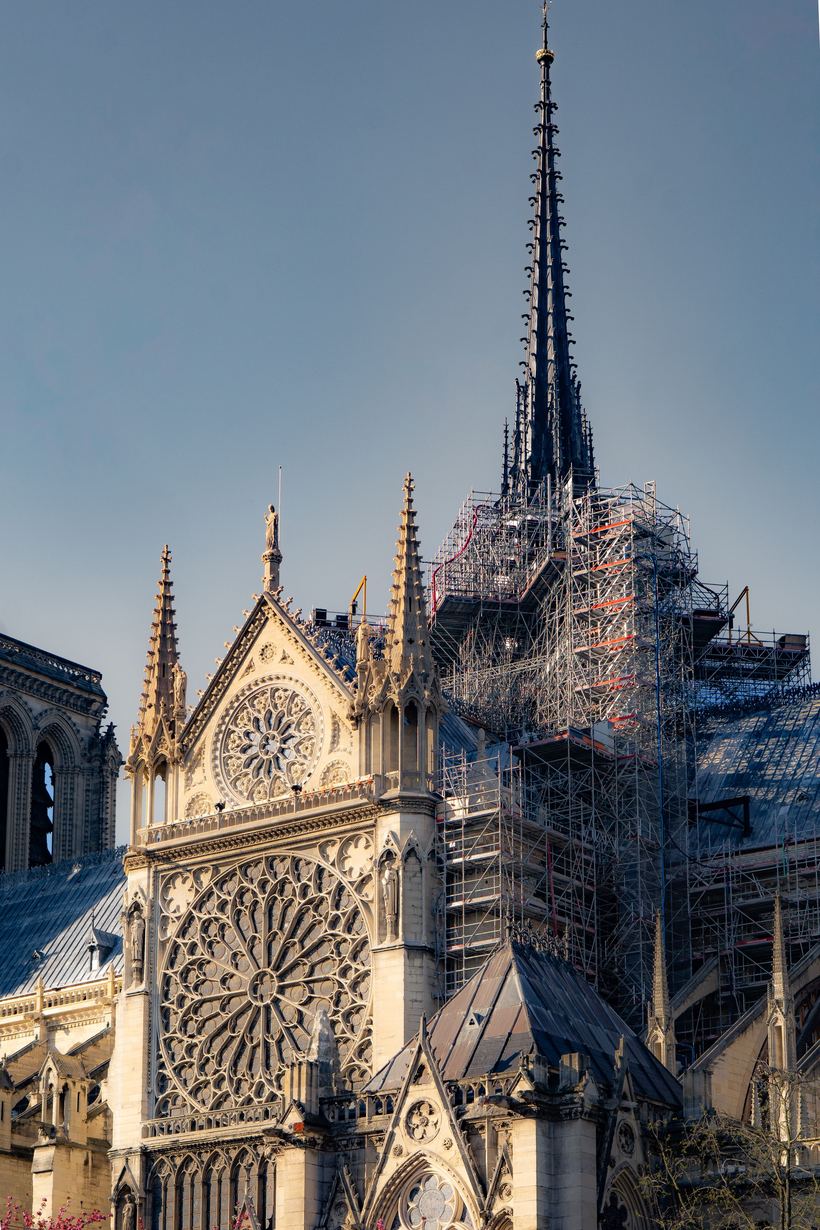
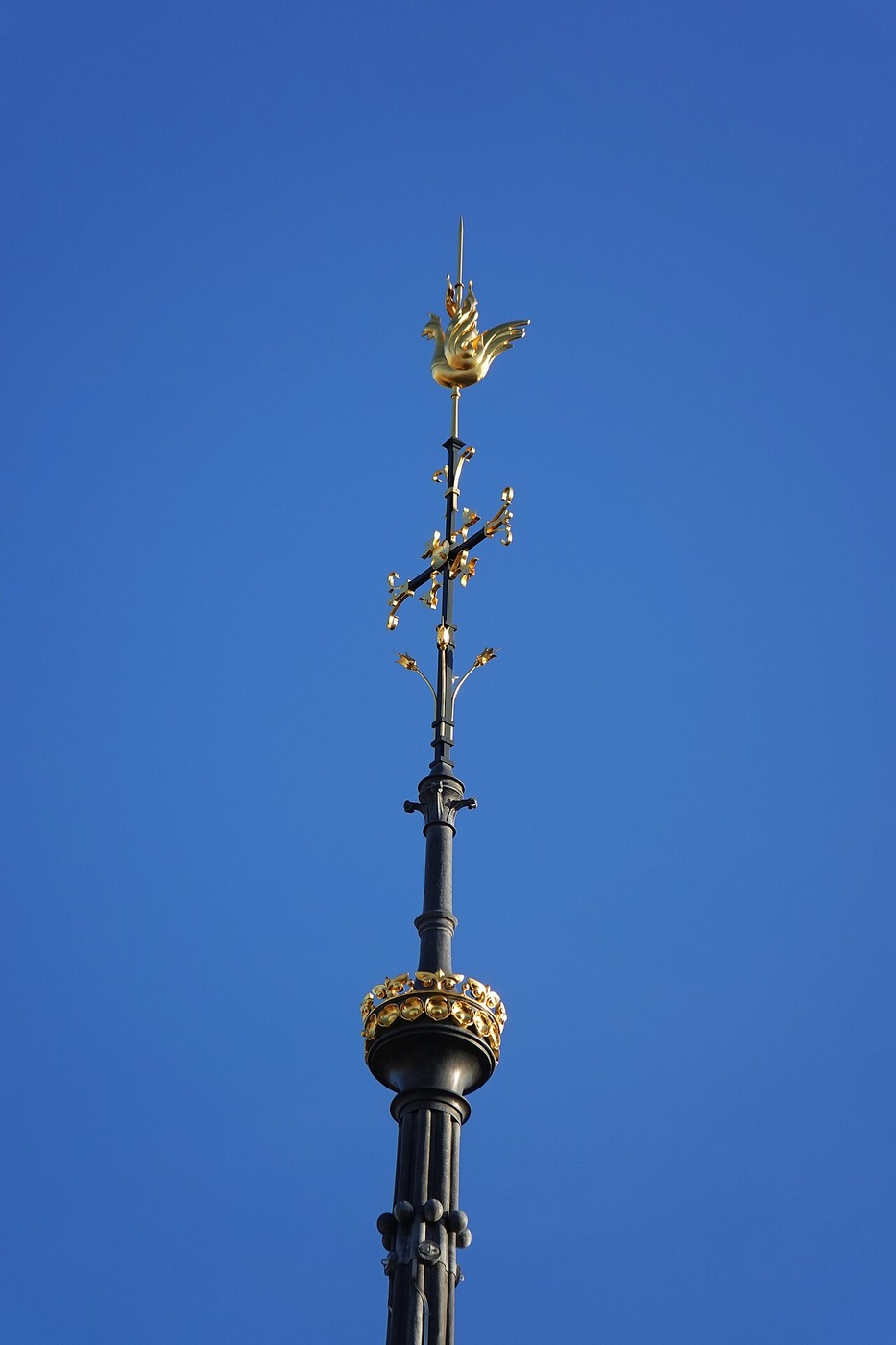
The fire started in the roof on the evening of 15 April 2019, during restoration work on the spire. It destroyed the medieval oak roof timbers, known as “the forest”, and at 7.50pm brought down the spire through the vaults. Firefighters saved the towers, the walls, the rose windows and the great organ; the Crown of Thorns was carried out during the blaze. The rebuilding took a little over five years, with oak frames made by traditional methods, the spire reconstructed to Viollet-le-Duc’s design and a new gilded rooster on top. The cathedral reopened on 7 December 2024, with a new altar, font and bishop’s chair by the designer Guillaume Bardet. Contemporary stained glass for six chapels of the south aisle is due to be installed at the end of 2026.
What to see, in the order you meet it
The square and the west front
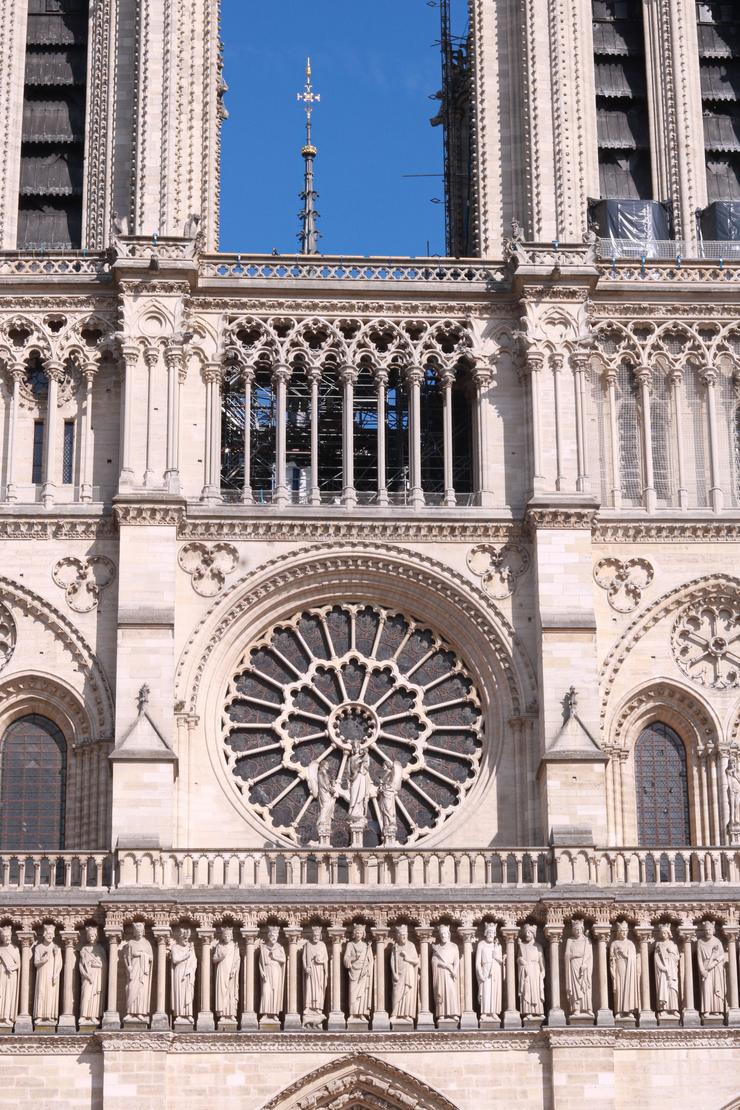
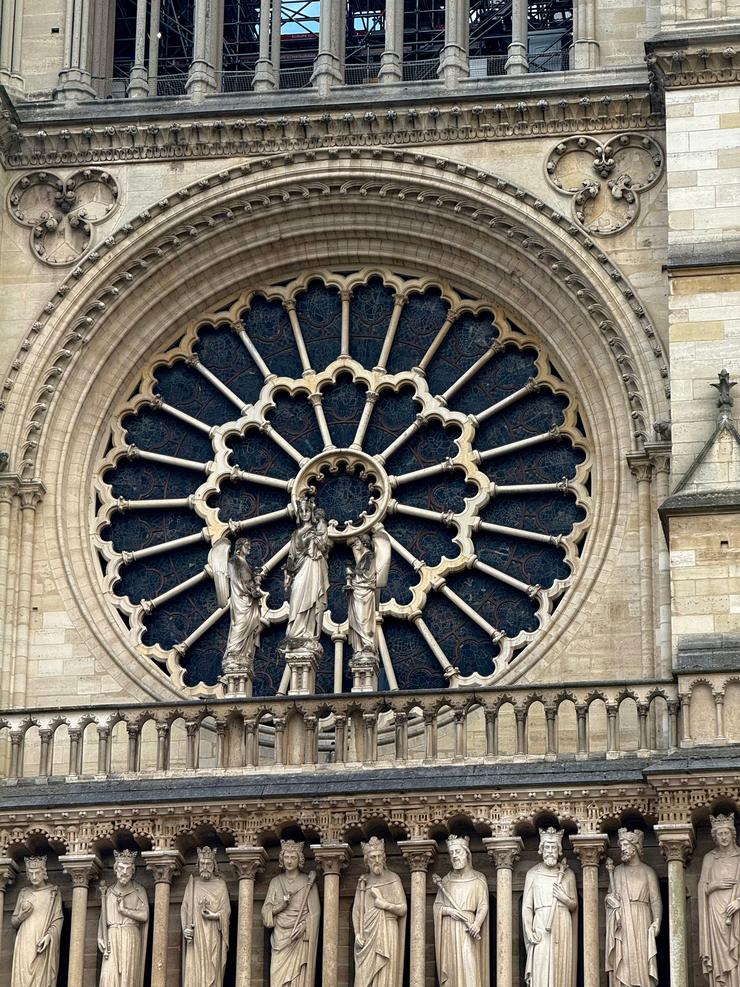
Start on the parvis, the square in front. Set into the paving near the west door is Point Zéro, the marker from which road distances from Paris are measured. Then look at the façade, which is one of the great compositions of Gothic architecture: three portals, a band of kings, the rose window, an open gallery and two square towers, all worked out in horizontals as much as verticals.
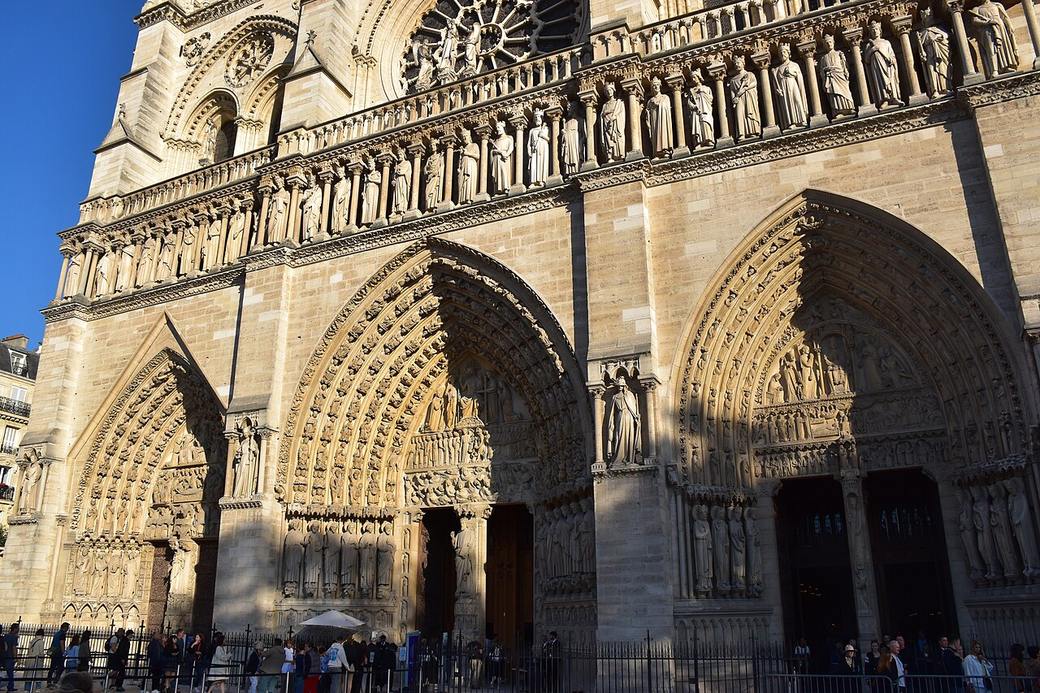
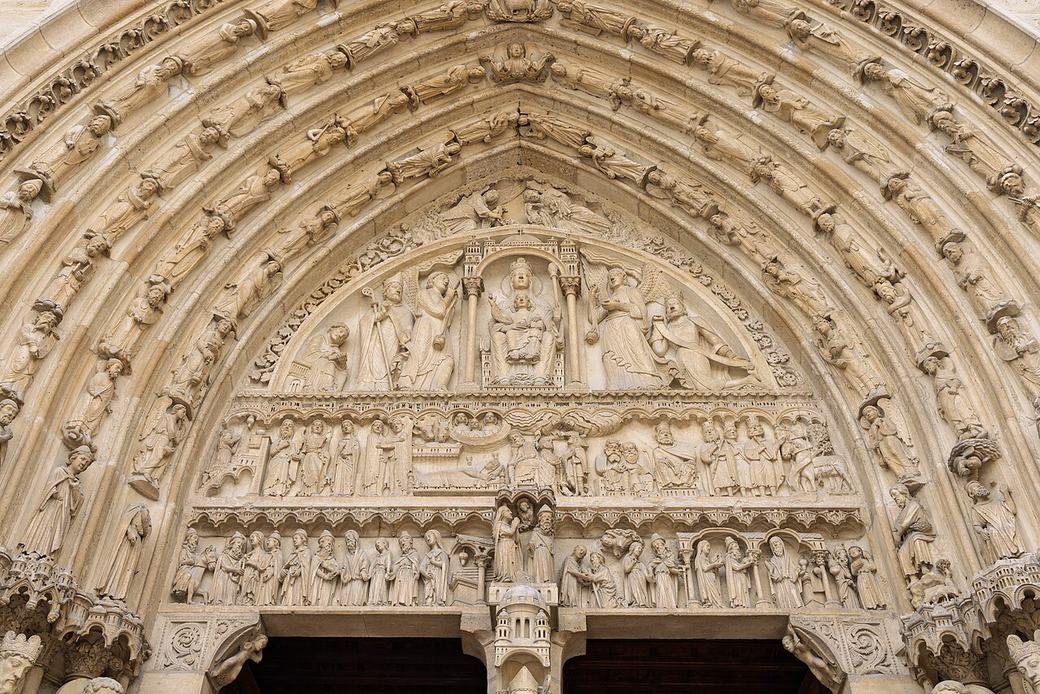
The three portals were cleaned during the restoration, and the sculpture is sharper than it has been for decades. On the left is the portal of the Virgin; on the right, the portal of St Anne, with some of the oldest sculpture on the building, from the twelfth century. In the centre is the Last Judgement: the dead rising from their tombs, St Michael weighing souls with a devil trying to tip the scales, the saved led off to the left and the damned to the right, and Christ in majesty above it all.
The towers and the chimeras
The towers are the only way to meet Viollet-le-Duc’s chimeras face to face: the gargoyle-like creatures that lean over the gallery between the towers and look down on Paris, the most famous of them chin in hands. The climb, reopened in September 2025 after the fire, is 424 steps to a terrace 69 metres up, with viewpoints on the way and a close view of the new spire from the top. Time on the top terrace is limited to five minutes. Visits take about 50 minutes, the entrance is on the right as you face the cathedral, and tickets are only sold online.
The nave
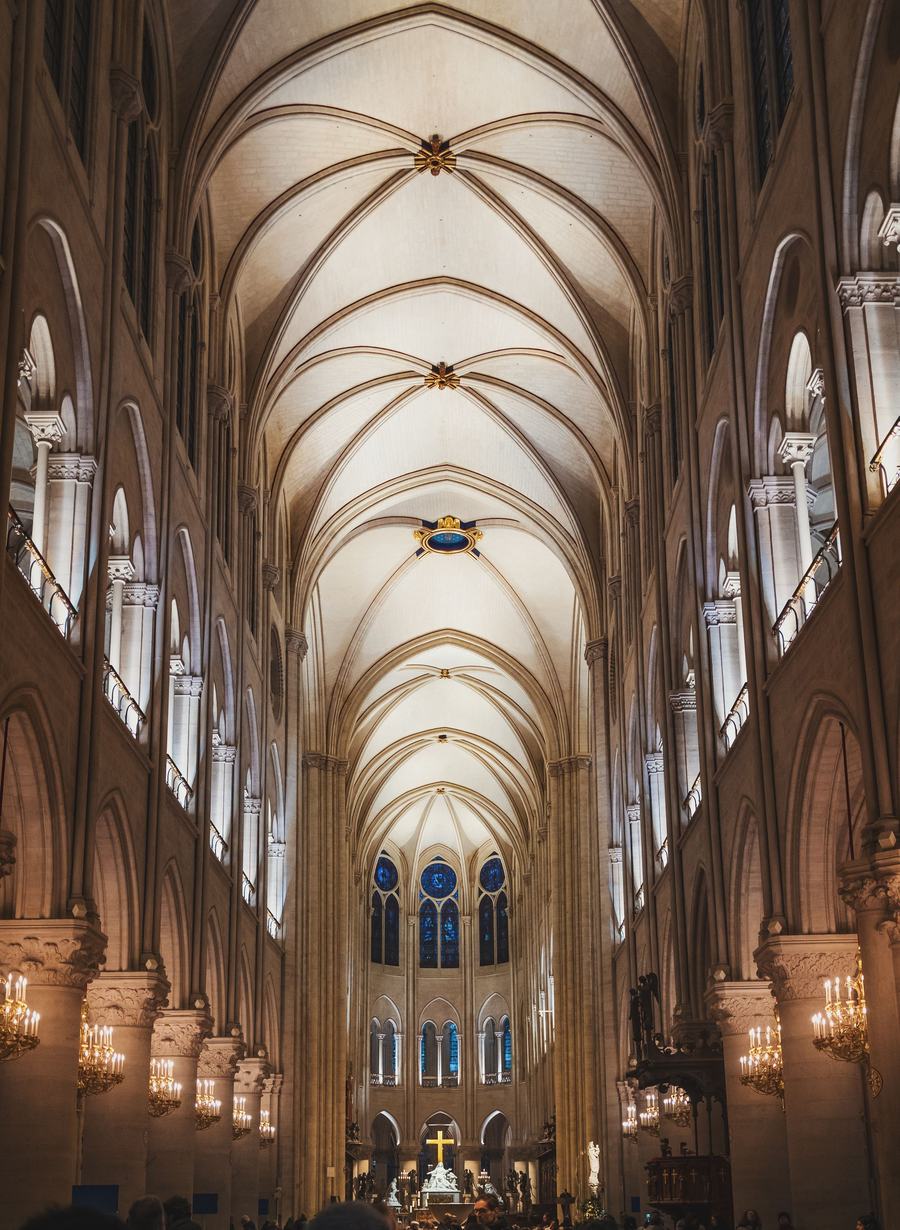
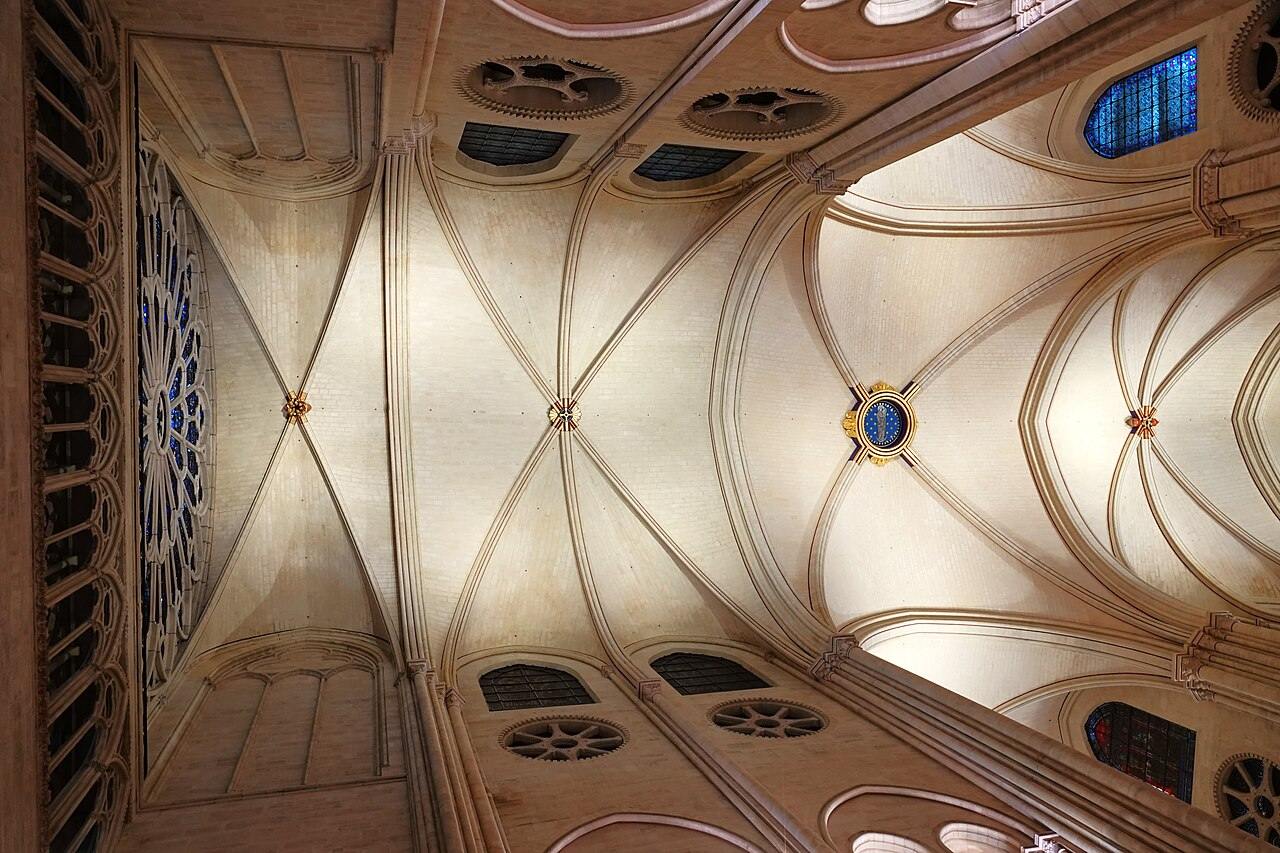
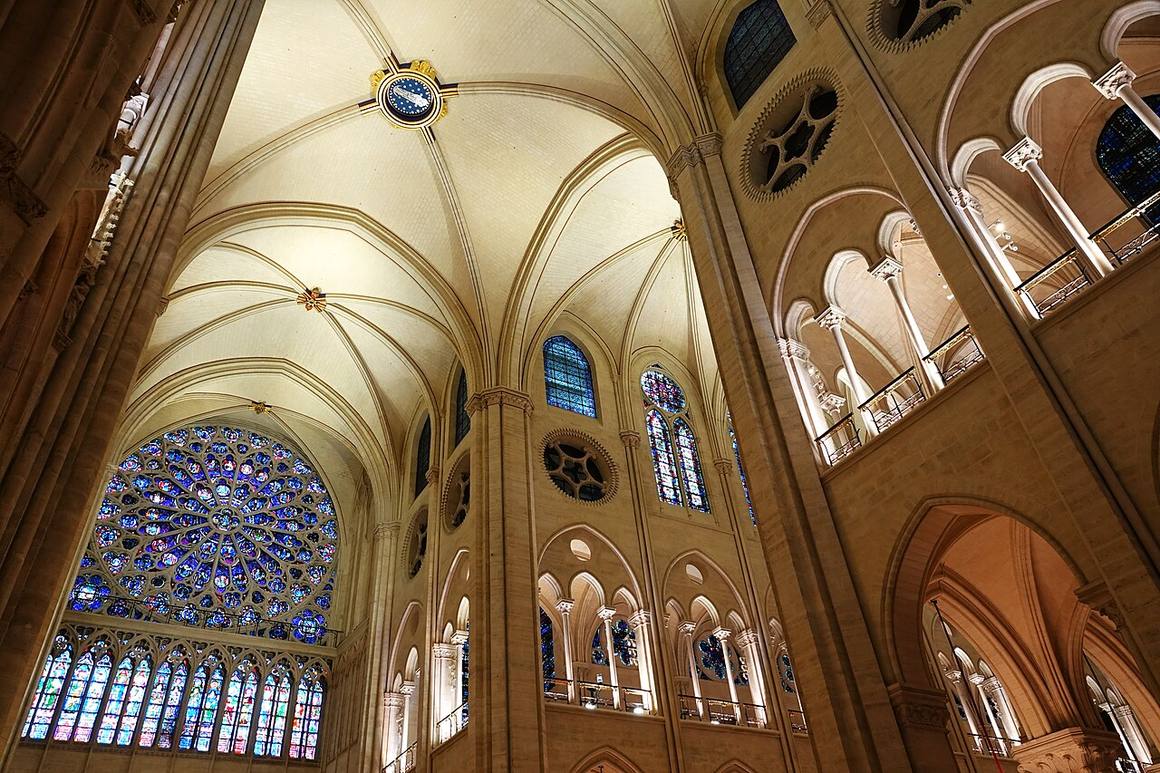
Inside, the first surprise is the light. Centuries of candle smoke and dirt have been cleaned off, and the limestone is its original pale cream. The vaults are about 33 metres high and the whole cathedral is about 128 metres long, with double aisles on each side and chapels between the buttresses. Walk down the side aisles rather than the middle: the chapels are full of paintings, including some of the Mays, the huge canvases the Paris goldsmiths gave the cathedral every 1 May in the seventeenth century.
The crossing and the roses
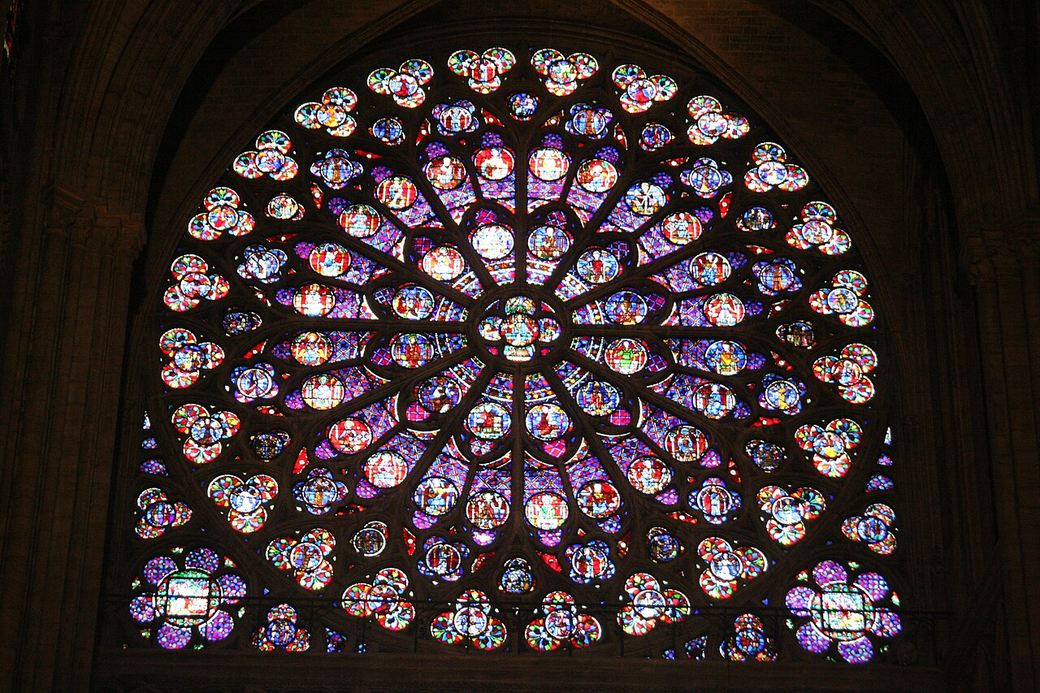
Under the crossing, where the spire came through the roof in 2019, stands the new altar. Turn to look at the two transept roses, each about thirteen metres across. The north rose, from the 1250s, keeps most of its thirteenth-century glass, with Old Testament figures around the Virgin and Child. The south rose, begun in 1258, centres on Christ surrounded by apostles, saints and angels. All three roses survived the fire.
The choir
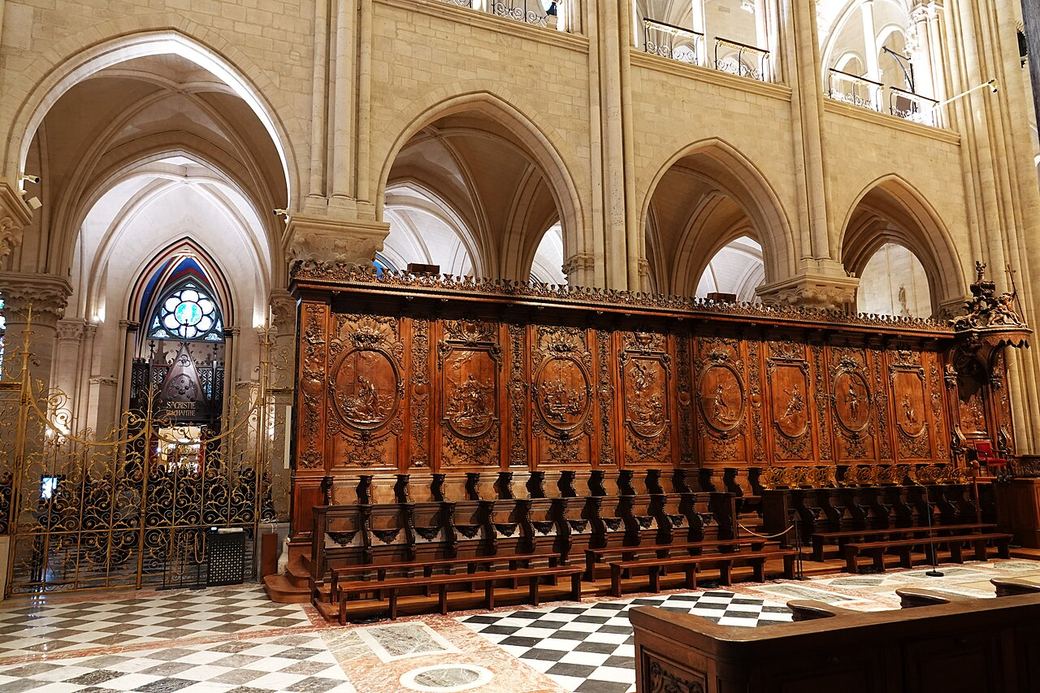
The choir behind the altar was refurnished in the early eighteenth century to fulfil a vow made by Louis XIII: the carved oak stalls, and behind the high altar Nicolas Coustou’s marble Pietà, with Louis XIII and Louis XIV kneeling on either side. Walk round the ambulatory to see the carved and painted stone screen of the choir, with scenes from the life of Christ, from the fourteenth century.
The treasury and the Crown of Thorns
The treasury, in the sacristy on the south side, has its own entrance charge. Its great object is the Crown of Thorns: a circle of bound rushes, without the thorns, which were given away as relics over the centuries. It is kept in a gilded reliquary of 1862 and shown every Friday from 3pm to 6.30pm. On the first Friday of the month it is presented for veneration in the nave, and the queue of the faithful is worth seeing even if you are not joining it.
Outside: the spire and the east end
Leave by the north side and walk round the east end, through the Square Jean-XXIII, for the best view of the flying buttresses of the choir, each spanning about fifteen metres, and of the new spire. It is a copy of Viollet-le-Duc’s, in oak and lead, 96 metres high, and the copper statues of the apostles have been put back round its base — one of them, St Thomas, with Viollet-le-Duc’s own face.
Tickets and tours
The cathedral is free; the towers are booked separately
Reserve a free time slot for the cathedral on its official website up to two days ahead, or queue on the square. For the towers, book a timed ticket on the Centre des monuments nationaux website: €16, free for under-18s and EU residents aged 18–25, online only. Guided tours of the cathedral are useful mainly for the history and the exterior; a combined walk taking in the Sainte-Chapelle two minutes away makes the most of a morning on the island.
Tour and hotel links go to GetYourGuide and Booking.com. This site earns nothing from them at present — they are here because they are the quickest way to check what is actually available.
Don’t miss
- The Last Judgement portal Freshly cleaned, and full of detail.
- The chimeras From the towers, if you have booked.
- The pale nave The cathedral as it has not looked for centuries.
- The three roses All survived the fire.
- The Crown of Thorns Fridays from 3pm.
- The flying buttresses From the garden behind the east end.
- Point Zéro In the paving of the square.
Insider tips
Come early or on a Thursday evening. The cathedral opens before 8am, and the first hour is the quietest of the day. On Thursdays it stays open until 10pm, and the nave after dark, lit and half empty, is a different building.
Book the towers well ahead in summer. Slots are released online, tickets are not sold at the door, and the free allocation for under-18s and young EU residents runs out first. If you arrive late for your slot, entry is not guaranteed.
Go to Mass, or to Vespers. The cathedral is first of all a working church, and hearing the choir and the great organ in the restored building is the best way to understand what all the effort was for. Visitors cannot walk through the nave during services, so check the times if you want to look round instead.
Travel light. There are bag checks at the door, large luggage is refused, and the towers do not admit rucksacks bigger than 40 by 40 by 20 centimetres. There are no toilets inside; there are public ones near the square.
Common questions
Is Notre-Dame de Paris free to enter?
Yes, entry to the cathedral is free for everyone. You can reserve a free time slot on the cathedral’s official website, from two days before your visit up to the day itself, or simply join the queue without a reservation on the square. Nobody else is authorised to sell tickets to the cathedral.
What are Notre-Dame’s opening hours?
Monday to Friday 7.50am to 7pm, with a late opening until 10pm on Thursdays, and Saturday and Sunday 8.15am to 7.30pm. Last entry is 30 minutes before closing. The cathedral is a working church, so some areas close during services.
How do you climb the towers of Notre-Dame?
The towers are run separately by the Centre des monuments nationaux and cost €16, free for under-18s and for EU residents aged 18 to 25. Tickets are sold online only, for a timed slot; none are sold on site. The climb is 424 steps to a terrace 69 metres up.
When can you see the Crown of Thorns?
Every Friday the Crown of Thorns is shown in its reliquary from 3pm to 6.30pm. On the first Friday of the month it is also presented for veneration in the nave from 3pm.
Does the towers ticket let you into the cathedral?
No. The towers are managed by the Centre des monuments nationaux and the cathedral by the Diocese of Paris. They have separate entrances and separate booking systems, so plan them as two visits.
Getting there, and where to stay
Notre-Dame is on the Île de la Cité in the centre of Paris. The nearest Métro is Cité (line 4); Saint-Michel Notre-Dame (RER B and C) is just across the river, and Châtelet and Hôtel de Ville (lines 1, 7, 11 and 14) are a short walk. Many bus lines stop nearby. The Sainte-Chapelle is a few minutes’ walk west on the same island.
Staying in the Latin Quarter or the Marais puts you within walking distance of the cathedral, which is the easiest way to be there when it opens.
More churches in France
- Sainte-Chapelle — built by Louis IX to hold the Crown of Thorns, five minutes away.
- Sacré-Cœur — the white basilica on Montmartre, and the view back over Paris.
- Chartres Cathedral — the Gothic cathedral that kept its medieval glass, an hour from Paris.
- Strasbourg Cathedral — the other great Notre-Dame, in pink sandstone.