
The Sainte-Chapelle, Paris
Climb a tight spiral stair out of a low, dark chapel, come up into the light, and you are standing inside what is very nearly a building made of glass. The Sainte-Chapelle was put up in under seven years in the 1240s by Louis IX to house the Crown of Thorns, and two-thirds of its glass is still the original. It is also one of the easiest great sights in Paris to get wrong: it sits inside the working law courts, so you go through court security; it has two prices, depending on where you live; and on a busy day, without a timed ticket, you may not get in at all.
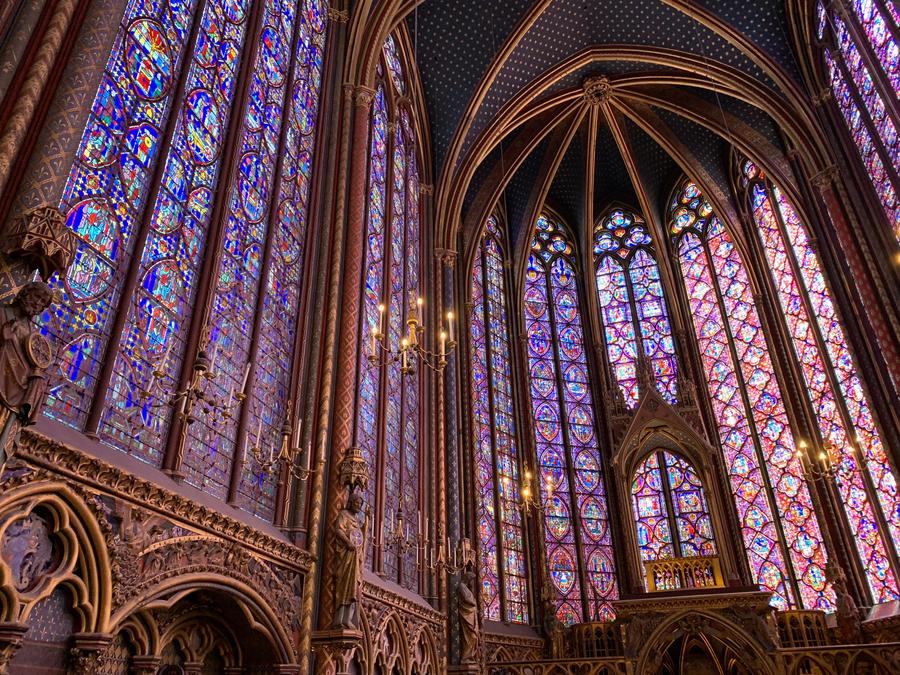
A reliquary you can walk into
In 1239 Louis IX, the king later canonised as Saint Louis, bought the Crown of Thorns from Baldwin II, the Latin emperor of Constantinople, who had pawned it to Venetian bankers. The price was 135,000 livres tournois, a sum that has been compared with half the annual revenue of the French crown. In 1241 Louis added more: a fragment of the True Cross, the Holy Lance and some twenty other relics of the Passion. Relics on that scale needed a setting to match, and the king built one in the courtyard of his own palace on the Île de la Cité.
The chapel was finished in 1248, in under seven years, and it was designed as the building equivalent of a jewelled reliquary: a casket turned inside out, with the relics at the east end and the walls given over as nearly as possible to coloured light. There are two storeys. The lower chapel was for the palace’s staff. The upper chapel was for the king, his family and the relics, and it was reached directly from the royal apartments.
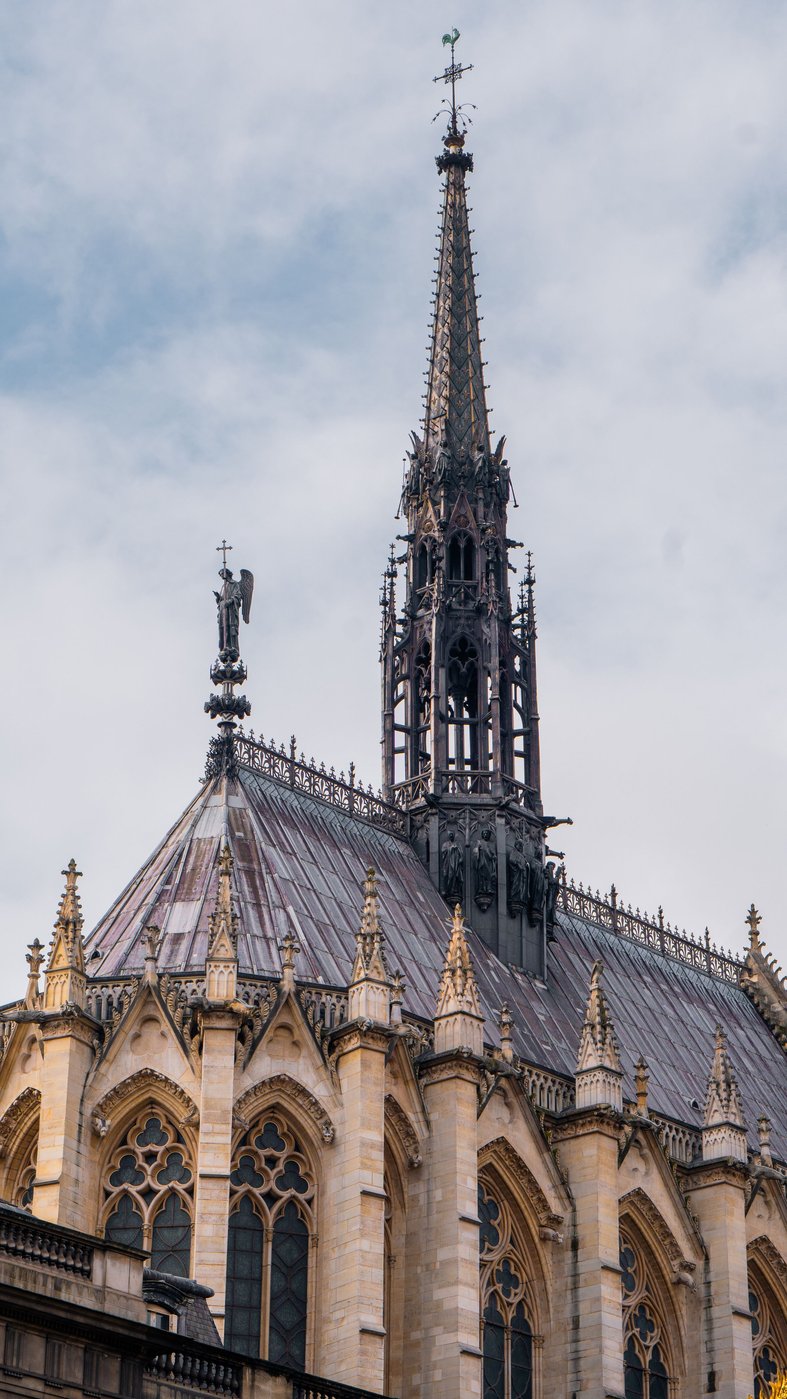
The palace became the seat of the Parlement of Paris and then the law courts, and the chapel was gradually swallowed by them. That is why you now reach it through a security gate on the boulevard du Palais, past lawyers and court staff, and why from the street you can see only its roof and spire.
The visitor’s cheat sheet
| Where | 10 boulevard du Palais, 75001 Paris, inside the Palais de Justice on the Île de la Cité. Métro Cité |
|---|---|
| Opening hours | 1 April–30 September 9am–7pm; 1 October–31 March 9am–5pm. Last entry 30 minutes before closing. Closed 1 January, 1 May and 25 December |
| Admission | €22 for visitors from outside the EEA, €16 for EEA nationals and residents. Free for under-18s and EU residents aged 18–25 |
| Combined ticket | With the Conciergerie next door: €30 (non-EEA) or €23 (EEA) |
| Booking | Timed tickets on the official website, strongly advised. Arrive at the time on your ticket: entry is guaranteed within 30 minutes of it |
| Security | Law-court security at the entrance. No knives, scissors, glass bottles or sharp objects, and no left luggage |
| Access | The upper chapel is reached by a narrow spiral stair; no pushchairs upstairs |
| How long | 45 minutes to an hour; longer with the Conciergerie |
Hours and admission checked against the official site in September 2026. They change; the official site is always the last word.
Book a time slot, and arrive on it. Tickets on the official website are sold for a specific time, and entry is guaranteed within 30 minutes of it. On a summer day the walk-up slots can be gone by mid-morning. Travel light: you are going through the law courts’ security, which turns away knives, scissors and glass, and there is no cloakroom to leave anything in.
Two prices since January 2026. Like the Louvre and some other national monuments, the Sainte-Chapelle now charges visitors from outside the European Economic Area more than residents: €22 against €16, or €30 against €23 with the Conciergerie. Under-18s get in free whatever their nationality, and so do EU residents aged 18 to 25. Bring ID if you are claiming the lower price.
The lower chapel
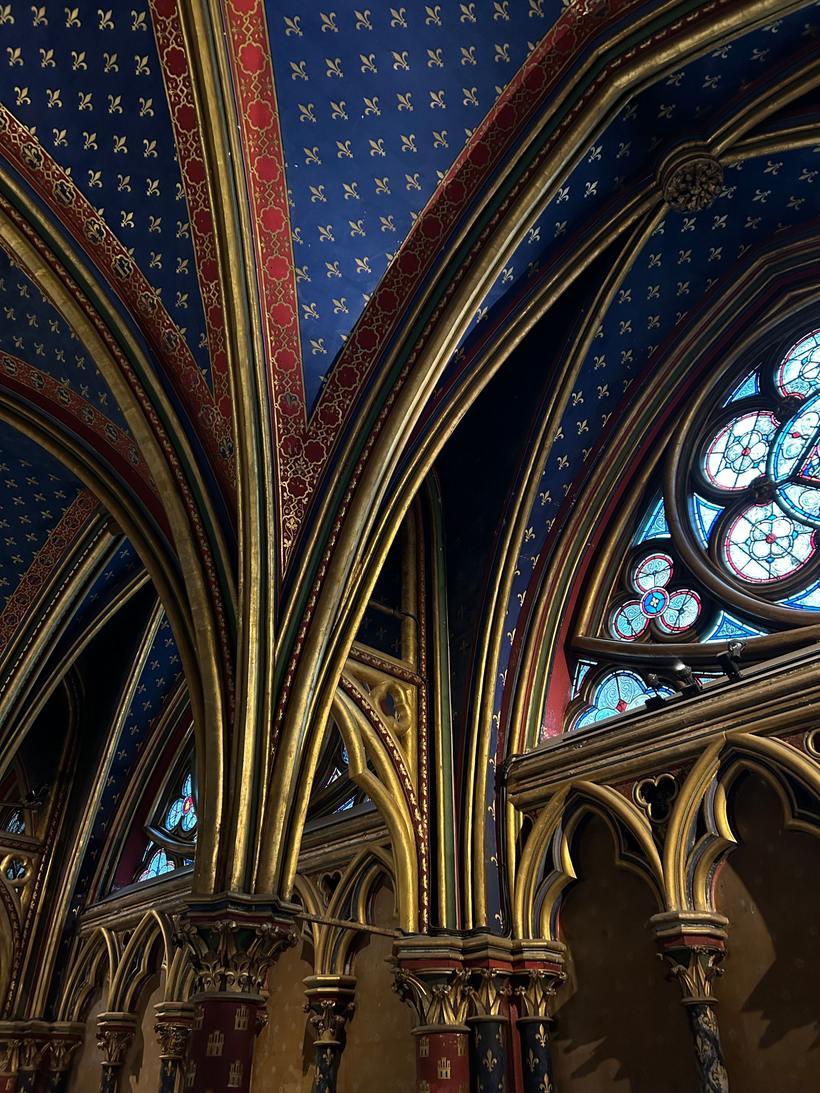
The visit begins downstairs, and the lower chapel is designed to be the prelude. It is low, only about seven metres high, with the vault held on slender columns set in from the walls, and it is dim. The painted decoration, blue vaults strewn with gold fleurs-de-lis and the castles of Castile for Louis’s mother, Blanche, is largely a nineteenth-century reconstruction, but it follows medieval evidence.
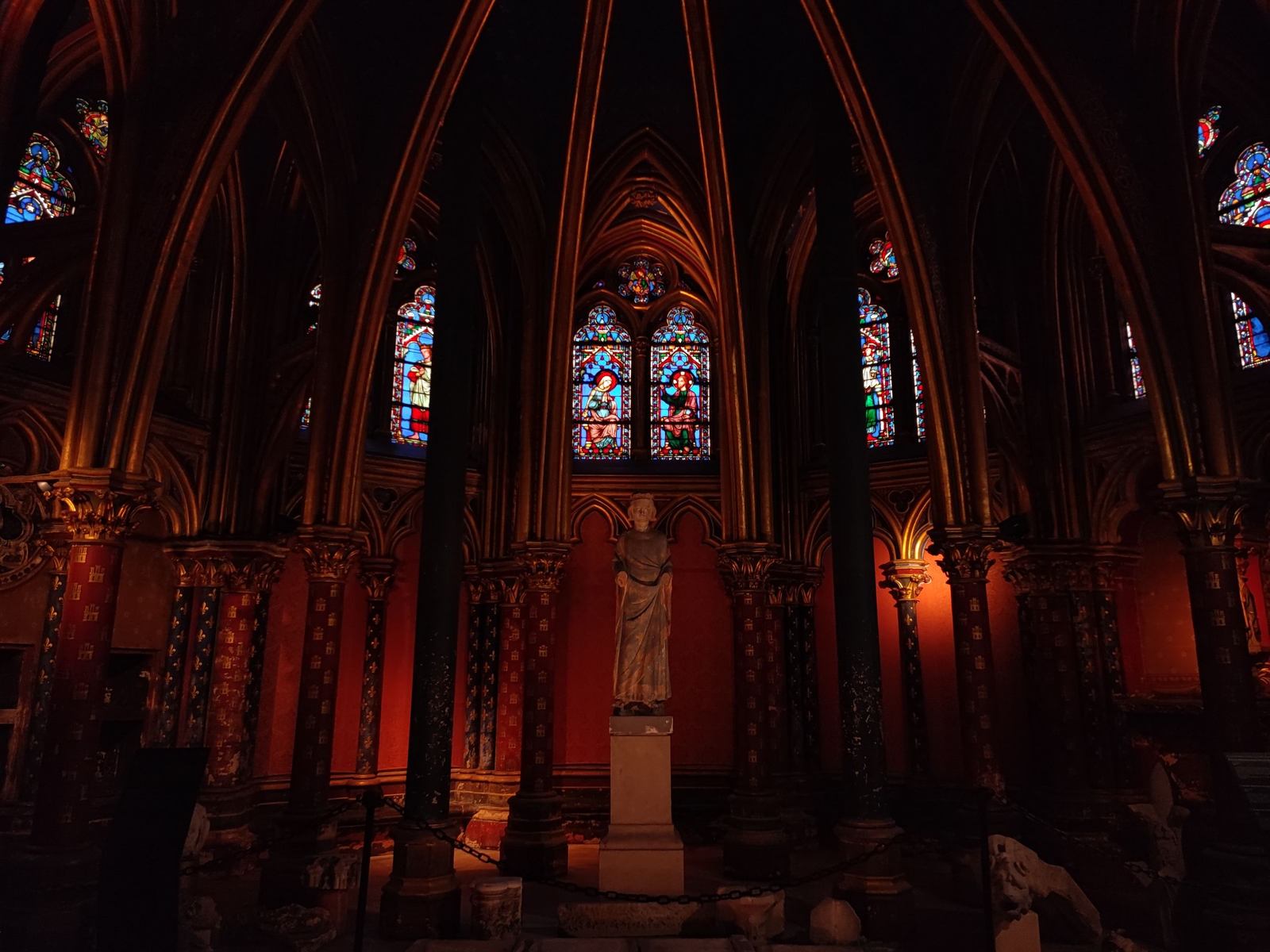
This was the parish church of the palace, dedicated to the Virgin, and it was where the servants, guards and officials heard Mass. Look at the statue of Saint Louis near the altar, and at the narrow windows: you are meant to notice how little light there is, so that the upper chapel strikes you all the harder.
The upper chapel
From the lower chapel a narrow spiral stair takes you up, and you come out at the west end of the upper chapel. Most visitors stop at the top of the stair; step in and away from it, because people are still coming up behind you.
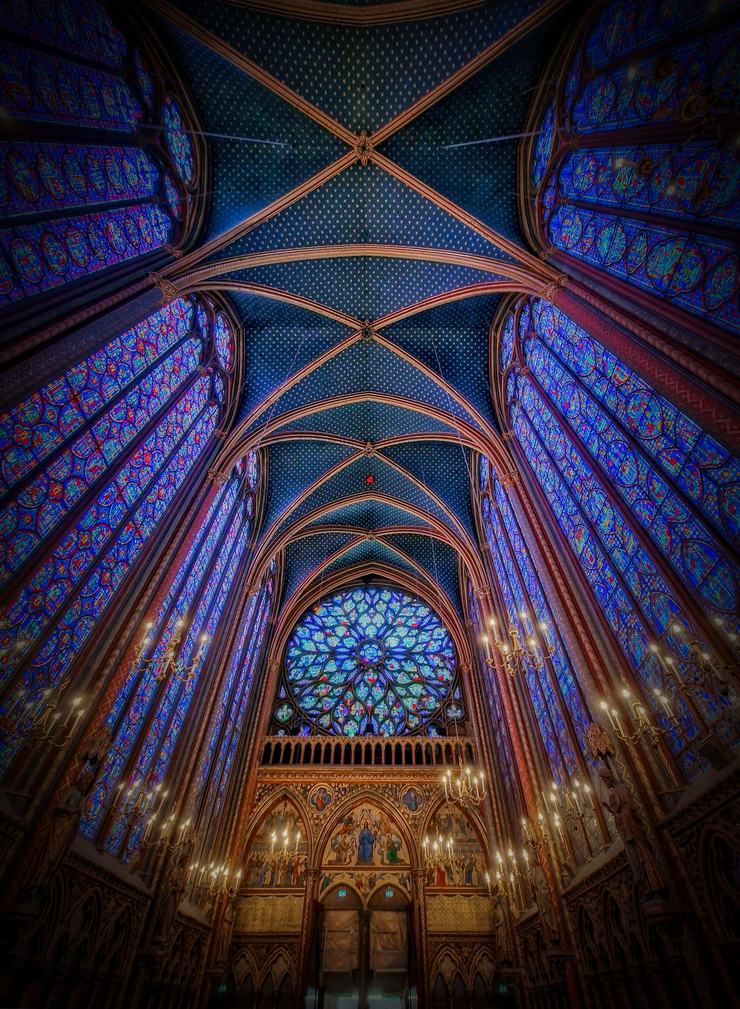
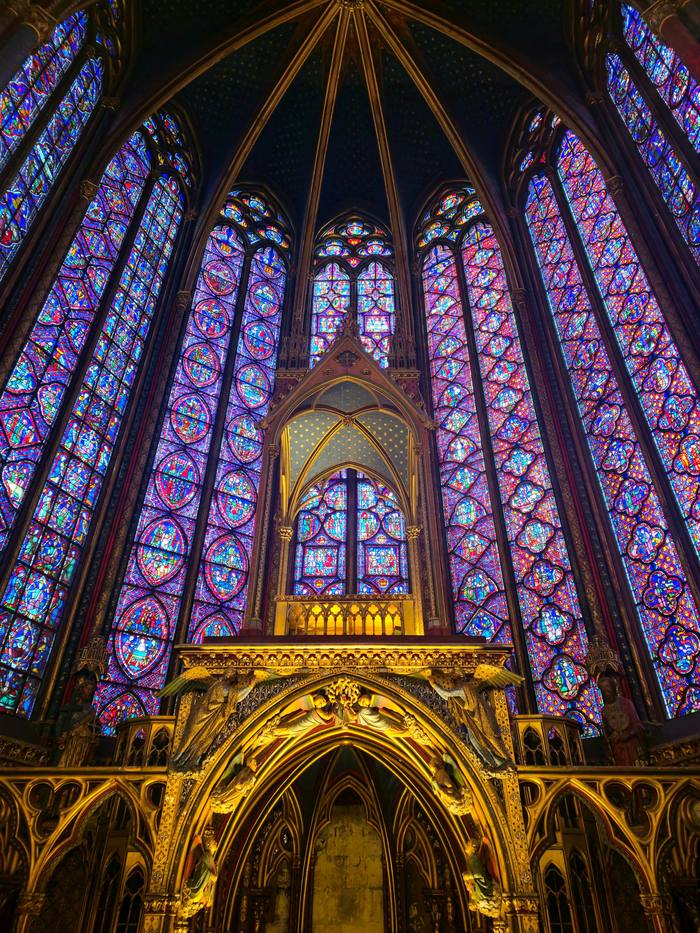
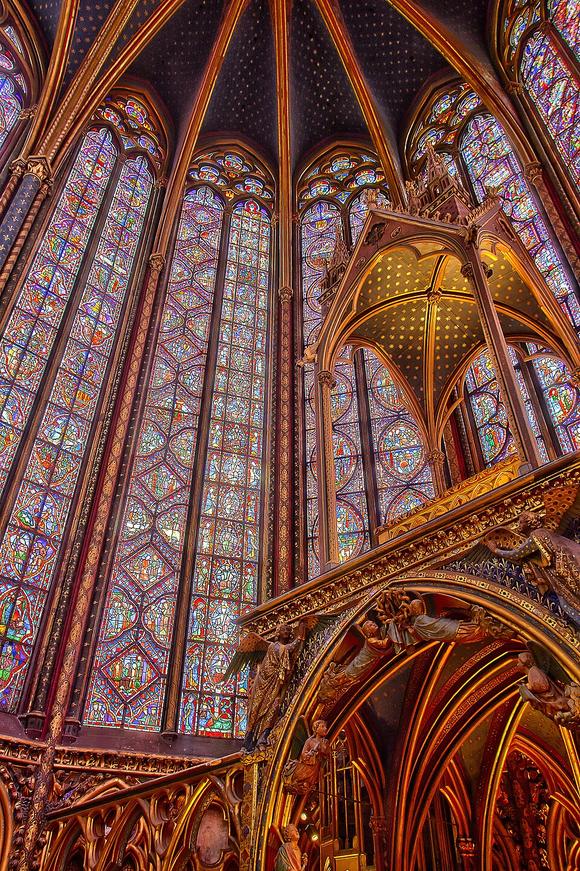
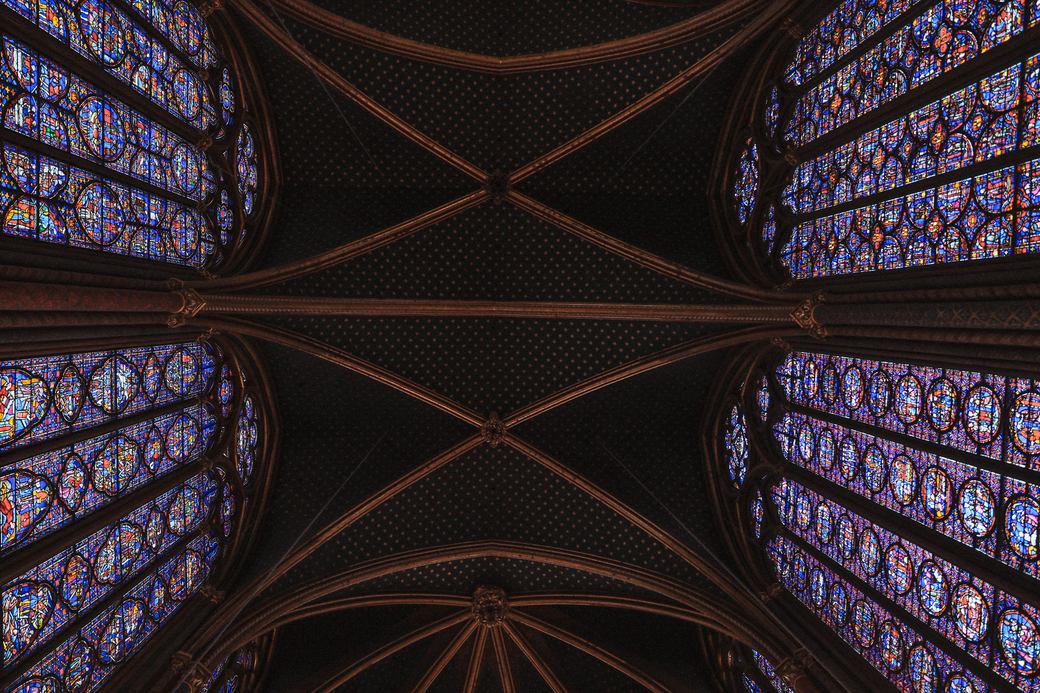
The room is a single space, about thirty-three metres long and twenty metres high, and on a sunny day it is extraordinary. The stone piers are thin, and between them, from knee height almost to the vault, is glass: fifteen great windows, up to fifteen metres tall, with a total of some 670 square metres of glass. The builders managed it by taking the thrust of the vault on buttresses outside and binding the whole structure with iron, so that the walls hardly needed to be walls.
At the east end, beneath the apse windows, is the tribune where the relics were shown: a raised platform under a Gothic canopy, reached by two small stairs. The king would climb it on great feast days and show the Crown of Thorns to the people below. The relics left in the Revolution; the Crown survived, and in 1806 it went to Notre-Dame, where it is still shown on Fridays.
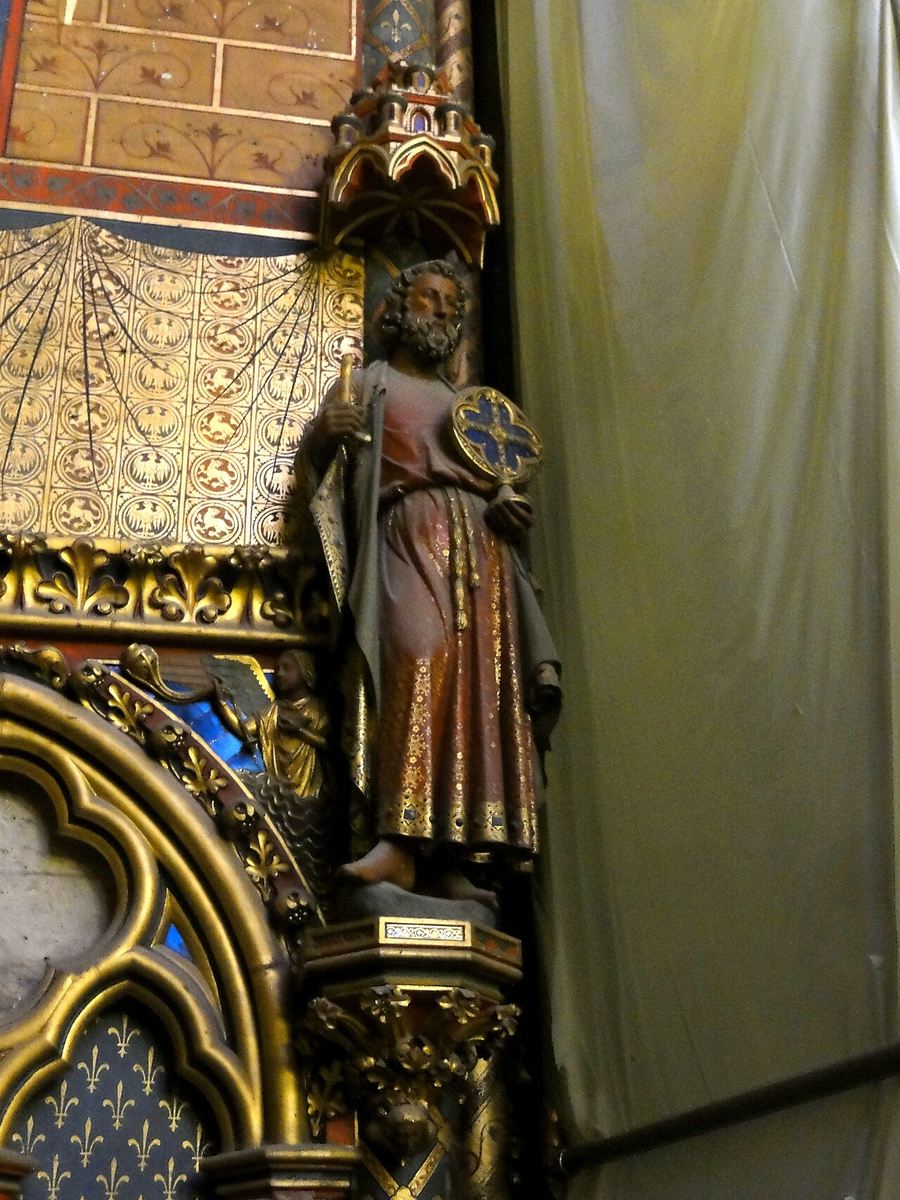
Against the piers stand the twelve apostles, each holding a consecration cross. Several are medieval originals; others were damaged in the Revolution and replaced, and some of the originals are now in the Musée de Cluny.
How to read the windows
The fifteen windows tell the story of the world from Genesis to the arrival of the relics in Paris, in 1,113 scenes. You do not need to read them all, and nobody does, but a little orientation makes a great difference. Start on the north side, the left as you face the altar, at the west end, and go round clockwise. Within each window the scenes run from the bottom left, row by row, upwards.
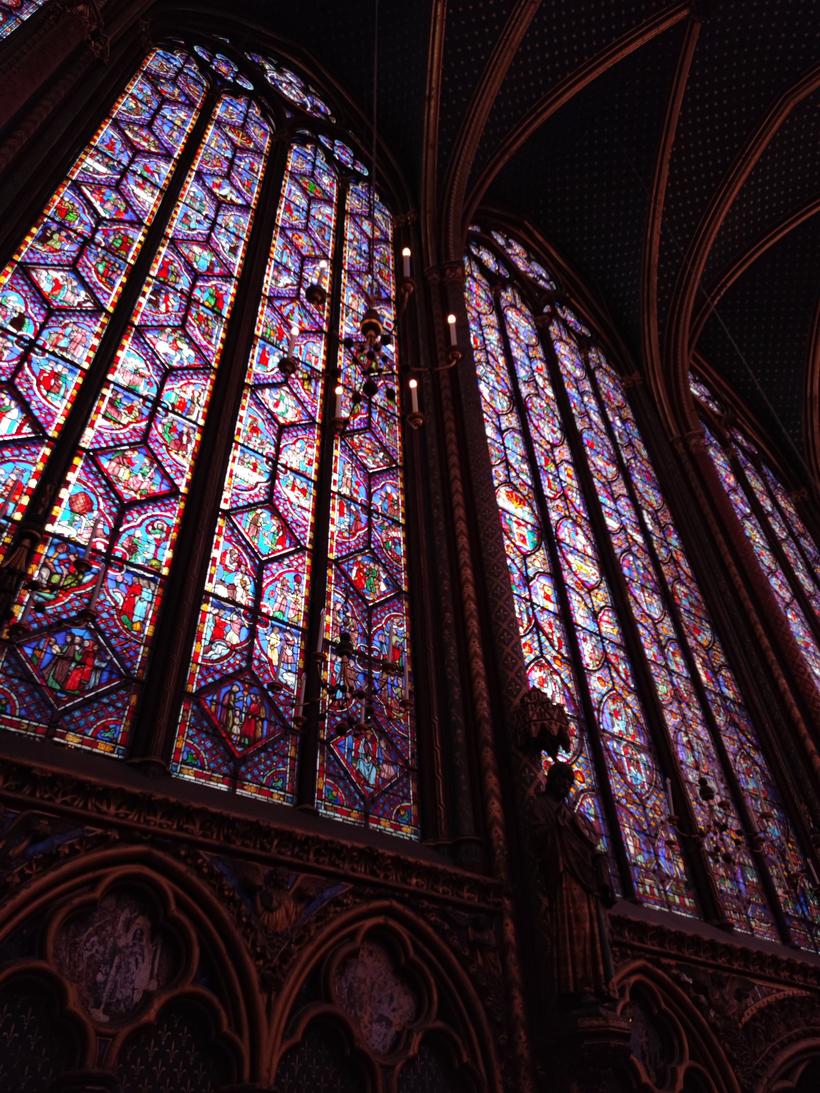
- Genesis is the first window on the left: the Creation, Adam and Eve, Noah.
- Exodus and the books of the Law follow along the north side.
- The Passion is in the centre of the apse, directly behind the tribune, where the relics of the Passion were kept.
- The books of the prophets fill the apse either side of it.
- Judith, Esther and Kings run down the south side.
- The story of the relics is the last window, on the south side at the west end: the Crown’s journey from Constantinople, and Louis IX carrying it barefoot into Paris.
The binoculars some visitors bring are a good idea. The best panels are high up, and a small pair turns the windows from a haze of colour into a sequence of stories. There is an audioguide for €4, and information panels in the chapel identify each window.
A note for 2026: the Ezekiel window on the south side has been under restoration since 2025, and part of it may be behind scaffolding when you visit. The rest of the chapel is open as usual.
The rose of the Apocalypse
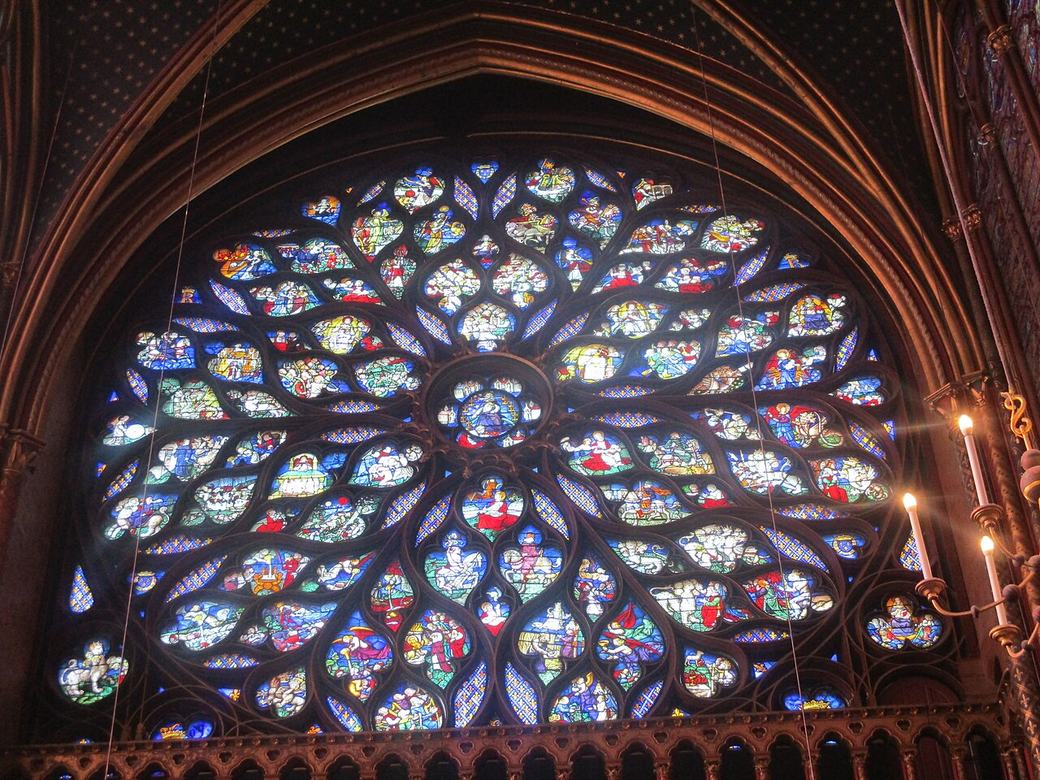
The west rose is not from Louis IX’s time. The original was replaced around 1485, under Charles VIII, with a rose in the Flamboyant style, nine metres across, showing the Apocalypse of Saint John in 87 panels. It is at its best late in the day, when the sun is in the west. It is also why the chapel looks subtly different at either end: the east is thirteenth-century, the rose fifteenth.
Fire, the Revolution and the archives
The chapel came through several near-disasters. Fires in the palace in 1630 and 1776 damaged the roof and the spire. In the Revolution the relics were dispersed, the reliquaries melted down, the spire pulled down and the building emptied. From 1803 it became a depository for the judicial archives, with shelves fixed across the lower part of the windows; some of the glass was removed to make room, and some of it was sold.
Restoration began in the 1840s, under Félix Duban, Jean-Baptiste Lassus and later Émile Boeswillwald, with the young Eugène Viollet-le-Duc, who would go on to restore Notre-Dame, among their assistants. They repainted the interior, replaced lost statues and reinstated missing glass, taking great care to match it. The spire you see, seventy-five metres to the tip, was designed by Lassus in the 1850s; it is the fifth to stand on the chapel. A restoration of the windows between 2008 and 2015 cleaned the glass and fitted a protective outer glazing.
When to go
The Sainte-Chapelle is a building made for light, and the weather matters more here than almost anywhere. On a bright day the glass blazes; on a dark winter afternoon it can look dull and heavy. The apse windows face east and are at their best in the morning, and the rose faces west and comes alive in the late afternoon, so a morning slot on a sunny day is the one to aim for, with a second look at the rose if you are passing later.
It is busiest from late morning to mid-afternoon, when the tour groups come through, and quietest at opening time and in the last hour. The upper chapel is not a large room, and when it is full the experience changes: the murmur of a crowd, people standing still in the middle of the floor with their phones up. If you can, book the first slot of the day, go straight up the stair, and have the glass almost to yourself for ten minutes.
In the evenings the upper chapel is often used for concerts of classical music, from string quartets to Vivaldi’s Four Seasons, organised by independent promoters and sold separately. They are not cheap, and the music is not always the point, but hearing it in the chapel as the light fades through the glass is an experience of its own.
What you are looking at: the palace
It helps to remember that the Sainte-Chapelle was never a free-standing church. It was the palace chapel of the Capetian kings, whose palace covered the western end of the Île de la Cité, and it stood in the middle of a courtyard surrounded by royal lodgings, halls and offices. When the kings moved out in the fourteenth century, the palace passed to the Parlement and the royal administration, and over the centuries it became the Palais de Justice. The chapel survived; most of the palace around it was rebuilt, burned or replaced.
The parts that do survive are next door, in the Conciergerie: the vast vaulted hall of the palace guards, of the early fourteenth century, and the kitchens of the 1350s. They give you a sense of the scale of the palace the chapel was built for, and of how grand its royal apartments must have been.
Getting there, and pairing it
The Sainte-Chapelle is on the Île de la Cité, about five minutes’ walk from Notre-Dame. The nearest Métro station is Cité on line 4; Saint-Michel, on lines 4 and RER B and C, is just across the bridge. The entrance is on the boulevard du Palais: look for the queue for the law courts, and the separate line for the chapel.
The obvious pairing is the Conciergerie, the rest of the medieval palace, whose huge vaulted Salle des Gens d’Armes and revolutionary prison, where Marie-Antoinette spent her last weeks, are just around the corner. The combined ticket saves a few euros. Notre-Dame makes a natural third, and the three together are a very full morning.
Plan your visit
Book the Sainte-Chapelle on the official website, and find somewhere to stay close to the Île de la Cité.
Some links are affiliate links. They cost you nothing extra and help keep this guide independent.
Frequently asked questions
Common questions
How much does the Sainte-Chapelle cost?
Since January 2026 there are two prices. Visitors from outside the European Economic Area pay €22, or €30 with the Conciergerie; nationals and residents of the EEA pay €16, or €23 with the Conciergerie. Entry is free for under-18s and for EU residents aged 18 to 25.
Do I need to book the Sainte-Chapelle in advance?
It is strongly advised. Tickets are sold for a time slot on the official website, and entry is guaranteed within 30 minutes of the time on your ticket. Without one you may find the day sold out, and you still have to go through the Palais de Justice security.
What are the Sainte-Chapelle’s opening hours?
From 1 April to 30 September, 9am to 7pm; from 1 October to 31 March, 9am to 5pm. Last entry is 30 minutes before closing. It is closed on 1 January, 1 May and 25 December.
Why is there airport-style security at the Sainte-Chapelle?
The chapel stands inside the Palais de Justice, the working law courts of Paris, and you go in through the courts’ security. Knives, scissors, glass bottles and other sharp objects are refused, and there is nowhere to leave them.
Is the Sainte-Chapelle still a church?
It is consecrated, but it has not been used for regular worship since the Revolution. It is a national monument run by the Centre des monuments nationaux, and it is visited as one.