
Rosslyn Chapel
Rosslyn Chapel is small — 21 metres long, not quite 13 high — and it is best known for a novel. Neither fact prepares you for the inside, where almost every stone surface is carved: angels, dragons, Green Men, a dance of death, the seven deadly sins, a pillar wound with garlands that inspired a murder legend. It also surprises people in two practical ways. You visit in a timed slot, so it is worth booking. And you cannot take a single photograph inside, so bring your eyes and leave the phone in your pocket.
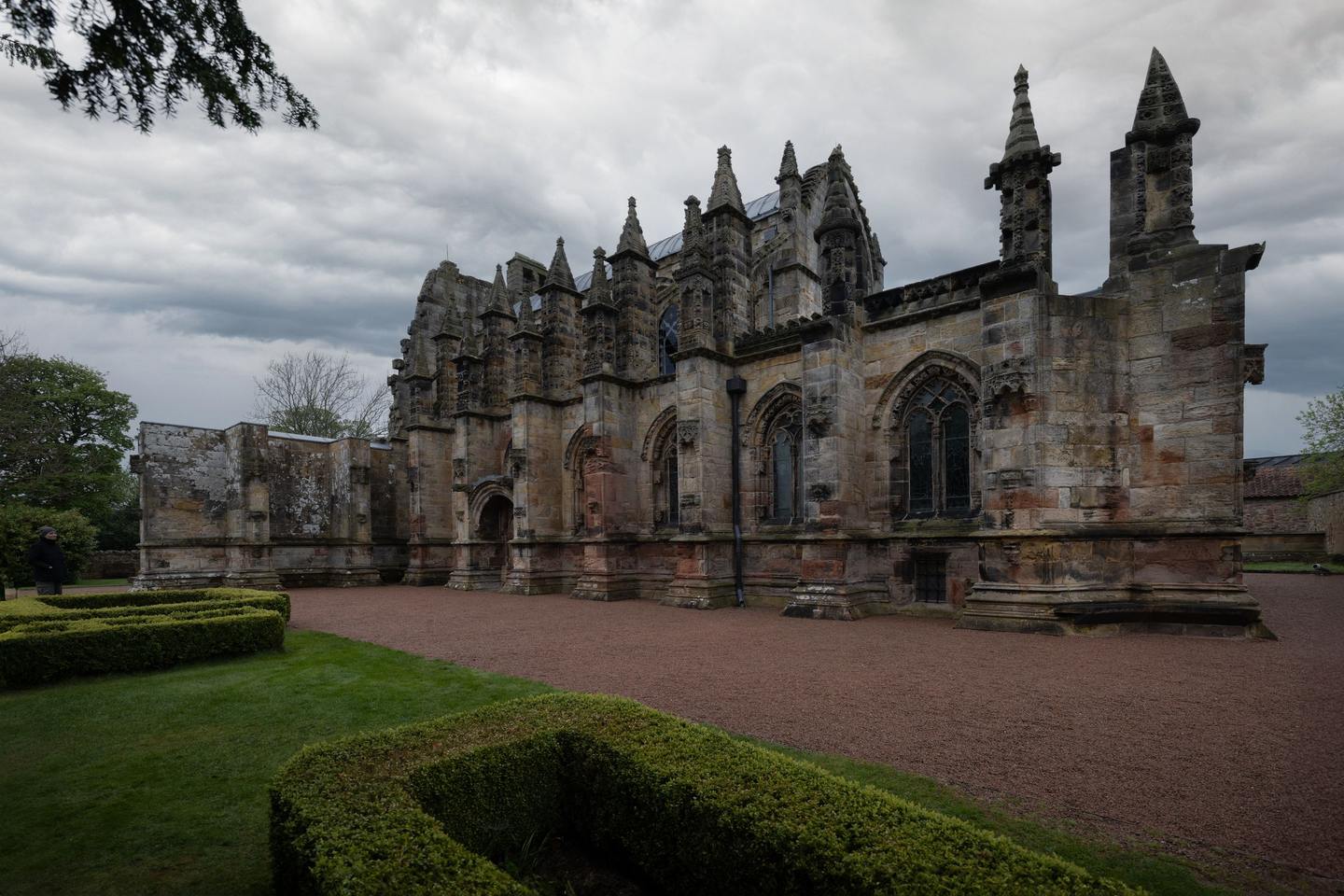
A family chapel that was never finished
The chapel was founded by Sir William St Clair, Earl of Orkney, whose family held the barony of Roslin and its castle in the glen below. The chapel dates its foundation to 1446, when the charter came from Rome; building seems to have begun in earnest in the 1450s, and an inscription on the north wall records the founding of the college in 1450. It was a collegiate church, dedicated to St Matthew, with a provost, six prebendaries and two choristers to sing the services and pray for the souls of the founder and his family.
It was meant to be much bigger. What stands today is only the choir of a cruciform church, and at the west end you can still see the blocked arches that were meant to open into transepts and a nave. When Sir William died in 1484, work stopped. His son Oliver roofed the choir with its stone vault and left it at that. Two writers on the chapel, Mark Oxbrow and Ian Robertson, point out that its plan is very close to the eastern end of Glasgow Cathedral, which is a better clue to its design than anything in the Da Vinci Code.
The visitor’s cheat sheet
| Where | Chapel Loan, Roslin, Midlothian EH25 9PU, seven miles south of Edinburgh city centre |
|---|---|
| Opening hours | Monday–Saturday 9am–5pm, Sunday 12 noon–5pm. Visits are in 90-minute slots; the last slot starts at 3.30pm. Closed 24 and 25 December and 1 January, and occasionally at short notice for funerals and weddings |
| Admission | £12 full price, £10 reduced (over-65s, students, disabled visitors, the unemployed, Armed Forces, Young Scot cardholders). Under-17s free in a family group. A carer goes free |
| Booking | Recommended, online through the chapel’s own website, for a timed slot |
| Talks | Free, 10–15 minutes, given by the chapel guides about half an hour after each slot begins |
| Photography | Not allowed inside the chapel. Allowed outside |
| Access | Ramp into the chapel; the sacristy is down a steep flight of steps. No pushchairs inside; assistance dogs only |
| How long | An hour and a half in the chapel; add an hour for the glen and the castle |
Hours and admission checked against the official site in September 2026. They change; the official site is always the last word.
Book a slot, and don’t plan on photos. Visits run in 90-minute slots from 9am (12 noon on Sundays), the last at 3.30pm, and the chapel recommends booking online. Tickets are £12, £10 reduced, and children under 17 are free with their family. No photography or filming is allowed inside the chapel — a rule in force since 2008 — so take a carvings map at the desk and look instead.
Ruin, romance and restoration
The Reformation emptied the chapel. Its endowments were seized in 1571, and in 1592 Oliver St Clair was ordered to destroy its altars as “a house and monument of idolatrie”. After that it was no longer used for worship, and it began to decay. In 1650 Cromwell’s troops attacked Rosslyn Castle; the chapel was spared, although tradition says they stabled their horses in it. Its windows were not even glazed until 1736, when Sir James St Clair put in glass, relaid the floor and repaired the roof.
By then the overgrown ruin had become a destination for the Romantics. Robert Burns and the painter Alexander Nasmyth came in the 1780s, Dorothy Wordsworth called the architecture “exquisitely beautiful” in 1803, and Walter Scott put Rosslyn into The Lay of the Last Minstrel in 1805. Queen Victoria visited in 1842 and wanted it preserved. The architect David Bryce restored it for the third Earl of Rosslyn, and it was rededicated in 1862 as a church of the Scottish Episcopal Church. It still is one: there is a service every Sunday at 10am.
The twentieth century nearly did more damage than Cromwell. A suffragette bomb went off inside in July 1914. In the 1950s the interior stonework was coated with a cement slurry meant to protect it, which instead trapped water in the stone. The Rosslyn Chapel Trust was set up in 1995, put a steel canopy over the roof to let the walls dry out, and spent the following years on a conservation programme that cost around £13 million, including the visitor centre you now enter through.
What to see, in the order you meet it
The outside
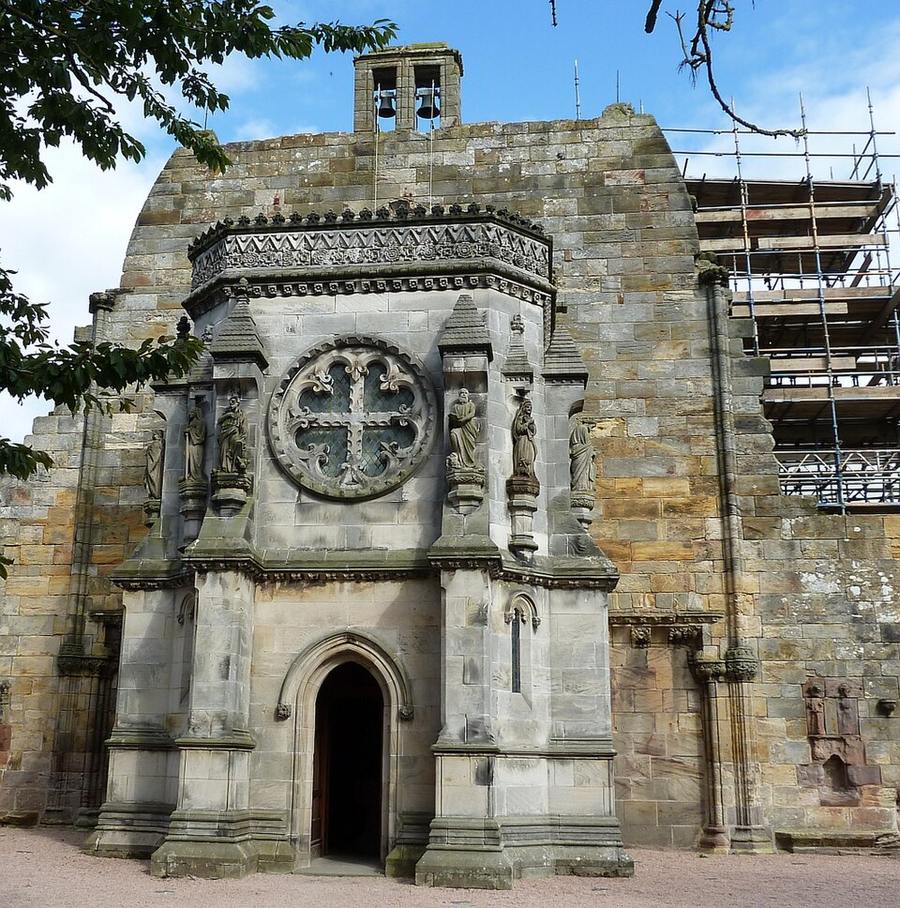
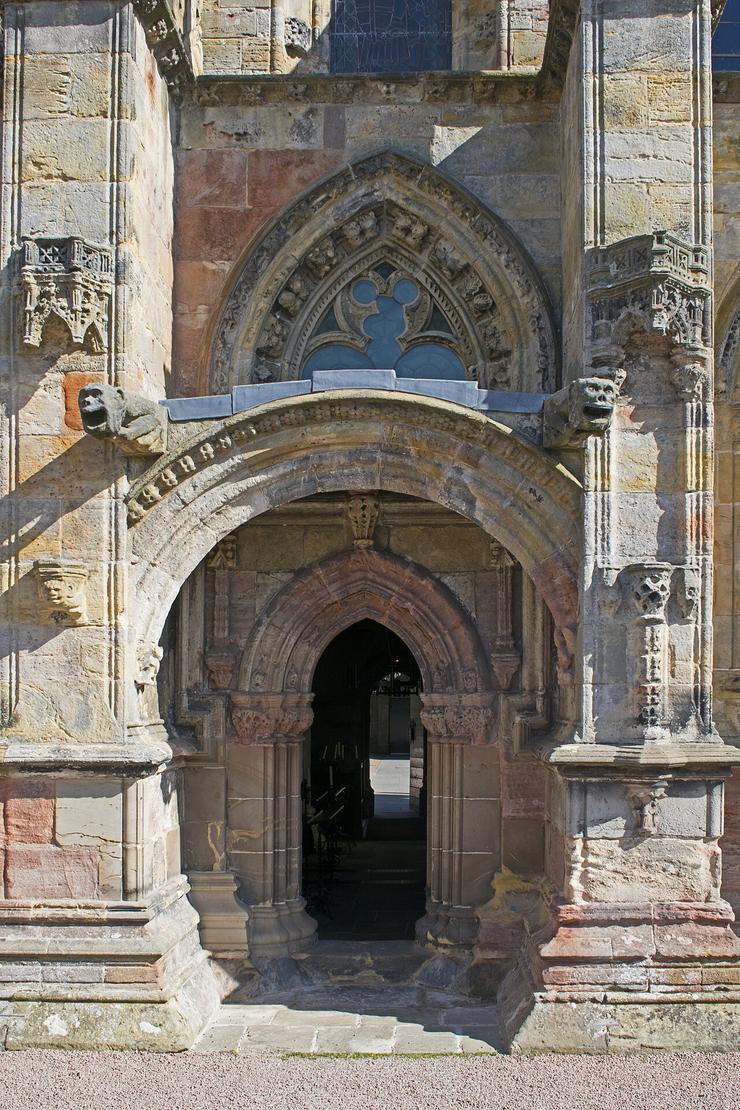
You approach from the visitor centre on the north side, and it is worth walking right round the building before you go in. The walls are covered in carving too, weathered but legible: on the north wall near the entrance, a fox running off with a goose while the farmer’s wife gives chase; on the south, faces, a stag and a ram in the window arches. High on the north side a row of shields carries the initials of the foundation inscription, which reads, expanded, “William Lord St Clair founded this college in the year of God 1450”.
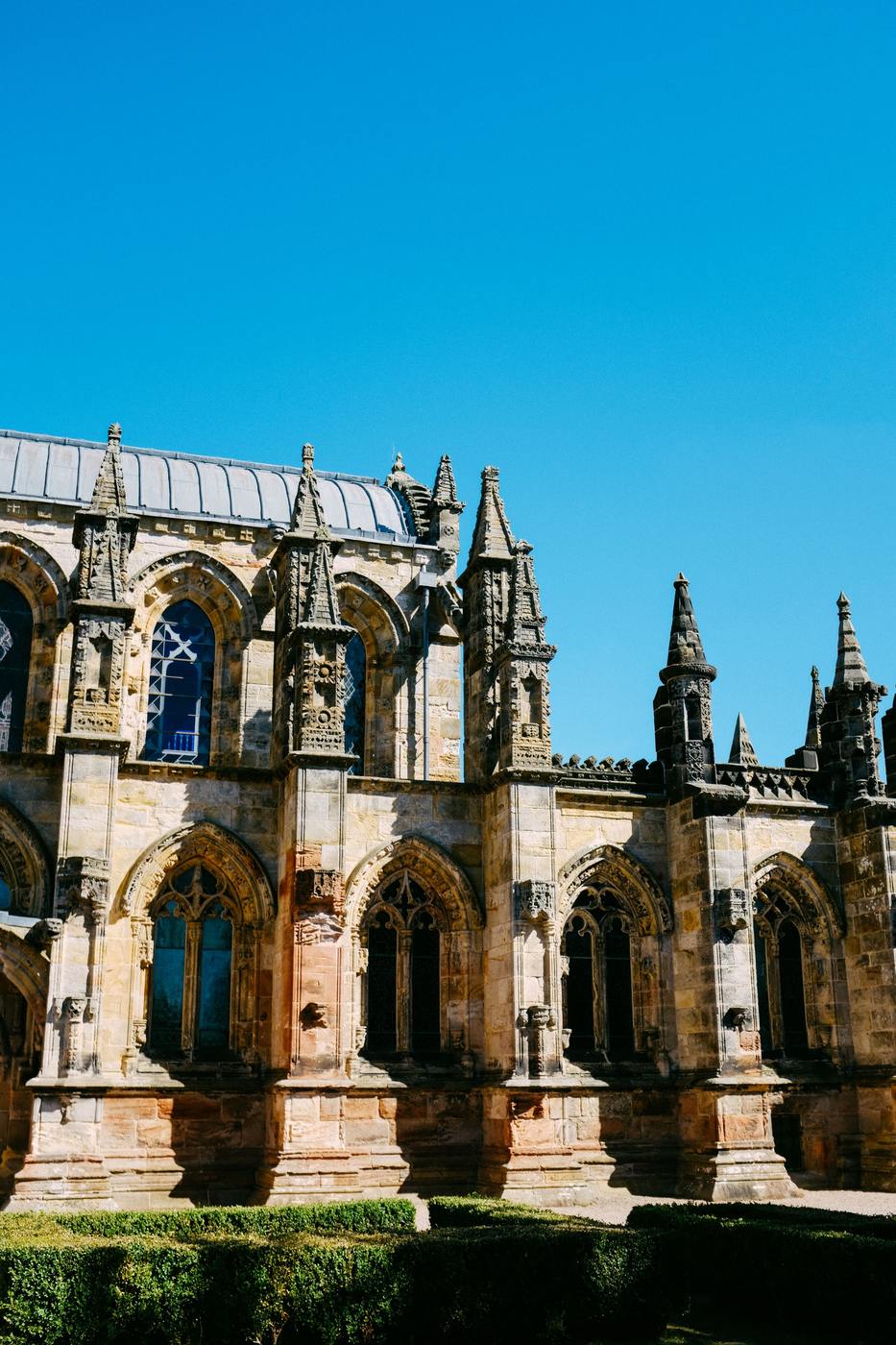
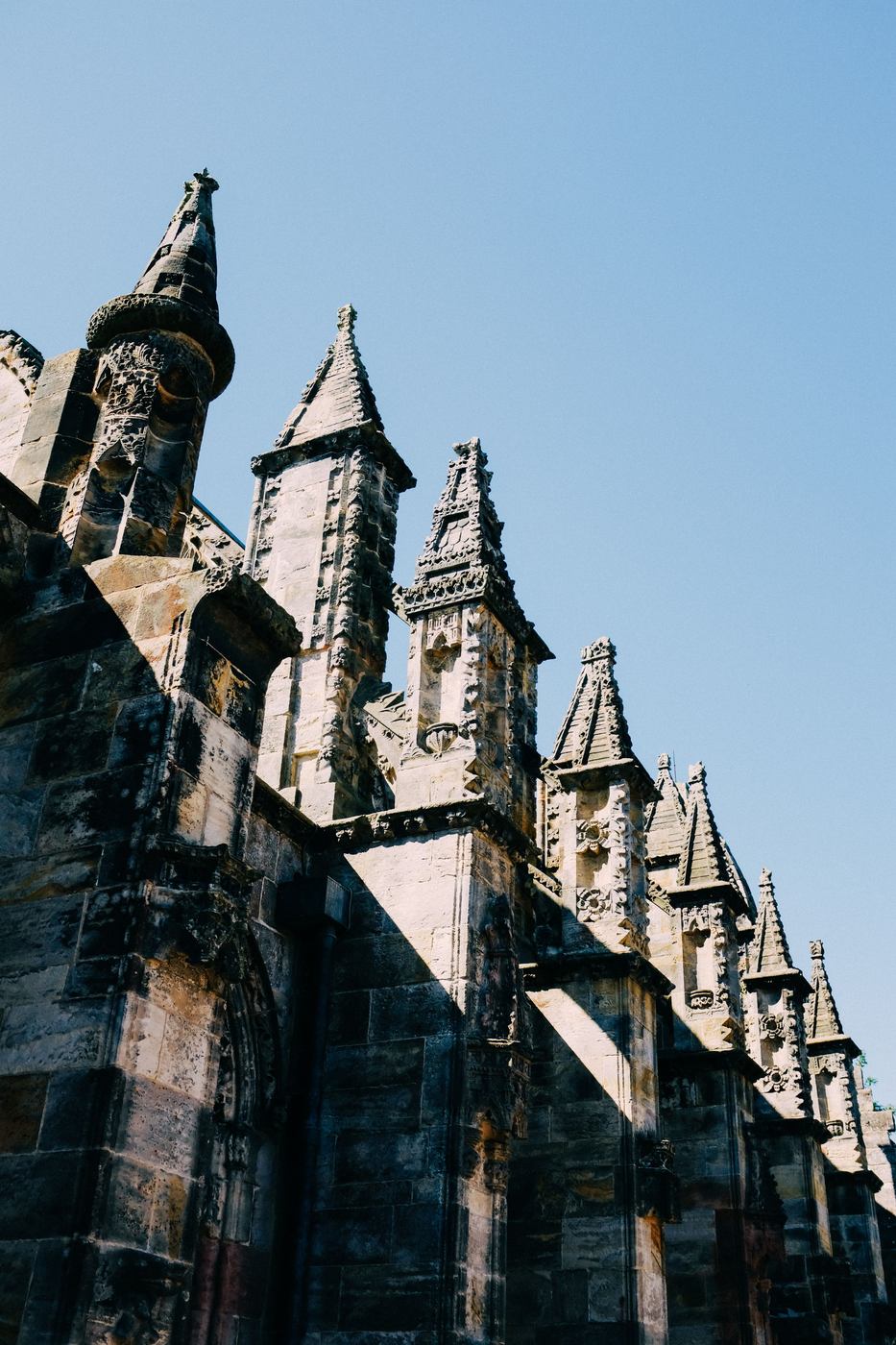
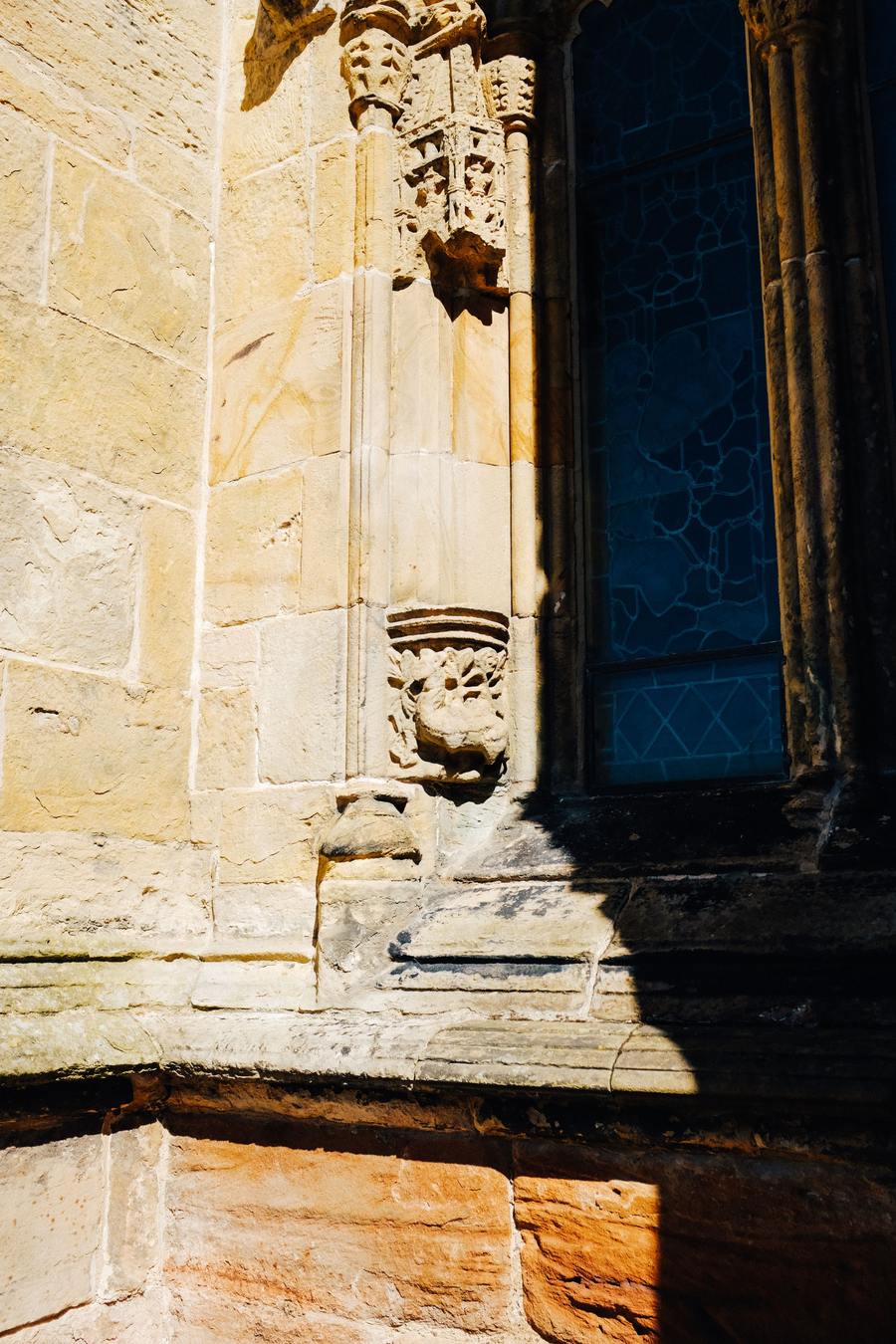
The west end is where the unfinished church is plainest: doorways and arches that lead nowhere, blocked with masonry, and features that only make sense on an interior wall. The baptistery in front of them, in a greyer sandstone, was added in 1880–81, with statues of St John, St Anna the Prophetess, St Luke, St Mark, St Agnes and St Matthew.
The choir and its ceiling
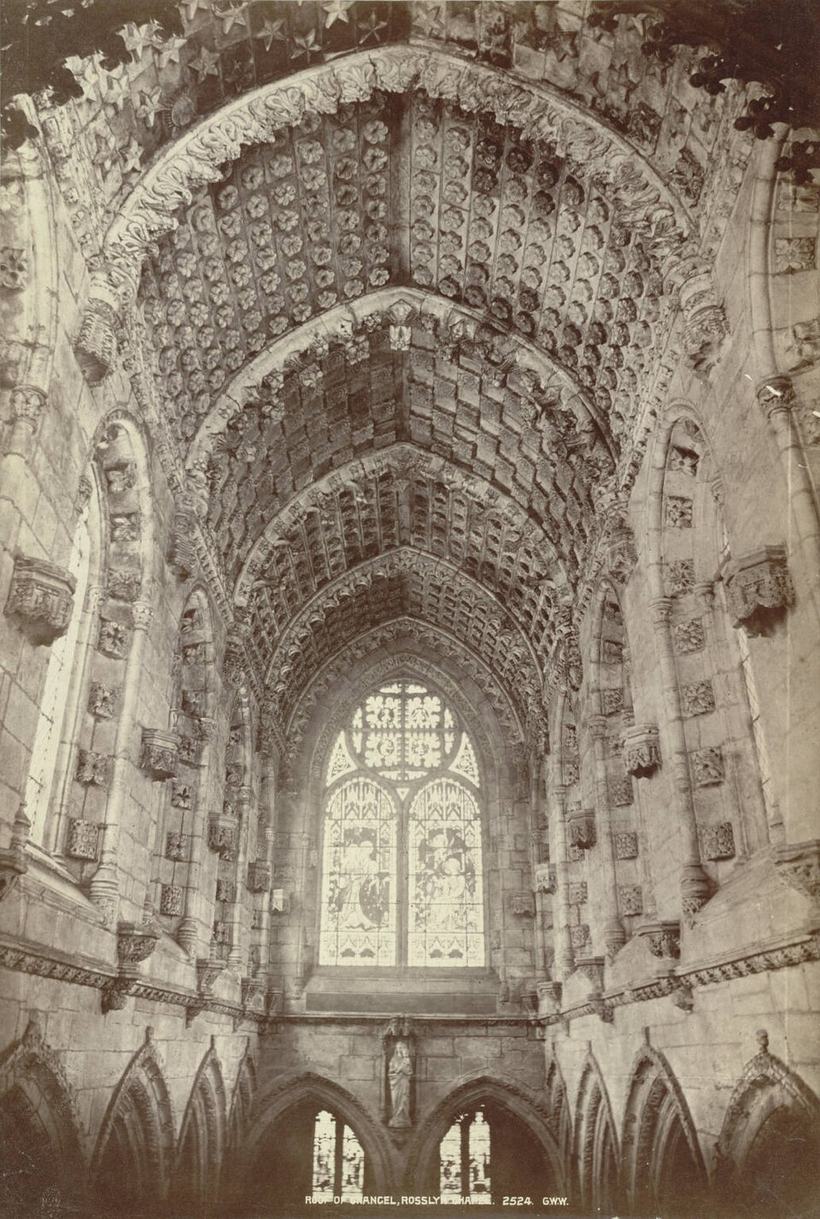
Inside, the chapel is a single tall space with aisles on three sides, fourteen pillars and twelve pointed arches. Look up first. The barrel vault is divided into five bands, each carved with a different motif — daisies, lilies, roses, simple flowers and stars. The lilies and roses are the Virgin’s flowers; the whole ceiling reads as a garden laid over the church.
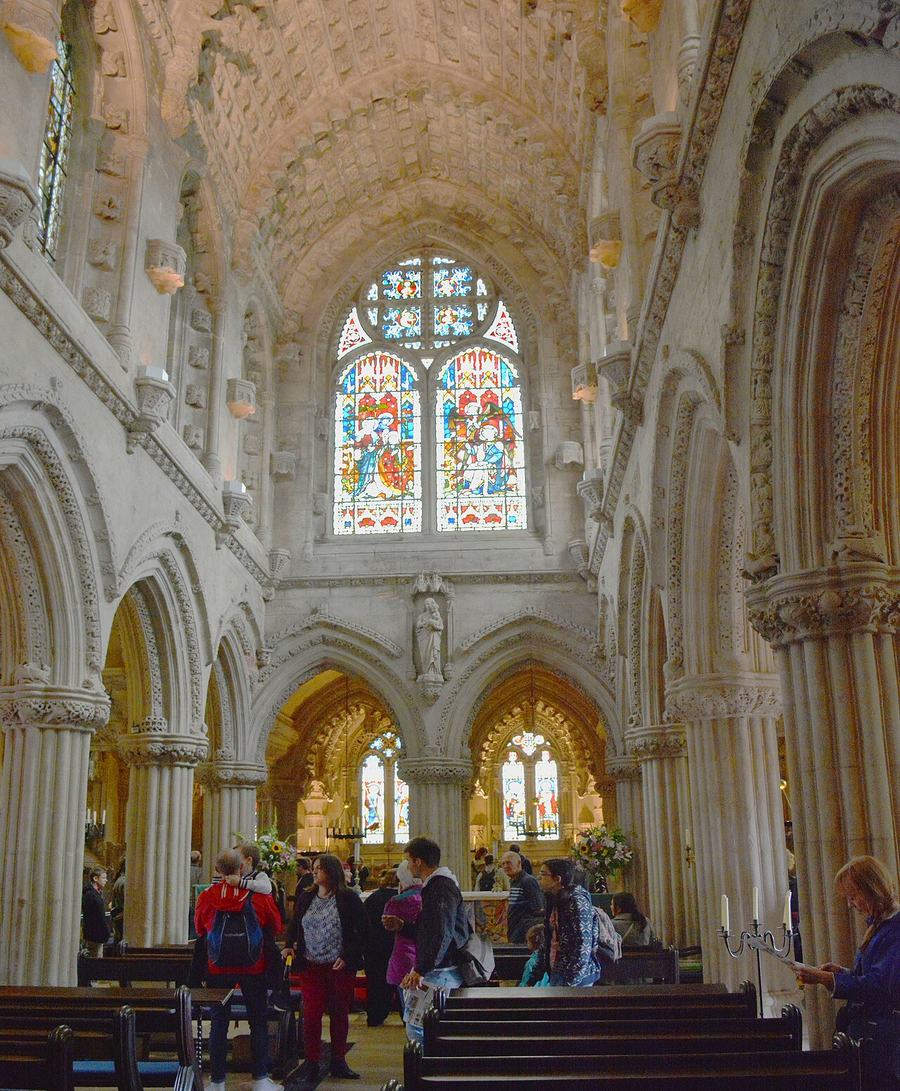
Then go slowly along the south aisle, where most of the story carvings are. Two carved rows face each other there: the seven virtues, shown as acts of mercy, and the seven deadly sins, each group led by a bishop: clothing the naked, visiting the sick, feeding the hungry, burying the dead, with St Peter waiting at the gate with his key; and opposite them pride, gluttony, anger, envy, sloth and lust, with the devil emerging from a monster’s mouth to hook the lot. Look closely and each set has one figure in the wrong place — avarice among the virtues, charity among the sins — which the guides will tell you is either a mason’s joke or a mason’s mistake.
Look out, too, for a knight on horseback, thought to be William “the Seemly” St Clair, the first of the family in Scotland, with a figure holding a cross behind him. The south aisle is also full of plants: ferns, curly kale, oak leaves, and round one window arch the carving that has made the chapel famous in a different way.
The maize, and why it is probably not maize
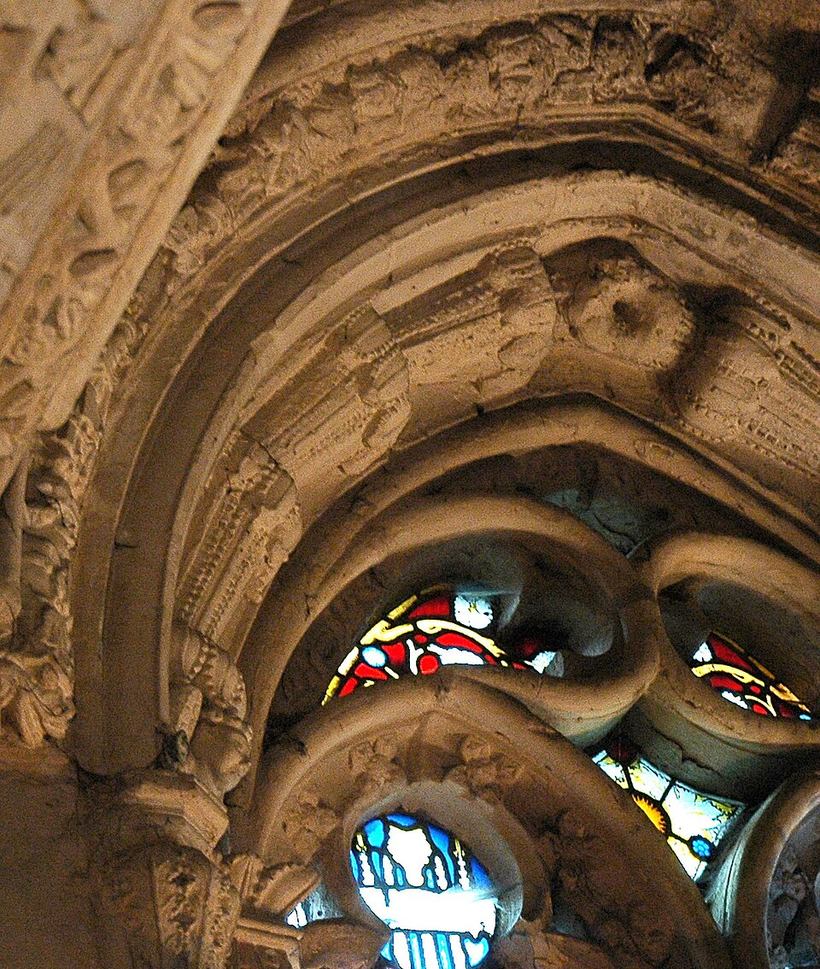
The carving round a window in the south aisle looks, to many visitors, like ears of maize. Maize was unknown in Europe until after Columbus reached the Americas in 1492, decades after the chapel was built, so it has become the evidence for a legend that the founder’s grandfather, Henry St Clair, sailed to North America a century earlier. The chapel’s own site tells the story with a question mark. The botanist Adrian Dyer, who studied the carvings, found only one plant he could identify with confidence and thought the “maize” was a stylised pattern. Look at it, and at the neighbouring carvings, and decide for yourself.
The Apprentice Pillar
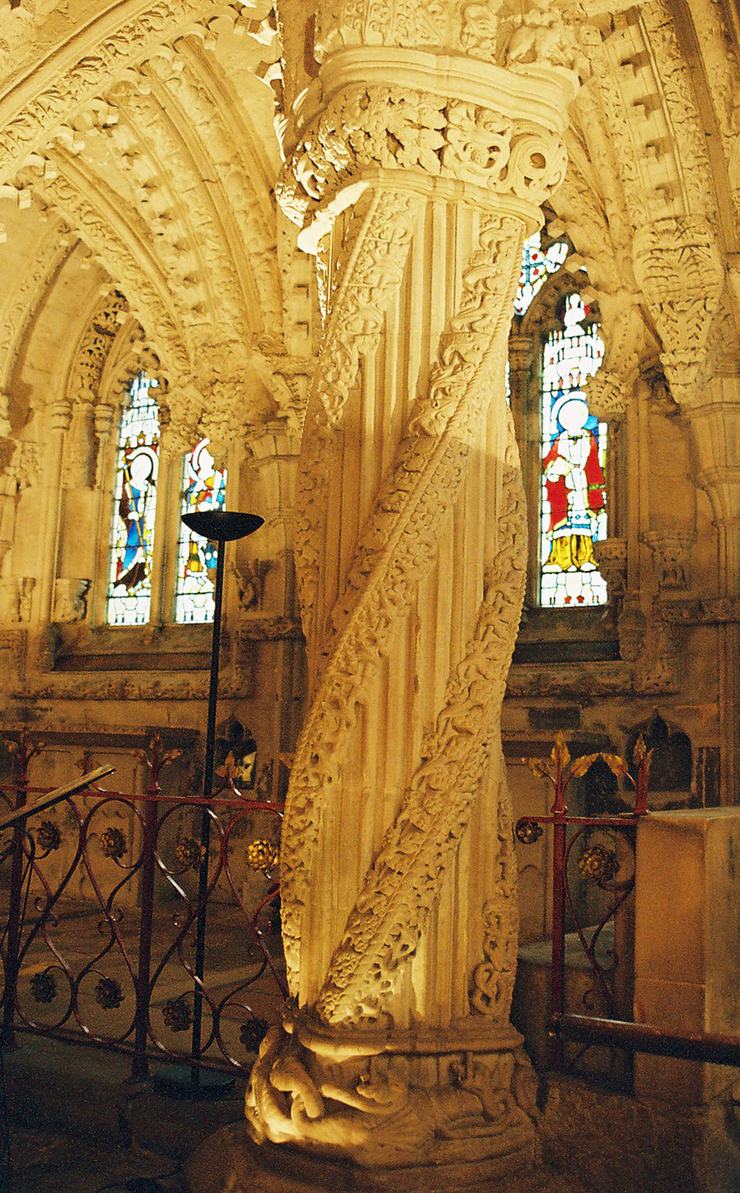
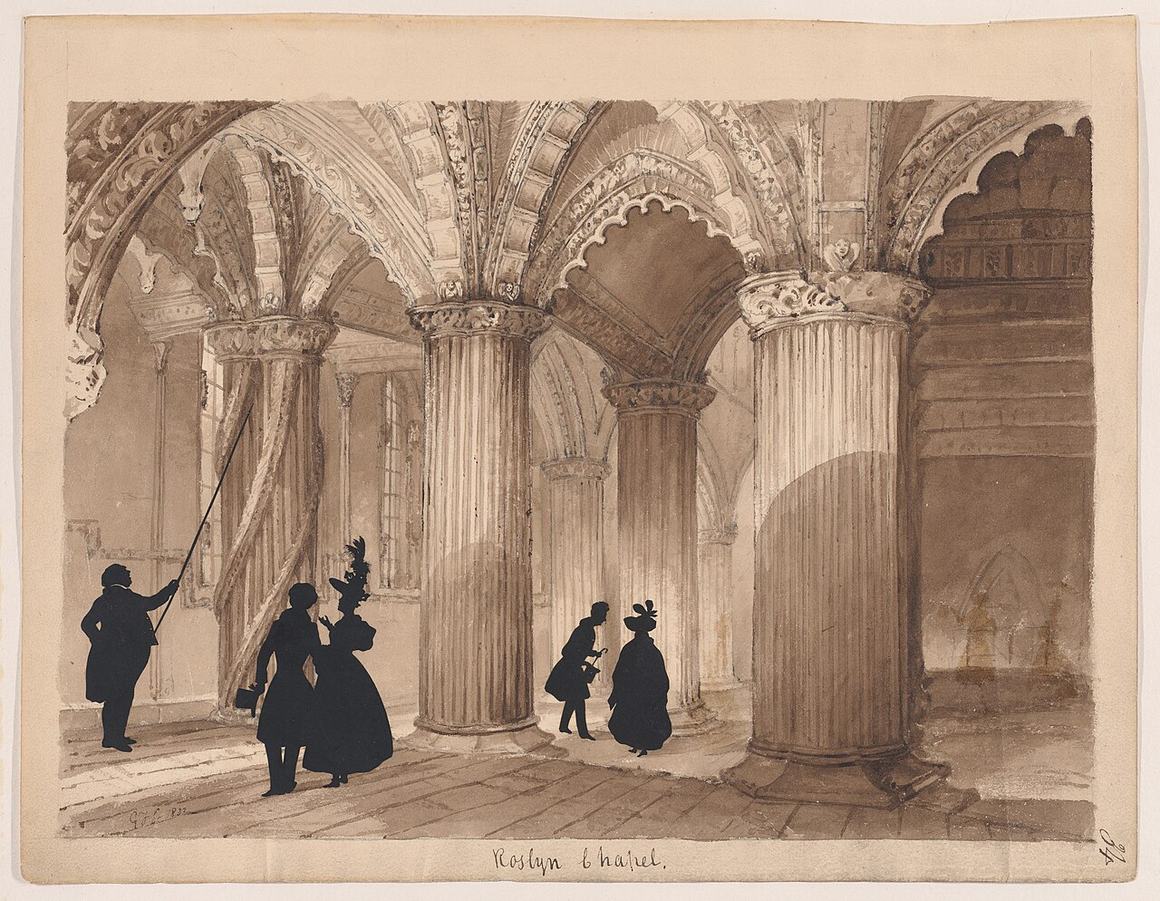
At the east end, three pillars divide the choir from the Lady Chapel. The southern one is the most elaborate thing in the building: four garlands of foliage spiral up the shaft, and round its base eight dragons bite at vines coming out of their mouths. The legend attached to it is the reason for its name. The master mason, it goes, went abroad to see the original that inspired the design; while he was away, his apprentice, working from a dream, carved the pillar himself; and when the master came home and saw it, he struck the apprentice dead with his mallet. A carved head in the corner of the chapel is pointed out as the murdered apprentice, another as the master, gazing at the pillar for ever.
It is a good story, and a relatively late one: an account of the chapel from 1778 calls it the Prince’s Pillar. On the lintel next to it is the only inscription inside the chapel, from the First Book of Esdras: Forte est vinum, fortior est rex, fortiores sunt mulieres, super omnia vincit veritas — “Wine is strong, the king is stronger, women are stronger still, but truth conquers all.” A full-size plaster cast of the pillar, made in 1871, stands in the Cast Courts of the Victoria and Albert Museum in London.
The Lady Chapel
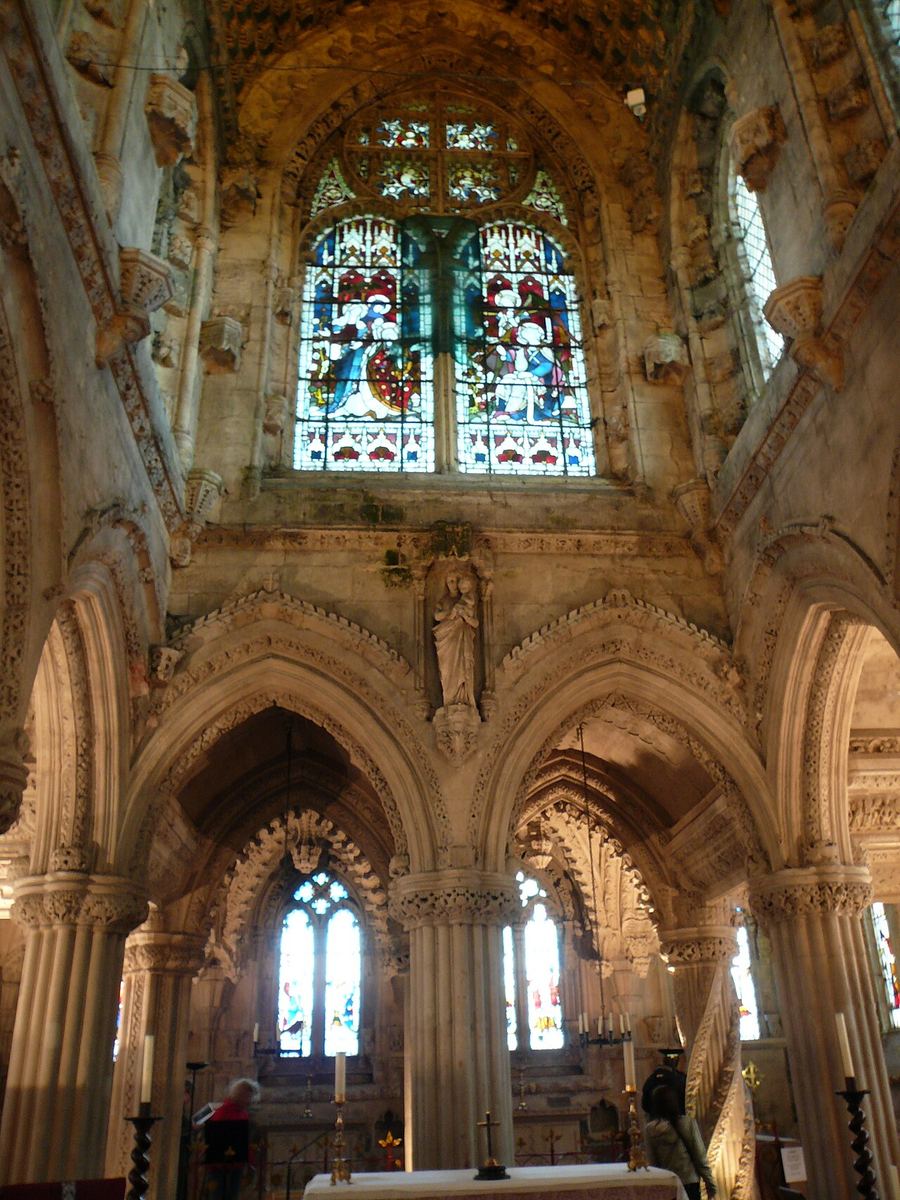
Behind the three pillars, the Lady Chapel runs the full width of the building but is only about fifteen feet high and seven and a half deep, with a vault of hanging bosses. This is the densest carving in Rosslyn. One pendant boss has an eight-pointed Star of Bethlehem underneath and the Nativity round its sides: the Virgin and Child, the manger, the three kings and three shepherds. On the pillar tops, angels celebrate with instruments, among them a lute, a psaltery and a set of bagpipes, which appeared in Scotland in the mid-fifteenth century and are thought to be carved here among the earliest depictions of the instrument in the country.
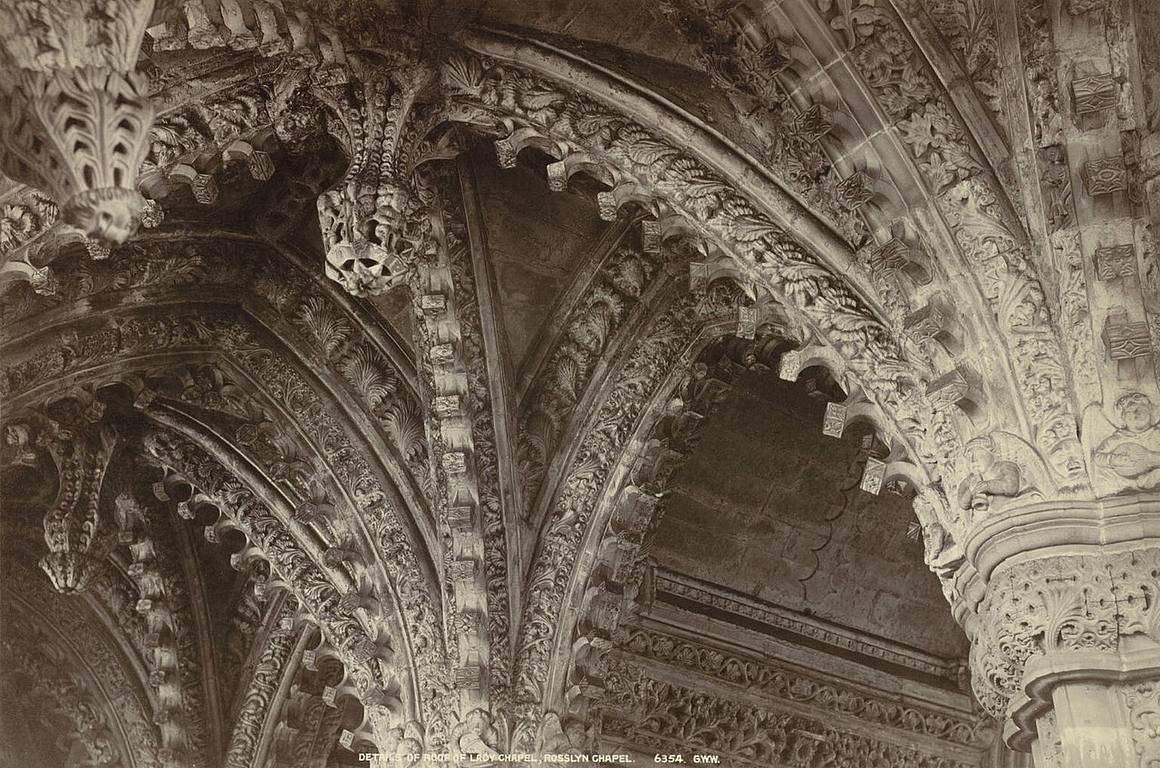
Look along the arches for the Dance of Death, people from every walk of life each led away by a skeleton; for Lucifer, the fallen angel, hanging upside down and bound with rope; and for the face that is claimed, without much evidence, to be the death mask of Robert the Bruce. Projecting from the arches are carved cubes, 213 of them, each with its own pattern of lines and dots. People have read them as a code; a father and son, Thomas and Stuart Mitchell, turned them into a piece of music, the Rosslyn Motet. Many of the cubes are nineteenth-century replacements, which makes any secret message harder to believe.
The Green Men
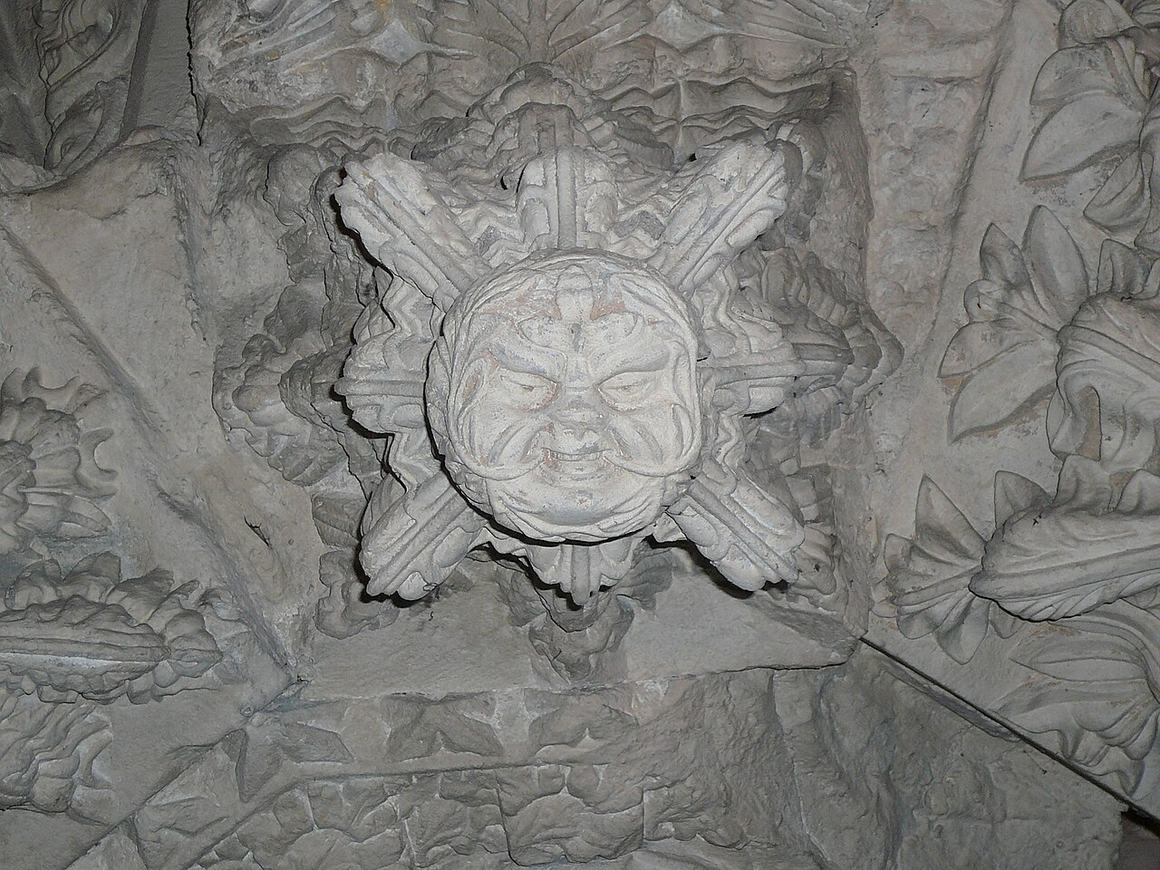
There are about a hundred Green Men in and around the chapel: faces with foliage growing from their mouths, a medieval image of nature, growth and, in some readings, the good and evil in every person. The chapel gives you a map and a challenge to count them. The Lady Chapel is the best place to start: there is a fine one on the end of a boss protruding from the east wall, and others between the angels at the tops of the pillars.
The stained glass
The windows were probably designed for glass but had only shutters until 1736. What you see is Victorian and later: most of the windows are by the London firm of Clayton and Bell, including the saints of the Lady Chapel, installed in 1867 for the fourth Earl. In the baptistery, a 1950 window by William Wilson commemorates two airmen who died in the Second World War, and a 1970 window of St Francis surrounded by animals includes a kangaroo, for Princess Dimitri, the sixth Earl’s Australian-born mother. The newest window, designed by the artist Joe Tilson, was unveiled in 2021 for the Trust’s 25th anniversary.
The sacristy
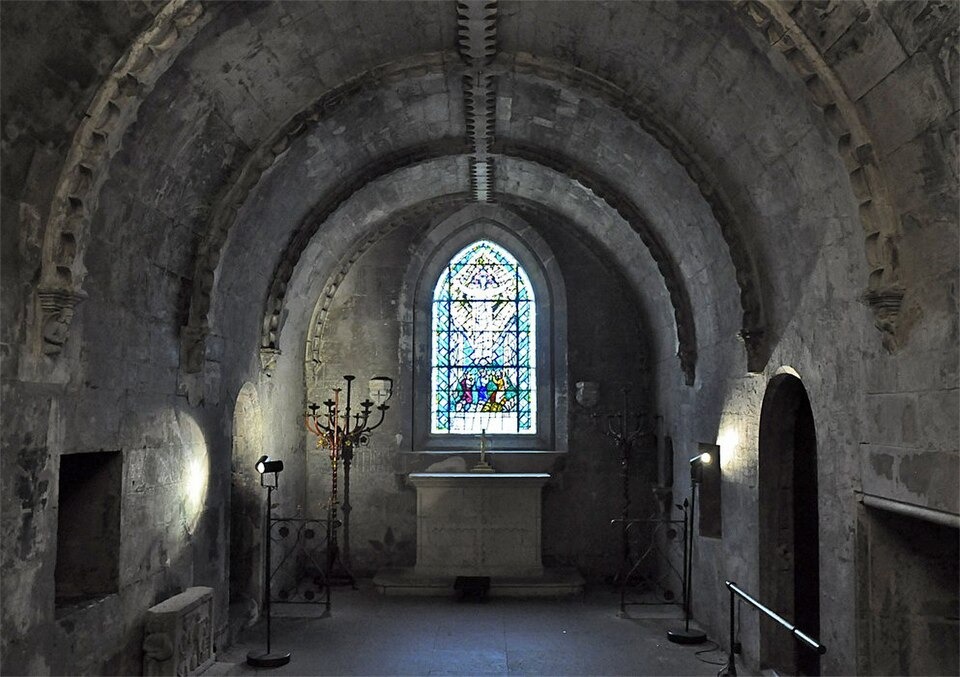
A steep flight of steps at the east end leads down to the sacristy, usually called the crypt, which is older and plainer than the chapel above. It served as the masons’ workshop during the forty years of building, and drawings scratched on its walls are evidence of the designs they were working from. The engrailed cross of the St Clairs is carved on the roof and on the altar, and the window of the Transfiguration, by Patrick Pollen, was added in 1954. This is where the final scenes of the Da Vinci Code film were shot in September 2005. It is not the family burial vault, which lies sealed beneath the chapel; when the second Earl died in 1837, a week’s search failed to find its entrance.
The Da Vinci Code, and the Templars
Dan Brown’s novel was published in 2003, and its climax at Rosslyn brought the chapel more visitors than it had ever had. It came on top of two decades of books linking Rosslyn to the Knights Templar, the Holy Grail and secret treasure in the vaults. Historians are unanimous that none of this has any documentary basis: the Templars were suppressed in 1312, long before the chapel was begun, and the theories first appear in the late twentieth century.
The real connection is with freemasonry. In the early seventeenth century the masons of Scotland signed charters recognising the Sinclairs of Roslin as their patrons, and the family’s heads were for a time regarded as hereditary Grand Masters. Some of the Lady Chapel’s angels are held by masons to be in significant positions. The curator of the Grand Lodge of Scotland’s own museum, Robert Cooper, wrote a whole book pointing out that the chapel predates speculative freemasonry by centuries.
Tickets and tours
Book your slot on the chapel’s own site
Tickets are sold through the Rosslyn Chapel website for timed visits: £12, £10 reduced, and free for under-17s in a family group. The ticket includes the visitor centre and the free talks. Outside guides may not lead groups inside the chapel, so organised tours from Edinburgh drop you at the door and the chapel’s own guides take over. Many day tours combine Rosslyn with the Borders abbeys or Stirling.
Tour and hotel links go to GetYourGuide and Booking.com. This site earns nothing from them at present — they are here because they are the quickest way to check what is actually available.
Don’t miss
- The Apprentice Pillar And the only inscription in the chapel, on the lintel beside it.
- The Star of Bethlehem boss The Nativity carved round a hanging stone in the Lady Chapel.
- The angel with bagpipes Among the earliest carvings of the instrument in Scotland.
- The Green Men Count them with the free carvings map.
- The misplaced vice Avarice in the row of virtues, charity among the sins.
- The sacristy The masons’ workshop, with their drawings on the walls.
- The fox and the goose On the outside of the north wall, near the way in.
Insider tips
Stay for a talk. The chapel guides give short free talks about half an hour into each slot, usually inside the chapel. They are the quickest way to find the carvings you have read about, and they are optional: carry on looking round if you prefer.
Take the carvings map. It is free, it is available in more than a dozen languages, and without it you will walk past half the things on this page. The chapel is dim inside, and the light is best on a bright morning.
Leave the pushchair outside. There is not room for them in the chapel, and there is a ramp for wheelchairs, with a manual wheelchair available inside. The sacristy steps are steep and not accessible; ask for the folder of photographs instead.
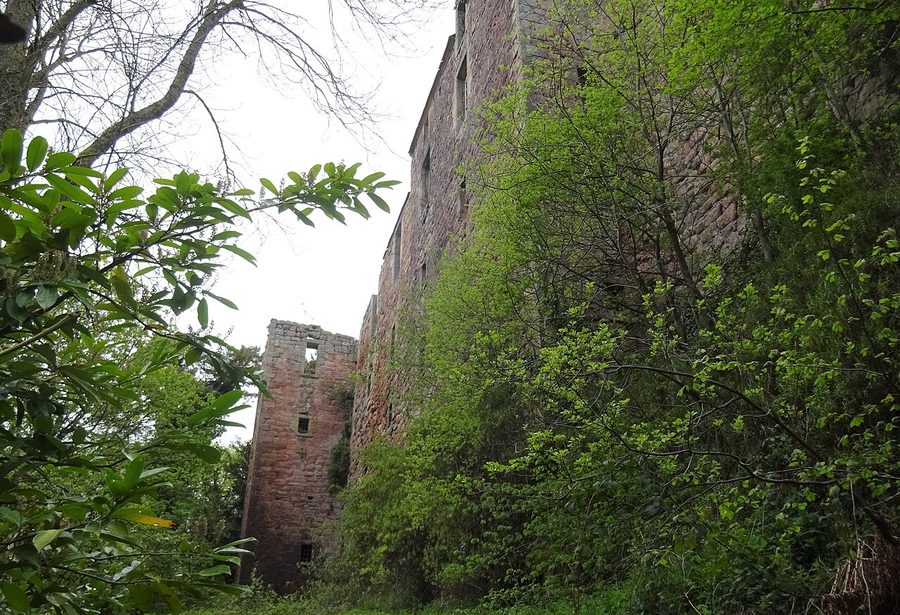
Walk down to the glen. Paths lead from the village into Roslin Glen and past the ruins of Rosslyn Castle, the St Clairs’ stronghold, in a steep wooded valley that the Romantics loved as much as the chapel. Allow an hour and sensible shoes.
Go to church. The Sunday service at 10am is open to all, before the chapel opens to visitors at noon, and the congregation also holds short lunchtime prayers at 1pm on Mondays, Wednesdays and Fridays.
Common questions
Do you need to book Rosslyn Chapel in advance?
It is strongly recommended. Visits run in timed slots of about 90 minutes, and the chapel advises booking online through its own website, especially in summer. Tickets are £12, or £10 reduced, and children under 17 in a family group go free.
Can you take photographs inside Rosslyn Chapel?
No. Photography and filming have not been allowed inside the chapel since 2008. You can photograph the exterior and the grounds for personal use, and the shop sells pictures of the carvings.
How do you get to Rosslyn Chapel from Edinburgh by bus?
Take Lothian bus 37, making sure it says Penicuik/Deanburn via Roslin on the front. It stops on Princes Street and North Bridge and takes about 45 minutes to an hour. Get off at the Original Rosslyn Inn; the chapel is a few minutes’ walk down Chapel Loan.
Can you see the crypt from The Da Vinci Code?
Yes, if you can manage a steep flight of steps. The sacristy, often called the crypt, is open to visitors and is where the film’s final scenes were shot in 2005. Staff have a folder of photographs for anyone who cannot get down.
Is Rosslyn Chapel connected to the Knights Templar?
Not in any way historians can document. The chapel was begun in the 1440s or 1450s, well over a century after the Templars were suppressed, and the Templar and Holy Grail theories date from the 1980s onwards. The St Clairs’ real link is with Scottish freemasonry, which came later.
Getting there, and where to stay
Roslin is seven miles south of Edinburgh, just off the A701 towards Penicuik; follow the brown signs. Parking at the chapel is free, with disabled spaces in the main car park and a charging point for electric cars. By bus, Lothian service 37 runs from Princes Street and North Bridge to the village in 45 minutes to an hour; check the destination board says it goes via Roslin. A taxi from the centre of Edinburgh is about £30. There is a coffee shop in the visitor centre, looking over the glen.
Most people visit from Edinburgh, and there is no reason not to. The St Clairs’ castle in the glen, restored, is let as holiday accommodation, as is Collegehill House, a former inn in the village.
More churches in Scotland
- St Giles’ Cathedral — on the Royal Mile, and the obvious pair with Rosslyn on a day from Edinburgh.
- Glasgow Cathedral — whose eastern arm has almost the same plan as Rosslyn.
- Iona Abbey — St Columba’s island, a very long way west.
- Lincoln Cathedral — the Angel Choir, for anyone who wants more carved angels.