
St Giles’ Cathedral, Edinburgh
St Giles’ stands in the middle of the Royal Mile, where every visitor to Edinburgh passes it, and it is free — so most people give it ten minutes on the way between the castle and Holyrood. It deserves longer. This is where John Knox preached the Scottish Reformation, where a thrown stool is said to have started a civil war, where four congregations and a prison once shared the building, and where the late Queen lay at rest in 2022. It is also, strictly speaking, not a cathedral at all.
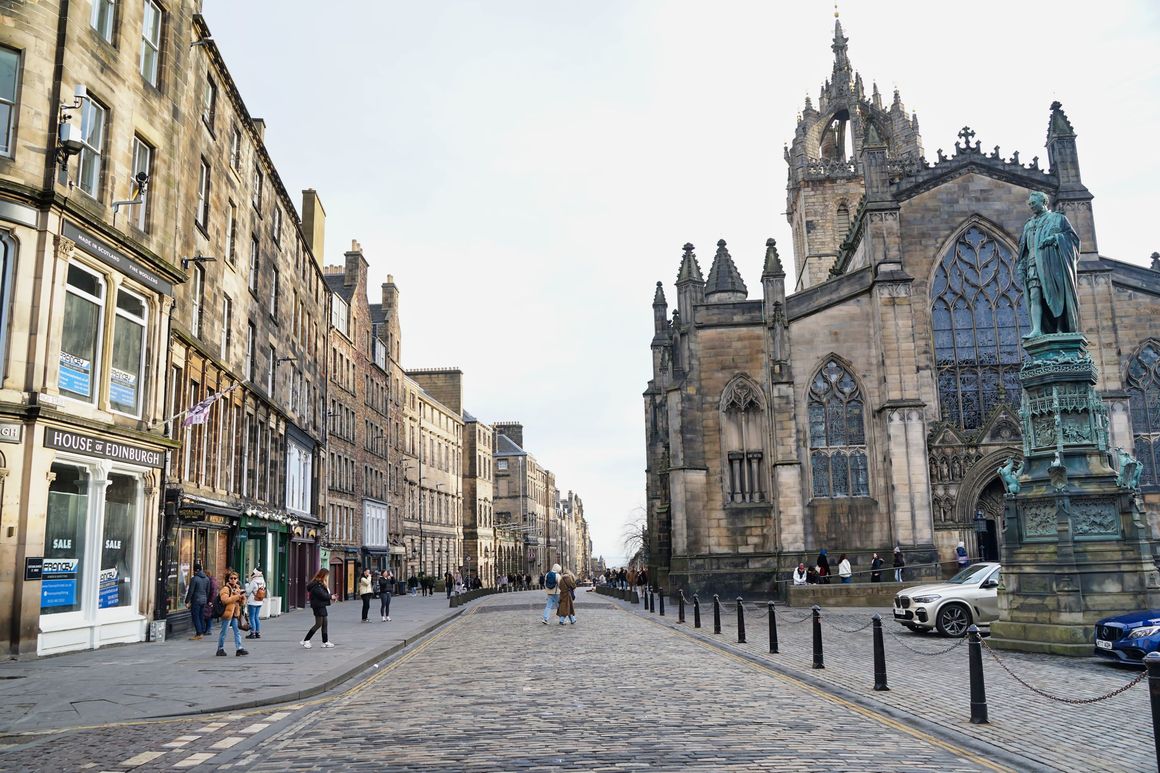
The town church of Edinburgh
St Giles’ was founded around 1124, by King David I or by his brother Alexander I, at what was then the eastern edge of the town. It was dedicated to St Giles, a seventh-century hermit in the south of France and the patron saint of lepers, and its first clergy were monks of the Order of St Lazarus, who cared for them. For centuries it was Edinburgh’s only parish church. An English army under Richard II burned it in 1385, and the Gothic church that replaced it grew, over the next hundred and fifty years, by the almost haphazard addition of chapel after chapel, paid for by kings, nobles, guilds and merchants.
In 1467 the pope made it a collegiate church, with a provost, sixteen canons and choristers. By the Reformation there were perhaps fifty altars in it. One of its great treasures was an arm bone of St Giles himself, brought from France by William Preston of Gorton; the Preston Aisle was built from 1455 to honour him, and his descendants carried the relic at the head of the procession every St Giles’ Day.
The visitor’s cheat sheet
| Where | High Street (the Royal Mile), Edinburgh EH1 1RE, on Parliament Square |
|---|---|
| Opening hours | Monday–Friday 10am–6pm, Saturday 9am–5pm (9–10am is a Quiet Hour), Sunday 1pm–5pm |
| Admission | Free; the cathedral runs on donations and suggests £10 |
| Audio tour | £5.50 at the desk or in advance: 25 minutes, on your own phone, in English, German or Ukrainian. A free digital visitor guide is available by QR code in ten languages |
| Guided tours | Paused for guide training in September 2026, resuming in mid-October |
| Services | Sunday 9.30am and 11am; weekdays 12 noon, fifteen minutes |
| Groups | Groups of more than five should book |
| How long | 45 minutes to an hour |
Hours and admission checked against the official site in September 2026. They change; the official site is always the last word.
Free to enter, open every day. Monday to Friday 10am–6pm, Saturday 9am–5pm, Sunday 1pm–5pm. There is no ticket; the cathedral asks for donations and suggests £10. The best-value extra is the £5.50 audio tour, which runs on your own phone for 25 minutes. The volunteer guided tours were paused for training in September 2026 and are due back in mid-October.
Knox, Jenny Geddes and the Covenant
On 29 June 1559 the Protestant Lords of the Congregation entered Edinburgh, and that afternoon John Knox preached in St Giles’. A week later he was elected its minister. The altars, statues and treasures were cleared out — workmen and sailors from Leith took nine days over the stone altars alone — the walls were whitewashed, and a pulpit and seats were put in for Knox’s long sermons. In August 1560 the Scottish Parliament abolished the pope’s authority, and St Giles’ became the pulpit of the Scottish Reformation. Knox preached his last sermon there on 9 November 1572 and died later that month.
After the Reformation, the town divided the building up. Stone walls went up between the arches, and by 1699 there were four separate churches inside, with galleries, while other parts served as a meeting place for the Parliament and the law courts, a prison, a store for the town’s guillotine and workshops for weavers. A room over the north door, where Royalist and Covenanter prisoners were held, became known as Haddo’s Hole.
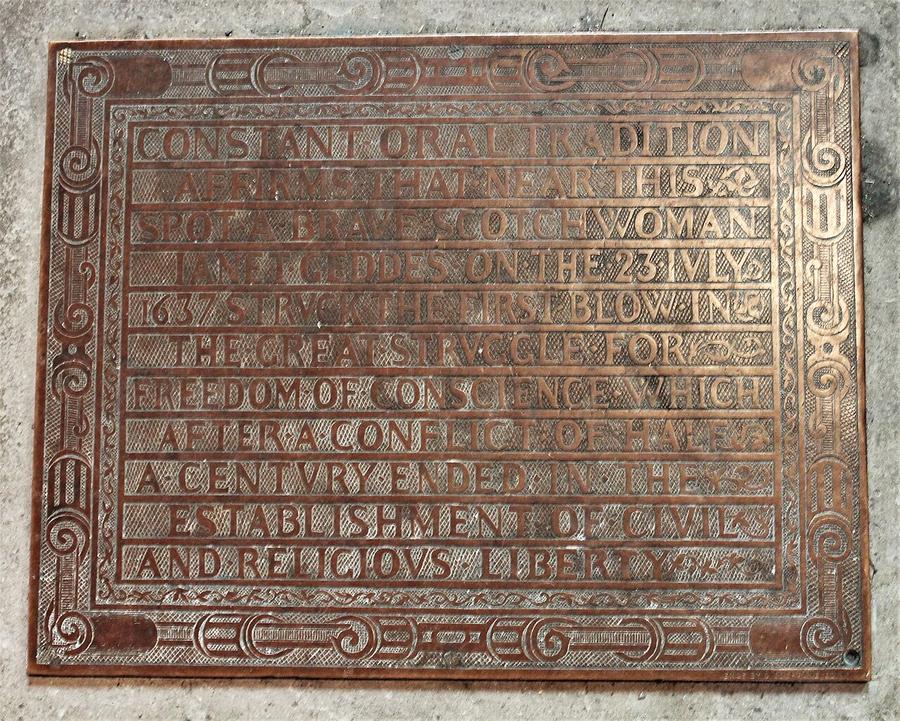
In 1633 Charles I made St Giles’ the cathedral of a new bishopric of Edinburgh, and in 1637 he ordered a new prayer book, modelled on the Church of England’s. On 23 July, when the dean began to read from it, a riot broke out. Tradition says it was started by a market woman called Jenny Geddes, who threw her folding stool at the dean’s head shouting “Dinna say Mass in my lug!”. The cathedral itself notes there is no definite evidence of her throw. The riot is certain, and it led directly to the National Covenant of 1638, the Bishops’ Wars and the Wars of the Three Kingdoms. It is why St Giles’ is called the mother church of world Presbyterianism.
Bishops were abolished in 1638, restored in 1661 and abolished for good in 1689. The Church of Scotland has no bishops, and so, strictly, no cathedrals; St Giles’ kept the title, and its official name is the High Kirk of Edinburgh.
What to see, in the order you meet it
The outside and the crown
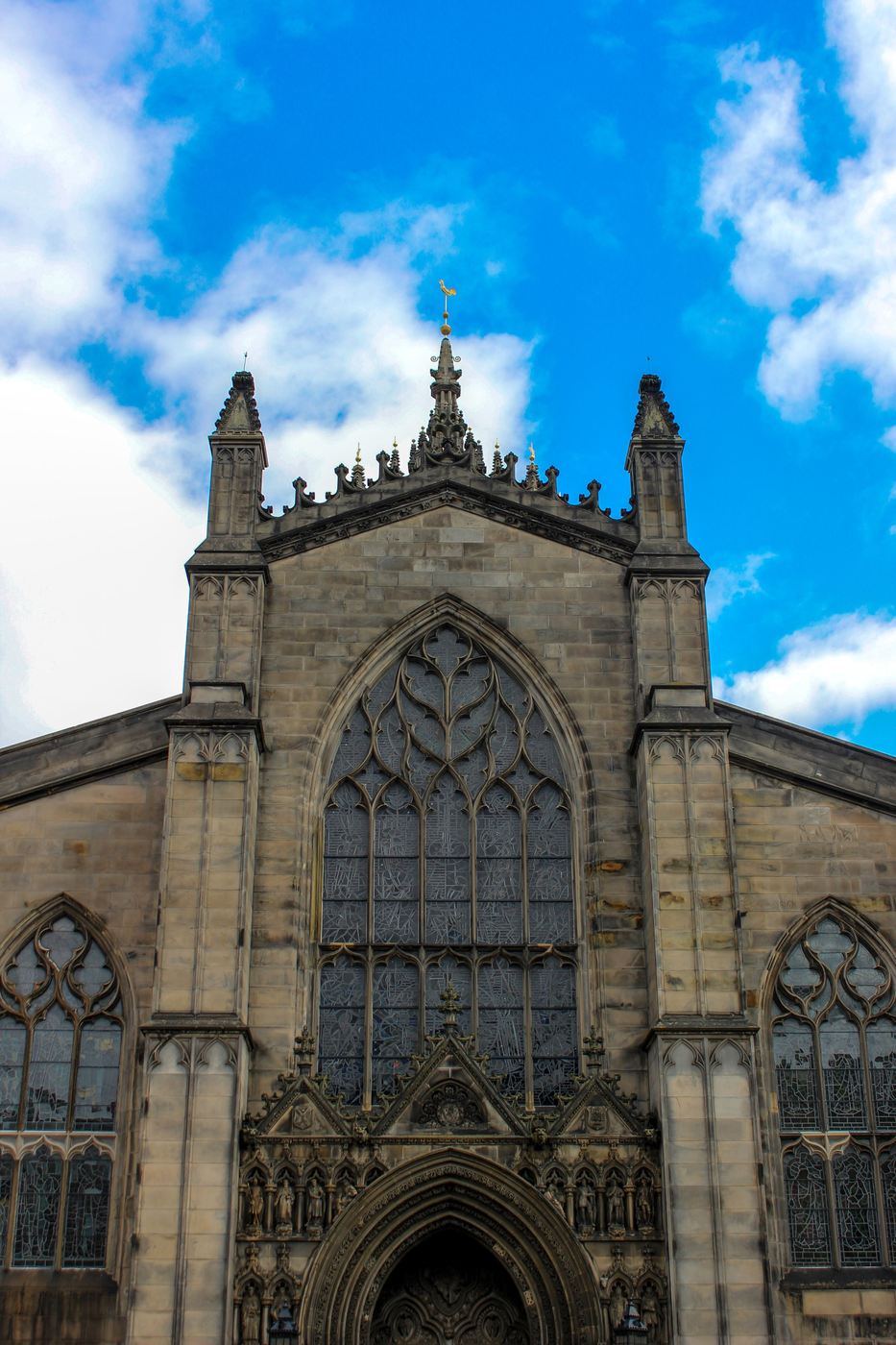
Most of what you see outside is nineteenth-century. When the shops and houses built against the church were cleared away, its walls were found to be leaning outwards, and between 1829 and 1833 the architect William Burn encased the whole building, except the tower, in a skin of smooth ashlar held on with iron ties. It saved the church and was much abused for it; Robert Louis Stevenson said Burn had left it “poor, naked, and pitifully pretentious”.
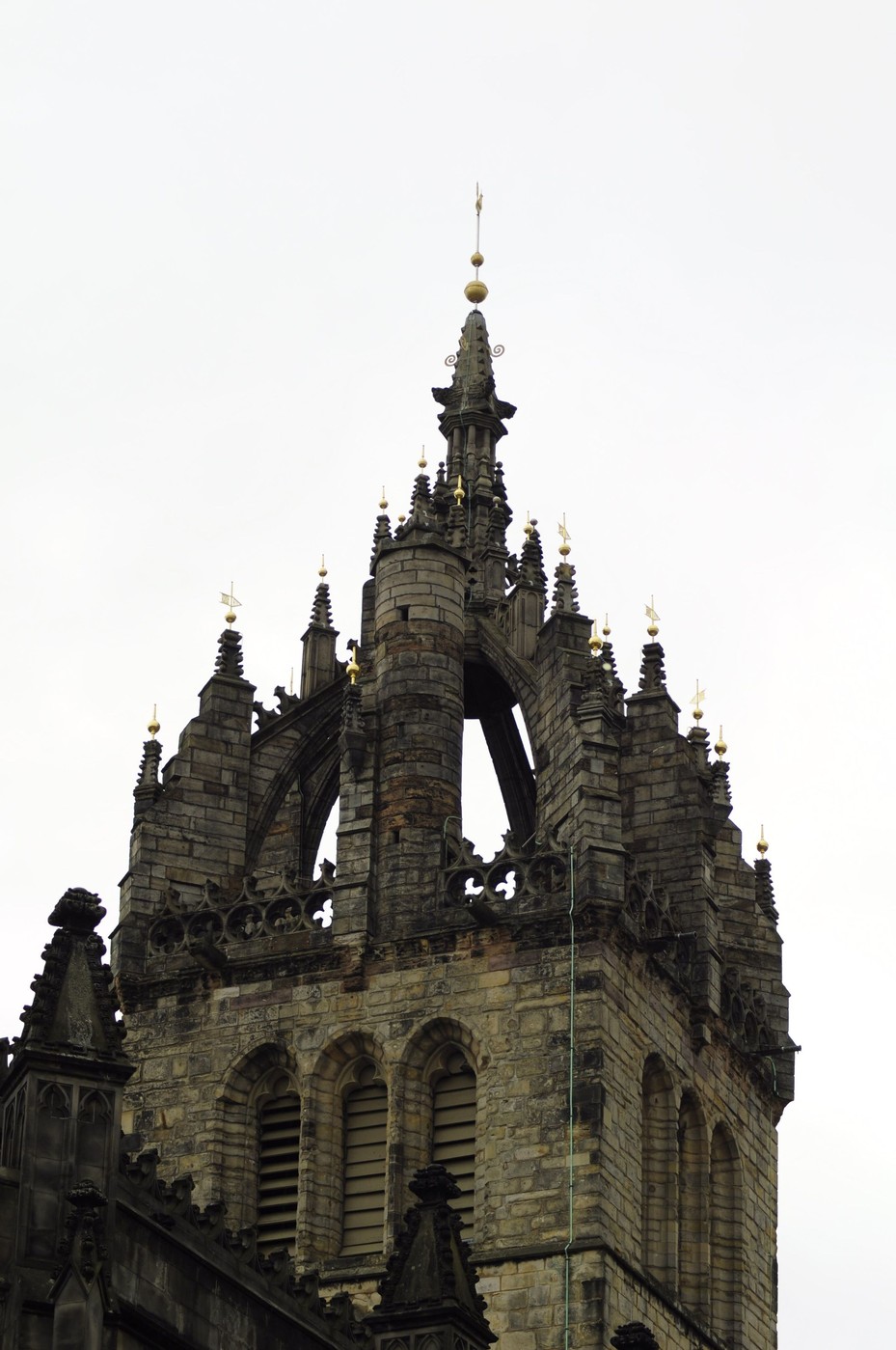
The tower and its crown steeple are the real thing. Tree-ring dating puts the crown in the 1460s: eight stone flying buttresses rising to a central pinnacle, the landmark of the Edinburgh skyline. It is one of only two medieval crown steeples left in Scotland — the other is at King’s College, Aberdeen — and the only one built with eight arms rather than four. The weathercock on top dates from 1667.
The nave and the crossing
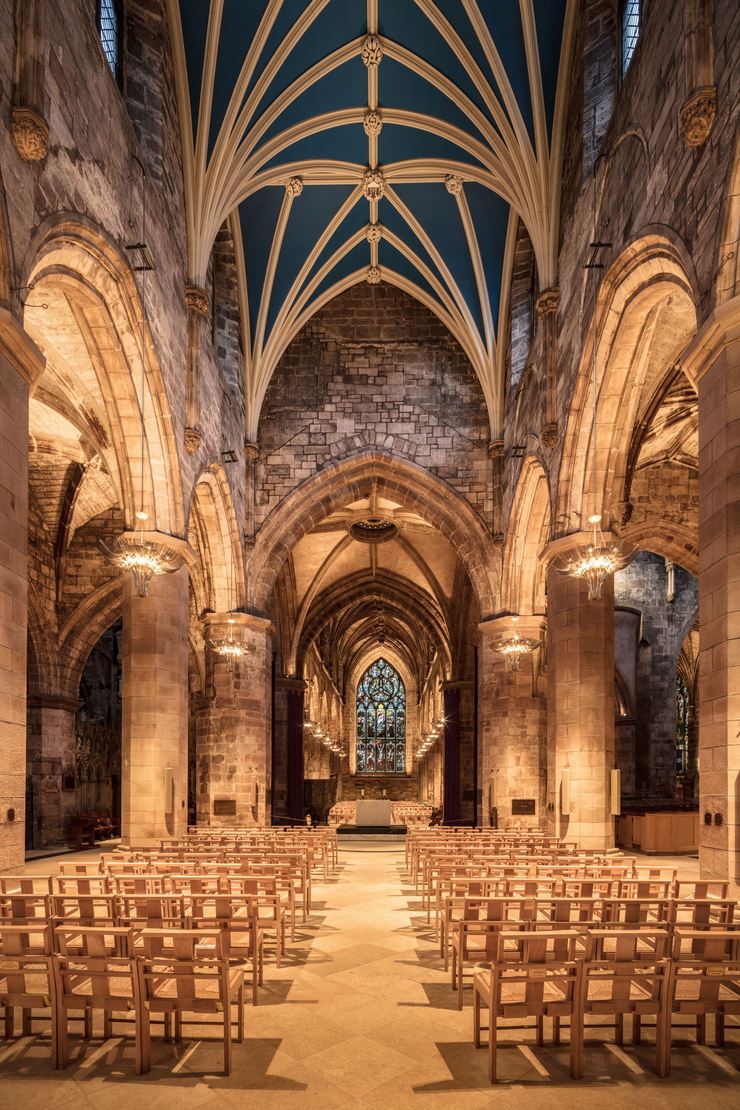
Inside, the church is a warren of aisles and chapels under stone and plaster vaults. The Victorian restoration, driven by the publisher and Lord Provost William Chambers and carried out by the architect William Hay between 1872 and 1883, took down the last of the partition walls and made it one church again, which Chambers hoped would be Scotland’s Westminster Abbey. He was carried in, frail, to see the result, and died on 20 May 1883, three days before it reopened. In 1982 the interior was reoriented round a communion table under the central crossing, with seats facing it from all sides.
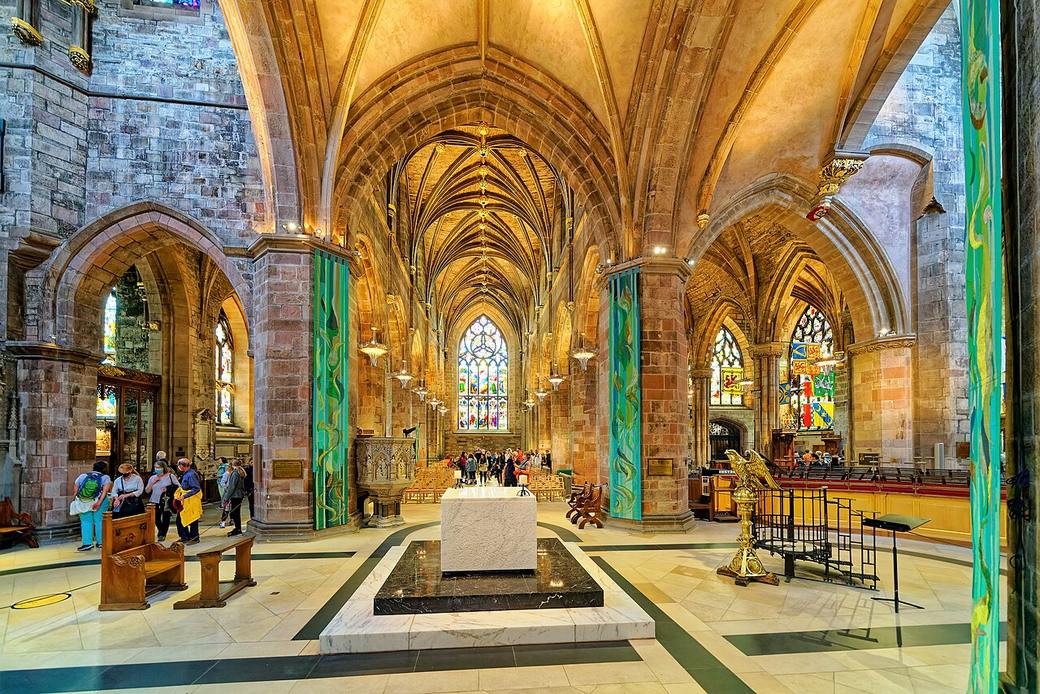
The glass
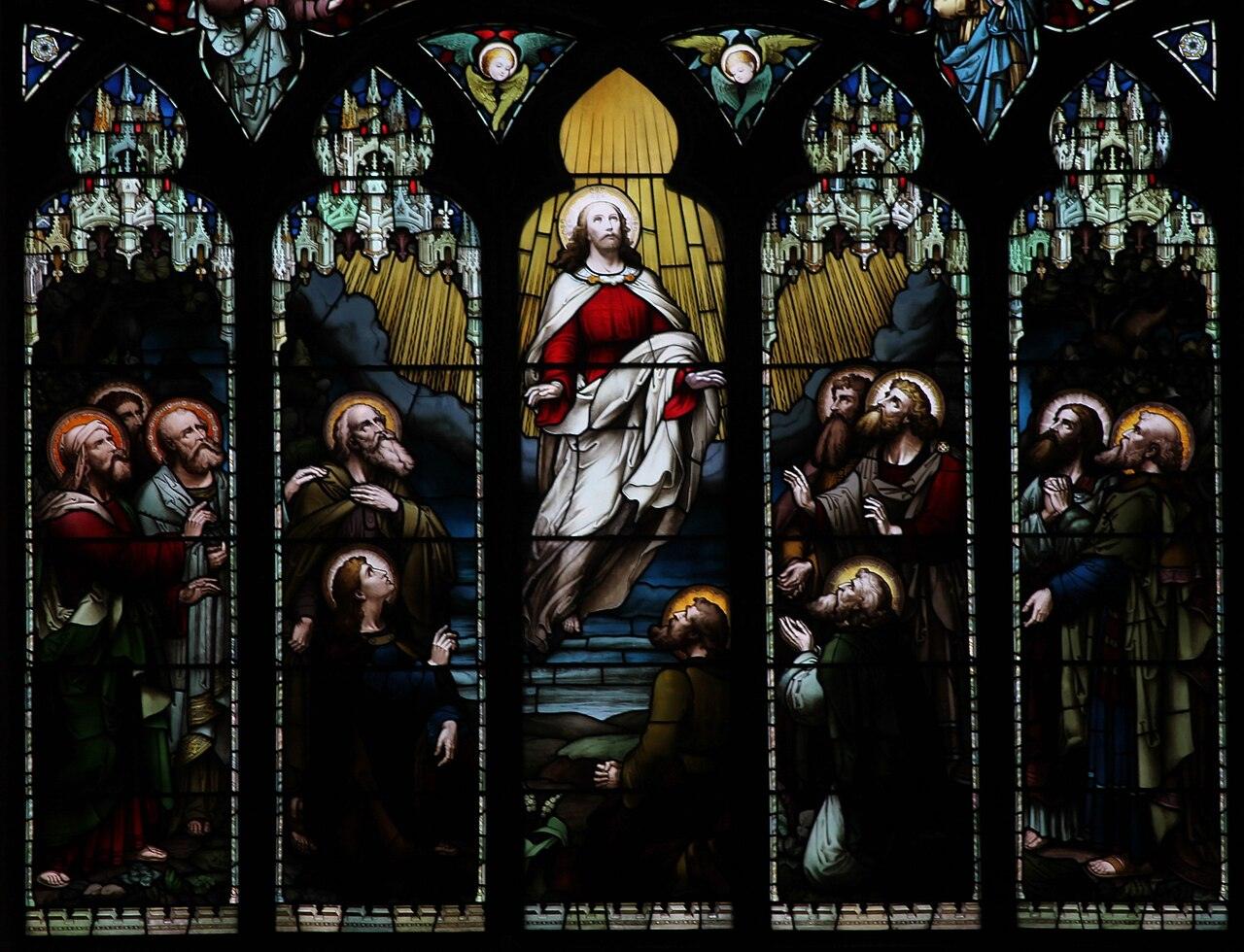
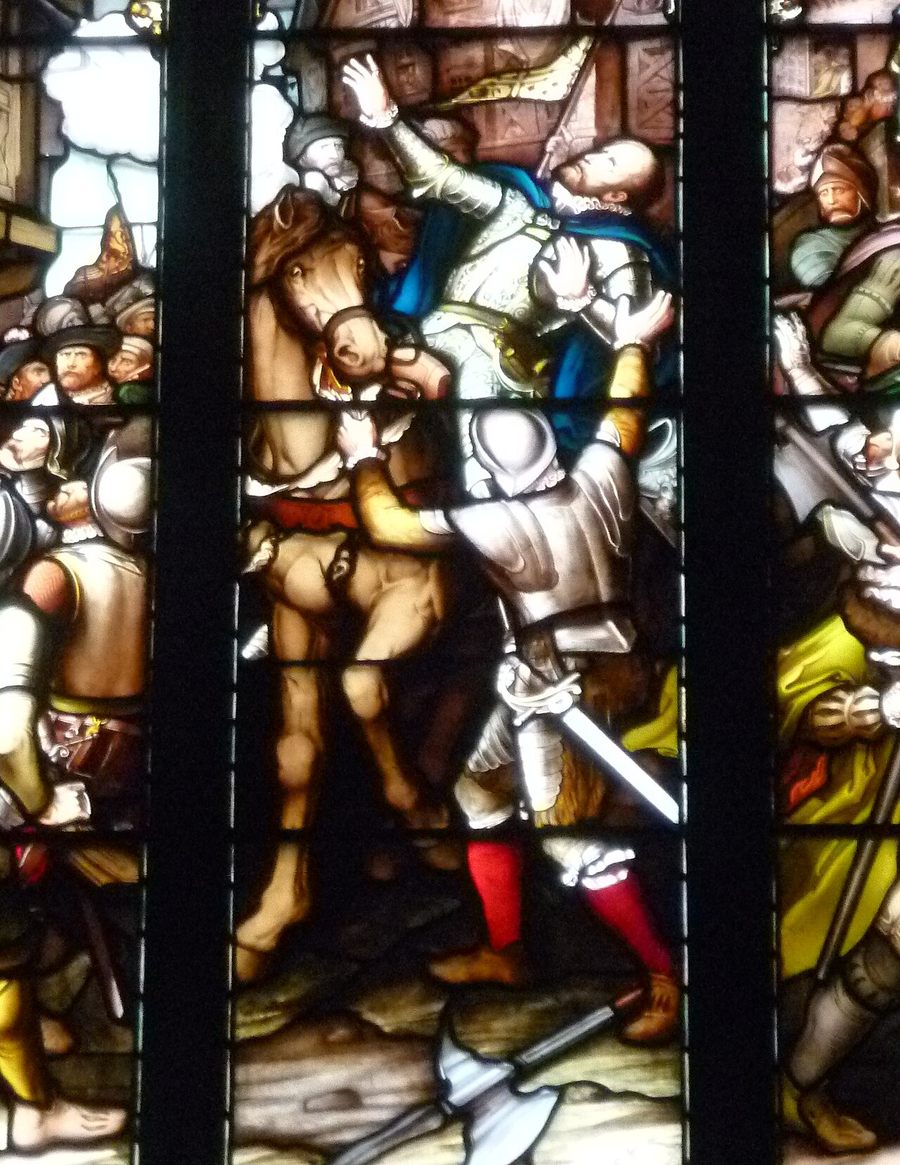
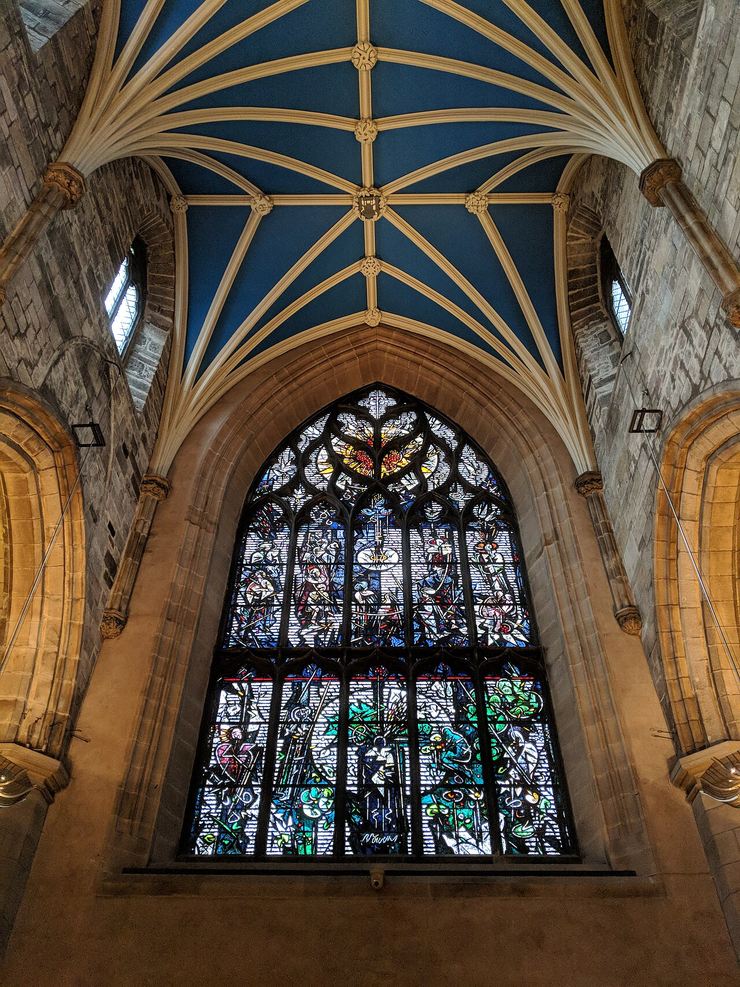
There was no coloured glass here after the Reformation until the 1870s. The Victorian windows, mostly by the Edinburgh firm of Ballantine, tell the life of Christ and end in the great east window of 1877. The window of the Holy Blood Aisle, showing the assassination and funeral of the Regent Moray in 1570, is the only one in the church that depicts Scottish history. At the west end, the great window is modern: a memorial to Robert Burns, installed in 1985 and designed by the Icelandic artist Leifur Breiðfjörð. There is also a window designed by Edward Burne-Jones and made by Morris & Co. in 1886, in the north aisle.
The Preston Aisle and the chapels
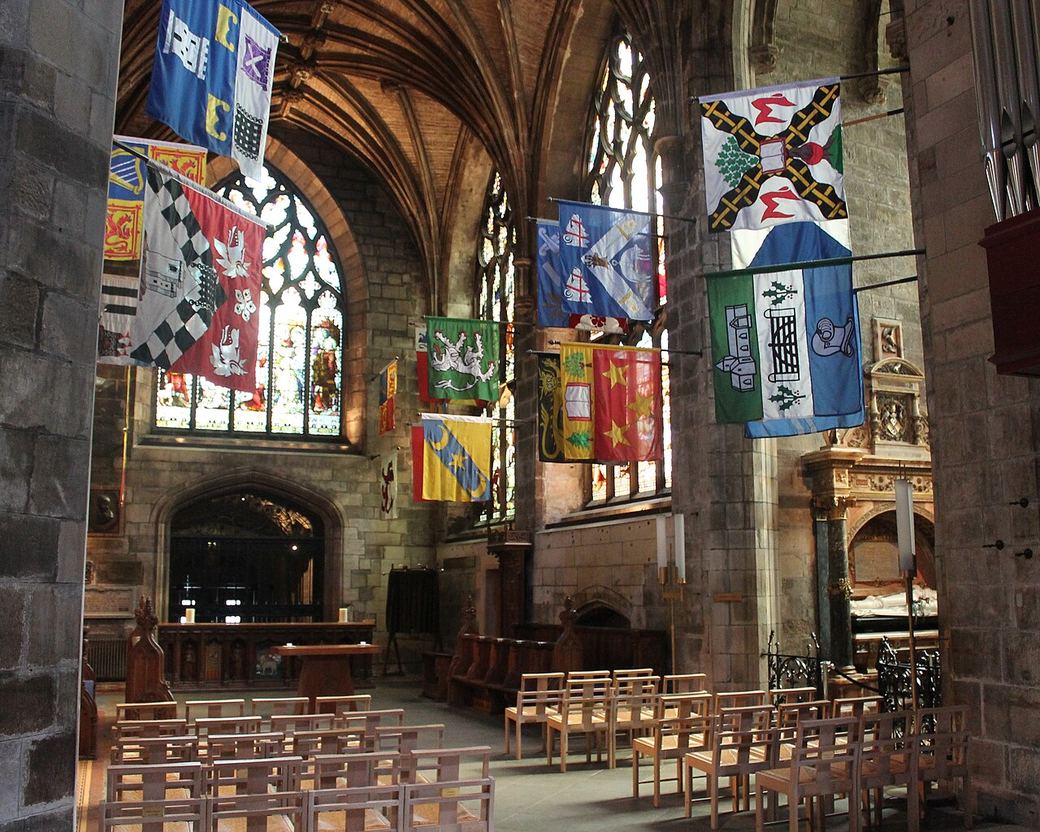
South of the choir, the Preston Aisle is hung with banners. At the east end of the choir the King’s Pillar carries the arms of James II, James III and Mary of Guelders, dating that part of the building to around 1460. Walk round the edge of the church and look for the Albany Aisle, now the war memorial chapel, and the Chambers Aisle, named after the man who reunited the building.
The Thistle Chapel
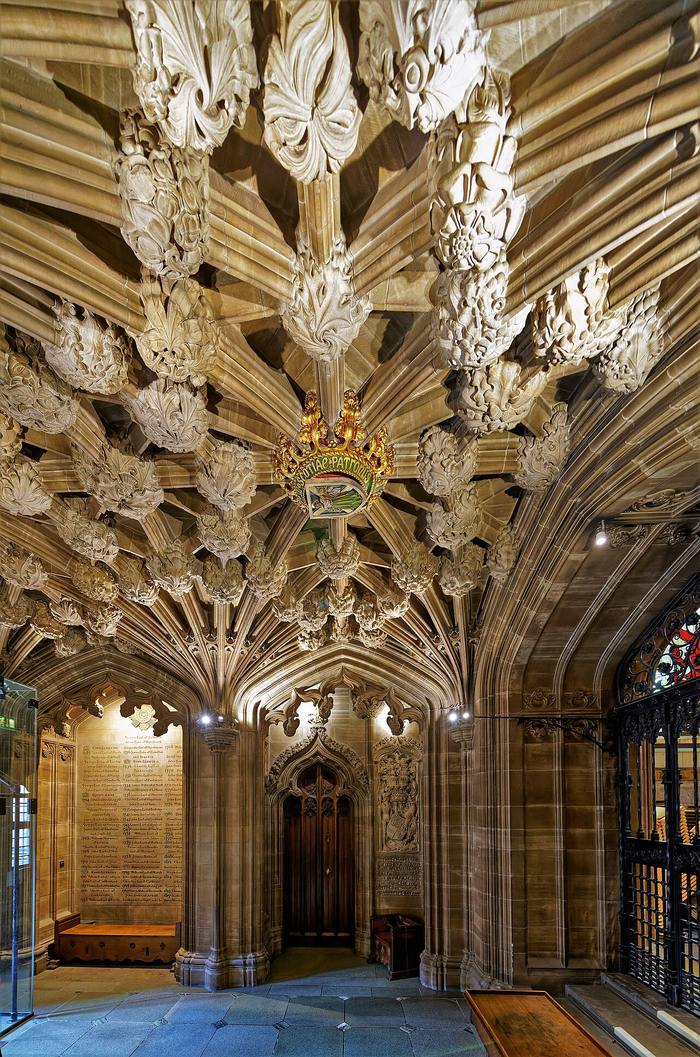
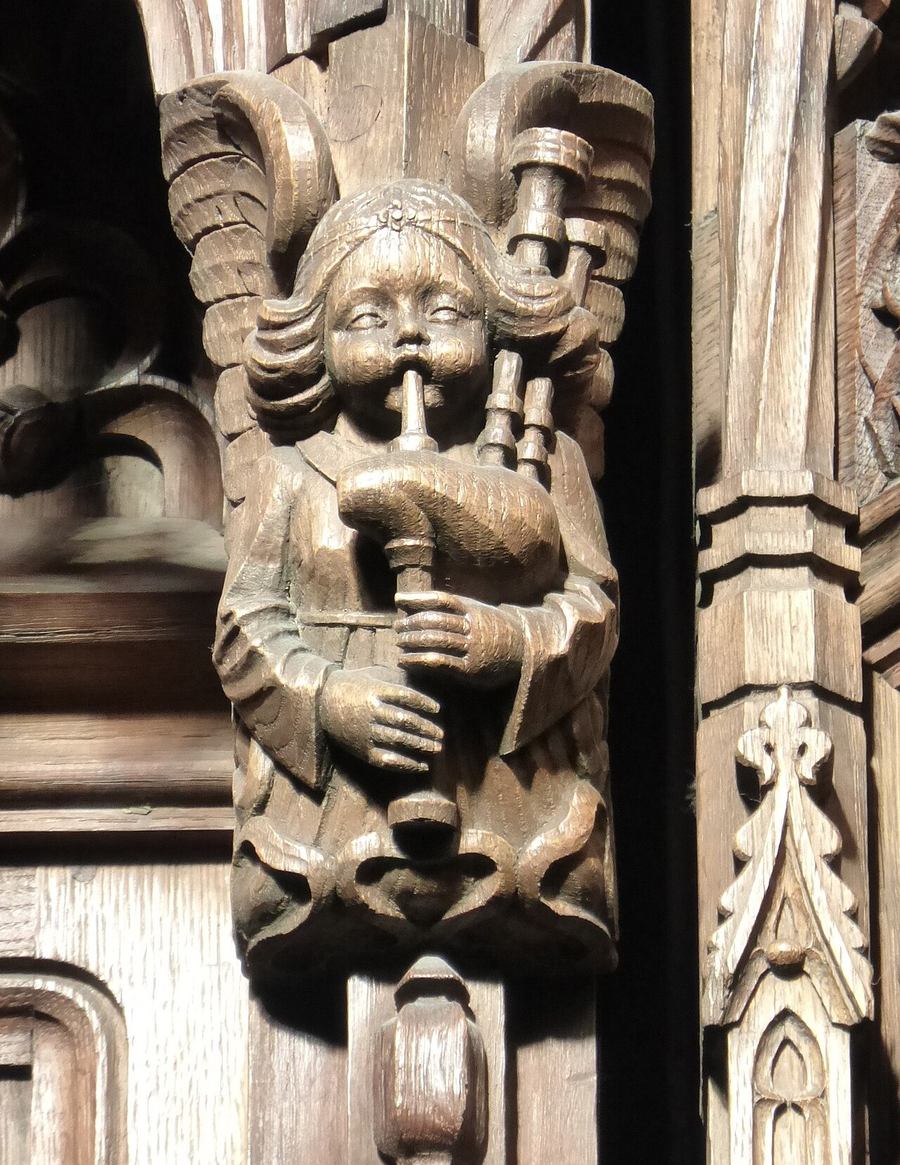
Off the south-east corner is the Thistle Chapel, the chapel of the Order of the Thistle, Scotland’s highest order of chivalry. The order was re-founded in 1687 by James VII, whose chapel for it in Holyrood Abbey was wrecked by a mob the next year; the knights then had no chapel of their own for more than two centuries. Robert Lorimer designed this one, and George V opened it in 1911. It is small and astonishingly rich: carved oak stalls for the sixteen knights and the royal family, each with its helm and crest, under a stone vault crowded with ribs and bosses, and heraldic glass all round. Look out for the angels, one of them playing the bagpipes.
Montrose, Argyll and the monuments
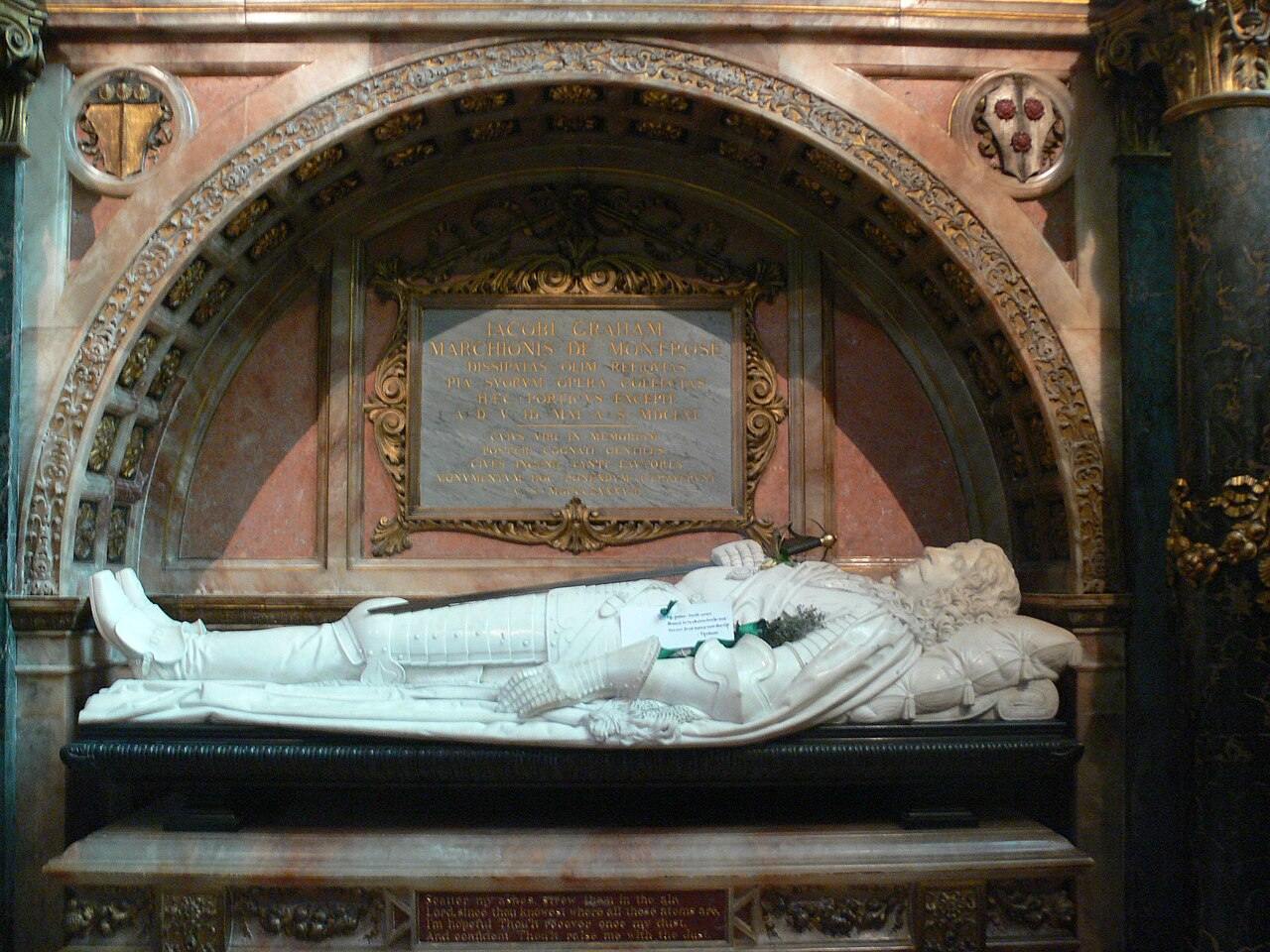
There are over a hundred memorials in the church. The grandest face each other across it: in the Chepman Aisle, the white effigy of James Graham, Marquess of Montrose, the Royalist general hanged by the Covenanters in 1650 and reburied here in 1661, on a monument of 1888; and in the St Eloi Aisle, his rival, the Covenanter leader Archibald Campbell, Marquess of Argyll, executed after the Restoration, on a matching one of 1895. Both signed the National Covenant; both died on the scaffold.
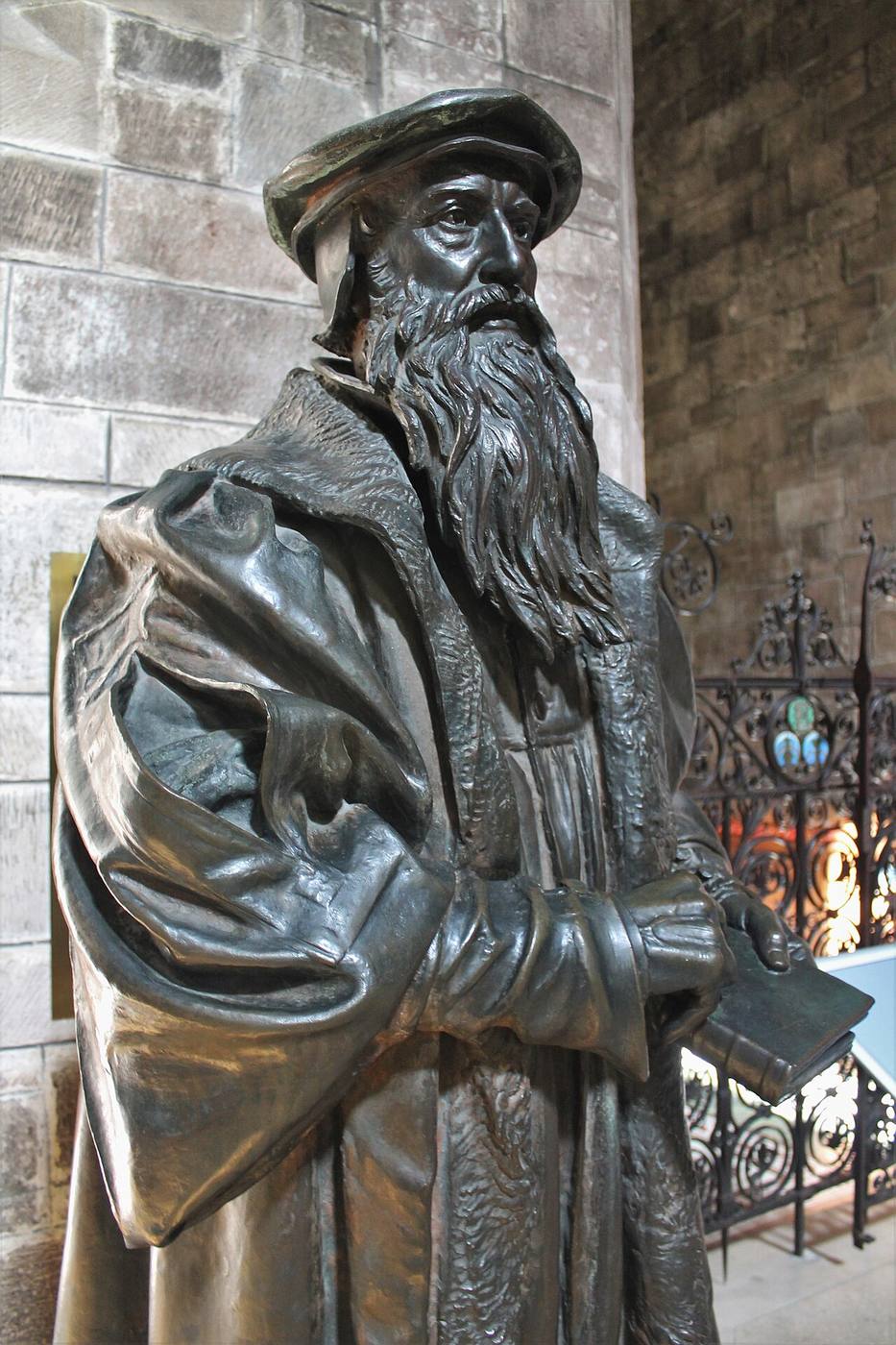
In the north nave aisle is the bronze statue of John Knox by James Pittendrigh MacGillivray, of 1906. In the Moray Aisle is Augustus Saint-Gaudens’s bronze relief of Robert Louis Stevenson, and nearby a “writers’ corner” of memorials. In the south nave aisle, a plaque on the floor marks where Jenny Geddes is supposed to have thrown her stool, and a bronze sculpture of a three-legged stool, given in 1992, stands nearby. The Victorians, even-handedly, also put up a plaque to the dean she threw it at.
Outside again: Knox’s grave and the Heart
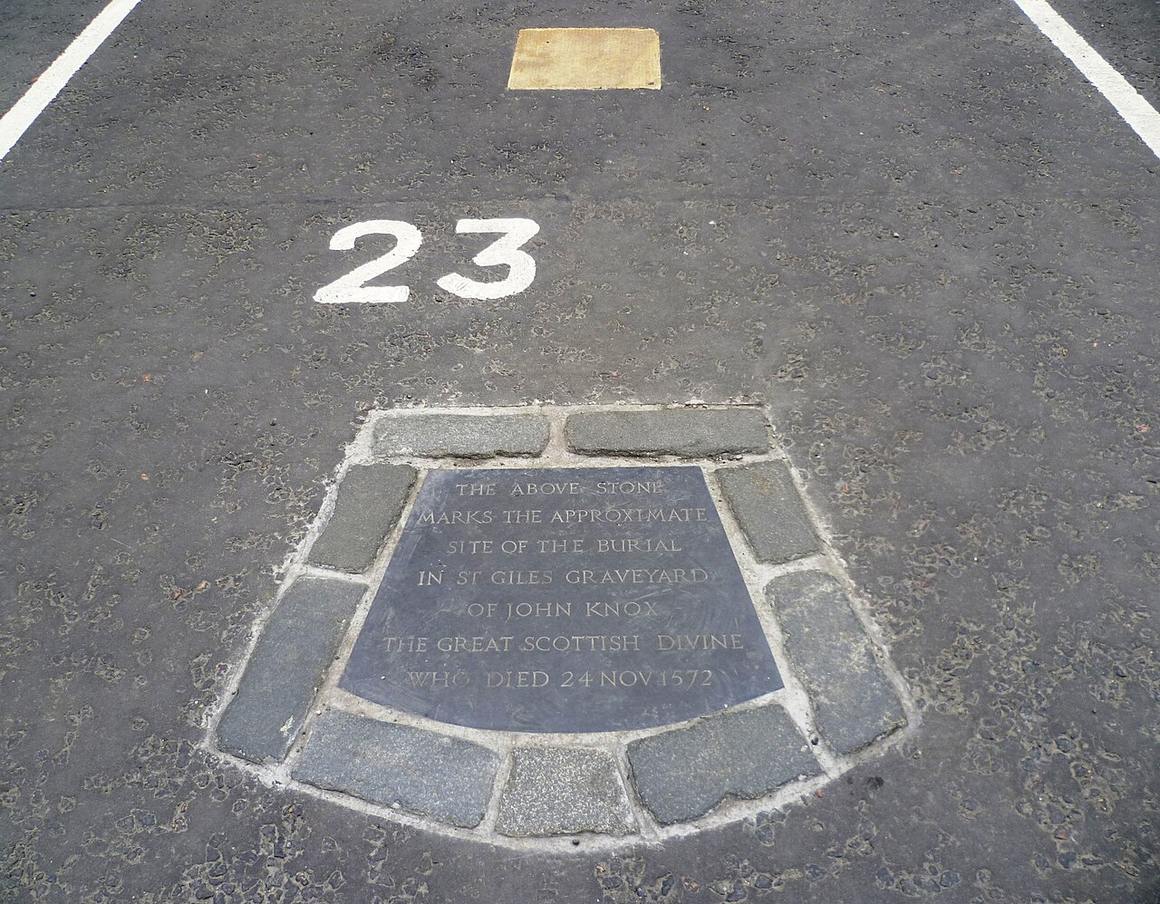
The old kirkyard of St Giles’, where Edinburgh buried its dead for more than 450 years, lay to the south of the church and is now Parliament Square. John Knox was buried there in 1572. A small plaque marks the spot, in parking space 23, behind the church towards the Law Courts.
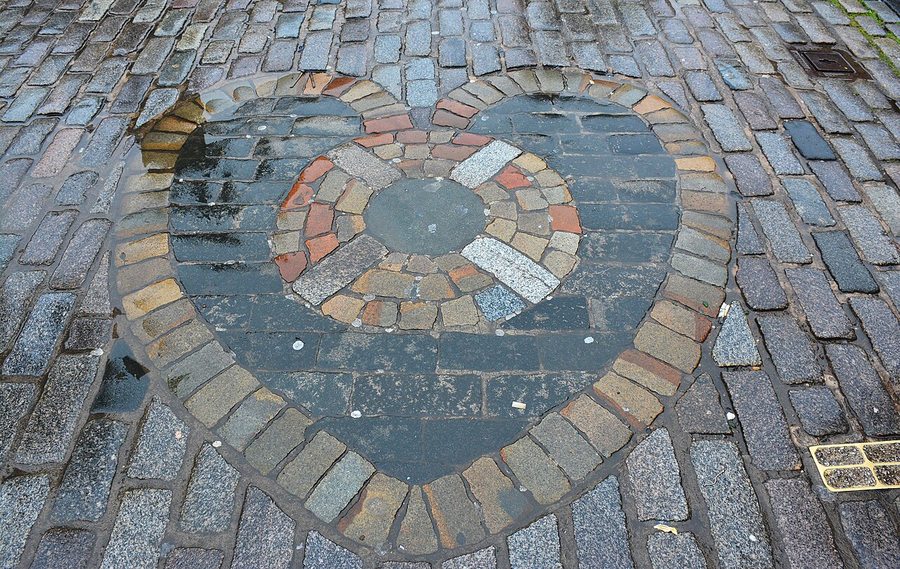
On the other side, set into the cobbles of the High Street near the west door, is the Heart of Midlothian, a heart-shaped mosaic marking the entrance to the Old Tolbooth, the town’s prison, which stood against the church until it was demolished in 1817. Edinburgh people spit on it; it is up to you. Further east along the church is the Mercat Cross, where royal proclamations are still read.
Royal occasions
St Giles’ is where the nation gathers in Scotland. In 1953 Elizabeth II received the Honours of Scotland — the crown, sceptre and sword — here, at a service of thanksgiving after her coronation. On 12 September 2022 her coffin was brought here from Holyroodhouse and lay at rest for 24 hours, guarded by the Royal Company of Archers, while tens of thousands of people filed past. In July 2023 the Honours were presented to King Charles III in the same church.
Tickets and tours
No ticket needed
Walk in during opening hours. The audio tour is £5.50 at the front desk or online in advance, and runs on your own phone, so bring headphones. The cathedral’s own guided tours were paused in September 2026 and due to resume in mid-October. Many Old Town walking tours stop here, and the cathedral asks groups of more than five to book.
Tour and hotel links go to GetYourGuide and Booking.com. This site earns nothing from them at present — they are here because they are the quickest way to check what is actually available.
Don’t miss
- The Thistle Chapel Lorimer’s tour de force, and the bagpiping angel.
- The crown steeple From across the High Street, or from Edinburgh Castle.
- The Burns window Best in afternoon light, at the west end.
- Montrose and Argyll Enemies in life, matching monuments in death.
- Jenny Geddes’s stool In bronze, in the south nave aisle.
- Knox’s grave Parking space 23, Parliament Square.
- The Heart of Midlothian In the cobbles by the west door.
Insider tips
Come at 9am on a Saturday, or late on a weekday. St Giles’ is one of the busiest places in Scotland, with more than a million visitors in 2018 alone. The Saturday Quiet Hour, 9 to 10am, is intended for people who find crowds and noise hard, and is the calmest time to be inside. On weekdays it stays open until 6pm, after the day-trippers have gone.
Avoid August if you can, or embrace it. During the Festival and the Fringe the Royal Mile outside is packed with performers, and the cathedral is itself a concert venue.
Go to the lunchtime prayers. The weekday service at noon lasts fifteen minutes and is the simplest way to hear the building used for what it is for.
Don’t miss the details on the west door: the statues of Scottish monarchs and churchmen round the doorway, John Knox among them, and a relief of St Giles in the tympanum above.
Common questions
Is St Giles’ Cathedral free to enter?
Yes. There is no admission charge; the cathedral is run on donations, and suggests £10 if you are able to give it. The audio tour on your phone costs £5.50.
What are St Giles’ Cathedral’s opening hours?
Monday to Friday 10am to 6pm, Saturday 9am to 5pm and Sunday 1pm to 5pm. The first hour on Saturday, 9am to 10am, is a Quiet Hour with reduced noise and lighting for visitors who find busy places difficult.
Is St Giles’ really a cathedral?
Not in the strict sense. The Church of Scotland has had no bishops since 1689, so it has no cathedrals. St Giles’ was a bishop’s seat twice in the seventeenth century, from 1633 to 1638 and from 1661 to 1689, and kept the name. Its proper title is the High Kirk of Edinburgh.
Where is John Knox buried?
In the old kirkyard of St Giles’, which is now Parliament Square. The spot is marked by a small plaque in parking space 23, behind the church. His statue stands inside, in the north aisle of the nave.
Can you go to a service at St Giles’?
Yes, everyone is welcome. There are services on Sundays at 9.30am and 11am, and a fifteen-minute prayer service at 12 noon on weekdays. The cathedral is also a concert venue, especially during the Edinburgh Festival in August.
Getting there, and where to stay
St Giles’ is on the Royal Mile, about ten minutes’ walk uphill from Waverley station and the same from the castle. Everything in the Old Town is within walking distance: the castle is at the top of the Mile, the Palace of Holyroodhouse at the bottom, and the National Museum of Scotland and Greyfriars Kirk, where the Covenant was signed, are just to the south.
The Old Town and the New Town are the obvious places to stay; book well ahead for August, when Edinburgh fills up and prices climb.
More churches in Scotland
- Rosslyn Chapel — seven miles south, and the easiest half-day trip from Edinburgh.
- Glasgow Cathedral — where the 1638 General Assembly abolished the bishops.
- Iona Abbey — St Columba’s monastery of 563, on an island in the Hebrides.
- Westminster Abbey — the church Chambers wanted St Giles’ to be.