
The Cathedral of the Assumption, Sedlec
Kutná Hora’s bone chapel takes twenty minutes to see and stays on your phone for the rest of your life. Four hundred metres up the road stands the building the bone chapel is attached to: a 92-metre Gothic cathedral that a twenty-five-year-old architect rebuilt out of a 280-year-old roofless ruin, and in doing so invented a style. When UNESCO inscribed Kutná Hora in 1995, this church was one of the two named components. The ossuary was not. Most visitors have it exactly backwards.

The thing to know before you buy a ticket
There is no ossuary-only ticket. To see the bones at all you must buy the 220 Kč Sedlec Area ticket, and that ticket includes this building. So the usual visitor experience — thirty minutes in the lower chapel, no photographs allowed, then the walk back to the station past a UNESCO-listed cathedral — involves walking past something already paid for. The cathedral alone is 150 Kč; the pair is 220 Kč. Whichever way you come at it, going in costs you nothing extra but the hour.
Two other practical traps. Tickets are sold only online or at the information centre on Zámecká, never at the church door. And on Sundays the cathedral does not open until 11am, which catches day-trippers from Prague constantly.
How it got here: silver, fire, and three centuries of sky
Founded in 1142 by Miroslav of Markvartice with twelve monks from Waldsassen in Bavaria — the first Cistercian house in Bohemia. Silver was then found on abbey land, and the leases on it paid for a cathedral built in about thirty years, 1290 to 1320, under Abbot Heidenreich. Its architect is unknown but plainly knew French and German cathedral practice, while keeping Cistercian discipline: no triforium, no towers, no flying buttresses.
Heidenreich is also, indirectly, why the ossuary exists. He is said to have brought back earth from the Holy Land and scattered it in the cemetery here, which made it the most desirable burial ground in central Europe and filled it far beyond capacity.
On the night of 24–25 April 1421 the Hussites drove the surviving Cistercians into the church and fired the roof. Roof and vault came down on the monks underneath. The building then stood open to the sky for the better part of three hundred years; Bohuslav Balbín, seeing the ruin, still called it splendissima basilica.
A famous story the parish itself calls untrue. Žižka, awed by the building, is supposed to have forbidden the burning, and on returning to find it done, to have had molten silver poured down the arsonist’s throat. It is a good story and there is nothing behind it. What is real is in a side-aisle niche: the bones of the monks killed that night, found during the eighteenth-century restoration and left where you can see them.
The abbot, the architect he sacked, and the boy he hired
In the Chapel of the Fourteen Holy Helpers is a tombstone inscribed Restaurator Magnificus. It belongs to Abbot Jindřich Snopek (1651–1709), and an archaeological survey in 2025 confirmed he is actually buried under it. Snopek became abbot at thirty-five, raised the money, and in 1700 hired the Prague architect Pavel Ignác Bayer, who consolidated the walls and got a roof back on. After two years he sacked him and handed the greatest building site in Bohemia to a twenty-five-year-old named Jan Blažej Santini-Aichel.
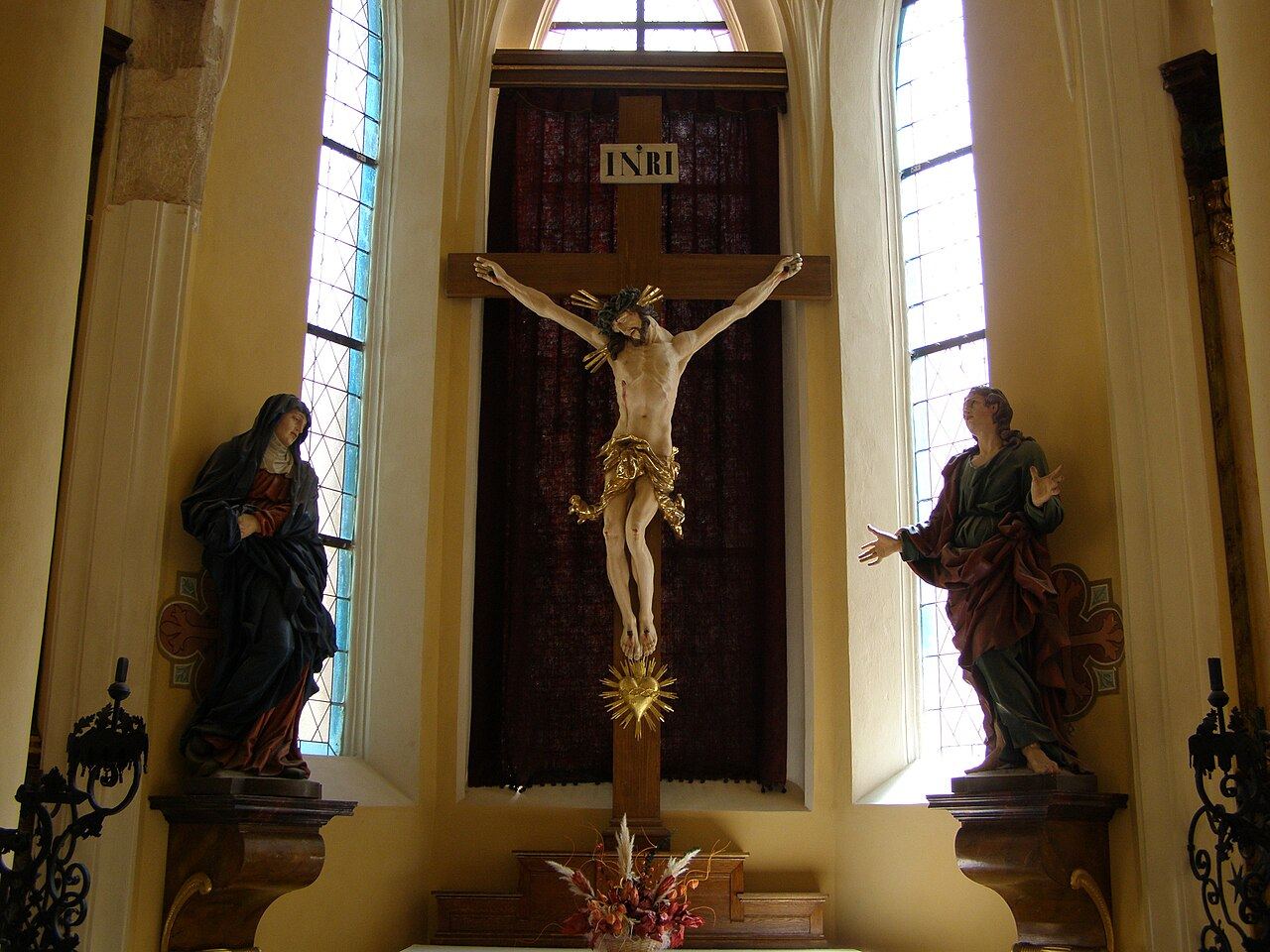
Santini worked here from the turn of 1702/03 until 1708, when the church was reconsecrated; his stonemason brother František Jakub worked with him. Snopek died the following year. The rebuild bankrupted the abbey, and the story after that is a short fall: the last abbot fled to Hildesheim with the cash in 1764, Joseph II dissolved the monastery in 1783, the church was deconsecrated, its furnishings auctioned and the building used as a flour warehouse. It became a parish church again in 1806. The convent buildings were sold to a tobacco company in 1812 — and the site is a cigarette factory to this day.
Outside: the porch and the front
Start under the portico, which Santini grafted onto a Gothic west front. Its plan is a hexagon stretched sideways, and the whole thing undulates — the cornice above it is visibly wavy, which is a Baroque move performed in Gothic dress. Look up into it: the vault is a pendant vault that dips towards you instead of lifting away, and at its lowest point hangs a carved bunch of grapes.
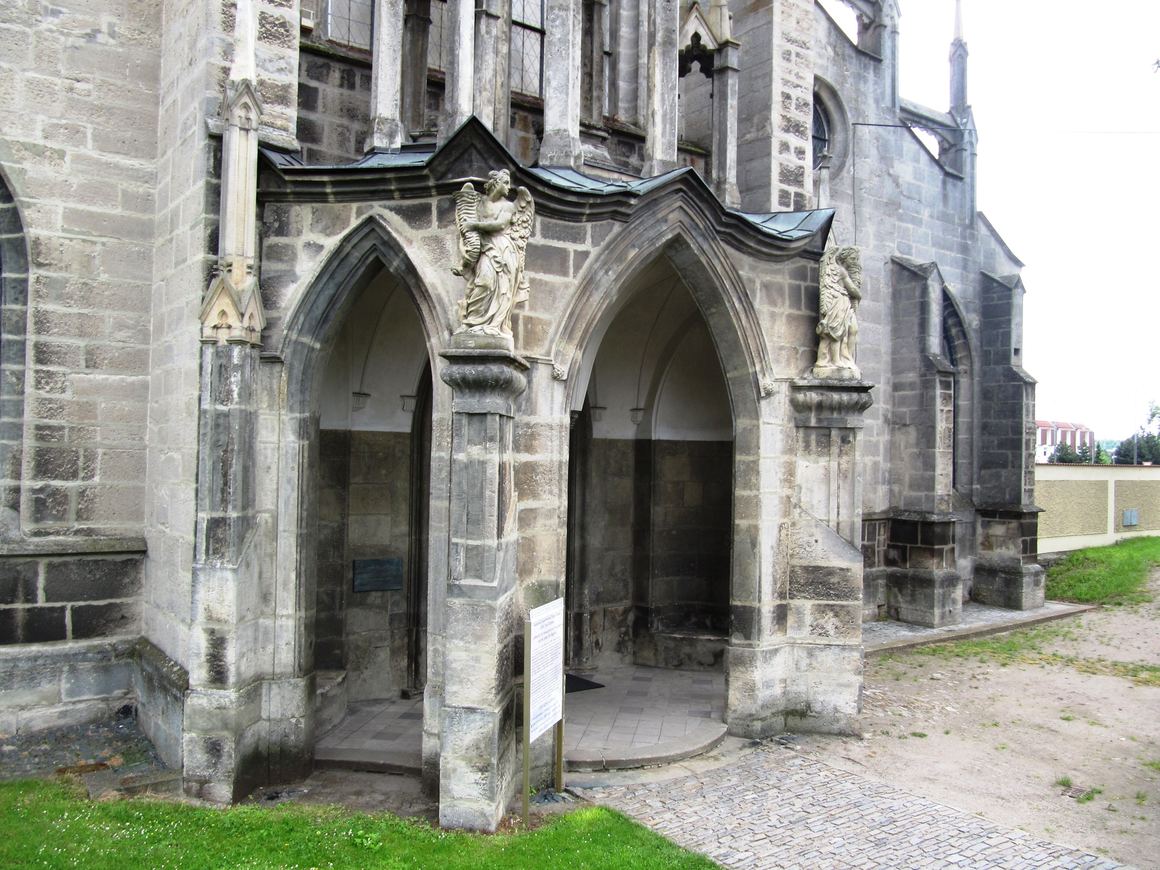
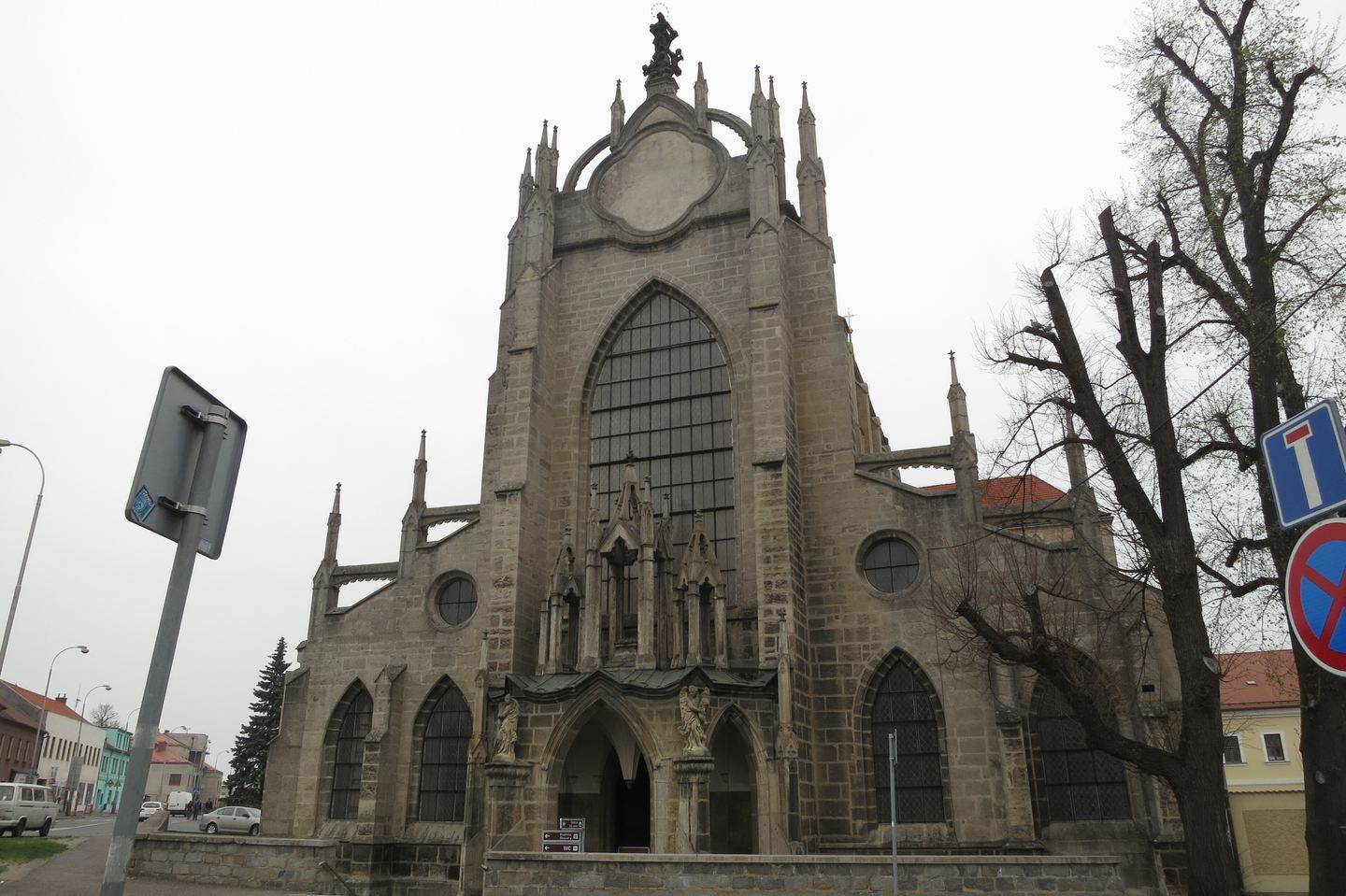
The medieval church had no twin-tower facade, no triforium and no flying buttresses, and Santini’s answer to that absence was theatre: long buttresses at the corners capped with finials, a statue of the Virgin at the apex of the gable, a huge quadrilobe punched in above the original Gothic window, and along the flanks a reminiscence of the external buttressing the building had never possessed. The sculpture is by Matěj Václav Jäckel.
Inside: what a cathedral actually means
Architecturally the word means a multi-aisled Gothic church with an ambulatory running round the presbytery. Only four such buildings survive in the Czech lands: this one, St Barbara’s up the road, St Bartholomew’s at Kolín and St Vitus in Prague. The numbers here are 92 metres long, 29 wide, 28 high; thirty-five pillars; thirty-two Tuscan columns carrying the side aisles; 106 windows. Because the nave walls are braced by internal arcades, the building needs no external buttressing whatsoever — which is why the outside looks so oddly plain for its size.
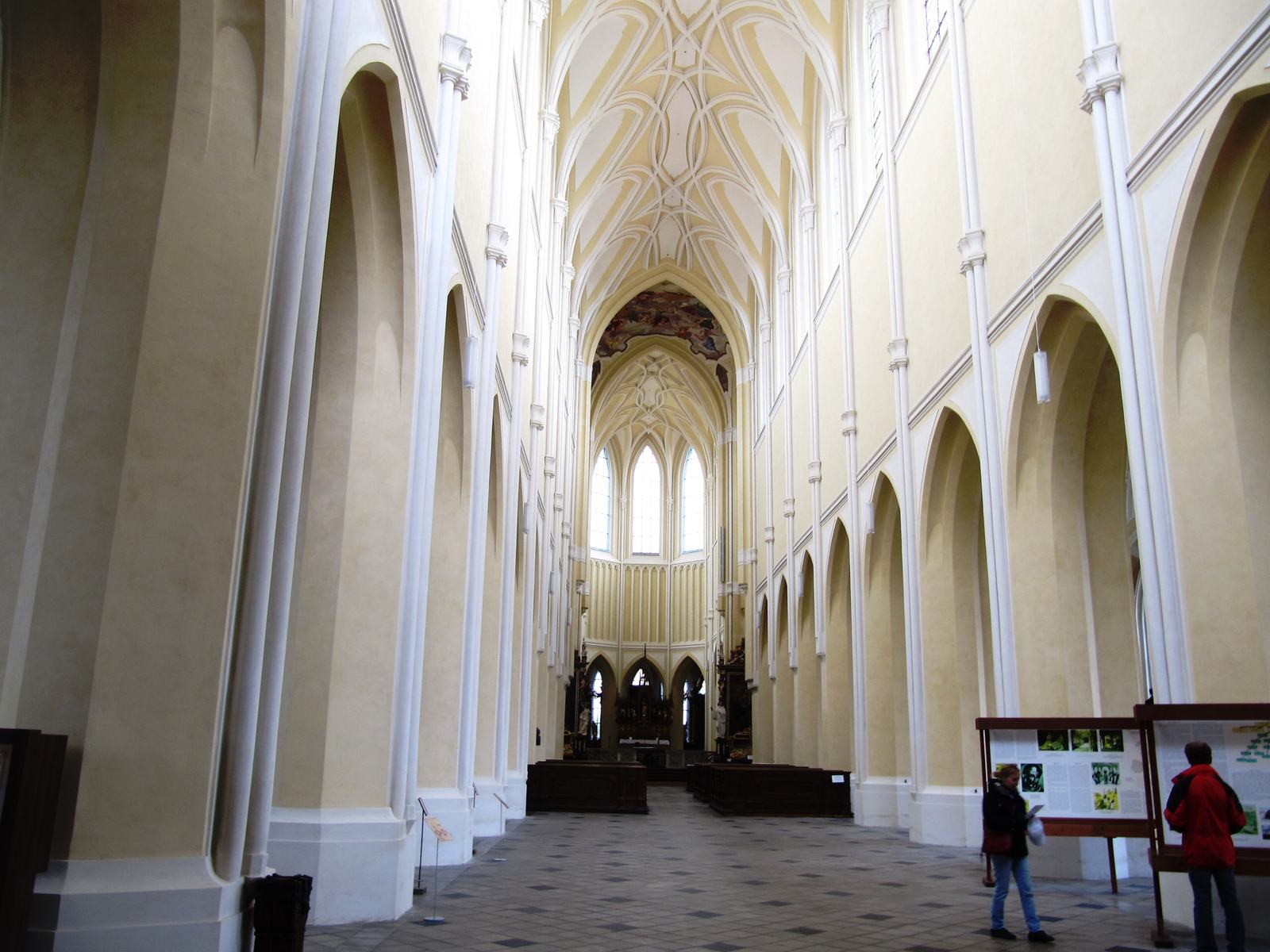
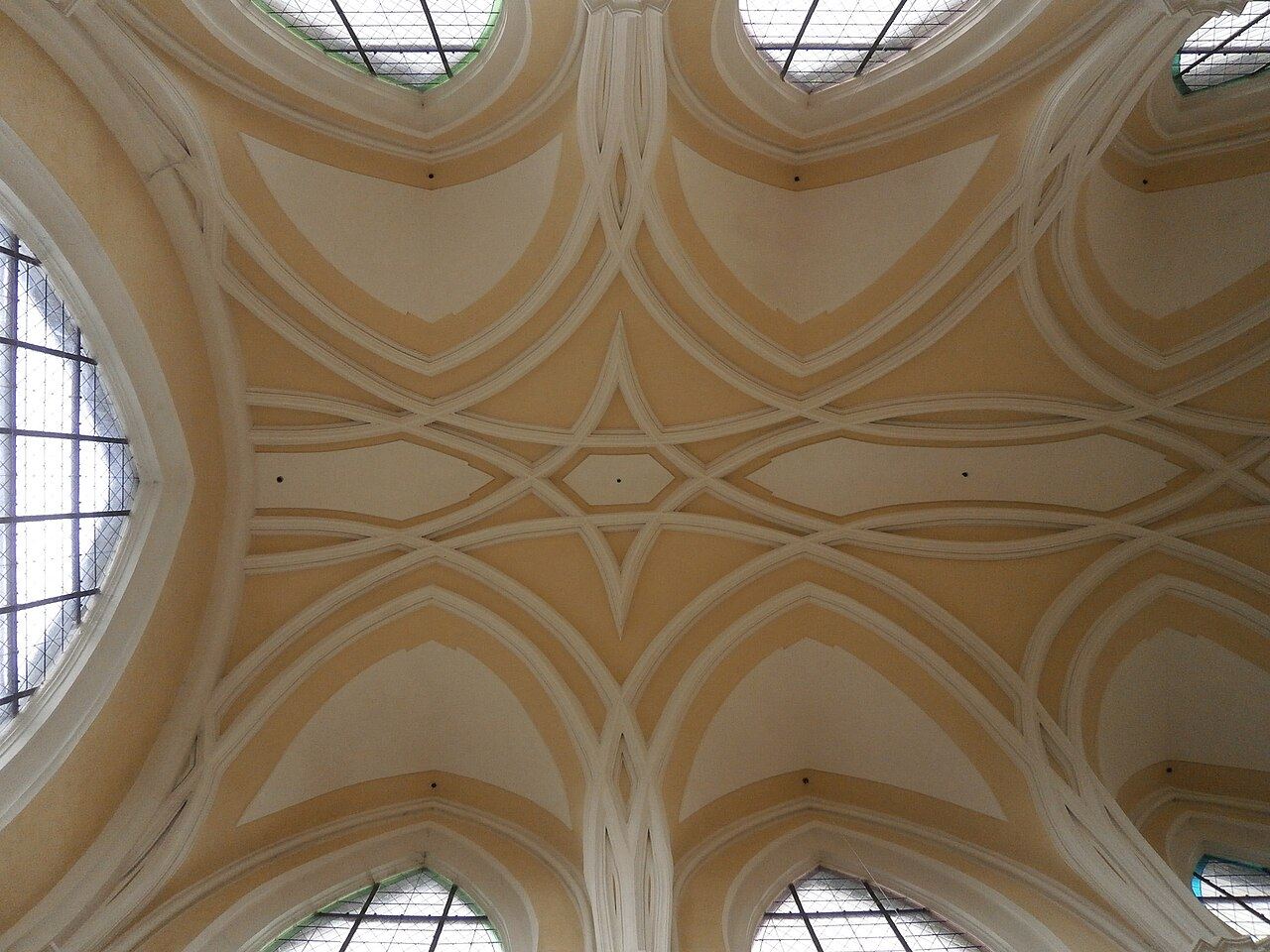
The vaults are the thing you came for. Nave and presbytery carry a barrel vault with three-sided lunettes, the ribs dying into consoles, and at the crown Santini set circling ribs — pairs looping across two bays at once, quoting late Gothic net vaulting while being structurally nothing of the kind. Over the crossing sits a self-supporting Bohemian cap. The wall shafts are bundles of three cylinders, interrupted by cut cubic rings and topped by chalice-shaped capitals that branch into the ribs. The recurring star, in the rib patterns and again in the presbytery paving, is a Marian sign.
The side aisles are the most instructive thing in the building, and it is worth knowing why. Bayer had already put in Tuscan columns — a Renaissance form, entirely wrong for the effect Santini wanted — and Santini could not remove them. So he Gothicised them, hollowing the corners of the plinths and of the abacus slabs so that the ribs appear to grow out of the capitals. This is Baroque Gothic as damage control, and once you have seen it you see the whole method.

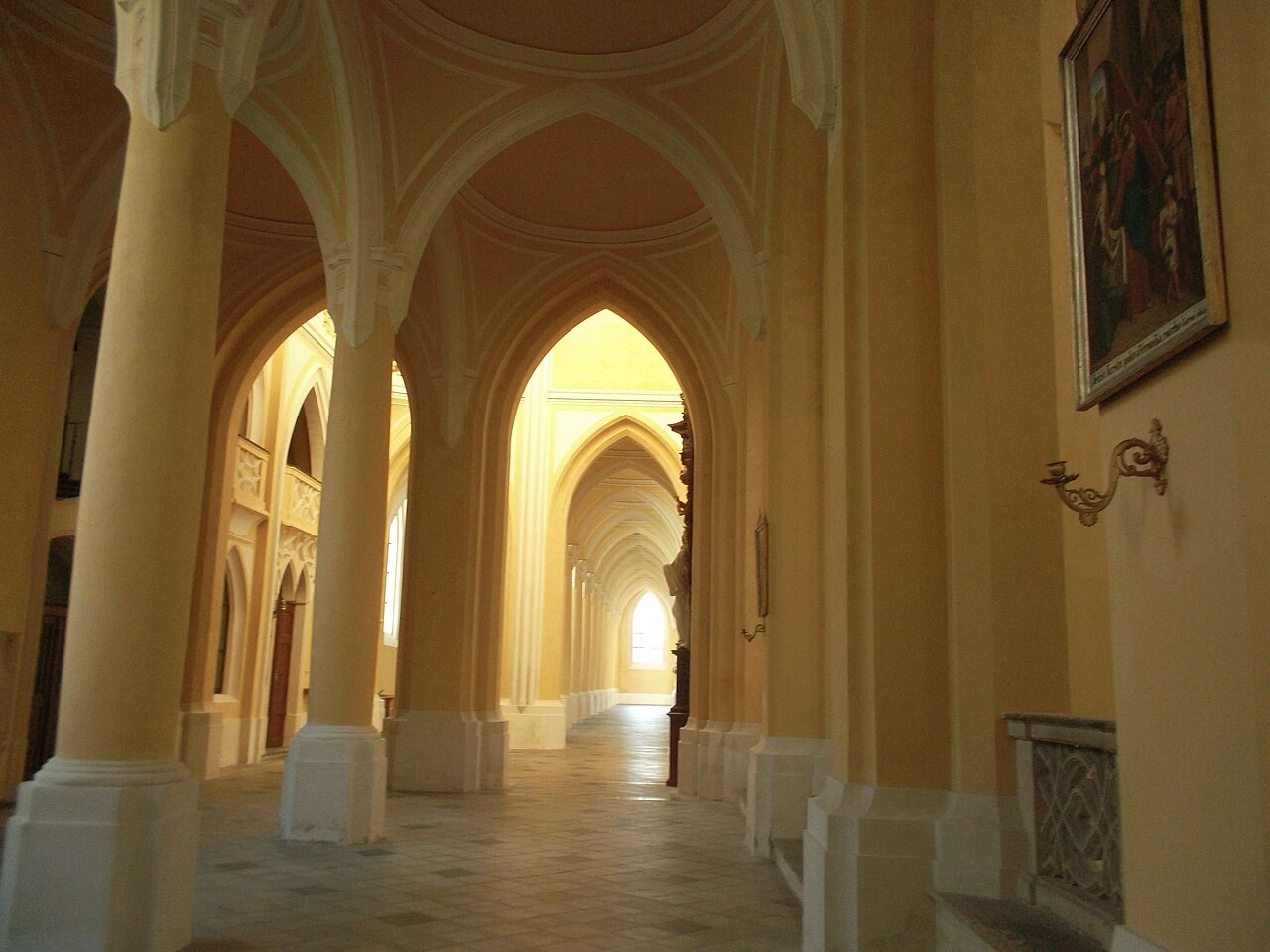
The colour is wrong, and you should know it. Santini painted this interior to read as a spring meadow — pale green on the smooth wall planes, darker green on every rhythmic element, the spiral stairs as flower stalks turning up towards the light. The nineteenth century replaced it with earthy white and yellow, and the restoration of 2001–2008 kept the nineteenth-century scheme.
The staircases, and the attic
East of the transept stand two spiral staircases built without a central newel, free-standing, anchored only in the perimeter wall, stabilised with iron ties and vaulted in two different ways. From the nave they read as pure helical curves with nothing holding them up. In the 2015 restoration the makers added metal cuffs to the handrail that spell out SANTINI AICHEL — a hidden signature, entirely in the spirit of the man.
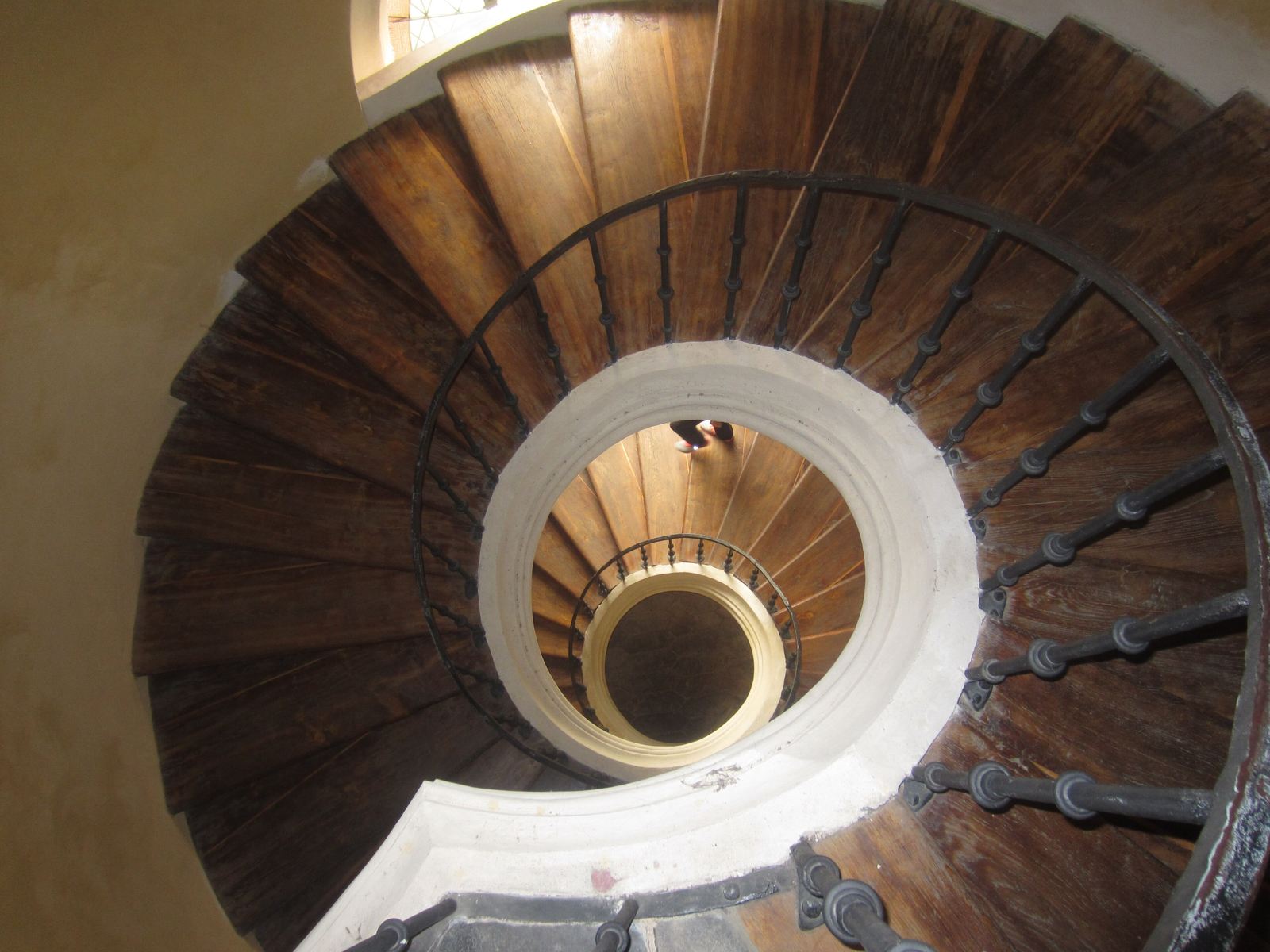
They are also the route up, and the attic is the best part of the visit. You walk a footbridge over the backs of the vaults, which is the clearest place in Bohemia to understand how a Bohemian cap is actually built: bricks dipped briefly in water so they would draw moisture from the mortar, each held five minutes until it bonded, the whole reinforced from above with brick belts. Some trusses are original and others spliced with new timber in the campaign of 2000–2009, during which parts of the roof had to be jacked up to stop the walls spreading. By the attic door is a Gothic staircase that once led straight into the monastery — by legend, the abbot’s escape route with the monstrance.
The west loft, and why there is no organ in it
The parish explains this one itself. Behind the loft is the fourteen-metre window, the largest of the cathedral’s 106, and an instrument there would face constant swings of heat and light; the reverberation at that end is also very long. So the organ went to the transept instead, where it is an early twentieth-century instrument in a case by the Kutná Hora builder Josef Melzer.
That window has one more trick. On the day of the equinox, the parish says, it throws a circle of sunlight directly onto the high altar. No astronomer seems to have checked it, and the claim is the parish’s own — but it is a good reason to come in late March or late September.

The pictures
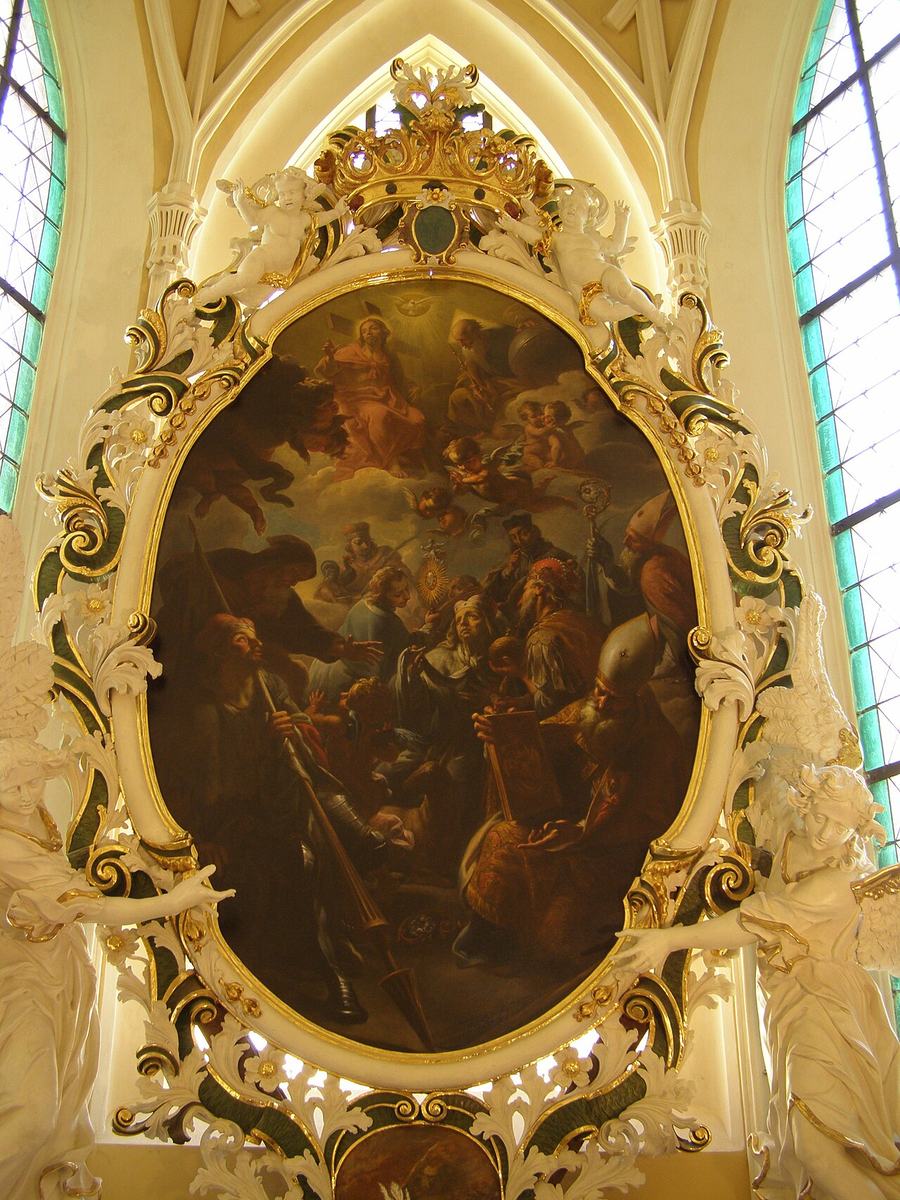
Petr Brandl (1668–1735), the leading High Baroque painter of the Czech lands, came to Sedlec because the abbot bailed him out of house arrest for debt in Hradec Králové in 1728. He stayed nearly two years and painted four canvases, three of which are still here: the Patron Saints of the Land of Bohemia, in which he painted himself as the central figure beside a sun-shaped monstrance; the Vision of St Lutgardis, whose sketch inspired Braun’s group on the thirteenth pillar of Charles Bridge; and St Juliana of Liège, shown as a Cistercian kneeling before the Sedlec monstrance. The fourth, a great Assumption, was sold to Vysoké Mýto after the dissolution and is still there; Josef Bergler painted the 1803 replacement you see over the transept altar. Brandl died poor in Kutná Hora in 1735. These are among his last works.
Michael Willmann (1630–1706), Rembrandt- and Rubens-influenced, took his Sedlec commission at the very end of his life: the Burning of the Sedlec Abbey, the Passion of SS Philip and James, and the Admission of the Young Bernard to the Cistercian Order. His stepson Jan Kryštof Liška added two more by the reliquaries. In the dome over the crossing, the Holy Trinity by Jan Jakub Stevens of Steinfels, 1705.
The treasury, and the oldest monstrance in the world
The Sedlec Monstrance is probably the oldest surviving Gothic monstrance anywhere: made before 1389 by the Parler workshop for Archbishop Jan of Jenštejn, 97cm tall, 4.7kg, engraved gilded cast silver. It went to Austria to escape the Hussites and came back to Sedlec only in 2011. Beside it are a facsimile of the abbey’s founding charter and a copy of a scene from the rare Gothic panel altar at Církvice.
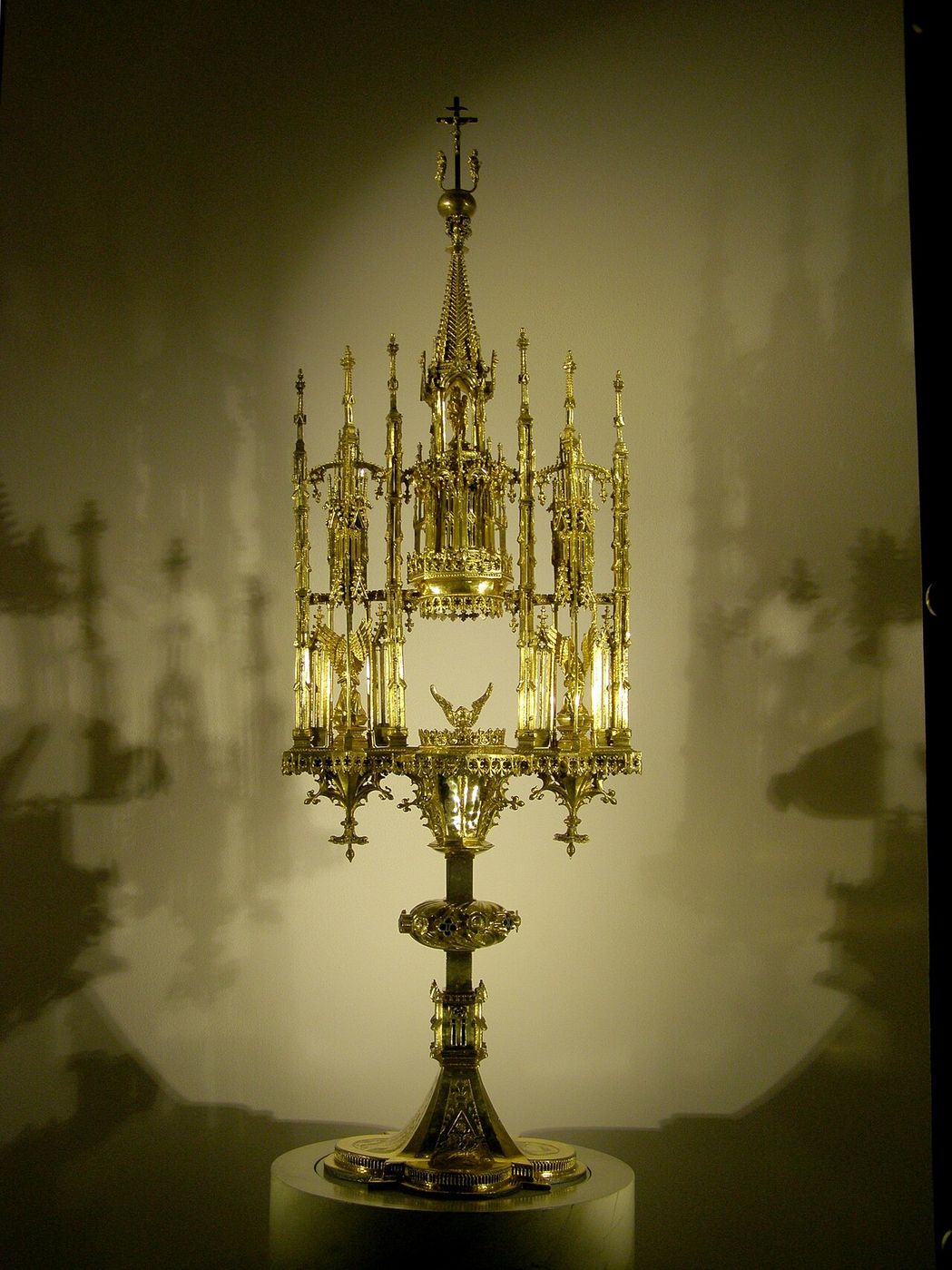
The presbytery, and the last room
The neo-Gothic high altar is by Josef Krejčík and dates only from 1912 — much later than everything around it, and worth knowing before you attribute it to anyone more interesting. The floor is Santini’s original interlaced, star-patterned tiling, and beneath it is the Baroque crypt built for the abbots. In glass cases by the front pillars lie the reliquaries of SS Vincent and Felix, second-century Roman martyrs articulated on figures and fixed with wax, given by Pope Benedict XIV in 1762.


The last stop is the original west-front sculpture by Jäckel, brought indoors for safety: two angels with cornucopias, St Benedict with his Rule and a cracked chalice, St John the Baptist with a lamb, and Robert of Molesme with a shepherd’s staff and a model monastery. Outside, what you saw was the copies.
Santini, and how to read him
Santini-Aichel was Prague-born of Italian descent, trained under Jean-Baptiste Mathey, and designed something like seventy to eighty buildings in a twenty-three-year career before dying at forty-six. Baroque Gothic is not Gothic Revival. He was not being nostalgic or antiquarian; he was using Gothic forms on Baroque structure and with Baroque spatial drama, almost always on medieval sites belonging to orders whose legitimacy had been contested in the Reformation. Rebuilding a Cistercian ruin in a Gothic idiom was an argument about continuity as much as a design decision.
To read the geometry, look for the governing figure. Here it is the star, Marian, repeated from the rib patterns down to the floor tiles. At his masterpiece, the pilgrimage church of St John of Nepomuk at Zelená hora — UNESCO-listed in its own right — it is the number five, worked through a golden-section plan. Sedlec is where the vocabulary first appears fully formed, and the parish says so itself: it was here that Santini first developed his talent to its full extent.
Don’t miss
- The grapes in the porch vault At the lowest point of a vault that hangs down towards you instead of lifting away.
- The hollowed corners on Bayer’s columns The moment you can see one architect quietly overruling another.
- The spiral staircases from the nave floor No newel, no visible support. Then climb one.
- The attic footbridge Walking over the tops of the vaults, which almost no visitor does.
- Brandl’s self-portrait The central figure in the Patron Saints of Bohemia is the painter himself.
Insider tips
Buy at the information centre on the way from the station. It sits between the ossuary and the cathedral, sells everything, and saves the walk back that catches people who turn up at a church door expecting a till.
Book the ossuary slot first, then let the cathedral fill whatever time is left on either side. The ossuary is timed and unforgiving; this building is not.
Do not come on a Sunday morning expecting to get in before eleven. If Sunday is the only day you have, do the ossuary first and come here after.
Take the attic if you can manage stairs, and know in advance that you cannot if you use a wheelchair — it is the one part of the building with no accessible route, and it is the part that explains the rest.
Common questions
Is this the same place as the bone church?
No, but they are sold together. The Sedlec Ossuary is the small chapel of bones four hundred metres down the road; this is the abbey church it belongs to. There is no ossuary-only ticket, so if you are seeing the bones you have already paid for this building whether you go in or not.
What does it cost, and where do I buy?
Cathedral alone 150 Kč; cathedral and ossuary together 220 Kč; add St Barbara’s in the town for 360 Kč. Buy online or at the Sedlec Information Centre on Zámecká street, halfway between the two churches. You cannot buy a ticket at the cathedral door.
Do I need to book a time?
For the ossuary, yes — it is strictly timed and capacity-limited, the time cannot be changed, and you should arrive five minutes early. The cathedral is not timed: you can walk in at any point in opening hours. Book the ossuary slot first and let the cathedral take up whatever is left either side of it.
Can I take photographs?
Here the official site contradicts itself. Its live visitor page says photography is allowed without flash; the rules document linked from that same page says it has been prohibited throughout the cathedral since 1 January 2020. Ask at the information centre and expect either answer. In the ossuary the ban is total and unambiguous.
Who was Santini, and what is Baroque Gothic?
Jan Blažej Santini-Aichel (1677–1723) was a Prague architect who used Gothic forms — pointed arches, rib patterns, pinnacles — on Baroque structure and with Baroque spatial drama, mostly for orders rebuilding medieval ruins. It is not Gothic Revival and it is not nostalgia; it is an argument about continuity, made in stone.
How long should I allow?
An hour, or seventy-five minutes if you go up into the attic, which is the best part and the one most people skip.
More near Kutná Hora
- The Sedlec Ossuary — four minutes away, and the reason almost everyone is here.
- St Barbara’s Church — the miners’ cathedral in the town, and the other named UNESCO component.
- All the churches worth visiting in the Czech Republic