
Bath Abbey
The floor of Bath Abbey was collapsing. Nearly nine hundred burials underneath it had decayed over two centuries, the ground had given way beneath the stone, and by the 2010s the church was slowly sinking into its own dead. The repair, finished a few years ago, lifted and relaid the whole floor — and while it was up, the abbey ran pipes under it and connected them to the hot springs that have been rising here since before the Romans. A medieval church is now heated by water that was previously poured away, from the same source the Roman baths next door have been using for two thousand years.
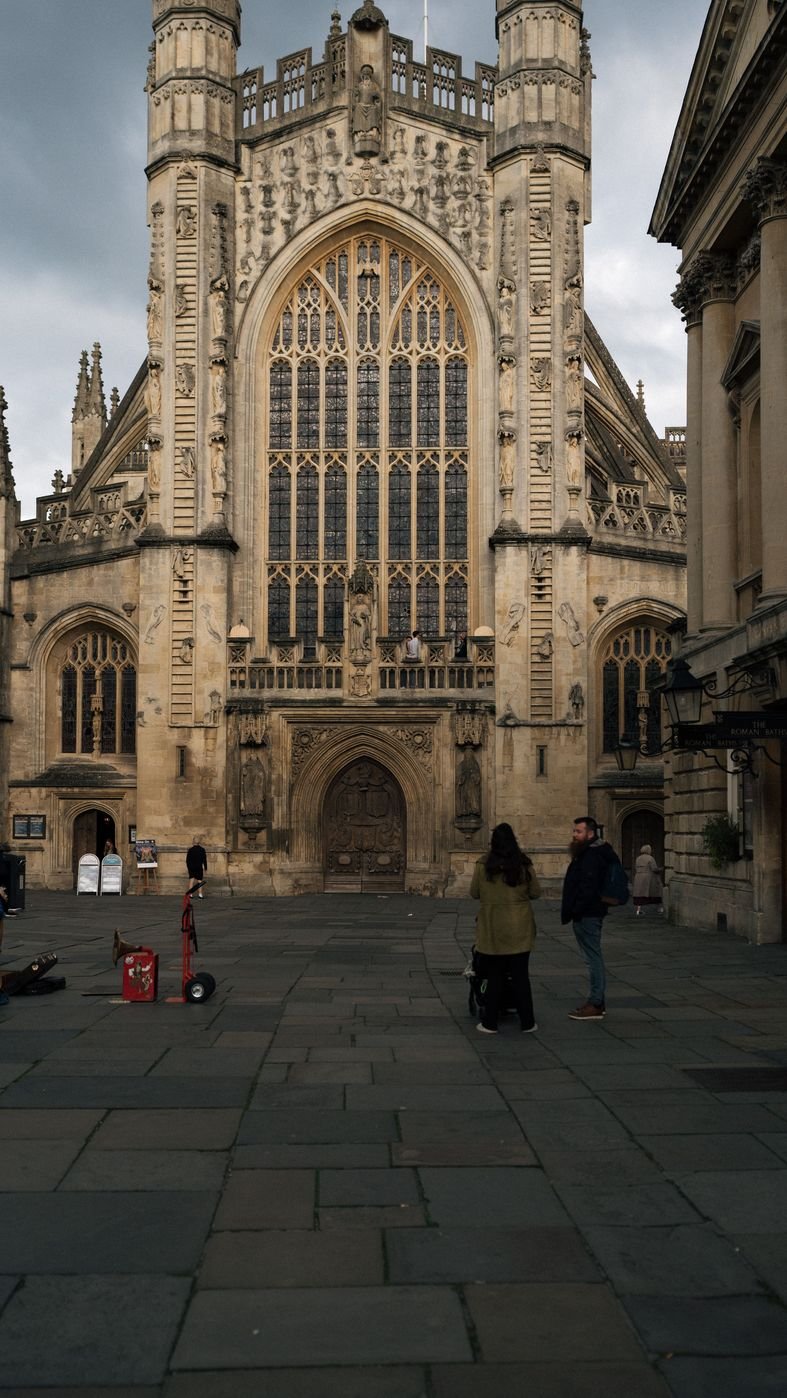
The last great medieval church in England
There has been a church on this spot for a very long time, and the present one is the third. An Anglo-Saxon minster stood here, and in 973 Edgar was crowned in it — the first king crowned as king of all England, in a service written by St Dunstan that is still the template for the coronation liturgy used at Westminster today. That is a considerable claim for a provincial abbey, and it is worth being exact about it: the ceremony happened on this site, in a building that has entirely gone.
The Normans replaced the minster with an enormous cathedral priory, bigger than what stands now — the present church would fit inside its nave. By the end of the fifteenth century that building was a ruin. Bishop Oliver King arrived in 1499 and found the church, in the phrase usually quoted, ruined to its foundations, and began again on a smaller footprint with the money he had.
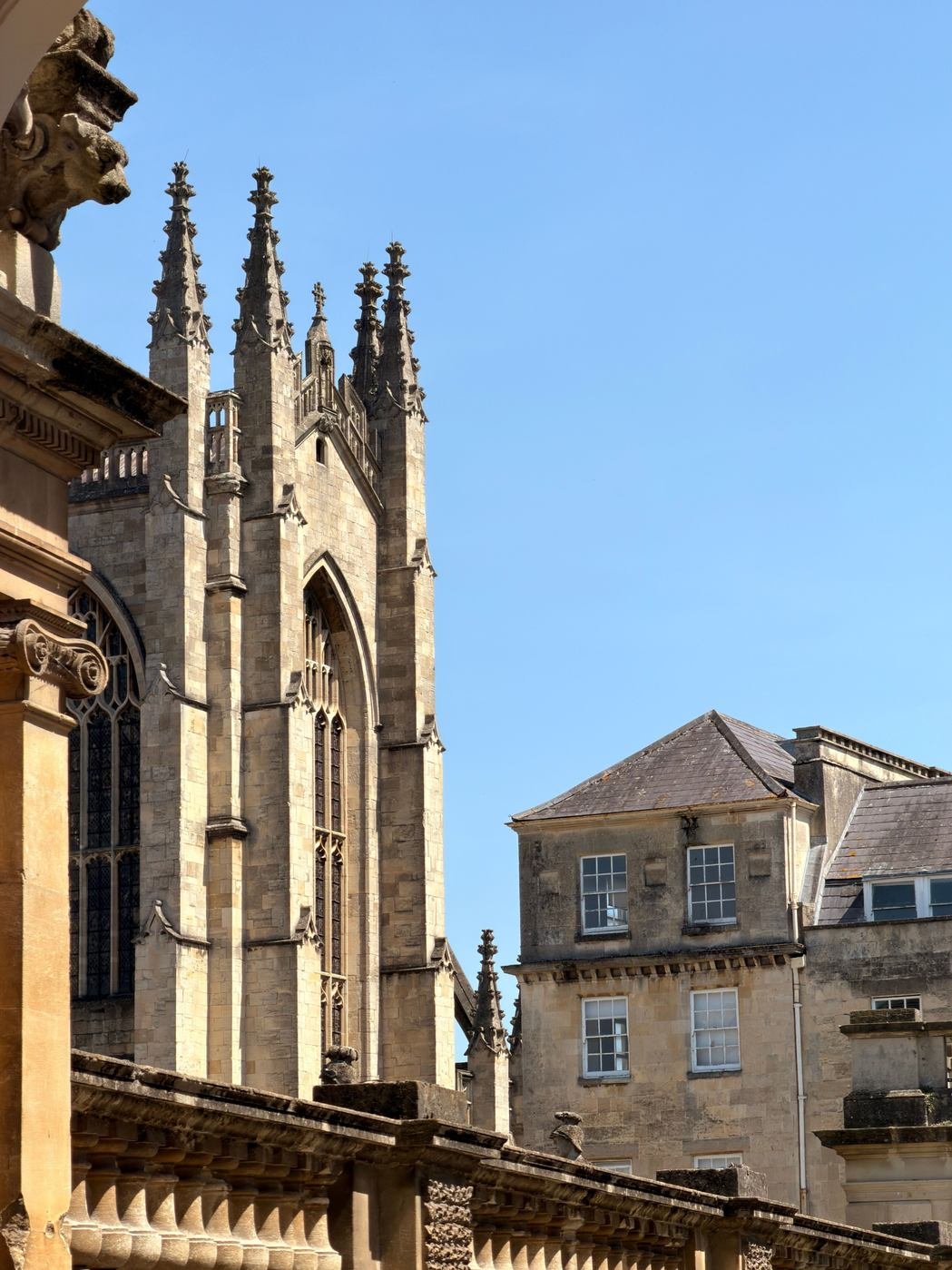
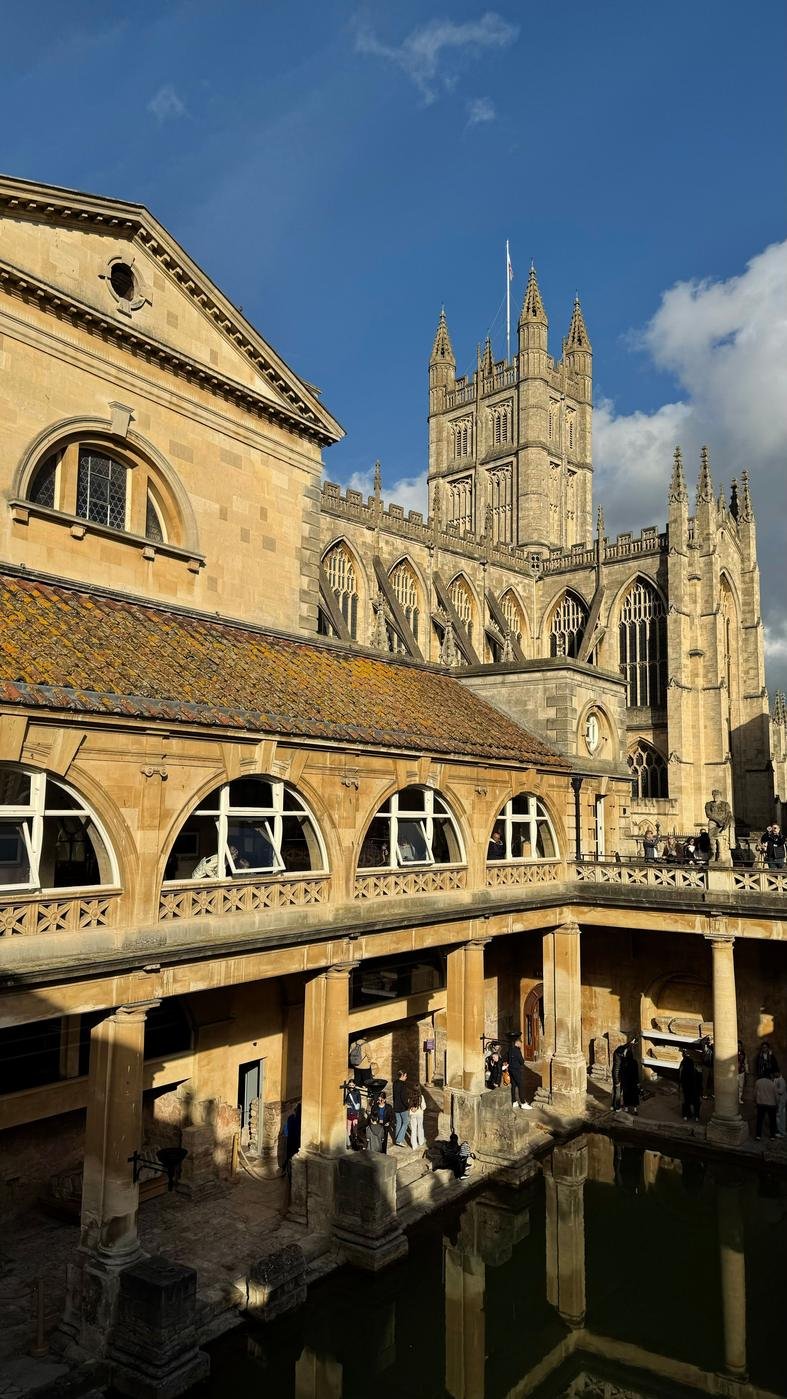
What he built is the last great church of the English Middle Ages: begun in 1499, interrupted by the Dissolution in 1539 when the roofless shell was sold off, patched back into use as a parish church, and not finally completed until 1611. It is Perpendicular Gothic at its most extreme — fifty-two windows, walls reduced to the minimum needed to hold the glass apart, and the nickname the Lantern of the West.
The visitor’s cheat sheet
| Where | Bath Abbey, Bath, BA1 1LT — in the centre, beside the Roman Baths and the Pump Room |
|---|---|
| Getting there | Bath Spa station is a seven-minute walk. The abbey is in the pedestrianised centre; use the city’s Park and Ride rather than trying to park nearby |
| Opening hours | Mon–Fri 10am–5.30pm, Sat 10am–6pm, Sun 1pm–3.30pm. The abbey publishes an upcoming closures page for services and concerts, which is worth checking |
| Admission | Adult £9; child 5–15 £5; student £7.50; families 10 per cent off. Free for BA1 and BA2 residents and Discovery Card holders. No charge to attend a service |
| Tower tour | Adult £18, child £12, Monday to Saturday subject to availability. 212 steps, behind the clock face and into the bell chamber. No under-5s; 5–15s must be accompanied |
| How long | Three-quarters of an hour to an hour, or two hours with the tower |
| Best time | Late afternoon on a weekday, when the sun is on the west front and the day-trip coaches have gone |
| Combining it | The Roman Baths are next door and the Pump Room is across the yard. The abbey is the half-hour that most Bath itineraries leave out and should not |
Hours and admission checked against the official site in September 2026. They change; the official site is always the last word.
Bath Abbey is not part of the Roman Baths ticket and is not included in any of the combined passes people usually buy for the city. It is a separate £9, it takes under an hour, and it is the building most visitors to Bath walk past on their way to somewhere they have already paid for.
What to see, in the order you meet it
The west front and the ladders of angels
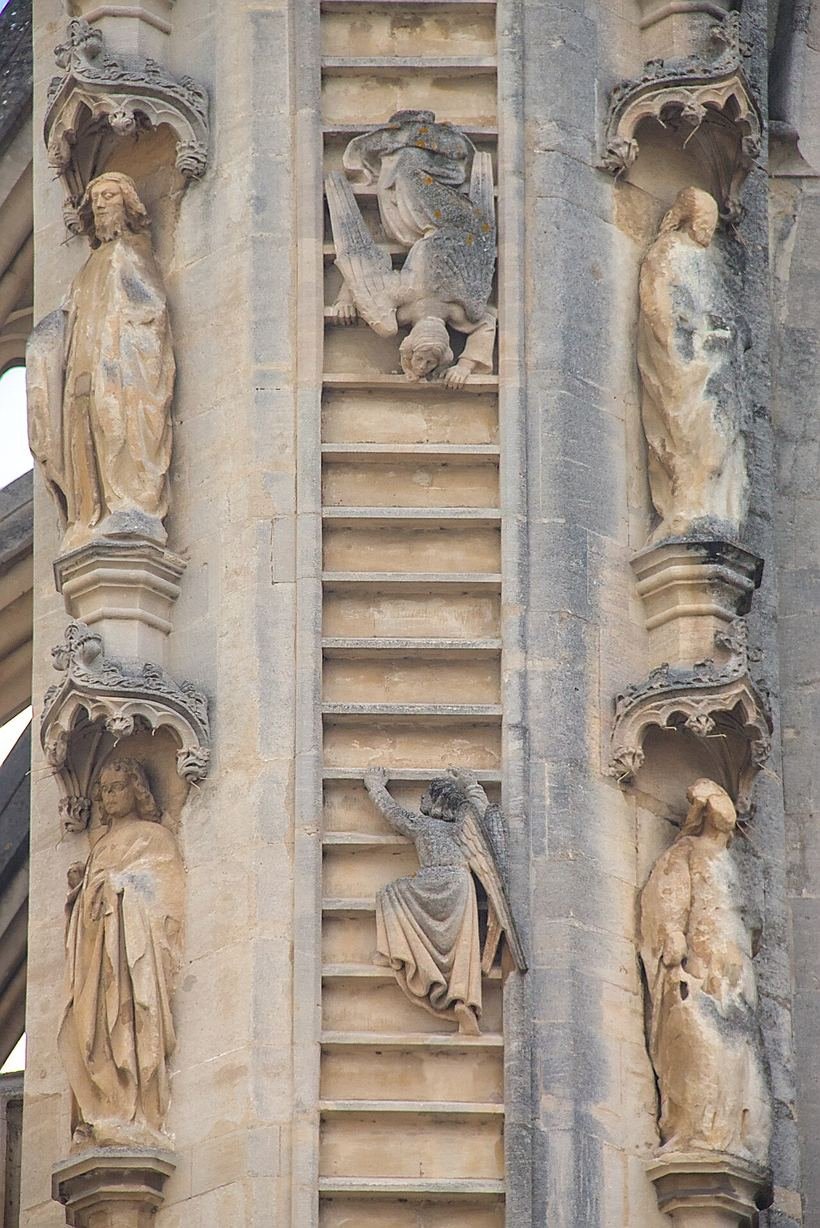
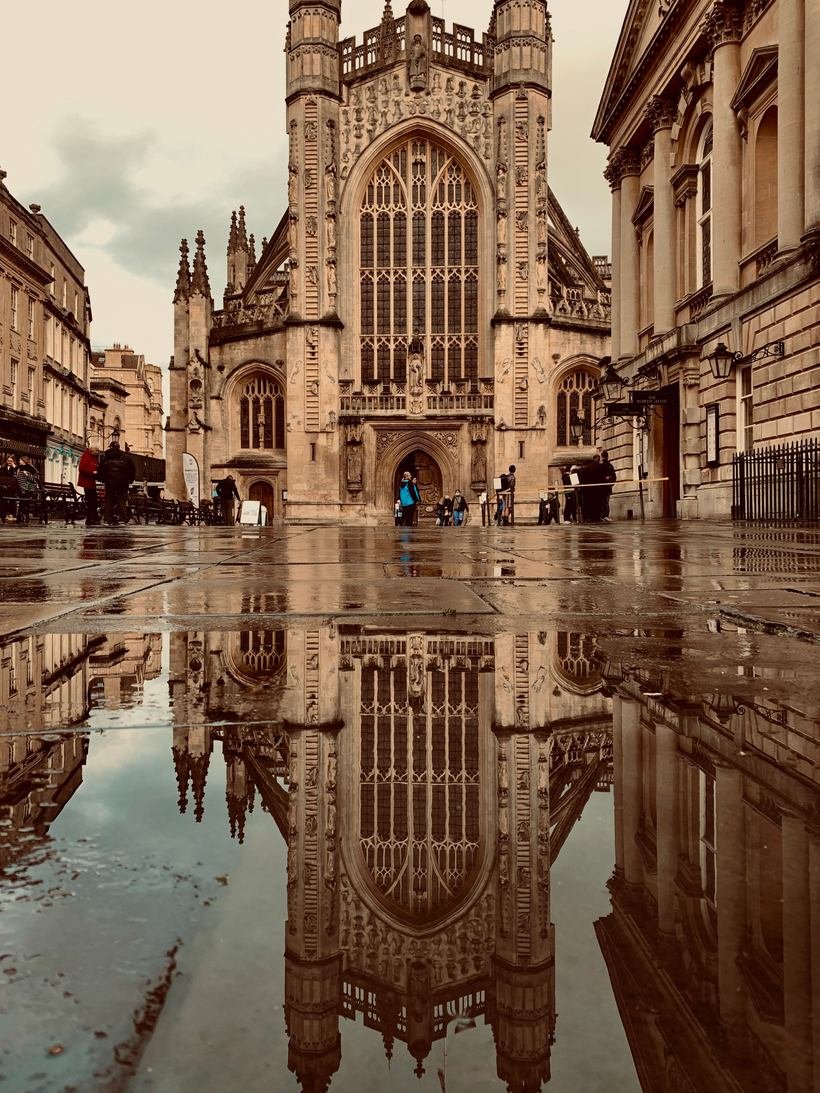
Stand back in the courtyard before you go in. Either side of the great west window, two stone ladders climb the full height of the front, with angels on them. Most are going up. At least one is coming down, head first, which visitors enjoy pointing out and which has been explained in about six different ways.
The story attached to the carving is that Bishop Oliver King dreamed of the heavenly host ascending and descending a ladder, and of a voice telling him to restore the church, and built what he had seen. It is a good story and it should be told with its dates attached: it first appears in the writings of John Harington around a hundred years after it is supposed to have happened, and it has been challenged ever since. The carving is Tudor and real. The dream is a tradition about the carving, recorded late, and nobody can now show it is more than that.
The nave, and the vault that took 350 years
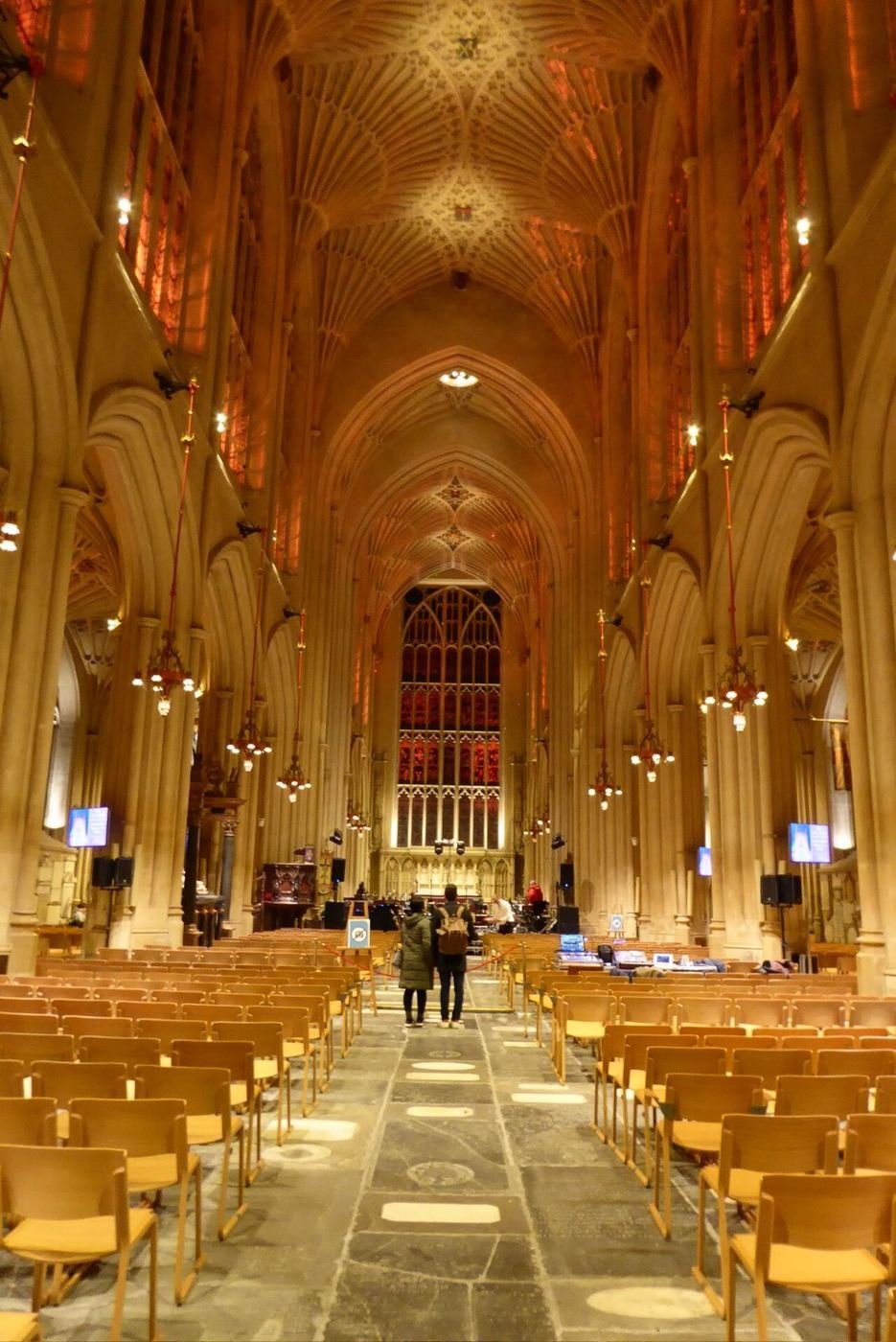
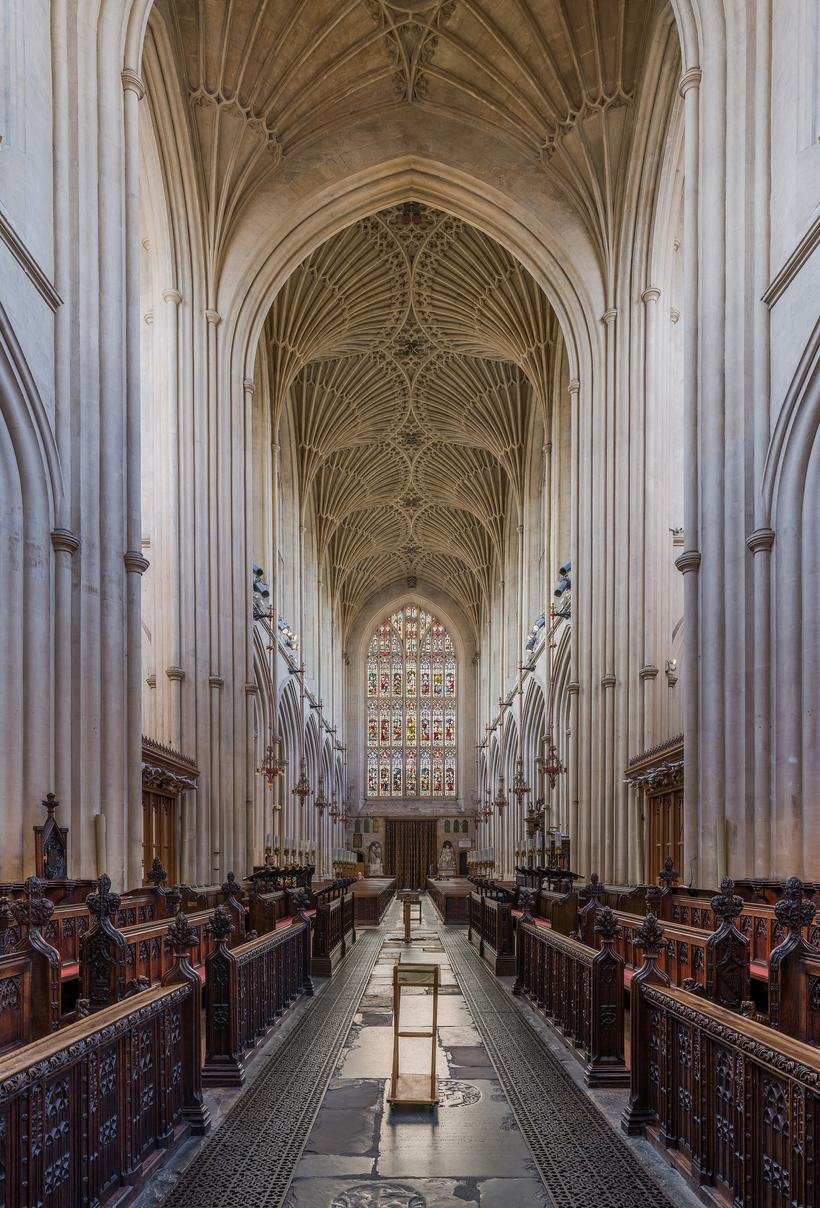
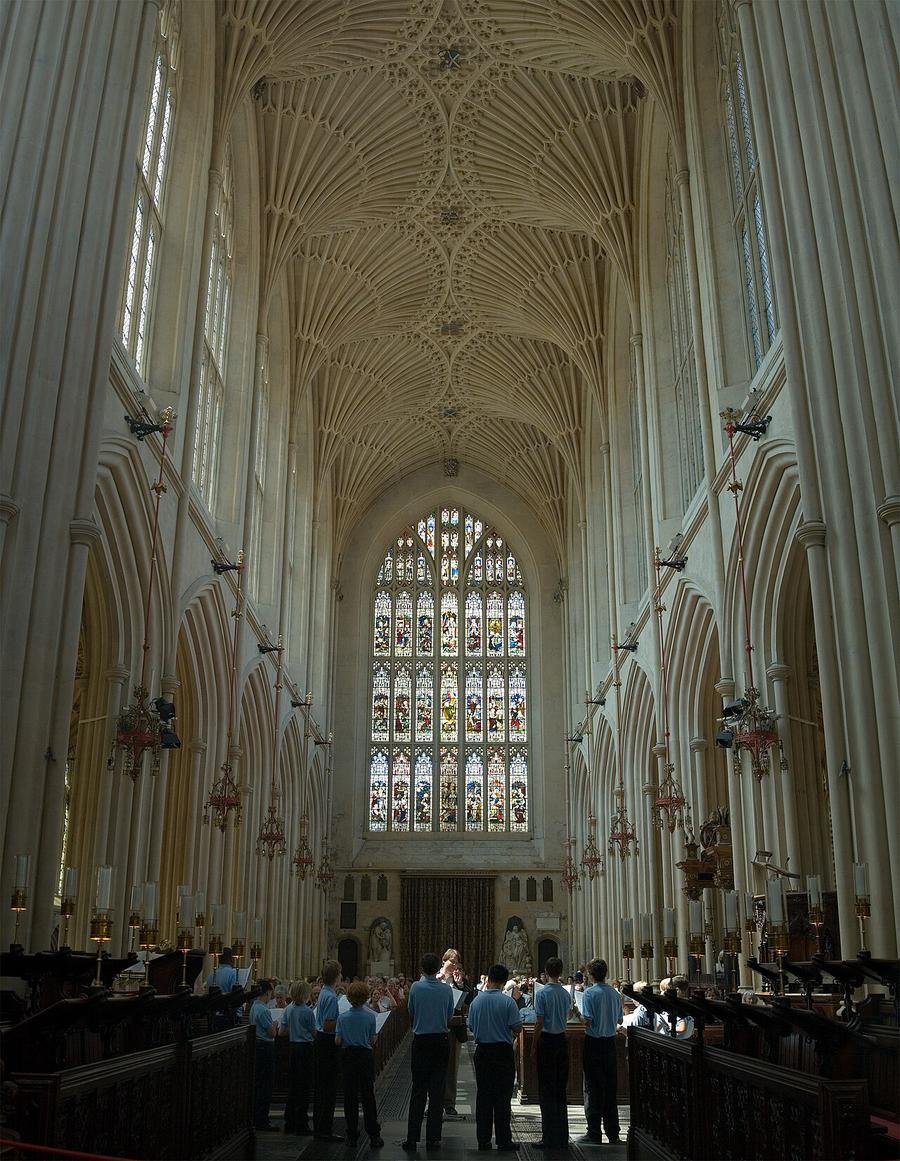
Inside, the building is one bright room. The fan vaulting over the choir is the original, by Robert and William Vertue, the king’s masons, who told Oliver King that there would be none so goodly in England or in France. They were not far wrong.
The nave vault, though, is Victorian. Sir George Gilbert Scott built it between 1864 and 1874, completing what the evidence in the stonework suggests was always intended and had been abandoned — most likely because the money ran out. For three and a half centuries the nave had a flat plaster ceiling. Scott matched the Tudor work so closely that almost nobody standing on the floor can see where one stops and the other starts, and knowing which is which turns the ceiling into the most interesting thing in the building.
The east window
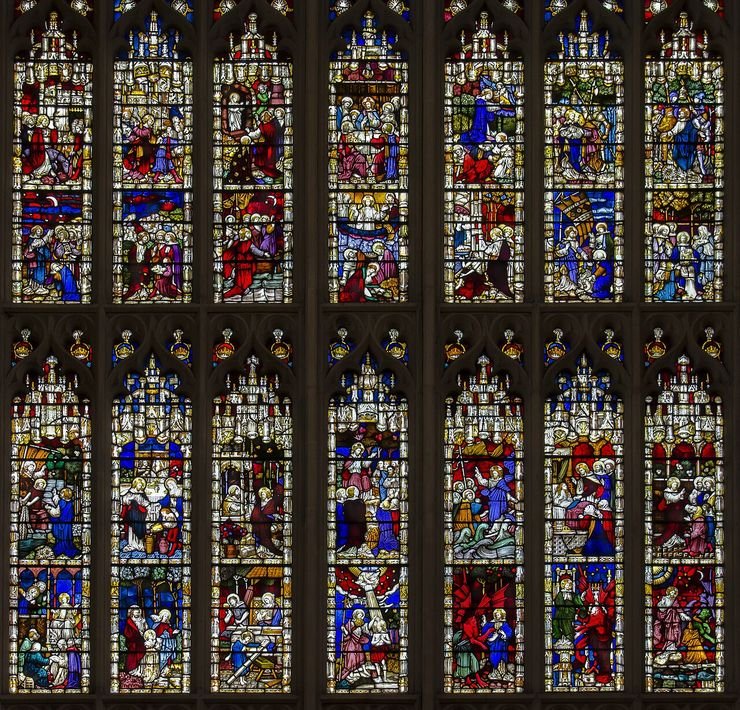
Fifty-six scenes from the life of Christ fill the east window. The glass is Victorian; the original was destroyed, like most of what was in here, in the century after the Dissolution. It is worth looking at as a piece of storytelling rather than as medieval work it is not.
Prior Birde’s chantry
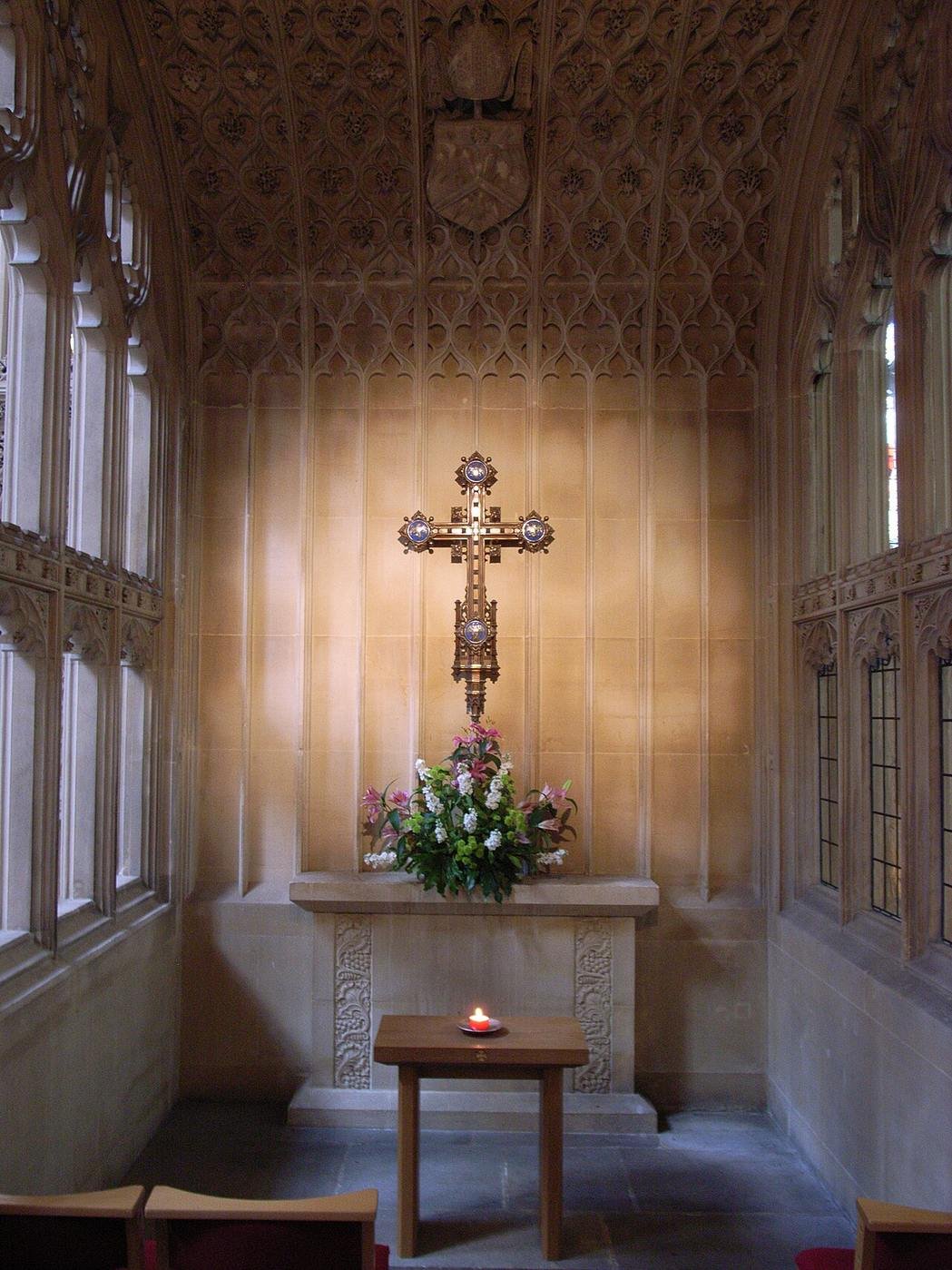
On the south side of the choir is a small stone box of astonishing delicacy, built for Prior William Birde and finished around 1515: lace-work tracery, a miniature fan vault of its own, and his rebus — a bird — hidden in the carving. It was smashed up after the Reformation and painstakingly restored in the nineteenth century. It is the finest small thing in the building and it is easy to walk past.
617 memorials on the walls, 847 in the floor
The walls of Bath Abbey are covered. There are 617 wall memorials and 847 inscribed floor stones, one of the densest concentrations of memorial inscription in any English church, and the reason is Georgian Bath. This was where the wealthy came to take the waters for gout, palsy, infertility and every other complaint of the eighteenth century, and a good many of them arrived ill and did not leave. The tablets are a directory of people who came here to get better. Read a dozen at random and the city’s whole social history is in them.
1539, and the years without a roof
Oliver King’s church was barely finished when the priory was surrendered to the Crown in January 1539. The new building was stripped — lead, glass, iron, the lot — and the shell was sold off to Humphry Colles of Taunton. It stood open to the weather for a generation. What saved it was a mixture of private charity and royal intervention: Colles’s son Edmund Colthurst gave the roofless remains to the corporation of Bath in 1572, and in 1574 Elizabeth I ordered a national fund set up to pay for the repairs. The work dragged on until 1611.
That is why so little medieval glass and furnishing survives here compared with a cathedral that never closed. The bones are Tudor; almost everything that fills them is later. It is also why Bath Abbey is a parish church and not a cathedral, despite being the size of one and having been the seat of a bishop for four hundred years before the Dissolution.
The abbey in Georgian Bath
For the century after 1700 this was the parish church of the most fashionable resort in England, and it behaved like one. Richard “Beau” Nash, the master of ceremonies who effectively invented Bath’s social season, is buried here; he died poor in 1761 and the city gave him a lavish funeral anyway. The pews filled every Sunday with visitors taking the cure, and the walls filled with their monuments as the cure failed. Jane Austen worshipped here while she lived in Bath and disliked the town intensely, which is not the impression the tourist trade gives.
The Victorians then gave the building the shape it has now. Sir George Gilbert Scott’s restoration of the 1860s and 70s took out the stone screen between choir and nave, opened the church up into the single bright space visitors see, and finished the nave vault. Almost every interior view that gets photographed is really his arrangement of Oliver King’s building.
The floor, and the hot springs under it
By the time the Footprint project began, the floor was in real danger: the ground beneath had collapsed into the voids left by centuries of burials, and large areas were unstable. Every ledger stone was lifted, recorded and relaid on new foundations.
With the floor up, the abbey did something no other medieval church has done. Around 1.1 million litres of hot spring water run through the Roman Drain under York Street every day at a constant 40°C, on their way from the Roman Baths to the river, and that heat had always been thrown away. Ten heat exchangers in the drain now feed underfloor heating throughout the church; the system was switched on in March 2021. The wider £19.3 million Footprint programme also brought new lighting, a song school, learning rooms and a Discovery Centre, which opened on 7 March 2023.
The tower
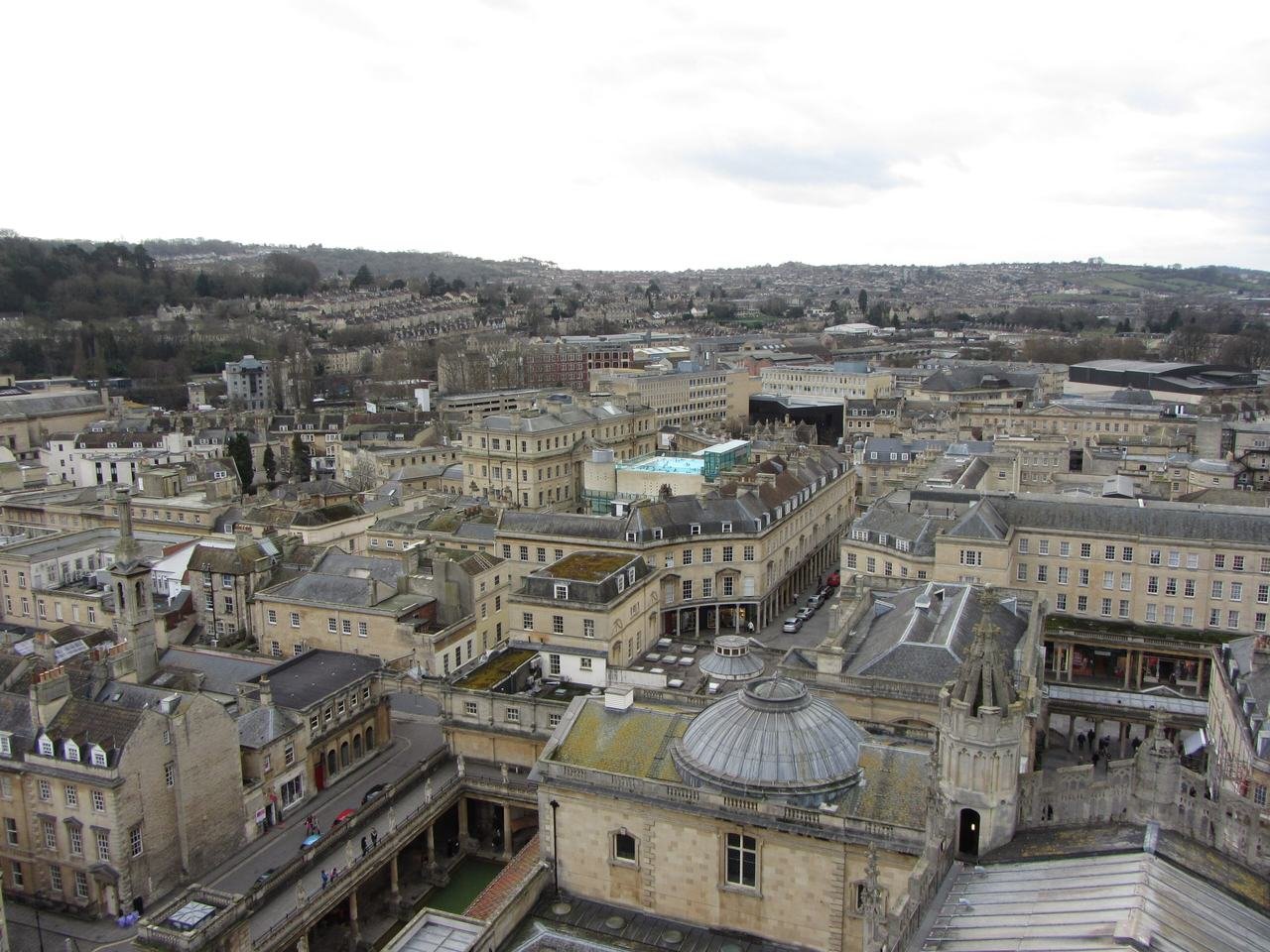
212 steps up a spiral stair in a tower 161 feet high, and unusually the route goes through the working parts: you stand behind the clock face looking out through it, sit above the vault looking down into the church you were standing in ten minutes earlier, and go into the bell chamber. At the top, Georgian Bath is laid out below in the same honey-coloured stone as the church you are standing on.
Tickets and tours
Book the tower, walk in for the church
Admission at £9 can be bought at the door and rarely needs planning. The tower tour is the one to book ahead: it runs Monday to Saturday subject to availability, takes small groups, and is the part of the visit people remember. If you live in BA1 or BA2, or hold a Discovery Card, entry is free — worth knowing before you queue at the desk.
Tour and hotel links go to GetYourGuide and Booking.com. This site earns nothing from them at present — they are here because they are the quickest way to check what is actually available.
Don’t miss
- The descending angel On the west front. Everyone finds the ones climbing; far fewer spot the one coming down head first.
- The join in the vault Tudor over the choir, Victorian over the nave, three and a half centuries apart and almost impossible to tell from the floor.
- Prior Birde’s rebus A carved bird hidden in his chantry chapel, about 1515.
- The underfloor heating Powered by the hot springs next door, from water that used to go down the drain.
- The memorial to the memorials 617 on the walls, 847 in the floor. Read a handful and you have read Georgian Bath.
- Behind the clock face On the tower tour, looking out through the dial at the city.
Insider tips
Come late in the day. Bath empties in the late afternoon when the coaches leave, the abbey is open until 5.30pm on weekdays and 6pm on Saturdays, and the low sun lands directly on the west front — which is the only time the angels really read from the courtyard.
Do the abbey before the Roman Baths, not after. The Baths take two hours and leave most people with no appetite for anything else, and the abbey is a forty-five-minute building. Reverse the usual order and you will actually look at it.
Sunday visiting is short — 1pm to 3.30pm — and the morning belongs to services, which anyone may attend for nothing.
If you are here for the tower, check availability before you travel. It runs Monday to Saturday but not on a fixed timetable, and it is the one thing at the abbey that can sell out.
Look down as well as up. The floor you are walking on is only a few years old as a piece of engineering, even though every stone in it is centuries older, and the story of how it was saved is signed around the building if you read the panels.
Common questions
How much does it cost to visit Bath Abbey?
Adult admission is £9, with children aged 5 to 15 at £5 and students at £7.50. Families get 10 per cent off. Entry is free for residents of the BA1 and BA2 postcodes and for Discovery Card holders, which is an unusually generous arrangement for a building in the middle of a tourist city. There is no charge to attend a service.
Can you go up the tower at Bath Abbey?
Yes, on a guided tower tour, Monday to Saturday subject to availability: adult £18 and child £12. It is 212 steps up a spiral stair in a tower 161 feet high, and the route takes you behind the clock face and into the bell chamber. Under-5s are not allowed, and children between 5 and 15 must be with an adult.
Was King Edgar crowned in Bath Abbey?
He was crowned at Bath in 973, and that service is the basis of the English coronation liturgy still used today — but not in this building. Edgar was crowned in the Anglo-Saxon minster that stood on the site. The church visitors walk into was begun in 1499 and not finished until 1611, more than five hundred years later.
Why are there angels on ladders on the front of Bath Abbey?
The carving shows angels climbing and descending ladders either side of the west window. The usual explanation is that Bishop Oliver King dreamed of the heavenly host on a ladder and was told to restore the church. That story first appears in John Harington’s writing about a century after the event, and historians have questioned it. The carving is genuine and Tudor; the explanation is a later tradition.
Is Bath Abbey heated by the hot springs?
Yes. The Footprint project installed underfloor heating powered by renewable energy drawn from Bath’s hot springs — water that had previously been allowed to run to waste. The same water the Romans bathed in next door now warms a medieval church, which is the neatest thing about the whole building.
How many memorials are there in Bath Abbey?
617 wall memorials and 847 floor stones. It is one of the densest collections of memorial inscriptions in any English church, and it exists because Georgian Bath was where the wealthy came to take the waters for their health. A good proportion of the people commemorated came here to get better and did not.
Where to stay and eat nearby
The abbey is in the middle of everything: the Roman Baths and Pump Room share its courtyard, Sally Lunn’s is two minutes away, and the whole centre is walkable from Bath Spa station. Bath makes an easy base for the Somerset churches — Wells is twenty-two miles south and Glastonbury a little beyond it, which makes a good day out by car.
More English cathedrals and abbeys
- Wells Cathedral — twenty-two miles south, and the obvious pairing with Bath.
- Gloucester Cathedral — where fan vaulting was invented, a century and a half before it reached here.
- Glastonbury Abbey — what the Dissolution did to a house that did not become a parish church.
- Winchester Cathedral — the other great Anglo-Saxon royal church of Wessex.