
Hereford Cathedral
In 1988 the dean and chapter of Hereford, desperate for money to repair their cathedral, announced that they would sell the Mappa Mundi. The outcry was immediate and national. The map stayed, a public appeal and a large private gift built it a new home, and today the greatest medieval map in existence hangs a few yards from where it has been for seven centuries, beside a seventeenth-century library in which every book is still chained to its shelf.
A murdered king, a burned church and a fallen tower
Hereford Cathedral is dedicated to St Mary and to St Ethelbert, a young king of East Anglia who came here in 794 to marry the daughter of Offa of Mercia and was murdered on Offa’s orders instead. Miracles were reported at his tomb, and a church grew up around it. In 1056 Welsh raiders burned that church to the ground.
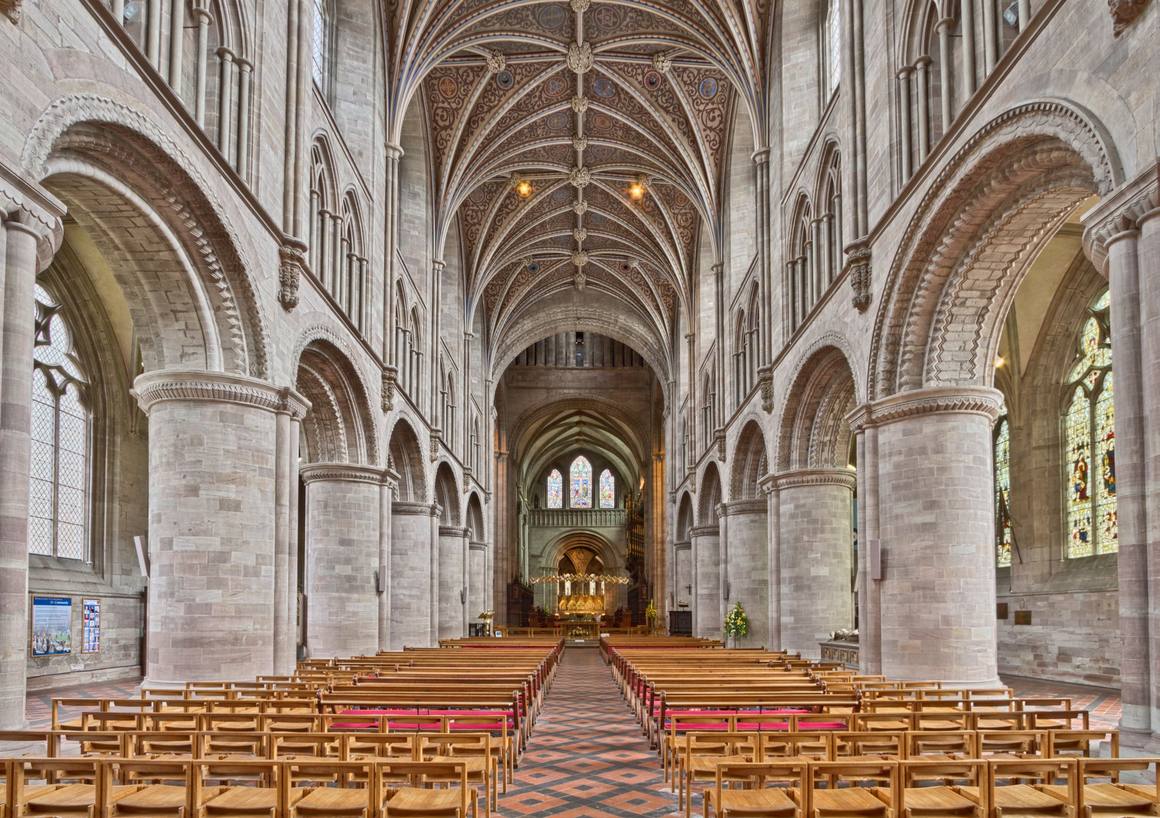
The Normans rebuilt it from about 1079, under Bishop Robert of Lorraine, and the nave arcade you walk through today is theirs: massive round piers and round arches of the early twelfth century. Over the next three hundred years the cathedral was extended and refashioned piece by piece — an Early English Lady Chapel, a startling north transept, a fourteenth-century central tower — until by the end of the Middle Ages it was a patchwork of every English style.
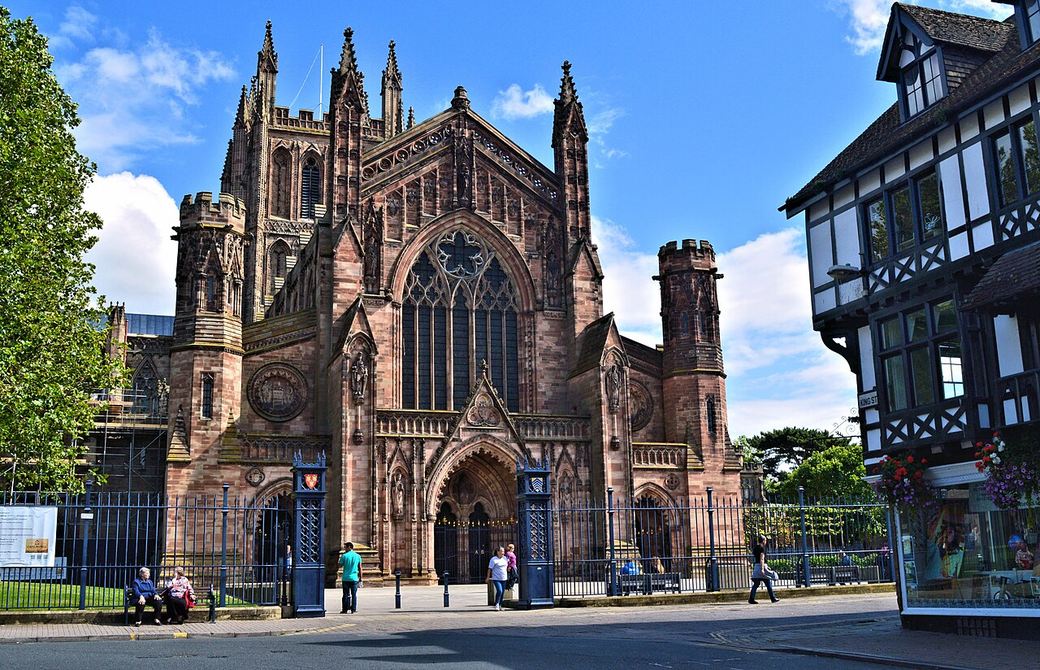
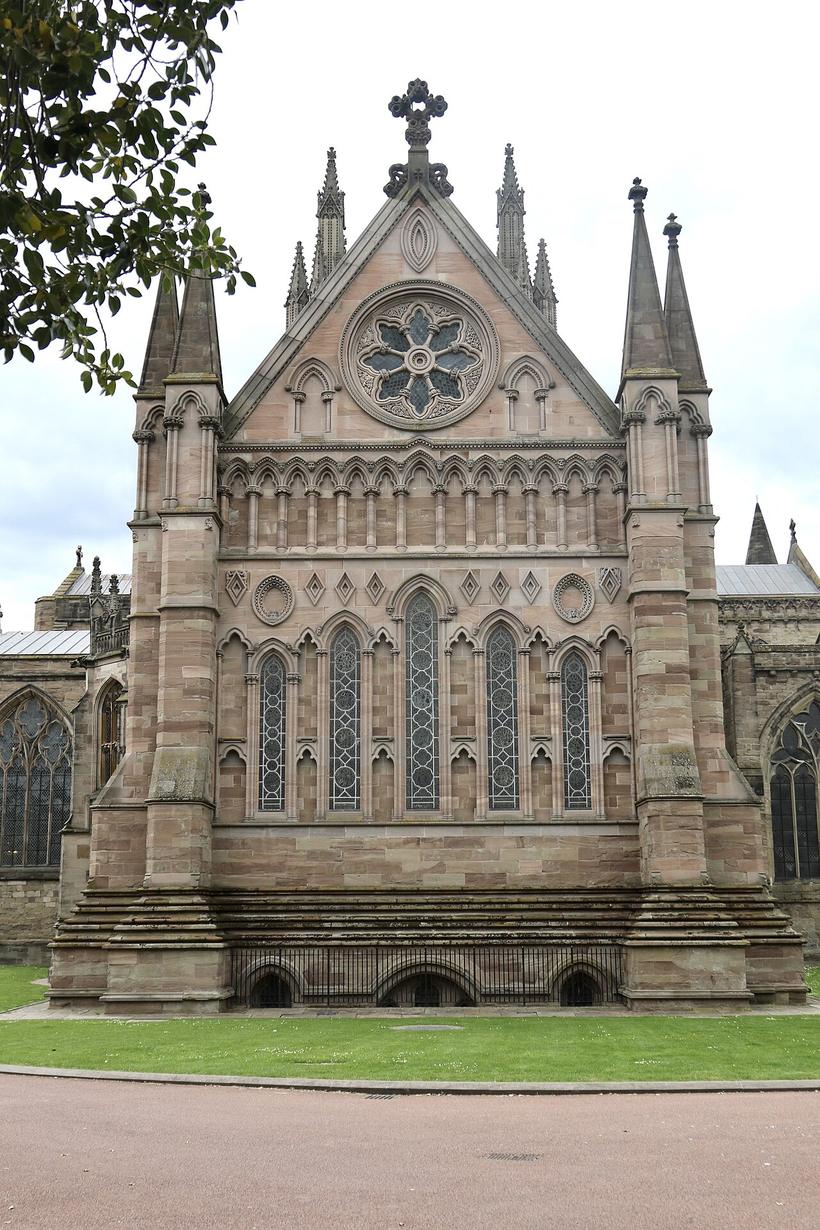
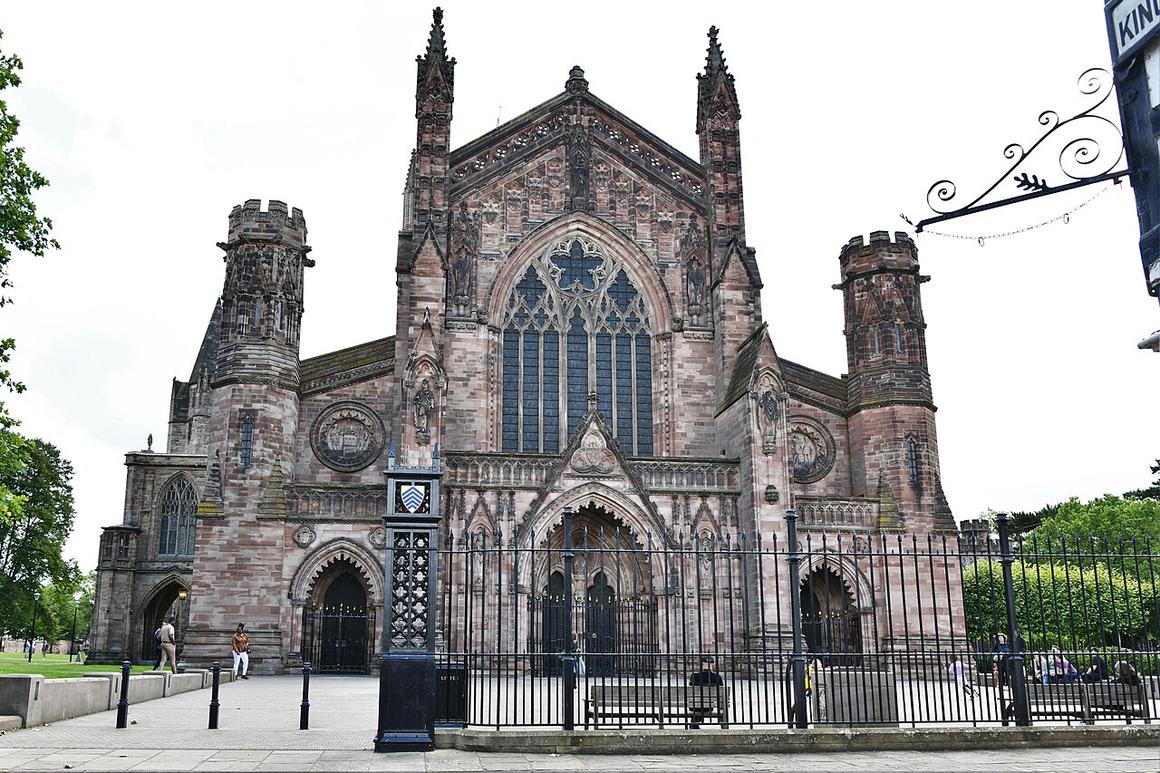
On Easter Monday 1786 the west tower collapsed, bringing down the west front and part of the nave. The architect James Wyatt was brought in to repair it, shortened the nave by a bay, and gave it a new front that almost nobody liked. That front was in turn replaced in 1902–08 by the one you see now, designed by John Oldrid Scott. It is a good Edwardian design in the local red sandstone, and it is worth knowing that it is younger than the railway station.
The visitor's cheat sheet
| Where | Cathedral Close, Hereford, HR1 2NG, in the city centre above the River Wye |
|---|---|
| Getting there | Hereford station is about 15 minutes’ walk; direct trains run from Birmingham, Cardiff, Worcester and London Paddington |
| Opening hours | Cathedral Mon–Sat 7.30am–5pm, Sun 12.30pm–3pm for visitors. The Mappa Mundi and Chained Library Museum, shop and café are open Mon–Sat 10am–4.30pm and closed on Sundays |
| Admission | Cathedral free, donations welcome. Mappa Mundi and Chained Library Museum around £7.50 adults, £6 students, £2 children 8–16, under-8s free |
| How long | 1 hour for the cathedral; 2 hours with the Mappa Mundi and Chained Library |
| Best time | A weekday morning, when the museum opens at 10am and before school groups arrive |
| Dress code | No formal code; respectful dress as in any working church |
| Dogs | Dogs are welcome in the cathedral but not in the museum, the cloisters, the inside of the café or services |
Hours and admission checked against the official site in September 2026. They change; the official site is always the last word.
Two tickets, or none. The cathedral is free. The Mappa Mundi and the Chained Library are in a separate museum in the cloister with its own ticket, and it is closed on Sundays. If the map is why you are coming, do not come on a Sunday.
What to see, in the order you meet it
The nave and the Norman east end
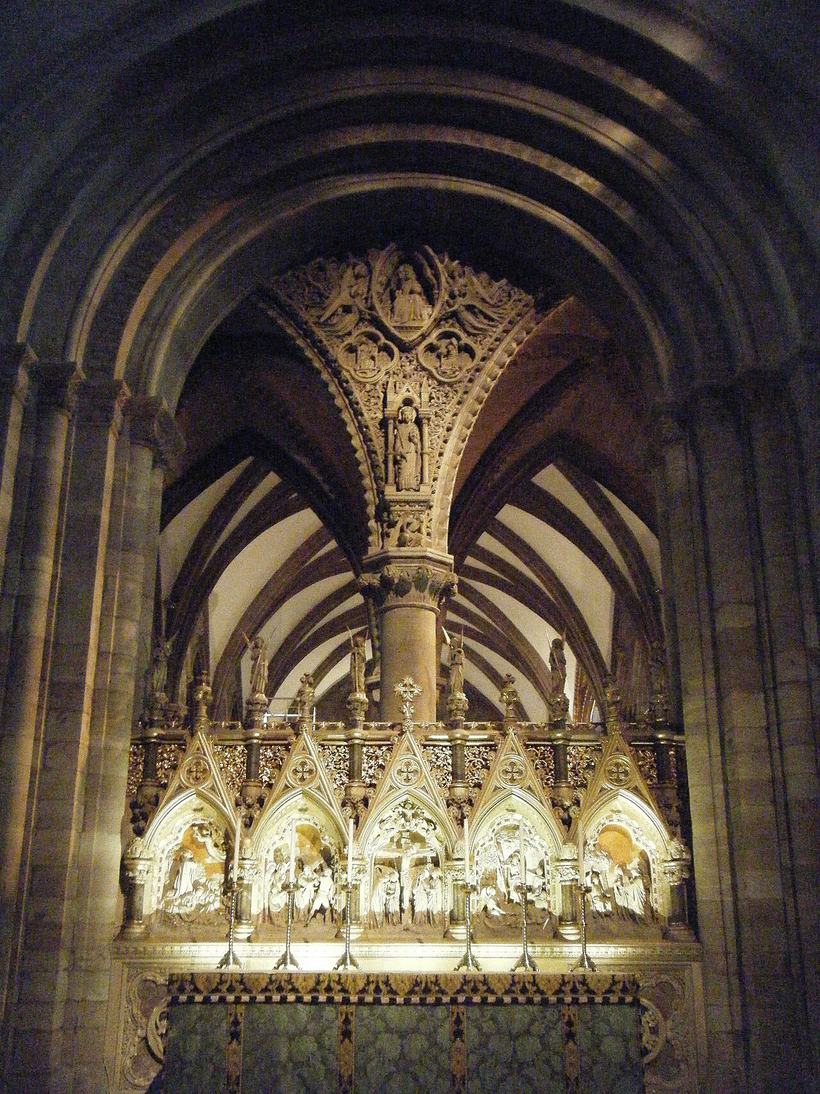
Enter by the north porch and the scale is Norman: the round piers march down the nave, heavy and plain, with carved capitals at their tops. Walk up to the crossing and look east through the choir to the high altar, which stands framed by a great Norman arch in the east wall of the presbytery — one of the best surviving pieces of the twelfth-century church.
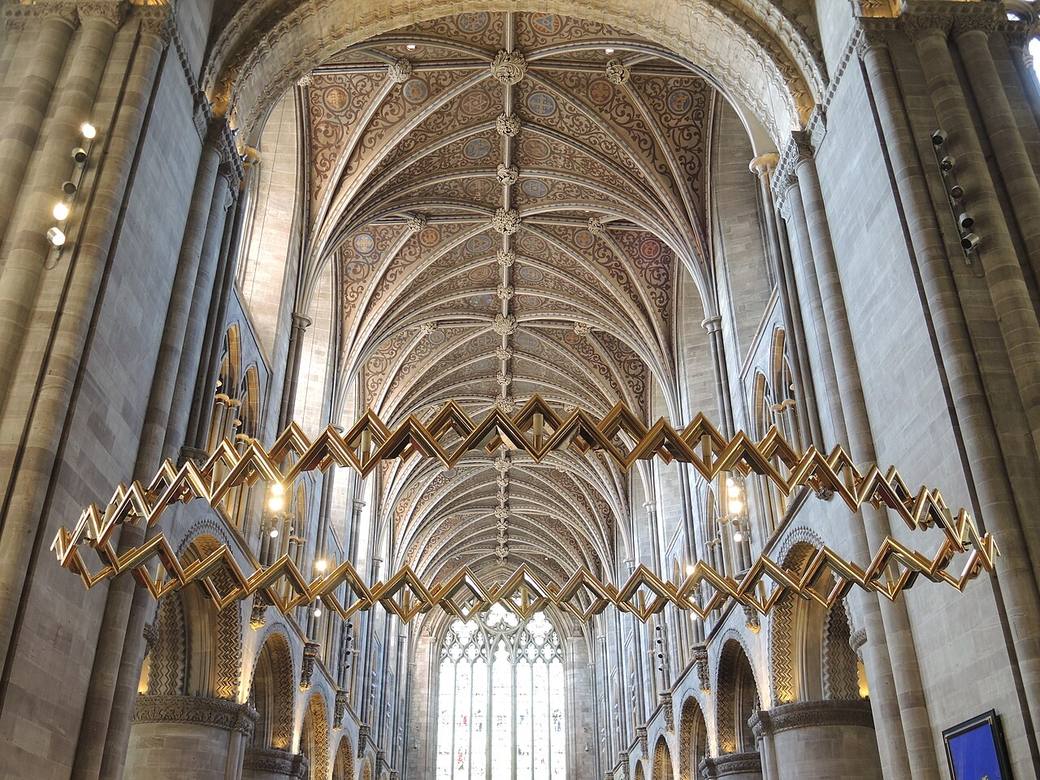
Under the tower hangs the corona, a modern crown of light suspended over the crossing. It is either a triumph or an intrusion depending on your view of new work in old buildings; either way, it makes the crossing feel inhabited.
The north transept and the shrine of St Thomas
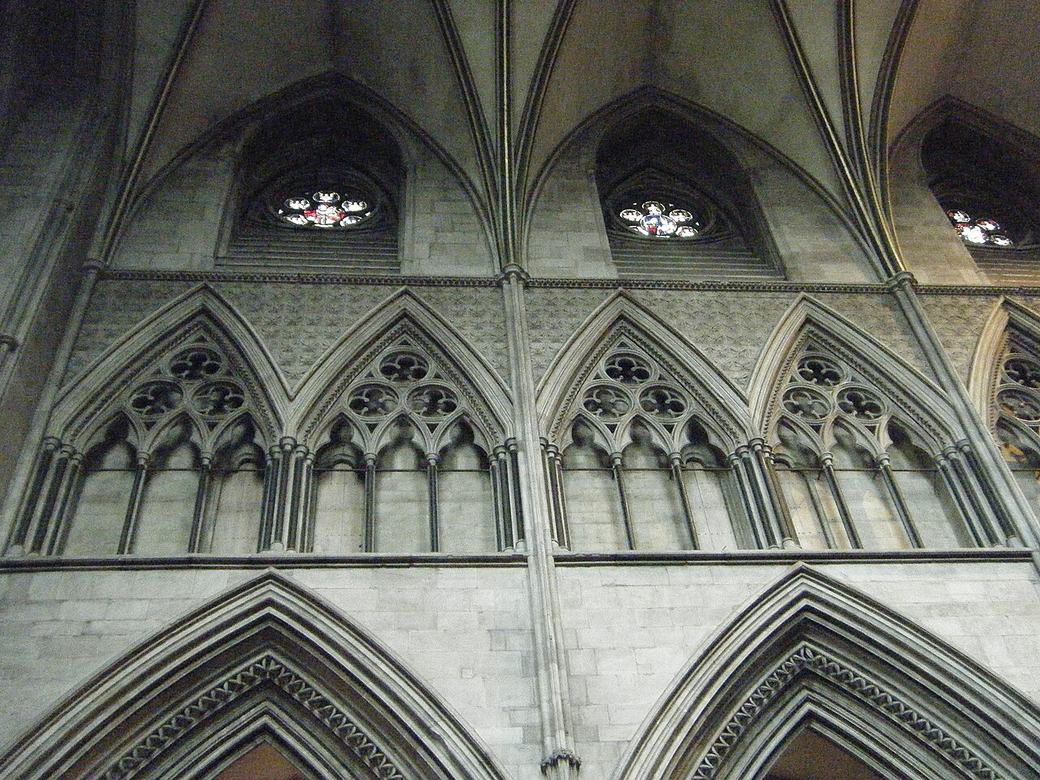
Turn into the north transept and the architecture goes strange. Built in the 1250s for Bishop Peter of Aquablanca, whose tomb is here, it has arches with straight sides rather than curves — triangles, almost — and a rich surface of carving that looks more French than English. It is one of the most distinctive thirteenth-century interiors in the country.
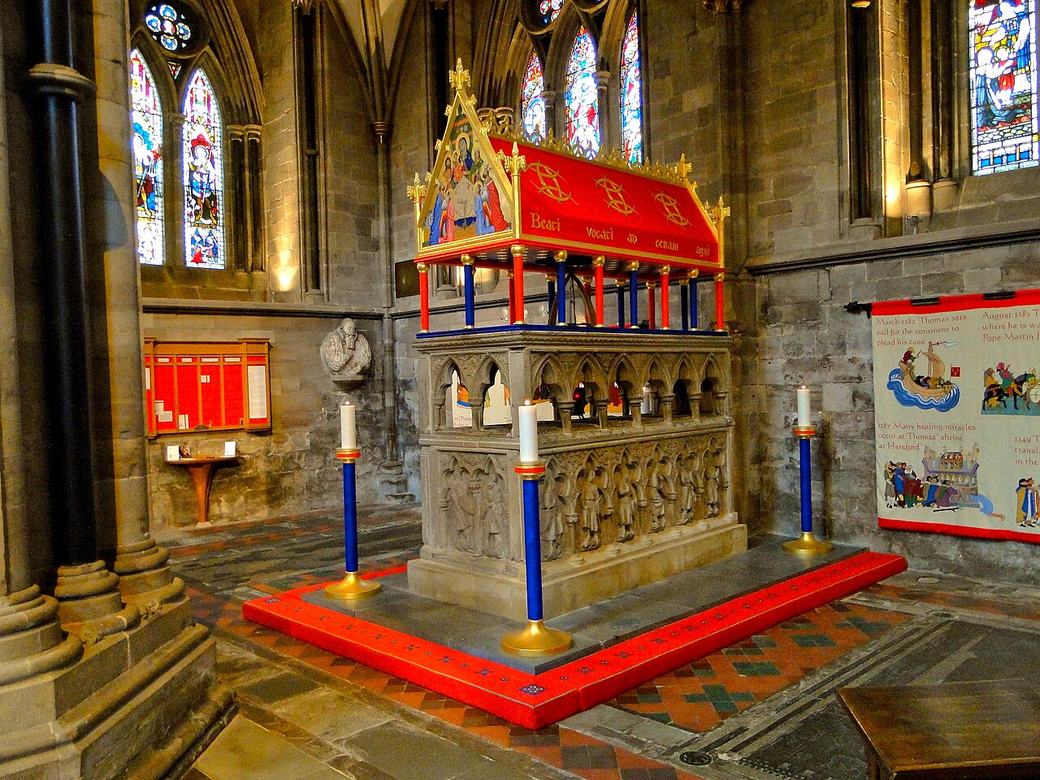
Here too is the shrine of Thomas de Cantilupe, bishop of Hereford, who died in 1282 and was canonised in 1320. He was the most popular English saint of his day after Becket, and the stone base of his shrine, carved with knights in armour, survived the Reformation. In 2008 it was given a new painted and gilded canopy, so that for the first time in five centuries it looks like a shrine again rather than a monument.
The Lady Chapel
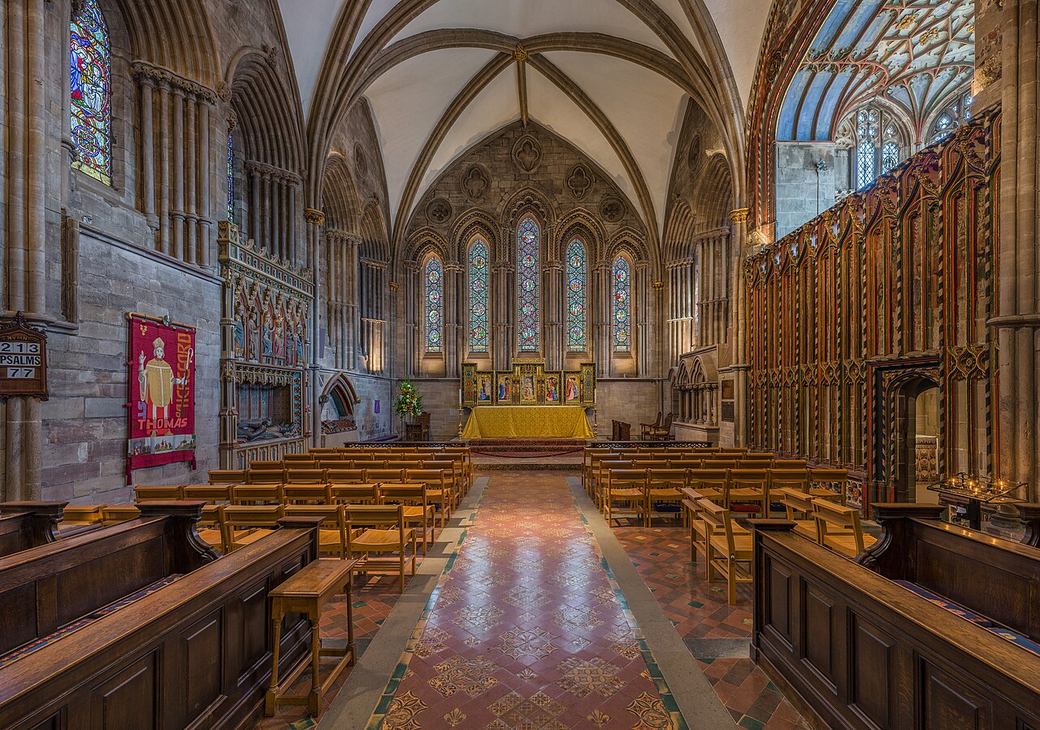
At the far east end, the Lady Chapel is Early English work of about 1220–40: tall lancet windows in groups, deep mouldings, and an east wall of five lancets that is one of the loveliest in the West Country. Beneath it is a crypt, which is unusual for an English cathedral of this date. Take a minute at the tombs along the side walls, and at the Audley chantry chapel opening off the south side.
Mappa Mundi
Now go out into the cloister and into the museum. The map is shown in low light in its own room, and the first surprise is its size: about 1.58 metres high by 1.33 wide, on a single calfskin, tapering to a point at the top. It was made about 1300 and names its author as Richard of Haldingham and Lafford — Holdingham and Sleaford, in Lincolnshire.
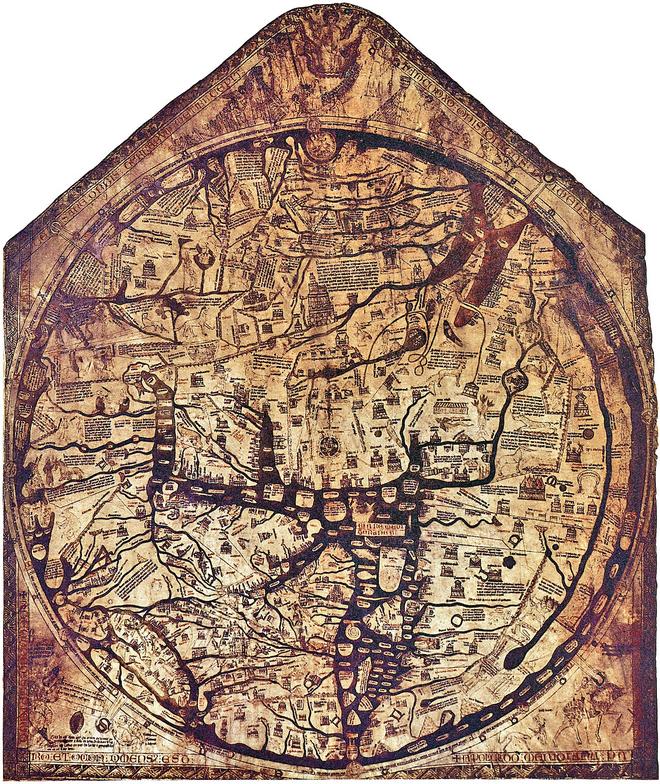
The second surprise is that it is not trying to be a map in our sense. East is at the top, where Paradise is shown as a circular island. Jerusalem is at the exact centre. The Mediterranean runs up the middle; Britain is squeezed into the bottom left-hand corner. And over the whole known world are some five hundred drawings: around 420 towns and cities, fifteen scenes from the Bible, plants, animals and the strange peoples medieval writers placed at the edge of the world — a man with one huge foot he uses as a sunshade, people with faces in their chests. At the top, Christ sits in judgement over all of it. It is history, geography, natural history and theology on one sheet, and an exhibition around it explains how to read it.
The Chained Library
In the next room stands the Chained Library, arranged as it was from 1611 to 1841. Each book is attached by a chain at the front cover to a rod along the shelf, so it can be taken down and read at the desk but not removed. They are shelved with their fore-edges facing out, which looks wrong until you realise it stops the chains tangling. It is the largest chained library to survive with all its chains, rods and locks. Among its more than 220 medieval manuscripts is the eighth-century Hereford Gospels, the cathedral’s oldest book, and the museum also holds one of the four surviving copies of the 1217 issue of Magna Carta.
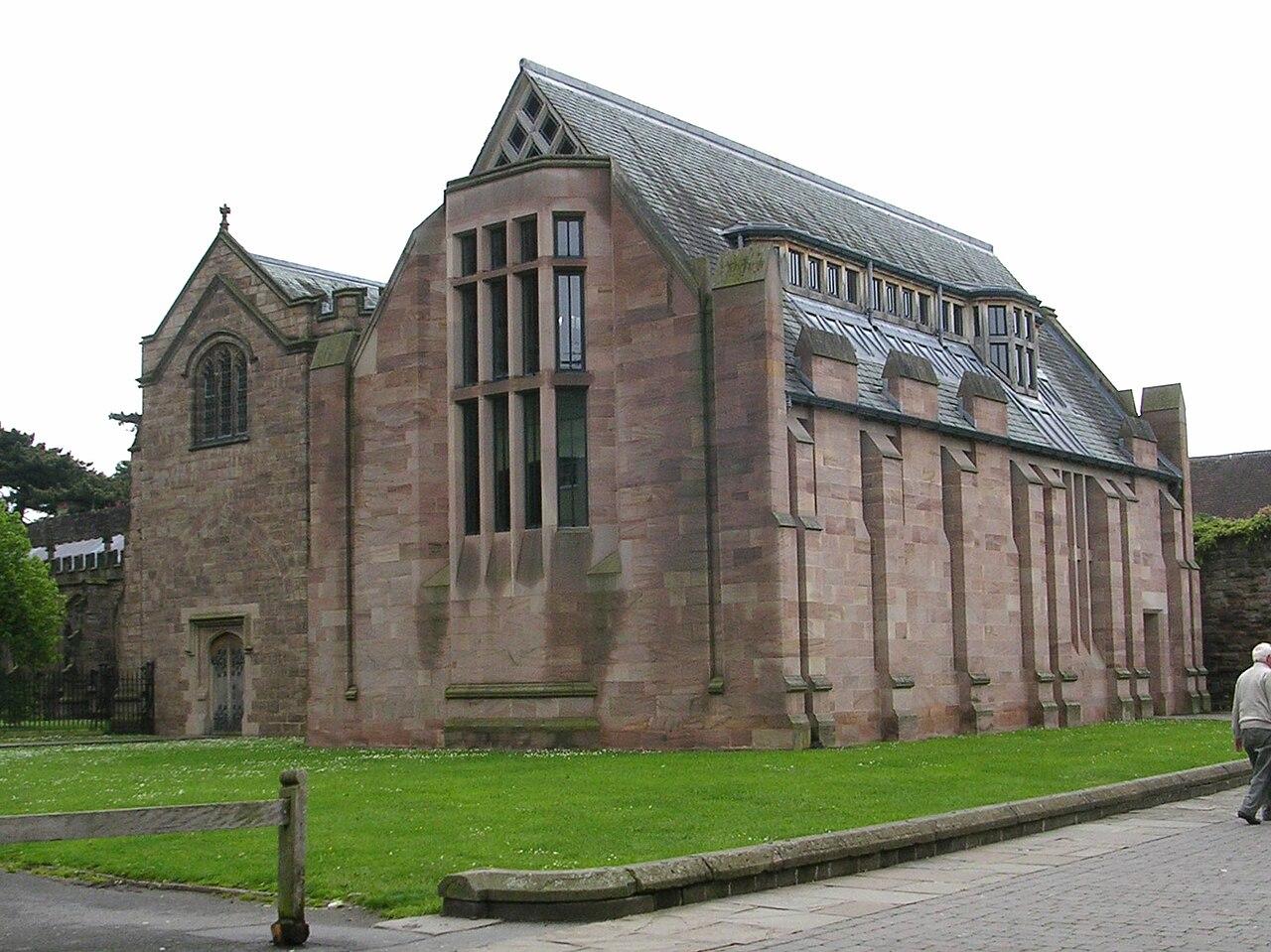
All of this is here because of the 1988 crisis. After the sale was announced, the National Heritage Memorial Fund and a large donation from Sir Paul Getty kept the map in Hereford, and the money paid for the New Library Building, opened in 1996, where the map and the library are now kept together.
Tickets and tours
Buy the museum ticket online in summer
The cathedral itself needs no ticket. The museum does, and in the school holidays it can be busy enough to make a timed booking worth having. It is open Monday to Saturday only; the last visitors are in by 4.30pm.
Tour and hotel links go to GetYourGuide and Booking.com. This site earns nothing from them at present — they are here because they are the quickest way to check what is actually available.
Don't miss
- Mappa Mundi The world as a medieval scholar saw it, about 1300, with Jerusalem in the middle and monsters at the edges.
- The Chained Library The largest surviving library with all its chains, arranged as it was in 1611.
- The Norman nave Round piers and round arches of the early 1100s, the oldest large part of the church.
- The north transept Straight-sided arches of the 1250s, and Bishop Aquablanca’s tomb.
- St Thomas de Cantilupe's shrine The medieval base, carved with knights, under its new painted canopy.
- The Lady Chapel Early English lancets at their best, and a crypt beneath.
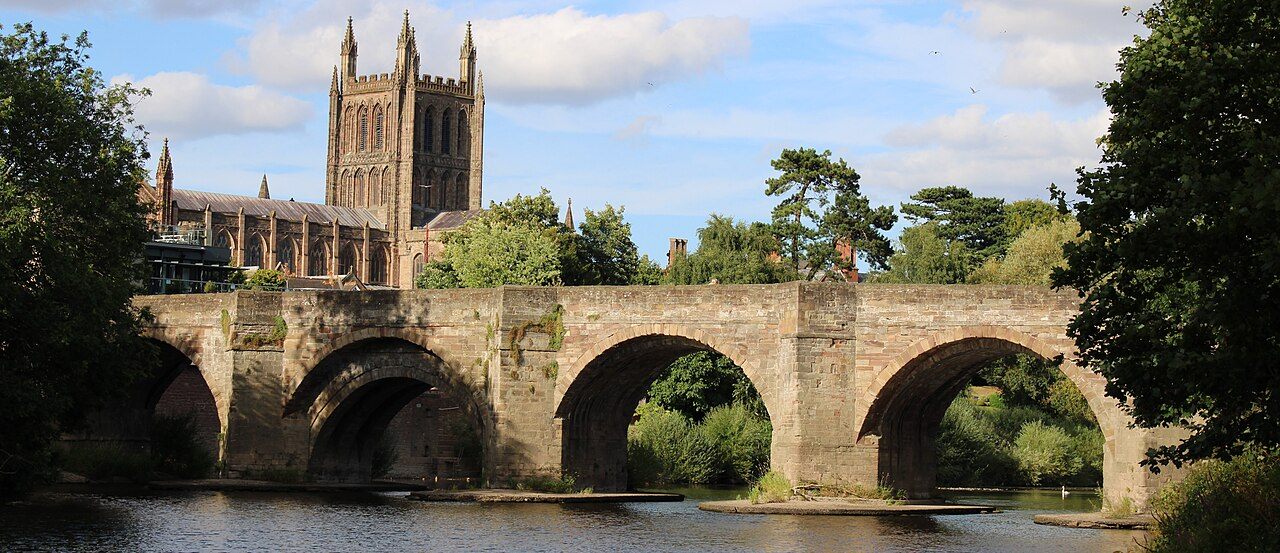
- The view from the Wye Bridge Five minutes’ walk, and the best view of the tower you will get.
Insider tips
Come on a weekday. Sunday sightseeing is limited to the afternoon, and the museum, shop and café are all closed. Saturday is fine, but weekdays are quieter.
Hereford is one of the three cathedrals of the Three Choirs Festival, which it shares with Gloucester and Worcester and which has been held since the early eighteenth century. When it is Hereford’s turn, in late July, the city fills with choral music and accommodation fills with singers; plan accordingly.
Evensong is at 5.30pm on weekdays and 3.30pm on Sundays and costs nothing.
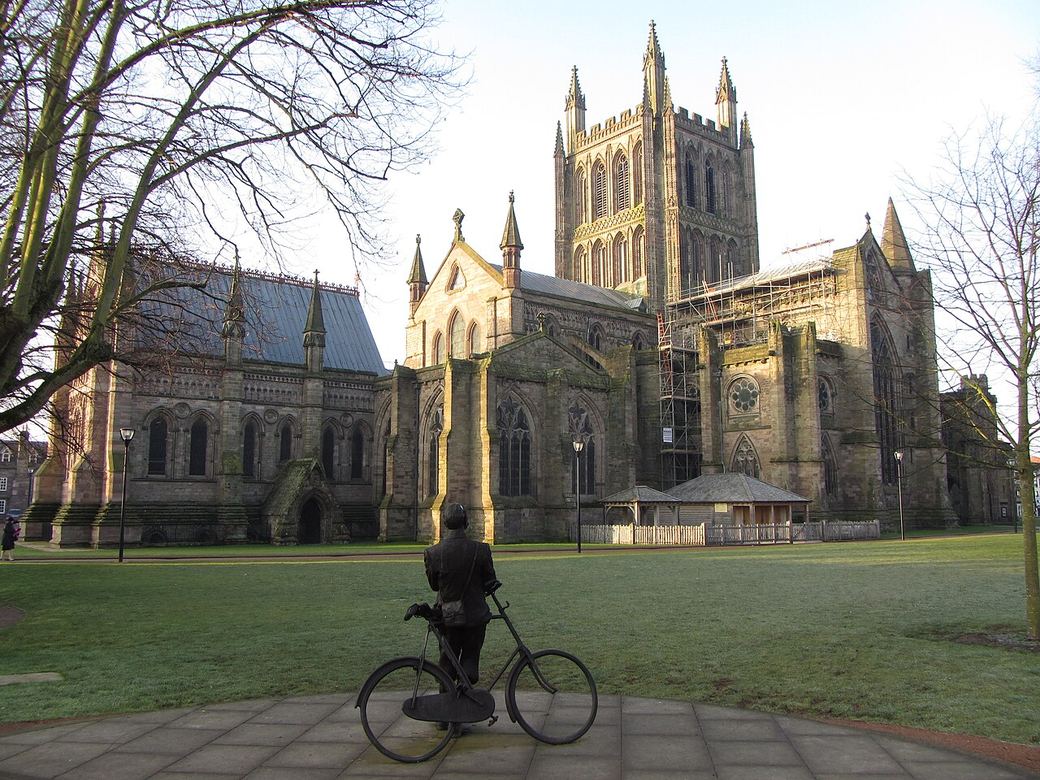
On the green by the cathedral, Edward Elgar leans on his bicycle and looks at the building. He lived in Hereford from 1904 to 1911 and cycled the lanes of Herefordshire while composing. Then walk down to the river: the medieval Wye Bridge is a few minutes away, and the view back to the tower across the water is the picture everyone takes.
Common questions
Is Hereford Cathedral free to visit?
Yes. There is no charge to enter the cathedral, though donations are welcome. The Mappa Mundi and Chained Library Museum is separately ticketed at around £7.50 for adults, £2 for children aged 8 to 16 and free for under-8s.
What is the Mappa Mundi?
The largest medieval map in the world still in existence, drawn on a single sheet of vellum about 1.58 by 1.33 metres around the year 1300. It puts Jerusalem at the centre and east at the top, and fills the known world with around 500 drawings: cities, Bible stories, animals, and the monstrous peoples medieval writers believed lived at the edges of the earth.
When is the Mappa Mundi open?
The museum is open Monday to Saturday from 10am, with the last visitors leaving by 4.30pm. It is closed on Sundays and over the main winter holidays, and closes for conservation work for part of January each year.
Why is the Chained Library chained?
Security. Books were valuable, and chaining them to the shelf let readers take them down and read them at the desk without walking off with them. Hereford’s library, arranged this way in 1611, is the largest to survive with all its chains, rods and locks in place. The books are shelved with their fore-edges facing out so they can be lifted down without tangling the chain.
How long do you need at Hereford Cathedral?
An hour for the cathedral and another hour for the Mappa Mundi and Chained Library. Add half an hour for the cloisters and a walk to the Wye Bridge for the view.
Where to stay and eat nearby
Hereford is a small market city and everything is walkable. Church Street and the lanes north of the cathedral have independent cafes; the Cathedral Café in the cloister is good for lunch. The Black and White House Museum, a Jacobean timber-framed house in High Town, is a ten-minute walk and worth the detour.
More English cathedrals
- Gloucester Cathedral — its Three Choirs partner, an hour away, with the first fan vault
- Exeter Cathedral — another Norman cathedral remade in the Gothic centuries
- Wells Cathedral — Early English at its most complete
See all the cathedrals and churches worth visiting in England →