
Lichfield Cathedral
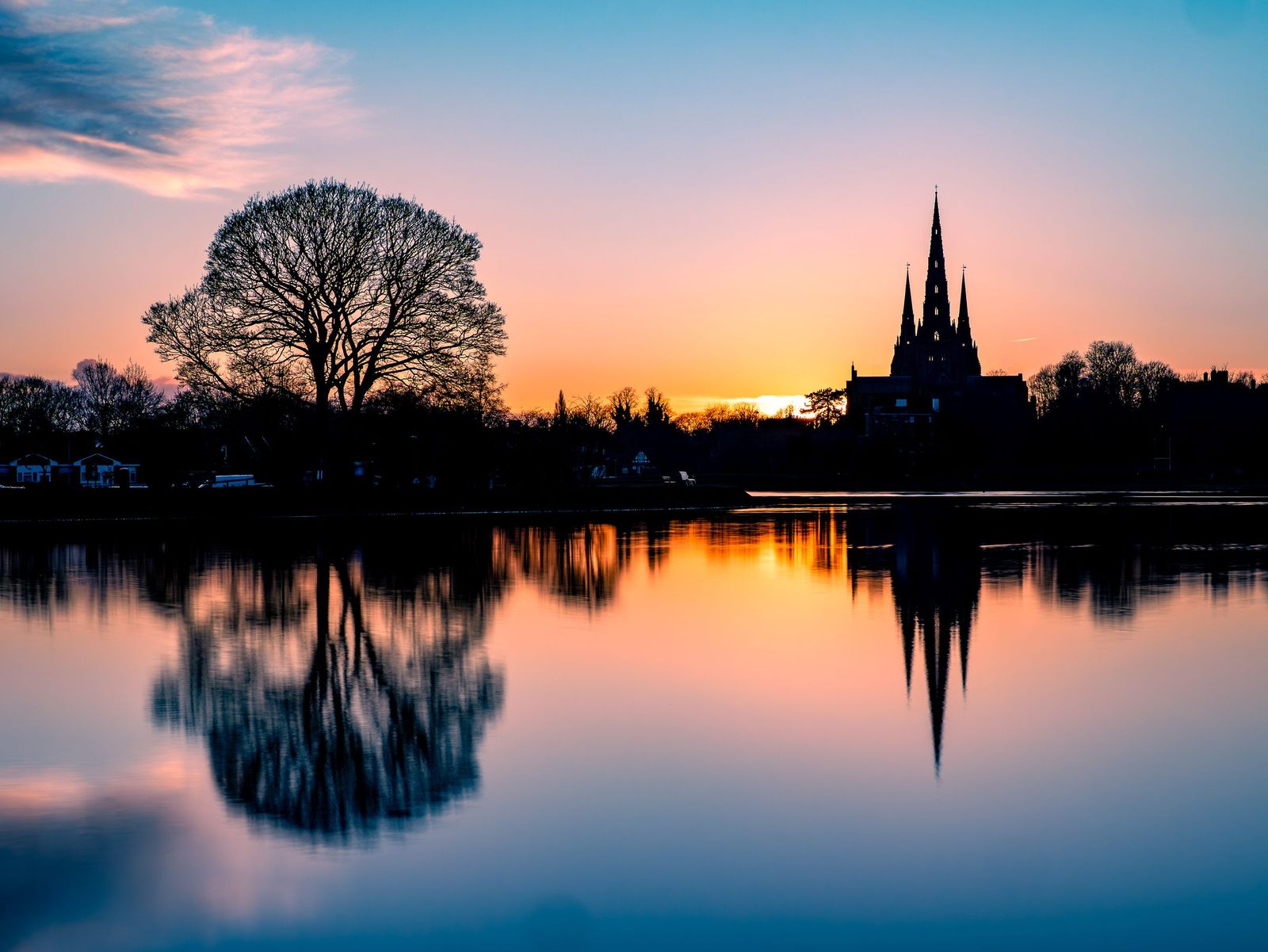
On 2 March 1643, St Chad’s Day, the Parliamentarian commander Lord Brooke was directing an attack on the Royalists holding Lichfield Cathedral when a shot fired from the central tower killed him outright. Three years later the tower’s spire was brought down by cannon. Lichfield rebuilt it, and today it is the only medieval cathedral in England with three spires — red sandstone, rising out of a quiet close beside two pools.
St Chad, an archbishop and three sieges
The story starts with Chad, the bishop of the Mercians from 669 until his death in 672. He fixed the centre of his huge diocese at Lichfield, and after his death his bones became the focus of a pilgrimage cult. A church to house them was built around 700. For a few years at the end of the eighth century, under King Offa of Mercia, Lichfield was even the seat of an archbishop, the only time England has had three archbishoprics.
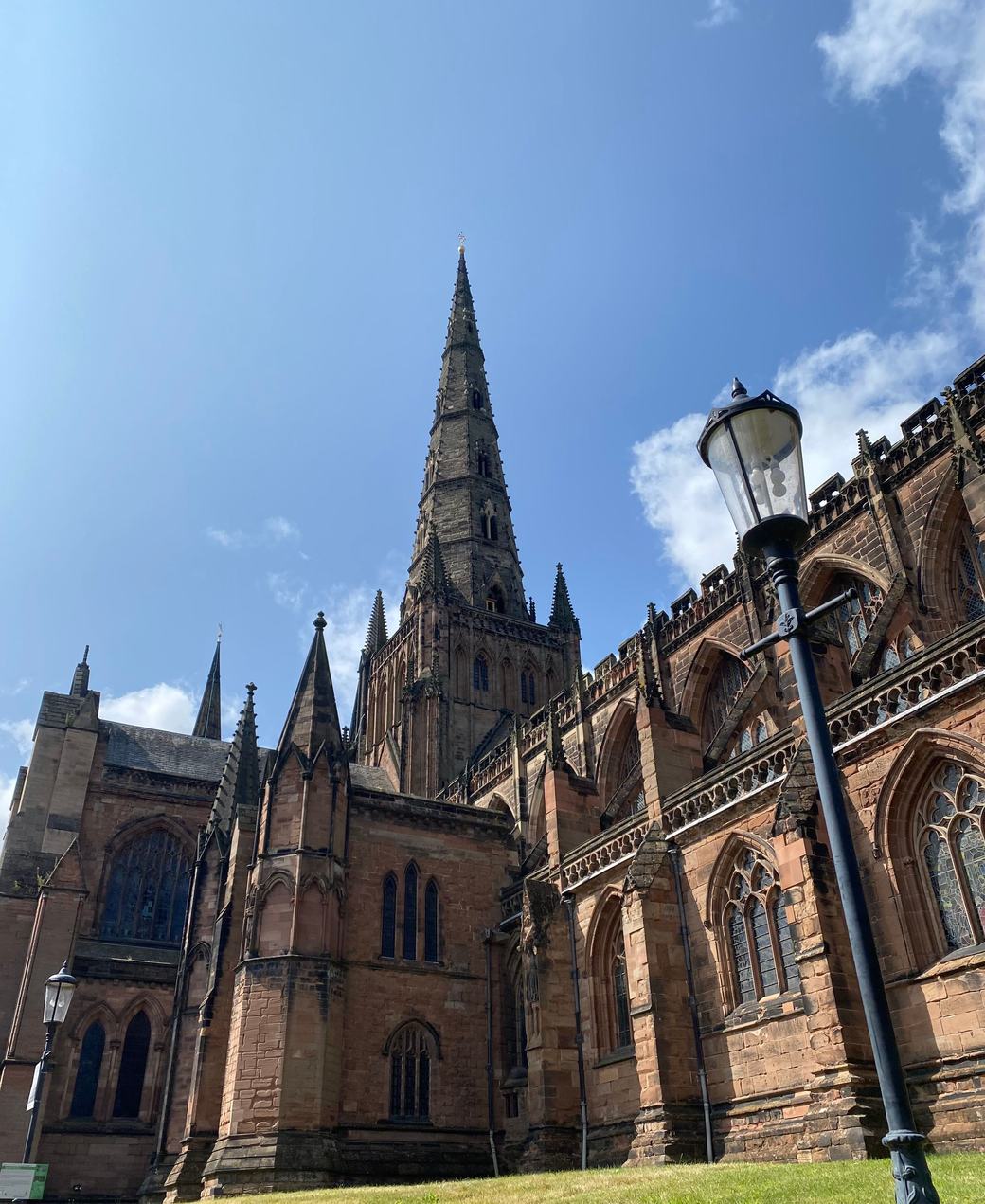
The Normans rebuilt the church from about 1085, and the present Gothic building replaced theirs in stages from about 1195: first the quire, then the transepts, the nave around the middle of the thirteenth century and the west front at its end, and finally the Lady Chapel and the spires in the fourteenth century. The red sandstone is local, and it is soft, which is why so much of the carving has had to be replaced.
The Civil War was a catastrophe for Lichfield. The Close was fortified and besieged three times between 1643 and 1646. Lord Brooke was shot at the start of the first siege; the central spire fell in the last. The building was left wrecked, and it was restored only after 1660, by Bishop John Hacket, who set about it with remarkable energy and lived just long enough to see it reconsecrated in 1669. A heavy-handed eighteenth-century scheme by James Wyatt was followed by a long Victorian restoration under George Gilbert Scott and his son, who gave the cathedral most of its present furnishing and repopulated the west front with statues.
The visitor's cheat sheet
| Where | 19a The Close, Lichfield, Staffordshire, WS13 7LD |
|---|---|
| Getting there | Lichfield City station is about 10 minutes’ walk (trains from Birmingham); Lichfield Trent Valley, on the main line from London Euston, is about 30 minutes’ walk or a short bus ride |
| Opening hours | Mon–Sat 10am–5pm; Sun 12pm–5pm; last entry 4.30pm. Services sometimes close the east end for part of the afternoon |
| Admission | Free; a £5 donation per person is suggested. Highlights tours about £5 at 11am and 2pm Mon–Sat; tower tours ticketed and bookable online |
| How long | 1–1.5 hours; 2–3 hours with a tower tour |
| Best time | Late afternoon for the light on the west front, or sunset from Stowe Pool |
| Dress code | No formal code; respectful dress as in any working church |
| Dogs | Well-behaved dogs on a short lead are welcome during visiting hours |
Hours and admission checked against the official site in October 2026. They change; the official site is always the last word.
Three spires, one survivor. The two western spires are medieval. The central spire is the one that came down in 1646; the version you see was rebuilt after the Restoration and later restored by the Victorians. From a distance you cannot tell, which is rather the point.
What to see, in the order you meet it
The west front
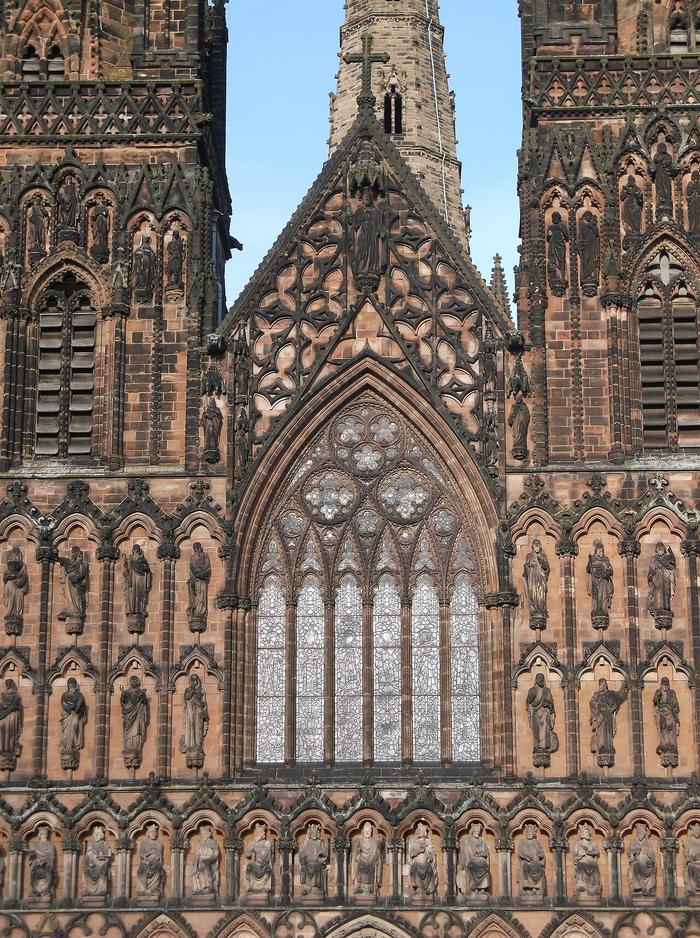
Start outside, on the lawn in front of the west end. The whole front is covered in tiers of carved figures — kings, saints, prophets, apostles, with Christ at the top — set in arcading between the two western spires. Almost all of the statues are Victorian replacements for medieval figures that were lost to the Reformation, the Civil War and the weather, but the composition is medieval, and the effect is the closest thing in England to the screen fronts of the French cathedrals.
The nave
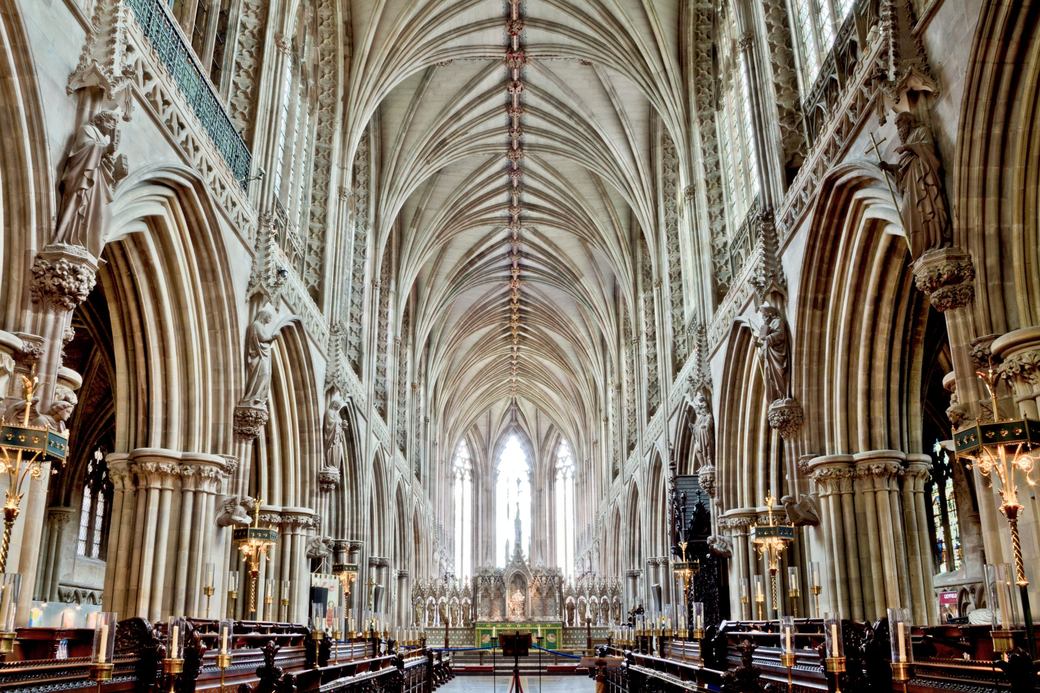
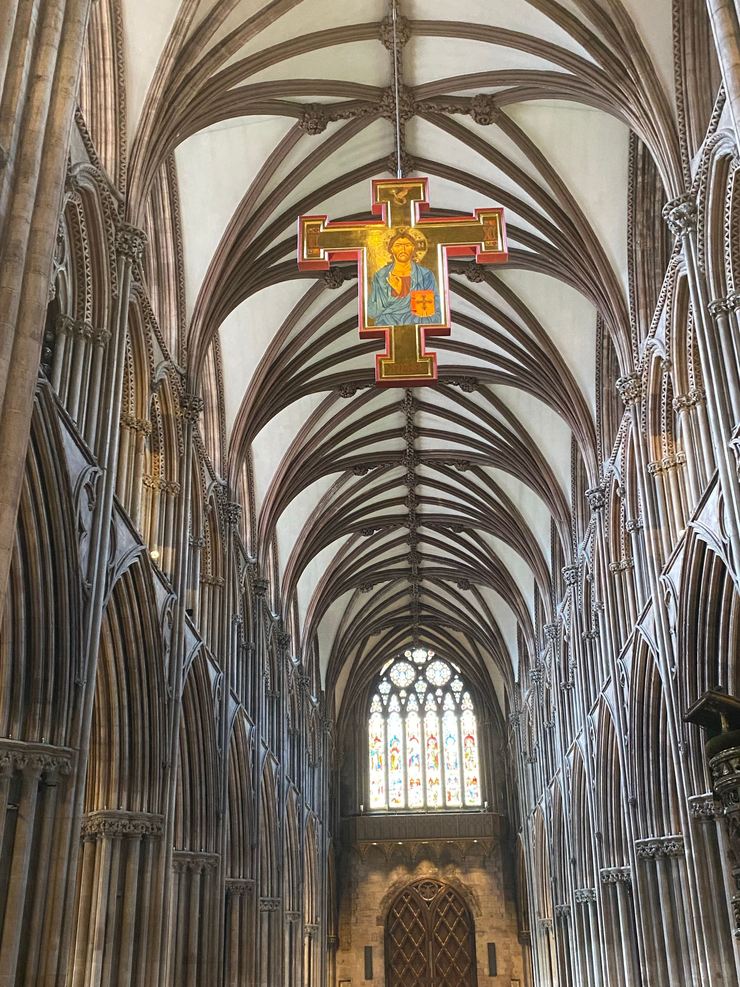
Inside, the nave is of the mid-thirteenth century, and it is one of the most elegant of its date: each pier is a bundle of slender shafts, the triforium is richly carved, and the clerestory windows are curved triangles, an unusual shape. The floor of the nave is where the Lichfield Angel was found.
The Lichfield Angel
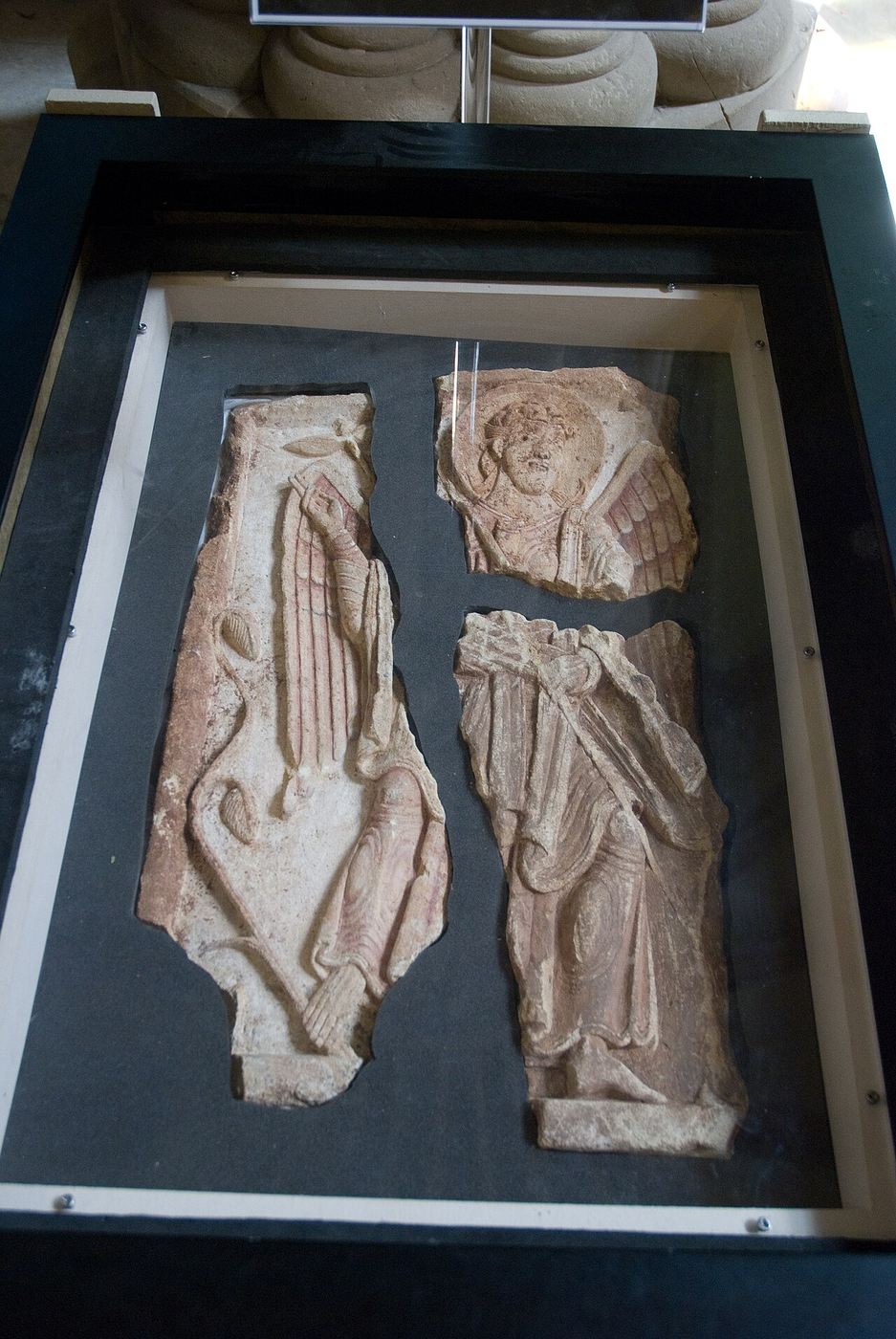
In 2003 archaeologists excavating beneath the nave before a new platform was built found three fragments of a carved limestone panel. Put together they make the archangel Gabriel, from a scene of the Annunciation, carved around 800 and still bearing traces of red and other pigments. It is thought to have been part of a shrine chest for St Chad. It is one of the finest pieces of Anglo-Saxon sculpture in existence, and it is on show inside the cathedral.
The St Chad Gospels
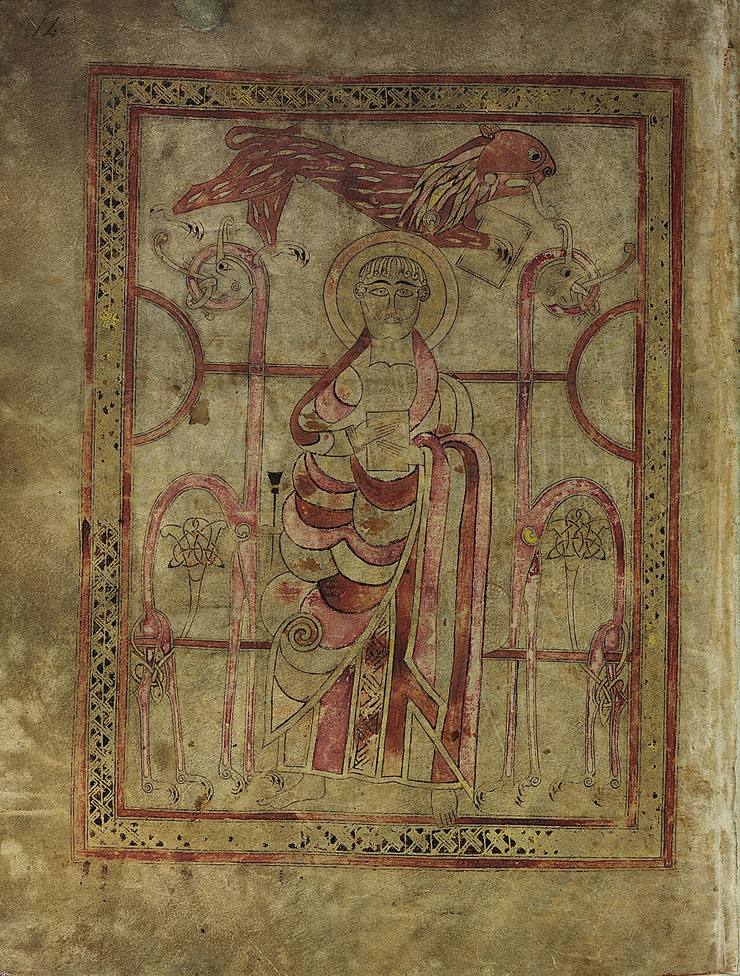
The cathedral’s greatest treasure is a book: the St Chad Gospels, an illuminated gospel book of the early eighth century, related in style to the Lindisfarne Gospels. At some point it was in Wales, where notes were written into its margins in Old Welsh — some of the oldest surviving written Welsh — and it has been at Lichfield since at least the tenth century. It is not always on display; ask what can be seen on the day.
The quire and the shrine of St Chad
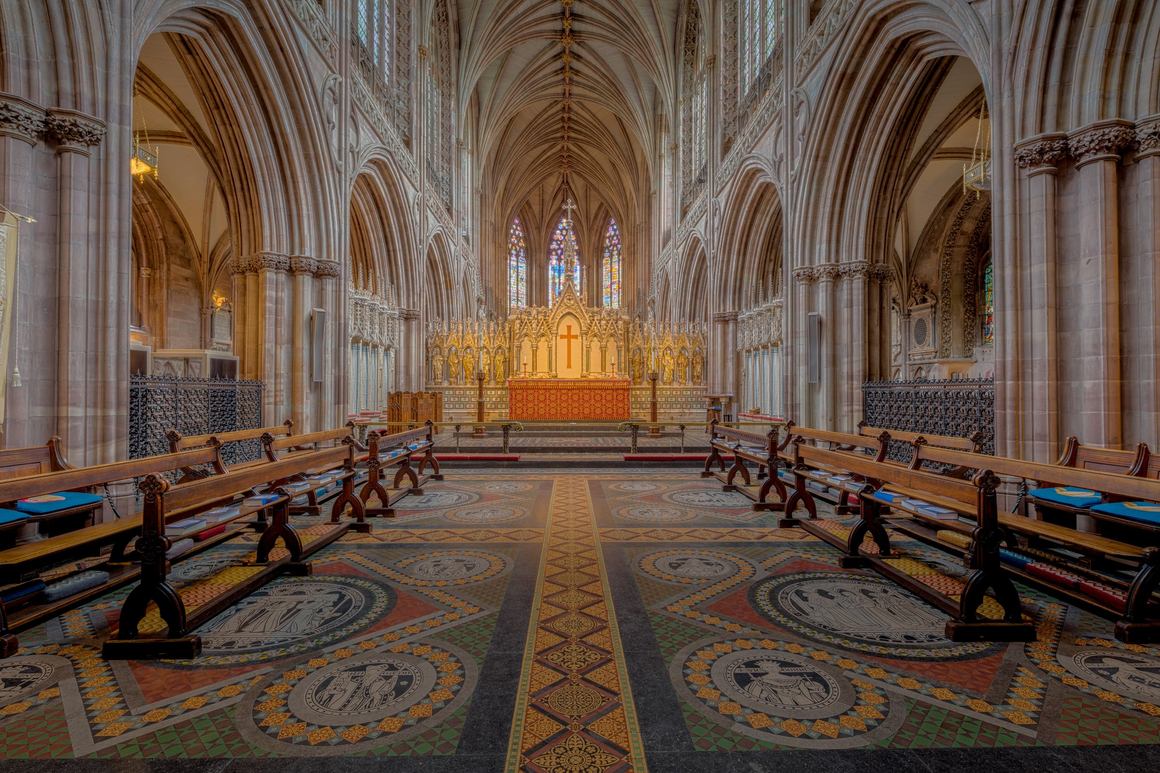
Through the screen, the quire is where the Victorian restoration is most lavish: the encaustic tile floor, the metalwork screen and the reredos are all of the 1860s. Behind the high altar, the site of Chad’s medieval shrine is marked, and the saint is commemorated each year on 2 March.
The Lady Chapel and the Herkenrode glass
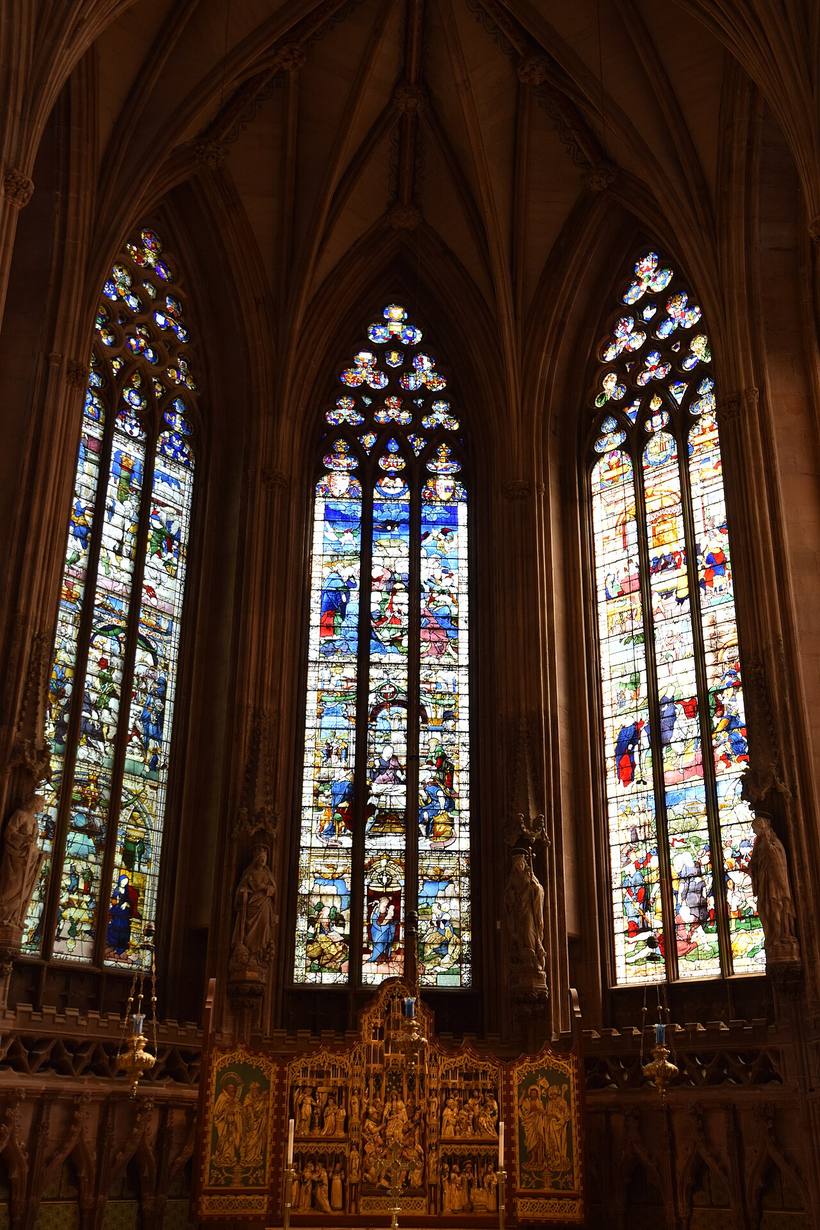
At the east end is the Lady Chapel of the fourteenth century, tall and filled with light, and its windows are the surprise of the visit. The glass in them was made in the 1530s for the Cistercian abbey of Herkenrode, near Hasselt in present-day Belgium. When that abbey was dissolved after the French Revolution, the glass was bought in 1802 by Sir Brooke Boothby, a local landowner, and brought to Lichfield. It is some of the finest Renaissance glass in England, and after a major conservation project it was put back in the chapel in the 2010s.
The Sleeping Children
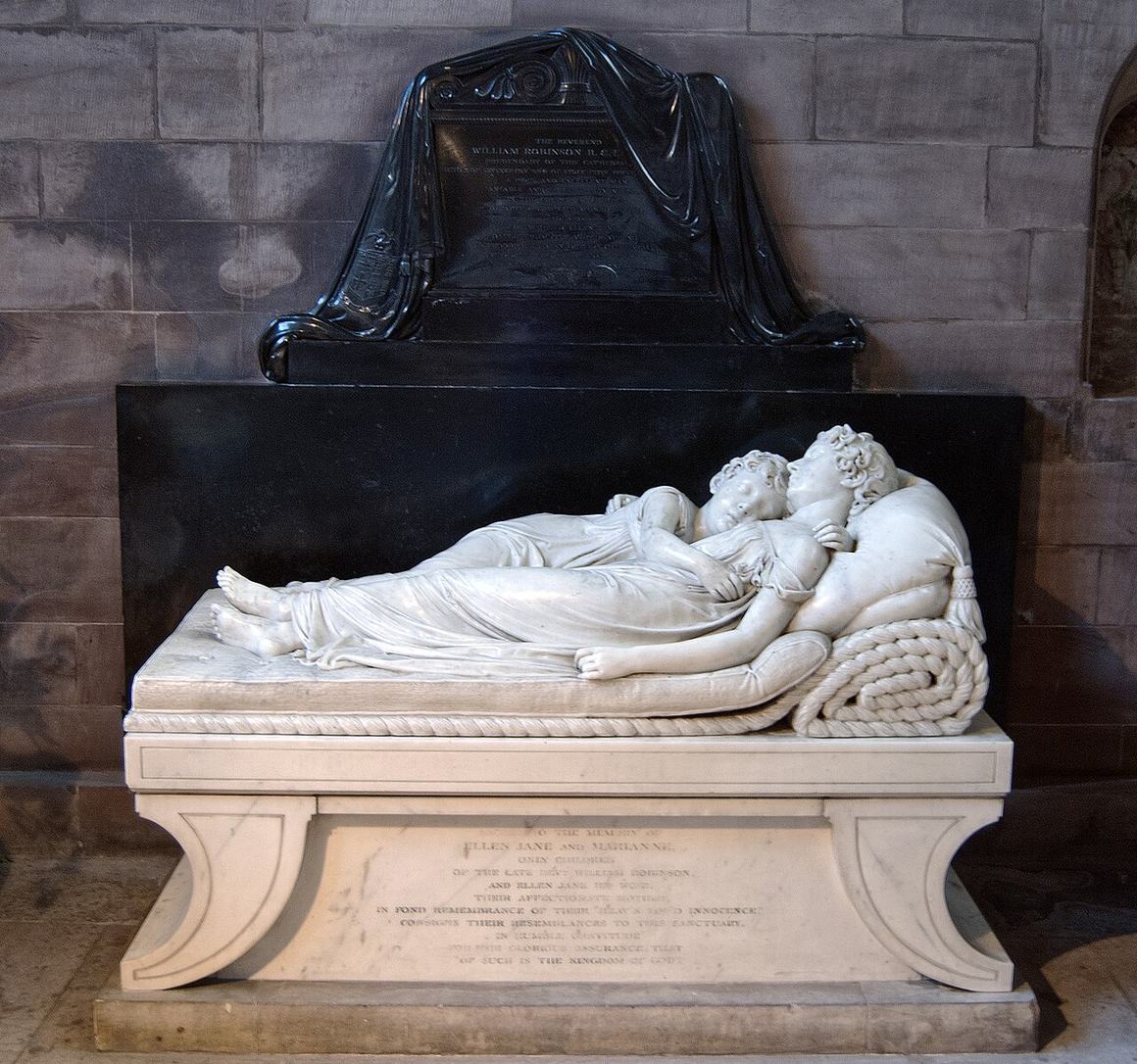
In the south quire aisle is a monument that has moved visitors since it was unveiled: Francis Chantrey’s Sleeping Children of 1817, two young sisters lying together in white marble, one with a bunch of snowdrops in her hand. It commemorates the daughters of the Reverend William Robinson, who died young.
The chapter house
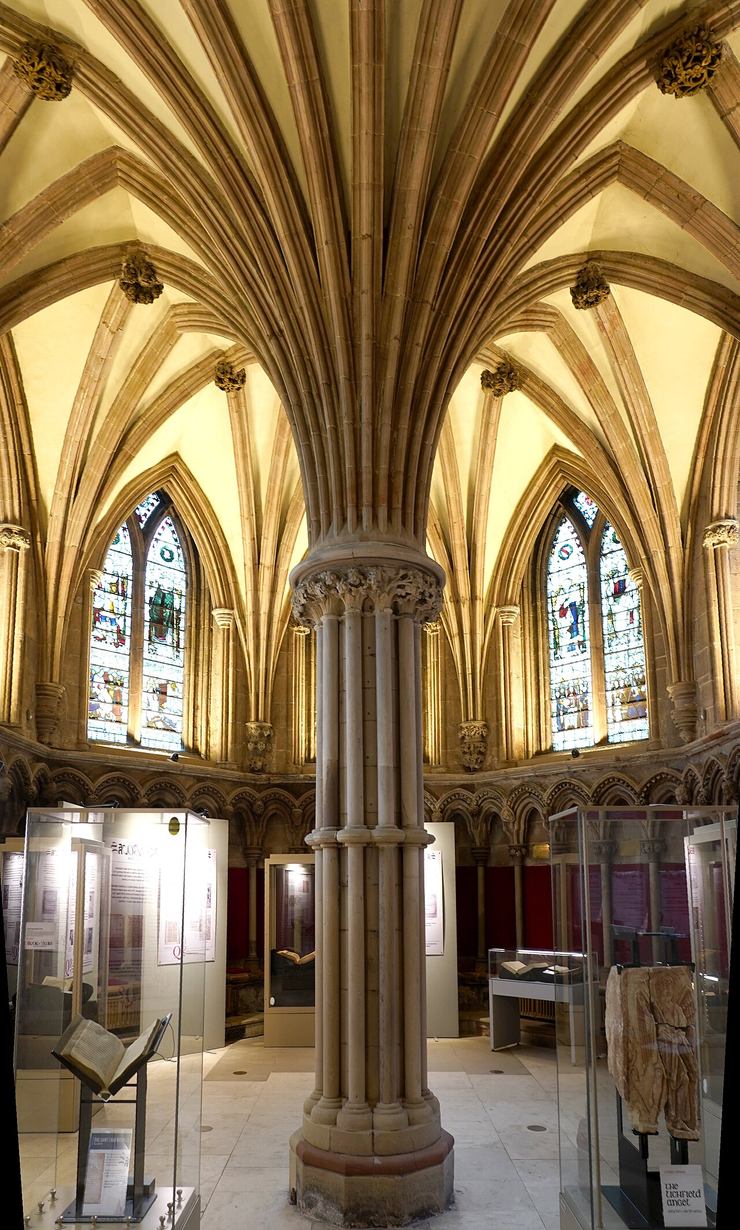
Off the north quire aisle a vestibule leads to the chapter house of the thirteenth century, an elongated octagon round a central pillar, with medieval wall painting and the cathedral library above it. It is used for exhibitions and displays of the cathedral’s treasures.
Tickets and tours
Book a tower tour in advance
Highlights tours run at 11am and 2pm from Monday to Saturday and cannot be booked; just turn up. The tower tours — a 60-minute climb to the room where the chimes are rung, and a 90-minute rooftop tour up the north-west tower and out above the nave — are booked online and sell out at weekends.
Tour and hotel links go to GetYourGuide and Booking.com. This site earns nothing from them at present — they are here because they are the quickest way to check what is actually available.
Don't miss
- The three spires Best seen together from across Stowe Pool or Minster Pool.
- The west front Tier upon tier of carved figures between the western spires.
- The Lichfield Angel An archangel of about 800, found under the nave in 2003.
- The St Chad Gospels An eighth-century gospel book with early Welsh in its margins.
- The Herkenrode glass Renaissance glass from a Belgian abbey, in the Lady Chapel.
- The Sleeping Children Chantrey’s two sisters in white marble.
- The chapter house A thirteenth-century octagon with its library above.
Insider tips
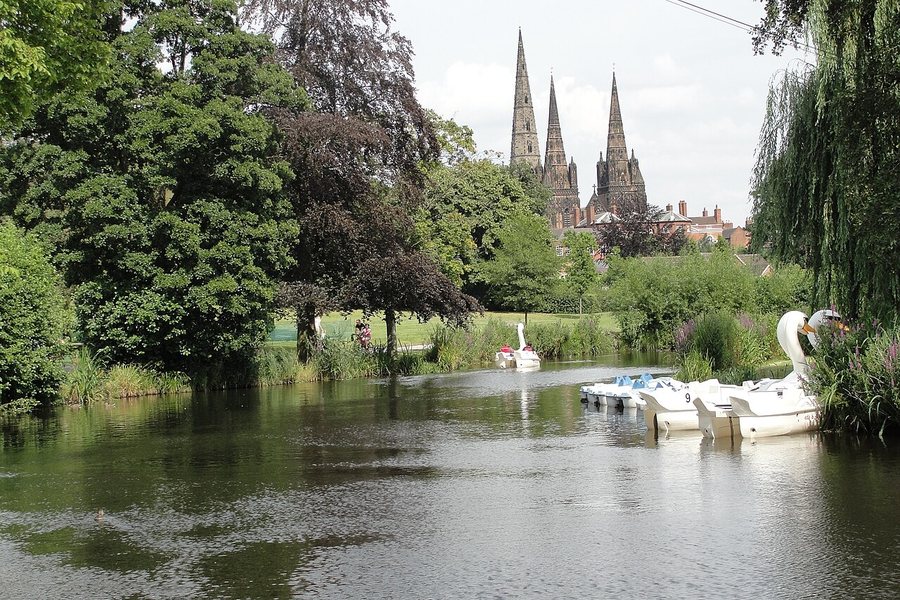
Walk round the pools. The classic views of the three spires are from the paths around Stowe Pool and Minster Pool, a few minutes from the Close. At sunset the spires are reflected in the water.
Lichfield is the birthplace of Samuel Johnson, who was born in 1709 in a house on the market square that is now a museum. Erasmus Darwin, the physician, poet and grandfather of Charles, lived in a house on the edge of the Close, also now a museum. Both are a short walk from the cathedral.
Choral Evensong is sung on most days. It is free and lasts about forty-five minutes.
Common questions
Is Lichfield Cathedral free to visit?
Yes. Entry is by donation, with about £5 per person suggested. The 45-minute highlights tours also cost about £5, and the tower tours are ticketed separately.
Why does Lichfield Cathedral have three spires?
Because its builders gave it two spires on the west front and a third over the crossing, and all three have survived, or been rebuilt. It is the only medieval cathedral in England with three. The central spire was shot down in the Civil War and rebuilt after 1660. Locally the three are known as the “Ladies of the Vale”.
What is the Lichfield Angel?
A carved limestone panel of the archangel Gabriel, made around 800 and probably part of the shrine of St Chad. It was found in 2003 when archaeologists dug under the nave before a new platform was built, and it still carries traces of its original paint. It is on display in the cathedral.
Who was St Chad?
The bishop of the Mercians from 669 until his death in 672, who made Lichfield the centre of his diocese. His shrine made the cathedral a place of pilgrimage for the rest of the Middle Ages. The cathedral is dedicated to St Mary and St Chad.
Can you go up the towers at Lichfield Cathedral?
Yes, on guided tower tours that are booked online: a 60-minute climb to the bell-chiming room and a longer rooftop tour that goes up the north-west tower and out above the nave. They involve narrow spiral staircases and sell out at busy times.
Where to stay and eat nearby
The Close has a café, and the small city centre beyond Dam Street has pubs, tearooms and restaurants within five minutes’ walk. Lichfield is a short train ride from Birmingham, and many visitors come for the day.
More English cathedrals
- Coventry Cathedral — half an hour away, and another cathedral wrecked by war
- Worcester Cathedral — King John’s tomb and a Norman crypt
- Wells Cathedral — the other great sculpted west front
See all the cathedrals and churches worth visiting in England →