
Churches to Visit in Japan
Christianity came to Japan with Francis Xavier in 1549 and spread fast around Nagasaki, until it was banned in the early seventeenth century. For two and a half centuries the Hidden Christians of the Nagasaki region kept their faith in secret; their villages and churches were inscribed by UNESCO in 2018 as the Hidden Christian Sites in the Nagasaki Region. This chapter begins at Urakami, a Hidden Christian village outside the World Heritage listing, whose cathedral was destroyed by the atomic bomb in 1945 and rebuilt, and at Oura Church, where the Hidden Christians made themselves known in 1865, and in Tokyo, at Kenzo Tange’s steel-clad cathedral of 1964.

Where to start
Urakami Cathedral, Nagasaki
The cathedral of the Hidden Christians, destroyed in 1945 and rebuilt, with scorched statues and the fallen dome of its bell tower. Free.

Oura Church, Nagasaki
The white church of 1864 where the Hidden Christians made themselves known in 1865: a National Treasure, with the Christian Museum. ¥1,000.
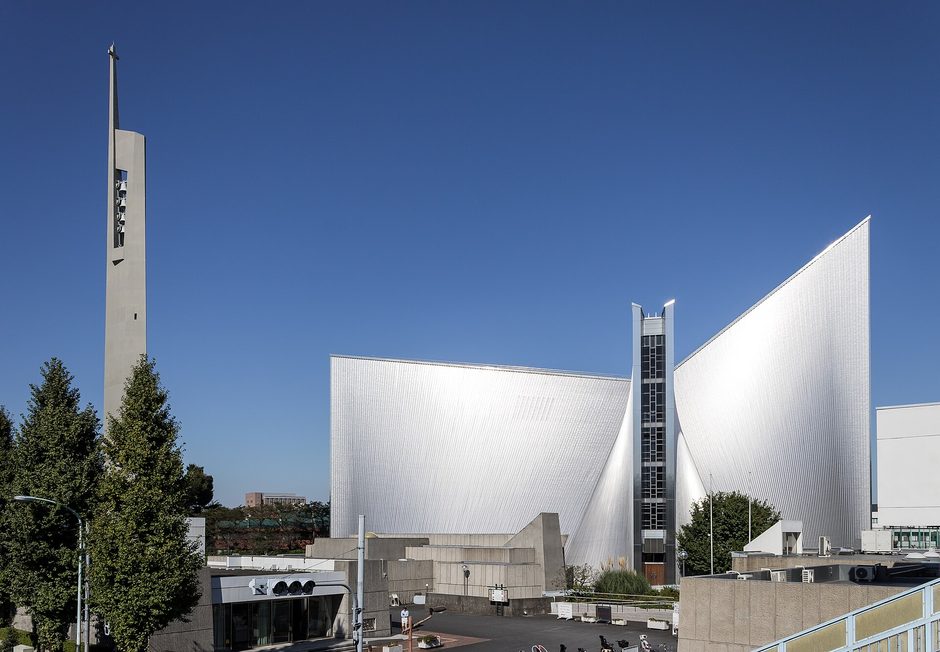
St Mary’s Cathedral, Tokyo
Kenzo Tange’s cathedral of 1964: eight curved shells clad in steel, meeting in a cross of light. Free.
Practical notes
| Admission | Most churches are free, with a donation box; Oura Cathedral in Nagasaki charges admission |
|---|---|
| Photography | Photography and filming are not allowed inside Nagasaki’s Catholic churches |
| Etiquette | Churches are places of prayer: no visiting during Mass, funerals or weddings; dress modestly, remove hats and keep out of the sanctuary |
| Advance notice | Several churches in the World Heritage villages, including Shitsu, Kuroshima and Kashiragashima, ask visitors to give prior notice through the Nagasaki Churches Information Center |
| Getting around | Nagasaki’s trams link the station, the Peace Park area and the old harbour districts |
Coming next
The Twenty-Six Martyrs Monument and Museum at Nishizaka, and the churches of the Hidden Christian villages, are the obvious next additions.