
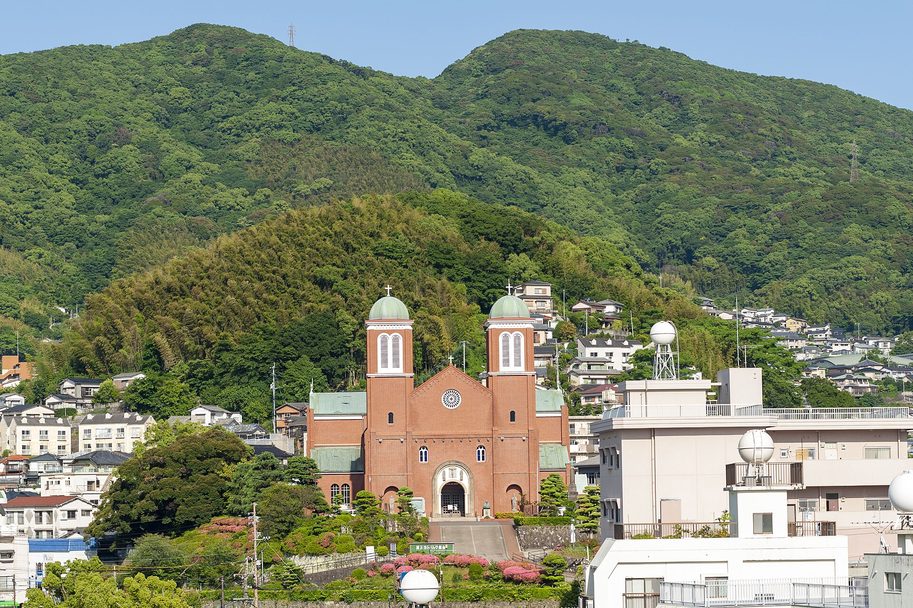
Urakami Cathedral, Nagasaki
Urakami was the village of Nagasaki’s Hidden Christians, who kept their faith in secret for two and a half centuries. Their great brick cathedral, finished in 1925, stood about 500 metres from the point over which the atomic bomb exploded on 9 August 1945, and was destroyed. The cathedral you visit today was built in 1959 and clad in brick in 1980 to recall the old one; around it are scorched statues from the ruins, and below it the dome of a bell tower still lies where it fell.

The Hidden Christians of Urakami
Christianity came to Nagasaki with Portuguese traders and Jesuit missionaries in the sixteenth century, and was banned in the early seventeenth. In Urakami, families went on practising in secret for some 250 years, while once a year officials made the villagers tread on Christian images at the house of the village headman, on the site where the cathedral now stands. In 1865 a group from Urakami revealed their faith to a French priest at the newly built Oura Church in Nagasaki. A wave of persecution followed: from 1867 more than 3,000 Urakami Christians were exiled across Japan, and many died before the ban was lifted in 1873.
When they came home, they bought the headman’s land. Building began in 1895 to a design by the French missionary Father Fraineau, and the villagers laboured on it for decades; the church was dedicated in 1915 (some sources say 1914), and its twin bell towers were completed in 1925 by the builder Tetsukawa Yosuke. It was said to be the largest church in East Asia.

The visitor’s cheat sheet
| Where | 1-79 Motoo-machi, Nagasaki, on a low hill east of the Peace Park |
|---|---|
| Opening hours | Daily 9am–5pm for visitors. No visiting during Mass, funerals or weddings |
| Admission | Free; donation box |
| Relics room | Ground floor of the parish hall: 10am–4pm, Sundays and holidays 10am–3pm, closed Thursdays; free |
| Mass | Weekdays 6am; Saturday 7pm; Sunday 7am and 9am, with an evening Mass on most Sundays |
| Photography | Not allowed inside the church; the grounds and the outside may be photographed |
| Dress | Modest clothing; remove hats; keep to the back of the church and do not enter the sanctuary |
| Getting there | Tram to Heiwa Koen (Peace Park), about 10 minutes from Nagasaki Station, then 8–10 minutes’ walk uphill |
| How long | Half an hour, more with the relics room and the fallen tower |
Hours and admission checked against the official site in November 2026. They change; the official site is always the last word.
9 August 1945
At 11.02am on 9 August 1945 the atomic bomb exploded over the Urakami valley. The cathedral, about 500 metres away, was destroyed and burned; the two priests and the people inside, who had come to make their confession before the feast of the Assumption, were killed, and a large part of the Catholic community of Urakami died. The dome of the north bell tower was thrown into the stream below the hill. The parish could not break it up, so the stream was diverted and the dome left where it fell; it is now part of a national historic site.
The larger of the two French bells was dug out of the rubble almost undamaged and rang again at Christmas 1945. It gave its name to The Bells of Nagasaki, the book by Dr Takashi Nagai, an Urakami doctor and survivor, and it still rings for the Angelus. In 2025 a new small bell, paid for by an appeal led from the United States, was hung in the other tower, and on 9 August 2025 both towers rang together for the first time in eighty years.

The ruins were cleared in 1958, despite calls to keep them as a memorial. A section of wall was rebuilt in Hypocentre Park, and the new cathedral, of reinforced concrete, was finished on the old site in 1959. It became the cathedral of the Archdiocese of Nagasaki in 1962, and in 1980, before Pope John Paul II’s visit, it was faced in red brick to look like the church that was lost.
What to see
The front and the scorched statues
Statues that survived from the old church were set into the new front, among them Our Lady of Sorrows and St John beside the crucifix over the door. More stand along the approach on the left: saints and angels blackened by the heat, with heads, noses and hands broken off.


The fallen bell tower
Walk round the north side of the grounds and look down the slope to see the dome of the old bell tower, lying on its side by the stream.


The Atom-bombed Mary
The most famous relic of the old cathedral is the head of the wooden statue of the Virgin that stood above the high altar, its glass eyes burned out. A Trappist monk from Urakami found it in the ruins after the bombing. It is kept in a small chapel in the cathedral that ordinary visitors do not enter, and a replica is displayed at the back of the church. On the 9th of each month at 10am the prayer for the atomic-bomb survivors is held in the chapel, and on 9 August the statue is carried in the evening torchlit procession to the Peace Park. From late November 2026 the archbishop is taking it to the United States for the first review conference of the Treaty on the Prohibition of Nuclear Weapons at the United Nations.
The relics room
On the ground floor of the parish hall, a small free exhibition shows objects recovered from the ruins: melted chalices and a monstrance, fragments of the small bell that was destroyed, stone heads, and a stone angel taken home by an American sailor and returned in 1985.
Inside the church
The interior is a single broad nave with stained-glass windows of the life of Christ. It is a busy parish church: visitors stay near the entrance, and the church is closed to sightseers during Mass, funerals and weddings.
A note on our pictures. Photography is not allowed inside Nagasaki’s Catholic churches, so our photographs show the outside, the grounds and historic pictures only.
Getting there
From Nagasaki Station, take the tram towards Akasako to the Heiwa Koen (Peace Park) stop, about ten minutes; older guides call it Matsuyama-machi. From there the cathedral is 8–10 minutes’ walk, uphill. Bus 30 from the station stops at Urakami Tenshudo-mae, a minute from the gate. The airport limousine bus on the route via Urakami stops at Heiwa Koen on its way to Nagasaki Station (under an hour; ¥1,400). The Atomic Bomb Museum, Hypocentre Park and the Peace Statue are all within about ten minutes’ walk.

Where to stay
Nagasaki is compact, and the trams make everywhere in the city easy to reach from a hotel near the station.
This link goes to Booking.com. This site earns nothing from it at present — it is here because it is the quickest way to check what is actually available.
Don’t miss
- The fallen dome The old bell tower’s top, where it landed in 1945.
- The scorched statues Saints from the old church, burned and broken.
- The relics room Melted chalices and the fragments of the small bell.
- The Angelus bell The bell that survived, still rung every day.
Insider tips
Come on the 9th. At 10am on the 9th of each month the parish prays for the survivors of the bomb in the Atom-bombed Mary’s chapel (not in December 2026, when the statue is in the United States).
Pair it with the museum. Visit the Atomic Bomb Museum and Hypocentre Park first and walk up to the cathedral afterwards: the wall fragment in the park and the fallen dome here tell the same story.
Check the relics room day. It is closed on Thursdays.


Common questions
Is Urakami Cathedral free to visit?
Yes. Visitors are welcome from 9am to 5pm, and there is a donation box. The small exhibition of objects recovered from the ruins, in the parish hall, is free too.
Can you see the Atom-bombed Mary?
The burned head of the cathedral’s statue of the Virgin is kept in a small chapel that ordinary visitors do not enter; a replica is displayed at the back of the church. The prayer for atomic-bomb survivors is held in the chapel at 10am on the 9th of each month, and the statue is carried in the torchlit procession on the evening of 9 August. From late November 2026 it is due to be in the United States, where the archbishop is taking it to the first review conference of the Treaty on the Prohibition of Nuclear Weapons at the United Nations (30 November–4 December); check its return before you go.
Can you take photographs inside?
No. Photography and filming are not allowed inside any of Nagasaki’s Catholic churches. You can photograph the outside and the grounds.
How far is Urakami Cathedral from the Atomic Bomb Museum?
About half a kilometre: the museum, Hypocentre Park and the Peace Park are all within about ten minutes’ walk.
More churches to visit
- Oura Church, Nagasaki — the white church of 1864 where the Hidden Christians of Urakami made themselves known.
- Ruins of St Paul’s, Macau — the Jesuit church at the gateway to China and Japan, carved, by tradition, with the help of Japanese Christians in exile.
- San Agustin Church, Manila — the church that survived the destruction of Intramuros in 1945.
- Myeongdong Cathedral, Seoul — Korea’s great Catholic cathedral, built on a hill above the city in the 1890s.