
Beverley Minster
Beverley Minster is a parish church in a market town in the East Riding of Yorkshire, and it is one of the most beautiful Gothic buildings in Europe. It is bigger than a third of England’s cathedrals, and more unified than almost any of them: the medieval masons who built its nave in the 1300s chose to copy the style of the east end, a century old by then, rather than follow fashion, so that the whole church reads as a single design. It holds a Saxon stone chair that once offered sanctuary to fugitives, the most extravagant tomb canopy in England, the largest set of misericords in the country, and dozens of medieval musicians carved in stone.
St John, the canons and the Reformation
John of Beverley was a Northumbrian monk who became Bishop of Hexham and then of York, and who founded a monastery at Beverley, where he retired and died in 721. Miracles were reported at his tomb, he was canonised in 1037, and Beverley grew rich on pilgrims. English kings carried his banner into battle against the Scots, and Henry V, whose victory at Agincourt in 1415 fell on the feast of John’s translation, came here to give thanks.
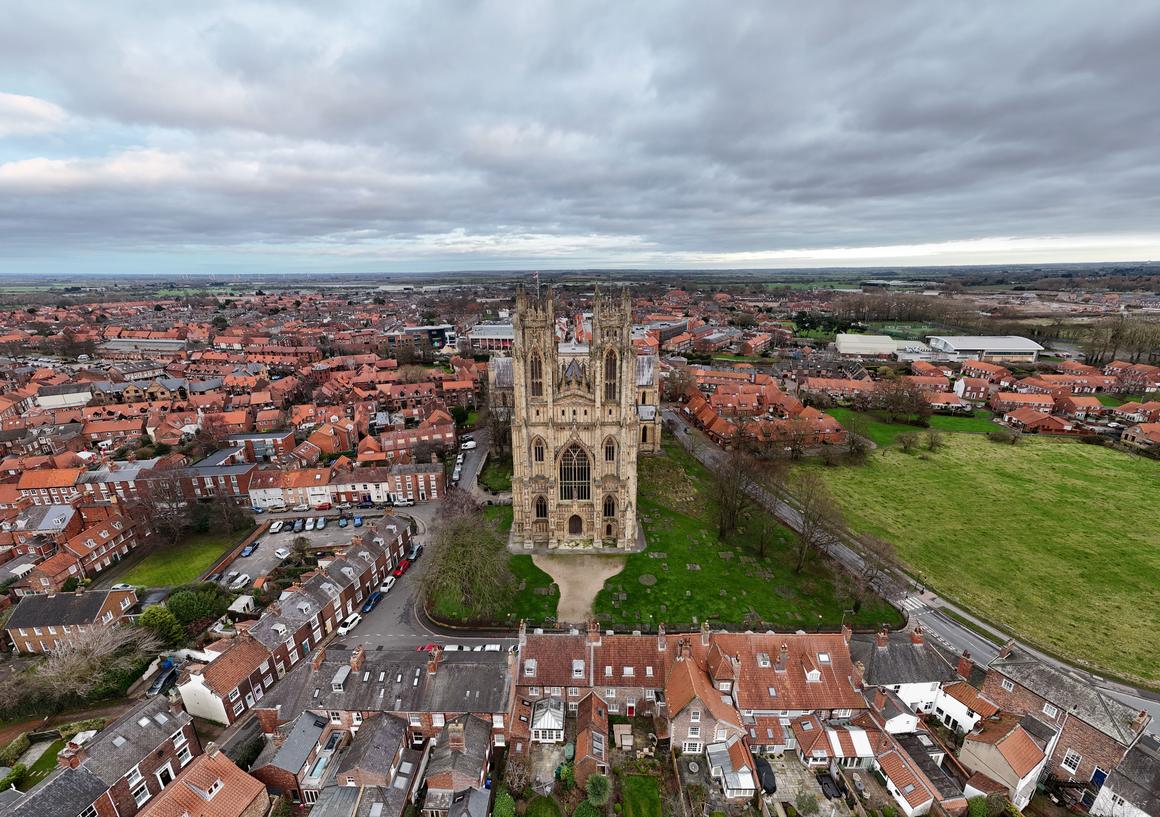
The church was served by a college of canons. After the central tower fell in the early thirteenth century, they began rebuilding the east end in the Early English style, from about 1220. The nave followed in the fourteenth century and the west front in the decades around 1400. At the Reformation the college was dissolved and the shrine of St John destroyed, but the townspeople kept the church as their parish church, which it has been ever since.
The visitor's cheat sheet
| Where | Highgate, Beverley, East Yorkshire, HU17 0DP, at the south end of the town centre |
|---|---|
| Getting there | Beverley station is about 10 minutes’ walk; trains from Hull take about 15 minutes. Car parks in the town centre |
| Opening hours | Daily 10am–4pm (closed 26 December). On Sundays before 12pm visitors are limited to the west end until the services finish |
| Admission | Free; donations welcome. Exploring Beverley Minster tour £6; Roof Tour £10 plus booking fee |
| How long | 1–1.5 hours; 2.5 hours with the roof tour |
| Best time | A weekday, or Saturday morning with the roof tour; then St Mary’s Church at the other end of the town |
| Dress code | No formal code; respectful dress as in any working church |
| Tours | Exploring Beverley Minster: Wednesdays 11am and Saturdays 1pm. Roof Tour: Saturdays 11am and 2pm, Wednesdays 1pm; over-8s only. Both must be booked |
Hours and admission checked against the official site in October 2026. They change; the official site is always the last word.
Not a cathedral, never was. Beverley has never been the seat of a diocese. It was a great collegiate church under the Archbishops of York, like Ripon and Southwell, which both became cathedrals in the nineteenth century; Beverley did not. It is run today by its parish, without a cathedral’s staff, and entry is free.
What to see, in the order you meet it
The west front
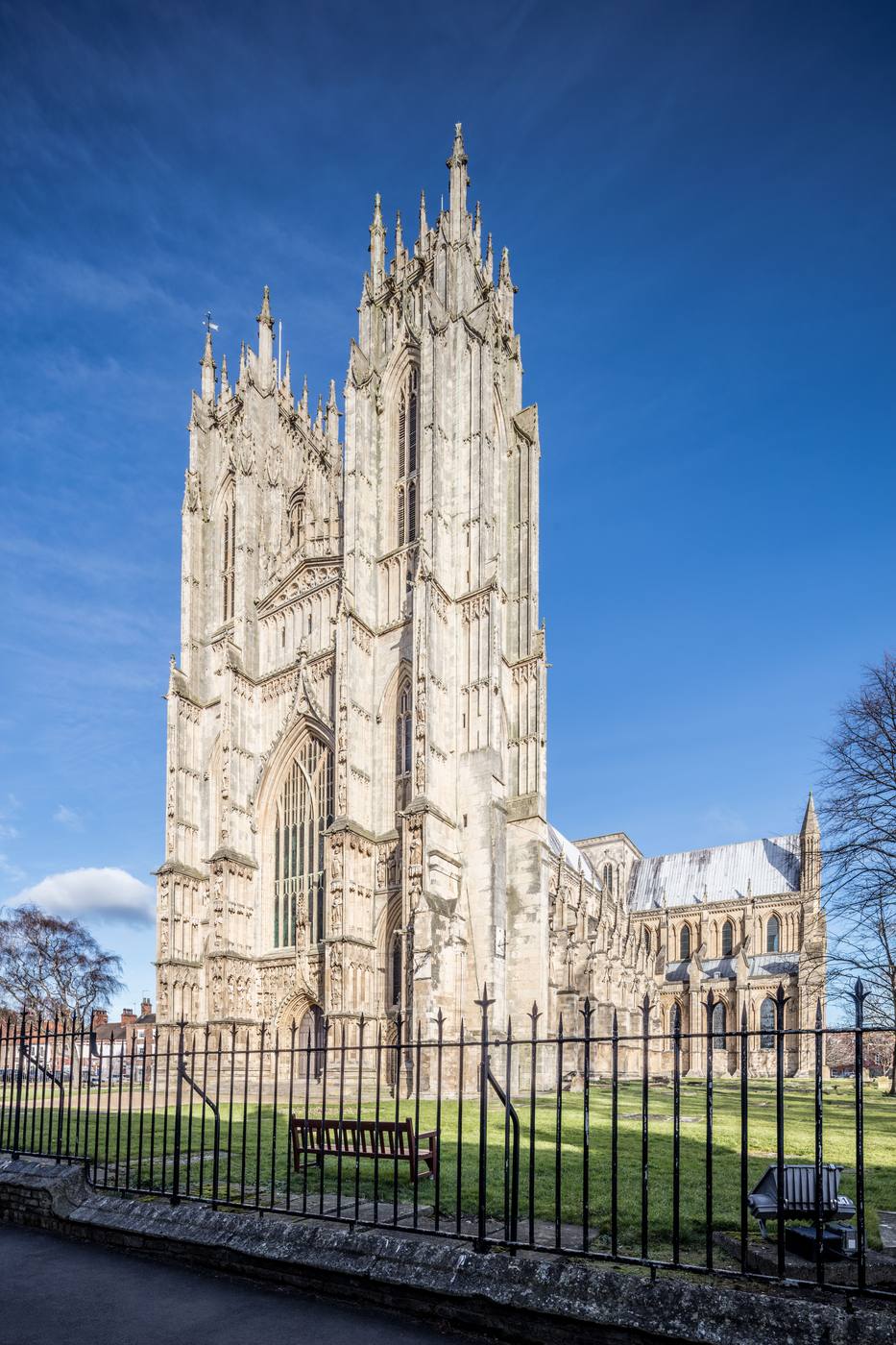
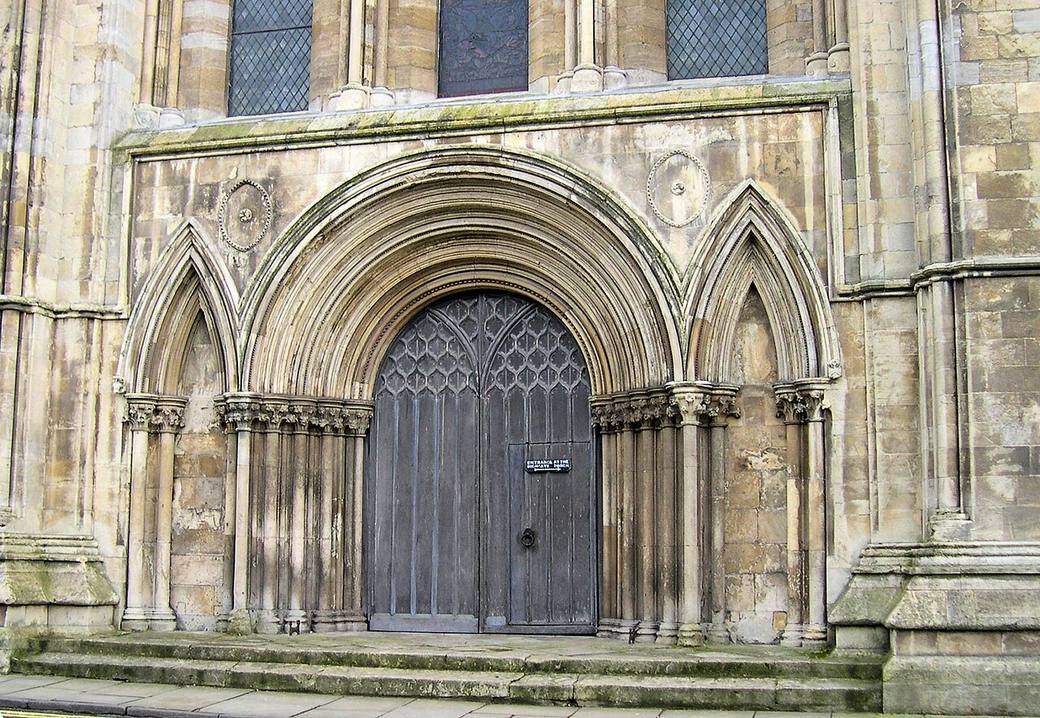
The twin towers of the west front were built in the Perpendicular style in the decades either side of 1400. They are tall, lean and covered in panelling and niches, and they are among the finest of their kind. Nicholas Hawksmoor, who worked on the Minster in the eighteenth century, admired them so much that they became his model for the west towers of Westminster Abbey.
The nave and its musicians
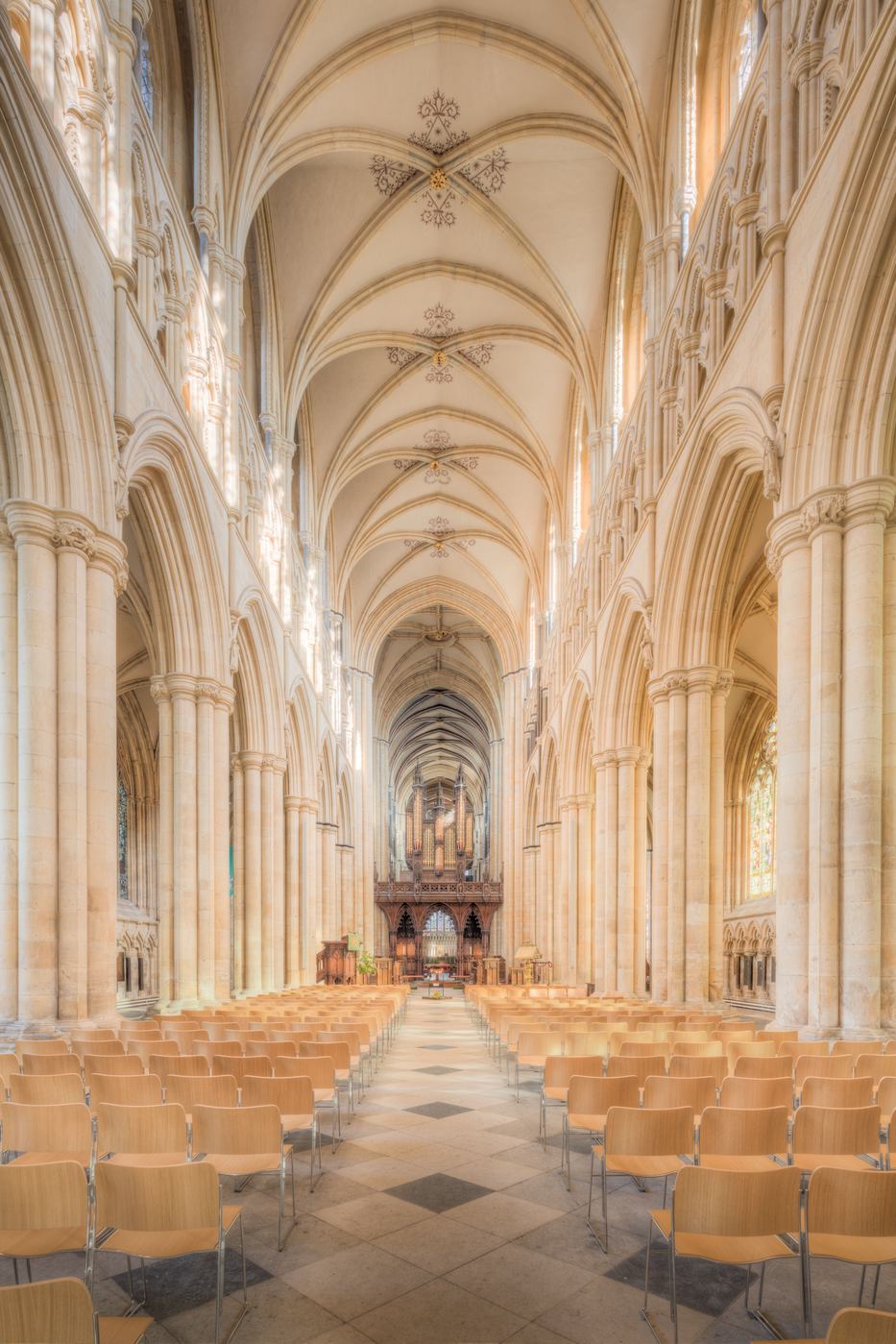
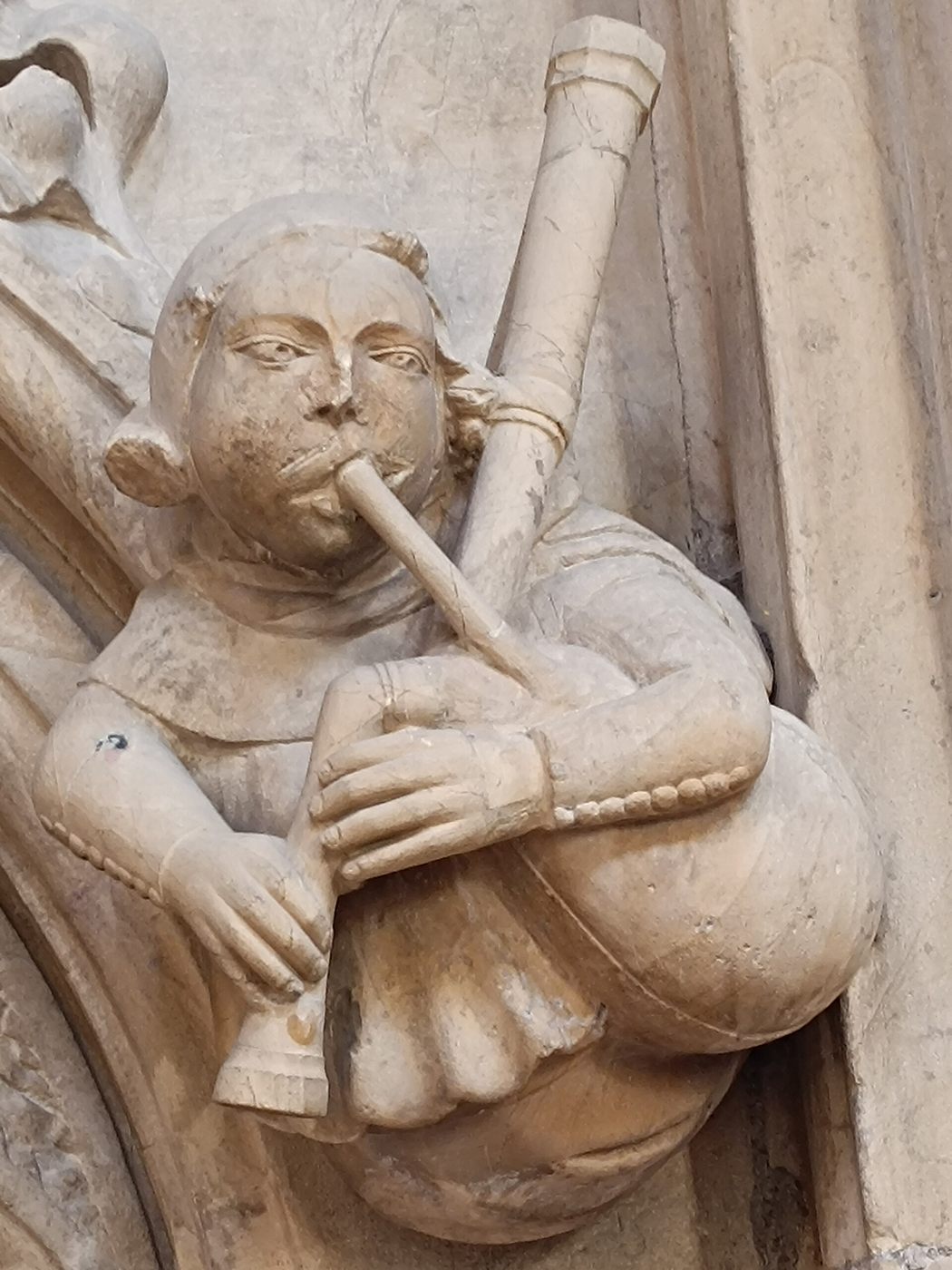
Inside, the nave looks thirteenth-century, but most of it was built between about 1308 and the 1340s. The masons followed the design of the Early English east end, with Purbeck marble shafts and deep mouldings, adapting only details. Look closely at the carvings along the arcades and on the corbels, though, and you meet a crowd of musicians: men playing bagpipes, fiddles, harps, drums, trumpets and instruments that have long disappeared. Beverley had a guild of minstrels, and the Minster and the nearby church of St Mary have between them one of the largest collections of carved medieval musicians in Europe.
In the nave floor near the crossing, a slab marks the grave of St John of Beverley, whose bones were found here in 1664.
The Frith Stool
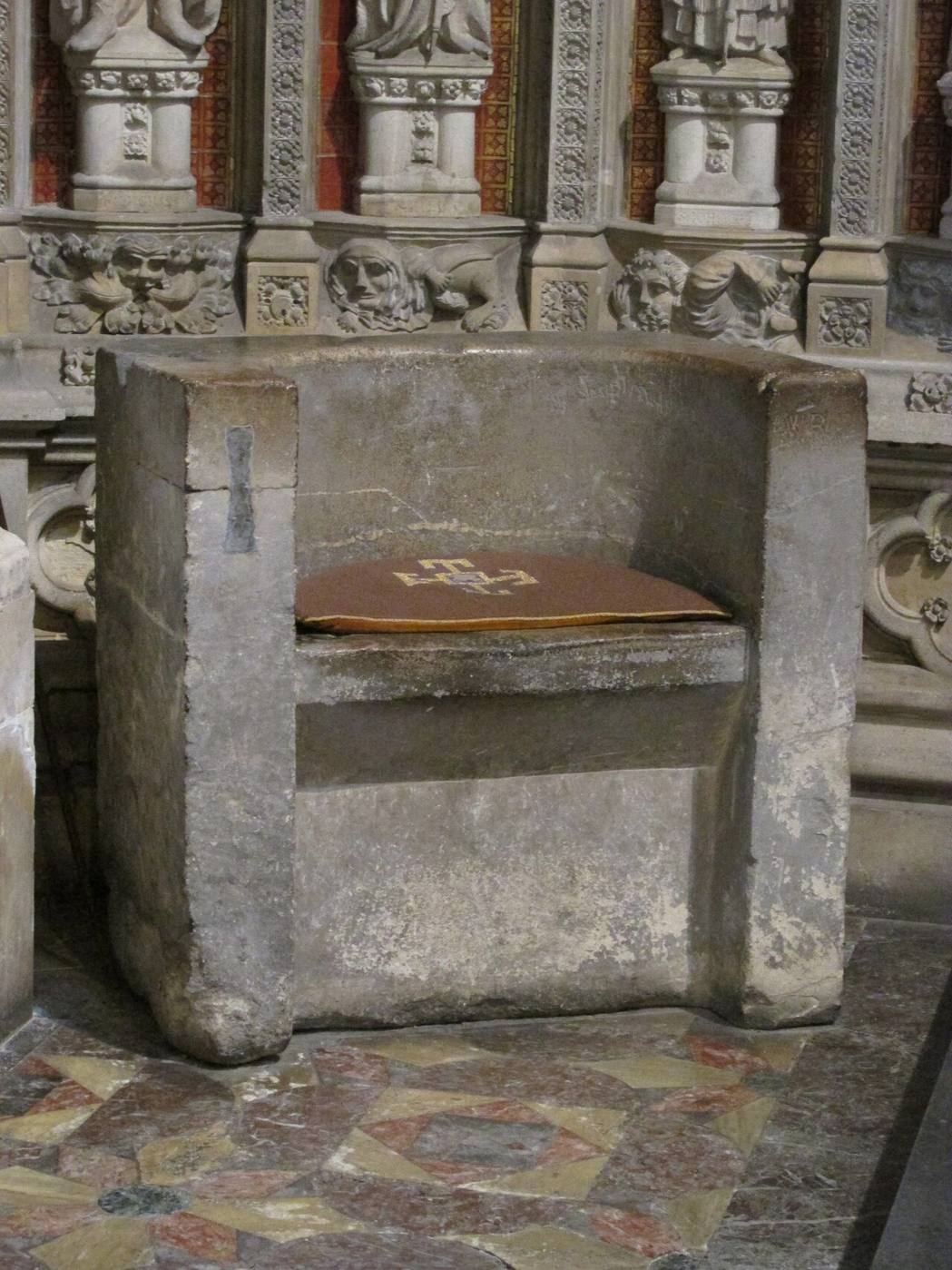
Near the high altar is a plain, worn stone chair: the Frith Stool. “Frith” means peace, and the stool is a relic of the Saxon church. Beverley was one of the great sanctuaries of medieval England: a fugitive who reached its protection, marked by crosses up to a mile from the church, could not be arrested, and one who reached the stool itself was safest of all.
The choir and the misericords
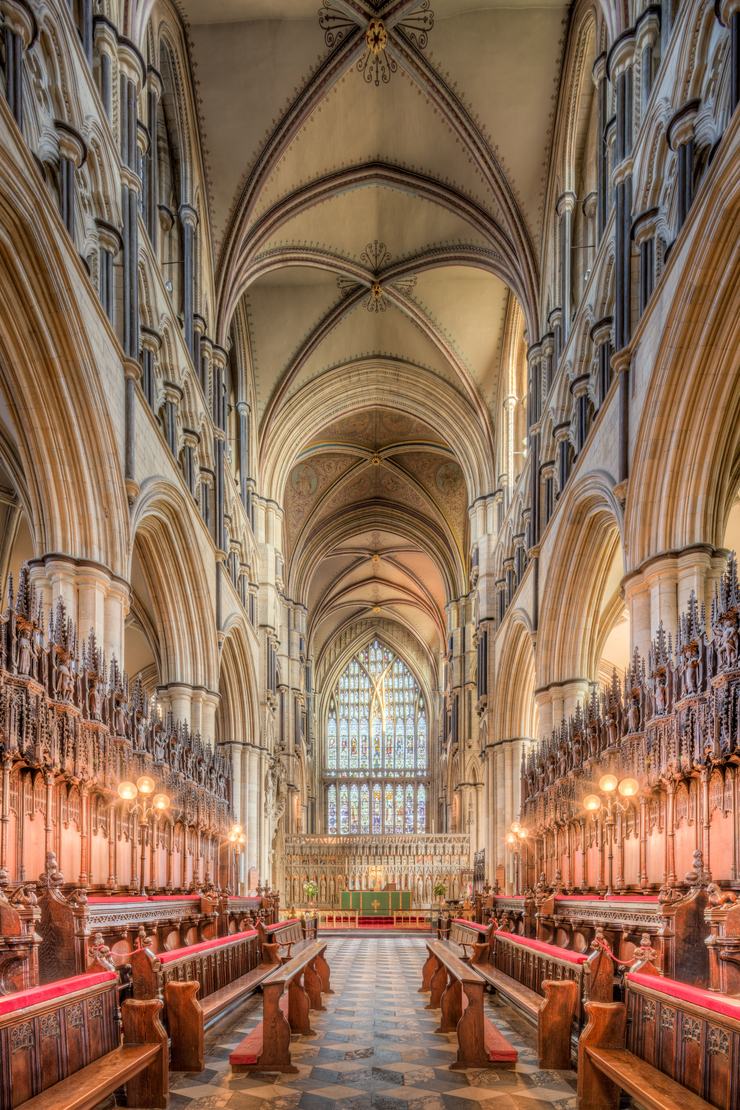
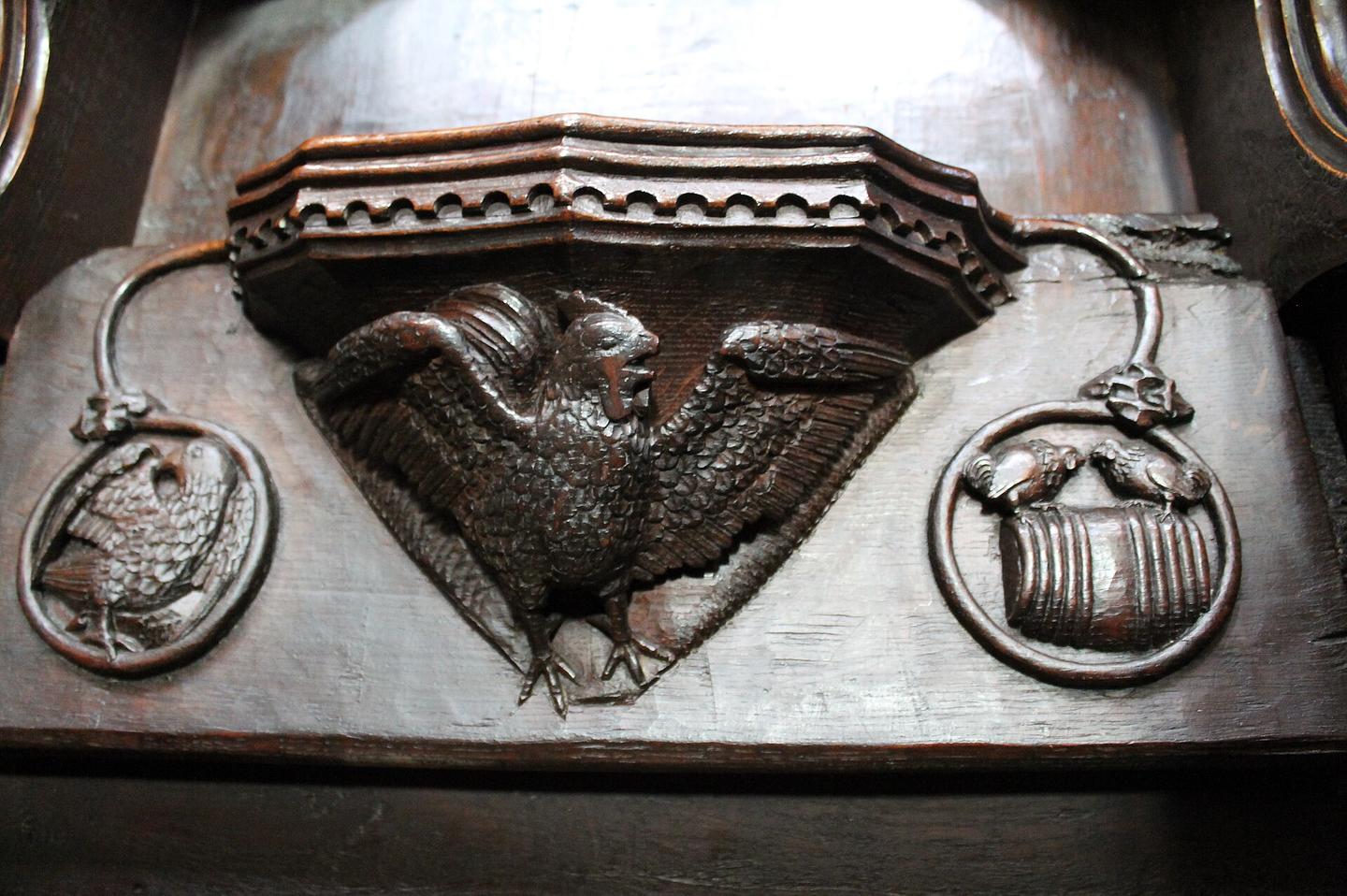
The choir stalls were carved in about 1520 by the same school of woodcarvers who worked at Ripon, and their 68 misericords are the largest set in England. Under the seats are scenes of everyday life, proverbs and fables: a man wheeling his wife in a barrow, foxes, monkeys, dragons, a bear, a hunt.
The Percy Tomb
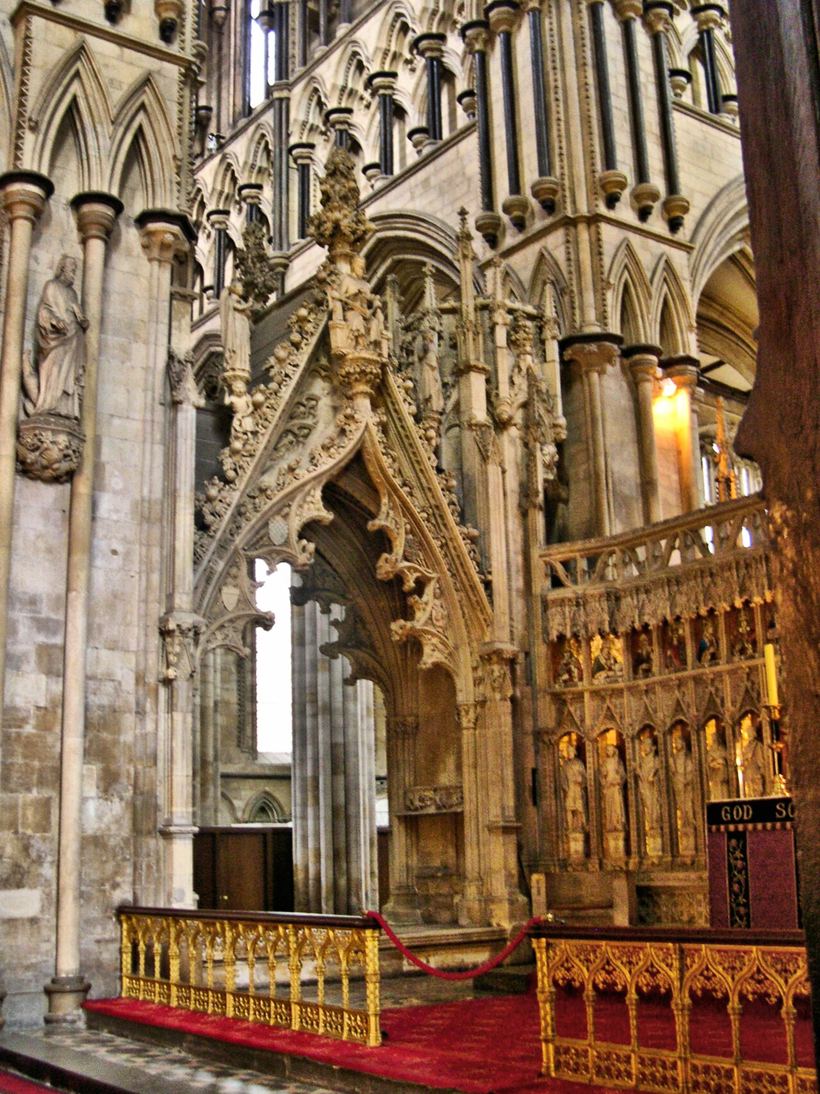
On the north side of the altar is the Percy Tomb, made in about 1340, probably for Lady Eleanor Percy, of the great Northumbrian family. Nothing in English Decorated Gothic is richer. The canopy rises in an ogee arch that bends forward as it climbs — a “nodding” ogee — and is crowded with leaves, angels, knights and beasts; at the top, Christ receives the soul of the dead woman.
The north transept and Hawksmoor
By the early eighteenth century the front wall of the north transept was leaning more than a metre outwards and seemed bound to fall. Under Nicholas Hawksmoor, the York carpenter William Thornton built a huge timber frame around it and, over several years from 1716, screwed the whole wall back to the vertical. It is still standing.
The roof and the treadwheel
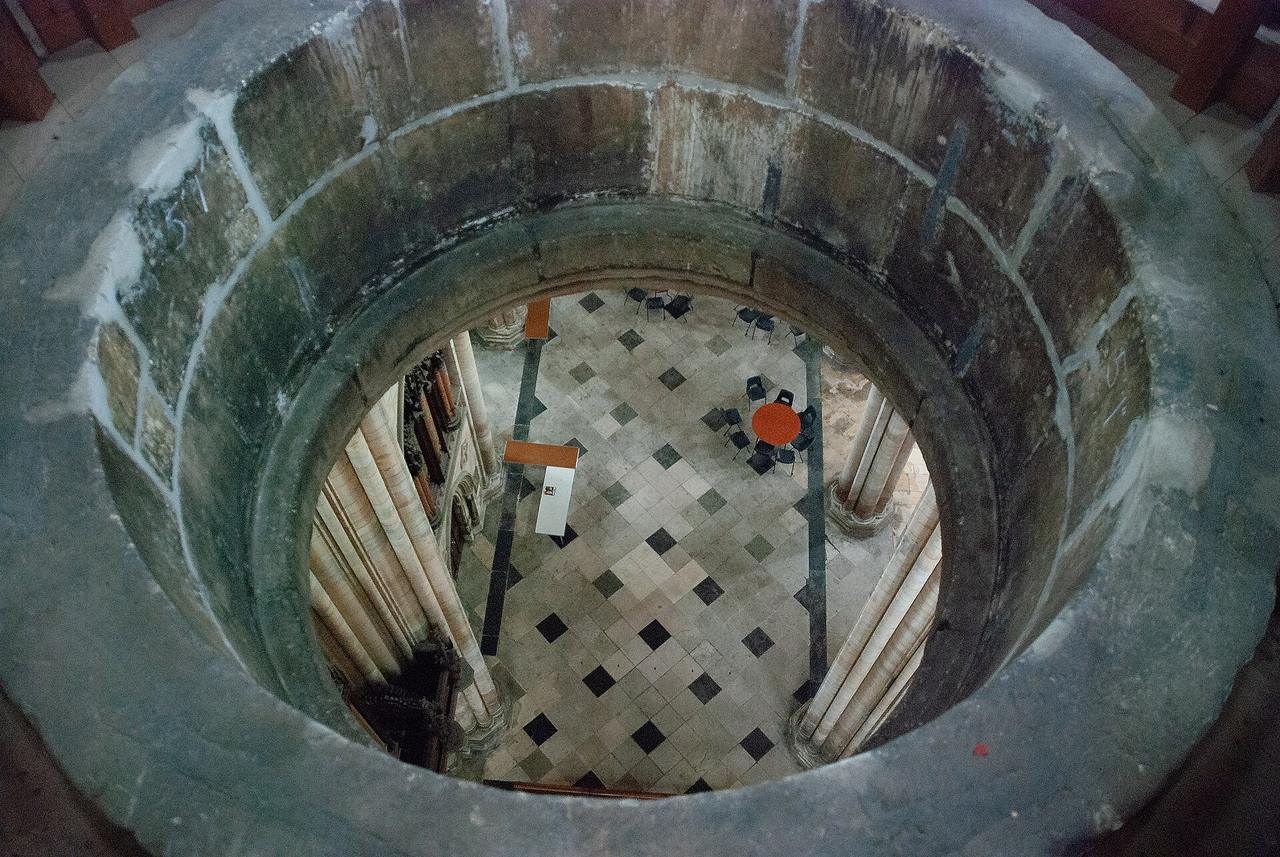
The Roof Tour climbs into the space above the vault. Its prize is a great wooden treadwheel crane, a man-powered wheel used for hoisting materials, which survives in the roof above the crossing, and a view down into the nave through a hatch in the vault.
Tickets and tours
Two tours, both booked ahead
Entry is free. The Exploring Beverley Minster tour runs on Wednesdays at 11am and Saturdays at 1pm and costs £6. The Roof Tour, for over-8s only, climbs 113 steps in narrow spaces; it runs on Saturdays at 11am and 2pm and on Wednesdays at 1pm and costs £10 plus a booking fee. Both must be booked in advance on the Minster’s website, and some dates are lost to events.
The hotel link goes to Booking.com. This site earns nothing from it at present — it is here because it is the quickest way to check what is actually available.
Don't miss
- The west towers The model for Hawksmoor’s towers at Westminster Abbey.
- The Percy Tomb The most extravagant canopy in English Gothic.
- The Frith Stool A Saxon seat of sanctuary.
- The musicians Carved minstrels all along the nave.
- The misericords Sixty-eight of them, the largest set in England.
- The treadwheel On the Roof Tour, above the crossing.
Insider tips
Walk to St Mary's. At the other end of the town, ten minutes’ walk up the main street, St Mary’s Church is a superb parish church in its own right, with a painted ceiling of English kings, a pillar carved with minstrels and, on a doorway in the north choir aisle, a carved rabbit dressed as a pilgrim that is often said to have inspired Lewis Carroll’s White Rabbit.
On the way you pass the market place and, at the far end of the town, the North Bar, a brick gateway of 1409 that still carries the traffic. Beverley Westwood, a stretch of common pasture with cattle grazing, comes almost to the edge of the town and has the best distant view of the Minster.
Common questions
Is Beverley Minster free to visit?
Yes. Entry is free and donations are welcome. The Exploring Beverley Minster tour costs £6, and the Roof Tour £10 plus a booking fee.
Is Beverley Minster a cathedral?
No. It is a parish church, and has been since the Reformation, when the college of canons that ran it was dissolved. It is larger than many English cathedrals, and is one of the largest parish churches in the country.
Who was St John of Beverley?
John was Bishop of Hexham and then of York, and founded a monastery at Beverley, where he died in 721. He was made a saint in 1037. Henry V credited his victory at Agincourt in 1415, fought on the feast of John’s translation, to the saint’s help. His grave is marked in the nave floor.
Can you go up onto the roof of Beverley Minster?
Yes, on the Roof Tour, which climbs 113 steps through narrow passages to the roof space, where a great wooden treadwheel crane survives. It runs on Saturdays and some Wednesdays, is for over-8s only, and must be booked in advance.
How do you get to Beverley Minster?
Beverley station, on the line from Hull to Scarborough, is about ten minutes’ walk away; Hull, with trains from London and York, is about fifteen minutes by train. The Minster is at the south end of the town centre, a short walk from the market place.
Where to stay and eat nearby
Beverley is a handsome Georgian market town with good pubs, cafés and restaurants around the Saturday Market and Wednesday Market, a few minutes from the Minster. There are hotels in the town, and a wider choice in Hull and York.
More English churches
- York Minster — forty minutes away, and Beverley’s mother church
- Ripon Cathedral — another minster of the Archbishops of York, with stalls by the same carvers
- Lincoln Cathedral — across the Humber
See all the cathedrals and churches worth visiting in England →