
Exeter Cathedral
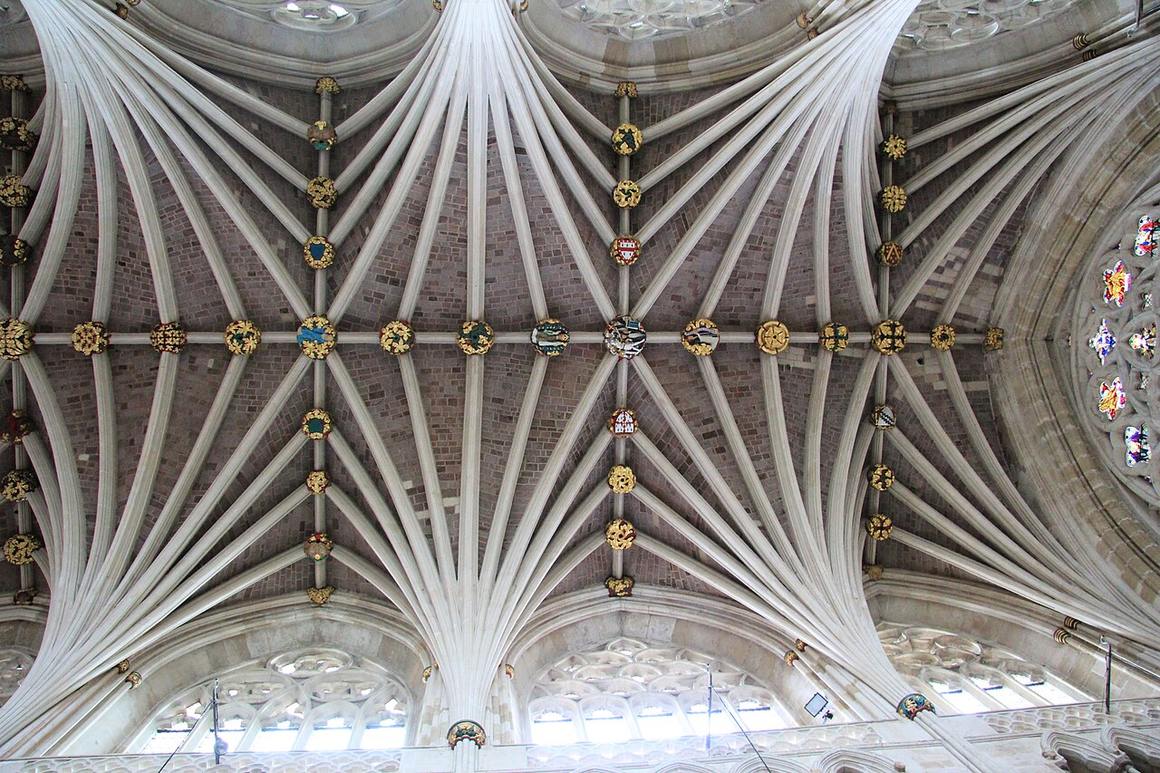
Walk in at the west door of Exeter Cathedral and look up. The ceiling does not stop. It runs, rib after rib, bay after bay, for about 96 metres to the far east end without a single tower or crossing to break it — the longest continuous medieval Gothic vault anywhere in the world. It looks like an avenue of stone palm trees, and it was finished around the time of the Black Death.
A Norman church with a Gothic makeover
Exeter became a cathedral city in 1050, when Bishop Leofric moved his seat here from Crediton, reckoning a walled Roman town safer from raiders than a village in the Devon countryside. Leofric brought books with him, and one of them is still in the cathedral library: the Exeter Book, the largest surviving collection of Old English poetry, with its riddles, its elegies and “The Seafarer”.
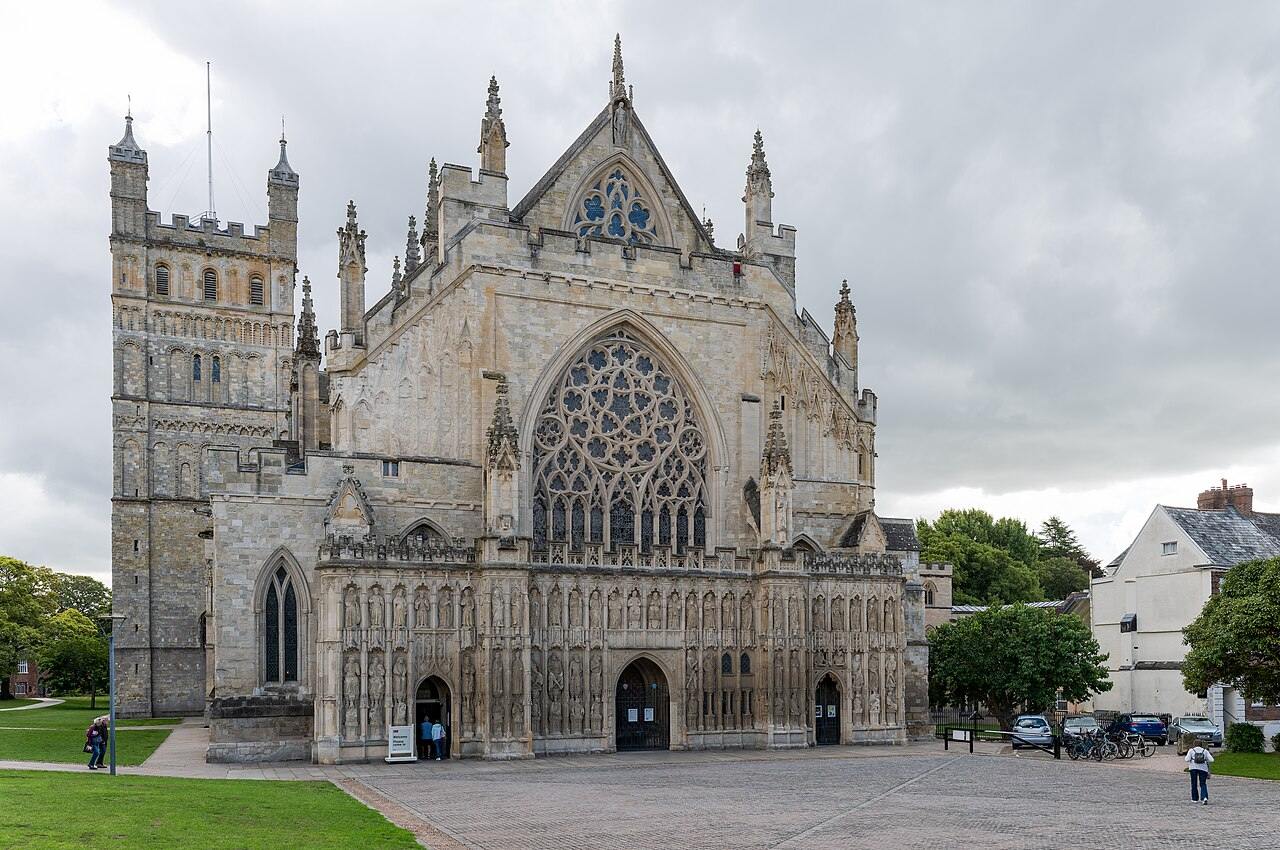
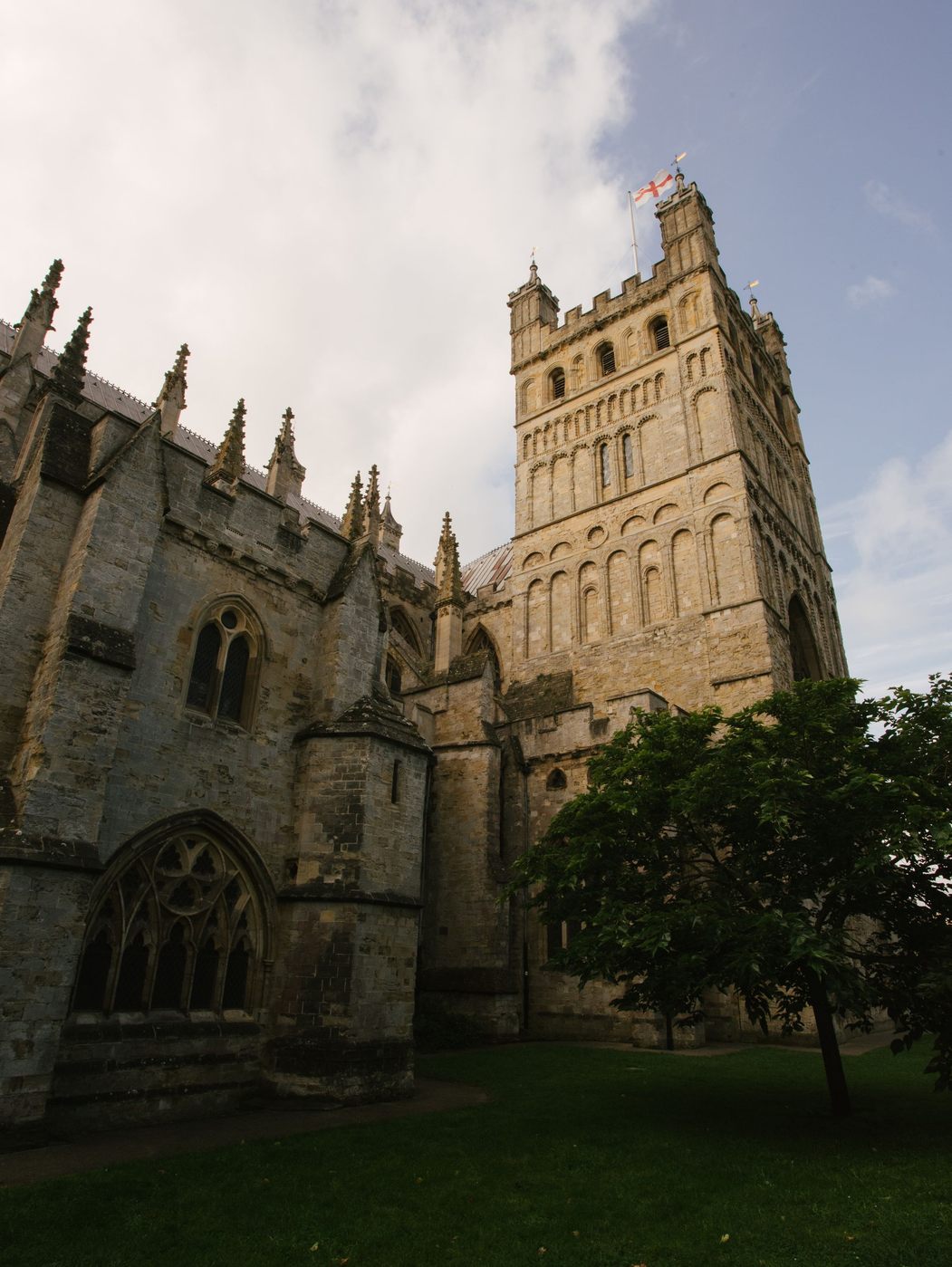
The Normans began a new cathedral in about 1112–14 and dedicated it in 1133. Almost all of it has gone — almost. Its two massive square towers were left standing, one on each side, and they are the key to the whole building. Because they were placed where transepts would normally go, there was never a central tower. When the next generation of builders decided to rebuild everything else in the new Decorated Gothic style, from about the 1270s, they kept the towers and ran a single vault straight through between them.
That rebuilding took roughly eighty years, under a string of bishops who each pushed it a stage further: Bronescombe began at the east end, Stapledon furnished the choir, and John de Grandisson, bishop from 1327 to 1369, finished the nave and started the carved screen across the west front. The result is a building of unusual consistency. Most English cathedrals are a collection of styles; Exeter is mostly one, carried through with confidence.
The visitor's cheat sheet
| Where | Cathedral Green, Exeter, Devon, EX1 1HS, in the middle of the city |
|---|---|
| Getting there | Exeter Central station is a few minutes’ walk; Exeter St David’s, on the main line from London Paddington and Bristol, is about 20 minutes on foot or a short bus ride |
| Opening hours | Mon–Sat 9am–5pm; Sun 11.30am–4pm for sightseeing. The Treasures Exhibition is closed on Wednesdays and Sundays, and services and events can close the building early — check the website before you travel |
| Admission | £12.50 adults, £10.50 seniors and students, under-18s in a family group free; includes a floor tour, audio guide and the Treasures Exhibition. Gift Aid turns the ticket into a 12-month pass. Roof tours around £18.50 extra |
| How long | 1–1.5 hours; 2–3 hours with a floor tour, or add 2 hours for a roof tour |
| Best time | A weekday morning, then back at 5.30pm for Choral Evensong |
| Dress code | No formal code; respectful dress as in any working church |
| Photography | Personal photography is welcome; commercial shoots need permission |
Hours and admission checked against the official site in September 2026. They change; the official site is always the last word.
Why there is no central tower. The two Norman towers stand on the north and south sides, where the transepts are. They are older than everything around them by a century and a half, and because the crossing never carried a tower, the vault could run the full length of the church. It is the building’s signature, and it was an accident of keeping what already worked.
What to see, in the order you meet it
The west front and the image screen
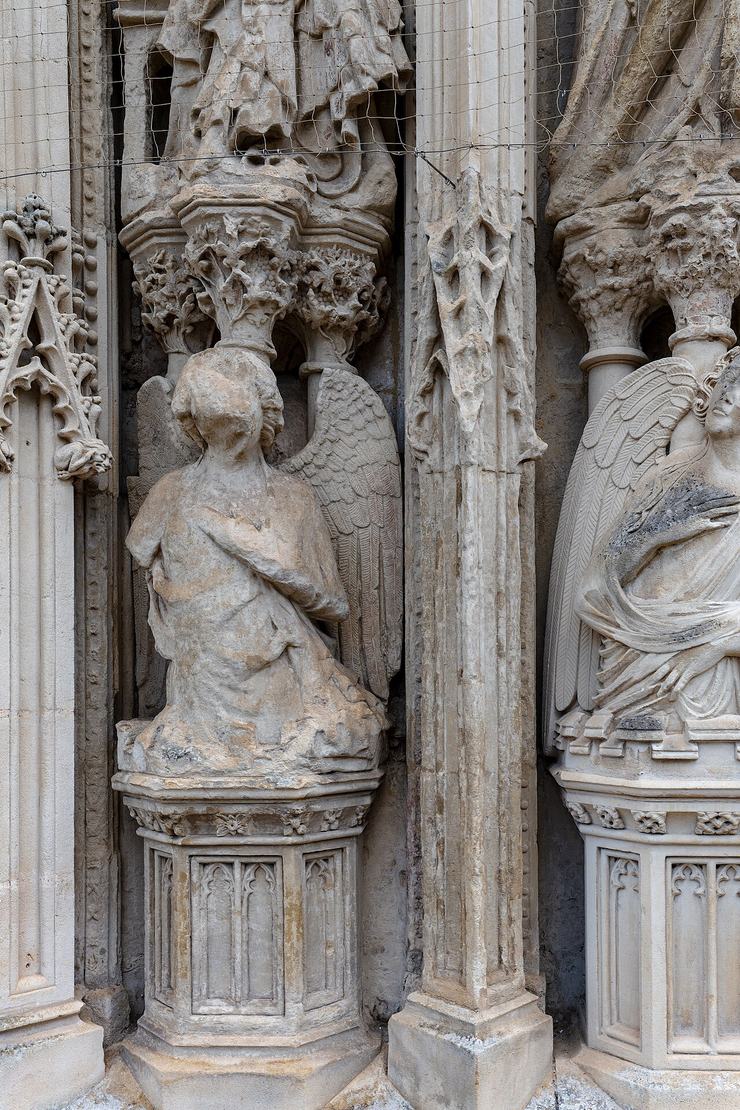
Start on Cathedral Green, the open lawn in front of the west end, which is where the city sits out on sunny days. Across the lower part of the west front runs the image screen: three tiers of carved figures — angels at the bottom, then kings, then apostles and prophets — set up from the 1340s onwards and once brightly painted. It is the largest surviving array of fourteenth- century sculpture in England, and the soft local stone has weathered so heavily that many of the figures read now as ghosts of themselves. Stand close and look at the kings: some sit cross-legged, one or two appear to be drawing swords.
The nave and the vault
Inside, the first impression is of a forest. The piers are clusters of shafts — up to sixteen to a pier — in grey Purbeck marble, and from each one the vault ribs spring outwards in a sheaf, like the fronds of a palm, to meet the ridge rib that runs down the middle of the ceiling. Where they meet are the bosses: more than four hundred carved and painted knots of stone, from foliage to beasts to scenes. One in the nave shows the murder of Thomas Becket, the knights closing in around him.
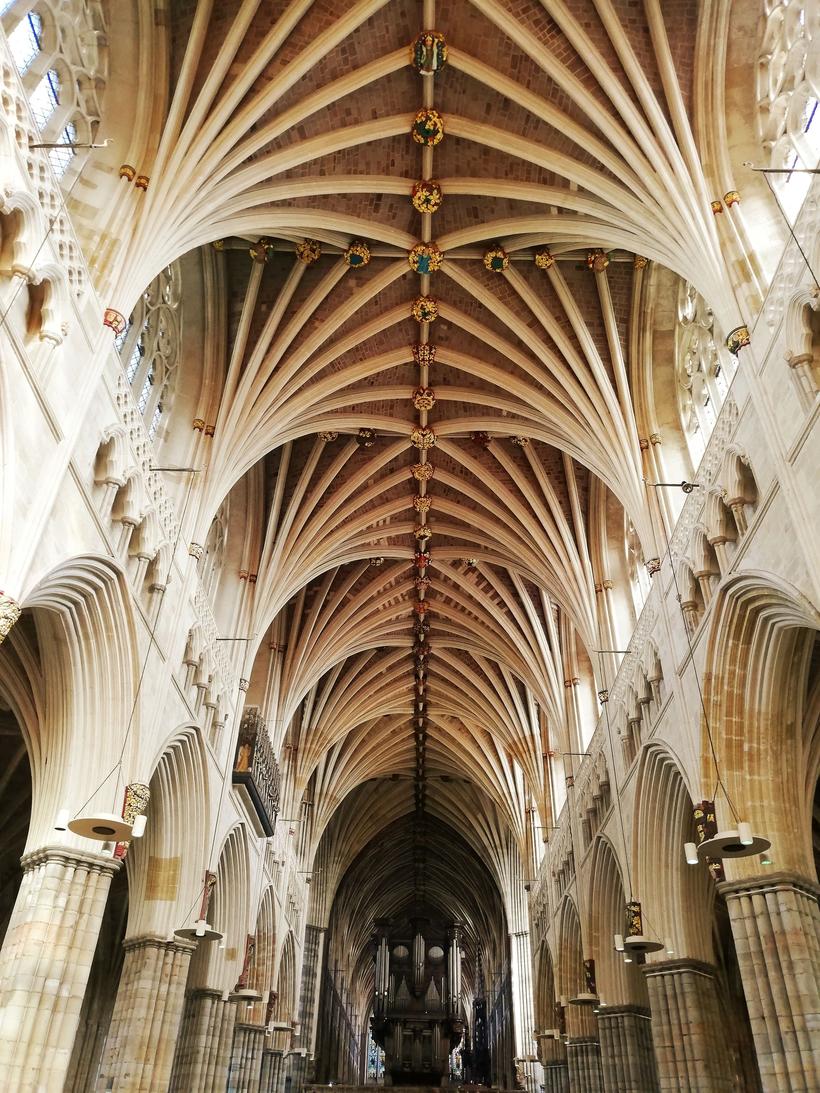
Bring binoculars if you have them, or borrow one of the mirror trolleys the cathedral puts out so you can look down at the vault instead of craning up at it. The painting on the bosses is largely restored, but it gives a fair idea of how colourful the whole interior would once have been.
The Minstrels' Gallery
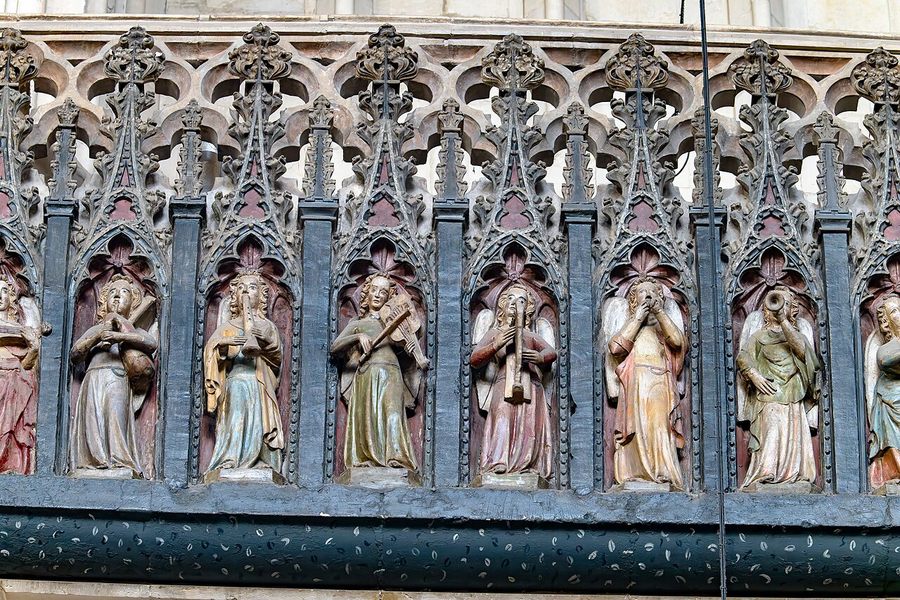
Halfway down the nave on the north side, a stone balcony juts out from the wall at triforium level. Along its front, in a row of niches, stand twelve angels playing instruments: bagpipes, recorder, harp, fiddle, a portative organ, cymbals and more. It dates from about 1360, and it is one of the best sources anywhere for what medieval instruments actually looked like. Nobody is sure what it was built for — possibly for singers or musicians on great feast days — but the choir still sings from it on occasion.
The pulpitum and the choir
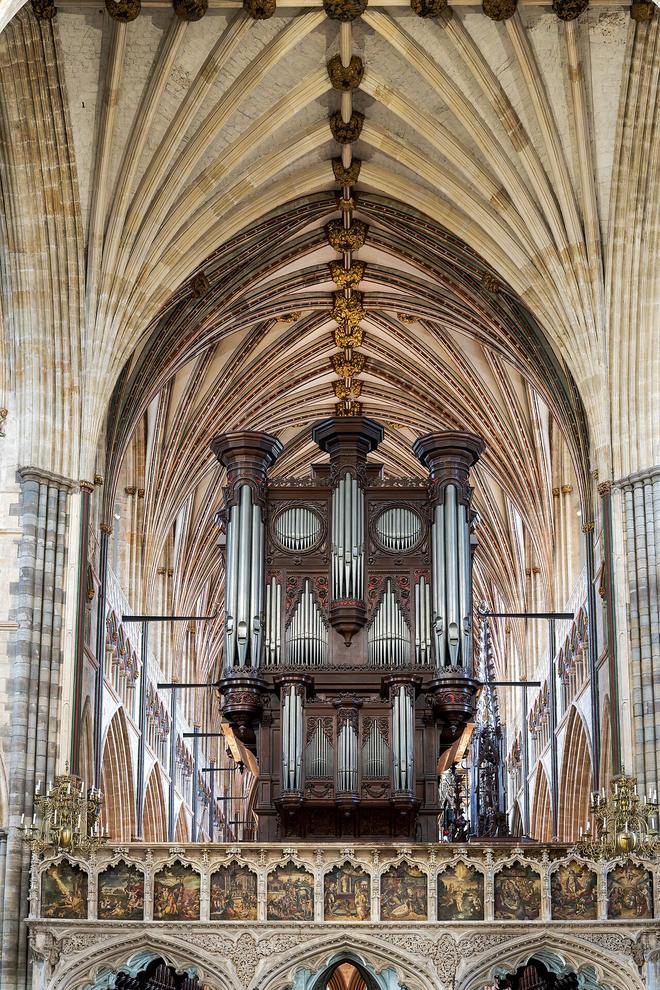
The nave ends at the pulpitum, the stone screen of the 1320s with the organ perched on top. Go through into the choir and two pieces of woodwork demand attention.
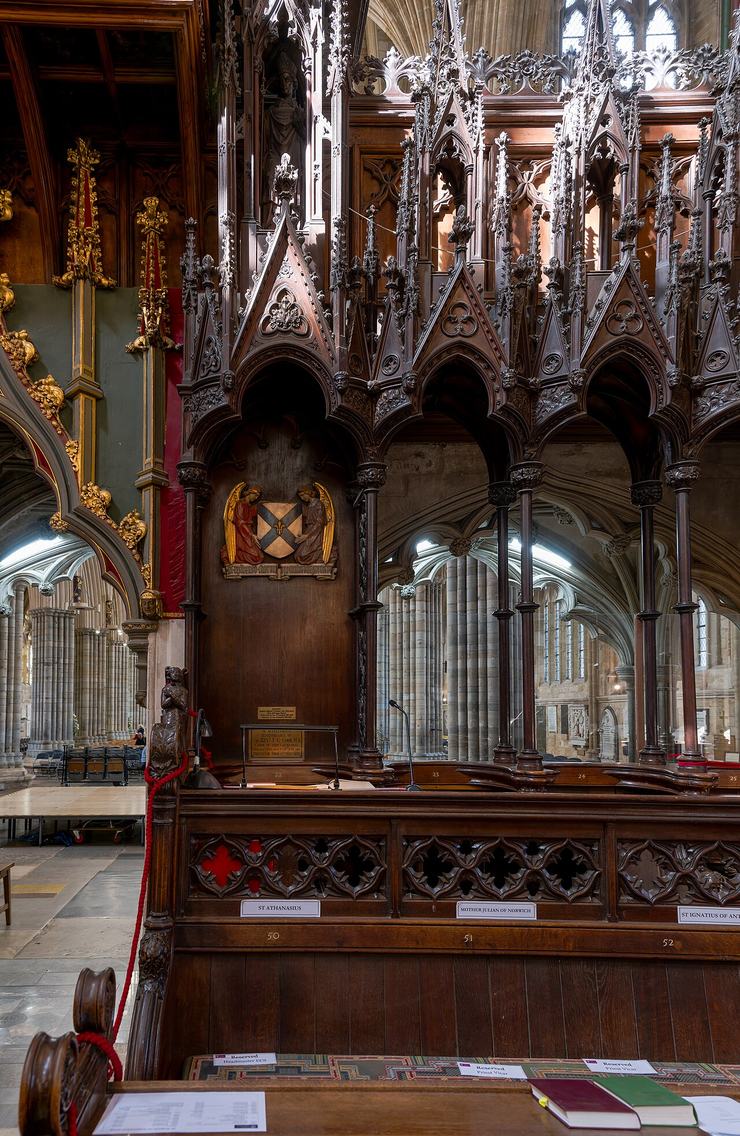
The first is the bishop’s throne, made for Bishop Stapledon in 1312–16: a canopy of Devon oak climbing about 18 metres in pinnacles and crockets, held together, it is often said, without a single nail. During the Second World War it was taken apart and stored out of harm’s way, which turned out to be wise. The second is under your feet — or rather under the seats. The choir stalls are Victorian, but the misericords beneath them are the earliest complete set in England, carved in the thirteenth century, and they include a mermaid, a lion, a centaur and an elephant carved by someone who had plainly never seen one.
The astronomical clock
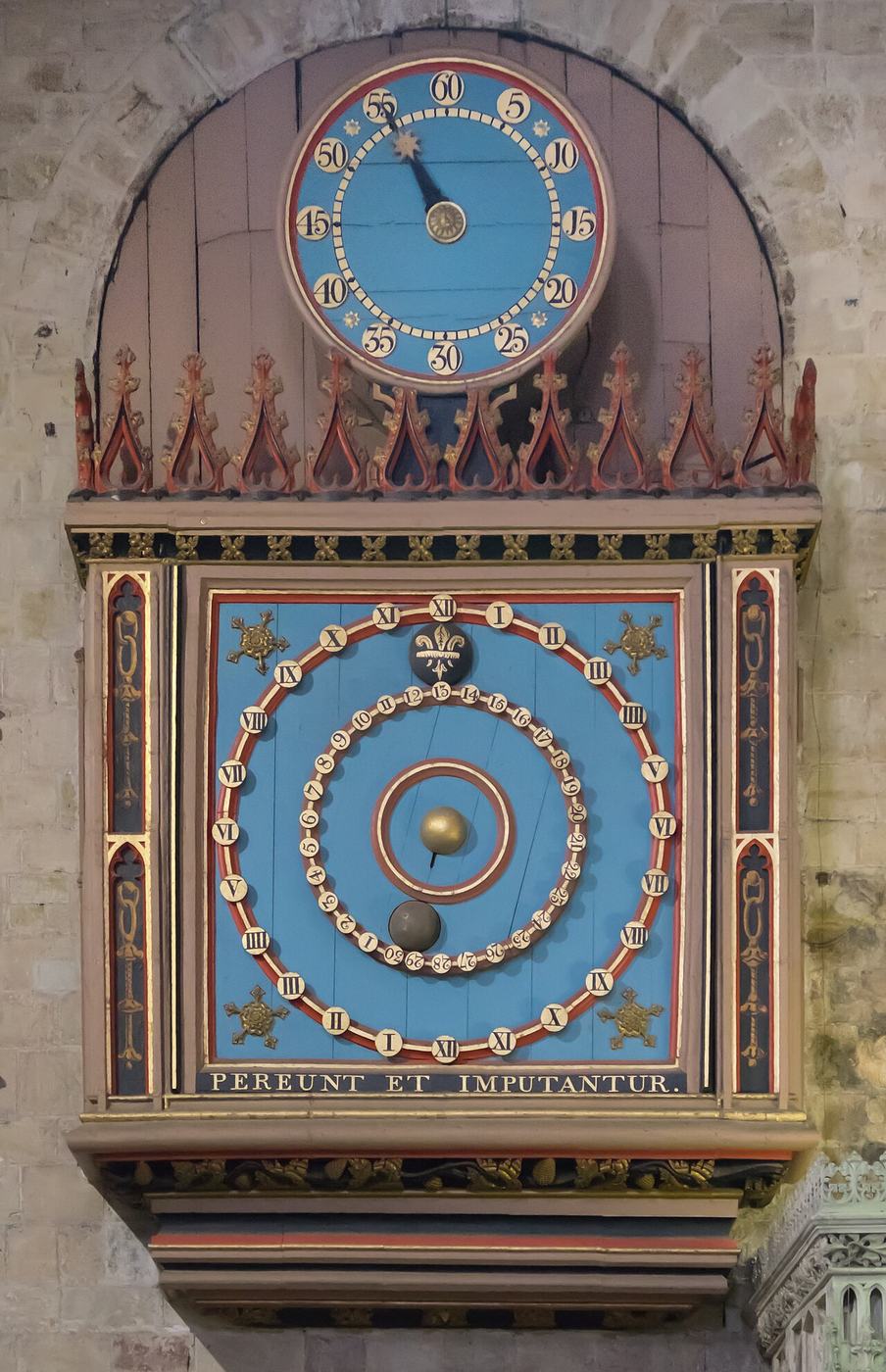
In the north transept, under the Norman tower, hangs the clock. The lower dial dates from about 1484 and shows the universe as the medieval church understood it: the earth at the centre, a golden ball for the sun turning around it, and a moon that shows its phases as it goes. The minute dial above it was added in 1760. The motto underneath, Pereunt et imputantur, roughly “they pass, and are counted against us”, is aimed at anyone wasting their time.
Now look at the door below it. There is a small round hole cut in the bottom. The cathedral’s own account is that it was for a cat, kept to deal with the mice attracted by the animal fat used to grease the works — and the cathedral accounts do record payments for a cat. Whether it inspired “Hickory Dickory Dock” is anyone’s guess.
The chapels, and 1942
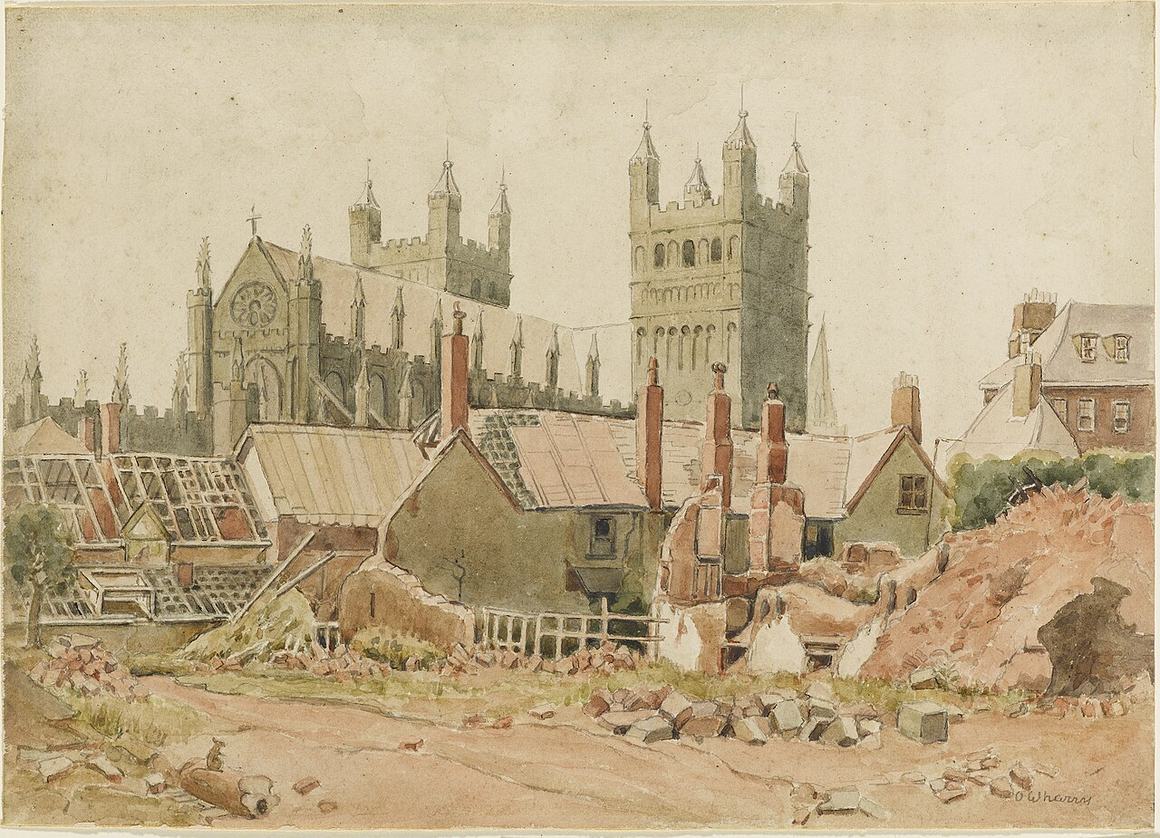
Walk around the east end through the ambulatory and the chapels. Look for Bishop Oldham’s chantry, carved all over with owls — a pun on his name. Then find St James’s Chapel on the south side, which looks medieval and is not. In the early hours of 4 May 1942, during the so-called Baedeker raids on historic English cities, a bomb hit the cathedral and destroyed the chapel along with the bays around it. It was rebuilt after the war, and the masons who did it left some modern jokes among the carvings, which the guides will happily point out.
The Treasures Exhibition
Included in the ticket, and open on most days except Wednesdays and Sundays, the exhibition brings out objects from the cathedral’s library and archive, which is one of the oldest in the country. The Exeter Book itself is rarely on show, but the displays explain what it is and why scholars of English literature treat this building as a place of pilgrimage.
Tickets and tours
The roof tour is the one to book
The floor tours are included with admission and run through the day. The roof tour is the one that sells out: it takes you into the space above the vault, through the ringing chamber of one of the heaviest rings of bells in the world and, weather permitting, onto the top of the north tower. Book it before you travel, wear flat shoes, and expect a lot of steps.
Tour and hotel links go to GetYourGuide and Booking.com. This site earns nothing from them at present — they are here because they are the quickest way to check what is actually available.
Don't miss
- The vault, end to end Stand at the west door and follow the ridge rib all the way to the east window. About 96 metres, no interruptions.
- The Becket boss In the nave vault, the murder of Thomas Becket in stone, carved some 170 years after it happened.
- The Minstrels' Gallery Twelve angel musicians of about 1360, the best picture of a medieval band you will find.
- The bishop's throne Around 18 metres of carved oak from 1312–16, and it survived the war in pieces in the countryside.
- The clock, and the cat door A universe with the earth at the middle, and a hole in the door below for the cathedral cat.
- The misericords England’s earliest complete set, with the elephant carved from hearsay.
- Bishop Oldham's owls A chantry chapel covered in owls, because the bishop liked a pun.
Insider tips
Gift Aid your ticket. If you pay UK tax, ticking the Gift Aid box turns your admission into a twelve-month pass at no extra cost. If you are in Exeter for more than a day, come back in the evening light, when the west window glows.
Choral Evensong is at 5.30pm on most weekdays and is free. It is the best way to hear the building: the vault gives a long, even acoustic that suits the choir well.
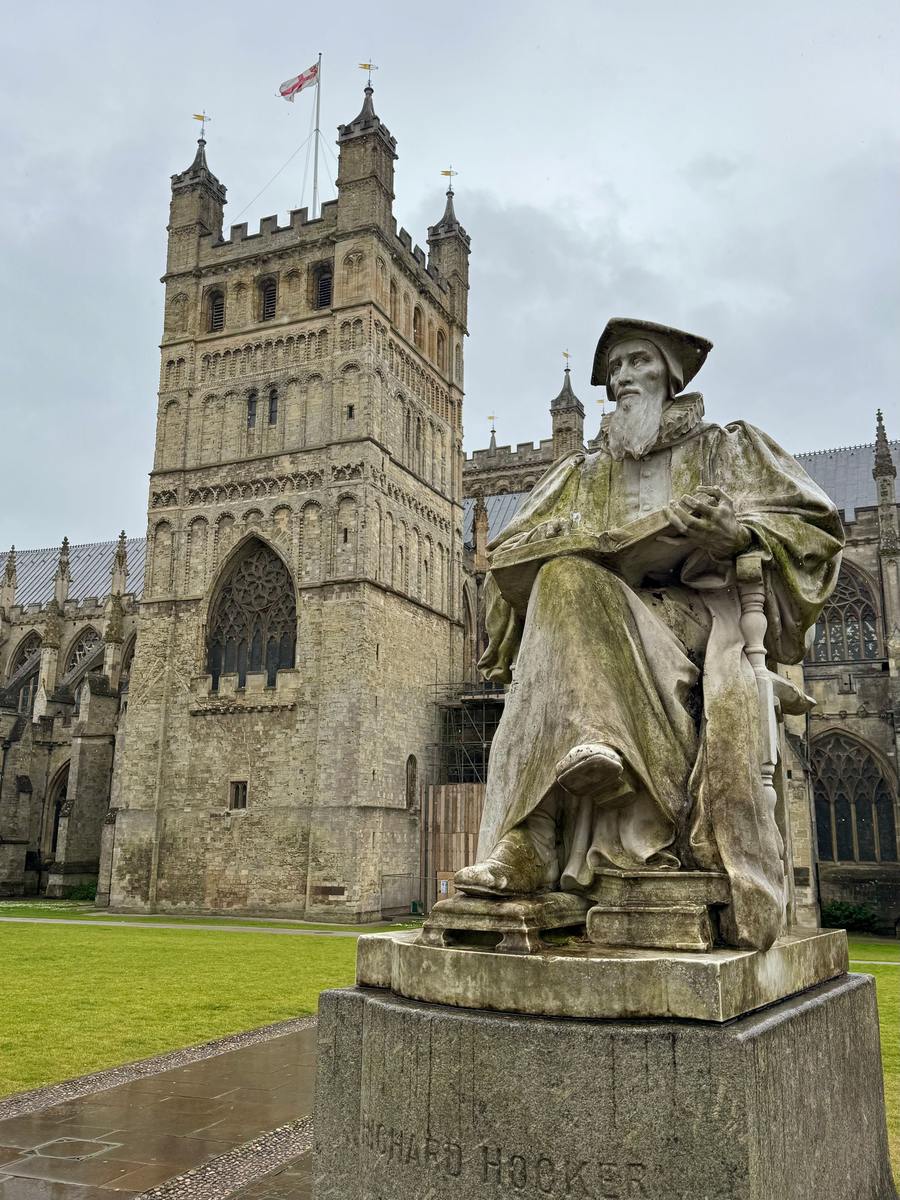
The Cathedral Green is a good place to see the exterior properly. Walk right round to the north side for the view of the two towers and the long roof between them, and to the Hooker statue for the classic photograph.
Exeter is compact and the cathedral sits in the middle of it. The Roman and medieval city walls, the underground medieval passages beneath the High Street and the quayside are all within a fifteen-minute walk, and together they make a full day.
Common questions
What is Exeter Cathedral famous for?
Its vault. The ribbed stone ceiling runs unbroken for about 96 metres from the west end to the east, the longest continuous medieval Gothic vault in the world, because the building has no central tower to interrupt it. It is also known for its carved west front, the Minstrels’ Gallery, a fifteenth-century astronomical clock and the Exeter Book of Old English poetry.
How much does it cost to visit Exeter Cathedral?
Adult admission is around £12.50, with seniors and students paying a little less and under-18s in a family group free. The ticket includes a guided floor tour, an audio guide and the Treasures Exhibition, and UK taxpayers who Gift Aid it get a twelve-month pass at no extra cost. Worship is always free.
How long do you need at Exeter Cathedral?
About an hour and a half for the building, the clock and the Treasures Exhibition; an hour longer if you join the free floor tour. A roof tour adds another two hours.
Can you go up the tower at Exeter Cathedral?
Yes, on a guided roof tour, which goes into the void above the nave vault, through the ringing chamber and, weather permitting, out onto the top of the north tower. It costs around £18.50, is not suitable for anyone who cannot manage a lot of steep stairs, and should be booked ahead.
Is the story about the cat hole in the clock door true?
The hole is real: a small round opening cut in the door beneath the astronomical clock. The story is that it let the cathedral cat in to catch mice drawn by the animal fat used to grease the mechanism, and some people link it to “Hickory Dickory Dock”. The cat is documented — the accounts record payments for one — but the rhyme connection is a pleasing guess, not history.
Where to stay and eat nearby
The streets around the Green — Cathedral Close, Martin’s Lane, South Street — are full of cafes and pubs. The Chapter House Café inside the cathedral precinct is the easy lunch. For an overnight stay, anywhere in the centre is within ten minutes’ walk.
More English cathedrals
- Wells Cathedral — the other great West Country cathedral, with its own astronomical clock and a better-preserved west front
- Salisbury Cathedral — built in a single campaign too, with the tallest spire in England
- Hereford Cathedral — another Norman core, and the Mappa Mundi
See all the cathedrals and churches worth visiting in England →