
Three Bells of Fira, Santorini
The Three Bells of Fira is the little blue-domed church on the rim of the caldera, one of the most photographed churches in Greece: a blue dome, a white bell gable with three bells, and below it the cliffs and the sea. It is a Catholic church, dedicated to the Dormition of the Virgin, and most people see it from the footpath above. It costs nothing, and the best time is first thing in the morning.
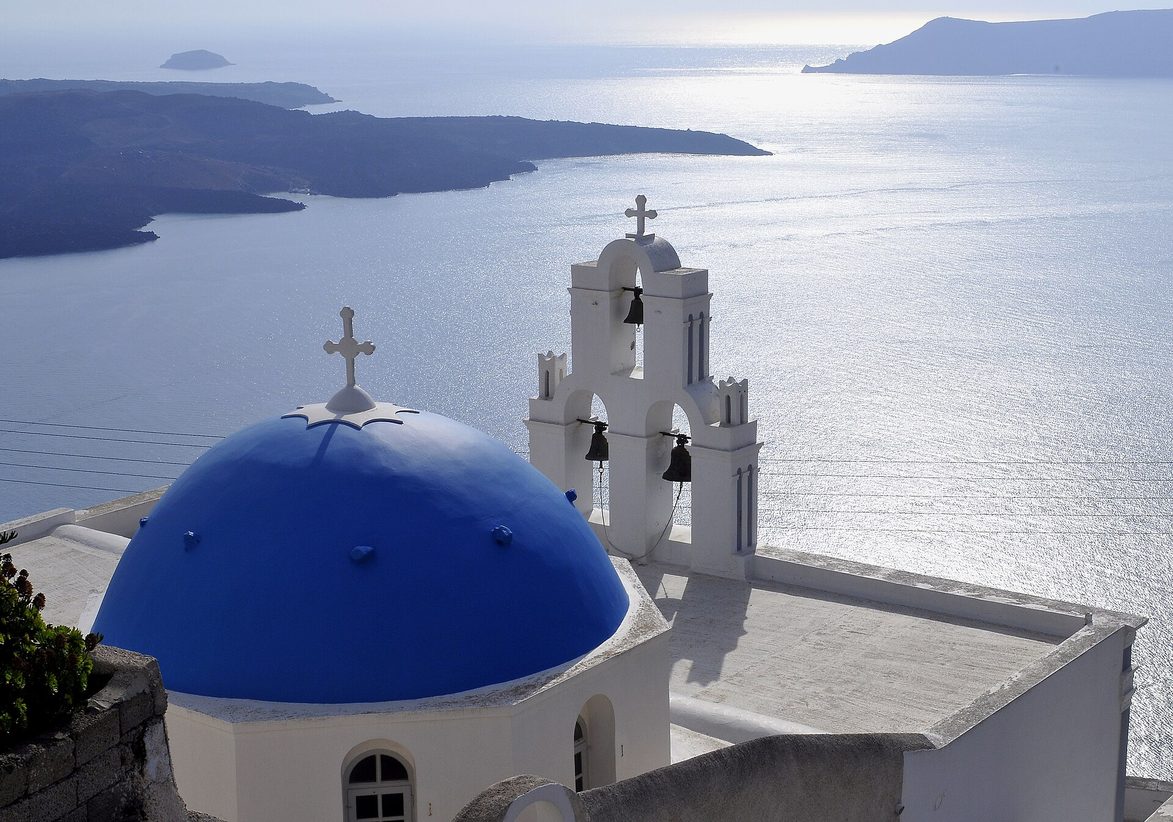
The church behind the photograph
“Three Bells” is a nickname. The church’s name is the Catholic Church of the Dormition (in Greek, the Koimisis tis Theotokou), and it belongs to the Catholic diocese of Santorini; the island has had a Catholic community since the Venetian middle ages. In the 17th century two small cave churches stood in the cliff here; when the cliff edge crumbled they were lost, and the site became an infirmary, later used by the Jesuits. The present church was built in 1757, and enlarged more than once.
On 9 July 1956 an earthquake centred near Amorgos wrecked much of Santorini, and the church was badly damaged; it was restored afterwards. Its feast day is 15 August, the Dormition, when pilgrims and visitors gather there.
The visitor’s cheat sheet
| Where | Caldera path, Firostefani, the northern part of Fira; 10–15 minutes’ walk north of the centre |
|---|---|
| Opening hours | Seen from the footpath at any time; the church itself has no regular visiting hours |
| Admission | Free to see from outside; the roof and terrace are private |
| Feast | 15 August, the Dormition of the Virgin |
| Best time | Early morning; avoid late morning on busy cruise days |
| Drones | Greece follows EU drone rules, and Fira lies close to the airport: in practice, do not fly one here |
| How long | Ten minutes for the view; combine it with the walk to Imerovigli |
Hours and admission checked against the official site in October 2026. They change; the official site is always the last word.
Is it the right church? Many photographs labelled “Three Bells” show other churches. The famous pair of blue domes side by side is in Oia, at the north of the island, and stands on private property. The Three Bells has one blue dome and a white gable with three bells, and stands just below the path between Fira and Firostefani.
What to see
The view from above
Walk north from the centre of Fira along the caldera path towards Firostefani. After 10–15 minutes, from the walkway just above the church, you look down over the dome and the bell gable to the caldera, with the dark volcanic islet of Nea Kameni and, across the water to the west, the island of Therasia. Please stay on the public path: the roof and terrace belong to the church, and people live in the houses around it.

The church
From the lane on the other side you can see the church’s plain front and its bell gable. It is not open on a regular timetable; if you find the door open, go in quietly, and dress as you would for any church.

Two cathedrals in Fira
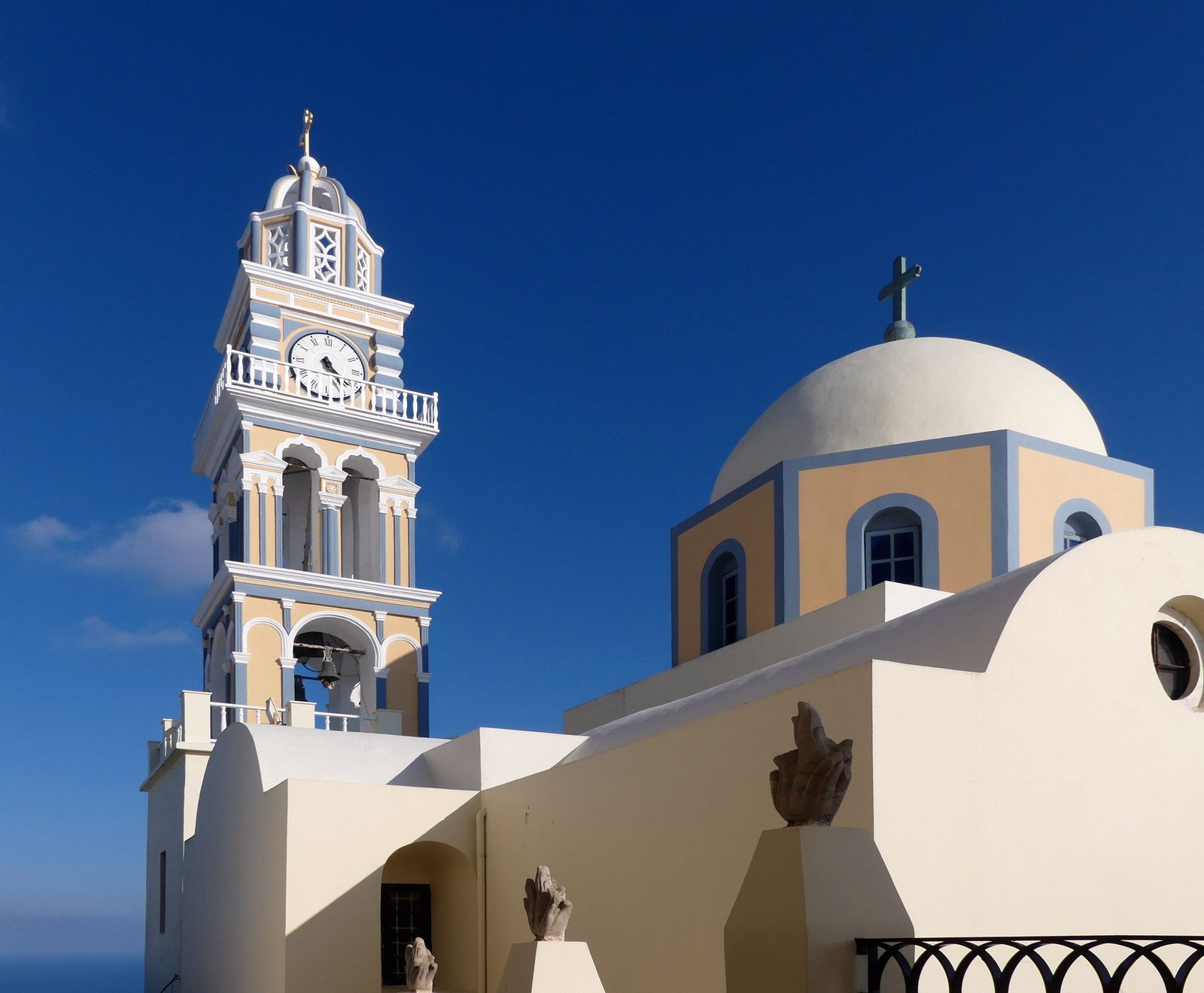
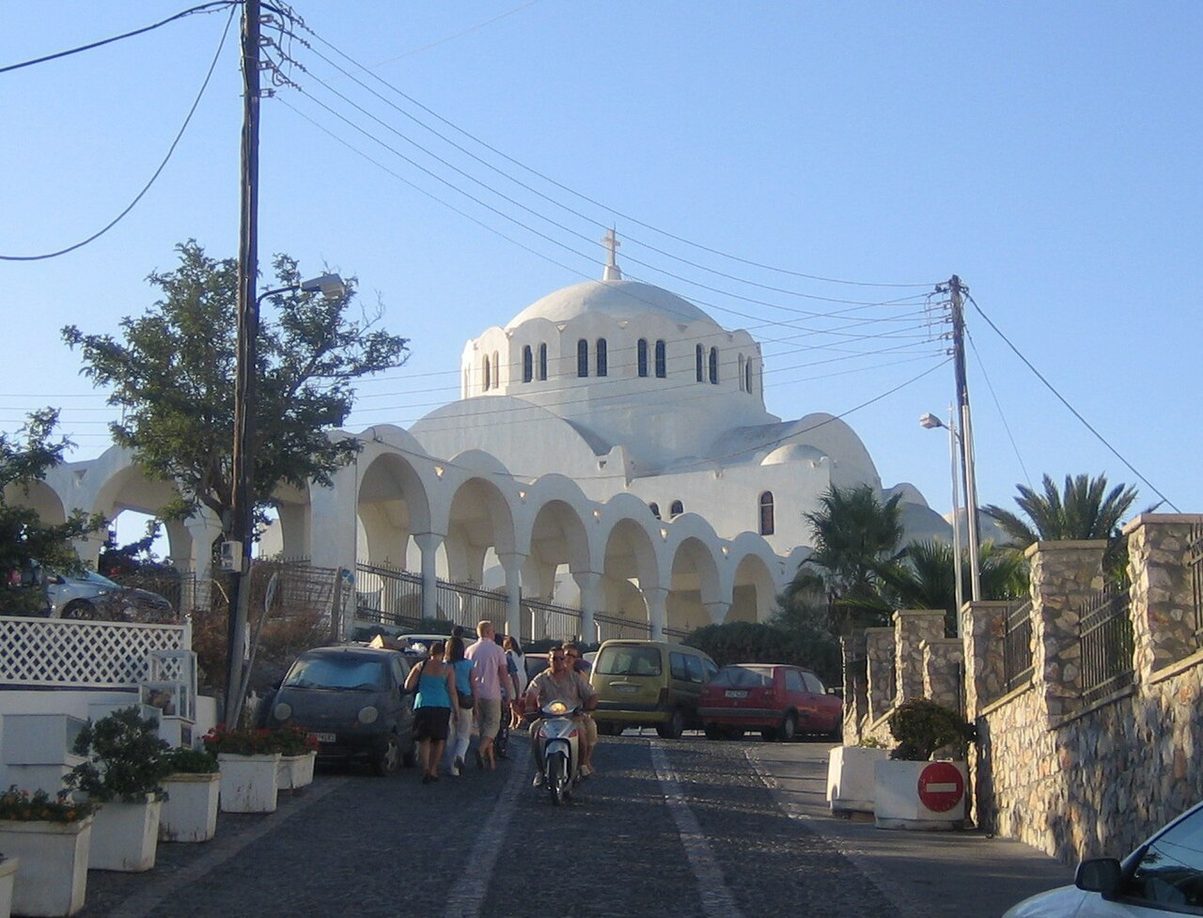
A few minutes’ walk away, in the old Catholic quarter, is the Catholic Cathedral of St John the Baptist, with its peach walls and tall clock tower, rebuilt after the 1956 earthquake. In the centre of town, beside the Museum of Prehistoric Thera, is the Orthodox Metropolitan Cathedral, built in 1827 and restored after the earthquake, with wall paintings by the local artist Christoforos Asimis.
Crowds and cruise ships
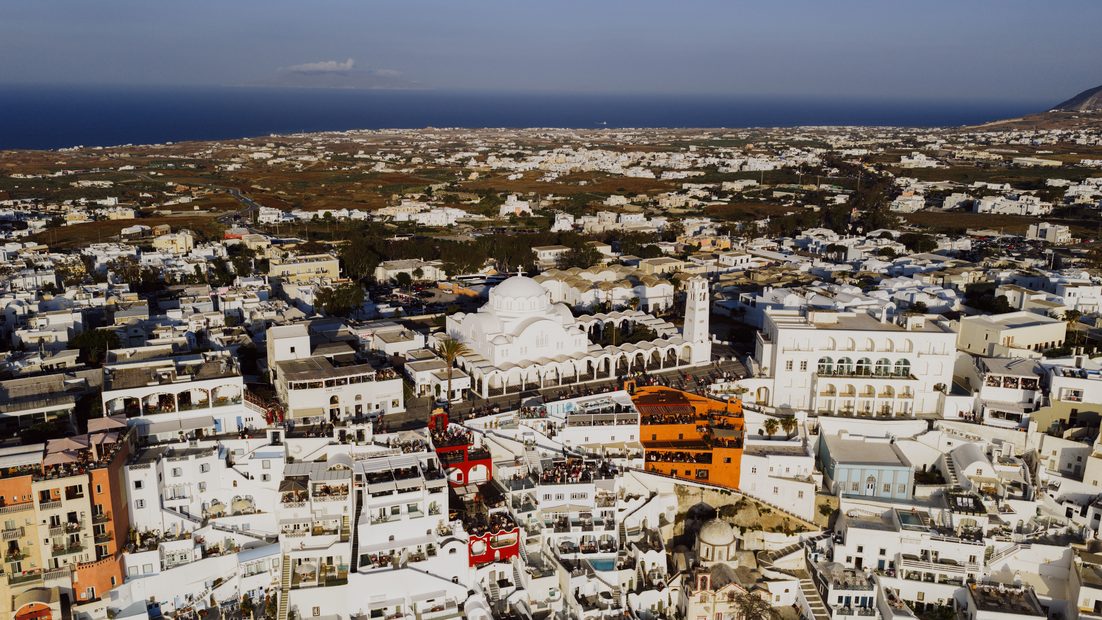
Most cruise passengers come ashore at Fira: their tenders land at the old port below the town, and they climb by cable car or by the zigzag steps. Since 2025 Greece has charged a fee on cruise passengers landing on Santorini, highest in summer, and the island limits the number of cruise passengers it accepts each day, to about 8,000. Even so, on busy days the caldera path is packed from late morning; come early, or in the evening after the ships have gone. The zigzag steps from the old port sometimes close after rockfalls (they were shut for about two weeks in summer 2026), and some areas around the old port are restricted under seismic precautions until March 2027; the cable car is the reliable way up.
Tours and where to stay
No ticket is needed. Firostefani, a few minutes’ walk away, is quieter than central Fira and has the caldera views; Fira itself has the buses and the most hotels.
These links go to GetYourGuide and Booking.com. This site earns nothing from them at present — they are here because they are the quickest way to check what is actually available.
Don’t miss
- The view from the path Dome, bells and caldera.
- First light Before the crowds.
- The caldera walk On to Imerovigli, about half an hour.
- St John the Baptist Fira’s Catholic cathedral.
- 15 August The church’s feast.
Insider tips
Keep walking. From the Three Bells the cobbled caldera path carries on through Firostefani to Imerovigli in about half an hour, with views all the way. There is no shade: in summer go early or late, and carry water.
Common questions
Where are the Three Bells of Fira?
On the caldera path in Firostefani, the northern edge of Fira, about 10–15 minutes’ walk north of the centre of town. The famous view is from the footpath just above the church, looking down on the dome and the bell gable with the caldera behind.
Is the Three Bells church the one in all the Santorini photographs?
Often not. The most famous blue domes, the two side by side above the sea, are in Oia, at the other end of the island, and belong to the churches of the Anastasi and Agios Spyridon. The Three Bells is a single blue dome beside a white bell gable with three bells.
Can you go inside the Three Bells of Fira?
Most visitors only see it from outside, which is free. The church is not open on a regular timetable, and its roof and terrace are private: photograph it from the public path above.
Is it a Catholic or an Orthodox church?
Catholic. Its official name is the Catholic Church of the Dormition of the Virgin, and it belongs to the Catholic diocese of Santorini; its feast is on 15 August. The Orthodox cathedral of Fira is in the centre of town.
When is the best time to see the Three Bells?
Early in the morning, before the crowds and when the light is soft. Sunset is beautiful but very busy, and late morning is the worst time on days when cruise ships are in.
More churches in Greece
- The monasteries of Meteora — monasteries on pillars of rock in Thessaly.
- Mount Athos — the monastic republic of northern Greece.