
Basilica of St George, Prague Castle
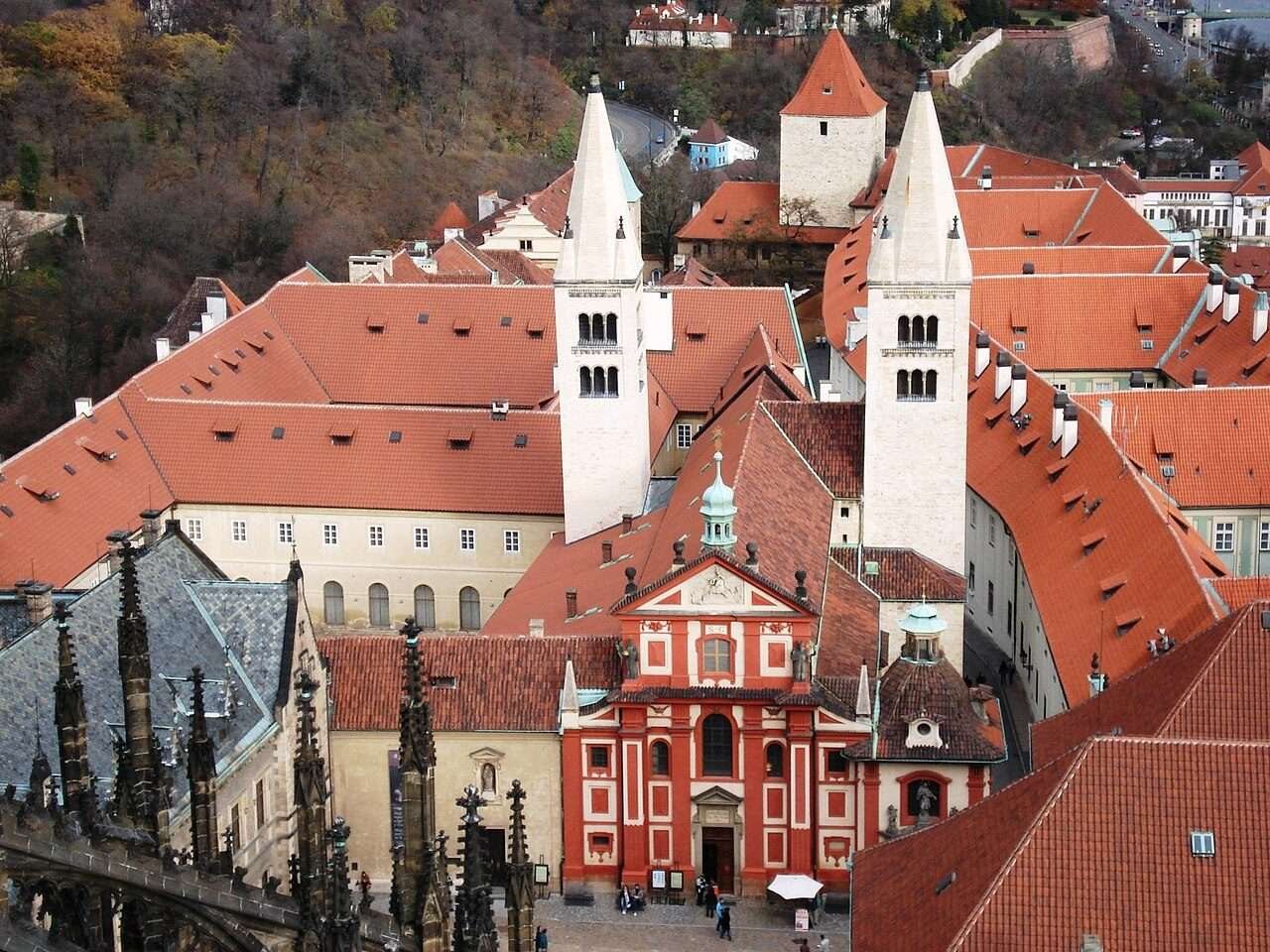
Behind a red Baroque front, in the shadow of the cathedral, is the oldest church still standing at Prague Castle — founded about 920, forty years before the Bohemians had a bishop. Inside there is almost nothing: bare stone, round arches, a flat timber ceiling, and a double staircase climbing to a raised choir. It is also the quietest of the four sites on the Castle ticket, which means that after the crush in St Vitus you can have a thousand-year-old building more or less to yourself.
The second church on the hill
It was founded about 920 by Prince Vratislav I, father of St Wenceslas — the second church built at Prague Castle after Bořivoj’s Church of the Virgin Mary, of which only excavated foundations remain. That makes this the oldest surviving church building at the Castle, and it predates the Prague bishopric by half a century.
Be clear what survives, though. The archaeology is blunt about it: of the 920 building only foundations remain, and the earliest standing fabric here dates from about the year 1000. What you walk through is essentially the rebuilding of 1145–1151, after the fire of 1142 — the eastern choir with its crypt, and the two towers.

Ludmila
In 925 the relics of St Ludmila were brought here from Tětín by her grandson Wenceslas, as part of her canonisation. Her story is the founding murder of Czech Christianity: on 15 September 921 she was strangled with her own veil by two Varangian retainers, Tunna and Gommon, at the instigation of her daughter-in-law Drahomíra — Wenceslas’s own mother, in a struggle over who would raise the boy and in which religion. Ludmila is the first Czech saint and the first Czech martyr, and she is still here.
The basilica went on as the burial church of the Přemyslid dynasty until 1055, when the burials moved to St Vitus.
The first convent in Bohemia, and the right to crown the queen
In 973, as the Prague bishopric was created, a Benedictine convent was founded beside the church — the first convent, and the first monastery of any kind, in Bohemia. Its first abbess was Mlada, sister of Prince Boleslav II, and the house she founded became the wealthiest abbey in the Bohemian crown lands, with around fifty nuns by 1400.
It also carried an extraordinary privilege: the abbess of St George crowned the queen of Bohemia. The archbishop crowned the king; the abbess crowned his consort. The privilege lasted until the convent was dissolved in 1782.
Stripped, barracked, and de-Baroqued
The Baroque left its mark twice. The red-ochre west front went up by 1680, attributed to Francesco Caratti with sculpture by Jan Jiří Bendl; and in 1718–1722 the Chapel of St John of Nepomuk was added by František Maxmilián Kaňka, with a statue by Brokoff and a cupola fresco by Reiner.
Then in 1782 Joseph II dissolved the convent. The buildings became barracks and were badly knocked about. And around the turn of the twentieth century — the Castle’s own account gives 1887 to 1908 under František Mach, while Czech sources credit Ludvík Lábler and run the dates to 1918 — the building underwent a purist restoration, stripping the Baroque out of the interior to recover the Romanesque church underneath.

The visitor's cheat sheet
| Where | Náměstí U Svatého Jiří, Prague Castle, Hradčany |
|---|---|
| Ticket | Not sold separately. Included in the Prague Castle Circuit: 450 Kč adult, 300 Kč reduced (6–16, students to 26, over-65s), 950 Kč family, valid two consecutive days, one entry per site. Free for under-6s and for disability card holders with a companion |
| What else the ticket covers | St Vitus Cathedral, the Old Royal Palace and Golden Lane with Daliborka. The permanent exhibitions — including the original St George bronze — are a separate ticket |
| Opening hours | Daily 9am–5pm from 1 April to 31 October; 9am–4pm from 1 November to 31 March. Castle grounds 6am–10pm. Note that St Vitus, on the same ticket, does not open until noon on Sundays |
| Security | Airport-style screening at every Castle gate. Queues are worst between 10am and 1pm and can run past half an hour in season |
| Best time | Arrive 8.15–8.45am and be through screening before nine; or come after 3.30pm, when the coach groups have gone. Avoid the noon changing of the guard if you are in a hurry |
| How long | 15–25 minutes inside |
| Photography | Permitted in the basilica without flash or tripod, and no longer needs a permit. Banned in the permanent exhibitions, the Picture Gallery and the convent |
| Accessibility | The nave is level and accessible; the raised choir, the Ludmila chapel and the crypt all involve steps, and there is no lift |
| Nearby | St Vitus Cathedral and the Old Royal Palace (both on the same ticket), Golden Lane just downhill, and the Old Castle Steps down to Malostranská |
Hours and admission checked against the official site in September 2026. They change; the official site is always the last word.
The one thing people get wrong. They read the bare interior as untouched tenth-century austerity. It is a nineteenth-century reconstruction of austerity. The restorers took out the altars, the plaster and the fittings to reveal the Romanesque — and the red Baroque front survived only because they worked inwards. So you are looking at two things at once: a genuinely Romanesque building, and an 1890s idea of what a Romanesque building ought to look like. Knowing that does not spoil it. It makes the one surviving Baroque chapel, deliberately left in, read as the joke it is.
What to see, in the order you meet it
The red front
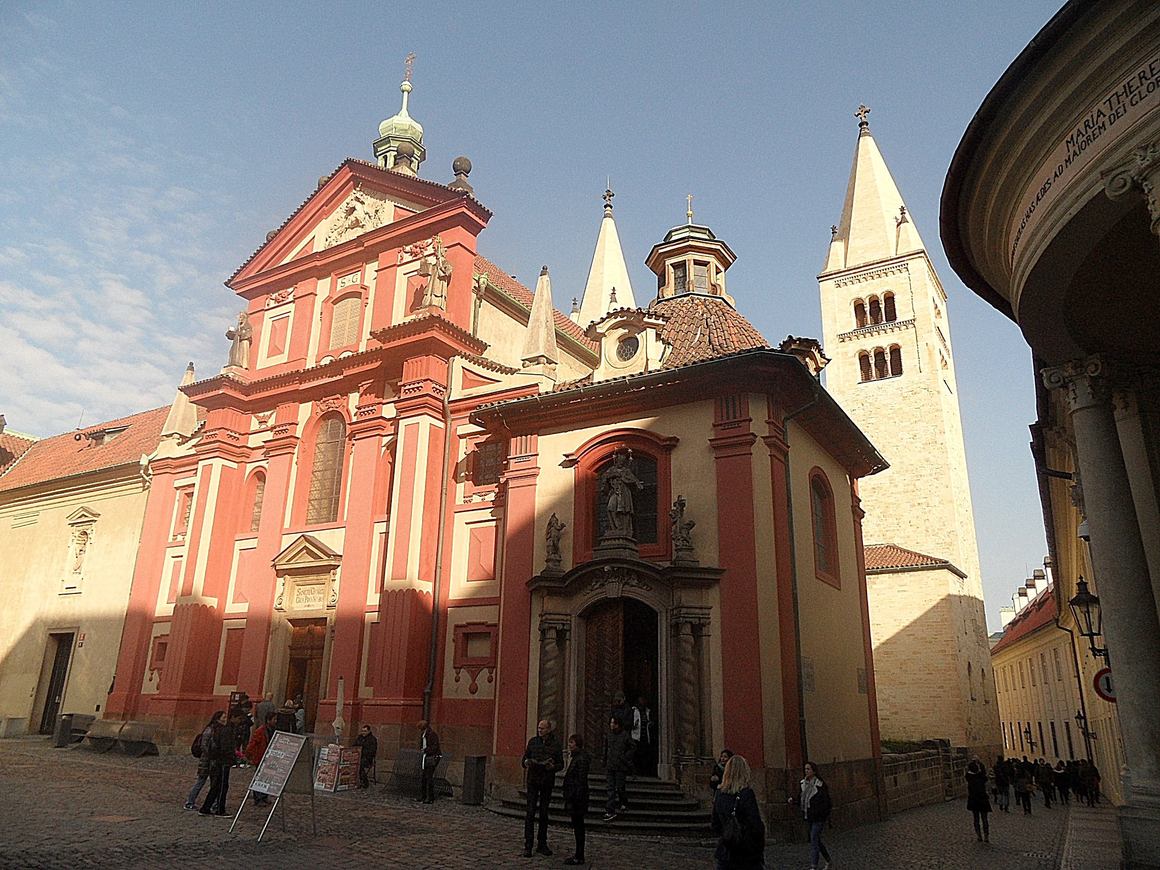
Early Baroque, in Habsburg “Schönbrunn” red, with a relief of St George and the dragon in the tympanum. In the two niches stand the founders: Princess Mlada on the left, holding a crown — the coronation privilege, carved — and Vratislav I on the right, holding a model of the church.
Adam and Eve, round the back
The two white limestone towers are not at the west front where you are standing; they are at the east end, flanking the choir, which is unusual in itself. Both are 41 metres. They are not the same: the southern one, Adam, is 6.3 metres wide; the northern, Eve, is 5 metres, and she is off true by something like 40 centimetres, which is why she had to be reinforced in the 1970s.

If the nickname rings a bell, it is because the Týn church in the Old Town calls its two unequal towers Adam and Eve as well, and guides regularly mix the two buildings up. To see these two properly, walk round towards Golden Lane; from the square in front of the red facade you can barely see them at all.
The nave, and the men in the floor
Inside: rough stone, round arches, plain cylindrical columns, a flat dark timber ceiling and almost no furnishing. In a Castle full of gilding it is a shock, and after twenty minutes in St Vitus it is a relief.

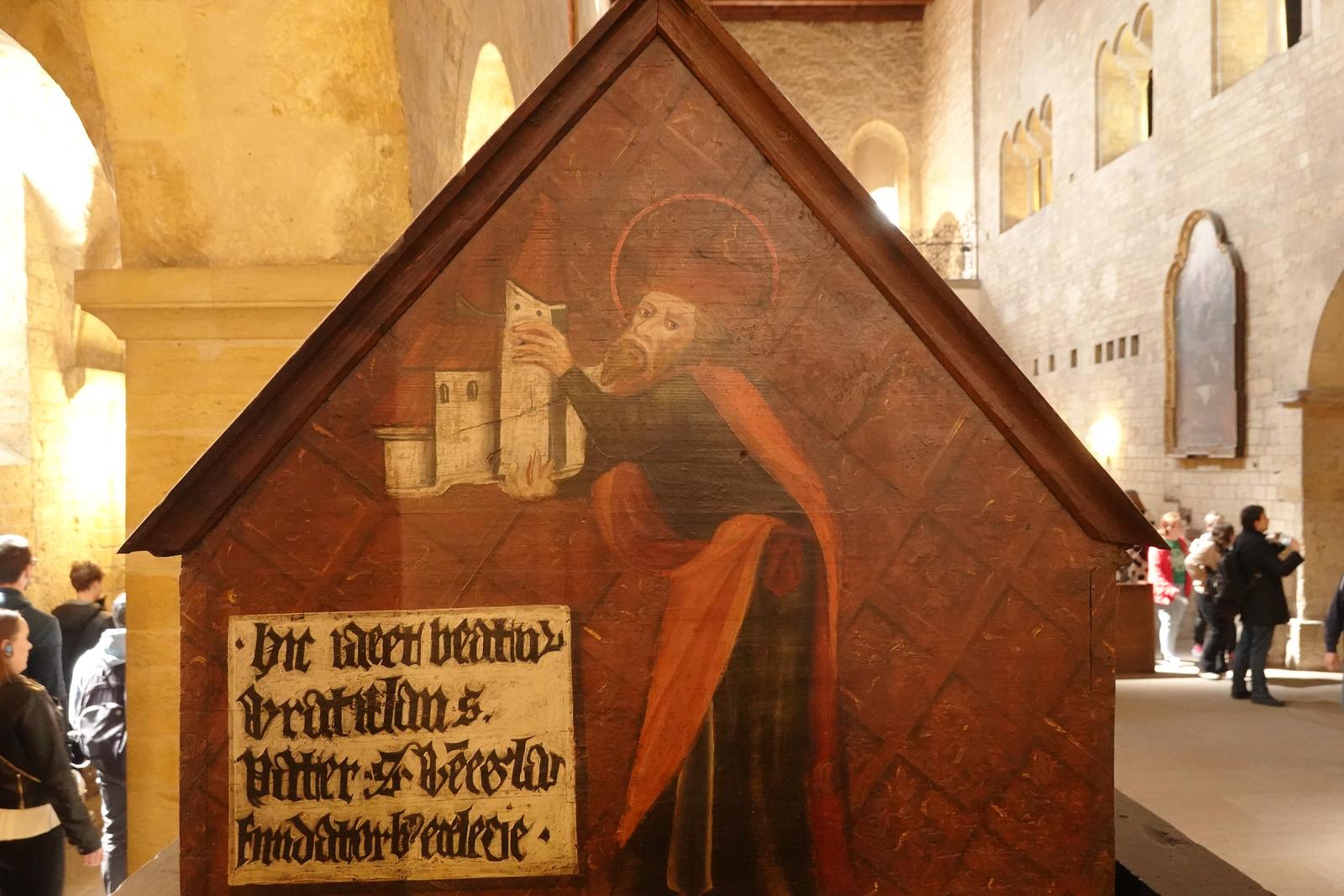
Look down. Low in the nave floor area is the tomb of Vratislav I — who founded this church, fathered St Wenceslas and died in 921 — a stone box with a fifteenth-century gabled top, and no fanfare whatever. Nearby is a second Přemyslid tomb, long identified as Boleslav II, Mlada’s brother, who died in 999 — though the identification is disputed, and one reading of the bones makes it Oldřich, who died in 1034. Most visitors photograph the staircase and walk straight over both.
The raised choir
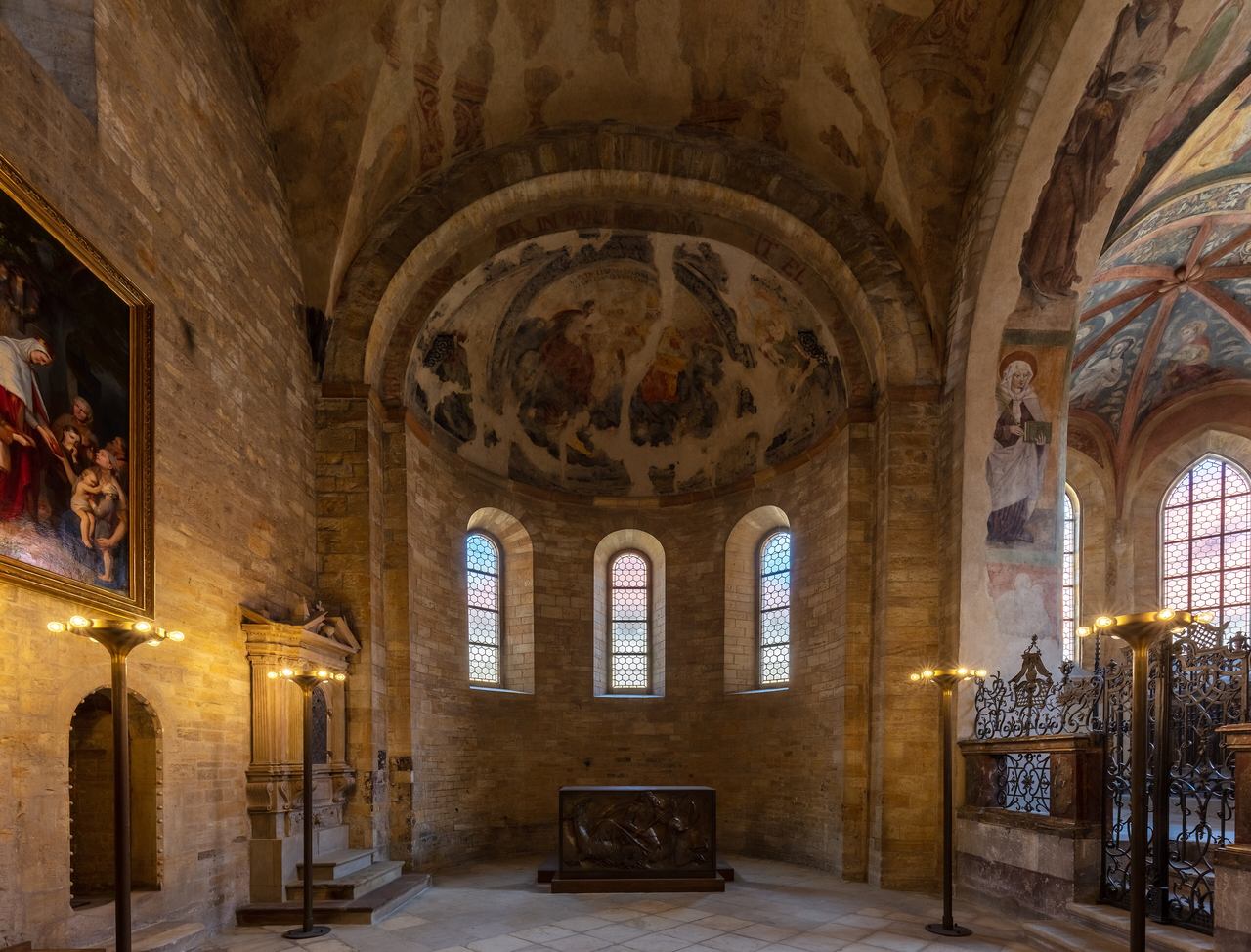
The east end is lifted well above the nave and reached by a double staircase climbing from both sides, with the crypt entrance below and between the flights. It is the most photographed sightline in the building and the one piece of theatre the restorers left alone.
St Ludmila's chapel
Off the south side of the raised choir, added in the thirteenth century and given a Gothic overhaul in the 1360s and 70s. Her tomb is here, the tumba attributed to the Parléř workshop in the fourteenth century. It is an active focus of pilgrimage, particularly for Orthodox visitors, for whom Ludmila is a saint of the undivided church — so you may well find someone praying while you are looking, and it is worth behaving accordingly.
Look up: what is left of the colour
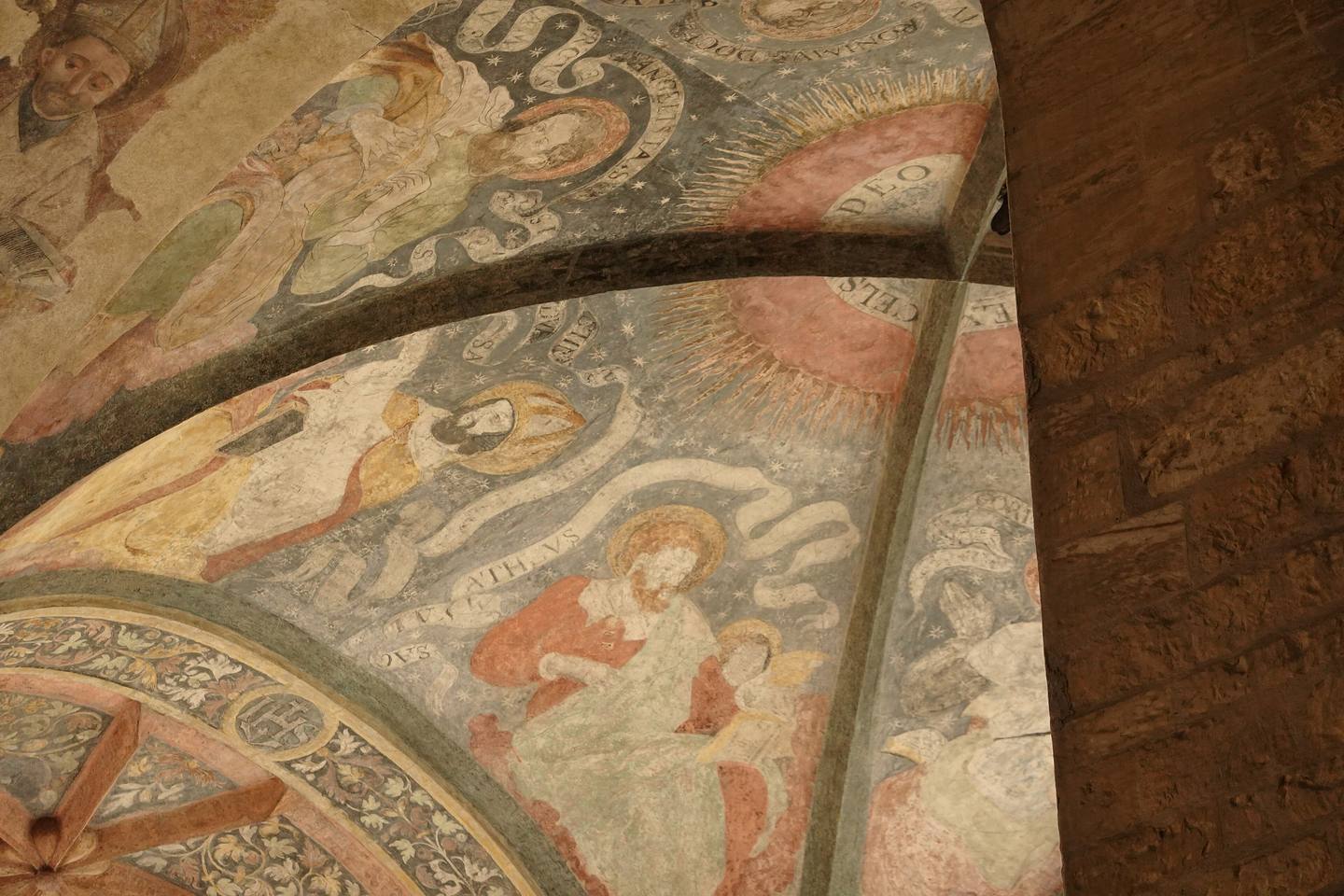
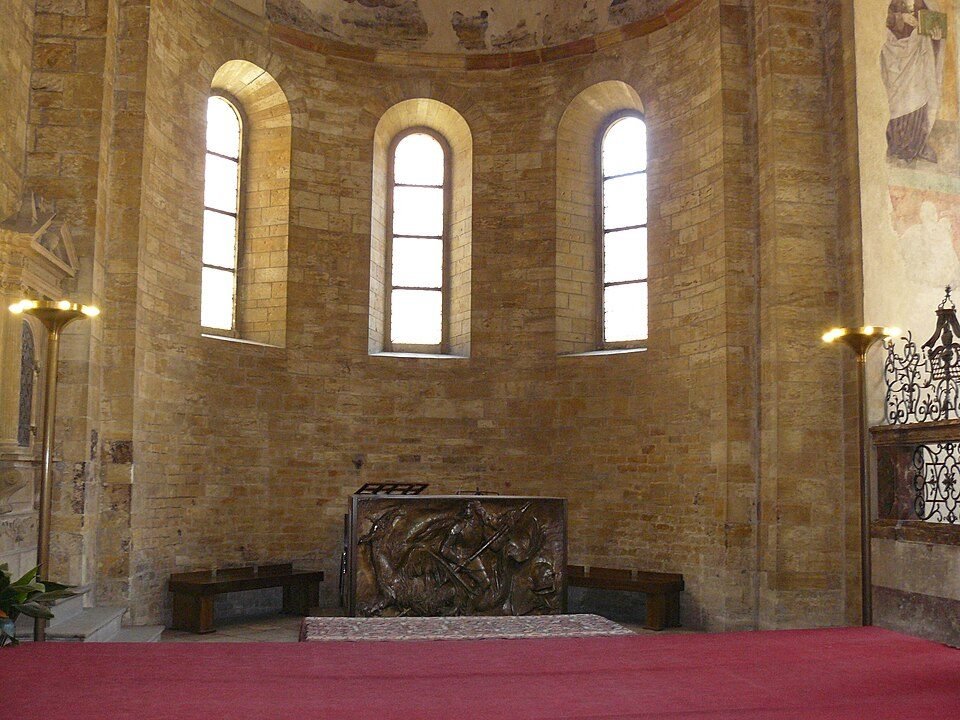
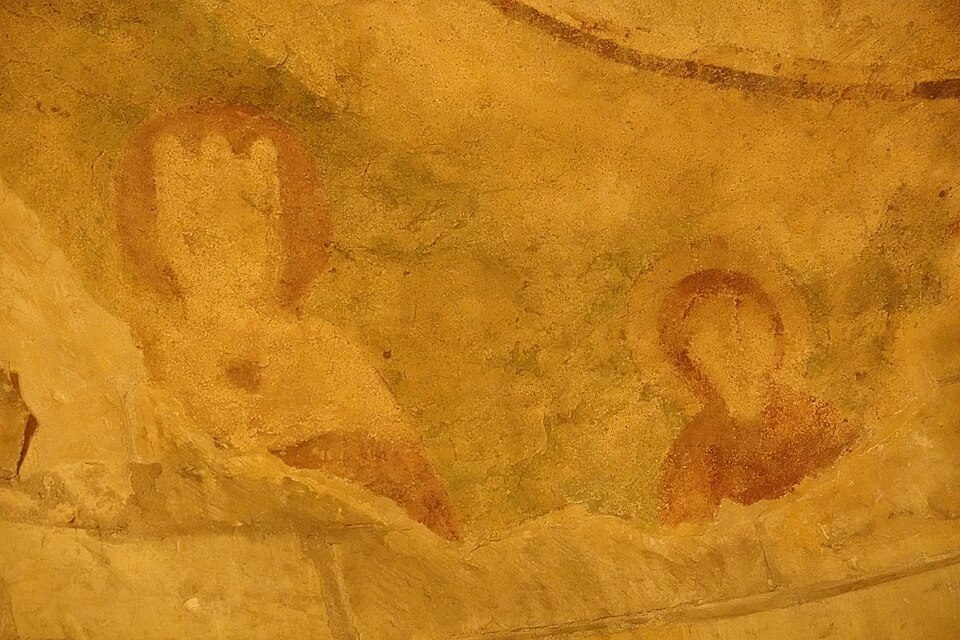
Fragments of twelfth and thirteenth-century wall painting survive in the choir vault and in the apses of the Ludmila chapel — the Heavenly Jerusalem, and figures of Christ, the Virgin and St John the Evangelist. They are faded, high and unlit, and the commonest mistake in this building after the tombs is to glance up, see grey, and move on. Stand still for half a minute and let your eyes adjust.

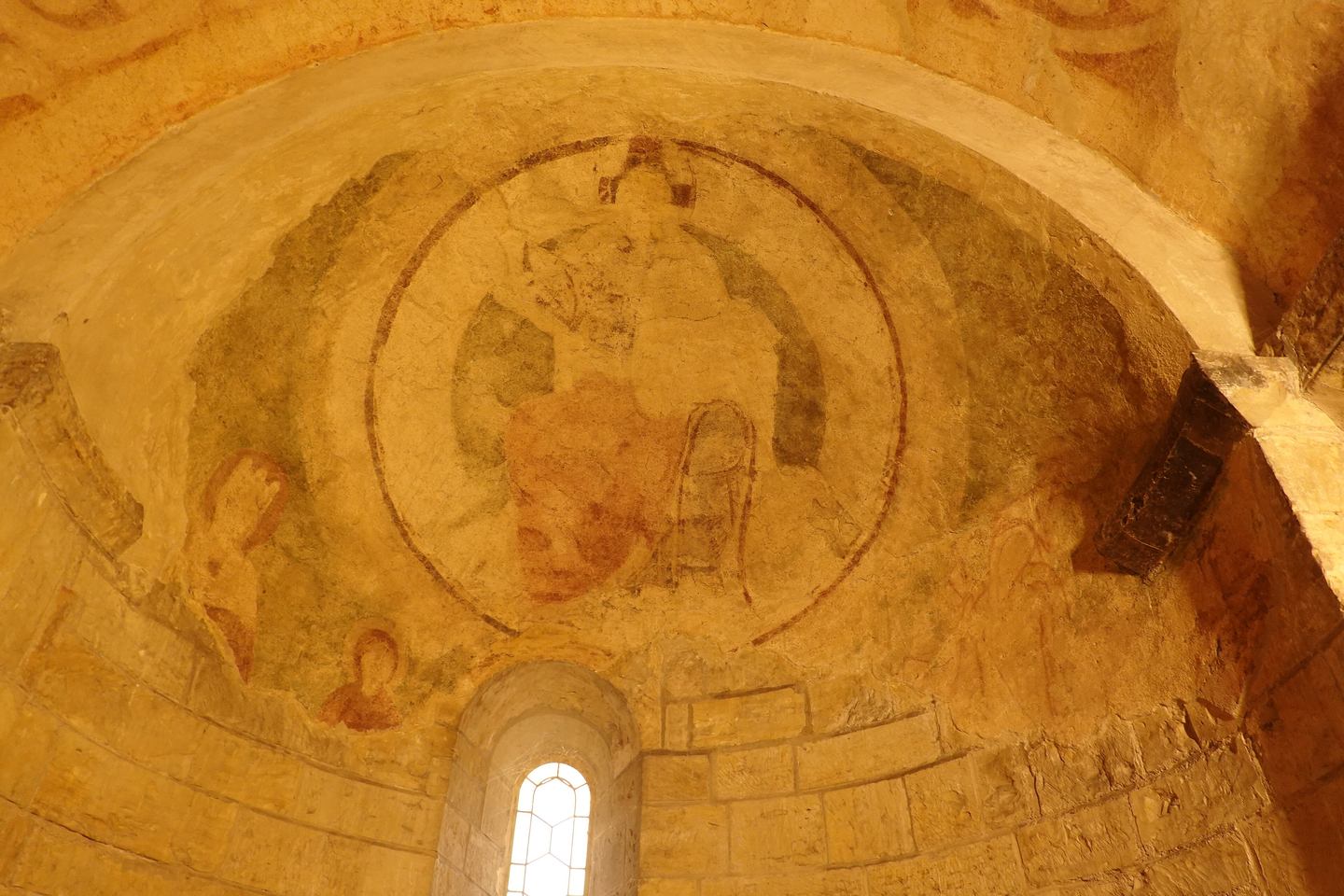

There is also a Romanesque relief of the Madonna crowned by angels, with the kneeling abbesses Mlada and Berta — the convent commemorating itself in the fabric.
The crypt, and Brigita
Under the choir is a three-aisled crypt, the oldest fabric on the site, and in it stands the strangest object in the whole Castle: “Brigita”, a stone figure of a decomposing young woman — hair, collapsing abdomen, and in the popular telling a snake coiled inside it. It is a memento mori by an unknown sculptor, with no close parallel in Czech sculpture; the dating is unsettled, with readings running from the late Gothic of about 1520 to the Rudolfine mannerism of the later sixteenth century.
The legend attached to it is that an Italian sculptor working at the Castle murdered his sweetheart Brigita out of jealousy, threw her into the Deer Moat, and was permitted to carve her decayed body before his execution. That is folklore, not history, and it comes in several incompatible versions, naming different killers and different victims — the piece was still waiting for a full art-historical treatment as late as 2024. Access is often limited to looking down into the crypt rather than going in, and the entrance sits under the staircase, where it reads like a service door. Almost no group tour mentions it.
The one Baroque chapel
The Chapel of St John of Nepomuk, off the south side, is what the purists deliberately spared: Kaňka’s architecture of 1718–22, Brokoff’s saint with his angels, Reiner’s fresco of 1722. Walking from the stripped nave into it is the building’s best single effect, and it is entirely an effect of what the nineteenth century chose to remove and what it chose to keep.
What happened to the bells
One small casualty worth noting, because it is the twentieth century leaving its mark on a tenth-century building. The basilica had a ring of bells; only one survives, cast in 1550. The rest were requisitioned for their metal during the two world wars, which is the fate of a great many Czech bells and the reason so few old ones are left in the country.
The rest of the modern history is quieter. The interior was repaired in 1958–62, the site excavated between 1958 and 1964, the convent reconstructed and Eve’s tower reinforced in 1969–75. It was declared a national cultural monument in 1962 and has been part of the UNESCO inscription of the historic centre of Prague since 1992. For most of the Communist period it worked as a concert hall, which it still does — the Romanesque acoustic is exceptional, and the building is at its very best with music in it and the electric light off.
Two things that are not here
The equestrian St George. The famous bronze — cast in 1373 by Martin and George of Kolozsvár, one of the most important surviving Gothic bronzes in Europe — is in the Third Courtyard beside the cathedral, not outside this church. And the one standing out there is a copy, put there in 1967; the original has been indoors ever since, latterly in the Story of Prague Castle exhibition, which is on the separate permanent-exhibitions ticket. A great many people photograph the copy believing it to be the original.
The convent. From 1975 the buildings next door housed National Gallery collections, and a lot of guidebooks still say so. The gallery closed the convent in 2012 because the building was falling apart; the Archbishopric got it back in 2016, and it is being converted into a culture and education centre and the permanent home of the St Vitus Treasure. There is no opening date. Do not plan on it.
Tickets and tours
It comes with the Castle, or not at all
There is no separate ticket. The basilica is site III on the Prague Castle Circuit — 450 Kč, also covering St Vitus, the Old Royal Palace and Golden Lane, valid two days. The permanent exhibitions, including the original St George bronze, are a different ticket. The Castle grounds and courtyards are free to walk through, so you can see the red front without paying anything; you need the ticket to get inside. Concerts held in the basilica are sold separately again — and it is unheated, so a winter concert is a genuinely cold hour.
Tour and hotel links go to GetYourGuide and Booking.com. This site earns nothing from them at present — they are here because they are the quickest way to check what is actually available.
Don't miss
- Vratislav I's tomb Low in the nave, unmarked by anything you would notice. The man who founded the church, and the father of St Wenceslas.
- St Ludmila's tomb South side of the raised choir, a 14th-century tumba from the Parléř workshop, and a place of active pilgrimage.
- Brigita, in the crypt A carving of a decomposing woman, under the staircase, that scarcely any tour mentions.
- The Heavenly Jerusalem 12th or 13th-century painting in the choir vault. Faint, high, unlit — give it thirty seconds.
- Adam and Eve Two 41-metre towers at the east end, one visibly slimmer than the other, and leaning.
- Mlada with her crown On the west front: the abbess whose successors crowned the queens of Bohemia.
- The Nepomuk chapel The one Baroque room the restorers spared, and the sharpest contrast in the building.
Insider tips
Come here after the cathedral, not before. It is the quietest of the four circuit sites, and the contrast — from the crush under the rose window to an empty thousand-year-old nave — is the best thing the Castle ticket buys you.
Get through security before nine. Screening at the gates is airport-style and the queues run worst from ten to one; the other good window is after half past three, when the coaches have gone. Just do not cut the last hour too fine in winter, when everything shuts at four.
Walk round to see the towers. From the square in front of the red facade they are behind you and invisible; the view is from the lane towards Golden Lane, or from the Old Castle Steps side.
Look for the crypt door under the staircase. Even if you can only look down into it, Brigita is the thing you will still be thinking about at dinner.
Do not go looking for the bronze St George outside. It is in the Third Courtyard by the cathedral, and it is a copy; the original is indoors on the other ticket.
Common questions
Do I need a Prague Castle ticket?
Yes — the basilica cannot be visited on its own. It is one of the four sites on the Prague Castle Circuit ticket, with St Vitus Cathedral, the Old Royal Palace and Golden Lane: 450 Kč adult, 300 Kč reduced, 950 Kč family, valid for two consecutive days, one entry per site.
How old is it really?
Founded about 920 by Prince Vratislav I, which makes it the second church ever built at the Castle and the oldest one still standing there. But almost nothing you can touch is from 920: the earliest surviving fabric dates to around the year 1000, and what you walk through is the rebuilding that followed the fire of 1142.
Why does the inside look so bare?
Because it was stripped to make it look old. The purist restoration of 1887–1908 removed the Baroque altars, plaster and fittings to recover the Romanesque character. The austerity is genuine Romanesque form and a nineteenth-century decision, both at once.
Who is buried here?
St Ludmila, in the chapel on the south side — grandmother of St Wenceslas, strangled in 921, and the first Czech saint. Also Vratislav I, who founded the church, and Boleslav II. It was the Přemyslid burial church until 1055.
Where is the famous statue of St George?
Not outside this church. The equestrian St George is in the Third Courtyard, by the cathedral — and the one out there is a copy, set up in 1967. The 1373 original, one of the great Gothic bronzes of Europe, has been indoors ever since, now in the Story of Prague Castle exhibition, which needs the other ticket.
How long should I allow?
Fifteen to twenty-five minutes, or forty if you read everything. Budget three to four hours for the Castle as a whole.
Where to stay and eat nearby
Eating inside the Castle is expensive and ordinary. Ten minutes will take you either down the Old Castle Steps into Malá Strana or up to Pohořelec, where the Strahov monastery brewery does the best-value lunch on the hill. Hradčany is a lovely and very quiet place to stay, a few minutes above the crowds, with trams down to everything else.
More churches in Prague
- St Vitus Cathedral — forty metres away, on the same ticket, and the opposite in every respect.
- The Loreta — five minutes outside the Castle gates, with no security queue.
- Strahov Monastery — fifteen minutes up the hill, for the library and the brewery.