
Clonmacnoise
Clonmacnoise stands on a low ridge above the River Shannon in the middle of Ireland: the ruins of a cathedral and eight smaller churches, two round towers, three outstanding high crosses and hundreds of early Christian grave slabs, in open country with the river meadows all round. St Ciarán founded the monastery in the 540s, and for centuries it was one of the great centres of learning in Ireland, its fame reaching across Europe. It is about 25 minutes’ drive from Athlone.
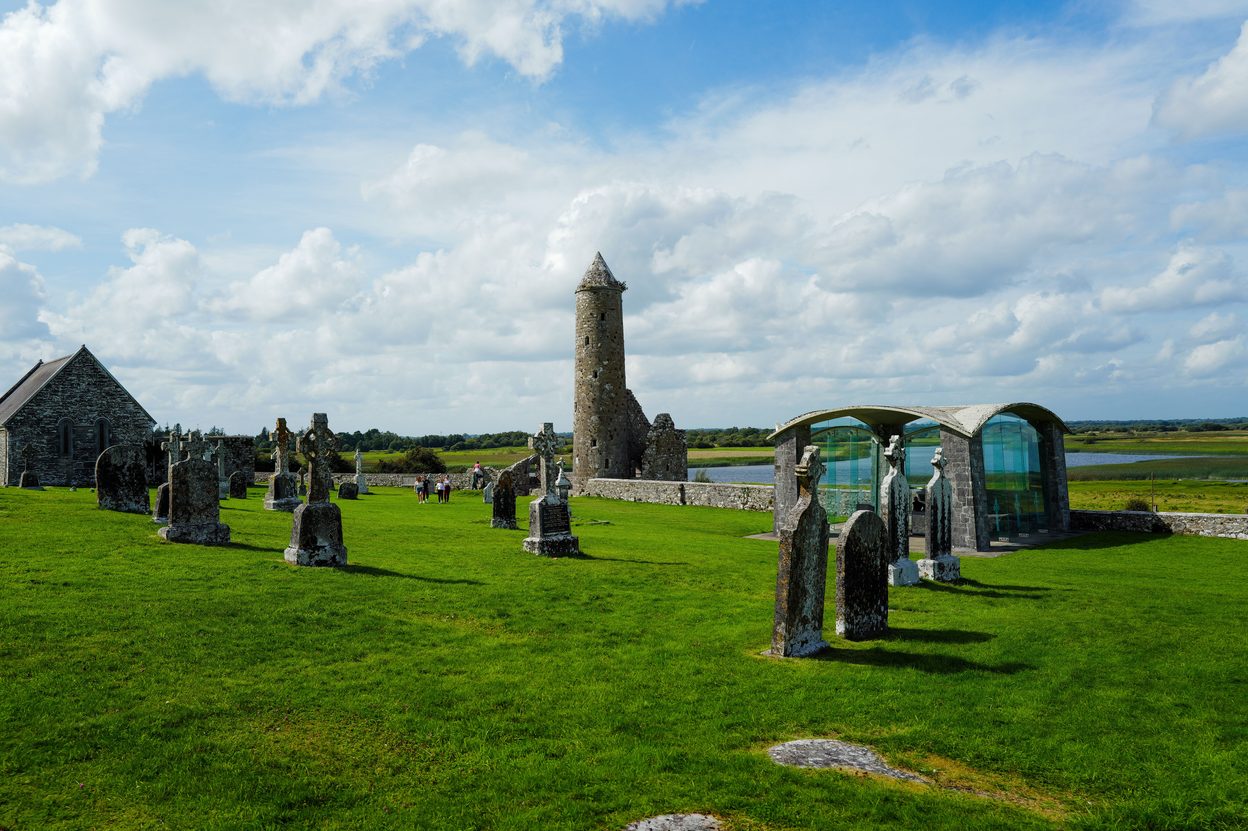
Closed until 1 January 2027. The Office of Public Works has shut the whole site from 19 October 2026, because the car park has to close while the visitor centre is rebuilt and there is no safe access. The redeveloped visitor centre, with the original high crosses and a new film, is due to open in spring 2027. Check heritageireland.ie before you set out.
A crossroads monastery
St Ciarán, the son of a craftsman (traditionally a carpenter), founded his monastery in about 545–548, on the east bank of the Shannon where the Eiscir Riada, the gravel ridge that carried the main road across Ireland, meets the river. He died young in 549, but his foundation grew into a monastic town of timber houses around stone churches, with craftsmen, scholars and a lay population as well as monks. Kings of Connacht and of Meath were buried here, among them Rory O’Connor, the last High King of Ireland, in 1198.
Its wealth made it a target. The annals record it raided again and again — by Irish kings, by Vikings and by the Normans — and it was rebuilt each time. Its decline began in the 13th century, as Athlone, with its castle and bridge, grew, and in 1552 the English garrison from Athlone reduced it to ruin. The site has been a National Monument in state care since 1877. Pope John Paul II came on 30 September 1979 and spoke of the “great monastic contribution to Ireland” made here for a thousand years.
The visitor’s cheat sheet
| Where | Clonmacnoise, Shannonbridge, Co. Offaly, N37 V292; about 21 km south of Athlone |
|---|---|
| Current closure | Closed to all visitors from 19 October 2026 until 1 January 2027, while contractors have the car park fully closed for the visitor-centre works (the OPW has not confirmed the reopening day); the new visitor centre is due in spring 2027 |
| Opening hours | Usually daily from 10am to about 5pm in winter and about 5.30pm from mid-March to October, with last admission up to an hour before closing (unofficial: the OPW publishes no timetable during the closure; check heritageireland.ie) |
| Admission | Adult €8, senior €6, child or student €4, family €20; free with the OPW Heritage Card |
| Getting there | Signposted from the N62 south of Athlone; Local Link bus 850 from Athlone station |
| Facilities | Car park, toilets and picnic area; no café at present, so bring food. Assistance dogs only |
| How long | Ninety minutes to two hours |
Hours and admission checked against the official site in October 2026. They change; the official site is always the last word.
What to see
The visitor centre and the high crosses
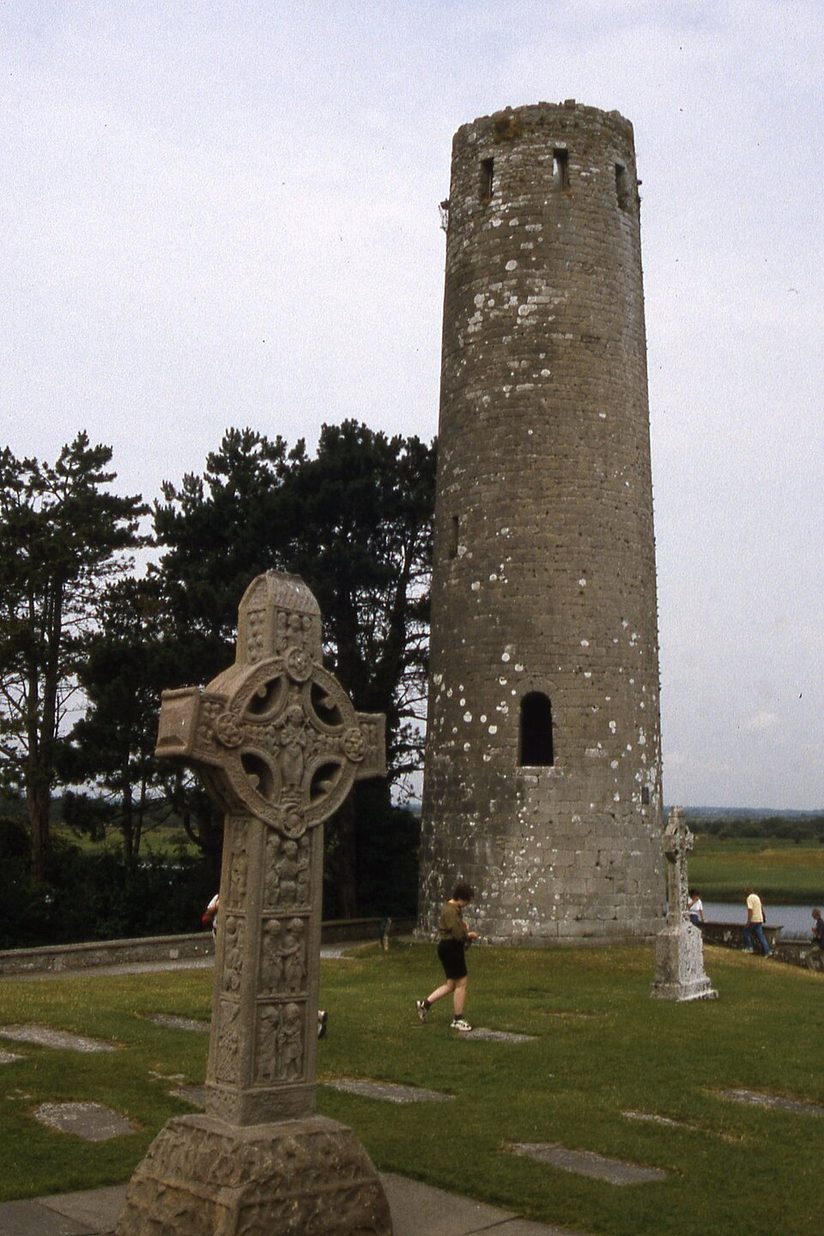
Normally a visit starts with a short film and the exhibition in the visitor centre, where the three original high crosses now stand indoors, with a large collection of carved grave slabs. The Cross of the Scriptures, about four metres of carved sandstone, was made around 900–910: the worn inscription on its base asks a prayer for King Flann and for Colmán, who made the cross for him, and its panels show the Crucifixion, the Last Judgement and Christ in the tomb. The South Cross, with the Crucifixion on its shaft, may be a little older, from the 9th century, and only the shaft of the North Cross, around 800, survives. Replicas stand outside on the original sites. The centre is being rebuilt and extended, with a new film and high-cross rooms, and is due to reopen in spring 2027.
The cathedral
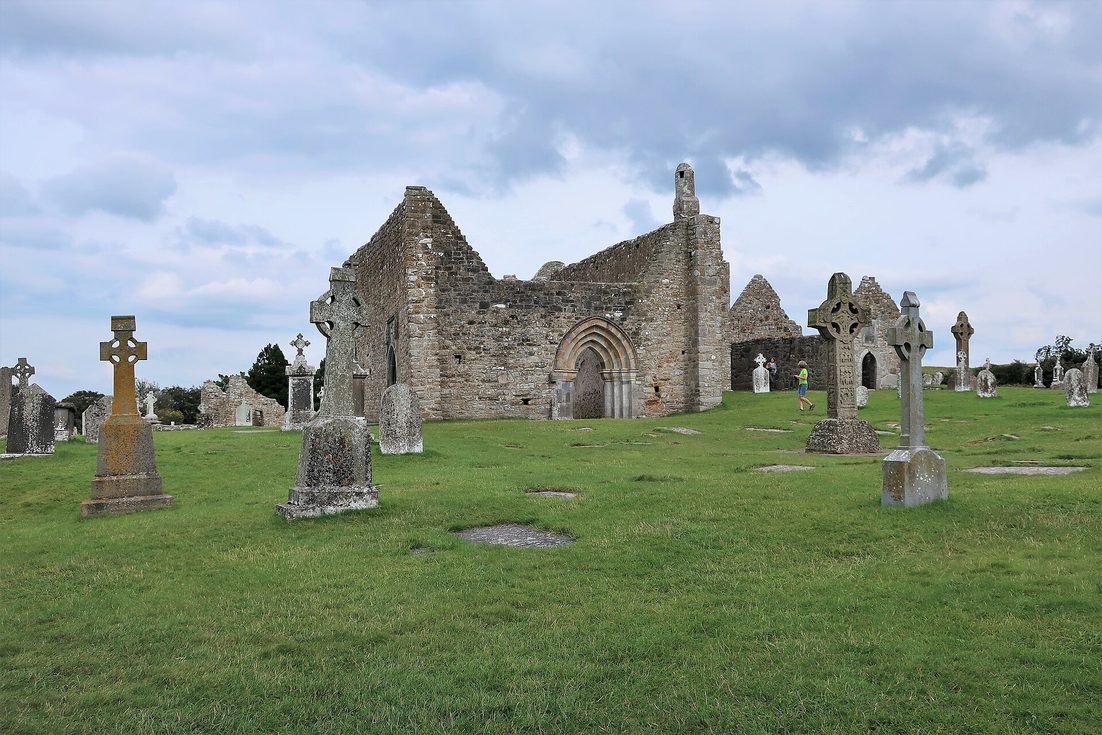
The largest building, also known as Temple McDermot, was built in 909 by the High King Flann Sinna and Abbot Colmán, the same two men named on the Cross of the Scriptures. It was altered many times: the west doorway is of around 1200 and the south wall was rebuilt in the late 13th century. Turlough O’Connor and his son Rory, the last High King, are said to lie near the altar.
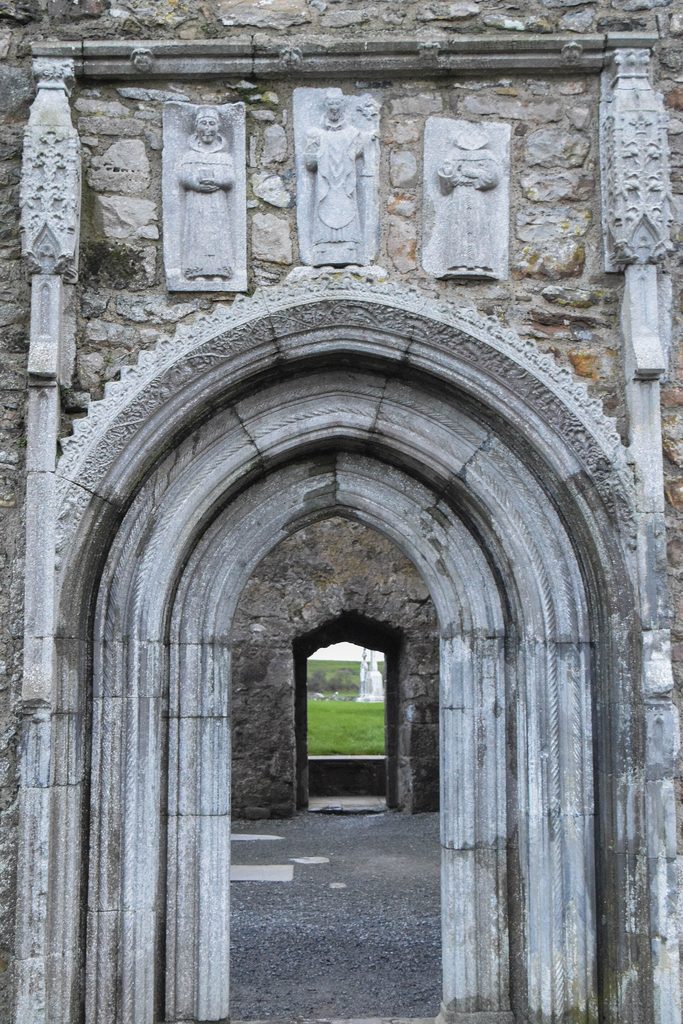
The north doorway is the Whispering Door, added in the 15th century by Odo, Dean of Clonmacnoise (who died in 1461); carved figures of St Dominic, St Patrick and St Francis stand above it. A whisper against one side of the arch can be heard clearly at the other, and tradition says it was used for confession, so that lepers could confess without coming close.
The round towers
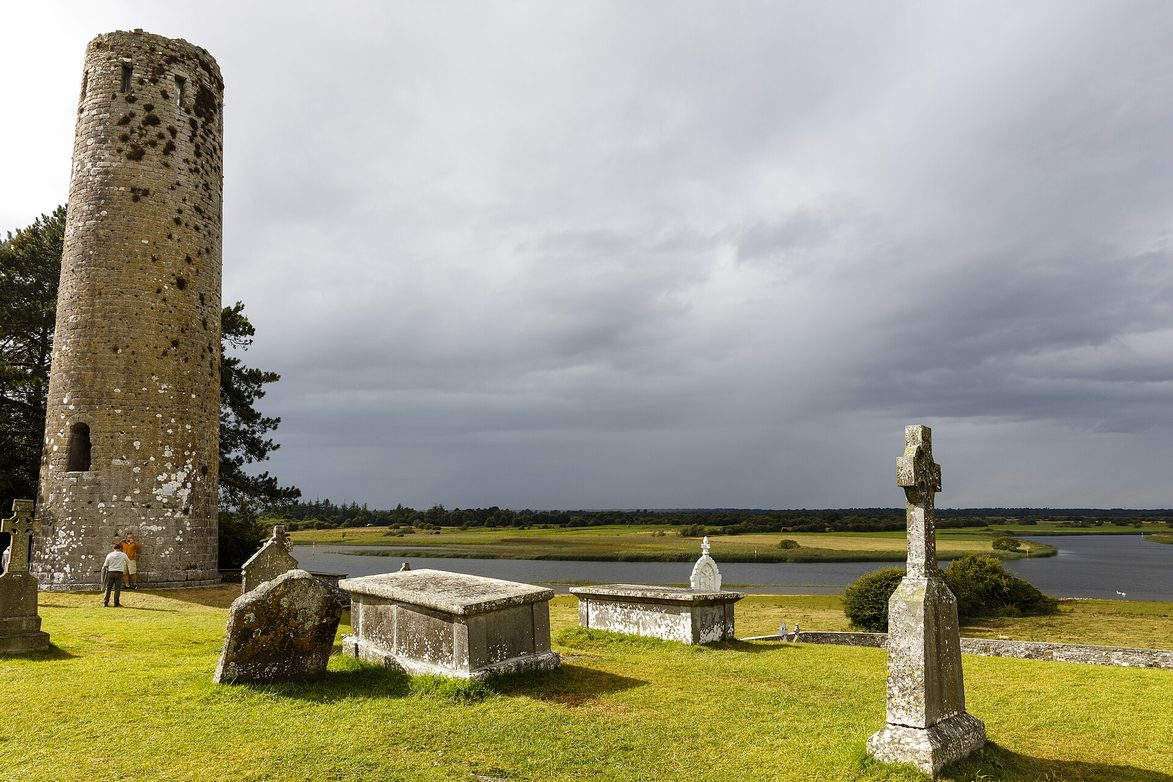
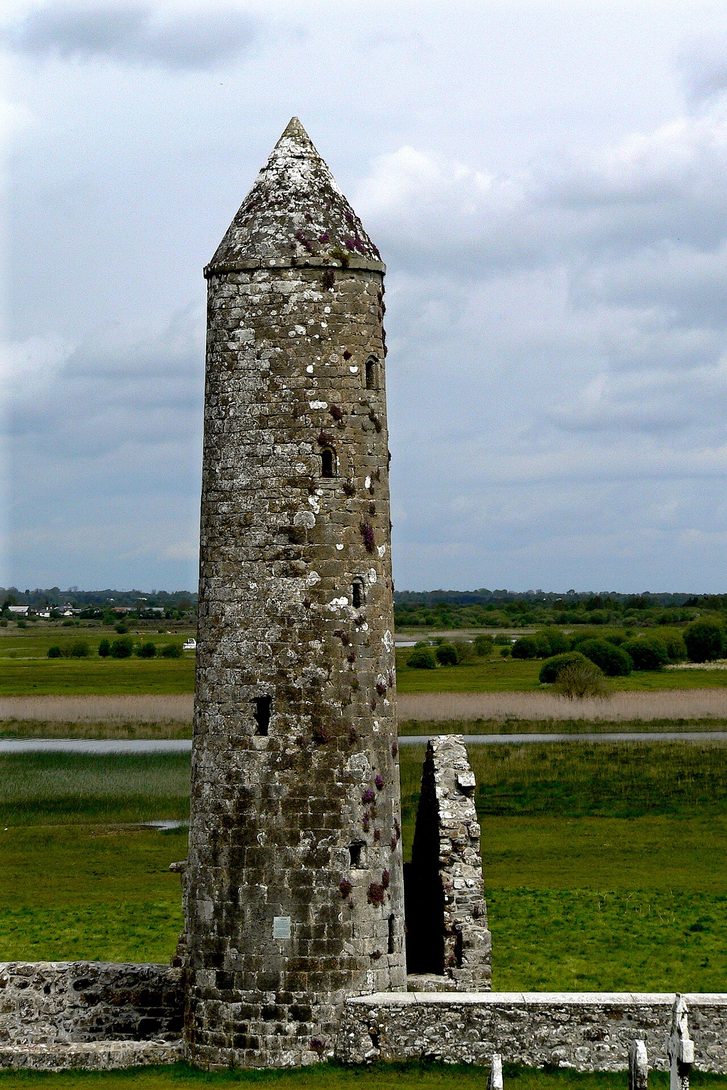
O’Rourke’s Tower, the free-standing round tower at the edge of the enclosure, was finished in 1124 by Turlough O’Connor and the abbot; lightning struck it in 1135, and the top storey, with its eight windows, is a later rebuilding. From beside it you look out over the Shannon and its flood meadows, the callows. On the north side, overlooking the river, is Temple Finghin, a small Romanesque church of around 1160–70 with a smaller round tower built onto it, its conical stone cap still intact.
The small churches
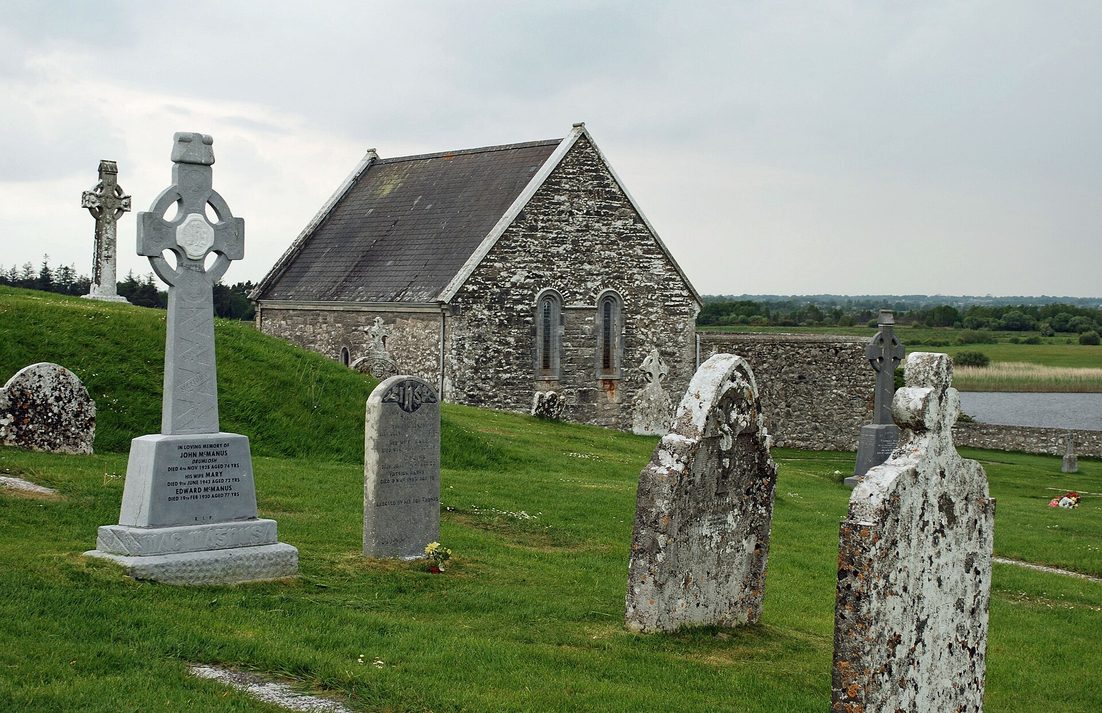
Temple Ciarán, the smallest, less than four metres long inside, is the reputed burial place of the founder and probably dates from the early 10th century. Temple Connor, with its windows and doorway of around the 12th century, is the only roofed church on the site: the Church of Ireland has used it since the 18th century, and holds an open-air service beside it each summer, usually on the last Sunday in July. Temple Dowling, Temple Hurpan, Temple Kelly and Temple Melaghlin make up the rest of the group inside the walls.
The Nuns’ Church
About 500 metres east, along the old pilgrim causeway, is the Nuns’ Church, completed in 1167 by Derbforgaill (Dervorgilla), wife of Tighernán O’Rourke, king of Breifne. Its west doorway and chancel arch are among the finest Hiberno-Romanesque carving in Ireland, with chevrons and beast heads (the chancel arch was rebuilt in the 1860s). Many visitors skip it, which is a reason to go.

Getting to Clonmacnoise
Clonmacnoise is in Co. Offaly, about 21 km south of Athlone (around 25 minutes by car), 8 km north of Shannonbridge and about 1 hour 45 minutes from Dublin by the M6; from Galway allow 1 hour 15 to 1 hour 30. It is signposted from the N62. Parking is at the visitor centre; spaces for vehicles over five metres are very limited, and the site asks visitors to avoid arriving between 10.30am and 3pm, the busiest hours.
Without a car, take the train to Athlone and then TFI Local Link bus 850, which runs from Athlone station to the Clonmacnoise stop at the car park about every three hours, seven days a week, taking just over half an hour; a taxi from Athlone takes about 20 minutes. In summer, Viking Tours sail down the Shannon from Athlone Castle to Clonmacnoise in about an hour and a half, returning by coach (€40 adults in 2026); the 2026 season has ended. Boaters can usually tie up at the public jetty below the site; check Waterways Ireland’s marine notices.
Tours and where to stay
Shannonbridge, a few minutes’ drive south, has a handful of places to stay; Athlone has many more. Most day tours from Dublin that include Clonmacnoise combine it with Athlone or Galway.
These links go to GetYourGuide and Booking.com. This site earns nothing from them at present — they are here because they are the quickest way to check what is actually available.
Don’t miss
- The Cross of the Scriptures Carved around 900–910 for King Flann.
- The Whispering Door Try it with a friend.
- Temple Finghin A church with its own round tower.
- The view over the Shannon From beside O’Rourke’s Tower.
- The Nuns’ Church Romanesque carving, 500 metres away.
Insider tips
Arrive early or late. Coach tours fill the car park in the middle of the day, and the light over the river is best in the evening. Wear proper shoes: the ground among the graves is uneven and the doorways are low. On or near St Ciarán’s feast, 9 September, the Diocese of Ardagh and Clonmacnois holds its pattern pilgrimage, with stations and an open-air Mass.
Common questions
Is Clonmacnoise open?
Not at the moment. The Office of Public Works has closed the whole site from 19 October 2026 until 1 January 2027, because building work on the visitor centre means the car park has to be shut and there is no safe way in. The new visitor centre itself is due to open in spring 2027. Check heritageireland.ie before you travel.
How much does it cost to visit Clonmacnoise?
Adults €8, seniors €6, children and students €4, and a family ticket €20. The site is run by the Office of Public Works, so the OPW Heritage Card covers it.
Where are the original high crosses?
The three finest crosses — the Cross of the Scriptures, the South Cross and what is left of the North Cross — were moved indoors to protect them from the weather, and replicas stand on the original sites. The originals are shown in the visitor centre, which is being rebuilt and is due to reopen in spring 2027.
Can you get to Clonmacnoise without a car?
Yes, just. TFI Local Link bus 850 runs from Athlone railway station to the Clonmacnoise stop about every three hours and takes just over half an hour. A taxi from Athlone takes about 20 minutes. In summer Viking Tours sail down the Shannon from Athlone to Clonmacnoise.
How long do you need at Clonmacnoise?
An hour and a half to two hours for the film, the exhibition and the monastic site. Allow longer if you walk out to the Nuns’ Church, about 500 metres east along the old pilgrim road.
More churches in Ireland
- Glendalough — St Kevin’s monastic city, with its own round tower, in the Wicklow Mountains.
- Rock of Cashel — the kings’ rock in Tipperary, with Cormac’s Chapel.
- Skellig Michael — the monastery on an Atlantic crag.