
Glendalough
Glendalough, “the valley of the two lakes”, is the most beautiful of Ireland’s early monastic sites: a round tower, a roofless cathedral and little stone churches in a wooded glacial valley in the Wicklow Mountains, an hour from Dublin. It was founded by St Kevin in the sixth century. The monastic city is free and always open; come early on a weekday to have it to yourself, and walk on to the Upper Lake.
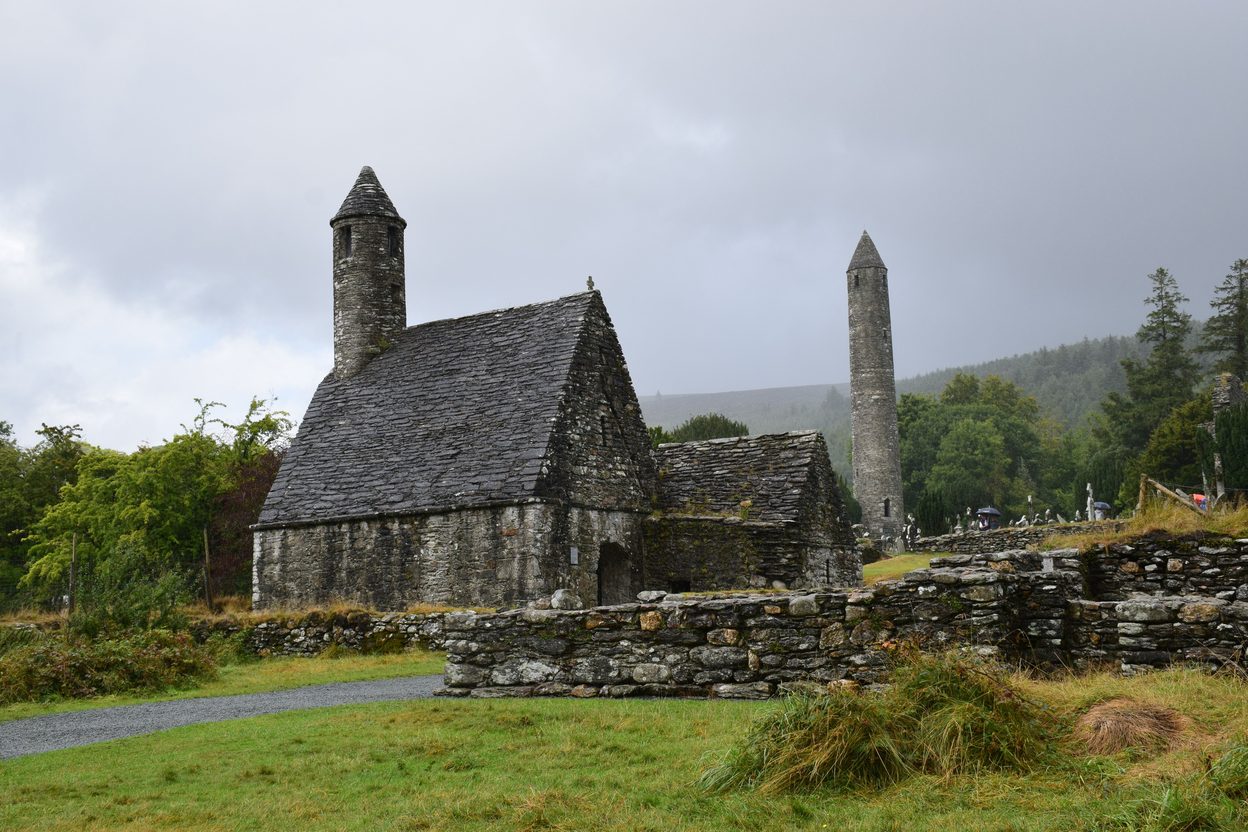
St Kevin’s city
Kevin, a young man of a noble Leinster family, came to the valley in the sixth century to live as a hermit, in a cave above the Upper Lake that is still called St Kevin’s Bed. Followers gathered, and he founded a monastery further down the valley; he is said to have died in about 618. Over the following centuries Glendalough grew into a monastic city with churches, workshops, houses and a school, and drew pilgrims from all over Ireland.
It was raided by Vikings and by Irish rivals more than once. In the early thirteenth century its diocese was united with Dublin, and in 1398 English forces destroyed the settlement, though pilgrims kept coming, especially on St Kevin’s feast, 3 June. Most of what survives dates from the tenth to the twelfth centuries.
The visitor’s cheat sheet
| Where | Glendalough, County Wicklow, about 50km south of Dublin; Eircode A98 HC80 (visitor centre) |
|---|---|
| Opening hours | Monastic city always open. Visitor centre mid-March to 14 October 9.30am–6pm, 15 October to mid-March 9.30am–5pm; last admission 45 minutes before closing; closed 23–29 December |
| Admission | Free; visitor centre €5, seniors €4, children and students €3, families €13 (free with the Heritage Card) |
| Parking | Paid car parks at the visitor centre and the Upper Lake, about €4–5; free parking in Laragh, about 1.5km from the monastic city. They fill on sunny weekends |
| Getting there | St Kevin’s Bus from St Stephen’s Green, Dublin, daily at 11am (€14 single, €23 return); about an hour by car |
| Dogs | Welcome on a lead |
| How long | An hour for the monastic city; half a day with the lakes |
Hours and admission checked against the official site in October 2026. They change; the official site is always the last word.
Free, but get there early. The monastic city costs nothing, but the car parks charge and fill up on sunny weekends and in summer, when traffic queues on the valley road. Come early or late, or on a weekday, or take St Kevin’s Bus from Dublin. Upgrade works on the White Trail, the long loop above the Upper Lake, began in July 2026 and are expected to take five or six months.
What to see, in the order you meet it
The gateway
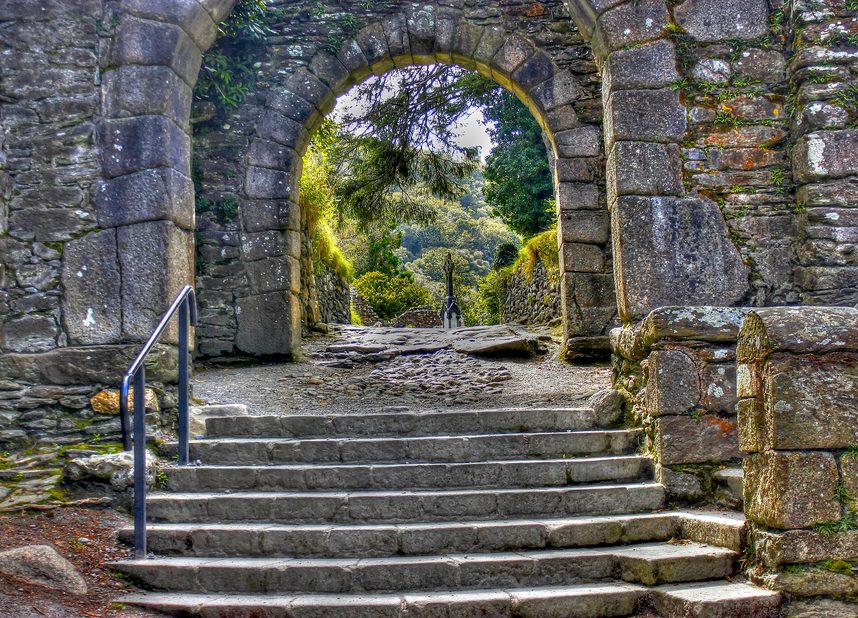
The monastic city is entered through a gateway of two granite arches, once two storeys high, the only surviving gateway of an early Irish monastery. Inside the passage, a stone carved with a cross marked the edge of the sanctuary.
The round tower and the cathedral
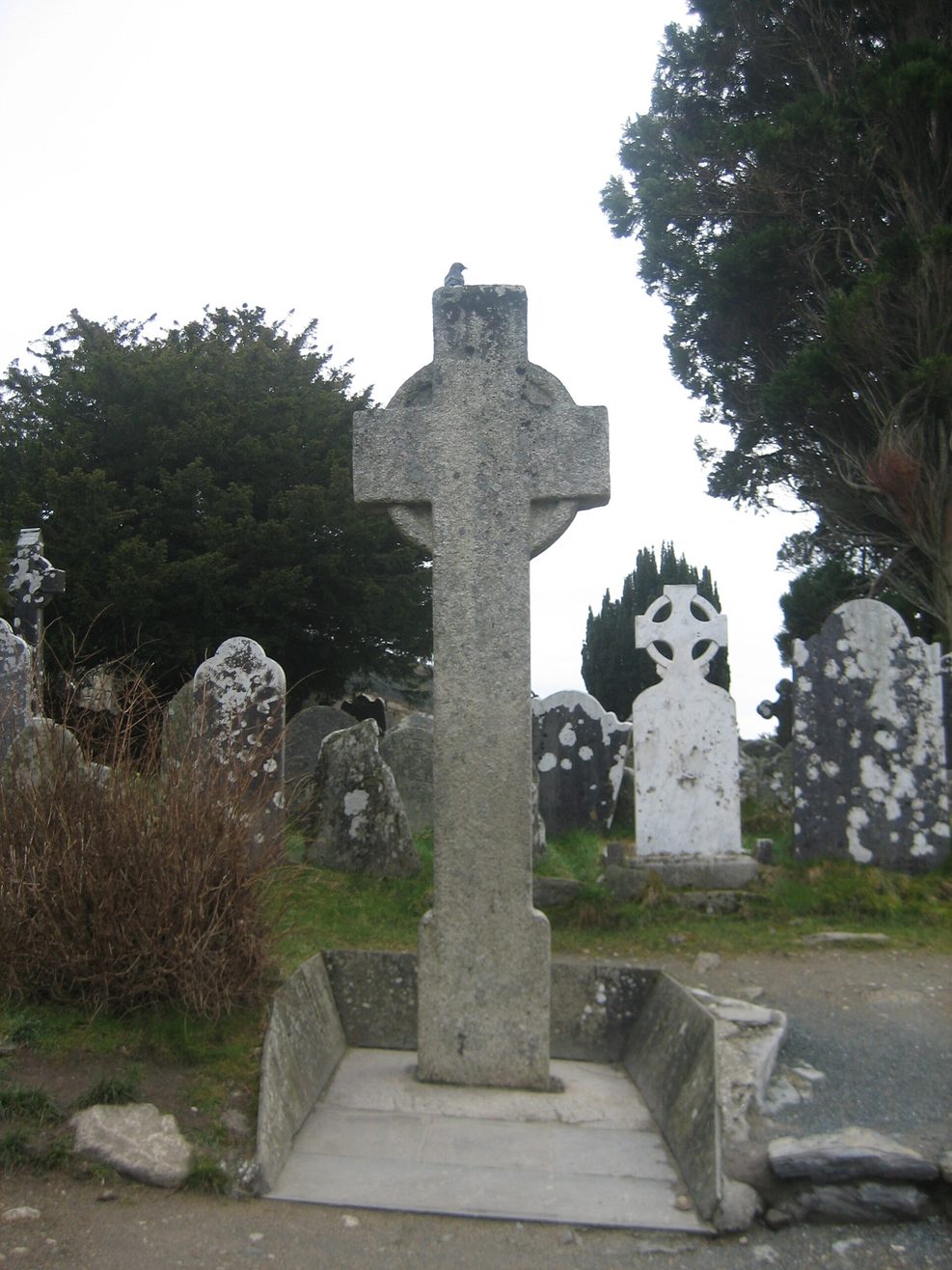
Beyond the gateway, the round tower rises about 30 metres above the graveyard. Built perhaps in the tenth or eleventh century as a bell tower, and a place of refuge, it has its door some three and a half metres above the ground. Nearby, the roofless cathedral of St Peter and St Paul is the largest building in the city, its nave older than its chancel of the late twelfth or early thirteenth century. South of it stands St Kevin’s Cross, a plain granite cross with an unpierced ring; the little Priest’s House has a carved Romanesque arch.


St Kevin’s Church
Down the slope is St Kevin’s Church, a small, steep-roofed church built entirely of stone, roof and all, with a little round belfry rising from one end like a chimney: hence its nickname, St Kevin’s Kitchen.

The Green Road and the Upper Lake
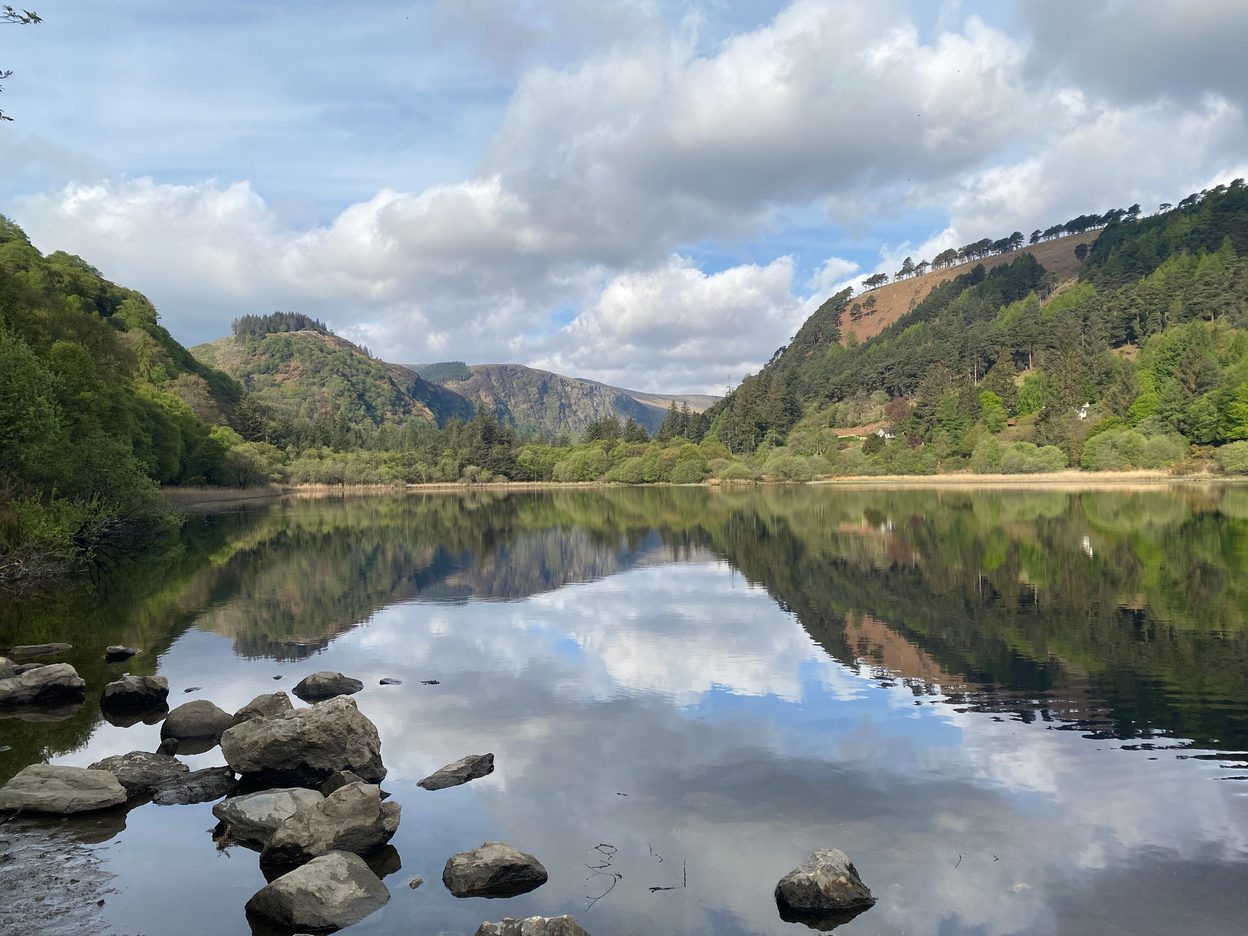
Across the river, the Green Road runs about two kilometres through the woods past the Lower Lake to the Upper Lake, passing the Deer Stone, a hollowed stone where legend says a doe left milk for an orphaned baby. By the Upper Lake are the ruins of Reefert Church, burial place of local chieftains, and across the water, on the cliff, St Kevin’s Bed and the ruins of Temple-na-Skellig, reachable only by boat, with no public boat service, so they are seen from across the lake.
Tours and where to stay
Day trips and hotels
Many day tours from Dublin combine Glendalough with the Wicklow Mountains or Kilkenny. To see the valley at its quietest, stay the night in Laragh or Glendalough itself and walk in the early morning.
The hotel link goes to Booking.com. This site earns nothing from it at present — it is here because it is the quickest way to check what is actually available.
Don’t miss
- The round tower About 30 metres, and almost complete.
- St Kevin’s Kitchen The stone-roofed church.
- The gateway The only one of its kind left in Ireland.
- The Green Road The walk to the Upper Lake.
- The Spinc The boardwalk above the Upper Lake, if you are fit.
Insider tips
Walk to the Upper Lake. Most visitors see only the monastic city; the Green Road is flat and takes 30–40 minutes. Fit walkers can climb the Spinc above the Upper Lake for the best view of the valley, about two hours for the short loop. Boots help in wet weather, and there is no swimming in the lakes.
The National Park Information Office at the Upper Lake has trail maps; in the autumn rut, rangers sometimes hold rut-watch days with telescopes trained on the red deer on the Spinc.
Common questions
Is Glendalough free to visit?
Yes. The monastic city and the park are free to walk round. The visitor centre, with its exhibition, charges €5 for adults; car parks charge about €4–5 a day, and paying for the visitor centre car park gets one free admission.
How do I get to Glendalough from Dublin?
St Kevin’s Bus runs every day except Christmas Day from St Stephen’s Green North at 11am, taking about an hour and twenty minutes, and returns from Glendalough at 4.30pm (with an early bus in the morning). It costs €14 single and €23 return. By car it takes about an hour; many day tours from Dublin include Glendalough.
Who was St Kevin?
A sixth-century hermit who came to live in a cave above the Upper Lake and founded a monastery in the valley; he is said to have died in about 618. The monastery grew into one of the great monastic cities of early medieval Ireland.
What is St Kevin’s Kitchen?
The nickname of St Kevin’s Church, a small stone-roofed church of about the eleventh or twelfth century whose round belfry looks like a chimney. No cooking was ever done there.
Can I bring my dog?
Yes, on a lead at all times. There are toilets at the visitor centre and at the Upper Lake car park, and none elsewhere in the park.
How long should I spend at Glendalough?
An hour for the monastic city, and two to four hours if you walk to the Upper Lake and take one of the trails. The Green Road from the visitor centre to the Upper Lake is about two kilometres.
Where to stay and eat nearby
There is a hotel by the monastic city, and Laragh, about a mile and a half away, has guest houses, a pub and cafés. Dublin is an hour away by car.
More churches in Ireland
- Christ Church Cathedral, Dublin — Dublin’s medieval cathedral, an hour away.
- Rock of Cashel — another great monastic and royal site, in Tipperary.
- Clonmacnoise — St Ciarán’s monastery on the Shannon, with high crosses and two round towers.