
Strasbourg Cathedral
Notre-Dame de Strasbourg is the great red cathedral of Alsace: pink Vosges sandstone, a single spire 142 metres high, and a west front so covered in open stone tracery that it looks like lace. It is free, and there is no booking. What catches visitors out is the timing. The cathedral closes to visitors in the middle of the day, the astronomical clock performs only once, at 12.30, with its tickets sold that morning only, and the platform up the tower is a separate entrance and a separate queue. Get those three right and you can see the whole thing in a morning.
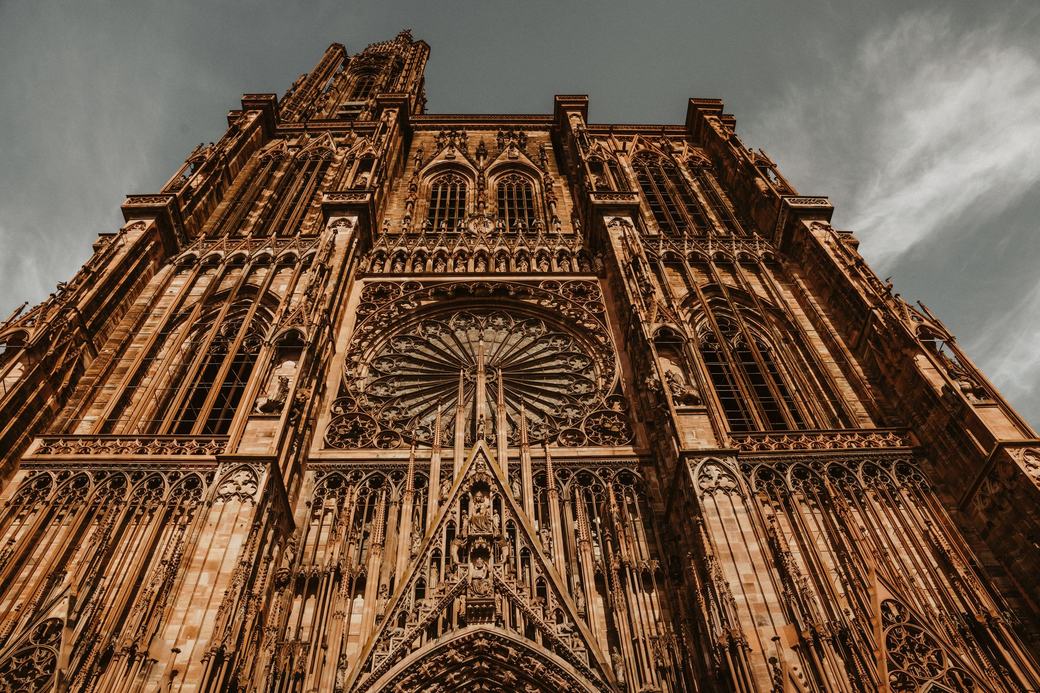
Eight centuries of the Frauenwerk
A cathedral was begun here in 1015, on the site of earlier churches, by Bishop Werner of Habsburg. It burned more than once, and after a fire in 1176 the rebuilding began that produced the present building. The east end and transepts went up first, in the late Romanesque style; then, from the 1240s, the nave, in the new Gothic of the Île-de-France, finished in 1275.
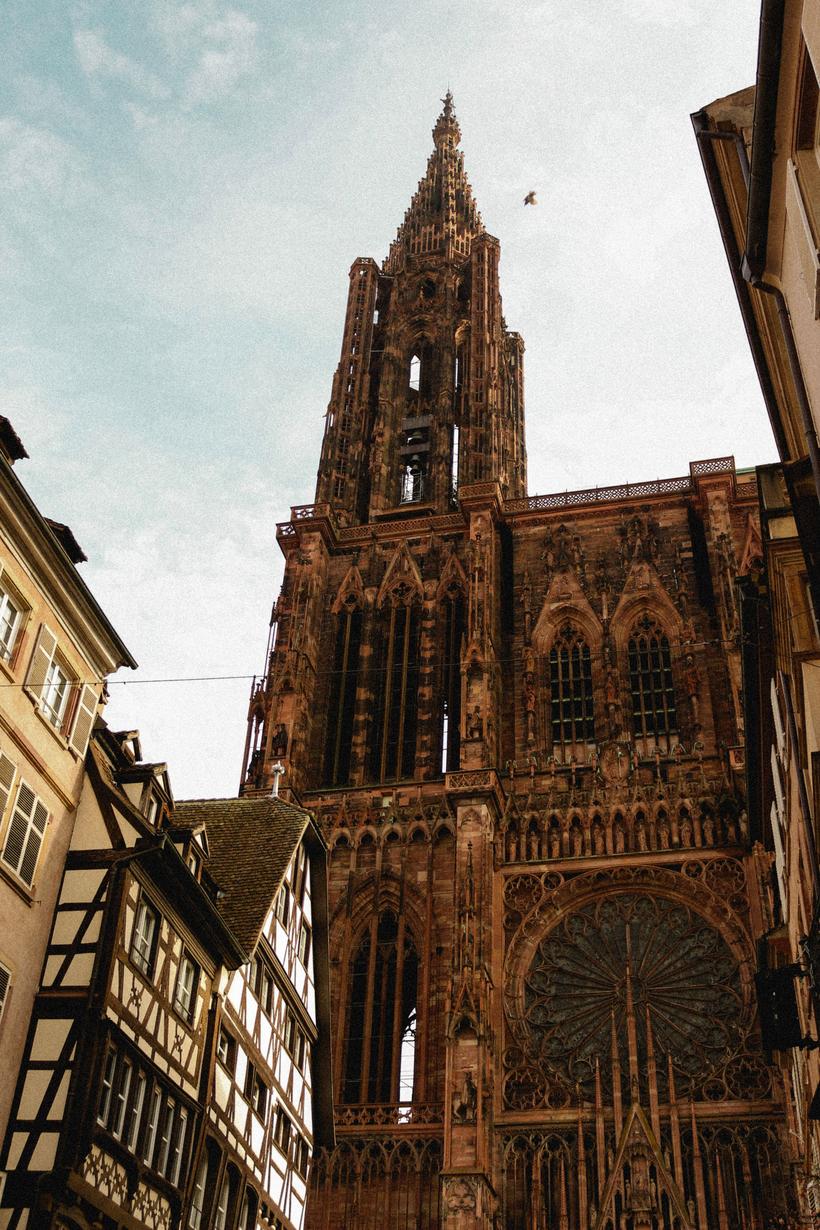
The west front was begun in 1277, and its first master, Erwin von Steinbach, who died in 1318, set the design of harp-string tracery. The north tower rose above it through the fourteenth and early fifteenth centuries, and in 1439 Johannes Hultz of Cologne finished the octagonal spire. The planned south tower was never built, which is why the cathedral has its famous lopsided silhouette. From 1647, when the spire of St Mary’s in Stralsund burned, until 1874, when St Nicholas in Hamburg overtook it, Strasbourg was the tallest building in the world.
The work was run, then as now, by the Œuvre Notre-Dame, the Frauenwerk, a foundation that has employed stonemasons on the building continuously for more than seven hundred years and still does. In the Reformation the city went Protestant, and the cathedral was a Lutheran church for most of the time from the 1520s until Louis XIV took Strasbourg in 1681 and returned it to the Catholics. Since 1988 it has been part of the Grande Île World Heritage Site.
The visitor’s cheat sheet
| Where | Place de la Cathédrale, 67000 Strasbourg, in the Grande Île. Tram stops Langstross/Grand’Rue or Broglie |
|---|---|
| Opening hours | Monday–Saturday 8.30am–11.15am and 12.45pm–5.45pm; Sundays and feast days 2pm–5.15pm |
| Admission | Free, no booking. Bag check at the entrance; dress respectfully, with shoulders covered |
| Astronomical clock | Automata daily at 12.30. €4 adults, €3 students, €2 ages 6–17. Same-day tickets only: 10–11am in front of the cathedral, then from 11.30am at the Saint-Michel entrance, Place du Château. No show during the Christmas market |
| Platform | €10, €6 reduced. 330 steps, 66 metres. April–September 9.30am–8pm (last climb 7.15pm), October–March 10am–6pm (last climb 5.15pm), both closed 1pm–1.30pm. No booking |
| Masses | Sunday 9.30am, 11am and 6pm; weekdays 7.30am and 9am; Saturday 9am and 6pm |
| How long | An hour inside; plan around 12.30 for the clock, and add an hour for the platform |
Hours and admission checked against the official site in September 2026. They change; the official site is always the last word.
Plan the day around 12.30. The cathedral closes to visitors between 11.15am and 12.45pm, and in that window the astronomical clock performs, for ticket-holders only. Tickets are €4 and sold only on the day, from 10am in front of the cathedral and then from 11.30am at the Saint-Michel entrance on Place du Château. A sensible plan: the cathedral at 8.30 or 9am, clock tickets on your way out, the platform climb, and back to the south side by noon for the film and the show.
The west front
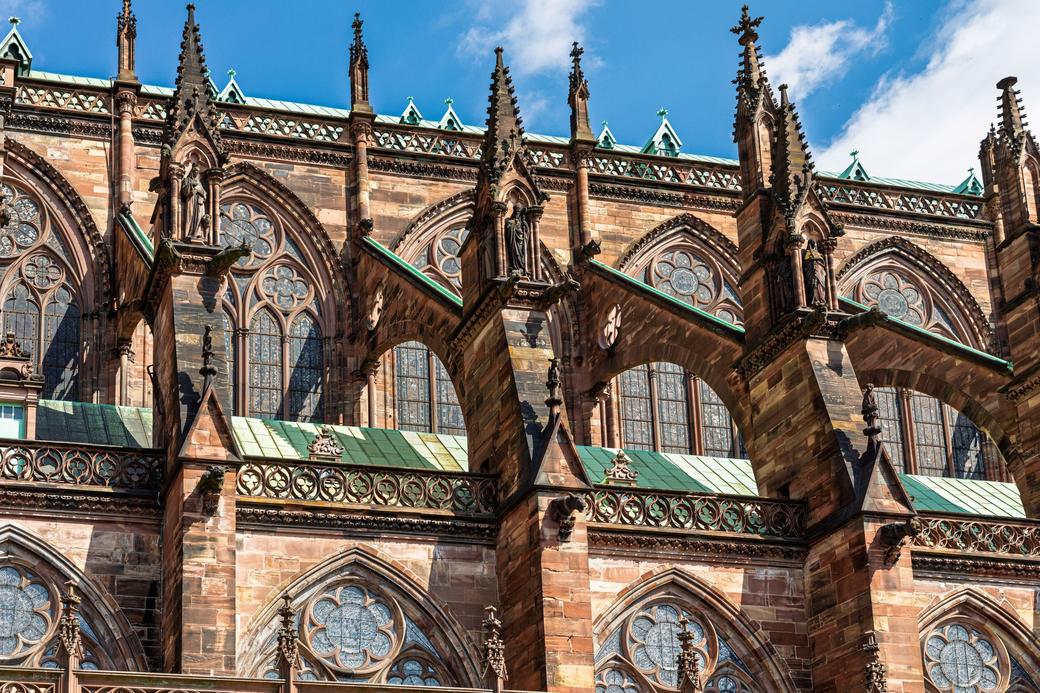
Stand back as far as the narrow square allows. The whole front is covered in a second skin of stone: slender free-standing rods of tracery, set a little in front of the wall, which make it look as if it were behind a curtain of lace. Behind them is the great west rose, and below it three deep portals full of sculpture.
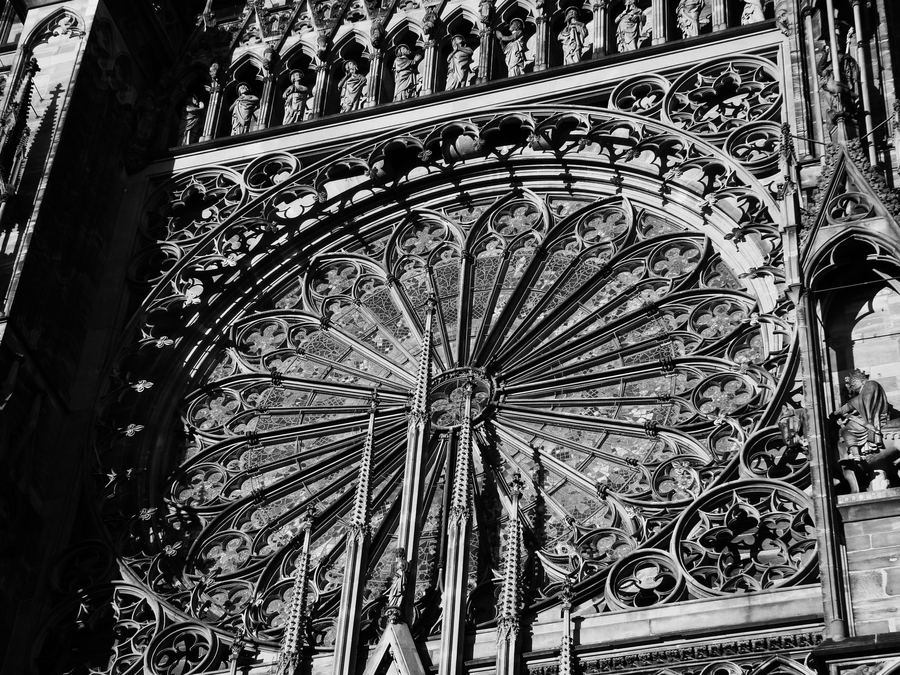
The right-hand portal is the one to study. On one side are the Wise Virgins with the Bridegroom, on the other the Foolish Virgins and, leading them, the Tempter: a smiling young man holding out an apple, whose back, if you walk round him, is crawling with toads and snakes. The Foolish Virgins, with their lamps upside down, are among the best Gothic statues in Europe. Many of the statues on the front are careful copies; the originals are across the square in the Musée de l’Œuvre Notre-Dame.
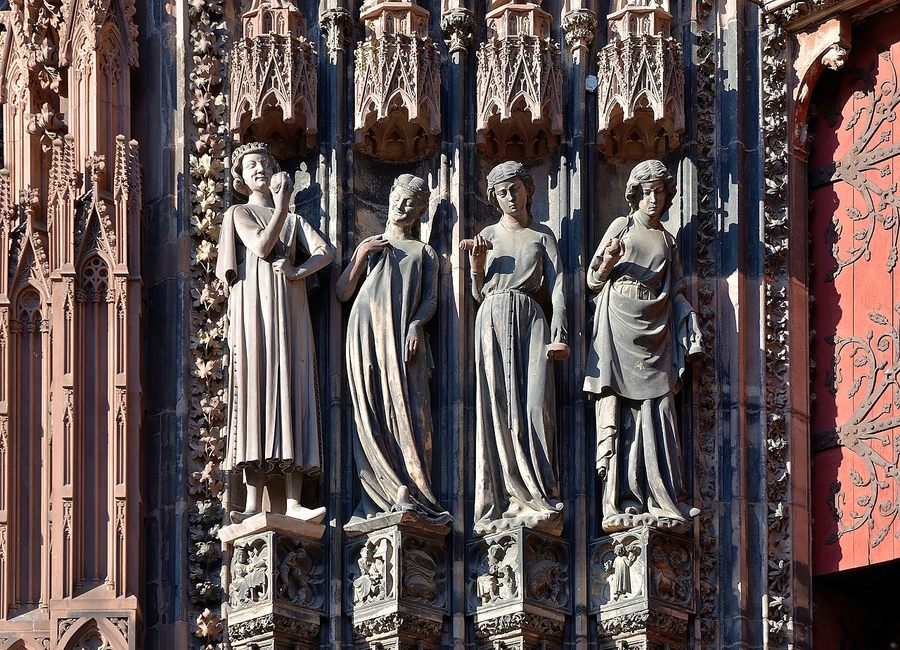
Walk round to the south side, too. Its portal, facing Place du Château, has the two famous figures of the Church and the Synagogue, one crowned and triumphant, the other blindfolded with a broken lance: in copies here, with the originals in the museum.
Inside
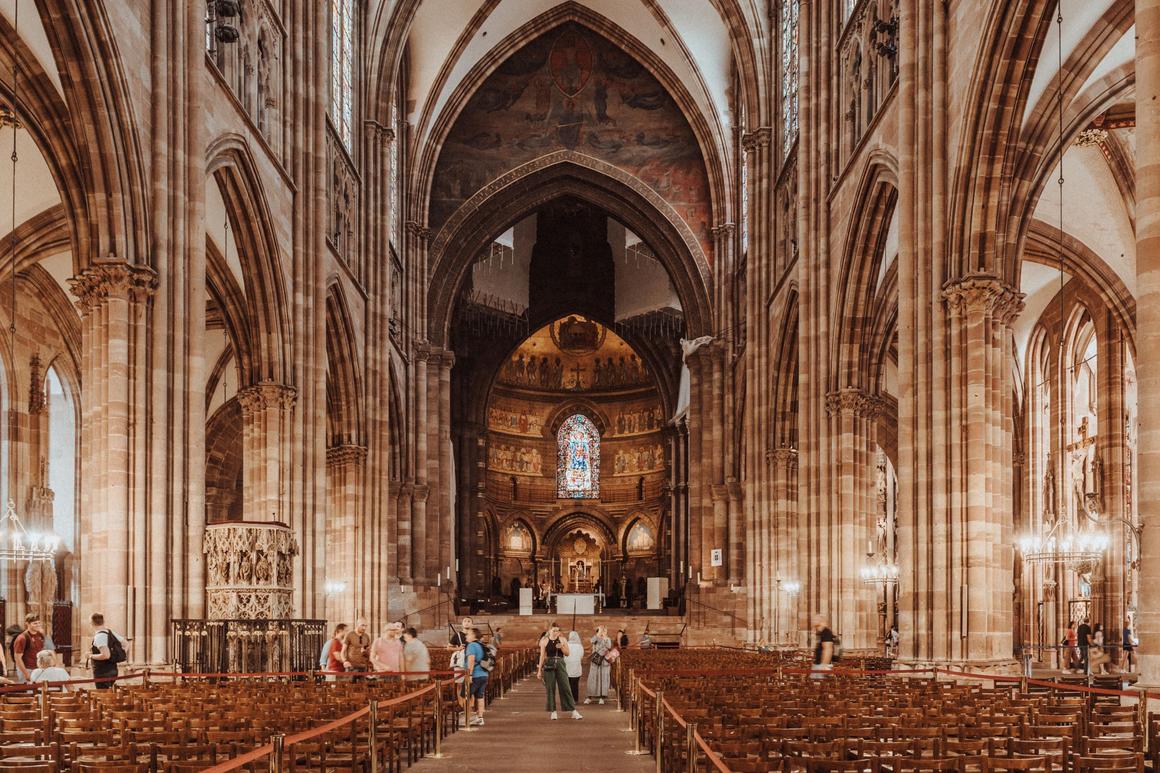
The nave is wide and high, and in the pink stone the light is warm even on a grey day. The windows of the nave are largely medieval, from the twelfth to the fourteenth centuries, with emperors of the Holy Roman Empire on the north side. In the apse is a very different window: the Virgin, by Max Ingrand, given in 1956 by the Council of Europe, whose seat is in Strasbourg.
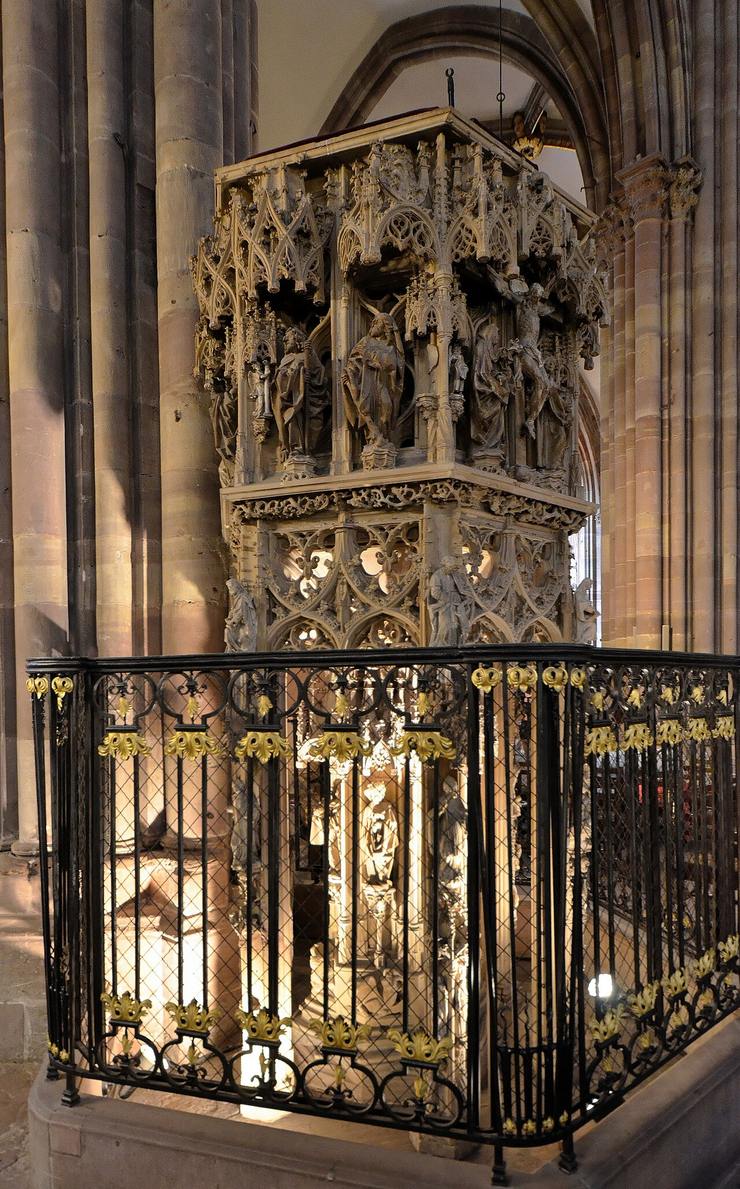
- The pulpit, on the north side of the nave, carved in 1485 by Hans Hammer for the preacher Johann Geiler von Kaysersberg: a filigree of stone with some fifty figures. Look for the little dog at the foot of the stair.
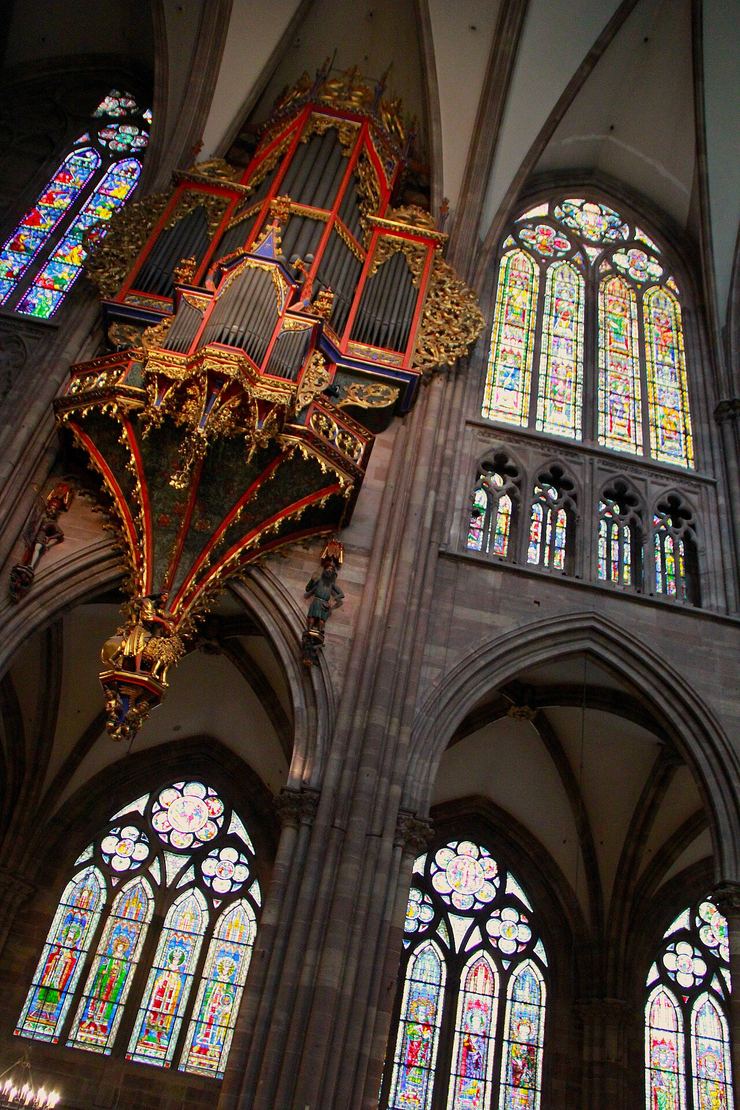
- The organ, on the north wall, hung like a swallow’s nest high above the nave. Its painted and gilded case is late Gothic; the instrument inside has been rebuilt many times, most recently in the twentieth century.
- The choir and crypt, raised above the nave at the east end, the oldest part of the cathedral.
The Pillar of Angels
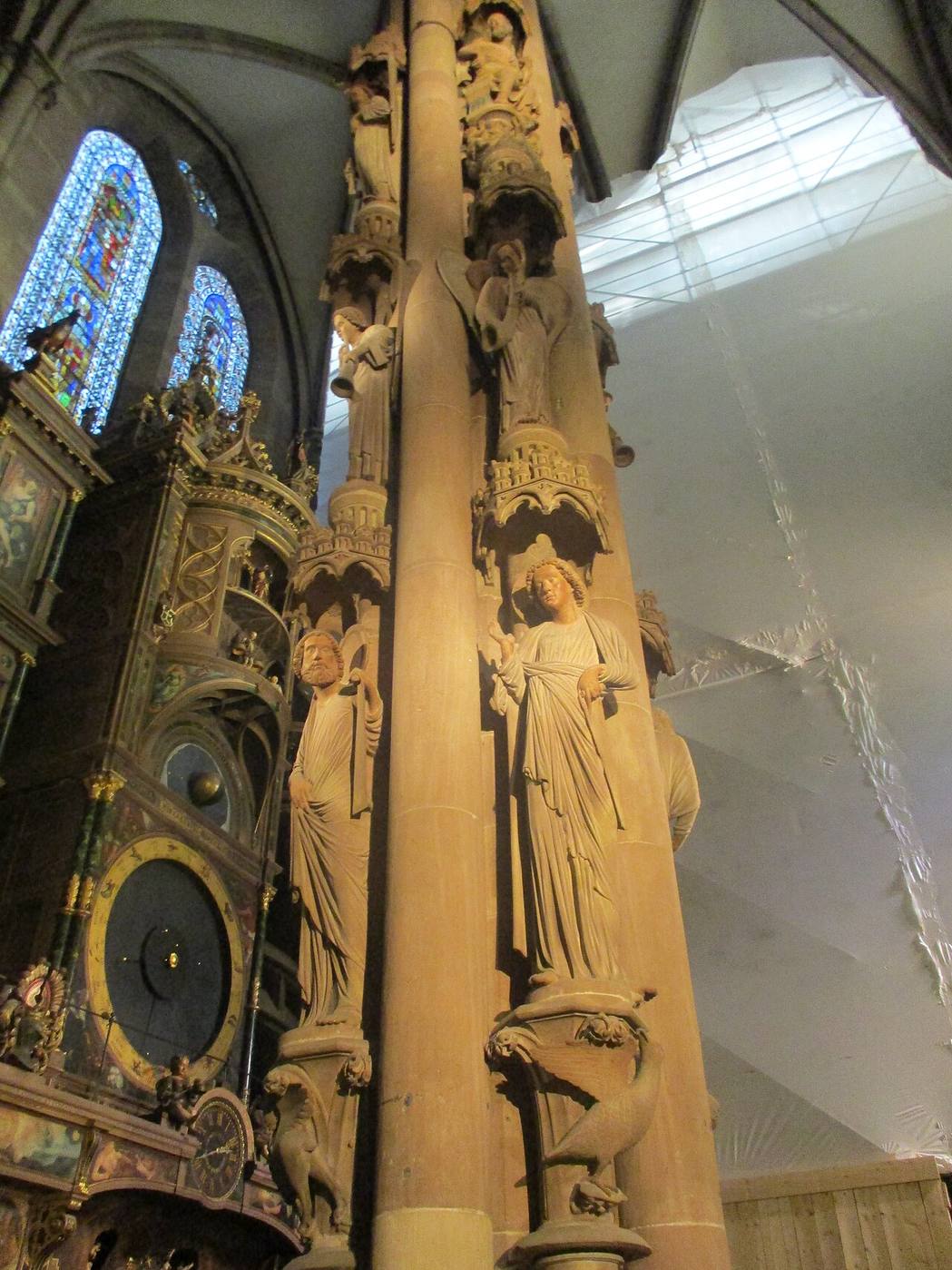
In the south transept, next to the clock, stands the finest single piece of sculpture in the building. The Pillar of Angels, of about 1225, is a central column carved with figures on three tiers: the four evangelists at the bottom, angels blowing the trumpets of the Last Judgement in the middle, and at the top Christ seated in judgement, with angels bearing the instruments of the Passion. Visitors crowd past it to the clock; stop and look up.
The astronomical clock
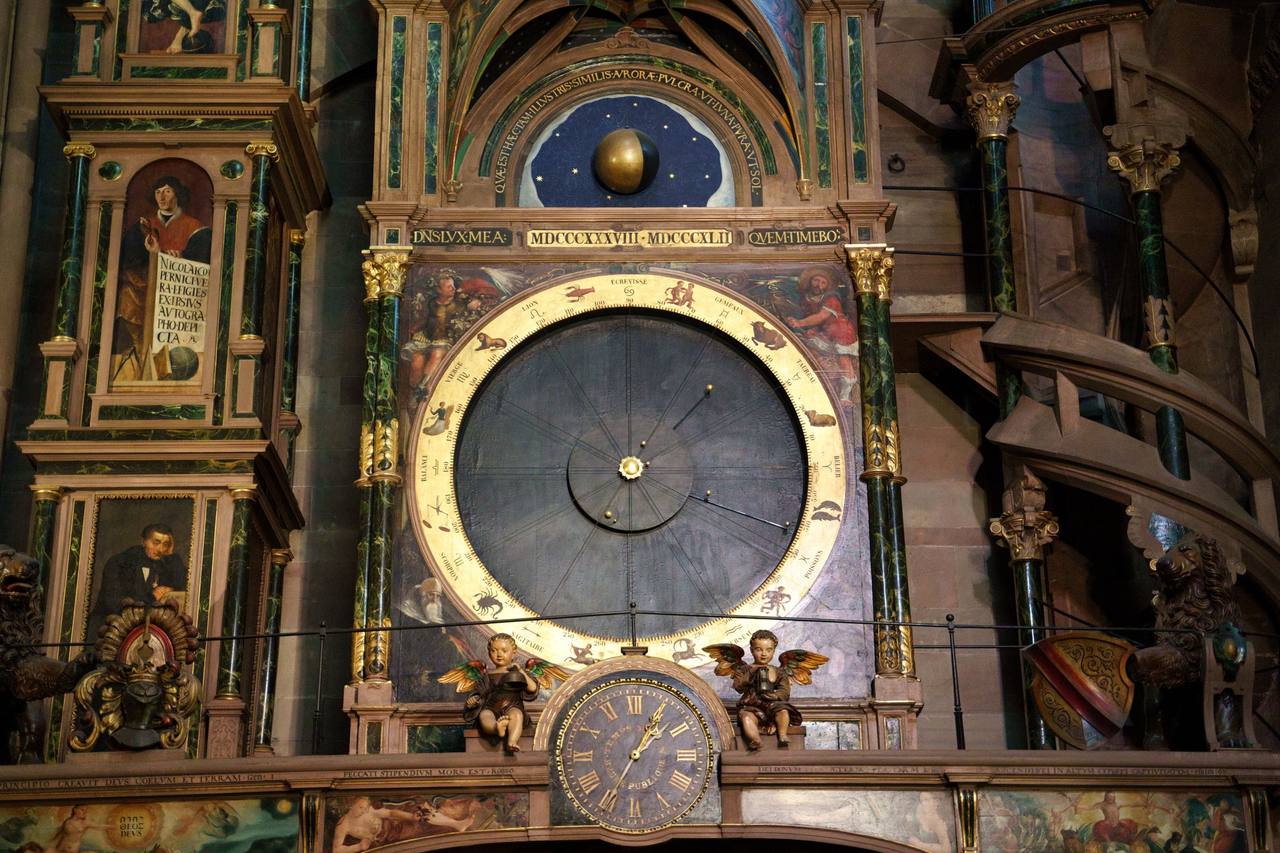
There has been a great clock in this transept since the fourteenth century. The first, of 1352–54, was replaced in 1571–74 by a far more elaborate one, whose painted case survives. By the eighteenth century that mechanism had stopped, and between 1838 and 1842 the self-taught engineer Jean-Baptiste Schwilgué built the present one inside the old case. It is a perpetual calendar that works out the date of Easter and other movable feasts for itself, shows the positions of the planets, the phases of the moon, eclipses and the sidereal time, and has been running ever since.
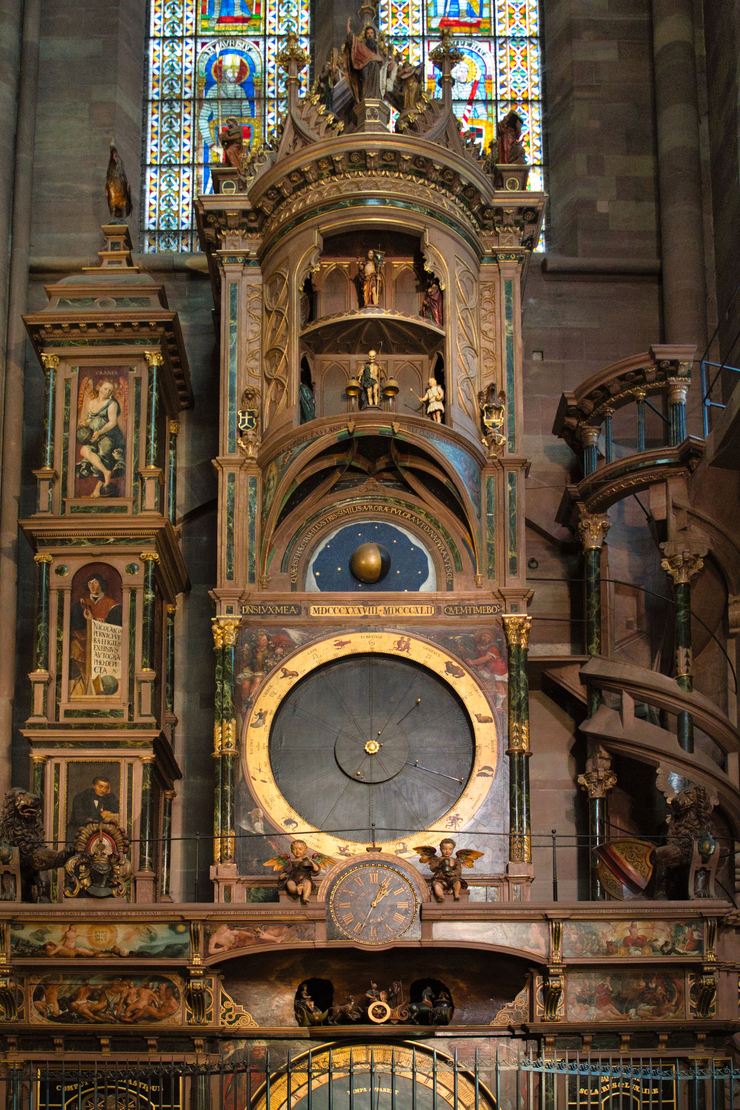
The automata move every quarter of an hour, but the procession everyone comes for takes place once a day, at 12.30: the twelve apostles pass in front of Christ, who blesses them, and the cock on the tower flaps its wings and crows three times. The show lasts only a few minutes; the film at 12 noon explains the mechanism and is worth arriving for. During the Christmas market in December there is no show.
Up to the platform
The climb to the platform, the plateforme, is 330 steps up a spiral stair to a terrace 66 metres above the square, at the foot of the spire. From it you look straight down on the roofs of the old town, and on a clear day across the Rhine plain to the Black Forest on one side and the Vosges on the other. It has its own entrance outside the cathedral and is run separately from it.
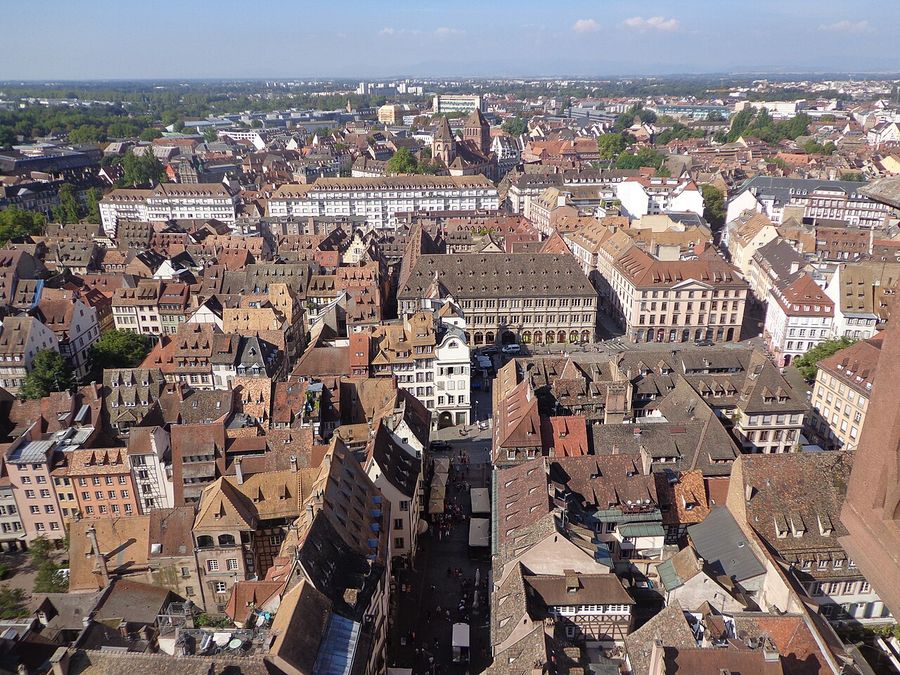
Tickets are €10, or €6 reduced, and the Strasbourg City Card takes €5 off the full price. There is no advance booking, and no more than a hundred people are allowed on the circuit at once. From April to September the platform is open from 9.30am to 8pm, with the last climb at 7.15pm; from October to March from 10am to 6pm, with the last climb at 5.15pm. It closes from 1pm to 1.30pm, and on 1 January, 1 May and 25 December.
The Musée de l’Œuvre Notre-Dame
Across the square from the south transept, in a group of old houses, is the museum of the cathedral works, and it is the natural second half of a visit. Here are many of the original statues from the façade and portals, brought in from the weather: the Wise and Foolish Virgins, the Tempter, and the Church and the Synagogue from the south portal. Here too are some of the medieval architectural drawings on parchment for the west front, among the earliest surviving anywhere, and a fine collection of Alsatian painting and glass. It takes an hour, and makes the cathedral itself much easier to understand.
When to go
The cathedral is quietest when it opens, at 8.30am, and that is the time to see the nave without crowds. In summer the west front is lit up in the evenings with a sound-and-light show, and the platform stays open until 8pm, which makes a late climb one of the best things to do in the city on a long evening.
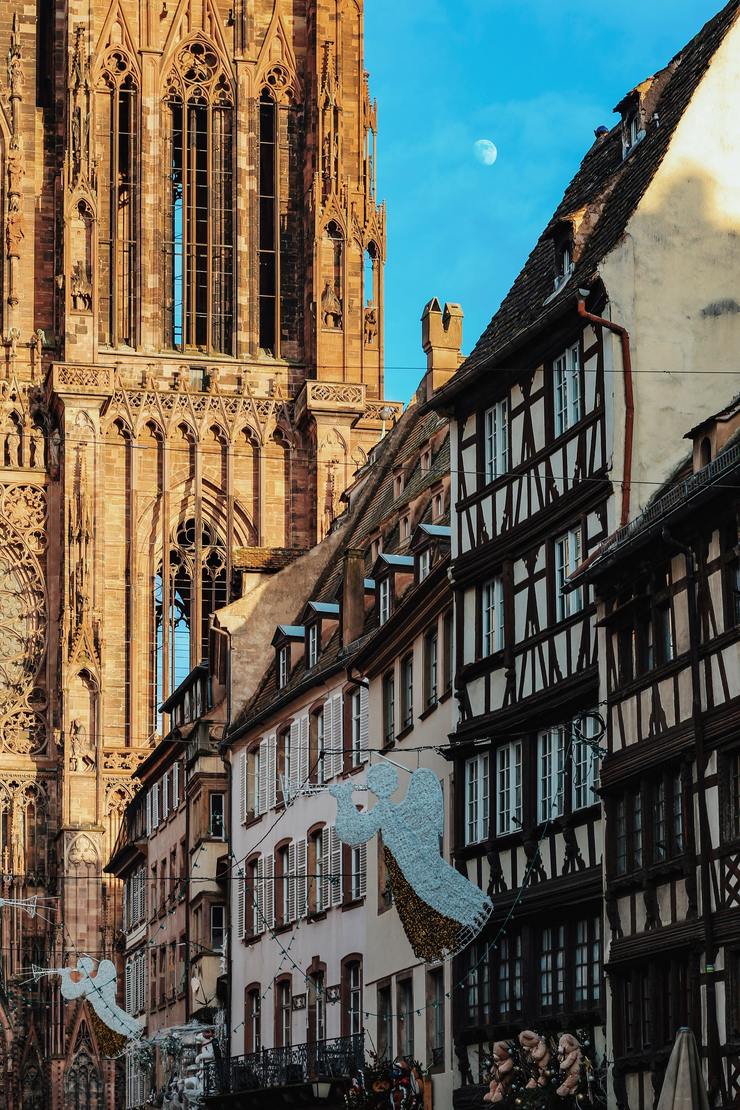
From late November to Christmas, Strasbourg holds one of the oldest and largest Christmas markets in Europe, the Christkindelsmärik, with its stalls around the cathedral. It is a wonderful time to see the city, but it is also very crowded, and the astronomical clock show does not take place while the market is on. If the clock is the reason for your visit, avoid December.
Goethe on the platform
In 1770, the young Johann Wolfgang von Goethe came to Strasbourg to finish his law studies. He climbed the cathedral again and again, by his own account to cure himself of his fear of heights, and the building moved him to write one of the founding texts of the Gothic revival, the essay Von deutscher Baukunst, ‘On German Architecture’, in praise of Erwin von Steinbach. Standing on the platform, looking up at the spire, it is not hard to see what he meant.
Getting there
Strasbourg is under two hours from Paris by TGV, from the Gare de l’Est, and makes a good stop on the way to Germany or Switzerland. From the station it is a twenty-minute walk across the old town to the cathedral, or a few stops by tram. The cathedral stands in the Grande Île, the island of the old town ringed by the river Ill, and most of the city’s sights are within a few minutes’ walk: the Musée de l’Œuvre Notre-Dame across the square, the Palais Rohan beside it, and Petite France to the west.
Plan your visit
The cathedral itself needs no ticket. For somewhere to stay in the old town, or a guided tour:
Some links are affiliate links. They cost you nothing extra and help keep this guide independent.
Frequently asked questions
Common questions
Is Strasbourg Cathedral free to visit?
Yes, the cathedral is free and there is no booking; there is a bag check at the door. Two things are paid: the astronomical clock show at 12.30, €4, and the climb to the platform, €10.
What are Strasbourg Cathedral’s opening hours?
Monday to Saturday 8.30am to 11.15am and 12.45pm to 5.45pm; Sundays and feast days 2pm to 5.15pm. The cathedral closes to visitors in the middle of the day so that the clock show can take place.
How do you see the astronomical clock at Strasbourg?
The automata perform once a day, at 12.30. Tickets, €4 for adults, are sold only on the day: first from 10am to 11am in front of the cathedral, then from 11.30am at the Saint-Michel entrance on Place du Château, on the south side. A short film is shown at 12 noon beforehand. You can see the clock free at other times, but it does not move.
How many steps is the Strasbourg Cathedral platform?
330 steps up a spiral stair to a platform 66 metres above the square. It costs €10, or €6 reduced, and there is no advance booking; no more than a hundred people are allowed on the circuit at once, so expect a short wait in summer.
Why does Strasbourg Cathedral have only one spire?
A second tower was planned for the south side of the west front, but it was never built. The north tower and its spire, finished in 1439, were enough to make the cathedral the tallest building in the world from 1647 until 1874.