
Strahov Monastery
Two of the most photographed rooms in Europe are here, and the standard ticket does not let you into either of them — you look in from the doorway. Know that before you buy, because everything else about Strahov is better than the photograph: a nine-hundred-year-old abbey that survived the Hussites, the Swedes, Joseph II and the Communists; a hall built around second-hand furniture from a monastery that had just been shut down; a narwhal tusk sold as a unicorn’s horn; and a working brewery in the courtyard.

Nine centuries on one hill
Strahov was founded in 1143, on the initiative of Jindřich Zdík, Bishop of Olomouc, with the backing of Vladislav II. The first monks were Premonstratensians — Norbertines, the order founded by St Norbert at Prémontré in 1120 — and this is the oldest Premonstratensian house in Bohemia and one of the oldest anywhere. The church began as a three-aisled Romanesque basilica, and its foundations are still down there; the joint tour takes you through the Romanesque halls beneath the later floors.
Then the disasters, which are the shape of Czech history in one institution. A severe fire in 1258, after which the wooden ceiling was replaced by Gothic vaulting. The Hussites in 1420, who plundered it and burned its books. A long decline, and a revival from 1586 under Abbot Jan Lohelius. In 1627 Abbot Questenberg brought the relics of St Norbert here from Magdeburg — which had turned Protestant — making Strahov a pilgrimage site and, in effect, the order’s spiritual centre. And in 1648, at the very end of the Thirty Years’ War, Swedish troops under Königsmark looted the abbey and carried off the library. Every book you will see was collected after that.
How Strahov dodged the dissolution
The interesting part comes next. From 1782 Joseph II dissolved religious houses that served no useful public purpose — and Strahov survived by arguing that it was not a contemplative house at all but a scholarly institution, a working research library open to scholars.
Abbot Václav Mayer then did something shrewd and slightly ruthless: he went shopping at the dissolutions. He bought books, and he bought fittings, from the monasteries the emperor was closing. Strahov grew rich on the policy that destroyed its neighbours, and the proof of it is the Philosophical Hall, which is built out of a suppressed monastery’s furniture.
1950, and after
In 1950, under Akce K, Czechoslovakia dissolved its religious orders overnight. The monks were expelled, interned and in many cases imprisoned; the buildings became the Memorial of National Literature, the library was absorbed into the state, and the archive, music collection and paintings were scattered between institutions. Hundreds of pictures never came back. The Premonstratensians returned after the Velvet Revolution, from 1990, and the church was raised to a minor basilica by John Paul II in 1991.
The visitor's cheat sheet
| Where | Strahovské nádvoří 1, Hradčany, Prague 1 |
|---|---|
| Getting there | Tram 22 or 23 to Pohořelec, then about five minutes on foot — the tram does the climbing. Tram 25 or buses 143/149/164 to Malovanka is the other approach. Prague Castle is about 15 minutes downhill, the Loreta about 5 |
| Opening hours | Library and gallery daily 9am–5pm, last admission 4.30pm. Closed 24–25 December and Easter Sunday. The ticket desk may shut for half an hour around noon |
| Admission | Library 220 Kč (110 reduced, 460 family); joint tour with the gallery, Romanesque halls and refectories 390 Kč (220/790); guided Abbey Tour 890 Kč. Free for under-6s and for holders of a disability card |
| Entry to the halls | Not included in the standard tickets — you view from the doorway. Only the guided Abbey Tour (890 Kč, book by email) goes inside, for up to 25 minutes |
| How long | 40–60 minutes for the library; 90 minutes to 2 hours for the joint tour |
| Photography | Allowed for private use. No tripods |
| Accessibility | Hilly, cobbled and full of stairs; the library route and gallery are upstairs and are not step-free. A free unguided accessible visit covering the Romanesque halls, cloister and refectories can be booked in advance |
| The brewery | Klášterní pivovar Strahov, on the courtyard, daily 10am–10pm. No monastery ticket needed |
| Nearby | The Loreta (5 minutes downhill), Prague Castle (15 minutes), and the Petřín gardens and lookout tower through the monastery orchards |
Hours and admission checked against the official site in September 2026. They change; the official site is always the last word.
The one thing people get wrong — and it is the whole visit. The standard ticket does not admit you to the library halls. The monastery's own booking page says so in capitals, in Czech and English: a self-guided tour of the Strahov Library (WITHOUT ENTRY TO THE HALLS). You stand at the doorway behind a barrier and look in; the reason is humidity and dust on historic bindings. The famous straight-down-the-middle photograph of the Philosophical Hall is taken from inside, on the 890 Kč guided Abbey Tour, which includes up to 25 minutes in the halls and has to be booked by email in advance. Decide which visit you are buying before you get to the desk. Practically every one-star review of Strahov is someone who found this out too late.
What to see, in the order you meet it
The Theological Hall
Built under Abbot Jeroným Hirnheim in the 1670s and finished in 1679 holding 5,564 volumes, to a design by Giovanni Domenico Orsi — hence the heavy Italian stucco framing that covers every inch of the barrel vault. It is low, white, and crowded.

The frescoes were painted around 1727 by Siard Nosecký, who was himself a Strahov Premonstratensian: a monk painting his own house’s library. Their argument is that wisdom is reached through piety rather than scholastic learning — a slightly pointed thing to say in a room containing twenty-one thousand books. The north wall is given over to Bibles in many languages.
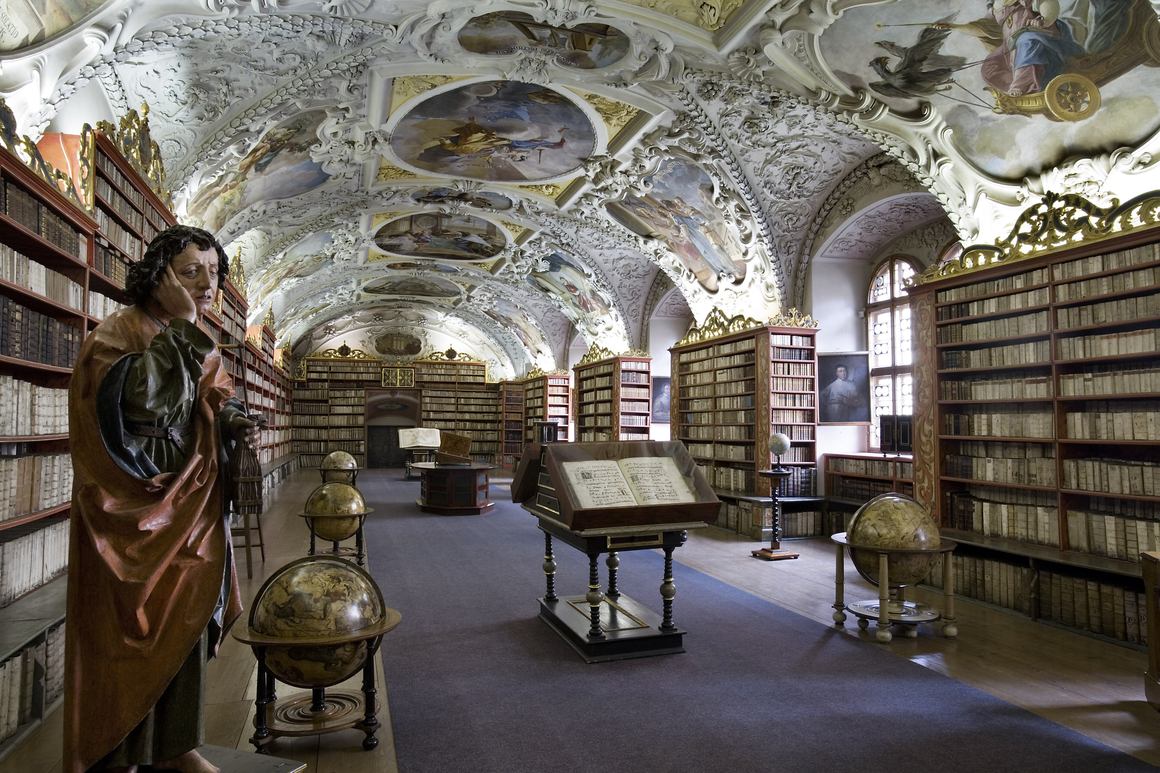
Look for two things from the doorway: the seventeenth-century Dutch globes, terrestrial and celestial, standing on the floor; and the wrought-iron cage that held the libri prohibiti, the forbidden books, which a librarian needed permission to open.
The cabinet of curiosities — which you CAN walk through
The corridor between the two halls is the part of Strahov you actually experience up close, and several visitors come away saying it was the best of it. The collection was bought in 1798 from the estate of Baron Karl Jan Eben, and it is a proper Wunderkammer.
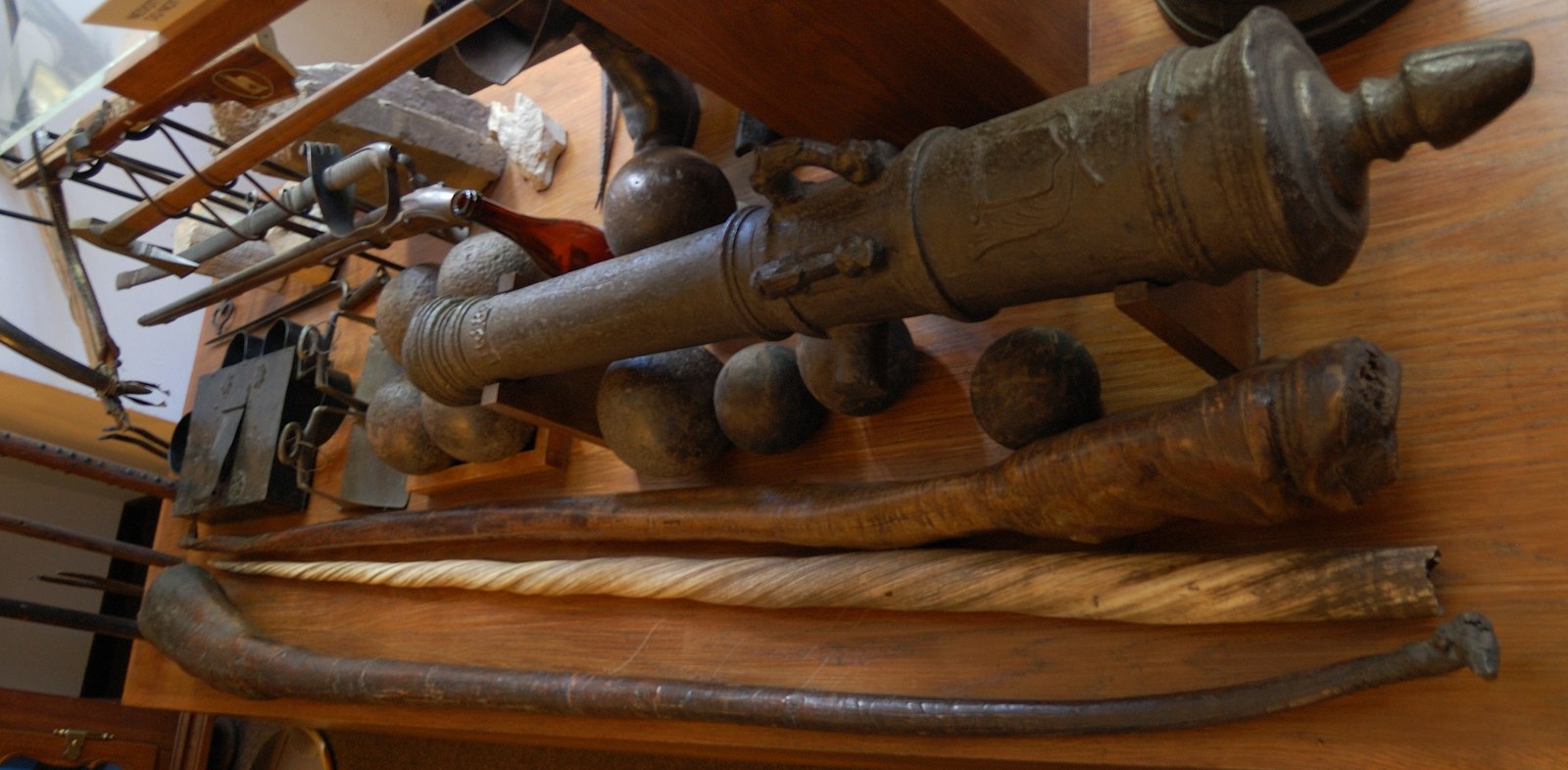
There is a long narwhal tusk — the object sold across medieval Europe as a unicorn’s horn. There are dried sharks, rays and turtles. There are two “basilisks”, small dragons fabricated out of the bodies of rays, a classic and entirely deliberate forgery of the period. There are toadstones, the button-shaped teeth of a fossil fish, once believed to cure poisoning. And there are five iron cannonballs from the siege of 1742.
Then the thing worth crossing Prague for: the Xylotheque, a library of sixty-eight wooden books made around 1825. Each “book” is a box standing for one tree species. The spine is that tree’s own bark, lichen sometimes still attached; inside are its roots, twigs, leaves, blossom, fruit, sections of the wood, and occasionally the insect that eats it. It is a library in which each volume is made of its own subject.
The Philosophical Hall, and the furniture that came first
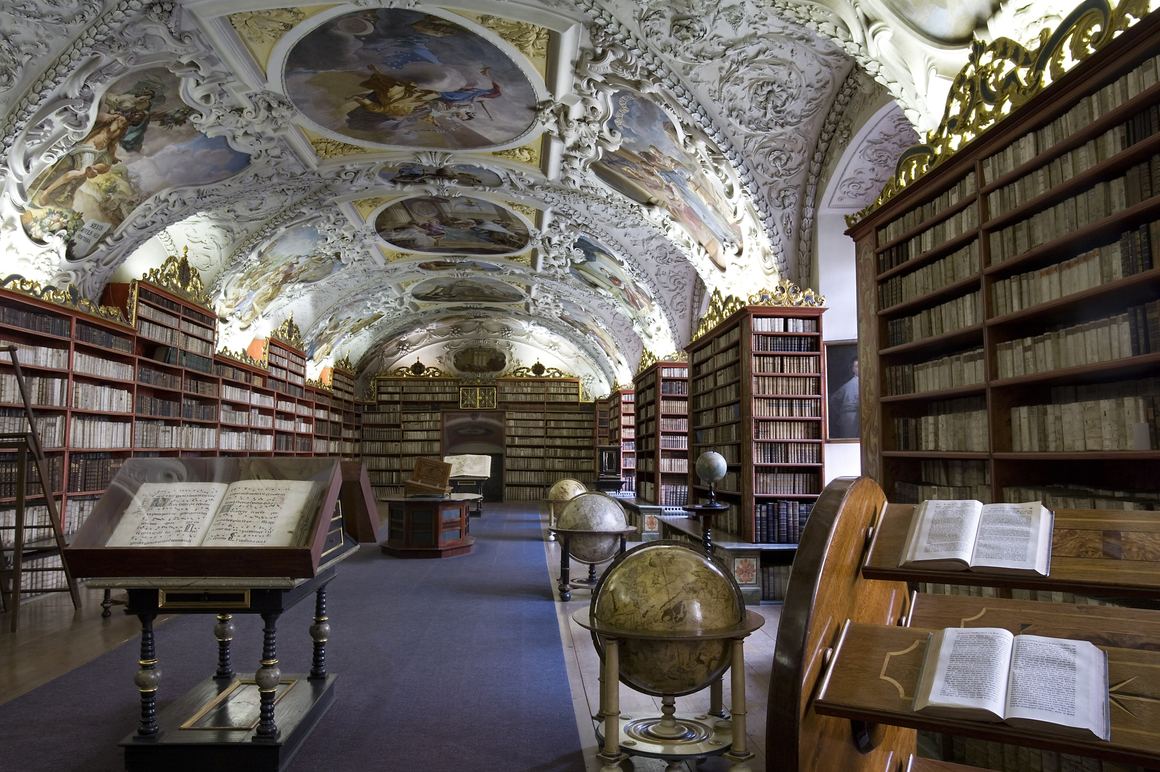
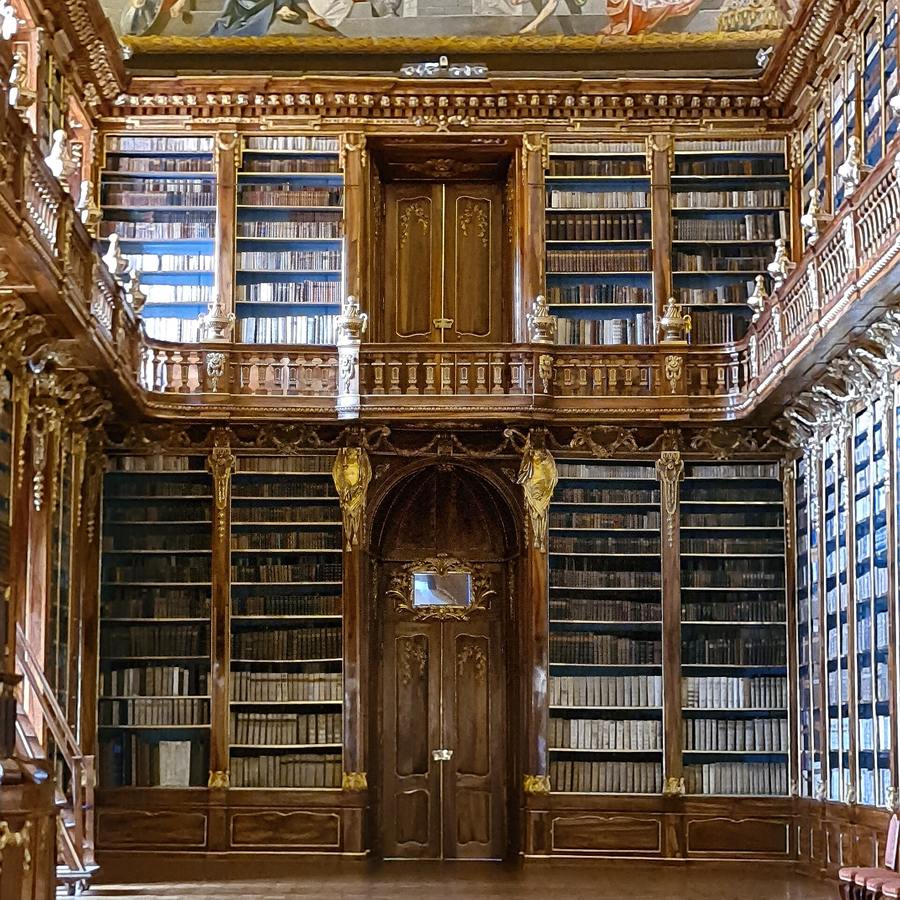
Tall, walnut, two storeys with a gallery reached by staircases hidden in the cases. And the reason it is shaped like that is not architectural ambition but a bargain: Abbot Mayer had acquired the walnut shelving from the dissolved monastery at Louka near Znojmo, and the hall was then designed around the furniture. The cabinetmaker Jan Lahoper of Dobšice installed it between 1794 and 1797. The gallery exists because the Louka cases needed the height.
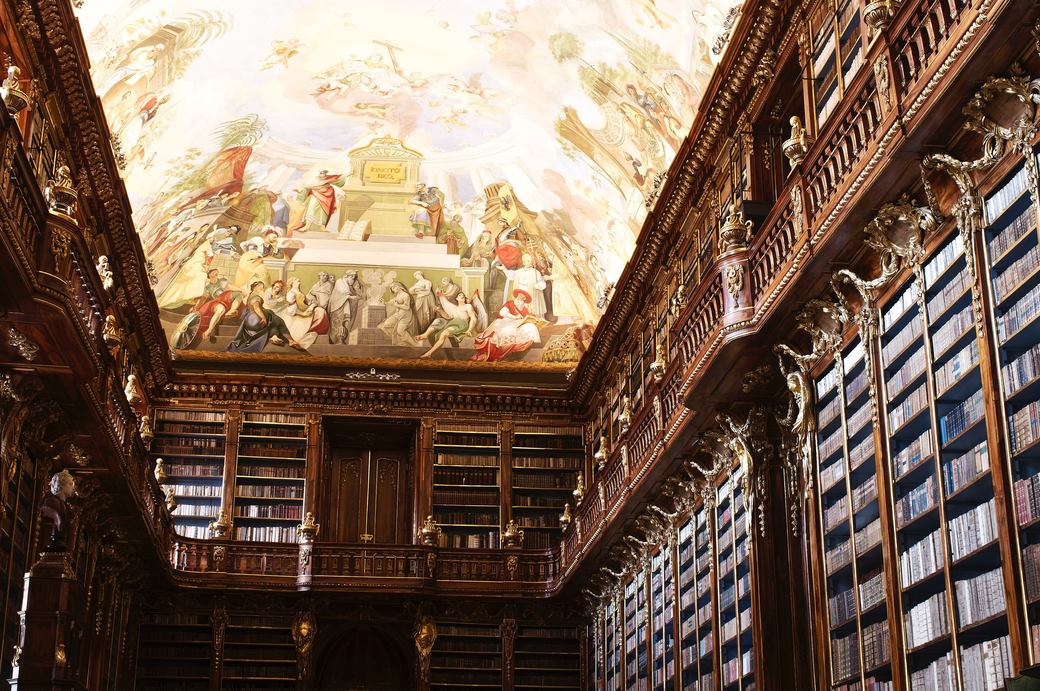
The ceiling is by Franz Anton Maulbertsch, the leading late-Baroque painter in the Habsburg lands: The Spiritual Development of Mankind, running from Genesis through Greek philosophy and the sciences to the Enlightenment, with St Paul preaching at Athens at its centre. The monastery’s own account says he painted it in six months of 1794, at about seventy, with a single assistant. He died two years later.
How many books, actually
You will see “200,000 volumes” everywhere, and it is a figure for the whole library, not for the rooms you are looking into. The monastery’s own account of the halls gives the Theological Hall over 21,000 volumes and the Philosophical Hall over 60,000 — some eighty thousand between the two — with the rest in stores and reading rooms no visitor sees. The library also holds over 3,000 manuscripts and around 1,500 incunabula. The star manuscript is the Strahov Gospel Book, generally dated to the ninth or tenth century.
The basilica
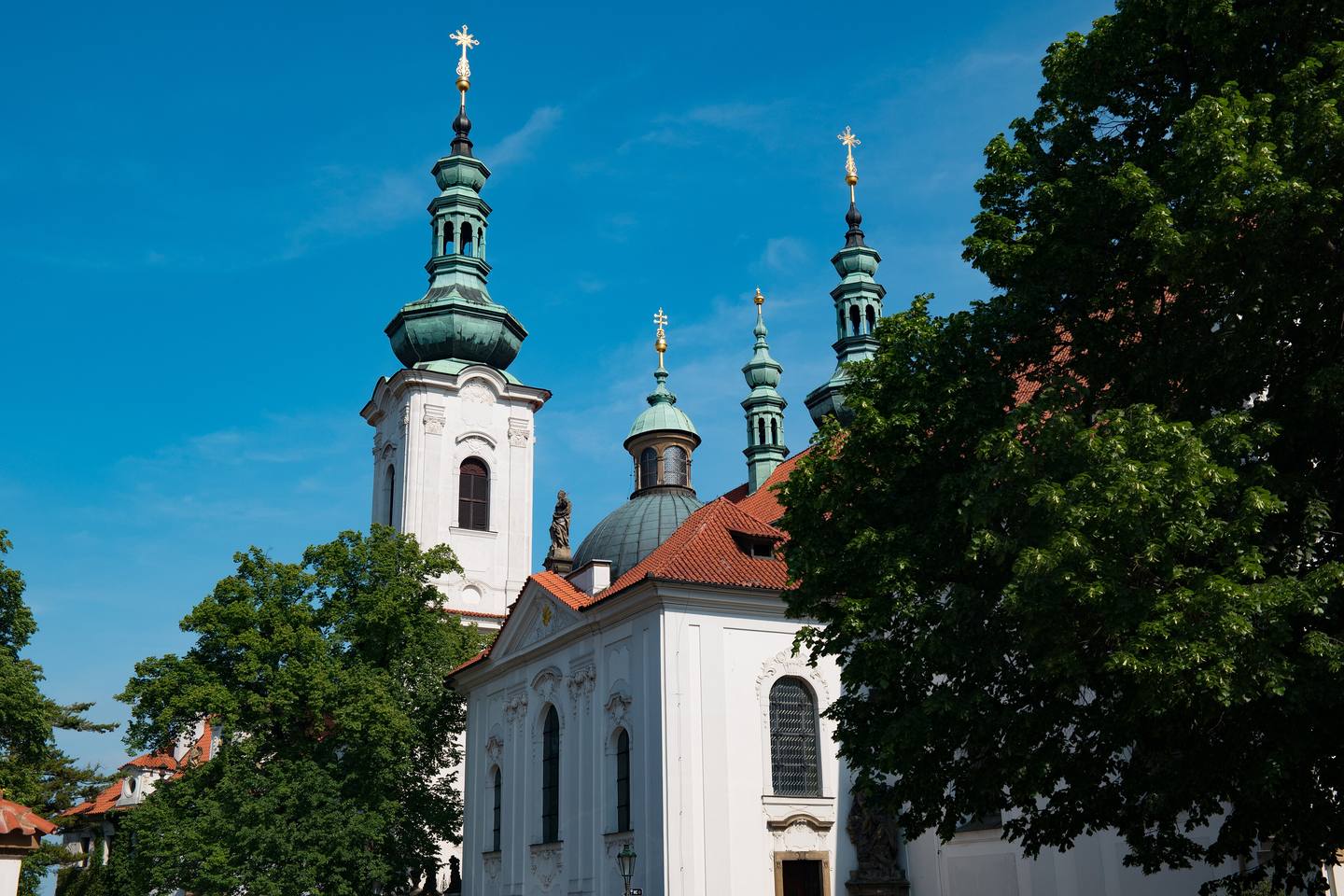
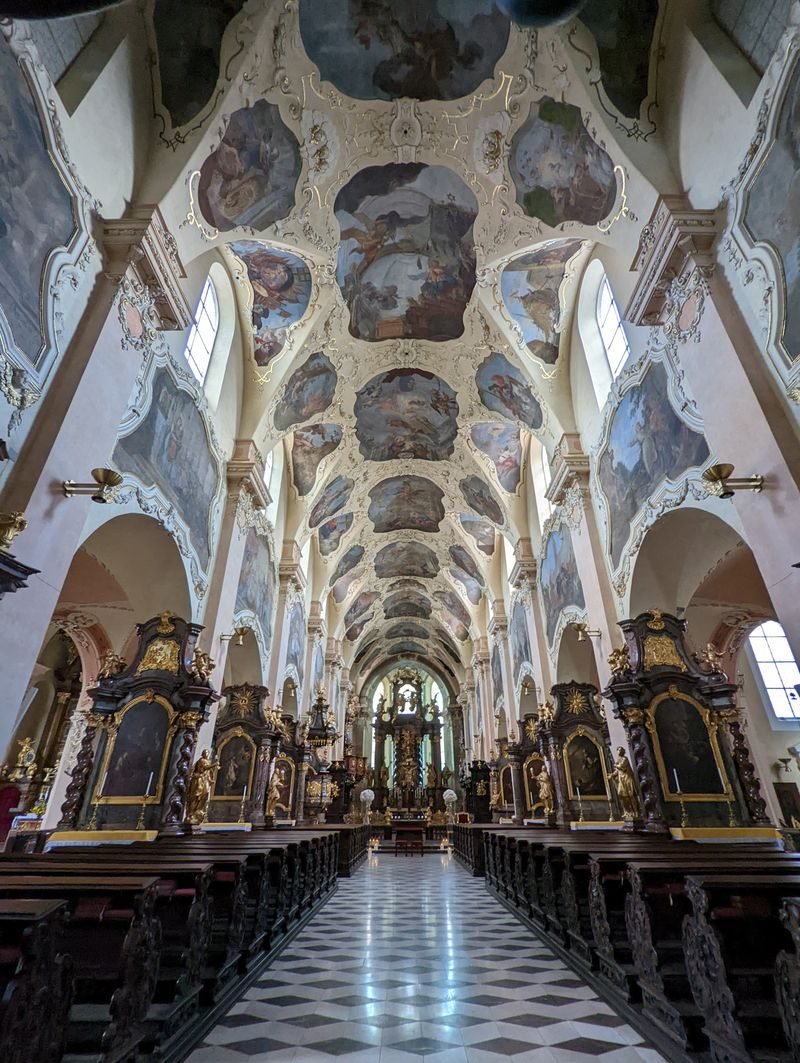
The Basilica of the Assumption keeps its Romanesque plan under Gothic vaults and a Baroque interior, largely as reworked by Anselmo Lurago after the bombardment of 1742. St Norbert lies here, moved from the nave to his own chapel in 1873.
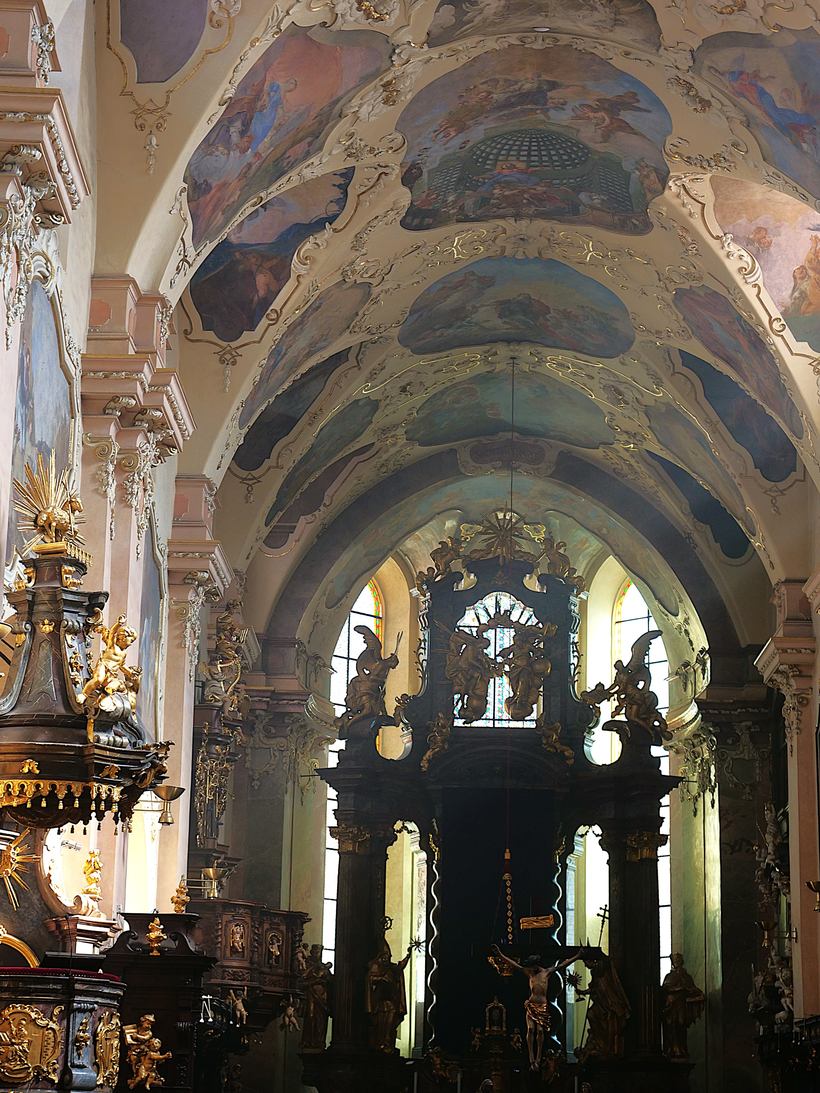
The organ was built in 1774 by Lohelius Oehlschlägel, a Strahov Premonstratensian. Mozart is said to have improvised on it in the autumn of 1787, during the Don Giovanni visit — and unusually for a Mozart-played-here story there is a thread of evidence: a priest-musician named Norbert Lehman was present and wrote down what he could catch — some fifty-seven bars survive, the writing-down broken off more than once. The account was set down in a letter of 1818, thirty-one years after the event; one witness recalling it that late is still one witness, but it is more than most such claims have.
The picture gallery
Built in 1835 in the upper cloister corridors, and sold only as part of the joint tour. It holds more than fifteen hundred paintings and shows about two hundred, from the fourteenth century onward — the Strahov Madonna of about 1340, Rudolfine painting, Brandl, van Dyck, Maulbertsch.
One correction: if you are coming for Dürer’s Feast of the Rosary, it is not here. Strahov sold it to the Czechoslovak state in 1934 to pay debts, and it hangs in the National Gallery. Several tourist pages still list it.
The refectories, the brewery and the view
The joint tour includes the refectories, and in the Summer Refectory, among Nosecký’s frescoes, is a portrait of the monastery’s own brewer. That tells you what kind of house this was.
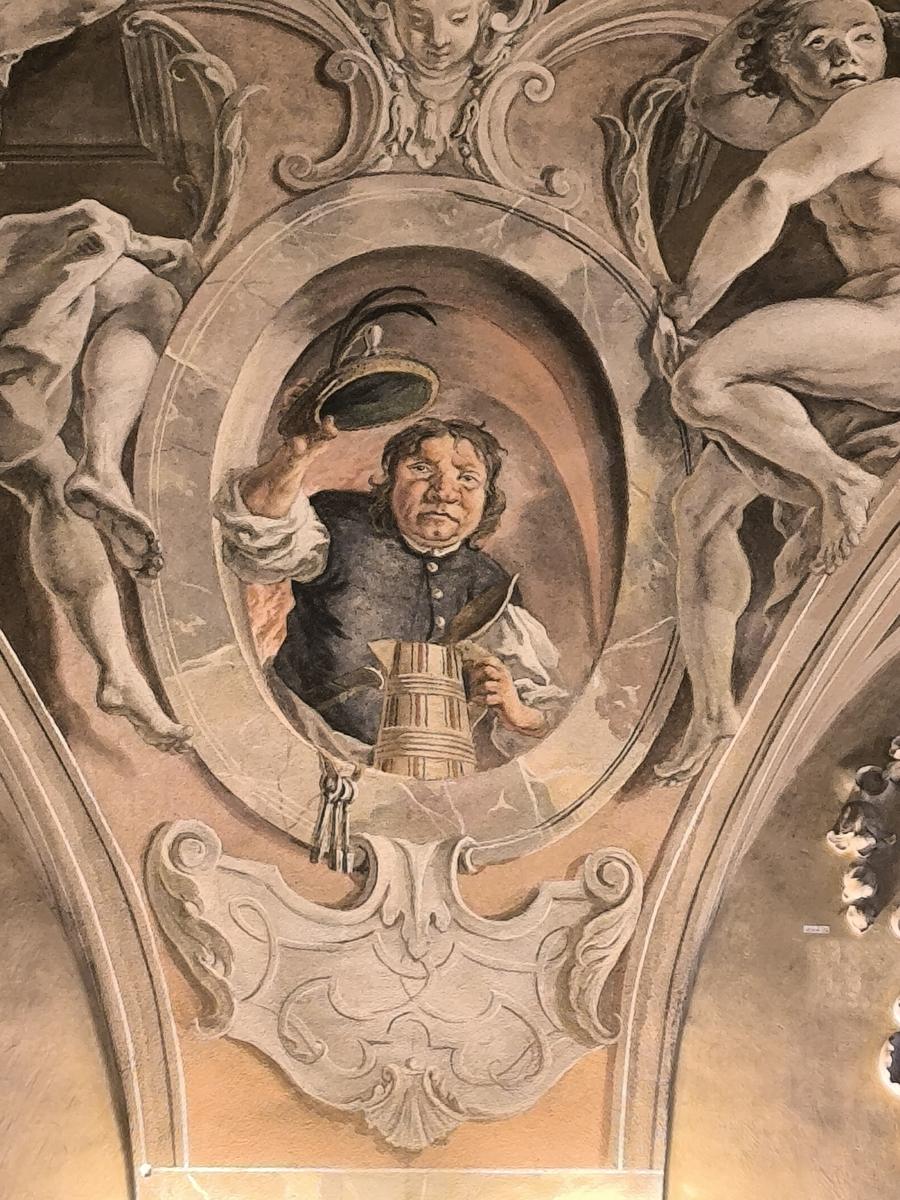

Brewing at Strahov is first recorded in 1400. It stopped in 1907, and the brewery was rebuilt and restarted in 2000, with the first batch out in June 2001. The St Norbert beers are brewed on the courtyard, the copper kettles are in the beer hall, and you do not need a monastery ticket to sit down. On a hill where the alternative is Castle-district pricing, it is also the best-value lunch for a mile.

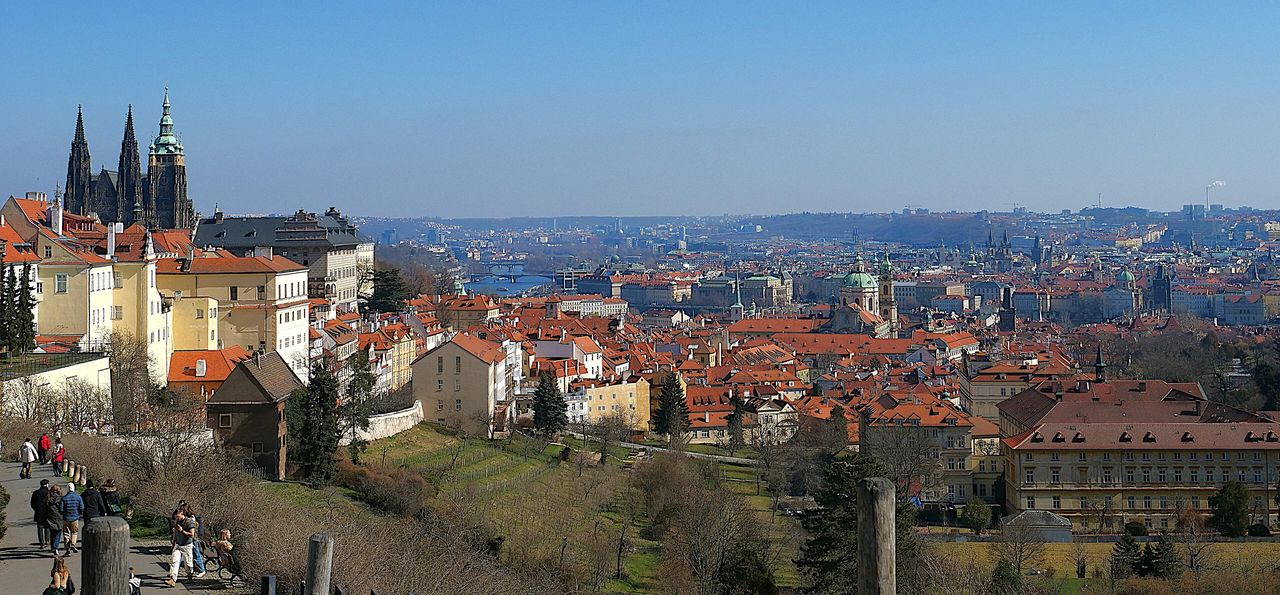
And then walk out of the gate and turn downhill, not back to the tram. The terrace below the monastery, on the Petřín side, gives a full panorama over Malá Strana, the Castle, the river and the Old Town, for nothing — no ticket, no queue, no stairs. A great many visitors pay for the library, leave, walk the wrong way and miss it.

Down through the orchards
From the monastery the gardens run downhill into the Petřín parkland — old orchards, gravel paths and, for most of the way, the city laid out on your right. It is about a kilometre’s walk to the lookout tower and the top of the funicular, and it is all downhill, which makes it far and away the best way to leave Strahov. The path has been closed for works in the recent past, so glance at the monastery’s directions page before counting on it; if it is shut, the tram back from Pohořelec is five minutes away.
One last thing worth knowing about what you are standing in. Between 1950 and 1990 this was not a monastery at all but a state museum of literature, and the community that came back in 1990 came back to buildings stripped of their archive, their music collection and a great many of their pictures. Some of it has been returned; much has not. The canonry is a working religious house again, with parishes attached, and the ticket you buy is part of how it keeps the roof on.
Tickets and tours
Which ticket, and why it matters here more than anywhere
220 Kč sees the library from the doorway. 390 Kč adds the gallery, the Romanesque halls, the cloister and the refectories. 890 Kč is the only ticket that takes you inside the halls — 80 minutes, guided, English tours on Mondays, Tuesdays and Thursdays, booked by email at [email protected], days to weeks ahead. Discounted tickets that need an ISIC or ITIC card cannot be bought online; buy those at the desk. Ignore the 150–200 Kč prices still printed on travel sites — they are pre-2025.
Tour and hotel links go to GetYourGuide and Booking.com. This site earns nothing from them at present — they are here because they are the quickest way to check what is actually available.
Don't miss
- The Xylotheque Sixty-eight wooden books, each bound in the bark of its own tree, with that tree's leaves, roots and fruit inside. In the corridor you are allowed to walk down.
- The narwhal tusk and the fake basilisks A unicorn's horn that isn't, and two dragons made out of rays. The cabinet of curiosities is included in the cheapest ticket.
- The Louka shelving The walnut cases in the Philosophical Hall came from a monastery Joseph II had just closed. The room was built to fit them.
- Maulbertsch's ceiling Painted in six months by a man of about seventy with one assistant, two years before he died.
- The forbidden-books cage In the Theological Hall, wrought iron, and exactly what it looks like.
- The brewer on the refectory ceiling Painted by a monk, in a house that has been brewing since 1400.
- The free terrace below the gate The best unticketed view in Prague, and the one most visitors walk away from.
Insider tips
Decide about the halls before you buy. Doorway view on the standard ticket; inside only on the 890 Kč Abbey Tour, booked by email in advance. If the wide photograph down the length of the Philosophical Hall is what you came for, that is the tour that takes it.
Come at nine, on a weekday. Doorway viewing means one person at a time, and by mid-morning the coach groups turn it into a shuffling queue. The morning light through the east windows is better too.
Watch the two time traps: the ticket desk often shuts for half an hour around noon, and last admission is 4.30pm. Arriving at a quarter past four is not enough.
Leave the tripod at the hotel.
Chain the hill properly: tram 22 up to Pohořelec, Strahov first, then downhill to the Loreta, then the Castle — or down through the orchards to the Petřín tower and the funicular. Doing Strahov as a standalone trip wastes the climb.
Common questions
Can you actually go inside the library halls?
Not on a standard ticket. The monastery says so in capitals on its own booking page: the ordinary library and joint tickets are without entry to the halls. You look in from the doorway, behind a barrier, because of what humidity and dust do to the bindings. The way in is the guided Abbey Tour, 890 Kč, 80 minutes, which includes up to 25 minutes inside — book it by email in advance.
How much does it cost?
220 Kč for the library alone, 390 Kč for the joint tour with the picture gallery, Romanesque halls and refectories, and 890 Kč for the guided Abbey Tour that gets you into the halls. Third-party sites quote older, much lower figures; the prices moved up through 2025–26, so check the monastery's own page.
Why was the Philosophical Hall built?
Because the abbot had bought the furniture. When Joseph II dissolved the Premonstratensian monastery at Louka near Znojmo, Strahov bought its walnut bookcases — and then built a hall tall enough to take them, gallery and all. The room exists because of the shelves, not the other way round.
How did Strahov survive the dissolutions?
By presenting itself as a scholarly institution rather than a contemplative one — a working research library open to scholars. Abbot Mayer then bought up books and fittings from the houses that were being closed. Strahov grew rich on the policy that destroyed its neighbours.
Is the brewery a real monastery brewery?
Yes. Brewing here is first recorded in 1400; it stopped in 1907 and was revived in 2000, with the first new batch in June 2001. The St Norbert beers are brewed on the premises, it is open 10am to 10pm, and you do not need a monastery ticket to drink there.
How long should I allow?
40–60 minutes for the library, 90 minutes to two hours for the joint tour. Half a day covers Strahov and the Loreta together comfortably, with lunch at the brewery in between.
Where to stay and eat nearby
The monastery brewery is the obvious lunch and genuinely good; there is also a restaurant in the complex and one in a cellar called Peklo — Hell. Beyond that, Pohořelec has a few places and then you are into Castle-district prices. Hradčany is a lovely, very quiet place to stay, ten minutes above the crowds, with the trams for everything else.
More churches in Prague
- The Loreta — five minutes downhill, for the carillon and the diamond monstrance.
- Basilica of St George — in the Castle, and older than Strahov by two hundred years.
- St Nicholas, Malá Strana — downhill again, and the great Baroque interior of the city.