
St Nicholas Church, Old Town Square
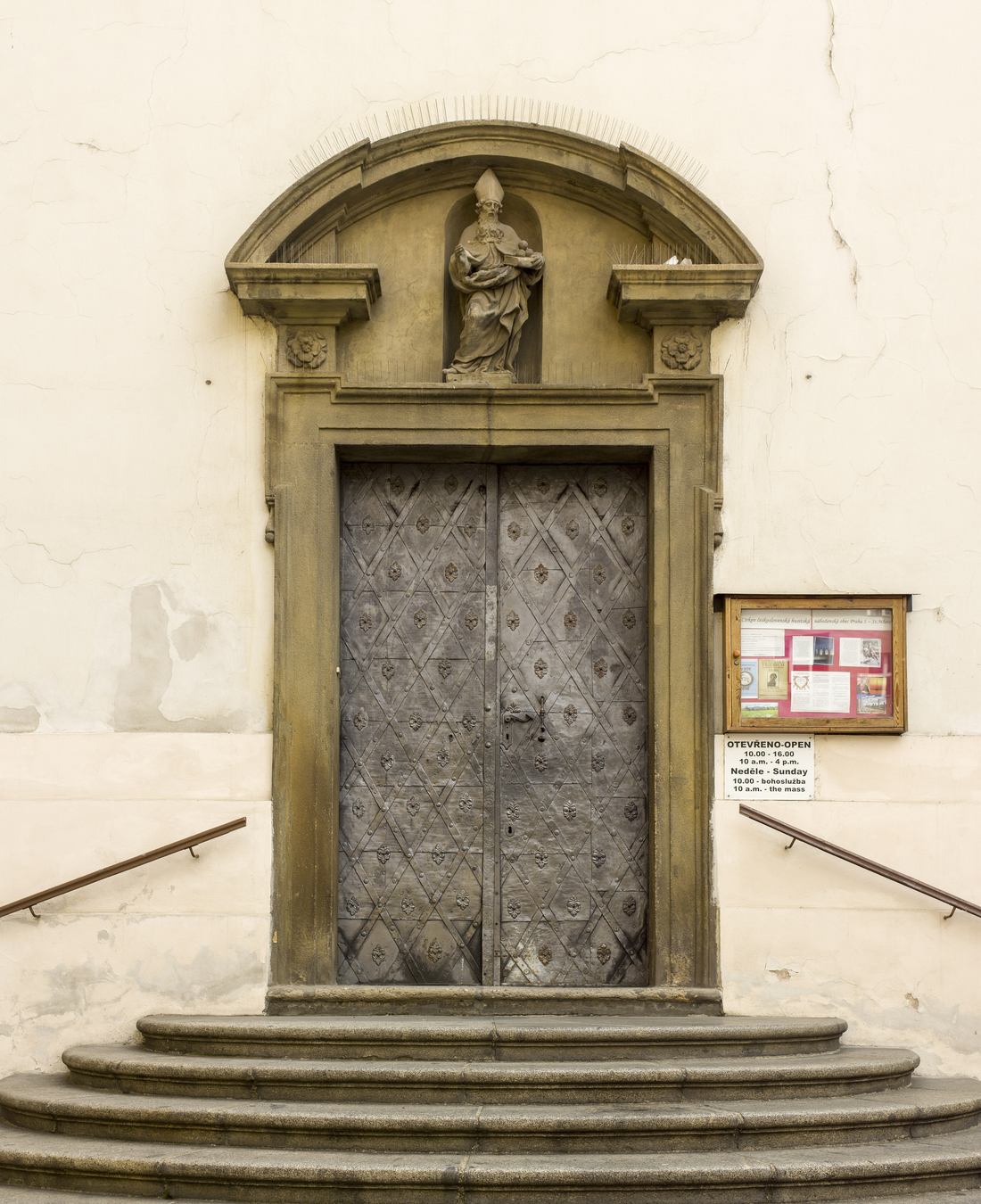
The white church standing on its own at the corner of Old Town Square is free to walk into, takes ten minutes, and is missed by most of the people photographing it — partly because the grand doors facing the square are locked and the way in is a small side door round the corner. Inside: an octagonal dome, frescoes that spent forty years under whitewash, and a crystal chandelier in the shape of a tsar’s crown, hanging in a Benedictine church that now belongs to a Czech national church proclaimed here in 1920.

Six owners in seven hundred years
There has been a church here since at least 1273, when a Gothic basilica with a west tower served as the parish church of the Old Town — the rival and counterweight to the Týn church diagonally opposite, until Týn outgrew it. It had a serious pulpit: Jan Milíč of Kroměříž and Matěj of Janov, the preachers of the reform movement that ran ahead of Jan Hus, both preached in it.
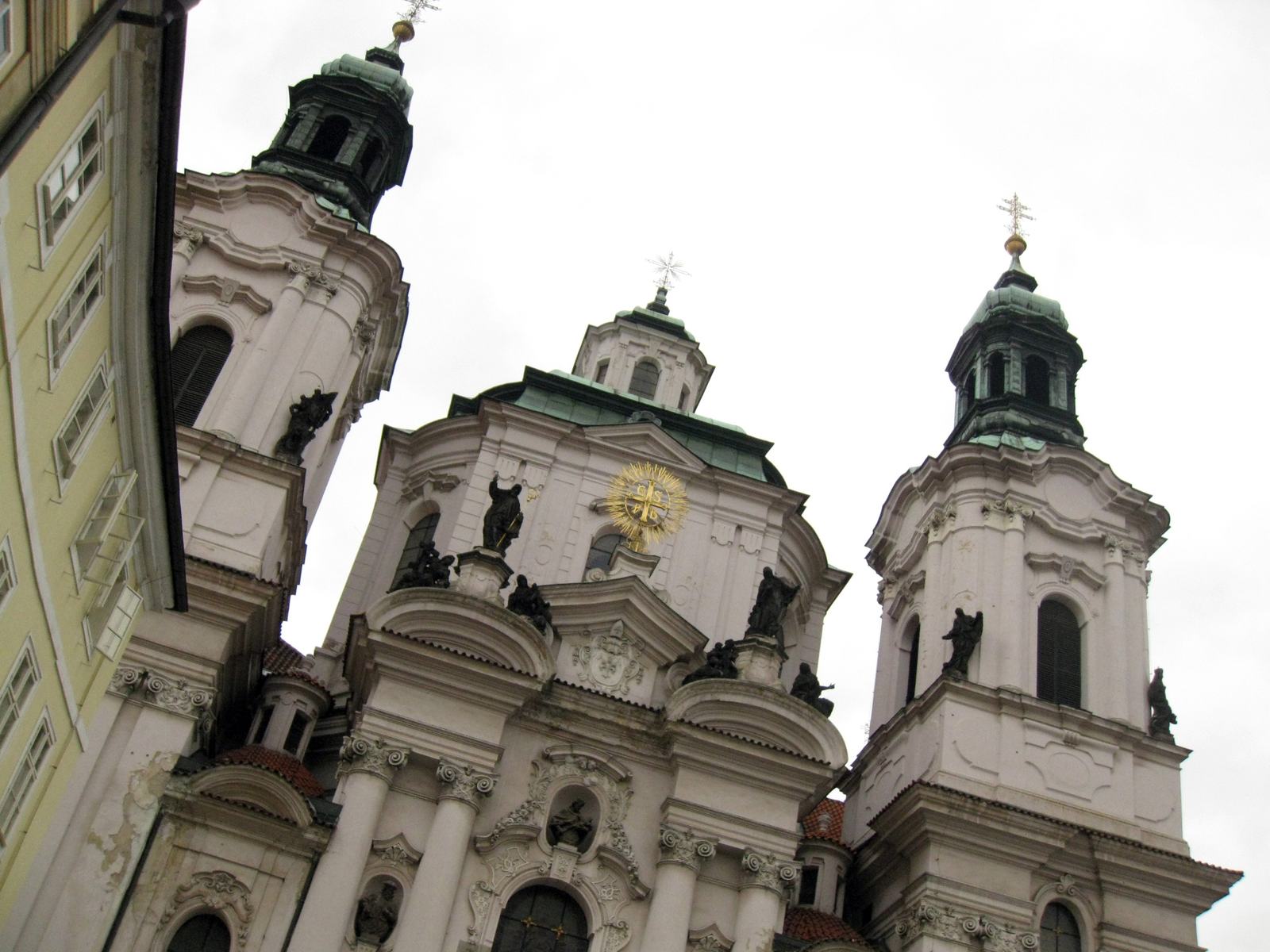
In 1635 the building was given to the Czech Benedictines of the Emmaus monastery, who had been displaced to make room for a Catalan community invited from Montserrat. They rebuilt once, and then, between 1732 and 1737, pulled the Gothic church down — keeping the crypt — and had Kilián Ignác Dientzenhofer build the present one: a centralised Baroque church with a dome over the crossing.
Grain, then concerts, then Russians
Fifty years later it was over. In 1787 Joseph II dissolved the monastery and deconsecrated the church. Its altars, paintings, statues and bells were sold or requisitioned — among the losses, works by Jan Kryštof Liška and Matěj Zimprecht that are simply gone. In 1791 the city bought the shell and used it as a storehouse; during the Napoleonic wars it held grain. In 1865 it was cleared out and fitted up as a concert hall, which is not a modern tourist idea but a century-and-a-half-old use.
Then, from 1871, it was leased to the Russian Orthodox — at the request of a Russian count, for Prague’s Czech and Russian Orthodox worshippers — and it stayed Orthodox until 1914. That tenancy left two marks: the exterior was painted white, the frescoes were whitewashed over, and a chandelier arrived that is still the first thing you look at.
After the Orthodox moved to their own churches it served as a garrison church and a store. And on the founding of Czechoslovakia it was handed, in 1920, to the Czechoslovak Hussite Church, which still holds it. Its central seat is elsewhere — Husův sbor in Dejvice — but this is the church where the new denomination was publicly proclaimed, on 11 January 1920, three days after the decision to break with Rome was taken.
What the Hussite Church is
Worth a paragraph, because visitors assume “Hussite” means medieval. It does not. The Církev československá husitská was founded on 8 January 1920, when reform-minded Catholic priests broke with Rome in the new republic — the slogan of the moment was “away from Vienna and Rome”, and the immediate trigger was a set of Czech-language Christmas masses in 1919 using a liturgy written by Karel Farský, who became its first patriarch.
It claims descent from Jan Hus, worships in Czech, does not require clerical celibacy, ordains women — about half its clergy are women — elects its bishops, and since 1994 has been aligned with European Protestantism through the Leuenberg Concord. It is small: around 24,000 members at the 2021 census, in one of the most secular countries in Europe. So this is a working church of a minority denomination, not a museum, and the emptiness inside is the point rather than a failure.
The visitor's cheat sheet
| Where | Staroměstské náměstí 1101/27, Prague 1 — the north-west corner of Old Town Square, next to the Jan Hus monument |
|---|---|
| The entrance | The small side door facing náměstí Franze Kafky, not the main portal on the square, which is normally opened only for concerts |
| Getting there | Metro line A to Staroměstská, three minutes on foot. Everything in the Old Town is within ten minutes |
| Opening hours | Daily 10am–5pm, but not guaranteed: the church closes to sightseers for weddings, baptisms and benefit concerts |
| Admission | Free, outside service times |
| Services | Sunday 10am–11am; Wednesday 12pm–12.30pm |
| Concerts | Most evenings, usually 6pm, about an hour — organ, organ and voice, or chamber orchestra. Roughly 500 Kč adult, 300 Kč students 15–26 and over-65s, 100 Kč ages 11–14, free under 10, and more over Christmas and New Year; prices vary by promoter for the same seats |
| How long | 10–20 minutes |
| Photography | Permitted in the daytime, no fee; not during concerts, and discreetly during services |
| Accessibility | Not step-free — there are steps at the entrance and no lift. It is, unusually for a Prague concert church, heated |
| Nearby | The Astronomical Clock and Old Town Hall (2 minutes), Our Lady before Týn across the square, the Jewish Quarter, and the Charles Bridge 10 minutes west |
Hours and admission checked against the official site in September 2026. They change; the official site is always the last word.
The two things people get wrong. First, the church: they book a “St Nicholas” concert and walk to the wrong bank of the river, because Prague has two Baroque churches of St Nicholas, both partly by Dientzenhofer. This is the white one on Old Town Square: free, Hussite, ten minutes. The other is the vast Catholic one under the Castle: 150 Kč, and the genuine Mozart organ. Second, the door: the grand portal on the square is usually locked in the daytime and the way in is the small side door facing náměstí Franze Kafky. People try the front, conclude it is shut, and leave.
What to see
The outside, and why it has one
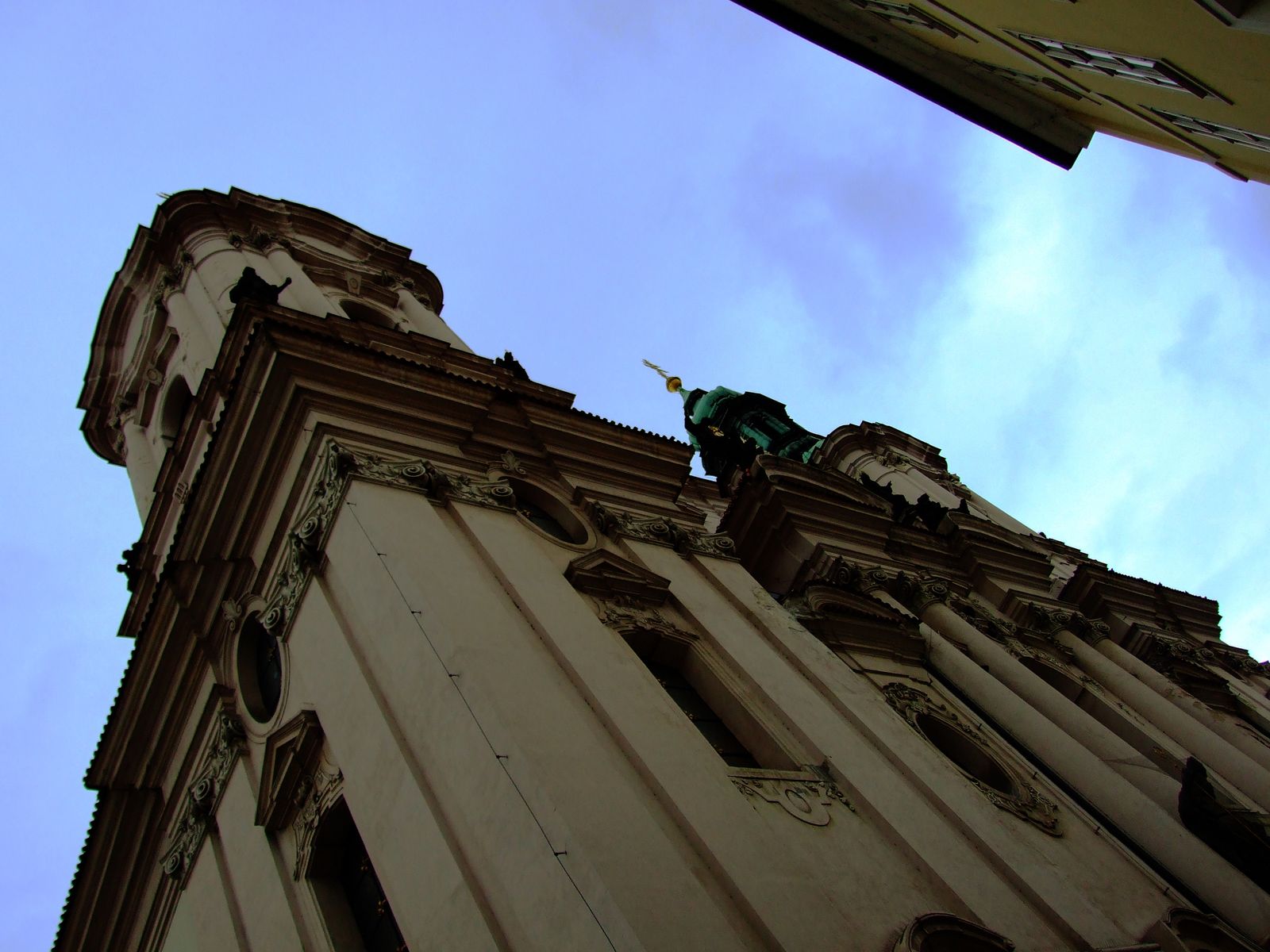
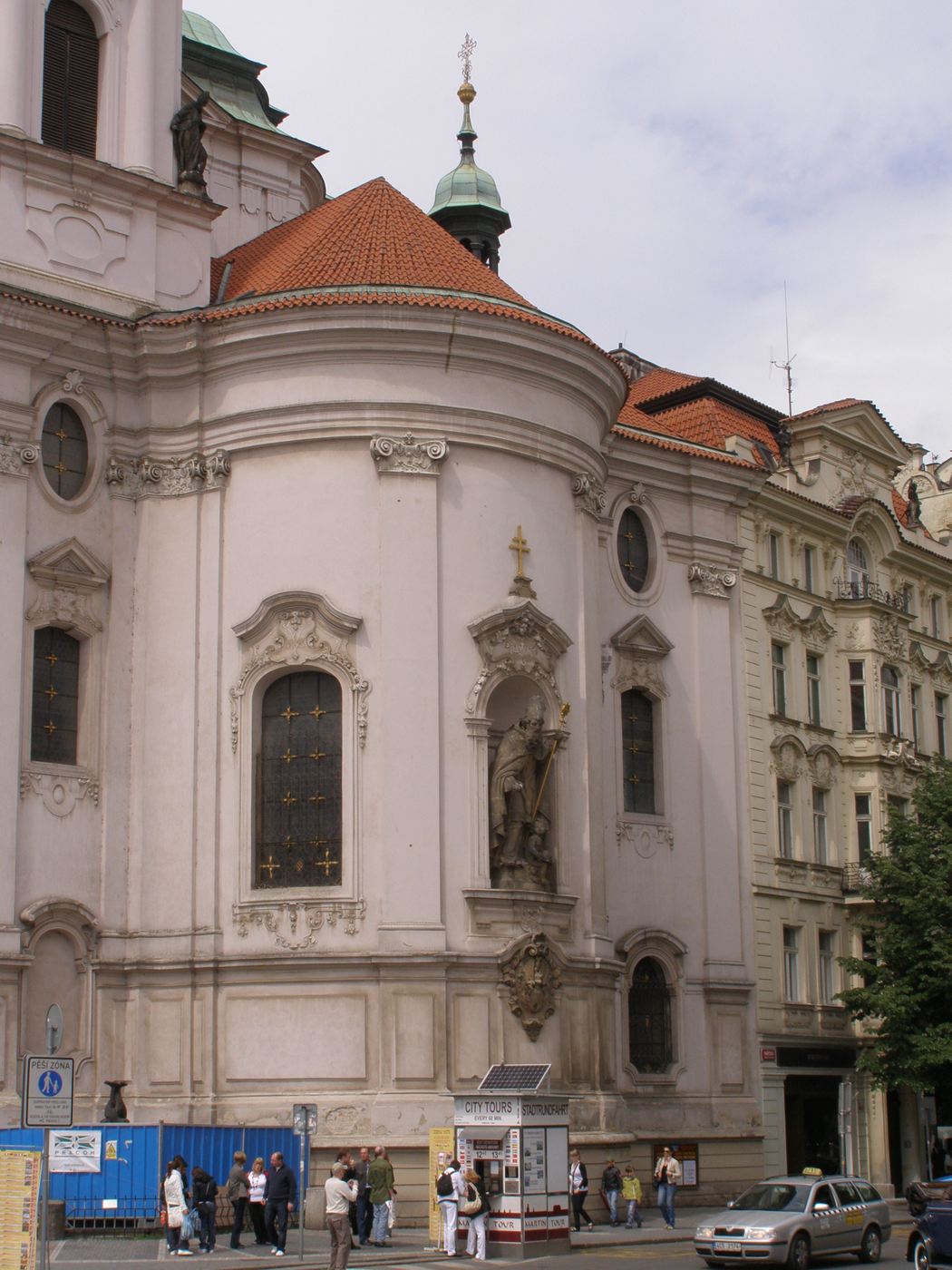
Most Prague churches are wedged into streets. This one stands loose, with a long show front facing open square — and that is an accident of demolition: the Dientzenhofer prelature and the monastery buildings were cleared in the Old Town slum clearances, finished by 1908, which exposed the south flank. The quasi-Baroque portal on that side was added in 1904 by Rudolf Kříženecký. In 2016 the exterior was repainted from its Orthodox-era white to the present warm stone-and-ochre.
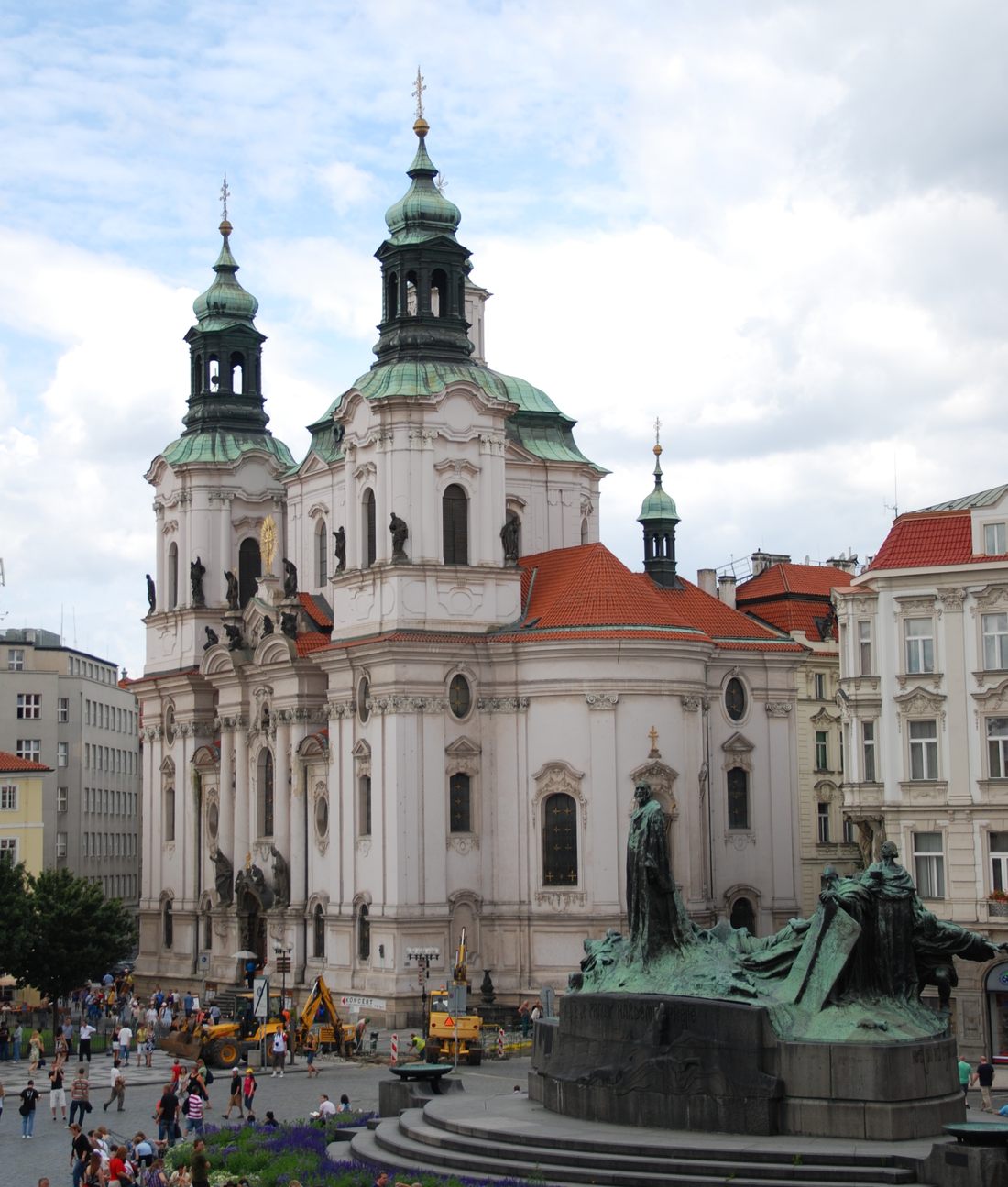
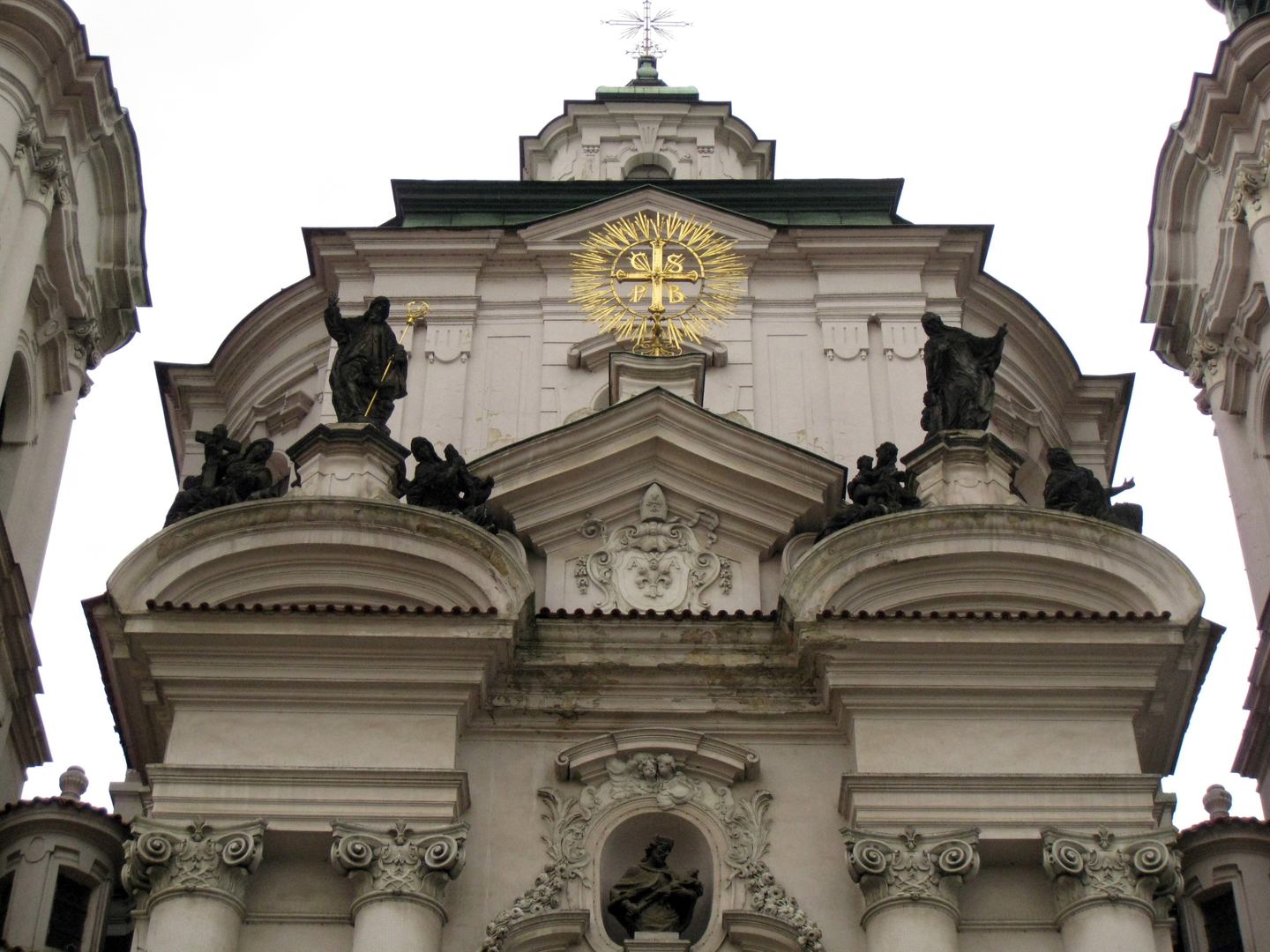
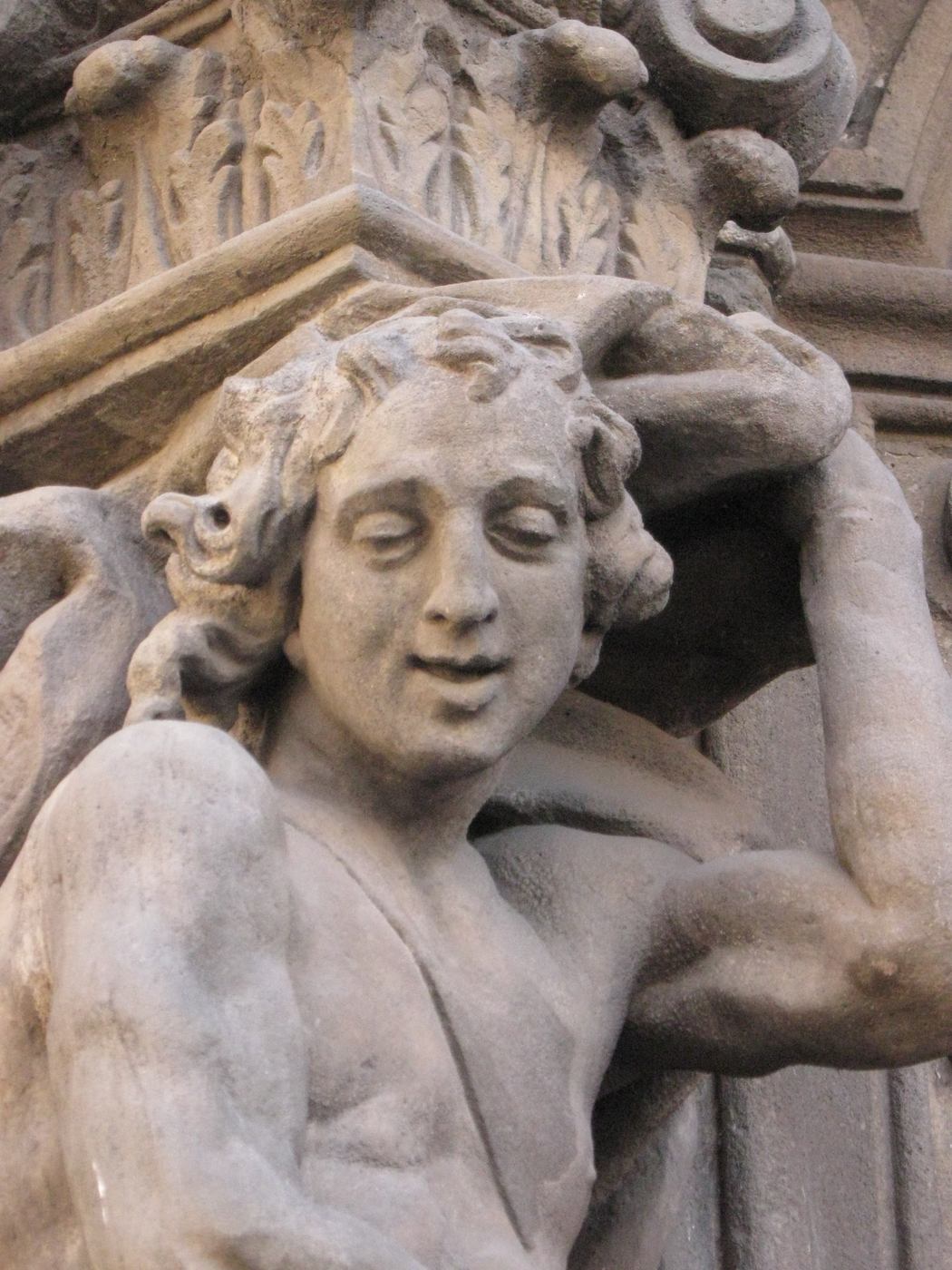
The sculpture is by Antonín Braun, nephew of the great Matthias Braun: saints, Czech patron saints, and allegorical figures of Faith, Hope, Charity and Temperance, with more statues in the drum of the dome. On the corner there is a Classicist fountain with a dolphin.
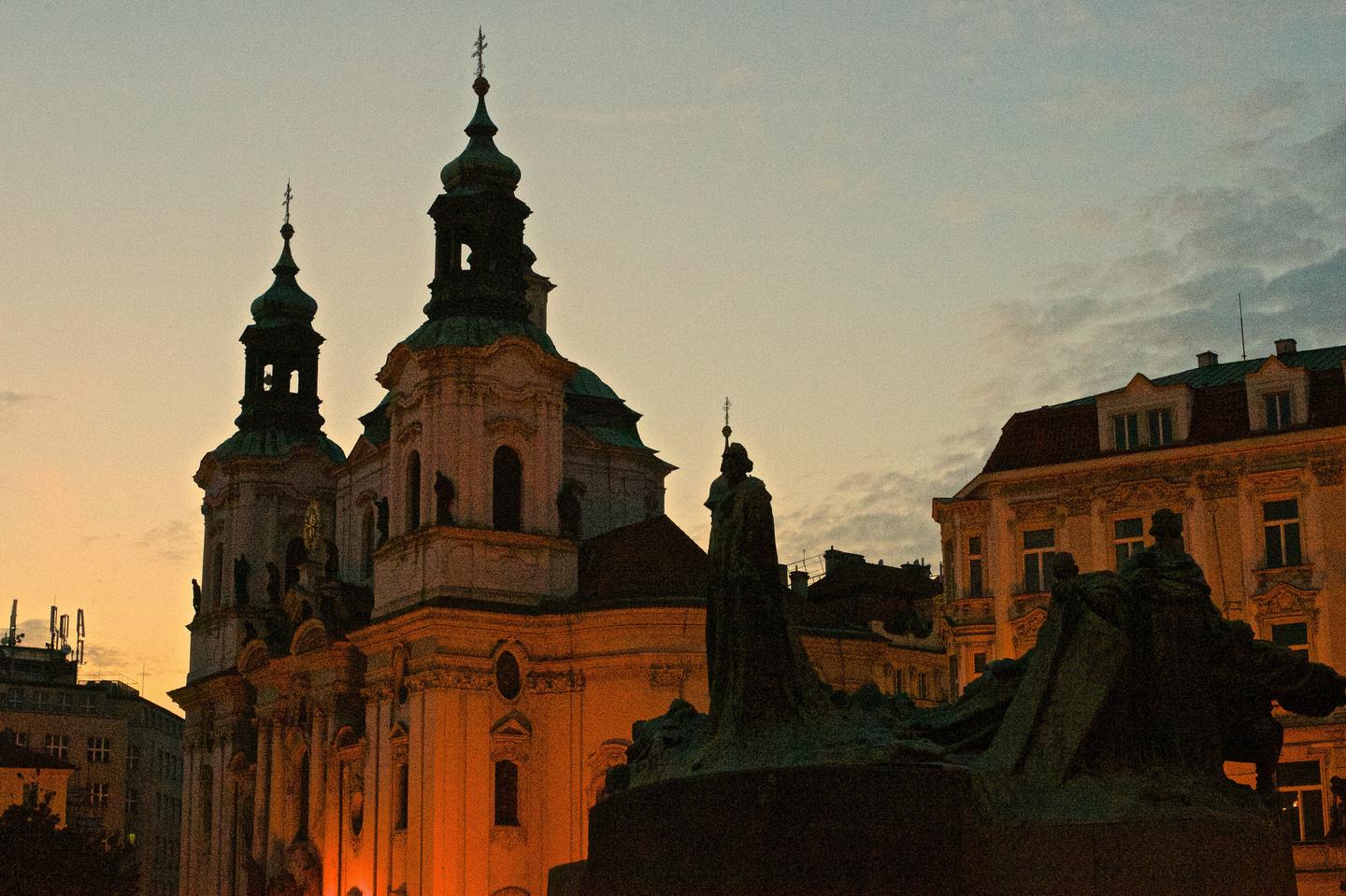
And look at what stands in front of it: the Jan Hus monument of 1915, put up on the five hundredth anniversary of Hus being burned. A monument to the great Czech reformer, immediately outside a Baroque church built by Benedictines during the Counter-Reformation, which now belongs to a church that takes his name. Old Town Square does not do subtlety.
Inside: an elongated centre
Dientzenhofer’s plan is an elongated centralised space — an octagonal dome carried on piers set diagonally, with arcaded side chapels and galleries round it, and heavy ornamental stucco by Bernardo Spinetti. It is smaller and simpler than its namesake across the river, and the light comes down the dome in a way the photographs never quite catch.

What is not here is as important. There are no altars crowding the walls, no relics, no candle stalls, no gift shop. Joseph II sold the contents in 1787 and they never came back; what you are looking at is a Baroque church that was stripped, used for grain, and then handed to a Protestant-aligned denomination that has no use for the furniture anyway. Visitors who arrive expecting Malá Strana’s gold are routinely disappointed. Come for the architecture, the light and the history, and it is one of the best free ten minutes in the city.
The frescoes
The paintings in the dome and vaults are by Cosmas Damian Asam, one of the two Bavarian Asam brothers, painted in 1735–36: the life of St Nicholas, the life of St Benedict — the Benedictines paying for their own patron — Old Testament scenes, and the four Evangelists under the dome.
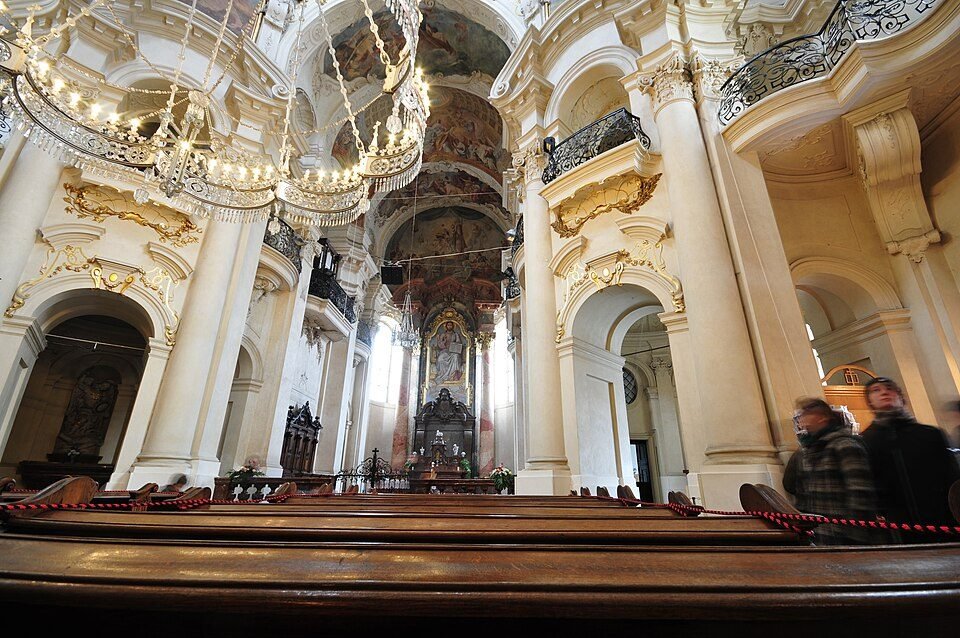
Do not read them as pristine eighteenth-century surfaces. They were whitewashed over during the Orthodox tenancy, recovered afterwards, repainted in part in 1914, and restored again in the reconstruction of 1967–69. What survives is a recovery, not a survival.
The chandelier
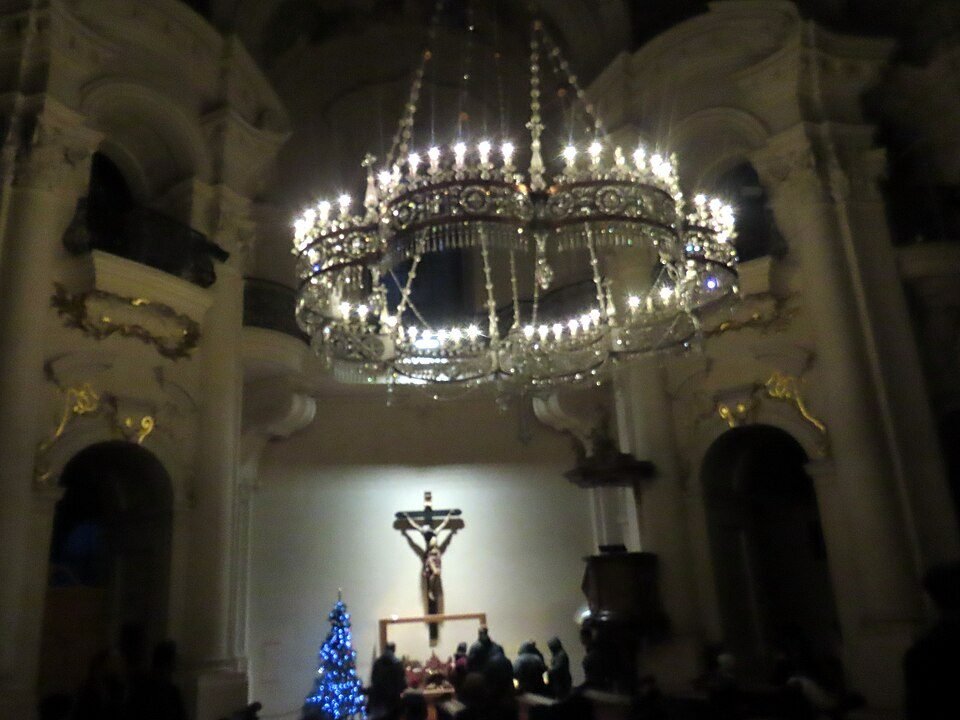
The single most photographed object in the building, and the one that carries the whole story. It is a chandelier in the shape of a tsar’s crown, with a four-sided crystal cross hanging beneath it — a panikadilo, an Orthodox liturgical form, not a Baroque one. It was made at the Harrachov glassworks in the Giant Mountains and given in 1880, during the Orthodox years.
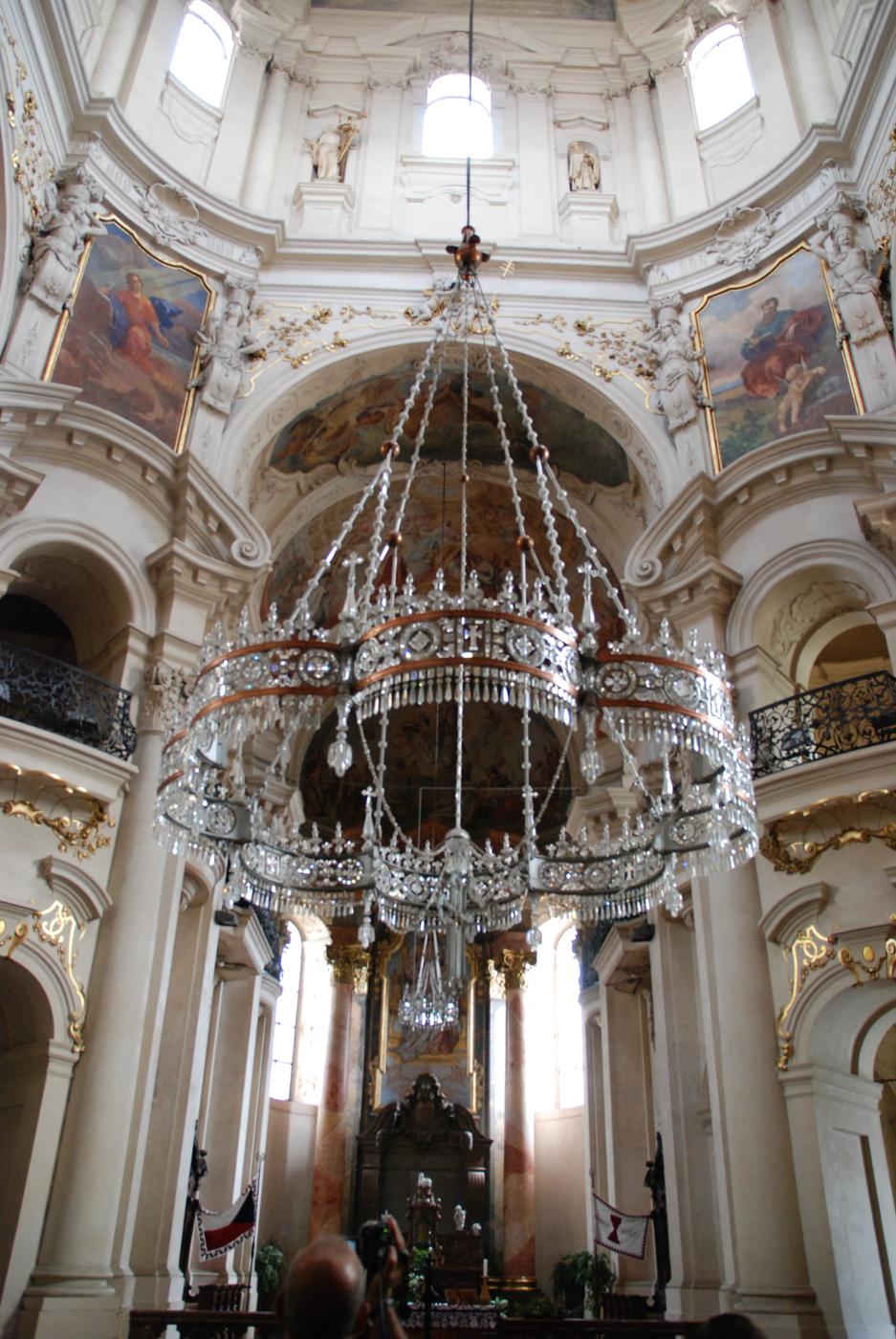
Who gave it is genuinely disputed: the parish’s own site says Tsar Alexander II, while Czech Wikipedia and the city tourist board say Nicholas II. Only Alexander II fits an 1880 date — Nicholas II was twelve years old then and did not reign until 1894 — so Alexander II it is, and you can watch the error propagate through the guidebooks. Its weight is usually given as 1,400kg; you will also see “1,400 pieces of crystal” and “1.5 tonnes”, which looks like one number that has wandered between units.
Stand under it for a moment and count the owners: a Russian imperial gift, hanging in a church built by Czech Benedictines, sold for grain by an Austrian emperor, and now in the hands of a Czech national church. That is four regimes on one hook.
The altar and the organ
The high altar is a torso. The marble columns are of 1737; everything else was lost in 1787, and it was completed in 1917 with a neo-Baroque tabernacle and an altarpiece of St Nicholas of Myra by Karel Špillar. The pulpit is an eighteenth-century piece given by Count Lamberg in 1916 and brought here from a church at Nezamyslice — furniture assembled after the fact, like most of what is left.
The organ is an eighteenth-century instrument, and with the acoustics it is the reason concerts work here.
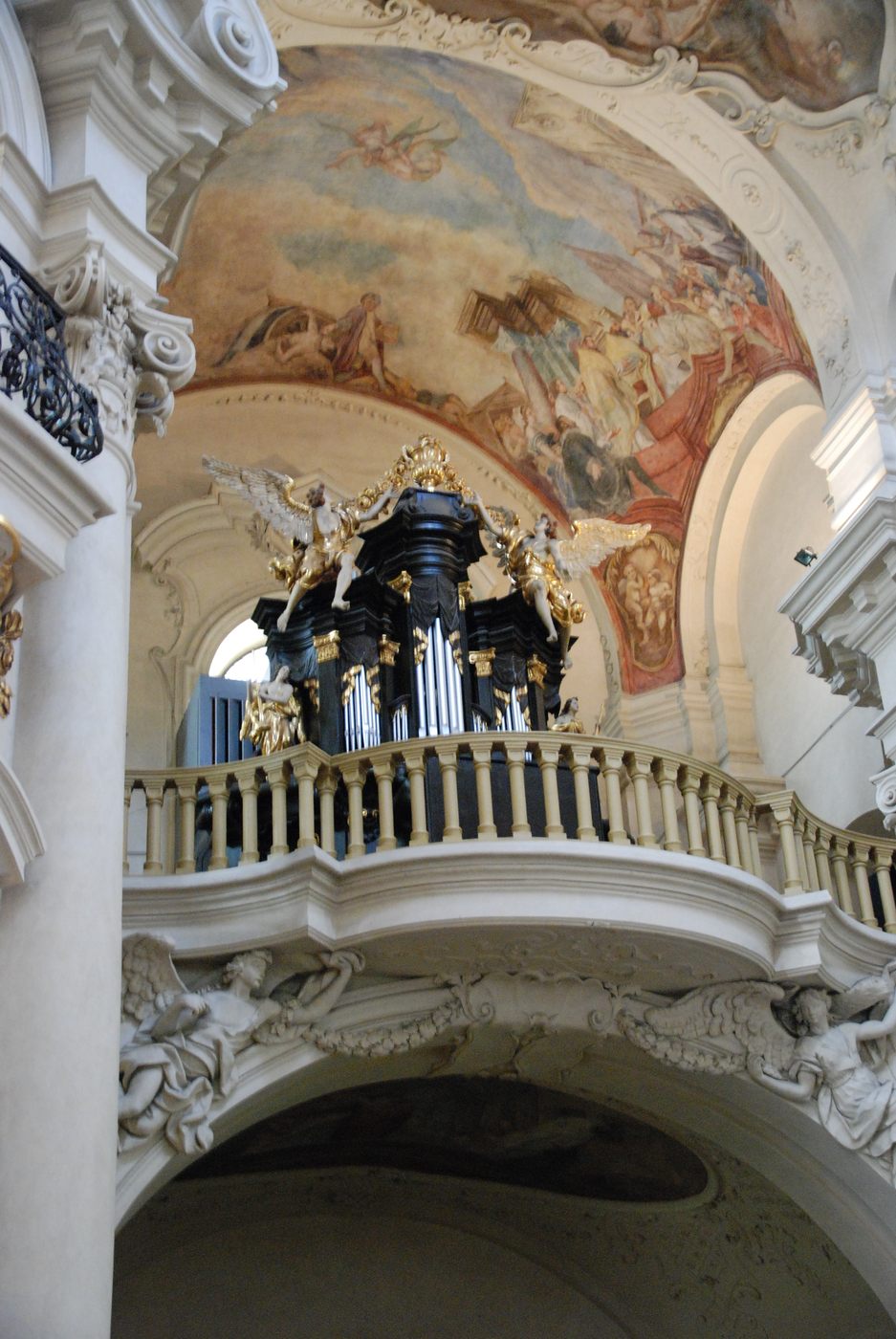
One story to put down: Mozart did not play it. That claim appears only on English-language visitor sites and is a straightforward contamination from the other St Nicholas, where he did improvise in 1787 and where his memorial requiem was sung in 1791. In 1787 this church was being deconsecrated and emptied. The memorial plaque you will actually find inside commemorates the proclamation of the Czechoslovak Hussite Church in 1920.
A war, a radio station, and the crypt below
Two last pieces of history, neither of them signposted. Under the floor is the crypt of the medieval church — a few fragments of the Gothic building survive down there, and in the 1930s a small catacomb was found beneath the lower church that had served as the medieval church’s burial ground. It is not part of a visit.
And in May 1945, during the Prague Uprising, when the main radio building came under attack by the Waffen-SS, Czech Radio is said to have broadcast from this church — the transmissions that called the city out and called for help. The claim rests on a thin chain of sources, so take it as tradition rather than record; but it fits a building that has been a parish church, a Benedictine abbey church, a grain store, a concert hall, an Orthodox chapel, a garrison church and a national church in the space of three hundred years. Very few buildings on this square have been more useful, and none has been more repeatedly repurposed.
Tickets and tours
Free in the day, ticketed at night
Daytime entry costs nothing. The evening concerts — most nights, usually 6pm, about an hour of Bach, Vivaldi, Mozart, Handel or Dvořák — are sold by several promoters at different prices for the same seats, usually around 500 Kč and more over Christmas and New Year. They are frankly a tourist-market product; the setting and the acoustic are good, the musicianship varies. If you go, sit centrally rather than at the back. And note the church is heated, which is rarer than it sounds in a Prague concert church.
Tour and hotel links go to GetYourGuide and Booking.com. This site earns nothing from them at present — they are here because they are the quickest way to check what is actually available.
Don't miss
- The crown chandelier Harrachov crystal in the form of a tsar's crown, given in 1880 — the one object that carries the building's whole history.
- Asam's dome frescoes 1735–36, the lives of St Nicholas and St Benedict, whitewashed over for forty years and recovered in the twentieth century.
- Braun's Virtues on the south front Faith, Hope, Charity and Temperance, by the nephew of the man who carved the Charles Bridge saints.
- The 1920 plaque Marking the proclamation of the Czechoslovak Hussite Church, which happened in this building.
- The emptiness Joseph II sold the contents in 1787 and they never returned. What you see is what survives of a church that was used as a grain store.
- The Hus monument outside The reformer, in bronze, immediately in front of a Counter-Reformation Benedictine church.
Insider tips
Use the side door. The portal on the square is locked in the daytime; the visitor entrance is the small door on the corner facing náměstí Franze Kafky. If it is shut, walk the perimeter before giving up.
Go before eleven. The square fills from mid-morning; at ten the church is nearly empty and the low light through the dome windows is at its best.
Use it as shelter. In a square where a coffee costs what a meal costs one street back, this is a free, heated, quiet Baroque interior. That is a genuinely useful thing to know in February, or in a thunderstorm.
Compare promoters before buying a concert ticket — the same evening in the same church is sold at noticeably different prices by different agencies and discount platforms.
Do not plan around it. Ten to twenty minutes, dropped into an Old Town walk between the Astronomical Clock and the Jewish Quarter, is exactly the right amount of attention for what is here.
Common questions
Is this the same St Nicholas as the one in Malá Strana?
No. Two Baroque churches of St Nicholas, both partly by the same architect, fifteen minutes apart. This is the white one standing free on Old Town Square, it belongs to the Czechoslovak Hussite Church, entry is free and it takes ten minutes. The huge Catholic one with the green dome is across the river below the Castle, and costs 150 Kč. Check whether a concert ticket says Staroměstské or Malostranské.
Is it free to go in?
Yes, in the daytime, outside services — roughly 10am to 5pm. There is no ticket desk. In a square where everything else costs money, that is worth knowing.
Where is the entrance?
Not the grand portal facing the square, which is usually locked by day. Look for the small side door on the corner facing náměstí Franze Kafky. People assume the church is shut and walk away.
What is the Czechoslovak Hussite Church?
A Czech national church founded on 8 January 1920, when reform-minded Catholic priests broke with Rome in the new republic. It claims descent from Jan Hus, uses Czech in the liturgy, does not require celibacy and ordains women — about half its clergy are women. It is small: some 24,000 members at the last census. The new church was publicly proclaimed in this building on 11 January 1920 and has held it ever since.
Did Mozart play the organ here?
Almost certainly not. That story belongs to the other St Nicholas, in Malá Strana, and no Czech source connects it with this church — which in 1787 was being stripped and shut by Joseph II, a poor year for a recital.
How long should I allow?
Ten to twenty minutes. It is one open room: dome, frescoes, chandelier, altar. There is no crypt, tower or treasury to tour.
Where to stay and eat nearby
Old Town Square is the most expensive place to eat in the Czech Republic and rarely the best. One street back — Týnská, Dlouhá, or towards the river — the same food costs half as much. For staying, the Old Town is convenient and very noisy at night; Josefov, the Jewish Quarter five minutes north, is quieter, and Malá Strana across the bridge is quieter still.
More churches in Prague
- Our Lady before Týn — across the same square, Gothic, and the church this one lost its parish to.
- St Nicholas, Malá Strana — the other one, the big one, and the reason for all the confusion.
- St Vitus Cathedral — up in the Castle, and the actual cathedral of Prague.