
Elgin Cathedral, Moray
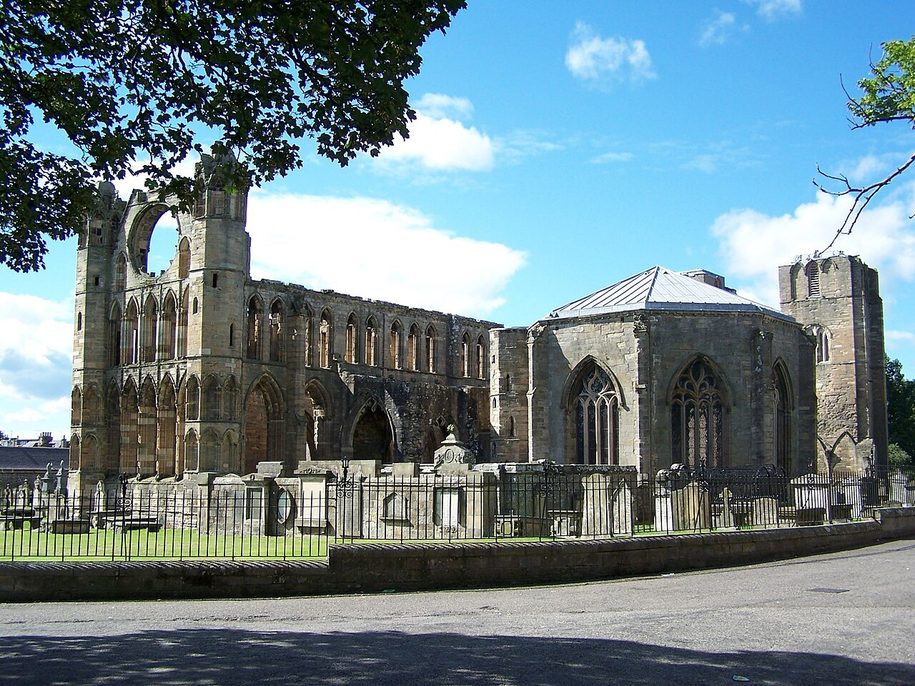
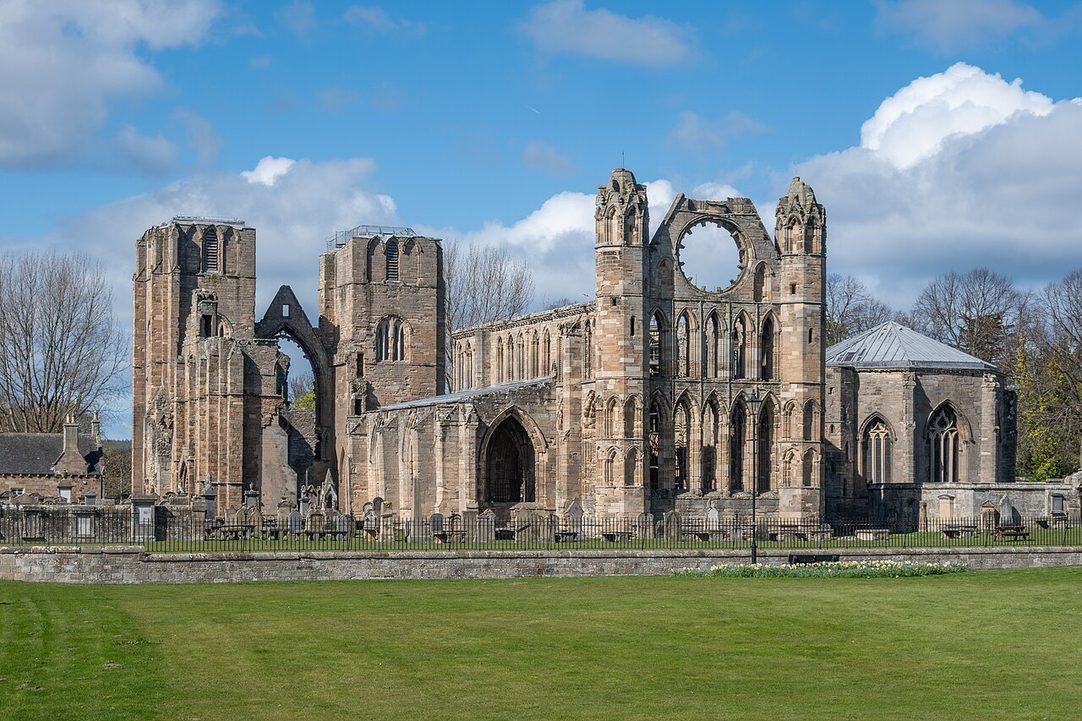
Even as a ruin, Elgin is one of the most beautiful buildings in Scotland. The cathedral of the bishops of Moray was so fine that it was called the Lantern of the North. It was burned by a king’s son, rebuilt, then left to decay after the Reformation — but its twin west towers, its east end with two rows of lancets under a rose window, and its octagonal chapter house still stand.
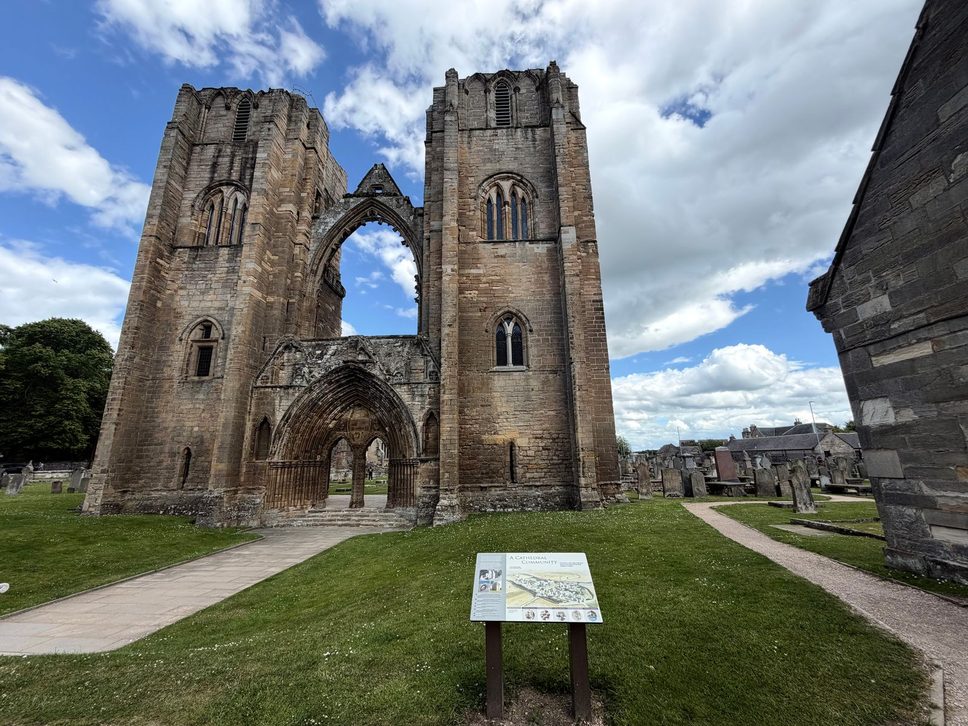
The Lantern of the North
The bishops of Moray had no settled cathedral until 1224, when the seat was moved to Elgin from nearby Spynie. After a fire in 1270 the church was rebuilt and enlarged, with a longer choir and the great east end you see today.
On 17 June 1390 Alexander Stewart, Earl of Buchan, known as the Wolf of Badenoch, burned the town and the cathedral after a quarrel with the bishop. Bishop Alexander Bur wrote to the king that it had been the ornament of the realm. The church was repaired; when the central tower fell in 1506 it was rebuilt, and the chapter house was given its new vault between 1482 and 1501.
After the Reformation of 1560 the cathedral was no longer needed. Its lead was stripped from the roof in 1567–68, the choir roof fell in a gale in 1637, and in 1711 the central tower collapsed. In the early 1800s a local shoemaker, John Shanks, became its keeper and cleared away much of the rubble — the start of its life as a monument.
The visitor's cheat sheet
| Where | King Street, Elgin, Moray, IV30 1HU |
|---|---|
| Getting there | Train to Elgin (45 minutes from Inverness), then a 20-minute walk; no car park; street parking nearby and drop-off at the entrance |
| Opening hours | 1 April–30 September daily 10am–5.30pm; 1 October–31 March Saturday–Wednesday 10am–4pm; last entry an hour before closing |
| Admission | Adults £10 online (£11 on the door), concessions £8 (£9), children £5 (£5.50); Historic Scotland members free |
| How long | An hour to an hour and a half |
| Best time | A summer afternoon, then the Biblical Garden next door |
| Dress code | Outdoor shoes; grass and uneven ground |
| Tours | Self-guided, with displays of carved stones; free Biblical Garden next door in summer |
Hours and admission checked against the official site in October 2026. They change; the official site is always the last word.
Scotland’s tallest gravestone. In the churchyard is the Anderson monument, about five metres high, said to be the tallest gravestone in Scotland. Inside the cathedral there is a Pictish cross slab found nearby, carved with a hunting scene and a falconer.
What to see, in the order you meet it
The west front
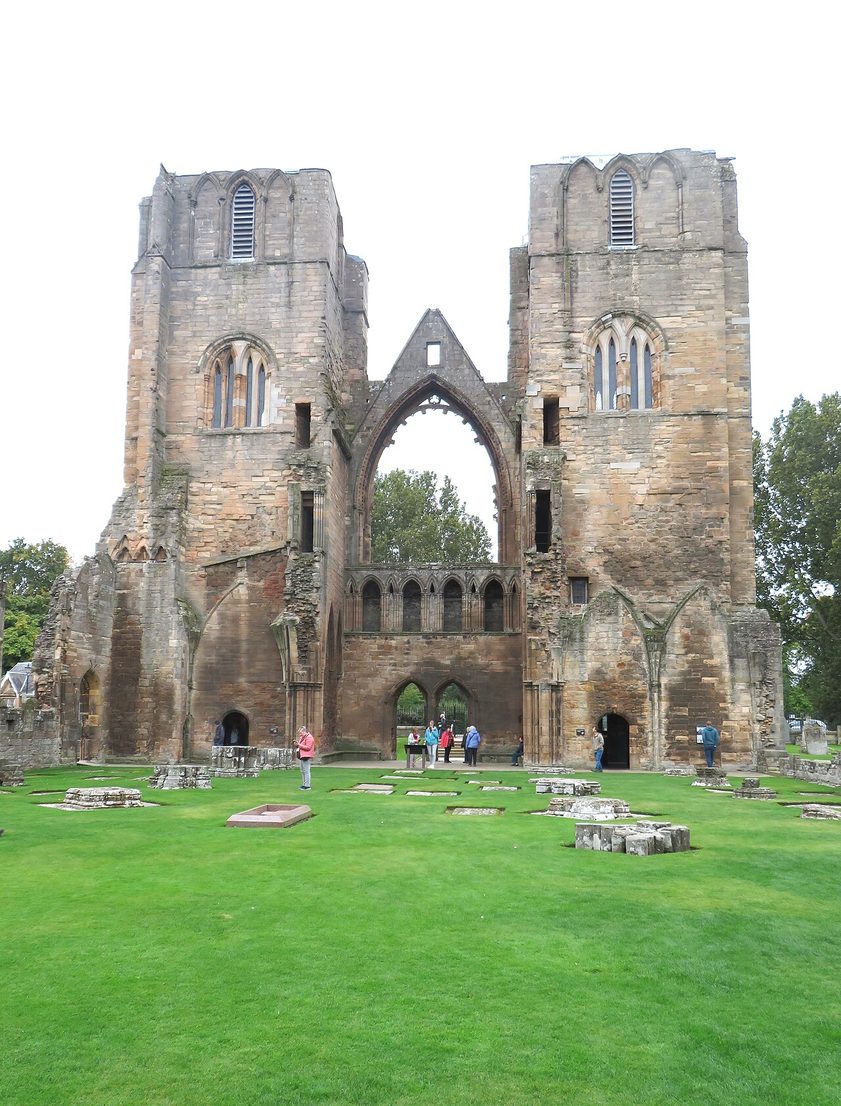
You enter through the west front, between two great towers. The doorway is deeply carved, and above it was a large window, now an empty frame.
The nave and choir
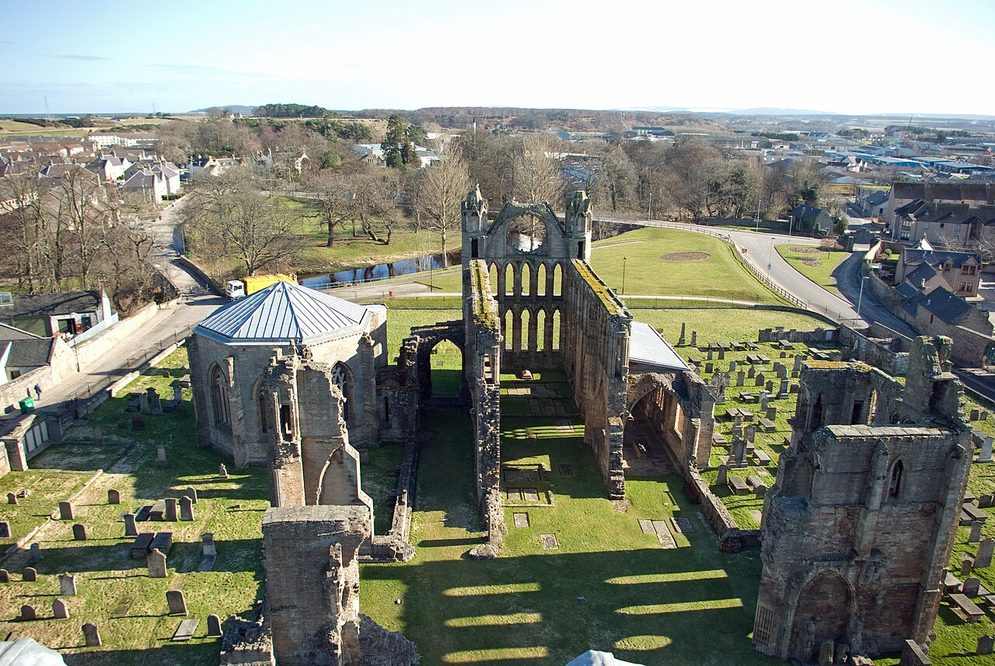
The nave is now a lawn, with only the bases of its pillars. Beyond the crossing is the choir, with the tombs and effigies of bishops, including Bishop John of Winchester, and of the first Earl of Huntly.
The east end
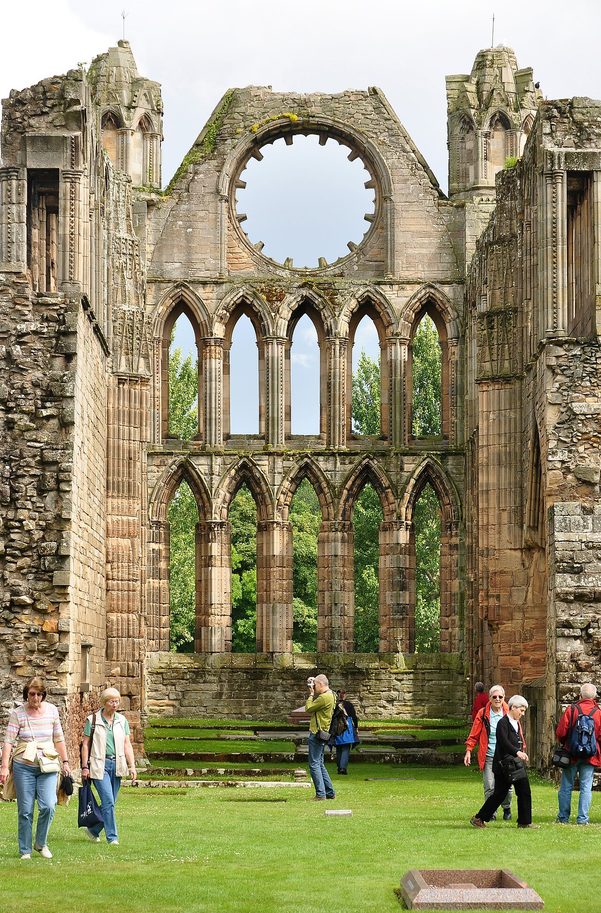
The east gable is the cathedral’s great sight: two tiers of tall lancet windows, with a rose window above. Stand on the grass of the choir and imagine it all filled with coloured glass.
The chapter house
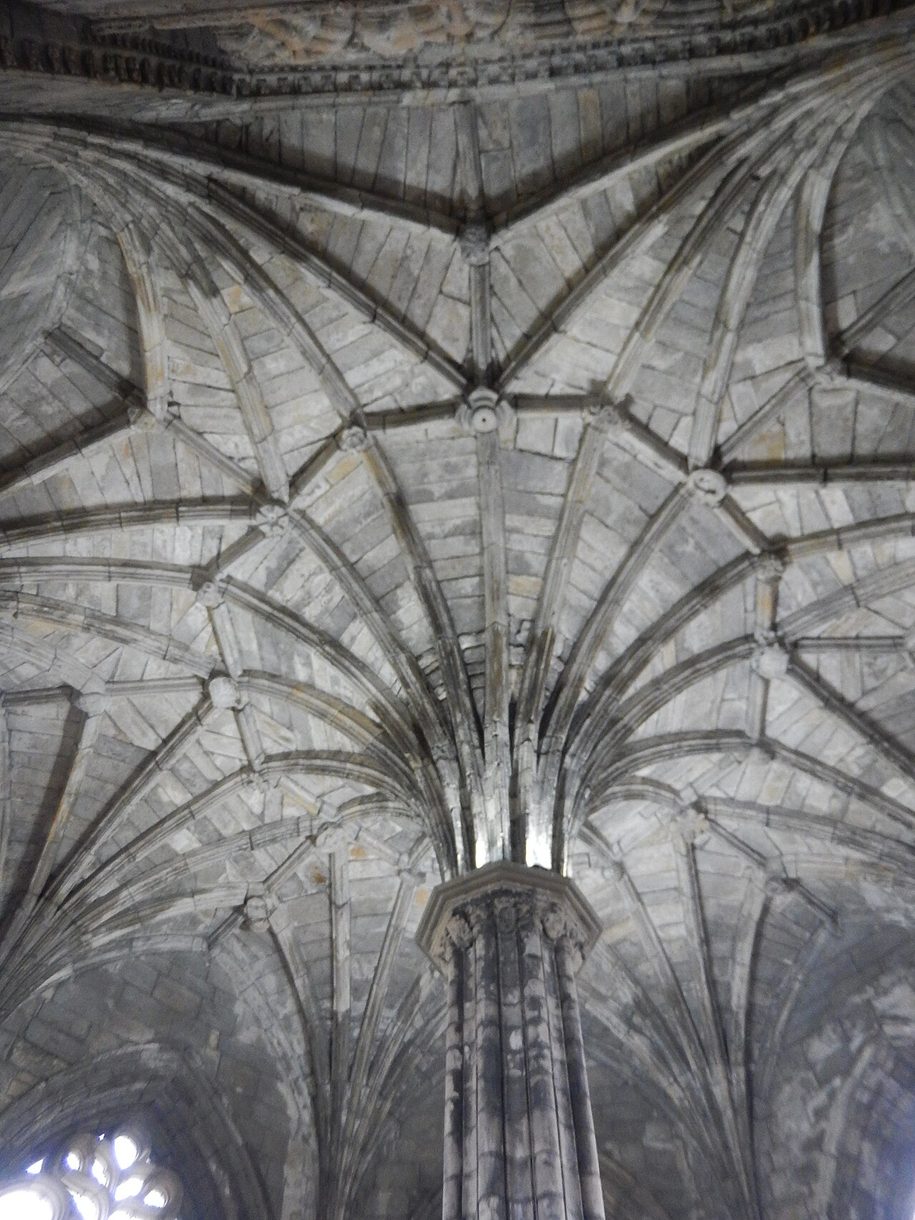
The octagonal chapter house, off the north side of the choir, is the most complete part of the cathedral. Its stone vault, rebuilt around 1500, fans out from a single carved central pillar.
Visiting
Tickets
Tickets are sold online through Historic Environment Scotland and on the door; online is cheaper, at £10 for adults. Work to protect the wall-tops may mean scaffolding on parts of the ruin.
The hotel link goes to Booking.com. This site earns nothing from it at present — it is here because it is the quickest way to check what is actually available.
Don't miss
- The east end Two rows of lancets and a rose window.
- The chapter house A vault from a single pillar.
- The west doorway Between the twin towers.
- The Pictish cross slab With its falconer.
- The Anderson gravestone Scotland’s tallest.
- The Biblical Garden Free, next door, in summer.
Insider tips
Visit the Biblical Garden. Next to the cathedral, in Cooper Park, is a free three-acre garden of around 110 plants named in the Bible, open from May to September. In winter, note that the cathedral is closed on Thursdays and Fridays.
Common questions
How much does it cost to visit Elgin Cathedral?
Elgin is run by Historic Environment Scotland. Booking online, an adult ticket is £10, concessions £8 and children £5; on the door it is £11, £9 and £5.50. Historic Scotland members and Explorer Pass holders go free.
When is Elgin Cathedral open?
From 1 April to 30 September it is open daily from 10am to 5.30pm. From 1 October to 31 March it is open Saturday to Wednesday from 10am to 4pm, and closed on Thursdays and Fridays. Last entry is an hour before closing, and it is closed from 24 December to 4 January. Booking ahead is recommended.
Why is it called the Lantern of the North?
In 1390, after the cathedral had been burned, Bishop Alexander Bur wrote to the king calling it the ornament of the realm and the glory of the kingdom. In later centuries its beauty earned it the name “the Lantern of the North”.
Who was the Wolf of Badenoch?
Alexander Stewart, Earl of Buchan, a son of King Robert II. After a quarrel with the bishop he burned the town of Elgin and its cathedral on 17 June 1390.
How do you get to Elgin Cathedral?
Elgin station is on the Inverness–Aberdeen line, about 45 minutes from Inverness and 90 minutes from Aberdeen. The cathedral is 0.8 miles from the station, about 20 minutes on foot. There is no car park at the cathedral, but there is street parking nearby and you can be dropped off at the entrance.
Where to stay and eat nearby
Elgin’s High Street, a few minutes’ walk away, has cafes, pubs and restaurants. The town makes a good base for the Moray coast and the Speyside whisky distilleries.
More churches in Scotland
- St Andrews Cathedral — Scotland’s greatest medieval cathedral, also in ruins
- St Magnus Cathedral — further north, in Orkney
- Glasgow Cathedral — a medieval cathedral that survived the Reformation whole