
Sweetheart Abbey, New Abbey
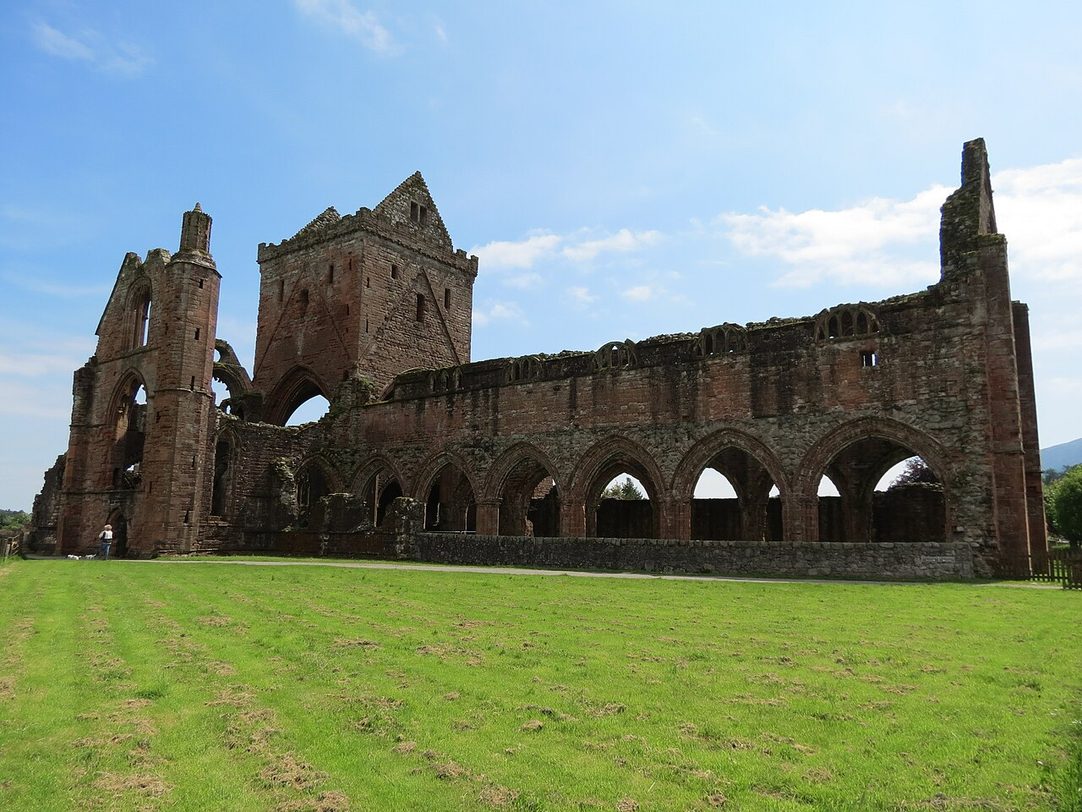
In a small village below Criffel, south of Dumfries, stand the blood-red ruins of Sweetheart Abbey. It was founded by Dervorguilla of Galloway in memory of her husband, John Balliol, whose embalmed heart she kept in a casket and took with her to the grave. The roofless church still stands almost to the wall-heads.
A widow's abbey
John Balliol, a great landowner in England and Scotland, died in 1268. His widow, Dervorguilla, a descendant of the lords of Galloway and of the Scottish royal house, had his heart embalmed and placed in a casket, which she kept with her. In 1273 she founded a Cistercian abbey here, with monks from Dundrennan, the last Cistercian house to be founded in Scotland. When she died, in early 1290, she was buried before the high altar with the casket, and the monks called their abbey Dulce Cor: sweet heart. She also endowed a college at Oxford in her husband’s name, Balliol College.
Their son, John Balliol, became King of Scots in 1292. The abbey survived the wars that followed and was repaired at the end of the fourteenth century by Archibald the Grim, Lord of Galloway. After the Reformation of 1560 its last abbot, Gilbert Broun, held on for decades as a Catholic, until he was arrested and exiled. In 1779 local people paid to preserve the ruin, a remarkably early act of conservation, and in 1928 it passed into state care.
The visitor's cheat sheet
| Where | Main Street, New Abbey, Dumfries, DG2 8BU |
|---|---|
| Getting there | About 7 miles south of Dumfries on the A710; bus 372 from Dumfries (Monday–Saturday); free public car park beside the abbey |
| Opening hours | 1 April–30 September, Sunday–Thursday 10am–4.30pm (closed Friday and Saturday); closed October–March; last entry 30 minutes before closing. Check HES before travelling |
| Admission | Reduced prices while conservation work continues: adults £4.50, concessions £3.50, children £2.50; Historic Scotland members free |
| How long | Under an hour; longer with the Corn Mill |
| Best time | A late afternoon, when the red sandstone glows |
| Dress code | Outdoor shoes; grass and uneven ground |
| Tours | No guided tours; small visitor centre |
Hours and admission checked against the official site in October 2026. They change; the official site is always the last word.
Conservation in progress. Historic Environment Scotland has been inspecting the high masonry of many of its ruins. At Sweetheart, the nave and cloister are open, some areas are fenced off and the tower is under scaffolding, and tickets are sold at reduced prices until the work is finished.
What to see, in the order you meet it
The church
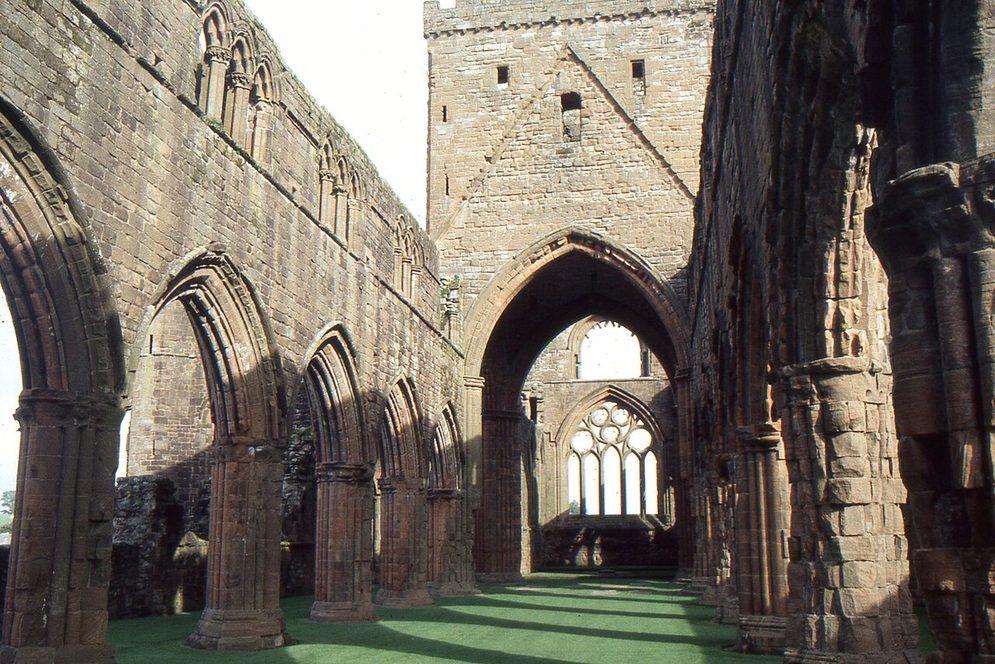
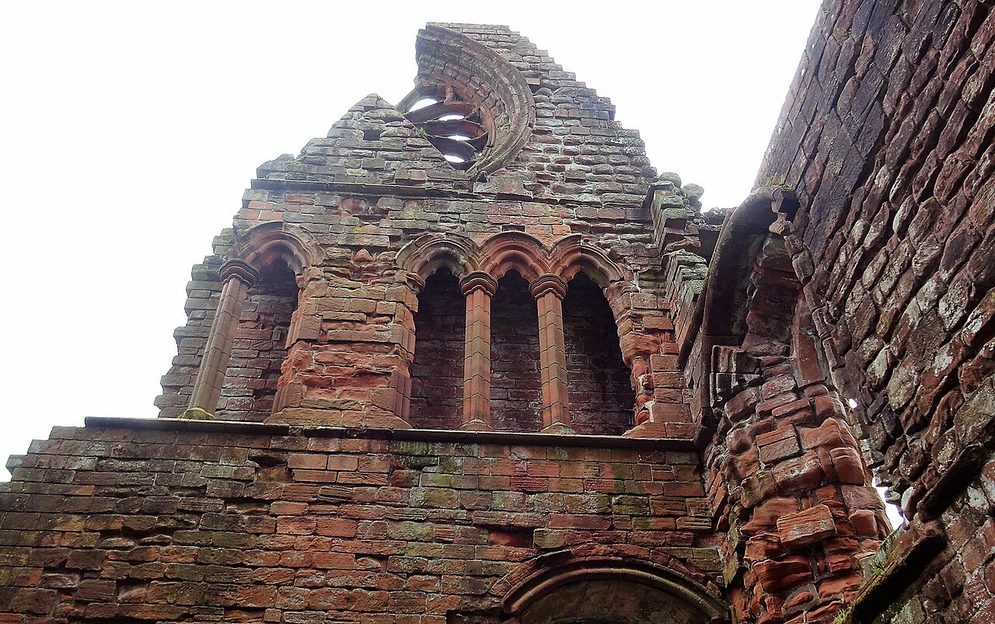
The church is built of deep red local sandstone in the Early English style, and stands almost to its full height: the west front, the six-bay nave with its pointed arcades, and the central tower above the crossing. In the presbytery the window tracery survives, and high in the gable of the south transept is a circular window.
Dervorguilla’s effigy
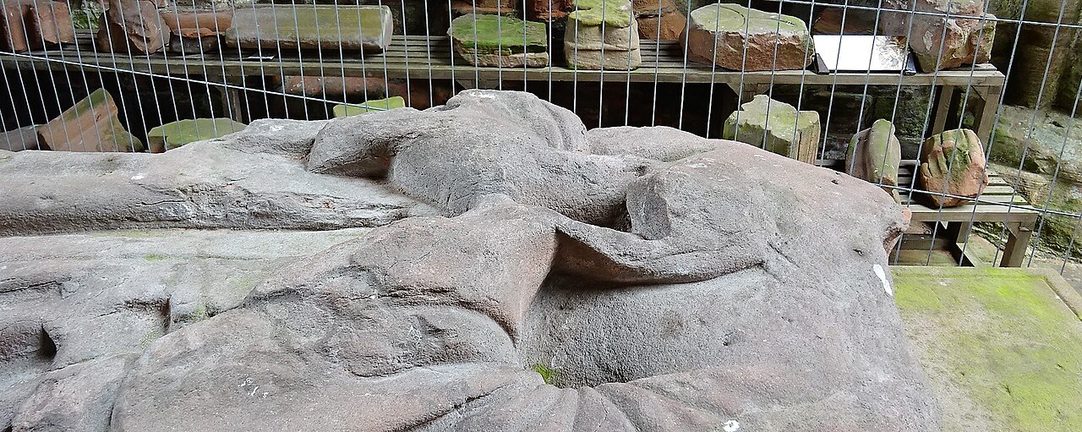
In the south transept is the effigy of Dervorguilla, holding the casket with her husband’s heart. It was put together in 1932 from the surviving fragments of a larger tomb.
The precinct wall
Walk around the outside to see the wall that enclosed the abbey’s precinct of about thirty acres. It is built of huge blocks of granite, and long stretches of it still stand.

Visiting
Tickets
Tickets are sold at the entrance at reduced prices while conservation work continues. Historic Scotland members go free.
The hotel link goes to Booking.com. This site earns nothing from it at present — it is here because it is the quickest way to check what is actually available.
Don't miss
- The red sandstone church Almost complete to the wall-heads.
- Dervorguilla’s effigy With the casket in her arms.
- The precinct wall Granite blocks around thirty acres.
- New Abbey Corn Mill A working water mill in the village.
- Criffel The granite hill above the village.
Insider tips
Pair it with the Corn Mill. New Abbey Corn Mill, also run by Historic Environment Scotland, is in the same village; it opens daily from April to September, and on Fridays and Saturdays only in October. The abbey closes on Fridays and Saturdays, so plan the days carefully.
Common questions
Why is it called Sweetheart Abbey?
When John Balliol died in 1268, his widow, Dervorguilla of Galloway, had his heart embalmed and kept it in a casket of ivory and silver. She founded the abbey in his memory in 1273, and when she died in early 1290 she was buried before the high altar with the casket. The monks named the abbey Dulce Cor, “sweet heart”.
When is Sweetheart Abbey open?
Historic Environment Scotland currently lists it as open from 1 April to 30 September, Sunday to Thursday from 10am to 4.30pm, with last entry 30 minutes before closing; it is closed on Fridays and Saturdays and from October to March. Its older pages give different hours, so check before you travel. From the roadside and the car park you can see the ruins at any time.
How much does it cost?
While conservation work goes on, tickets are sold at reduced prices on the day: adults £4.50, concessions £3.50 and children £2.50. Historic Scotland members and Explorer Pass holders go free.
Can you go inside the ruins?
Partly. Historic Environment Scotland has been inspecting and repairing the high stonework, and some areas can only be seen through protective fencing; the tower is under scaffolding. The nave and the cloister are open.
How do you get to New Abbey?
The village is about seven miles south of Dumfries on the A710. Bus 372 from Dumfries runs about every two hours, Monday to Saturday, and takes around twenty minutes; there is a free car park beside the abbey. Dumfries has trains from Glasgow and Carlisle.
Where to stay and eat nearby
New Abbey is a small village with little to eat or stay. Dumfries, twenty minutes away, has the widest choice.
More churches in Scotland
- Melrose Abbey — the finest of the Border abbeys
- Dryburgh Abbey — Sir Walter Scott’s grave
- Carlisle Cathedral — an hour away, across the border