
Melrose Abbey, Scottish Borders
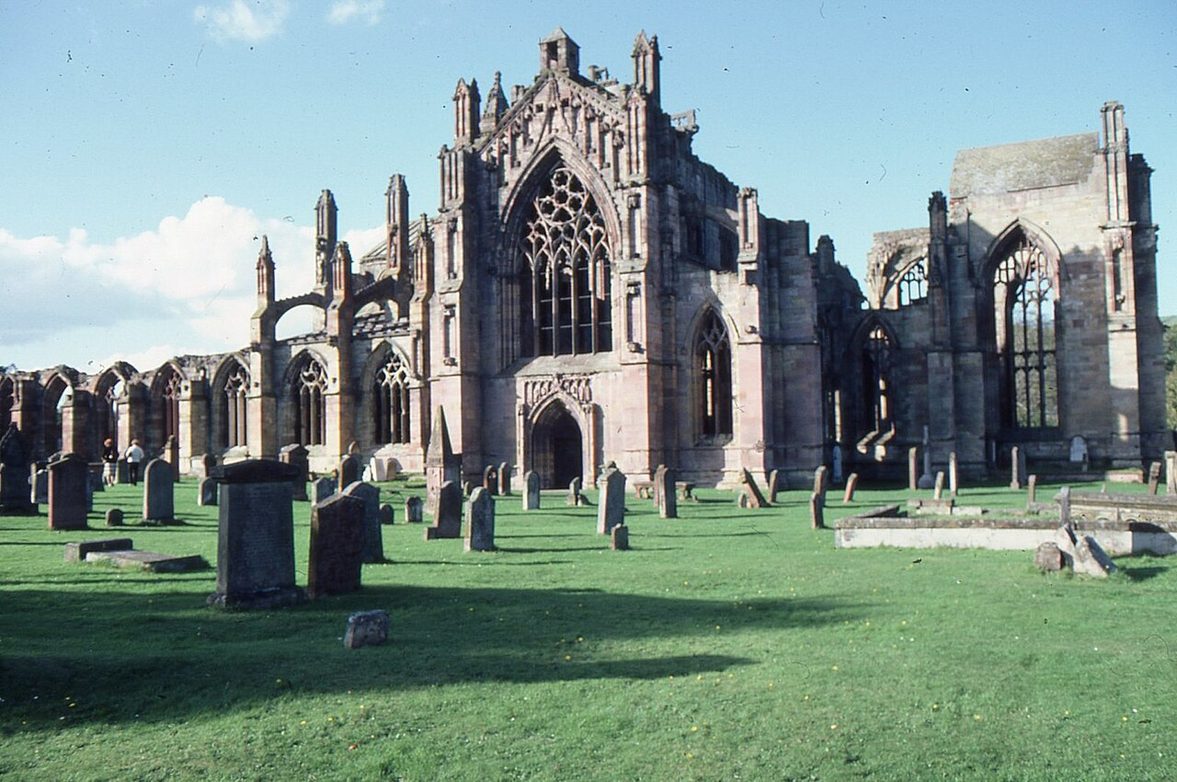
Of the four great ruined abbeys of the Scottish Borders, Melrose is the most beautiful. Its red sandstone church was burned by English armies and rebuilt in the finest Gothic carving in Scotland, then wrecked again at the Reformation. What is left is a roofless shell of soaring windows, saints and gargoyles — and, in the grounds, the heart of Robert the Bruce.
From Rievaulx to Robert the Bruce
Melrose was founded in 1136 by King David I for Cistercian monks from Rievaulx in Yorkshire. It was the first Cistercian abbey in Scotland, and its church was dedicated on 28 July 1146. The monks grew rich from sheep, and Melrose became one of the wealthiest abbeys in the country.
Its place on the road between England and Scotland made it a target. English armies burned it in 1322 and again in 1385, when Richard II’s troops destroyed most of it. The church you see today was rebuilt over the following century, on a grander scale and with carving of a quality found nowhere else in Scotland. It was hardly finished before the English came back in the 1540s, and the Reformation of 1560 ended monastic life for good.
The visitor's cheat sheet
| Where | Abbey Street, Melrose, Scottish Borders, TD6 9LG |
|---|---|
| Getting there | Borders Railway from Edinburgh to Tweedbank (about an hour), then a short bus ride or a two-mile walk; parking in the town |
| Opening hours | 1 April–30 September daily 9.30am–5pm; 1 October–31 March daily 10am–4pm; last entry 30 minutes before closing; museum closed 12–2pm |
| Admission | Adults £7.50, concessions £6.00, children £3.50; Historic Scotland members free |
| How long | An hour to an hour and a half |
| Best time | A sunny afternoon, when the red sandstone glows |
| Dress code | Outdoor shoes; grass and uneven ground |
| Tours | Free talks Tuesday to Saturday at 2.30pm and 3.30pm; audio guide; museum in the Commendator’s House |
Hours and admission checked against the official site in October 2026. They change; the official site is always the last word.
The Bruce’s heart. Robert the Bruce asked for his heart to be carried on crusade. Sir James Douglas took it to Spain in a casket and died fighting there in 1330; the heart was brought home and buried at Melrose. A lead casket found in 1921 was dug up again in 1996 and reburied in 1998 in the grounds, under a carved stone.
What to see, in the order you meet it
The nave
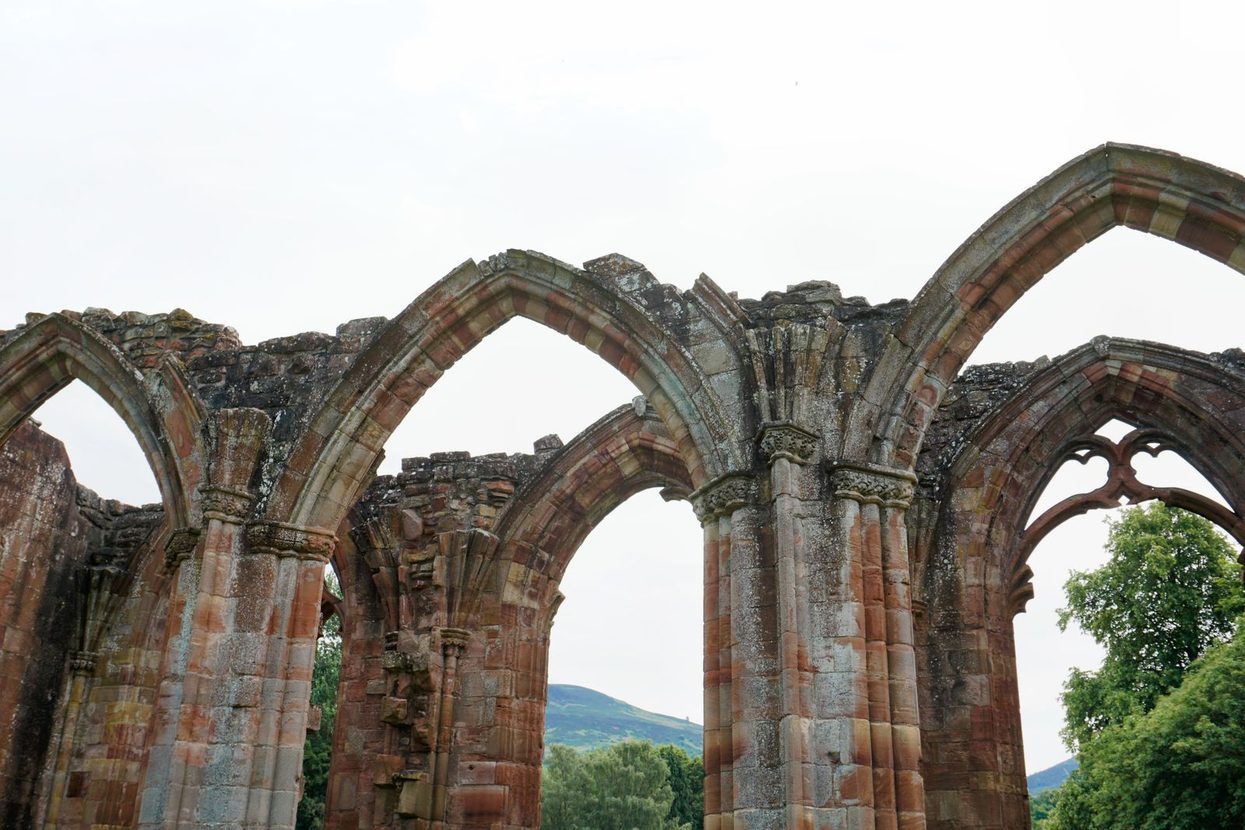
Most of the nave has gone, but its south side still has the row of chapels added in the fifteenth century, each with its own window. At the east end of the nave, the monks’ choir was later walled off and given a vault to serve as the parish church of Melrose, which it remained from 1618 until 1810.
The presbytery and the east window
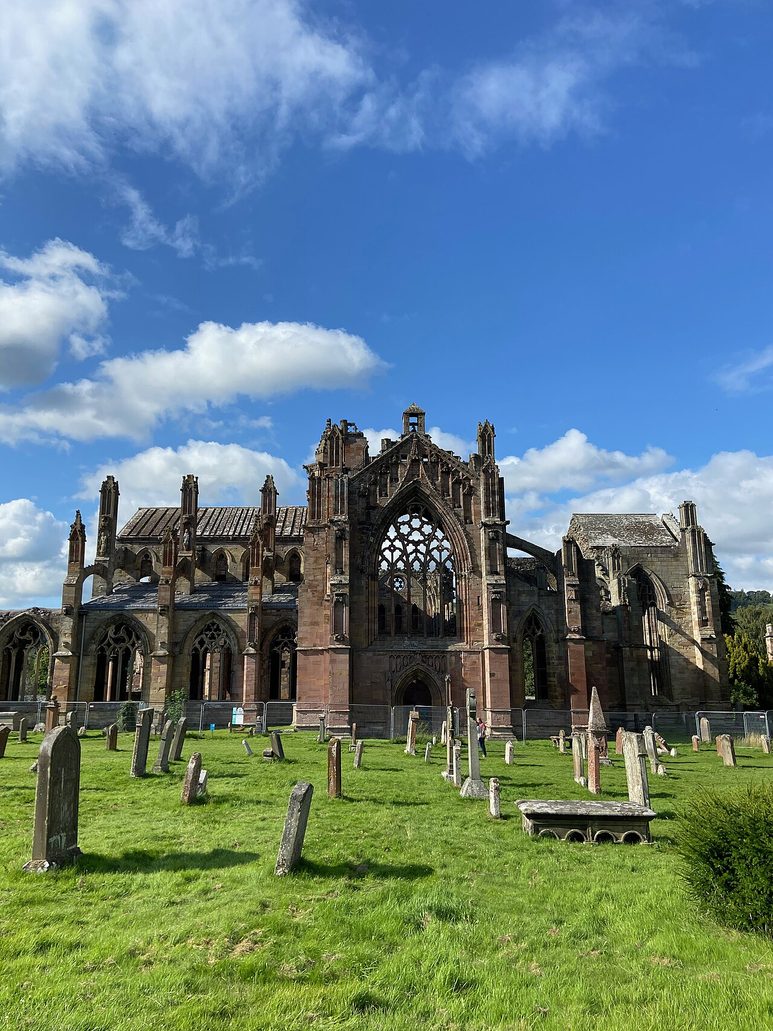
The east end is the best-preserved part of the church. Its great east window, tall and straight-lined, is in the English Perpendicular style — very unusual in Scotland, and probably the work of an English mason after the 1385 attack. Alexander II, who died in 1249, was buried before the high altar.
The south transept
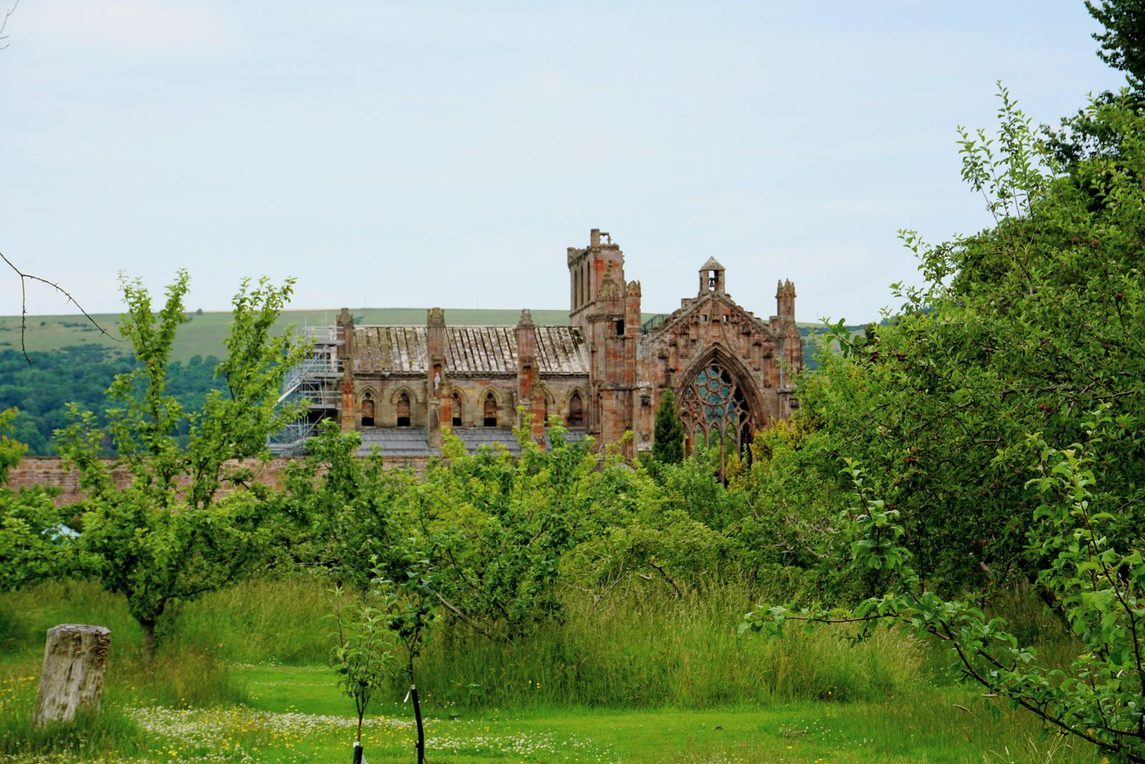
The south transept has a great window of flowing tracery and, on the wall, an inscription recording the mason John Morow, who came from Paris and worked on several of Scotland’s great churches.
The carvings
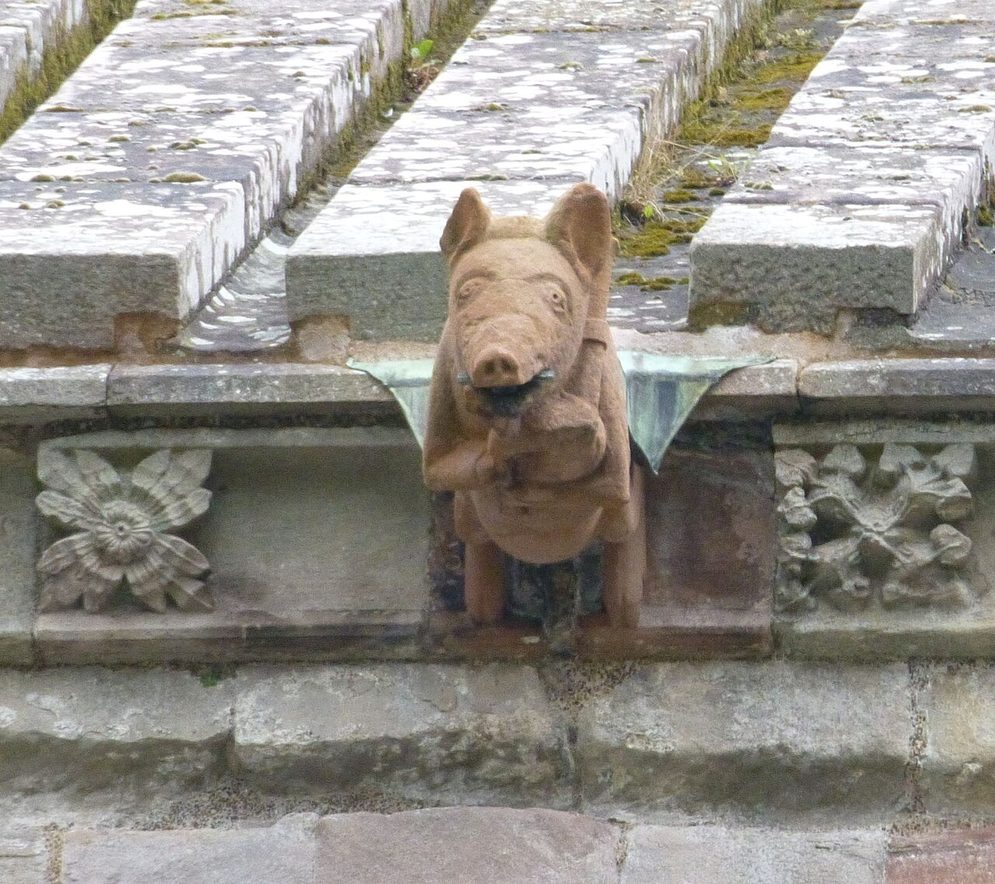
Walk around the outside of the church and look up. The buttresses and walls are covered with saints, monsters, musicians and gargoyles, including the famous pig playing the bagpipes. Inside there are carved capitals and roof bosses, and a hand holding a bunch of flowers.
The cloister and the museum
North of the church are the foundations of the cloister and the monks’ buildings, with the great drain that served them. The Commendator’s House, built from part of the abbey’s buildings, is now a museum of finds from the site.
Visiting
Tickets
Tickets are sold at the entrance and online through Historic Environment Scotland; booking online gets the best price. Adults pay £7.50.
The hotel link goes to Booking.com. This site earns nothing from it at present — it is here because it is the quickest way to check what is actually available.
Don't miss
- The east window English Perpendicular, far from England.
- The bagpiping pig High on the south side.
- The heart burial The stone over Bruce’s heart.
- John Morow’s inscription A master mason signs his work.
- The museum In the Commendator’s House.
- Priorwood Garden Next door, with an orchard of old apple varieties.
Insider tips
Make a day of the Borders abbeys. Melrose, Dryburgh, Jedburgh and Kelso are all within a dozen miles of each other, and the Borders Abbeys Way links them on foot. Sir Walter Scott, who helped save Melrose and is buried at Dryburgh, lived at Abbotsford, three miles away.
Common questions
How much does it cost to visit Melrose Abbey?
Melrose is run by Historic Environment Scotland. An adult ticket is £7.50, concessions £6.00 and children £3.50, and booking online gets the best price. Historic Scotland members and Explorer Pass holders go free.
When is Melrose Abbey open?
From 1 April to 30 September it is open daily from 9.30am to 5pm; from 1 October to 31 March it is open daily from 10am to 4pm. Last entry is 30 minutes before closing. It is closed on 25–26 December and 1–2 January.
Is Robert the Bruce buried at Melrose?
His heart is. Bruce was buried at Dunfermline in 1329, but his heart, after being carried on crusade, was brought back and buried at Melrose. A casket thought to hold it was found in 1921, dug up again in 1996 and reburied in the grounds in 1998, where a stone now marks the spot.
Where is the bagpiping pig?
High on the roof of the church, on the south side of the nave, among the gargoyles and carved figures. Bring binoculars or a zoom lens; the staff can point it out.
How do you get to Melrose?
The nearest station is Tweedbank, on the Borders Railway from Edinburgh, about two miles away; buses and a riverside path link it to Melrose. The abbey is in the centre of the small town, on Abbey Street.
Where to stay and eat nearby
Melrose has cafes, pubs and small hotels within a few minutes’ walk of the abbey.
More churches in Scotland
- Rosslyn Chapel — on the way back to Edinburgh
- Dunfermline Abbey — where the rest of Bruce is buried
- Hexham Abbey — across the border in Northumberland