
Basilica of the Annunciation, Nazareth
The Basilica of the Annunciation in Nazareth is built over the grotto where, by Catholic tradition, the angel Gabriel told Mary that she would bear the Son of God. It is often called the largest church in the Middle East: a modern basilica of the 1960s on two levels, enclosing the remains of the Byzantine and Crusader churches that stood here before it. It is free, and every Saturday evening pilgrims carry candles round it.
Before you go
Check the travel advice. Nazareth is in northern Israel, in Lower Galilee. In October 2026 the UK Foreign Office’s no-travel zones in the north were close to the Lebanese border and in the northern Golan, more than 30 km away, though it warns that rocket and drone attacks are possible anywhere in Israel; the US State Department’s advice for Israel was Level 3, “Reconsider travel”, with a no-travel zone north of Route 85 that takes in parts of Galilee often visited on day trips. Read your own government’s current advice before you go.
Seventeen centuries on one spot
Pilgrims were coming to a grotto in Nazareth by the 4th century: around 383 the pilgrim Egeria saw “a grand and splendid grotto” with an altar. A Byzantine church was built over it, and some of its mosaic floors survive. After the First Crusade, Tancred, Prince of Galilee, began a large Romanesque cathedral here, and Nazareth became the seat of an archbishop. It was destroyed in 1263 by the forces of Sultan Baibars.
The Franciscans obtained the ruins in 1620 and in 1730 were allowed to build a small church over the grotto, lengthened in 1877. In 1955 it was demolished, the site was excavated, and the present basilica, designed by the Italian architect Giovanni Muzio and built by an Israeli firm with Nazareth stonemasons, rose on the line of the Crusader walls. Pope Paul VI came while it was being built, in January 1964, and it was consecrated in 1969.


The visitor’s cheat sheet
| Where | Al-Bishara Street, Nazareth, in the old town; buses stop on Paulus VI Street below |
|---|---|
| Opening hours | Daily 8am–6pm for visits (last entry 5.45pm); lower church open for silent prayer 6–9pm. Closes 3pm on Holy Thursday; closed Good Friday |
| Admission | Free |
| Mass | Daily 6.30am in the grotto (Italian); Saturday 11am international Mass; Sunday Masses in Arabic; confirm with the pilgrims’ office (+972 4 656 0001) |
| Candlelight procession | Saturdays 8.30–9.30pm |
| Travel advice | October 2026: no UK warning for Nazareth itself; US Level 3 for Israel. Check before you go |
| How long | An hour to an hour and a half, with St Joseph’s |
Hours and admission checked against the official site in October 2026. They change; the official site is always the last word.
Two churches in one. Enter from the west to reach the lower church and the grotto; stairs lead up to the upper church. Go on Saturday evening if you can, for the candlelight procession. Dress modestly: this is a working parish and shrine.
What to see
The west front and the courtyard
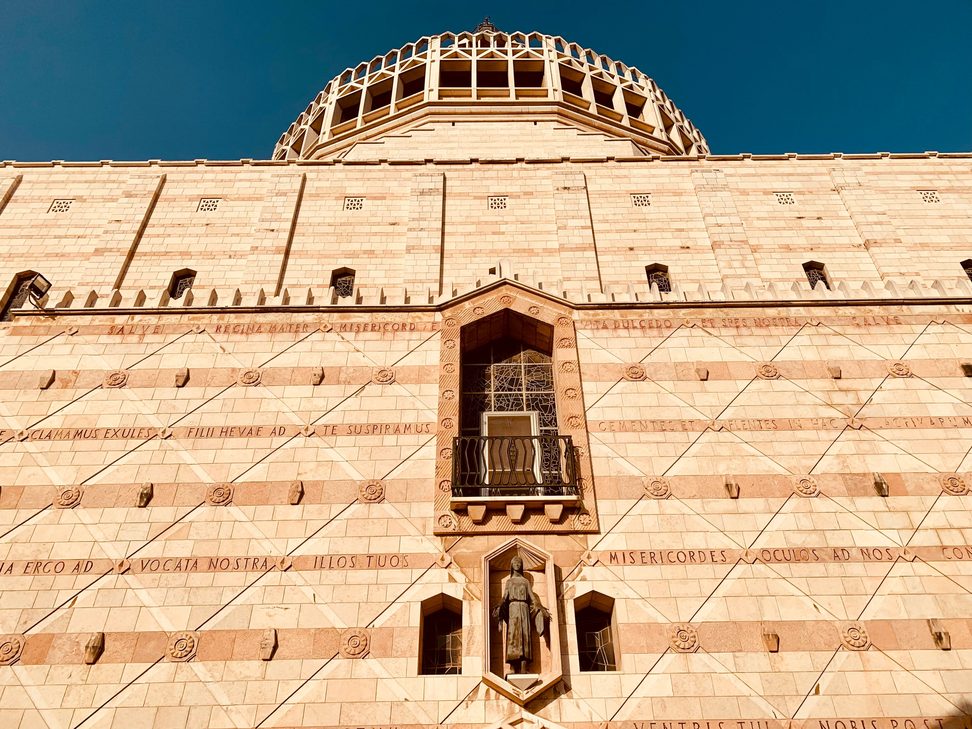
The west front, in pale stone, carries reliefs of the Annunciation and the Evangelists and the words “Verbum caro factum est”, “the Word was made flesh”. Round the courtyard and along the arcades hang images of the Virgin given by Catholic communities from all over the world, from Spain to Ukraine.

The Grotto of the Annunciation
The lower church follows the plan of the Crusader cathedral, and at its centre, sunk below the floor, is the grotto itself, behind the remains of the earlier churches. On its altar are the words “Verbum caro hic factum est”, “here the Word was made flesh”. Look for the broken column, split open in Ottoman times by treasure-hunters, and for the Byzantine mosaics near the entrance, one naming a deacon called Conon of Jerusalem.


The upper church
An octagonal opening in the floor of the upper church looks down onto the grotto. Above it rises the dome, about 55 metres high, its ribs shaped like an inverted lily, a symbol of Mary. The walls are lined with large Marian images given by different countries, among them England, Australia, the United States and Canada.
St Joseph’s Church and the excavations
From the terrace north of the basilica, which shelters the excavated remains of the ancient village, a path leads to St Joseph’s Church, built in 1911–14 on Crusader foundations over caves that tradition links with Joseph’s house and workshop.

The other Annunciation church
About a kilometre to the north, the Greek Orthodox Church of St Gabriel stands over the spring where, according to the apocryphal Gospel of James, Gabriel first greeted Mary as she drew water. The present church dates from the 18th century; the spring still flows in its crypt, and Mary’s Well, a fountain fed by it, stands a short walk away.
Tours and where to stay
The basilica is free, and group Masses are booked through the Franciscans’ pilgrim office. Many Galilee tours stop in Nazareth; Casa Nova, the Franciscan pilgrim house, is opposite the basilica.
These links go to GetYourGuide and Booking.com. This site earns nothing from them at present — they are here because they are the quickest way to check what is actually available.
Don’t miss
- The grotto “Here the Word was made flesh”.
- The Byzantine mosaics By the grotto.
- The dome From inside the upper church.
- Saturday night The candlelight procession.
- St Gabriel’s The Orthodox tradition, at the spring.
Insider tips
Mind the Sabbath. Buses from Tel Aviv and Jerusalem do not run from Friday afternoon to Saturday evening, or on Jewish holidays; the Haifa buses do. On Saturday evenings the candlelight procession draws pilgrims. Drivers should use one of the paid car parks in the centre.
Common questions
Is the Basilica of the Annunciation free?
Yes. There is no charge for the upper church, the Grotto of the Annunciation in the lower church, the courtyard or St Joseph’s Church next door.
When is the Basilica of the Annunciation open?
The upper church and the grotto are open for visits every day from 8am to 6pm, with last entry a quarter of an hour before closing. From 6pm to 9pm the lower church stays open for silent prayer. It closes early on Holy Thursday and all day on Good Friday.
What is the Saturday candlelight procession?
Every Saturday from 8.30pm to 9.30pm the friars lead a rosary in many languages, carrying a statue of the Virgin round the arcades and down to the grotto, where the Gospel of the Annunciation is read. Anyone may join.
Is it safe to visit Nazareth?
In October 2026 the UK Foreign Office’s no-travel zones in northern Israel were close to the Lebanese border and in the northern Golan, well north of Nazareth, though it warns that rocket and drone attacks are possible anywhere in Israel; the US State Department’s advice for Israel was at Level 3, “Reconsider travel”, with a wider no-travel zone in the far north. Read your own government’s current advice before you go.
Where did the Annunciation happen?
Catholic tradition places it in the grotto under the basilica, believed to be part of Mary’s house. The Greek Orthodox tradition, following the apocryphal Gospel of James, places Gabriel’s first greeting at the spring now inside the Church of St Gabriel, by Mary’s Well.
More churches in the Holy Land
- Church of the Nativity — the birthplace of Jesus by tradition, in Bethlehem.
- Church of the Holy Sepulchre — the place of the Crucifixion and the Tomb, in Jerusalem.