
Church of the Holy Sepulchre
For most of the world’s Christians, the Church of the Holy Sepulchre stands over the two most important places on earth: Calvary, where Jesus was crucified, and the tomb where he was buried. Six denominations share it under rules fixed in the Ottoman era, two Muslim families keep the key, and the building is a dim, crowded maze of chapels from the fourth century to the twentieth. Entry is free. The church opens before dawn, and that is the best time to come.
Before you go
Check the news and the travel advice. The church was closed for security reasons from 28 February to 9 April 2026, during the regional war involving Iran, and Easter access was restricted. In October 2026 the UK Foreign Office did not advise against travel to Jerusalem but warned that the situation could escalate quickly; the US State Department’s advisory for Israel, the West Bank and Gaza had Israel at Level 3, “Reconsider travel”. Read your own government’s current advice before you book, and check that the church is open on the day.
Fifteen centuries of rebuilding
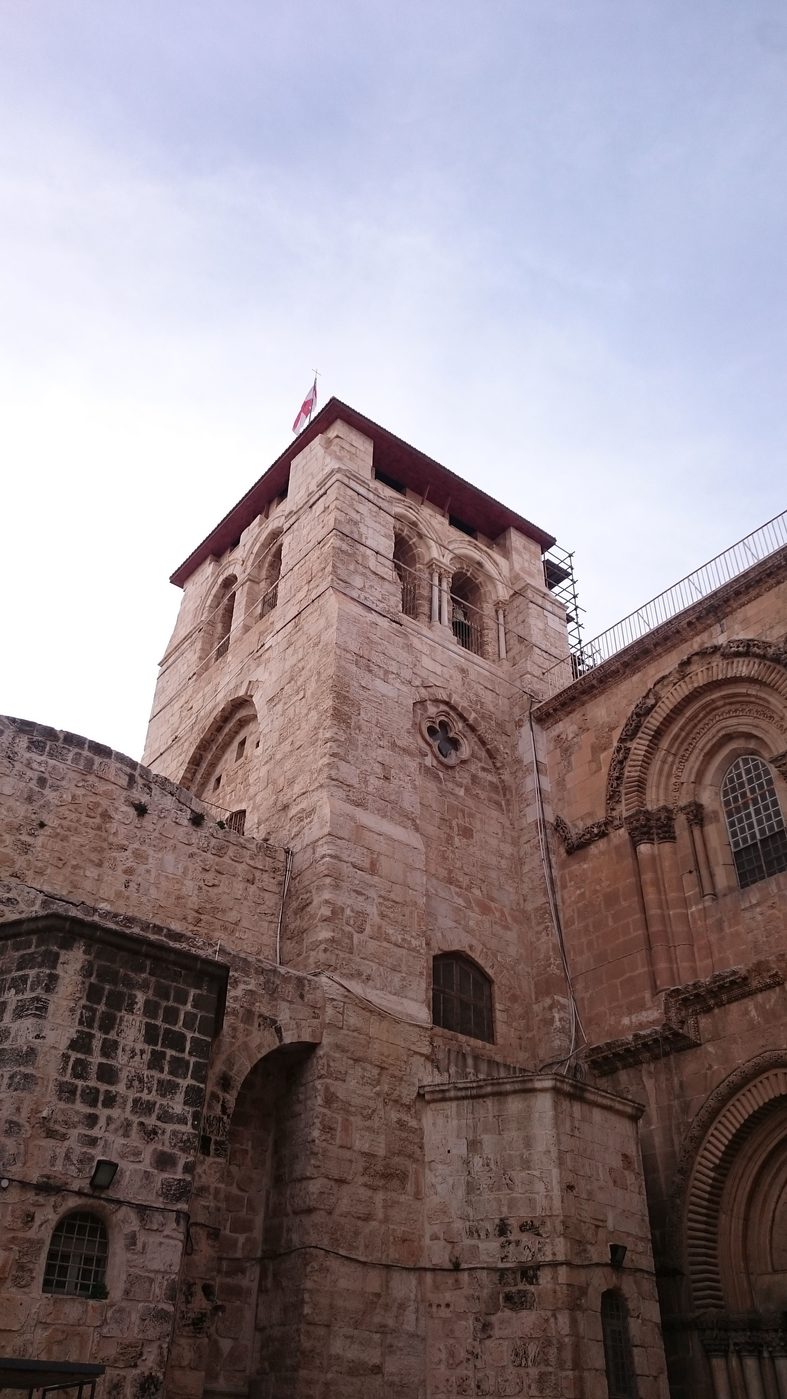
In the 320s the Emperor Constantine had a Roman temple cleared from the site, which his mother, Helena, visited in 327. His church, dedicated in 335, had a great basilica and, to the west, the tomb, cut free from the surrounding rock and enclosed in a rotunda. Testing of mortar during the 2016–17 restoration of the tomb shrine dated it to about 345, consistent with Constantine’s building. The Persians sacked the church in 614, and in 1009 the Fatimid caliph al-Hakim ordered it destroyed. The Byzantines rebuilt the rotunda by 1048, and the Crusaders, who took Jerusalem in 1099, added the Romanesque church that survives today, consecrated on 15 July 1149.
After a fire in 1808 the Tomb was given its present shrine, the Aedicule, in 1809–10. Ottoman decrees of 1757 and 1852 froze the rights of each community, the Status Quo that still governs every lamp, candle and cleaning rota. The Greek Orthodox, the Franciscans and the Armenians hold the main shares; the Copts, Syriac Orthodox and Ethiopians have smaller ones. Since the Middle Ages two Muslim families, the Nuseibeh and the Joudeh, have kept the key and opened the door each morning.
The visitor’s cheat sheet
| Where | In the Christian Quarter of the Old City of Jerusalem; one entrance, from the courtyard on the south side. About 10 minutes’ walk from Jaffa Gate, less from New Gate |
|---|---|
| Opening hours | About 5am–8.45pm in summer (to 8pm in October) and 4am–7pm in winter (to 7.30pm in March). Changed hours at Christmas, on 2 February and in Holy Week |
| Admission | Free |
| The Tomb | Queues can run to two hours or more at busy times; much shorter at opening and in the evening. Only a few people at a time, for a minute or so, through a very low door |
| Services | Franciscan procession daily, 4pm in winter and 5pm in summer. Early-morning Masses at the Tomb |
| Dress | Modest dress: covered shoulders and knees |
| Access | Steep, narrow stairs to Calvary and down to St Helena; uneven old floors |
| Closures | Closed 28 February–9 April 2026 for security reasons; closures can come at short notice |
| How long | An hour without the Tomb queue; up to three hours with it at busy times |
Hours and admission checked against the official site in October 2026. They change; the official site is always the last word.
Come at opening time. The church opens at about 4am in winter and 5am in summer, and in the first hours you can walk straight into the Tomb. From about 10am the tour groups arrive and the queue for the Tomb can run to two hours or more. Evenings, after the groups have left, are also quieter. The floor has been under restoration since 2022 and the final phase was still under way in 2026, so parts may be screened off.
What to see, in the order you meet it
The courtyard and the immovable ladder
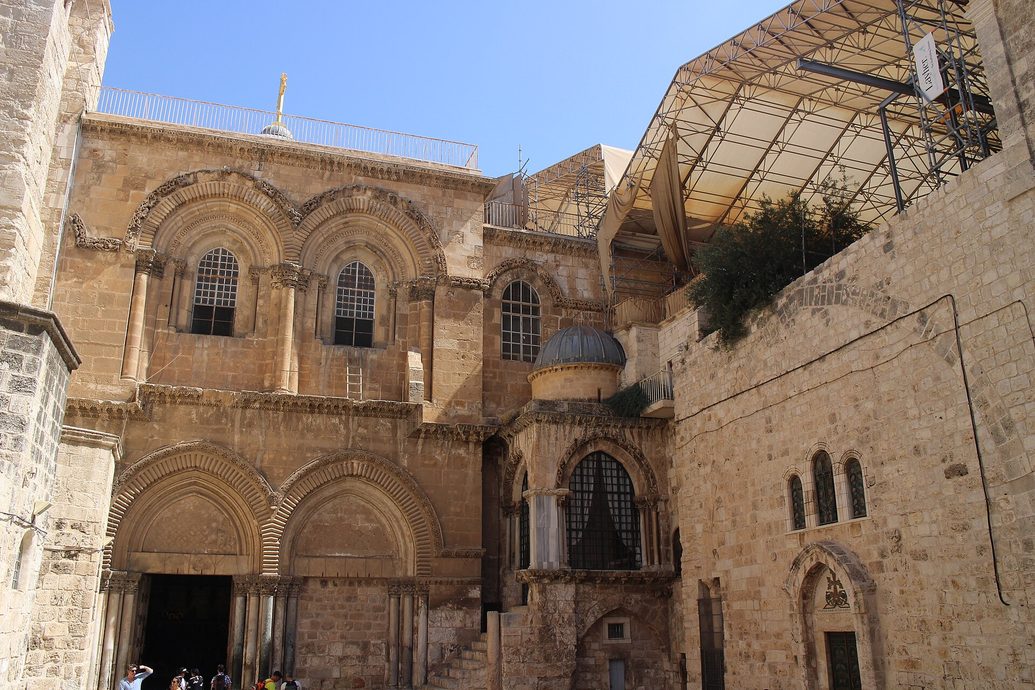
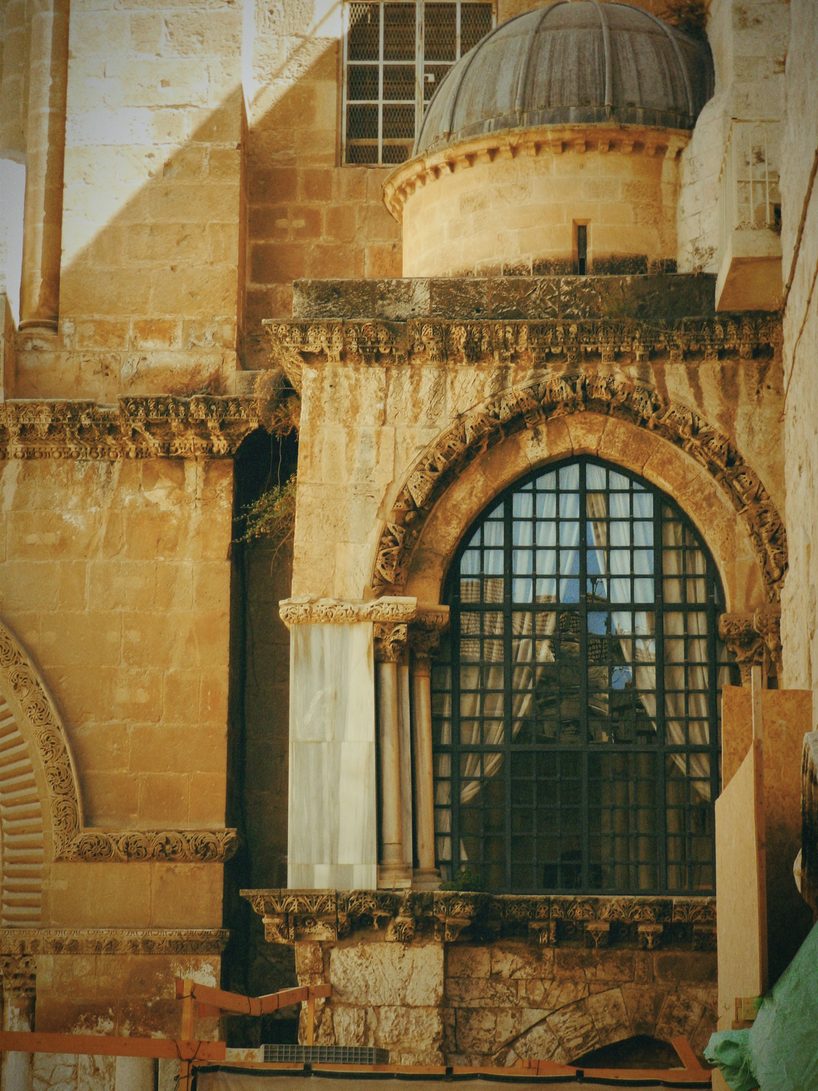
You reach the church through the narrow lanes of the Christian Quarter and enter a stone courtyard before the Crusader facade, with its pair of arched doorways, one long since walled up. On the ledge above the right-hand door stands a wooden ladder. It has been there since at least the eighteenth century, because under the Status Quo no one may move it.
The Stone of Anointing
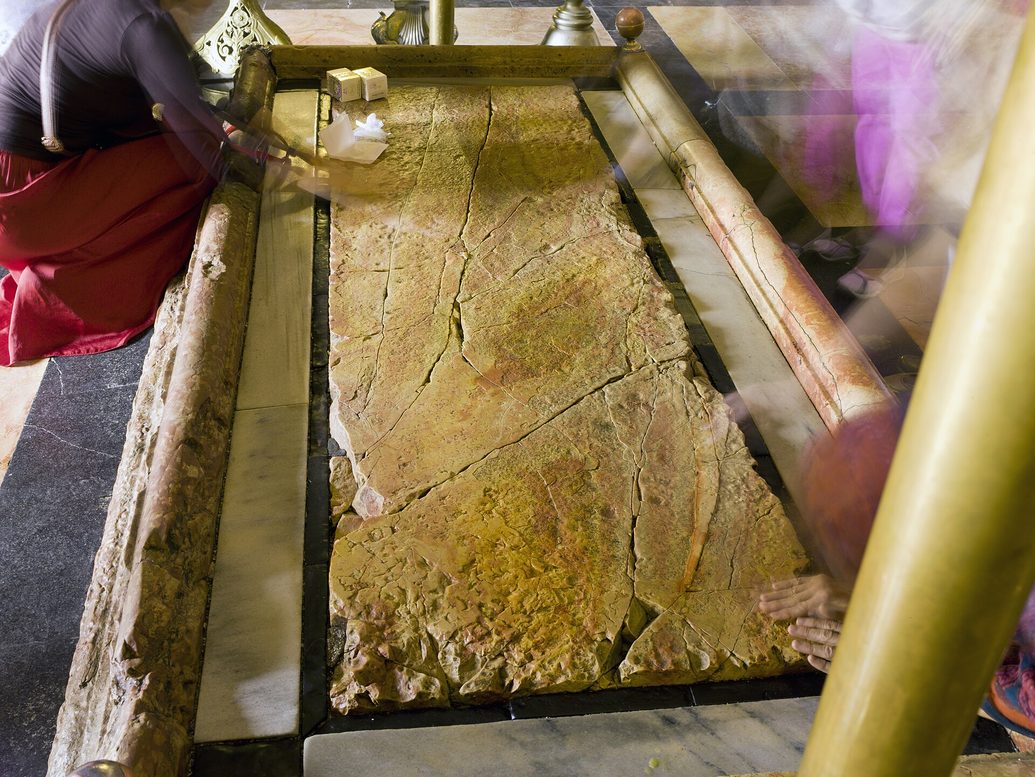
Just inside the door, pilgrims kneel at a slab of reddish stone, said to be where Jesus’s body was prepared for burial. The tradition is medieval and the present slab dates from 1810, but it is the first thing everyone touches.
Calvary
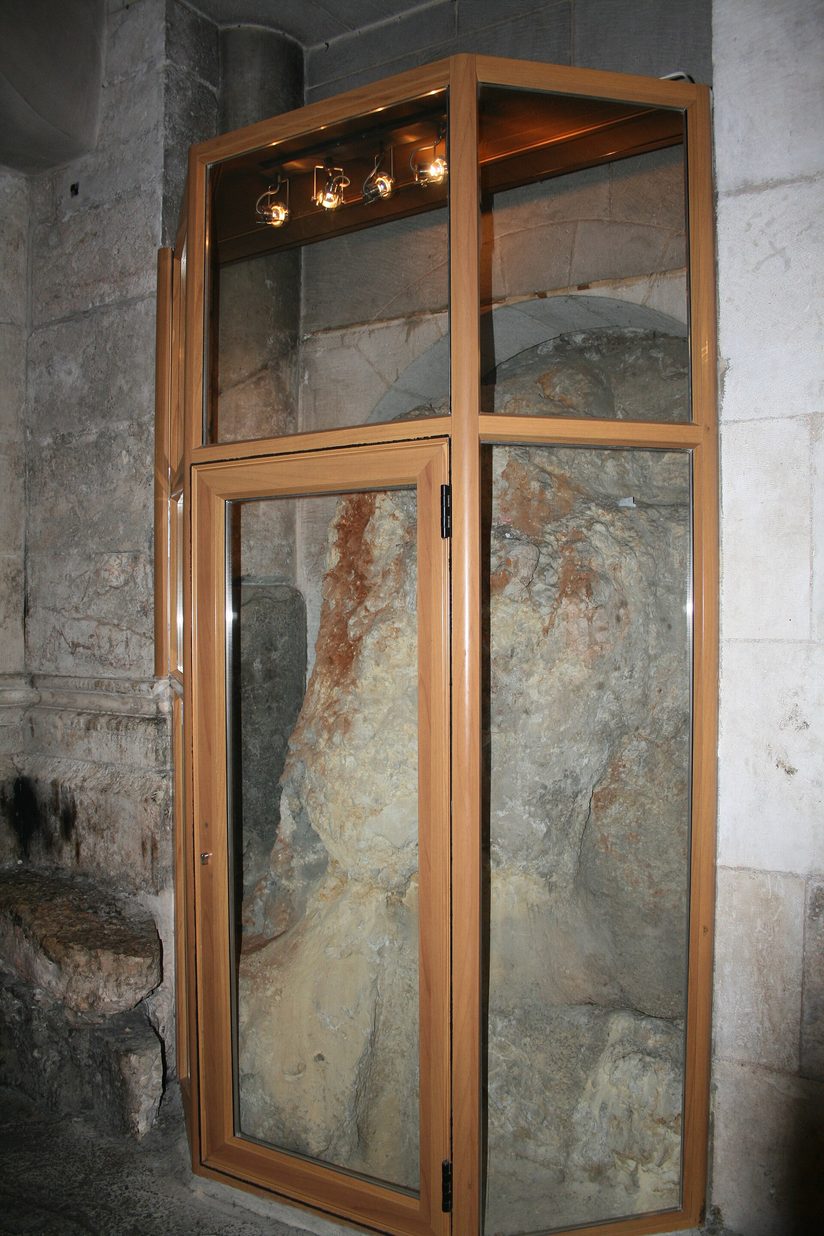
Immediately to the right, a steep stair climbs to Calvary, or Golgotha, about five metres above the floor. There are two chapels side by side: the Latin (Franciscan) chapel, marking the Nailing to the Cross, and the Greek Orthodox chapel with the altar of the Crucifixion, where you can reach through an opening under the altar to touch the rock, and see it under glass on either side. Below, in the Chapel of Adam, a crack in the rock is visible.
The rotunda and the Tomb
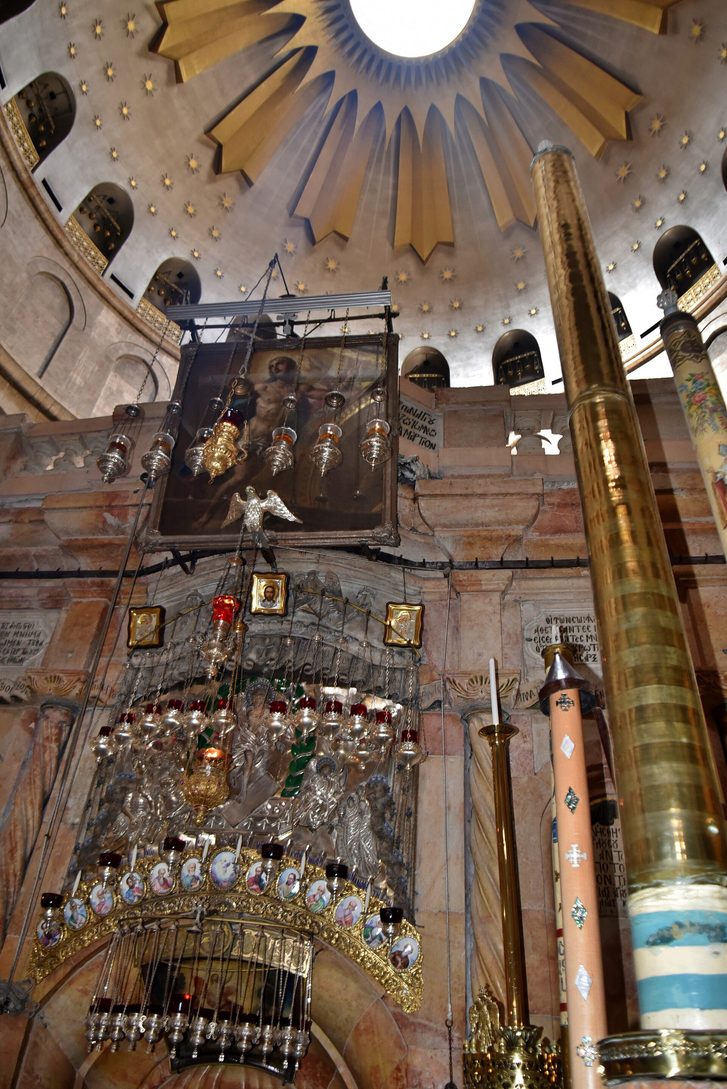
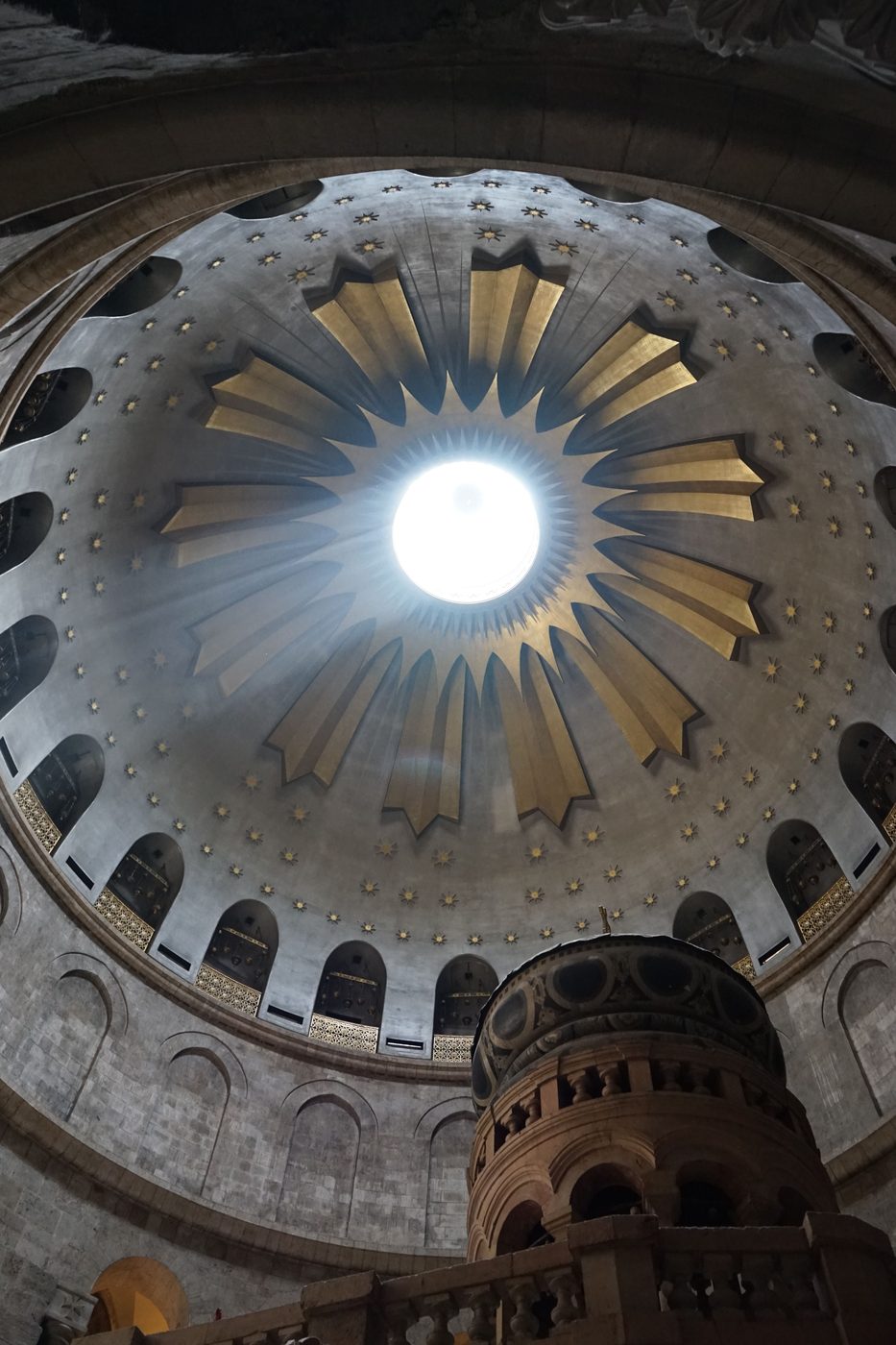
To the left of the entrance is the rotunda, the Anastasis, under its great dome. In the centre stands the Aedicule, the shrine built over the Tomb in 1809–10 and restored by the National Technical University of Athens in 2016–17. Inside, the small Chapel of the Angel leads through a very low door into the tomb chamber, with the marble-covered burial bench. Monks keep the line moving, and you will have a minute or so. At the back of the Aedicule is the small Coptic chapel, and across the rotunda, in the Syriac chapel, a rock-cut Jewish tomb of the first century, known as the tomb of Joseph of Arimathea.
The Katholikon
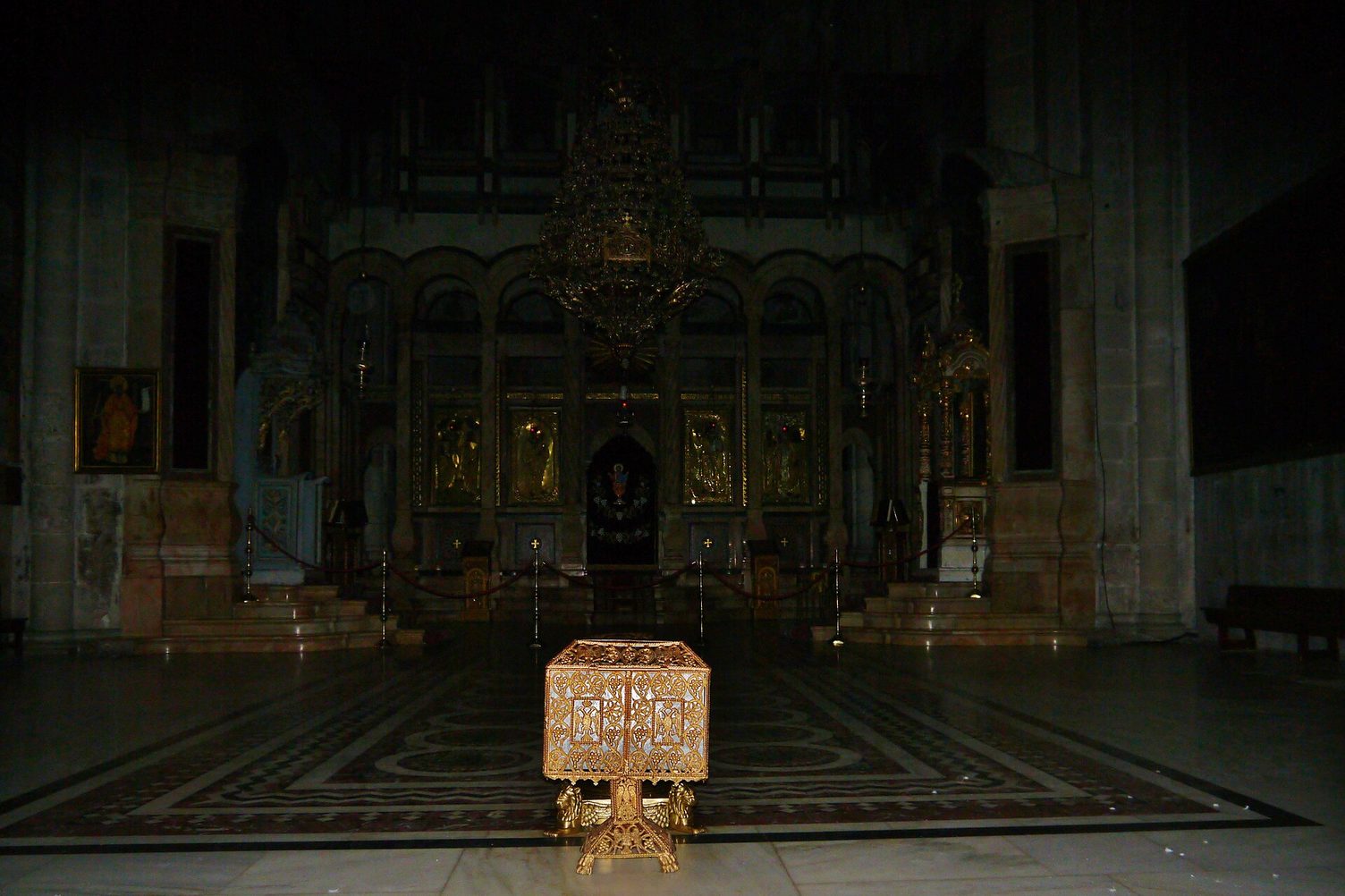
East of the rotunda is the Katholikon, the Greek Orthodox church at the heart of the building, in the Crusader choir. A stone bowl on its floor, the omphalos, marks what medieval pilgrims called the centre of the world. Around the ambulatory behind it are small chapels, among them the Prison of Christ and the Division of the Robes. North of the rotunda, the Franciscans keep the Chapel of the Apparition.
St Helena and the Finding of the Cross
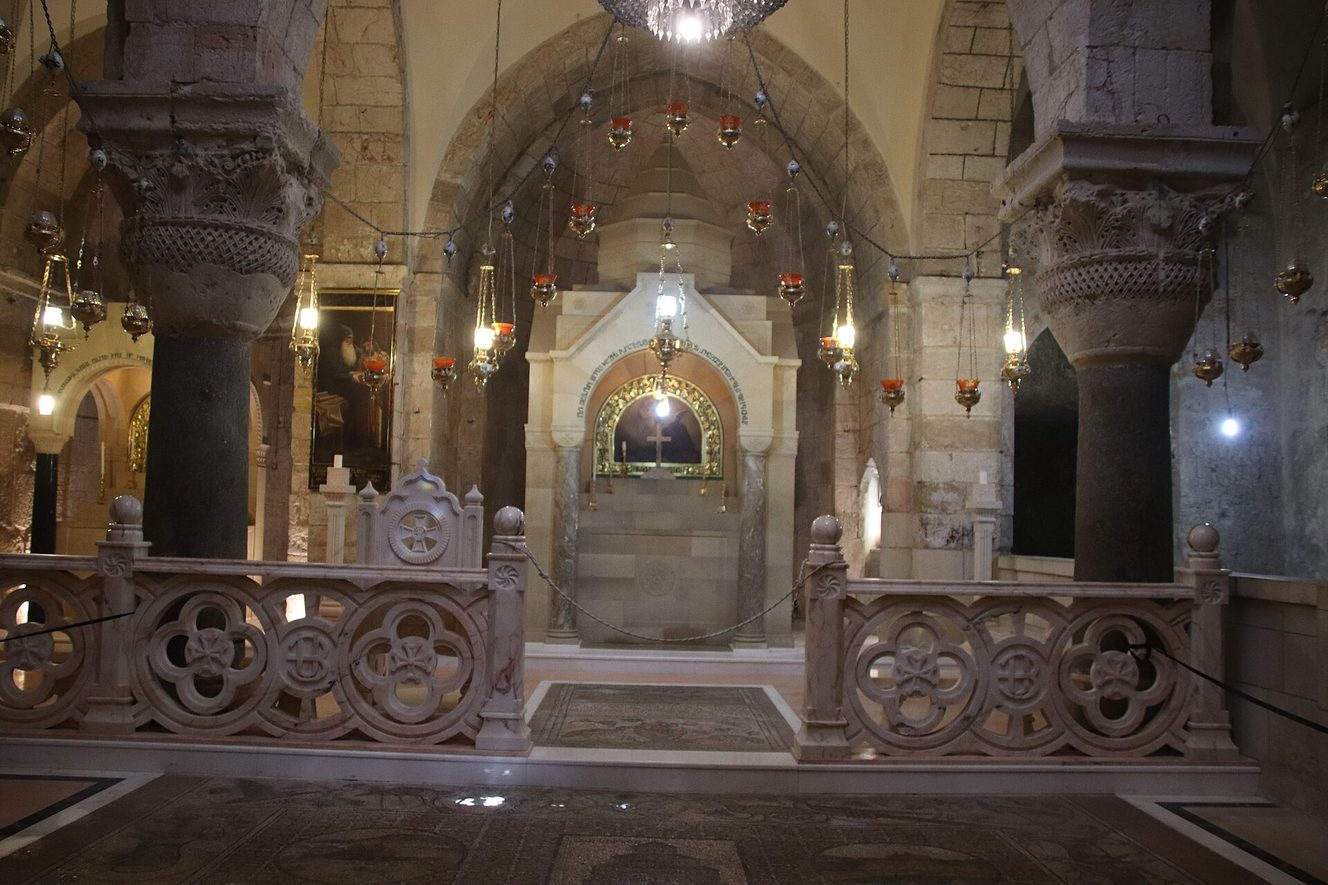
From the ambulatory a stair goes down to the Armenian Chapel of St Helena. The walls of the stair down to it are covered with small crosses, often called Crusader graffiti, carved over the centuries by pilgrims. Further steps lead down to the Chapel of the Finding of the Cross, the lowest point of the church, in an old quarry where Helena is said to have found the True Cross.
Tours and where to stay
Old City tours and hotels
There is nothing to book for the church itself. A guide is a great help in the first visit, because the communities’ chapels interlock and nothing is labelled; many Old City walks end here along the Via Dolorosa. Then come back alone early one morning for the Tomb.
Tour and hotel links go to GetYourGuide and Booking.com. This site earns nothing from them at present — they are here because they are the quickest way to check what is actually available.
Don’t miss
- The Tomb Inside the Aedicule, best at opening time.
- Calvary Up the steep stair to the right of the door.
- The Stone of Anointing Just inside the entrance.
- The immovable ladder On the ledge above the walled-up right-hand doorway.
- The Chapel of St Helena And the pilgrims’ crosses on its walls.
- The Franciscan procession Every afternoon, around the holy places of the church.
Insider tips
Join the Franciscan procession. Every afternoon, at 4pm in winter and 5pm in summer, the friars walk with candles and chant from chapel to chapel, stopping at the Tomb and at Calvary. Following them is the best way to understand how the church fits together.
There is only one door, and the church can be very crowded. Keep valuables close, dress modestly, and be ready to give way to processions: the services of the different communities take priority over sightseeing.
The Holy Fire on Orthodox Holy Saturday is one of the great ceremonies of the Christian year, but entry is by tightly controlled pass, and the church and the lanes around it are packed. On Sundays the communities celebrate their liturgies one after another from before dawn.
Private cars may not enter the Old City in the daytime. Walk in from Jaffa Gate or New Gate; the light rail stops at City Hall (Safra Square), about five minutes’ walk from New Gate and 10–15 from Jaffa Gate.
Common questions
Is the Church of the Holy Sepulchre free to enter?
Yes. There are no tickets: the entrance fee was abolished in 1832. Donations are welcome at the chapels.
What are the opening hours of the Church of the Holy Sepulchre?
It opens very early: at 5am in summer and 4am in winter. It closes at about 8.45pm in summer (8pm in October) and 7pm in winter (7.30pm in March). Hours change at Christmas, on 2 February and in Holy Week, so check the Christian Information Centre’s listing before you go.
How long is the queue for the Tomb?
It can run to two hours or more at busy times. At opening time, or in the evening after the tour groups have gone, it can be a matter of minutes.
Was the Church of the Holy Sepulchre closed in 2026?
Yes. The authorities closed it for security reasons from 28 February to 9 April 2026, during the regional war involving Iran. It has been open since, but closures can come at short notice.
Who owns the Church of the Holy Sepulchre?
It is shared under the Status Quo, the arrangement fixed by Ottoman decrees in 1757 and 1852. The Greek Orthodox, the Roman Catholics (through the Franciscans) and the Armenians hold the main rights; the Copts, Syriac Orthodox and Ethiopians have smaller ones. Two Muslim families keep the key and open and close the door.
When is the Holy Fire?
On Orthodox Holy Saturday, the day before Orthodox Easter: 1 May in 2027. Entry is tightly controlled and was by wristband in 2026; check the arrangements locally.
Where to stay and eat nearby
Staying inside the Old City or just outside Jaffa Gate means you can be at the door when it opens. The Christian Quarter has small guesthouses and pilgrim hostels, and the lanes around the Muristan are full of cafés and juice stalls.
More churches in the Holy Land
- Church of the Nativity, Bethlehem — under an hour away by bus.
- Basilica of the Annunciation, Nazareth — in Galilee, over the grotto of the Annunciation.