
Church of the Nativity, Bethlehem
The Church of the Nativity stands over the cave where, by a tradition going back to the second century, Jesus was born. It is one of the oldest churches in daily use in the world: the nave is the one built for the Emperor Justinian in the sixth century, on the foundations of Constantine’s church of the 330s. Entry is free, through a door so low you must bow to pass. In 2026 the Grotto itself is being restored, so check what you can see before you go.

Before you go
Check the Grotto and the travel advice. The Grotto of the Nativity is being restored, and in August 2026 the Christian Information Centre listed it as closed until further notice, with visits allowed on a restricted basis; the church above stays open. Bethlehem is in the West Bank. In October 2026 the UK Foreign Office did not include Bethlehem in the areas where it advised against travel; the US State Department’s advisory for Israel, the West Bank and Gaza was at Level 3, “Reconsider travel”. Read your own government’s current advice before you go, and carry your passport.
Seventeen centuries of pilgrims
By the second century Christians were pointing to a cave in Bethlehem as the place of the birth. The Emperor Constantine, encouraged by his mother Helena, built a great church over it, dedicated in 339, with an octagon above the cave. After it was damaged, probably in a revolt in the sixth century, the Emperor Justinian rebuilt it larger, and his church is essentially the one standing today. When the Persians invaded in 614 they destroyed almost every church in the Holy Land but spared this one; the story goes that they saw the Magi, dressed as Persians, in a mosaic over the entrance.
The first Crusader kings were crowned here, and in the 1160s the church was redecorated with wall mosaics, a joint project of the King of Jerusalem and the Byzantine emperor. Since the Ottoman era it has been shared by three churches under the Status Quo. In 2002 armed men sheltered inside during a siege that lasted more than a month. In 2012 it became a World Heritage site, and a restoration from 2013 renewed the leaking roof and uncovered the mosaics; in 2016 a seventh angel was found under the plaster. In January 2026 the Greek Orthodox Patriarchate and the Custody of the Holy Land announced the first restoration of the Grotto in some six hundred years.
The visitor’s cheat sheet
| Where | Manger Square, Bethlehem, about 10km south of the Old City of Jerusalem |
|---|---|
| Opening hours | About 6.30am–7.30pm in summer and 5.30am to 5pm or 6pm in winter (sources differ); call +970 2 274 2440 to confirm. The Grotto is normally closed on Sunday mornings |
| Admission | Free |
| The Grotto | Under restoration since 2026; in August 2026 listed as closed until further notice, with restricted visits |
| Dress code | Shoulders and knees covered |
| Getting there | Bus 231 from near Damascus Gate, Jerusalem, 30–45 minutes, then a 20-minute walk; carry your passport for the checkpoint on the way back |
| How long | An hour, more if there is a queue for the Grotto |
Hours and admission checked against the official site in October 2026. They change; the official site is always the last word.
What to see, in the order you meet it
Manger Square and the Door of Humility
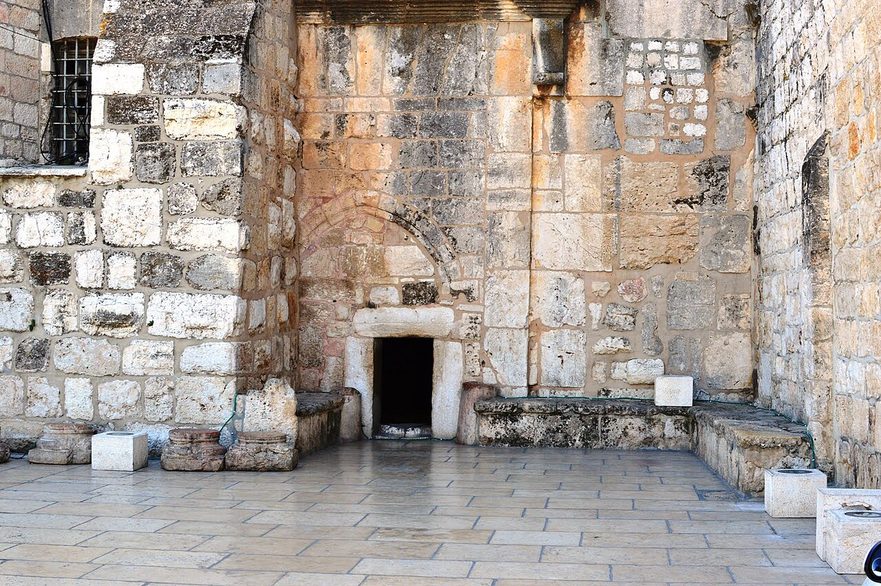
The church looks more like a fortress than a basilica from Manger Square, with the convents of the three communities built against it. The entrance is the Door of Humility, about 1.2 metres high: you can still see the outline of Justinian’s great doorway, and the pointed Crusader arch that narrowed it, in the stonework around it.
The nave
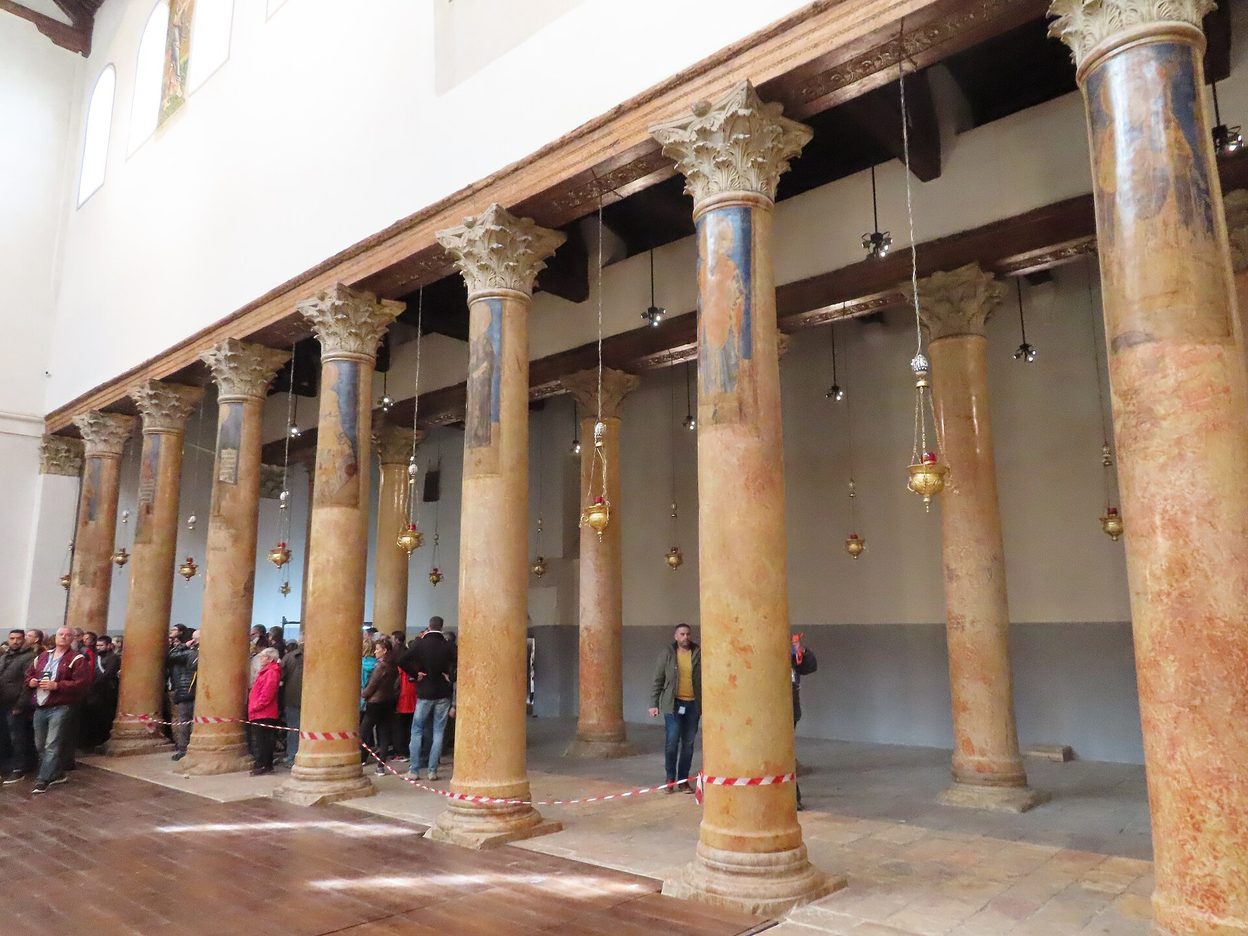
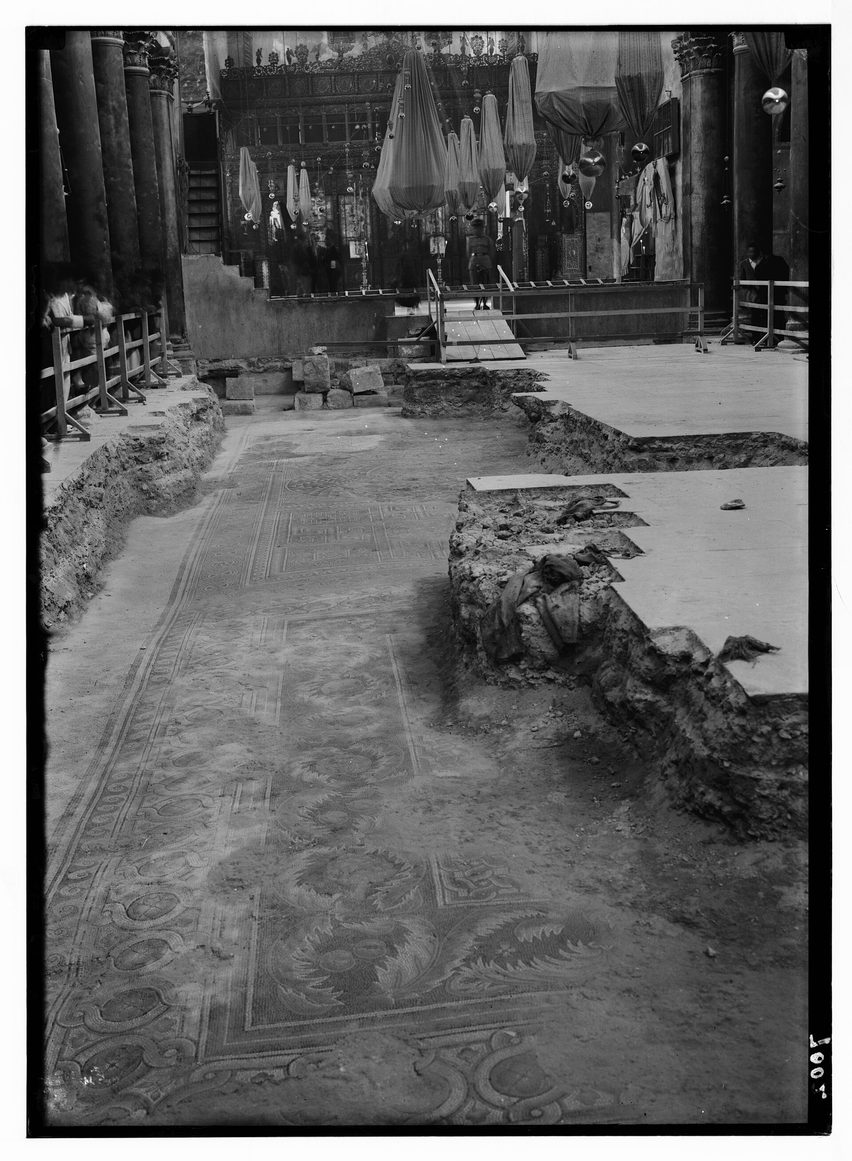
Inside, four rows of red limestone columns, forty-four in all, divide the nave from the aisles. Many still carry faint paintings of saints from the Crusader period. Wooden trapdoors in the floor open onto mosaic floors of the first, Constantinian church, about 60 centimetres below.
The wall mosaics
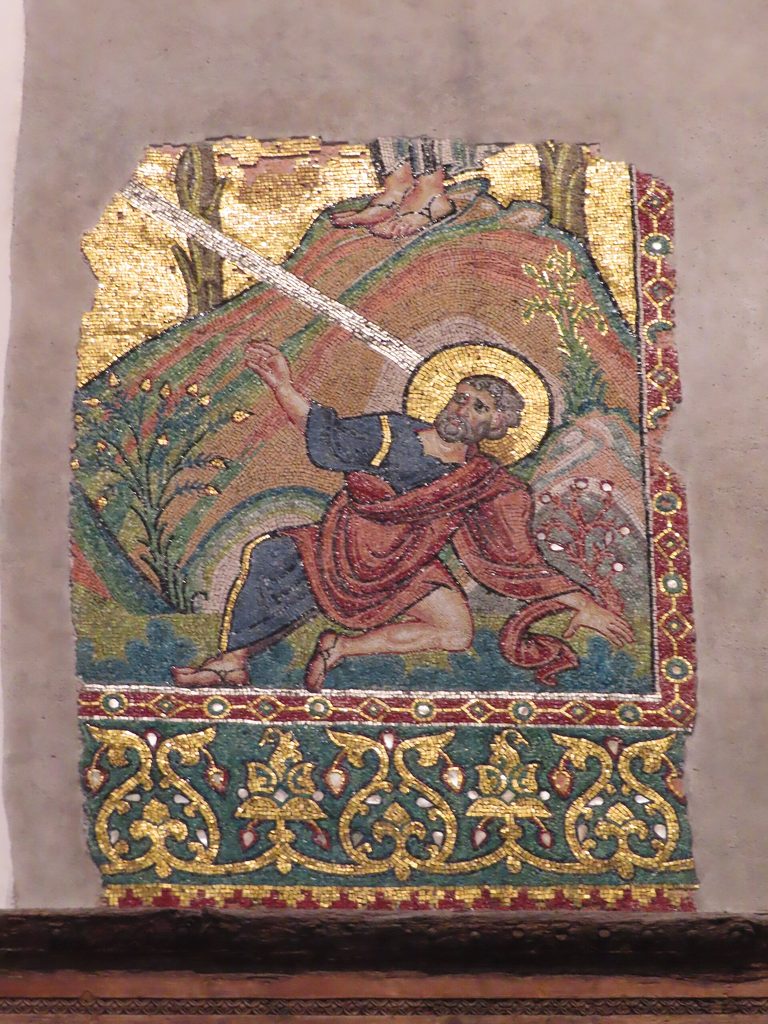
High on the walls, the twelfth-century mosaics show the ancestors of Christ, the councils of the church, and a procession of angels walking towards the Grotto. The recent restoration cleaned away centuries of soot, and the gold glitters again.
The Grotto of the Nativity
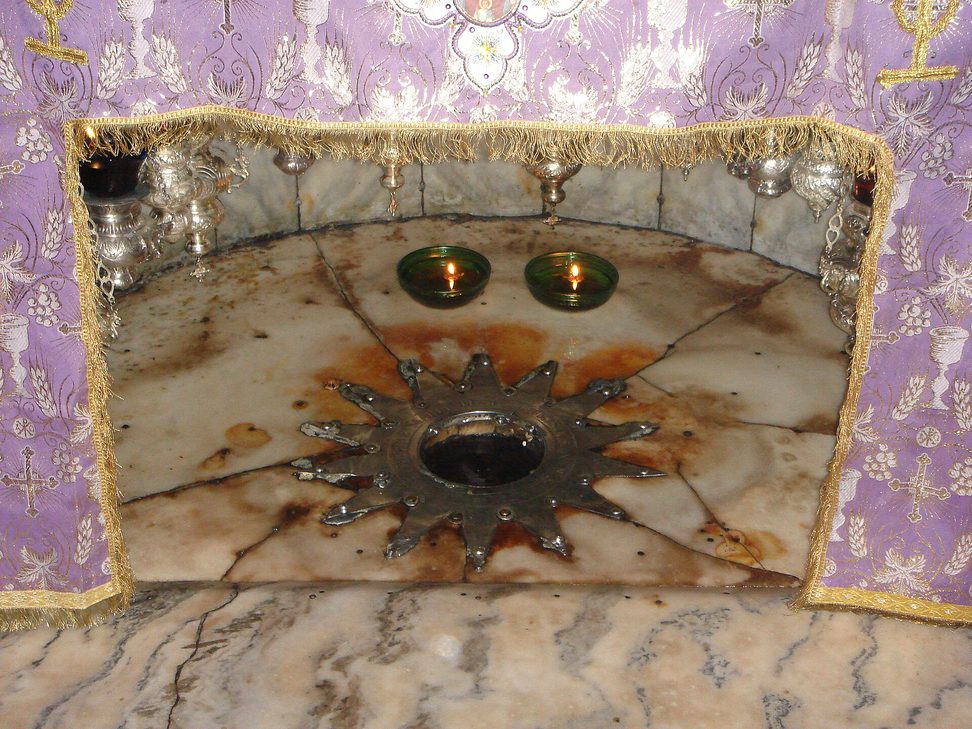
At the east end, beyond the Greek Orthodox iconostasis, two flights of steps lead down on either side to the Grotto. A silver star with fourteen points, set in the marble floor under an altar, marks the place of the birth, with the Latin inscription Hic de Virgine Maria Jesus Christus natus est: “Here Jesus Christ was born of the Virgin Mary”. A few steps away is the Chapel of the Manger. In normal times the queue to reach the star can take an hour or more; in 2026 the Grotto is under restoration, and access is restricted.
St Catherine’s and the caves
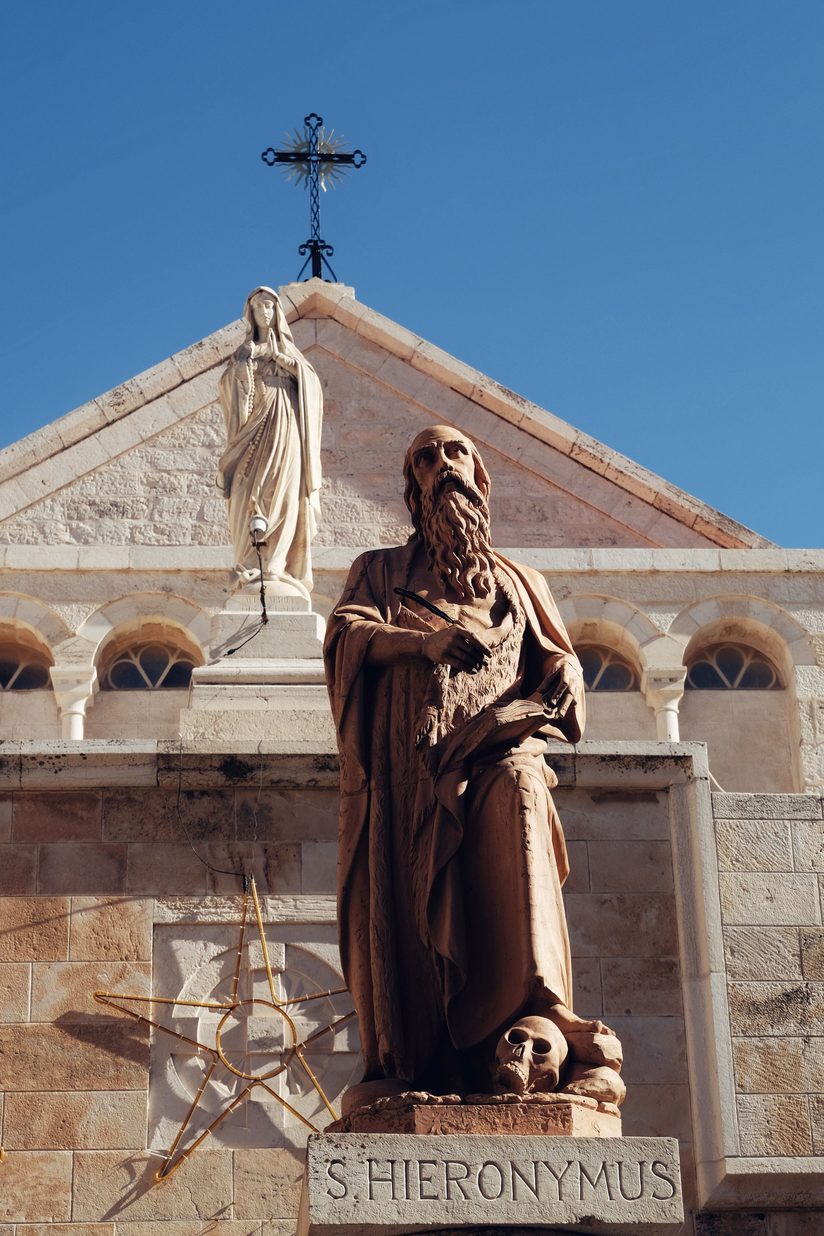
A passage from the north side leads into the Catholic Church of St Catherine, rebuilt in 1881, where Midnight Mass is broadcast around the world on Christmas Eve. In its cloister stands a statue of St Jerome, who lived in Bethlehem from 386 until his death in 420 and translated the Bible into Latin. Stairs from St Catherine’s lead down to the caves beneath, including the one associated with Jerome.

Tours and where to stay
Tours and hotels
Many visitors come on a half-day tour from Jerusalem, which takes care of the checkpoint and usually adds the Shepherds’ Field and the Milk Grotto. Staying a night in Bethlehem lets you reach the church at opening time, before the groups.
Tour and hotel links go to GetYourGuide and Booking.com. This site earns nothing from them at present — they are here because they are the quickest way to check what is actually available.
Don’t miss
- The Door of Humility And the outlines of the older doors around it.
- The early floors Mosaics of the first church, under the trapdoors.
- The angels Twelfth-century mosaics high on the north wall.
- The silver star In the Grotto, if it is open to visitors.
- St Jerome’s cloister At St Catherine’s, next door.
Insider tips
Go early, and on a weekday. The church opens soon after dawn, and the tour groups from Jerusalem arrive from mid-morning. On Sunday mornings the Grotto is normally kept for services, and around Christmas and Easter the crowds are at their greatest.
Nearby are the Milk Grotto, a chapel in a white rock cave a few minutes’ walk away, where tradition says the Holy Family sheltered, and the Shepherds’ Field in Beit Sahour, east of the town.
Tourism in Bethlehem has been hit hard by the wars since 2023, and many hotels, shops and restaurants have closed at times. The Christmas tree in Manger Square was lit again in December 2025 for the first time since 2022.
Common questions
Is the Church of the Nativity free to visit?
Yes. There is no entrance fee for the church, the Grotto or St Catherine’s next door.
Is the Grotto of the Nativity open?
The Grotto is being restored for the first time in some six hundred years, work that began in 2026. In August 2026 the Christian Information Centre listed it as closed until further notice, with visits allowed on a restricted basis. Ask at the church on the day; the basilica itself stays open.
How do I get to Bethlehem from Jerusalem?
Bus 231 runs from the East Jerusalem bus station near Damascus Gate to Bethlehem in 30–45 minutes; from the stop it is about 20 minutes’ walk to Manger Square. Coming back, the bus stops at the checkpoint, where passengers may be asked to get off or soldiers board to check documents, so carry your passport. Taxis and organised tours also run.
Why is the door so small?
The great doorway of Justinian’s church was walled up in stages, and around 1500 reduced to the present opening, about 1.2 metres high, probably to stop people riding in on horseback or driving in carts. It is called the Door of Humility, because everyone has to bow to enter.
Who looks after the Church of the Nativity?
Three churches share it under the Status Quo, the rules fixed in the Ottoman era: the Greek Orthodox, who hold the main church, the Armenian Apostolic Church and the Catholic Church, through the Franciscans of the Custody of the Holy Land, who hold St Catherine’s next door.
When is Christmas celebrated in Bethlehem?
Three times: on 24–25 December by the Catholics and Protestants, with Midnight Mass in St Catherine’s (tickets needed); on 6–7 January by the Greek Orthodox and other churches that keep the old calendar; and on 18–19 January by the Armenians in the Holy Land.
Where to stay and eat nearby
Bethlehem has hotels and guest houses close to Manger Square, and restaurants serving Palestinian food around the square and in Star Street. Jerusalem is the more usual base, under an hour away.
More churches in the Holy Land
- Church of the Holy Sepulchre — in the Old City of Jerusalem, under an hour away.
- Basilica of the Annunciation — over the grotto of the Annunciation, in Nazareth.