
Truro Cathedral
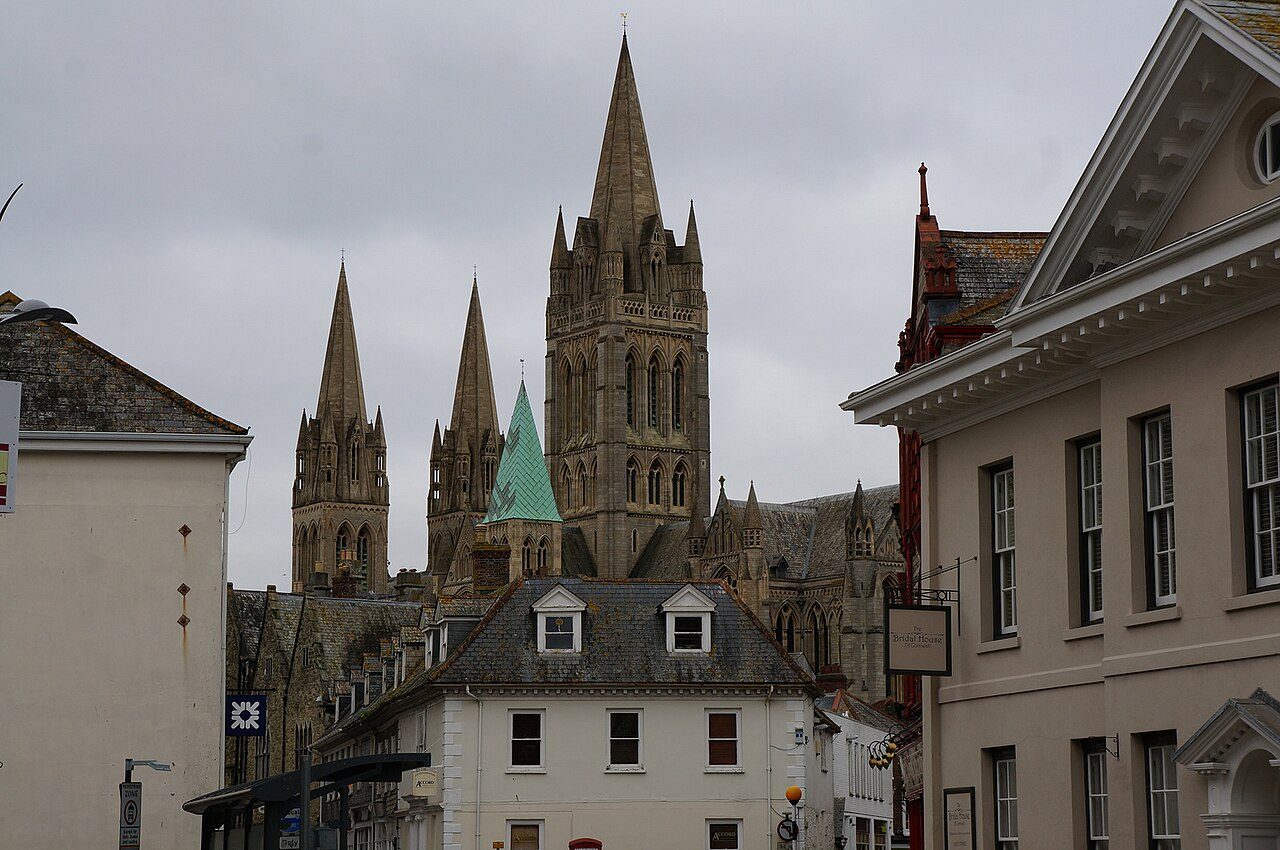
Truro Cathedral looks medieval and is not. Its three spires rise over the roofs of Cornwall’s only city as if they had been there for seven hundred years, but they were built between 1880 and 1910, to the designs of John Loughborough Pearson, one of the great Victorian Gothic architects. It was the first Anglican cathedral built on a new site in England since Salisbury in the 1200s, and it was squeezed into the centre of a crowded town, on the site of the parish church — part of which Pearson kept, and built around.
A new diocese and a new cathedral
For eight centuries Cornwall had been part of the Diocese of Exeter. In 1876 a separate Diocese of Truro was created, and its first bishop, Edward White Benson, later Archbishop of Canterbury, set out to build a cathedral. He chose the site of St Mary’s, the old parish church in the centre of Truro.
Pearson’s design is Early English Gothic, with the tall lancets and stone vaults of the thirteenth century and spires that owe something to Normandy. The foundation stones were laid in 1880 by the Prince of Wales, the future Edward VII. The quire was consecrated in 1887, the central tower and spire were finished by 1905 and the western towers in 1910. Pearson died in 1897 and his son, Frank, saw the building through. The chapter house followed only in 1967.
While the cathedral was being built, services were held in a temporary wooden building, and there, on Christmas Eve 1880, Bishop Benson held the first service of Nine Lessons and Carols, later made famous by King’s College, Cambridge.
The visitor's cheat sheet
| Where | St Mary’s Street, Truro, Cornwall, TR1 2AF, in the city centre |
|---|---|
| Getting there | Truro station (main line from London Paddington) is about 10 minutes’ walk; car parks and park and ride in the city |
| Opening hours | Mon–Sat 10am–5pm; Sun 11.30am–4pm. The cathedral closes to visitors for graduations, funerals and some events — the What’s On page lists the closures |
| Admission | Free; donations welcome. Free guided tours in season; audio tour £5 |
| How long | About 1 hour |
| Best time | A weekday morning in season, for the 11am free tour |
| Dress code | No formal code; respectful dress as in any working church |
| Tours | Free guided tours Mondays to Thursdays at 11am in the main season, no booking needed; tower and roof tours on set dates |
Hours and admission checked against the official site in October 2026. They change; the official site is always the last word.
Built into a town. Most English cathedrals stand in a green close. Truro’s had to fit between streets of shops and houses, which is why it seems to rise straight out of the town, and why its axis is slightly bent: Pearson set the nave a little off the line of the quire to fit the site.
What to see, in the order you meet it
The west front and the nave
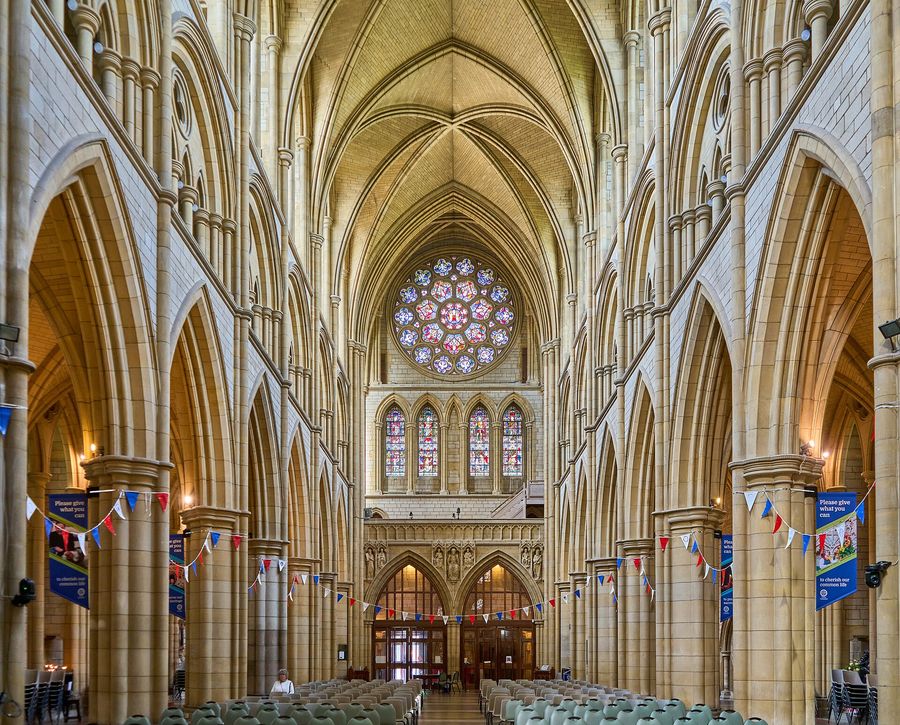
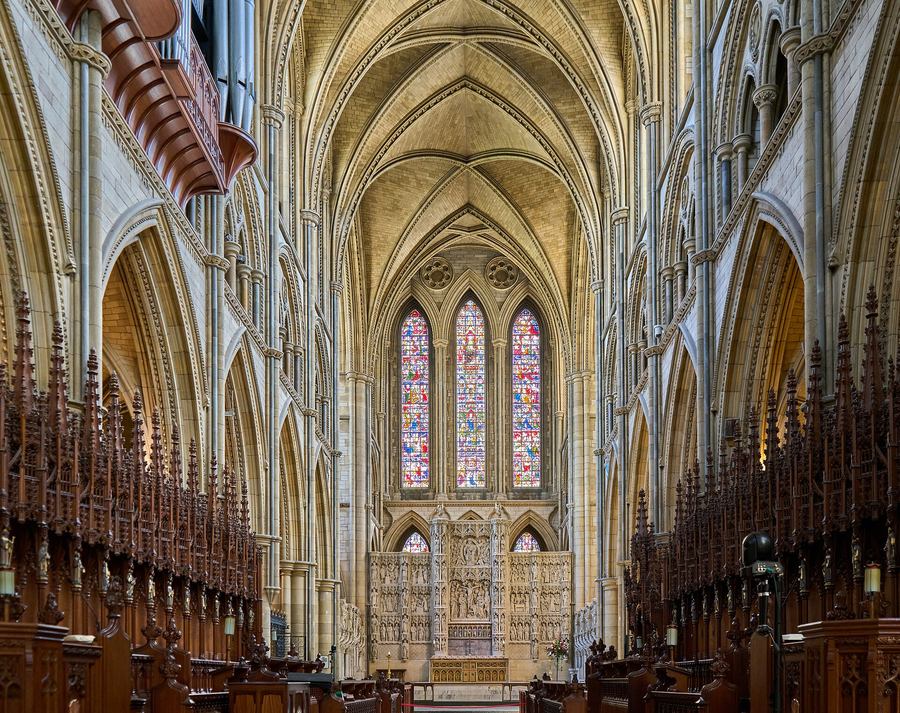
You enter at the west end, between the two western towers. The nave is tall and narrow, vaulted in stone throughout, built of Cornish granite with dressings of Bath and Polyphant stone. Pearson used the narrowness of the site to make the building feel higher than it is; stand at the west end and look east to see how the vista is framed. The great rose window at the west end shows God the Creator and the seven days of Creation.
St Mary's Aisle
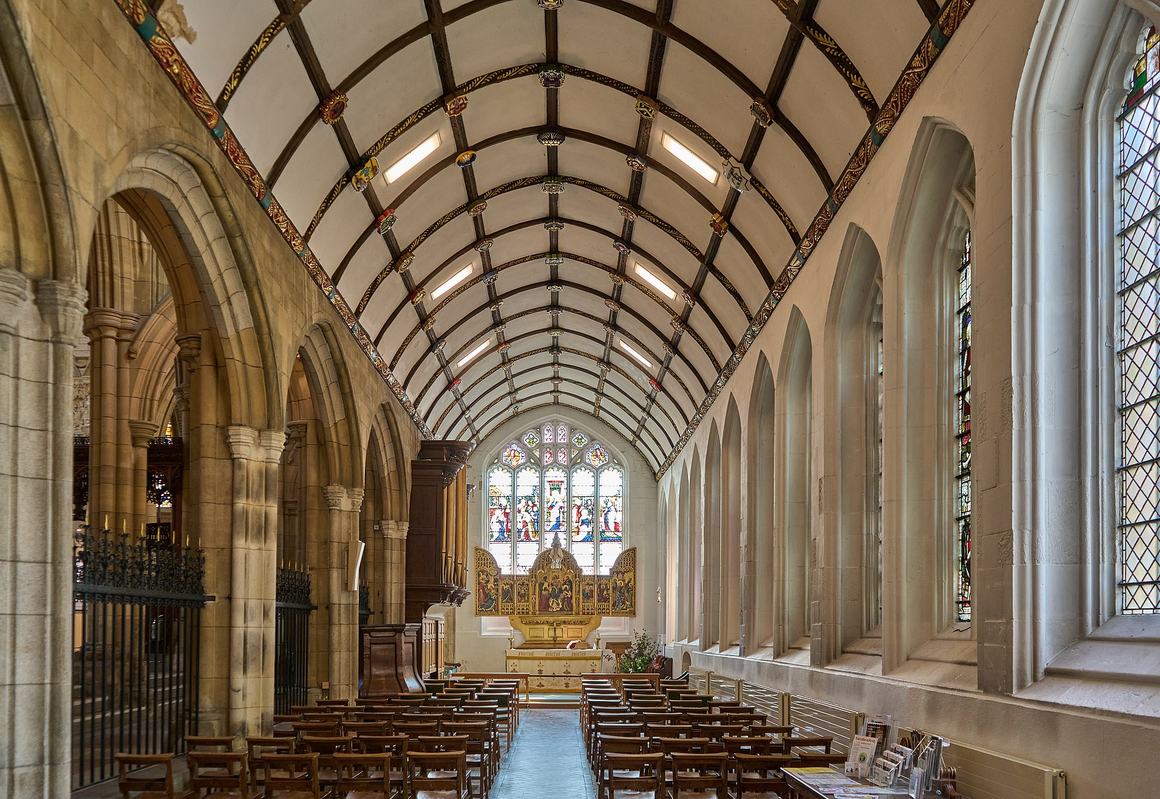
On the south side of the quire is St Mary’s Aisle, the surviving south aisle of the old parish church, built in the early sixteenth century, with a wooden wagon roof and granite walls. Pearson kept it and joined it to his cathedral, and it is still the parish church of the city centre. Step from the cathedral into it and you move from Victorian vaults to a Tudor Cornish church.
The quire and the reredos
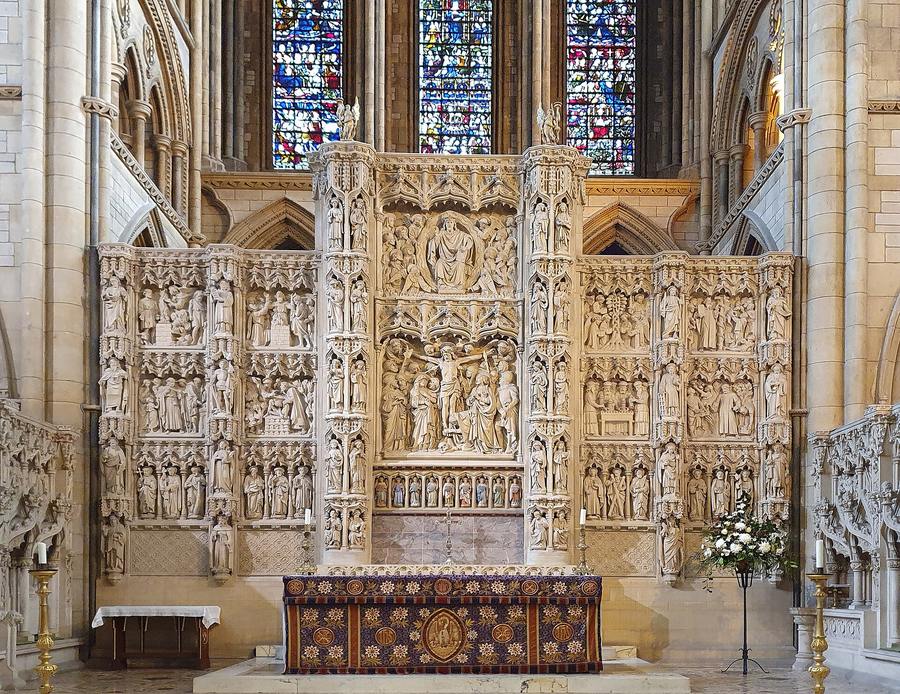
The quire was the first part to be finished. Behind the high altar, the great reredos is carved in Bath stone with the Crucifixion at its centre and rows of saints, prophets and angels. The cathedral’s stained glass, almost all made by the London firm of Clayton and Bell, forms one of the largest and most complete schemes of Victorian glass in the country.
The baptistery and the tower
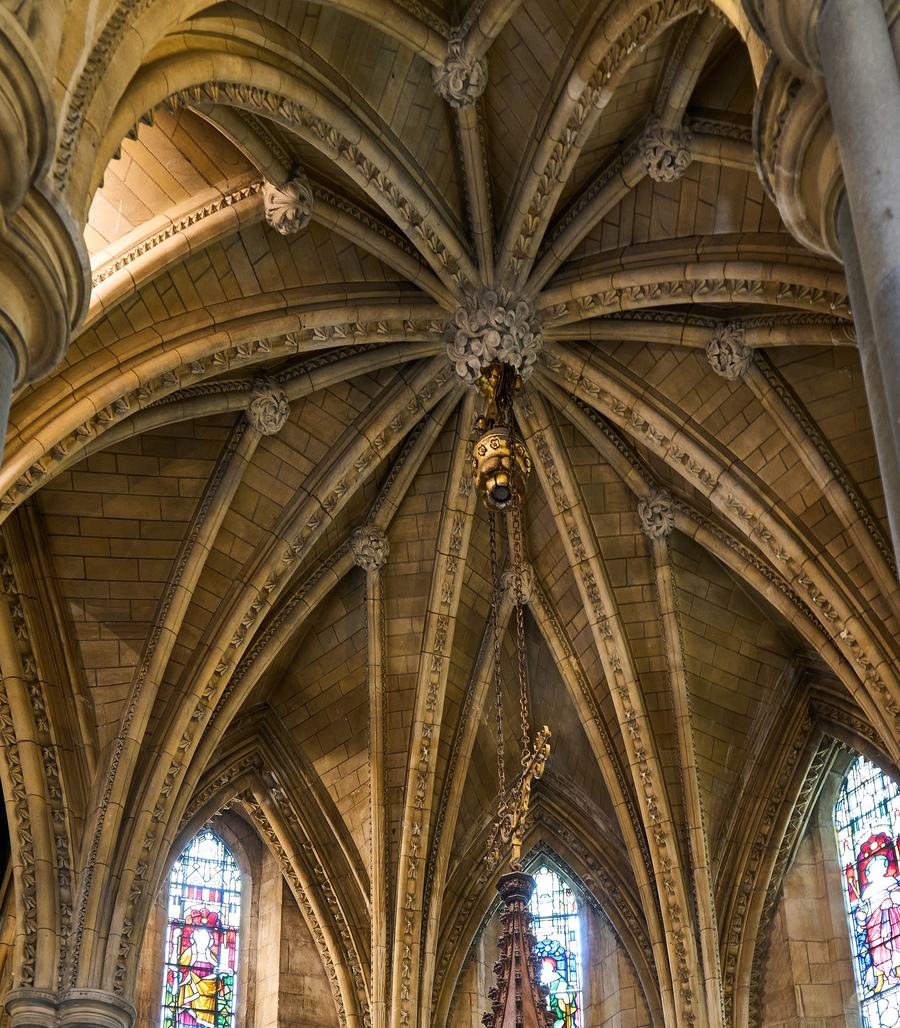
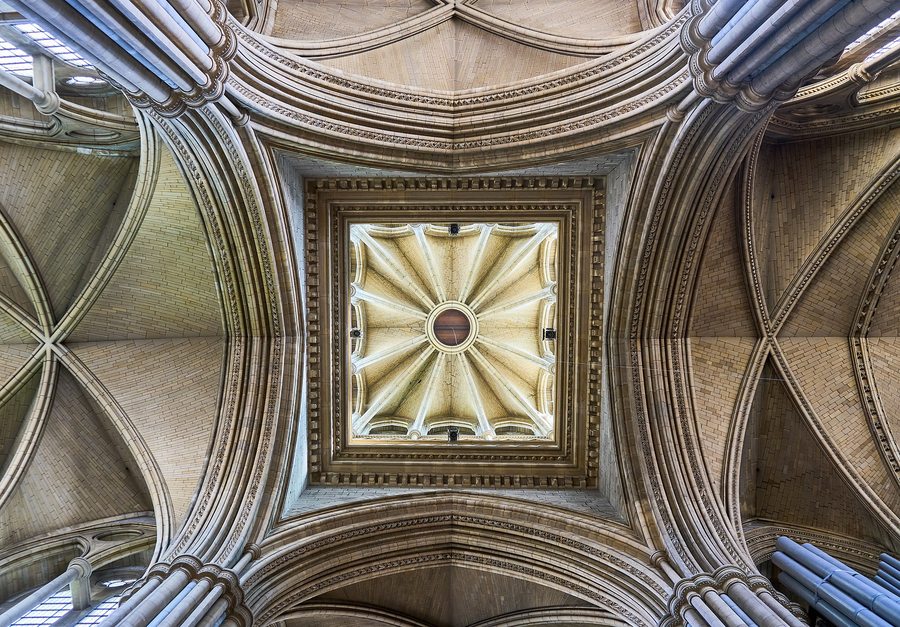
Near the south door, the baptistery is a memorial to Henry Martyn, the missionary and translator, who was born in Truro in 1781. Its vault is one of the most elaborate in the building. Stand at the crossing and look up into the vault under the central tower, known as the Victoria Tower.
Tickets and tours
Free tours in season
Entry is free. Free guided tours of about an hour run on Mondays to Thursdays at 11am through the main season, from spring to the end of October, with no need to book. An audio tour through the VoiceMapp app costs £5 at the Welcome desk. Tower and roof tours run on set dates during the year and are booked through the cathedral’s What’s On page.
The hotel link goes to Booking.com. This site earns nothing from it at present — it is here because it is the quickest way to check what is actually available.
Don't miss
- The three spires Best seen from the river or the railway viaduct.
- St Mary's Aisle A Tudor church kept inside a Victorian cathedral.
- The reredos Bath stone, carved with the Crucifixion and the saints.
- The stained glass Clayton and Bell’s great Victorian scheme.
- The baptistery A memorial to Truro’s missionary, Henry Martyn.
- Nine Lessons and Carols Begun here, on Christmas Eve 1880.
Insider tips
Come at Christmas. The Nine Lessons and Carols, the service invented in Truro, is still sung here every Christmas, and Advent and Christmas are the cathedral’s busiest and most atmospheric weeks. Check the closures list before any visit: the cathedral sometimes closes for whole days, for example for university graduations.
The Royal Cornwall Museum, a few minutes’ walk away, tells the story of the county. Truro is also a good base for the gardens of Cornwall and the south coast; boats run down the Fal to Falmouth in season.
Common questions
Is Truro Cathedral free to visit?
Yes. There is no admission charge and donations are welcome. Free guided tours run in the main season, and an audio tour, played through the VoiceMapp app, costs £5 at the Welcome desk.
How old is Truro Cathedral?
It is Victorian and Edwardian. The foundation stones were laid in 1880, the quire was consecrated in 1887 and the western towers were finished in 1910. It was the first Anglican cathedral built on a new site in England since Salisbury in the thirteenth century.
What is the connection with Nine Lessons and Carols?
The service of Nine Lessons and Carols was devised by Edward White Benson, the first Bishop of Truro, and first held on Christmas Eve 1880 in the temporary wooden building that served as the cathedral while it was being built. King’s College, Cambridge, adapted it in 1918.
Can you climb the tower of Truro Cathedral?
On certain dates. Tower tours, up the central Victoria Tower and into the south-west tower, and roof tours run several times a year and are listed on the cathedral’s What’s On page.
How do you get to Truro Cathedral?
Truro station, on the main line from London Paddington to Penzance, is about ten minutes’ walk. The cathedral is in the city centre; there is no parking at the cathedral, but there are public car parks and park and ride.
Where to stay and eat nearby
The streets around the cathedral, especially Boscawen Street and Lemon Street, have cafés, restaurants and pubs. Truro has hotels in the centre and many more in the countryside around.
More English churches
- Exeter Cathedral — Cornwall’s cathedral for eight centuries
- Wells Cathedral — the real thing, from the age Truro imitates
- Salisbury Cathedral — the last cathedral built on a new site before Truro
See all the cathedrals and churches worth visiting in England →