
Porto Cathedral
Porto Cathedral, the Sé, sits on the hill at the heart of the old city like a castle, its granite walls topped with battlements. Inside is a dark Romanesque nave, a main chapel blazing with gilt wood and a silver altar in a side chapel; beside it is a Gothic cloister lined with blue and white tiles. The church is free, the cloister and treasury cost €4, and the terrace outside has one of the best views in Porto.
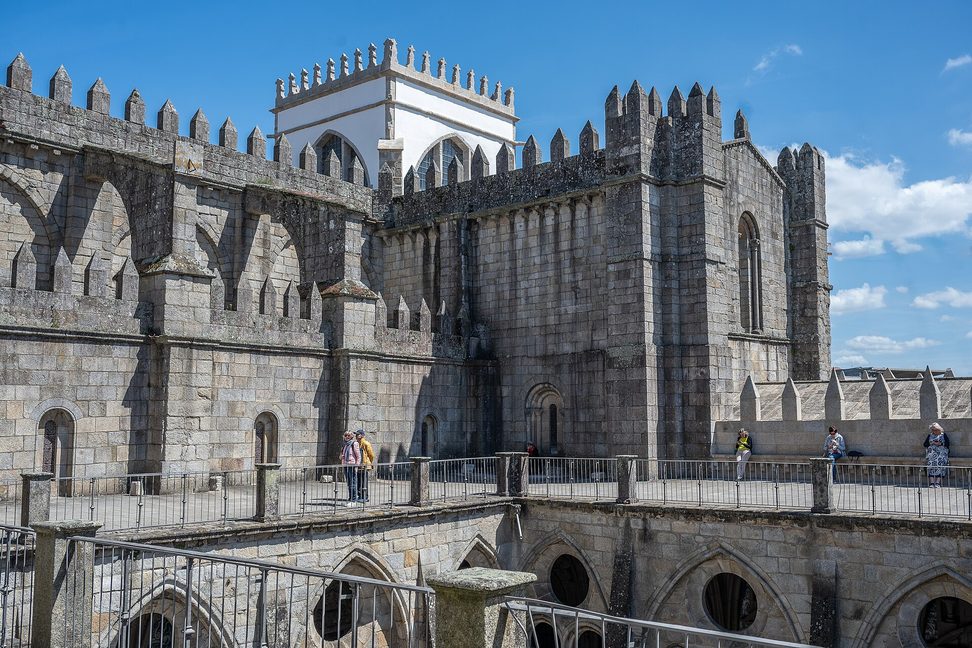
A fortress church
The first bishops of the restored diocese of Porto built here in the 12th century, on the hill where the Roman and medieval town began. The church they started was Romanesque, with battlements on the walls, and the west front still has two square towers and a 12th-century rose window. In February 1387 King João I married Philippa of Lancaster here — the marriage that cemented the Anglo-Portuguese alliance agreed at Windsor the year before; she became the mother of Henry the Navigator.
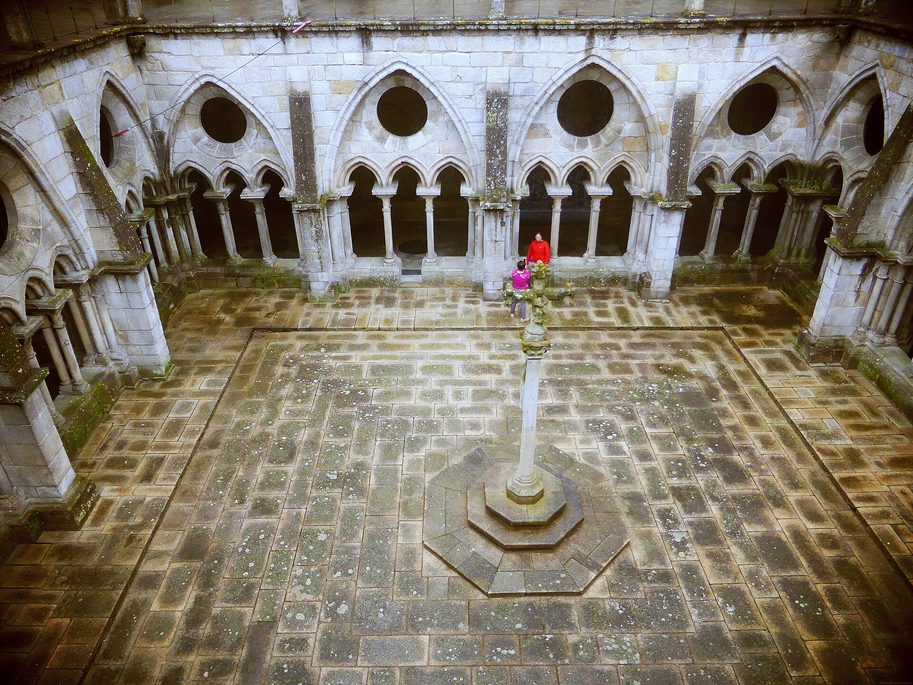
The Gothic cloister was begun at the end of the 14th century. In the 17th and 18th centuries the church was remade inside in the Baroque style: a new main chapel and altarpiece, a silver altar in the chapel of the Blessed Sacrament, and in 1736 a loggia on the north side by the Italian architect Nicolau Nasoni, who had come to Porto in 1725 to paint the cathedral’s frescoes and stayed for the rest of his life. In the 1930s the state restored the building, and around 1940 it cleared the surrounding houses to create the broad square in front, the Terreiro da Sé. The cathedral is a national monument and part of Porto’s historic centre, a UNESCO World Heritage Site.
The visitor’s cheat sheet
| Where | Terreiro da Sé, Porto; 5–10 minutes uphill from São Bento station |
|---|---|
| Opening hours | Daily 9am–6.30pm April–October, 9am–5.30pm November–March; closed at Christmas and Easter |
| Admission | Church free. Cloister, terrace, treasury and tower €4; students and Porto Card €3; children up to 10 free |
| Mass | Daily 11am |
| Pilgrims | Popular starting point of the Camino Português; credentials and stamps at the cathedral |
| How long | About an hour; 45 minutes more for the Bishop’s Palace |
Hours and admission checked against the official site in October 2026. They change; the official site is always the last word.
What to see
The Terreiro da Sé
The square in front of the cathedral is a viewpoint in its own right, looking down over the roofs of the Barredo quarter to the Douro and the port lodges of Vila Nova de Gaia. The twisted stone pillory in the middle looks medieval, but it was put up in 1945, copying an 18th-century drawing. On the north side stands a bronze of Vímara Peres, who brought Porto (Portus Cale) back under Christian rule in 868.

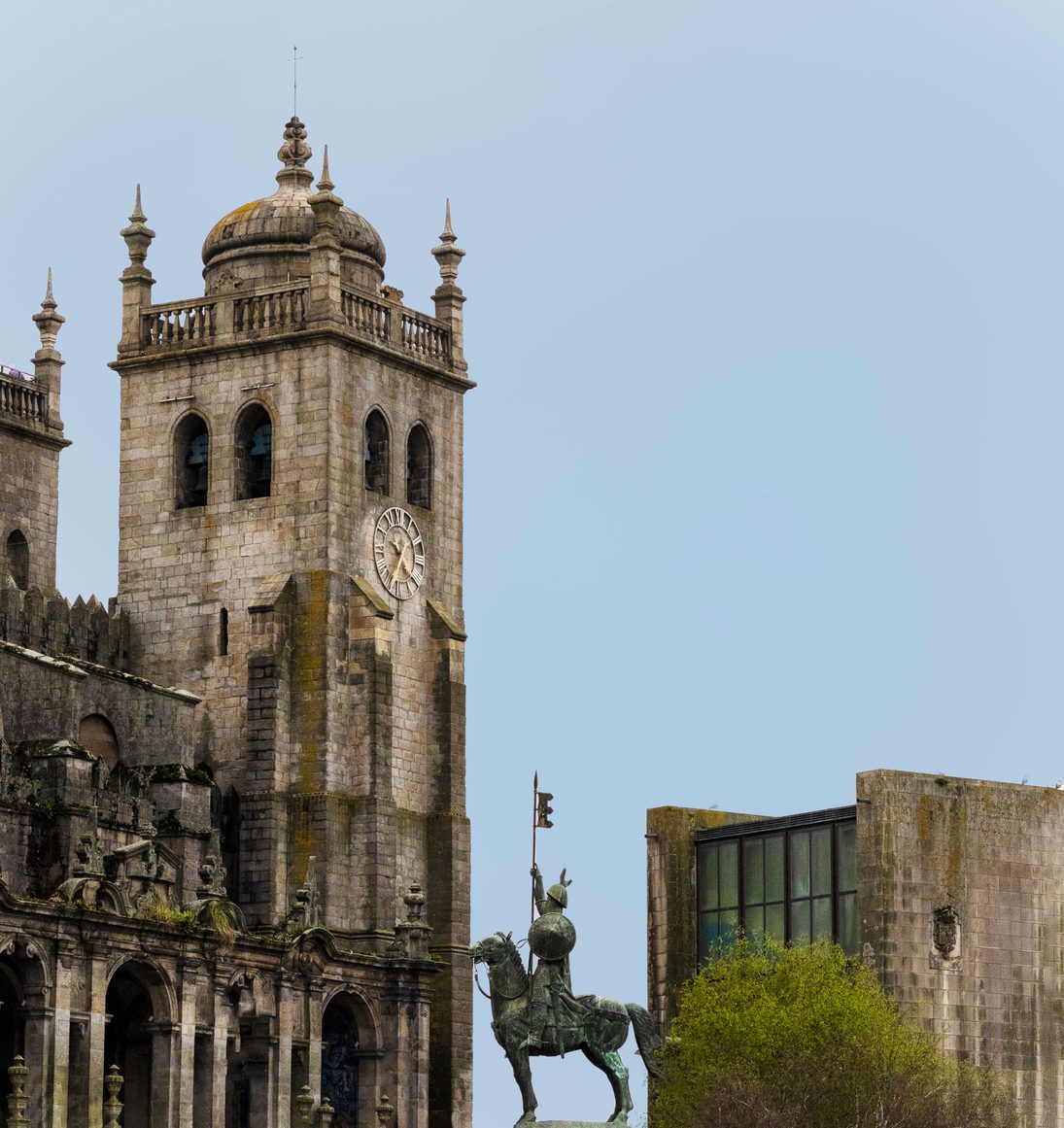
The nave and the main chapel
The nave is narrow, tall and plain, granite Romanesque with heavy piers, so the main chapel at the end comes as a shock: a gilt-wood altarpiece of the 18th century, one of the landmarks of Portuguese Baroque, framed by wall paintings by Nasoni. In the chapel of the Blessed Sacrament, on the north side, is the silver altar, begun in 1632 and worked on into the 19th century. In the transepts are two much-venerated images, Nossa Senhora da Vandoma, Porto’s patron, and Nossa Senhora da Silva.

The cloister
The ticketed visit starts in the Gothic cloister. Its walls are faced with azulejos painted by Valentim de Almeida in 1729–31: seven great panels, in blue and white, of scenes from the Song of Songs, with more tiles by António Vidal on the terrace above. Off the cloister is the chapter house, under a ceiling painted by Giovanni Battista Pachini in 1737 with allegories of the virtues, and upstairs the treasury of church silver and vestments. The upper level of the cloister and the tower look out over the old town, the Luís I bridge and the river.

Nasoni’s loggia and the Bishop’s Palace
Walk round to the north side to see Nasoni’s Baroque loggia of 1736, which faces the city. Beside the cathedral, the long white Bishop’s Palace (Paço Episcopal) is open as a museum; the visit takes about 45 minutes and ends with a view of the Douro, it closes for lunch, and tickets are usually sold at the cathedral entrance.
Tours and where to stay
No booking is needed: buy the cloister ticket inside the cathedral. The old town around the Sé and the Ribeira below it are the most atmospheric places to stay, though the streets are steep.
These links go to GetYourGuide and Booking.com. This site earns nothing from them at present — they are here because they are the quickest way to check what is actually available.
Don’t miss
- The cloister tiles The Song of Songs in blue and white.
- The silver altar In the chapel of the Blessed Sacrament.
- The main chapel Gilt wood and Nasoni’s paintings.
- The view From the terrace and the tower.
- Nasoni’s loggia On the north side, facing the city.
Insider tips
Walk on to the bridge. From the cathedral it is a few minutes’ walk to the upper deck of the Luís I bridge, which you can cross on foot to the Serra do Pilar viewpoint in Gaia. Coming back, the stepped lanes down through the Barredo lead to the Ribeira.
Common questions
Is Porto Cathedral free?
The church is free. A ticket of €4 (€3 for students and Porto Card holders, free for children up to 10) covers the Gothic cloister, its terrace, the treasury and chapter house, and the climb to the upper level for the views.
What are Porto Cathedral’s opening hours?
Every day, 9am–6.30pm from April to October and 9am–5.30pm from November to March. It closes at Christmas and Easter.
Is there Mass at Porto Cathedral?
Yes, every day at 11am. You can enter the church freely for Mass, but please don’t sightsee during it.
How do I get to Porto Cathedral?
It stands on the hill above the Ribeira, a 5–10 minute walk uphill from São Bento station (metro line D and suburban trains). From the riverside it is a steep climb by steps and cobbled lanes.
Where does the Camino Português start?
The full route begins in Lisbon, but many pilgrims start at Porto Cathedral, the usual starting point for the central and coastal routes from Porto. Credentials and stamps are available at the cathedral secretariat, on the right side of the church in office hours, and at the pilgrim office at Rua da Pena Ventosa 38 nearby.
More churches in Portugal
- Igreja do Carmo, Porto — the church with the famous tiled wall, and the hidden house beside it.
- Lisbon Cathedral — the capital’s own Romanesque fortress cathedral.
- Bom Jesus do Monte — the Baroque staircase sanctuary above Braga, an hour north of Porto.