
St Isaac’s Cathedral, St Petersburg
St Isaac’s is the largest church in St Petersburg and one of the largest domed buildings in Europe: a colossal neoclassical cathedral of red granite, gilded dome and malachite columns, built over forty years for the tsars. It is now a state museum in which services are also held, and the colonnade around its dome has one of the best views of the city. Read the travel advice first: in 2026 the UK and US governments advise against all travel to Russia.

Before you go
Read the travel advice first. In October 2026 the UK Foreign Office advised against all travel to Russia, and the US State Department’s advice was “Do not travel”; travel insurance may not cover you if you go against your government’s advice. British, American and Australian visitors need a full visa, not the e-visa. Visa and Mastercard cards issued abroad do not work in Russia, and international booking sites such as Booking.com and Viator stopped selling in Russia in 2022, which is why this page has no booking links.
Forty years in the building
The cathedral is dedicated to St Isaac of Dalmatia, on whose feast day Peter the Great was born, and it is the fourth church on the site. Tsar Alexander I chose a design by the young French architect Auguste de Montferrand, and building went on from 1818 to 1858. The site is marshy, and some 24,000 piles were driven into the ground before the walls could rise. The 48 granite columns of the porticoes, each a single block quarried in Finland, were raised before the walls. The dome was gilded with mercury, and the fumes are said to have killed dozens of workers.
In 1931 the Soviet authorities turned the cathedral into an anti-religious museum, and hung a Foucault pendulum from the dome to demonstrate the rotation of the Earth. In the Second World War the dome was painted grey to hide it from German aircraft and artillery. Services returned in 1990, alongside the museum.
The visitor’s cheat sheet
| Where | St Isaac’s Square 4, St Petersburg; Admiralteyskaya metro, about 10 minutes’ walk |
|---|---|
| Travel advice | In October 2026 the UK advised against all travel to Russia and the US said “Do not travel” |
| Opening hours | Museum 10am–6pm (ticket office to 5.30pm), closed Wednesdays except in some school holidays and on public holidays; colonnade 10am–6pm; evening sessions 6–9.30pm (last entry 9pm) from May to September |
| Admission | Cathedral 700 roubles, colonnade 700 roubles, evening sessions 800 roubles each (October 2026, Russian-language price list); check before you go |
| Money | Visa and Mastercard cards issued outside Russia do not work; bring cash to exchange |
| Services | Morning liturgy and evening vespers, free; no sightseeing in the area of the service |
| How long | An hour, more with the colonnade |
Hours and admission checked against the official site in October 2026. They change; the official site is always the last word.
Not on Wednesdays. The museum is closed on Wednesdays, and the ticket office closes at 5.30pm. From May to September there are evening sessions in the cathedral and on the colonnade until 9.30pm. The museum’s English-language pages show out-of-date prices; the Russian-language list is the current one.
What to see
The porticoes and the dome
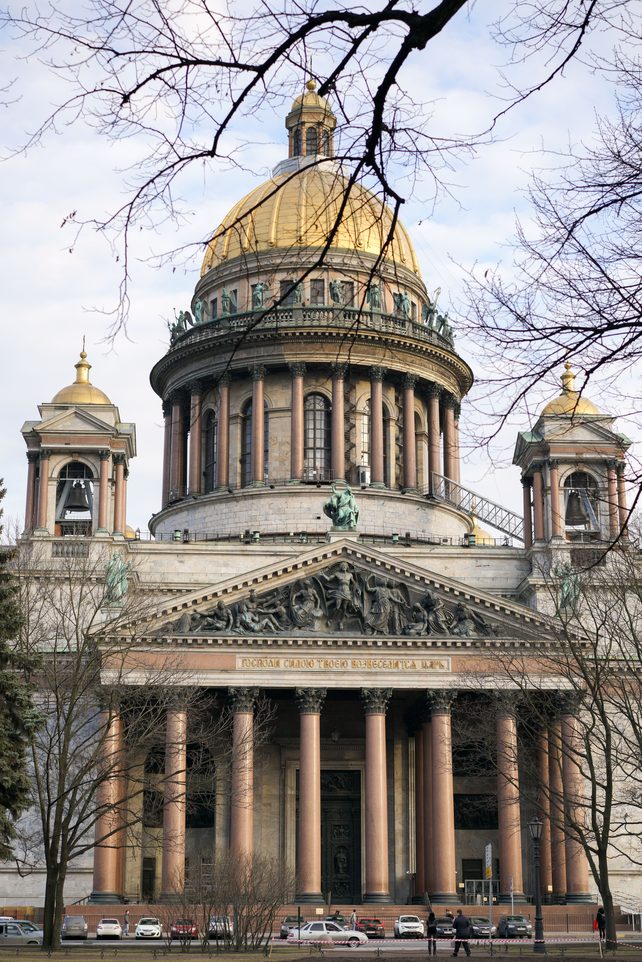
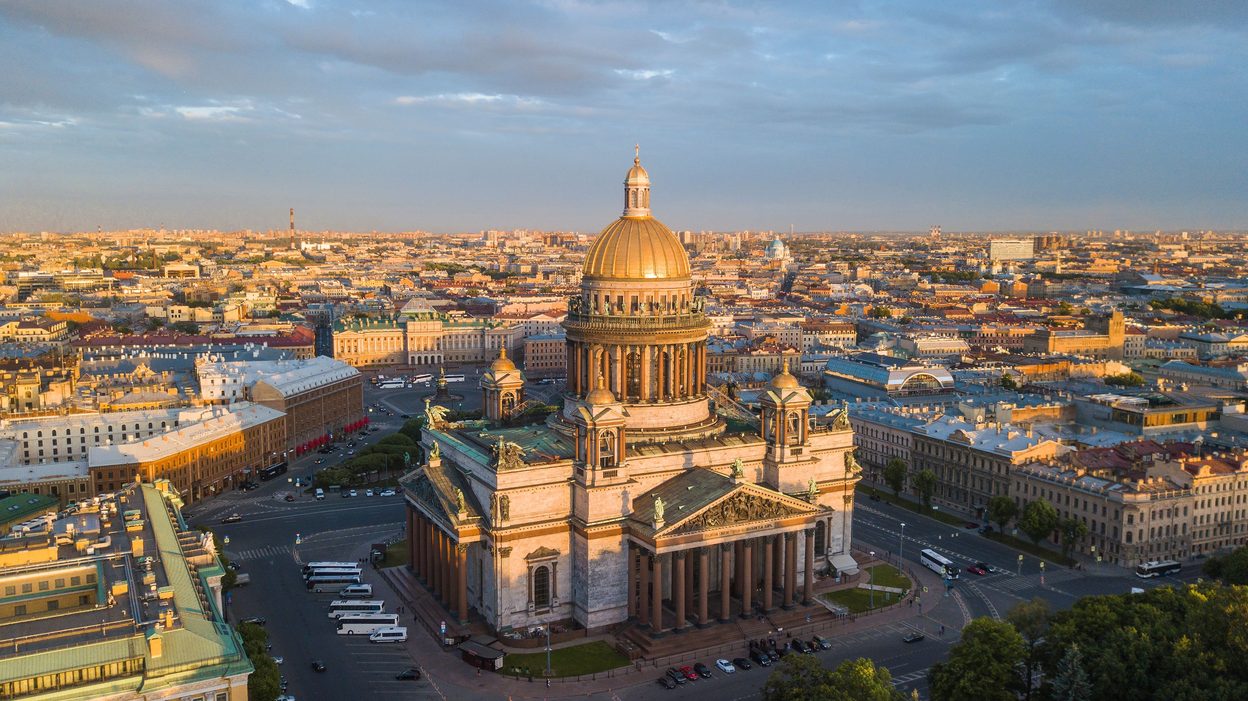
Walk round the outside first. Four porticoes, on giant columns of red granite, face the four points of the compass, with bronze reliefs in their pediments. Above them, the gilded dome rises to just over 100 metres, surrounded by its colonnade.
The interior
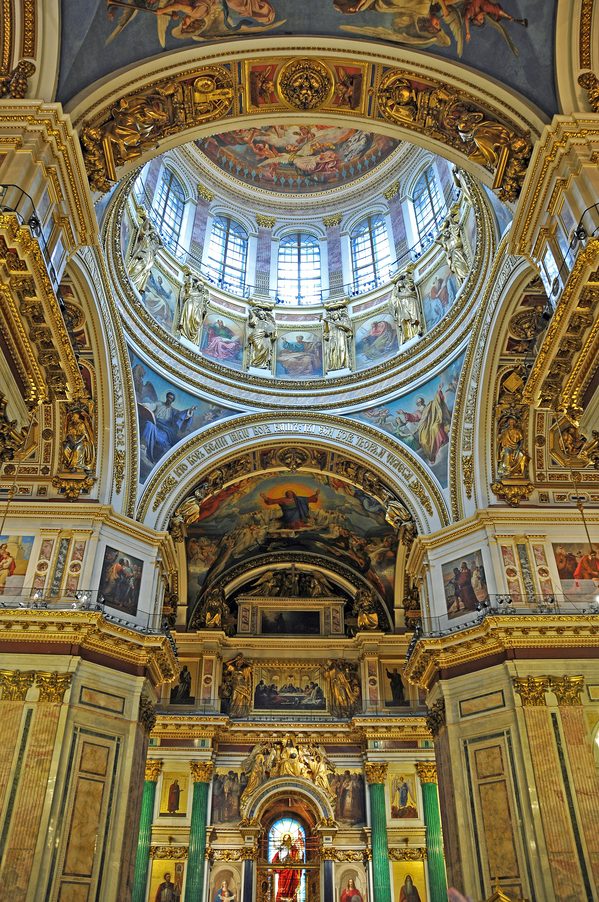
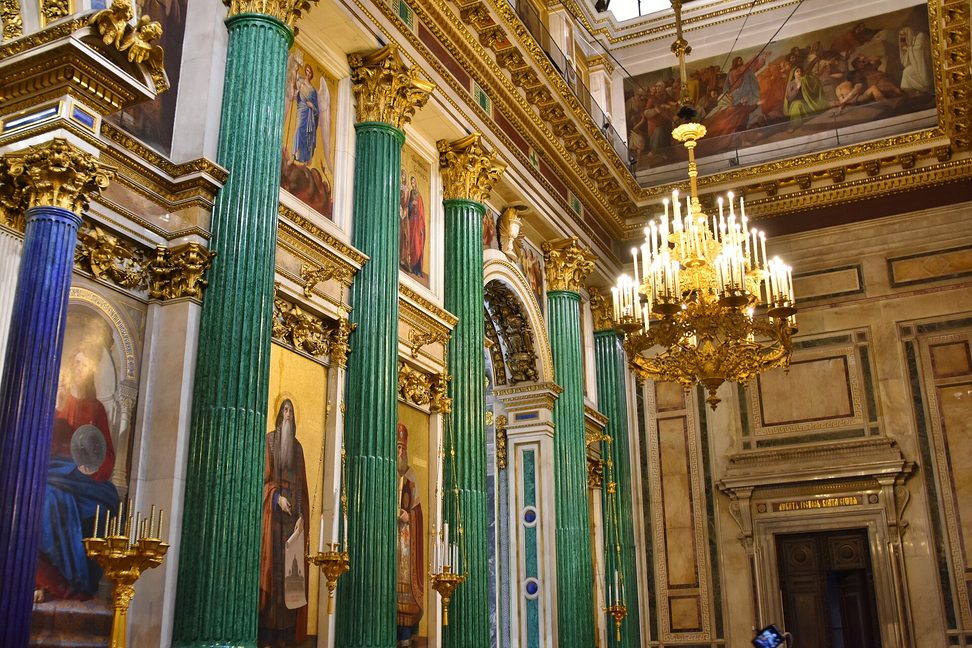
Inside, the walls are faced with marble from Italy, Russia and elsewhere, and many of the paintings by Karl Bryullov and others were copied in mosaic, to survive the damp; the programme was never finished. The iconostasis, the screen in front of the altar, is framed by columns of green malachite and two smaller ones of blue lapis lazuli, and in the window behind it is a stained-glass figure of the risen Christ. Look up into the dome, painted with the Virgin in glory, and for the spot under it where the Foucault pendulum hung.
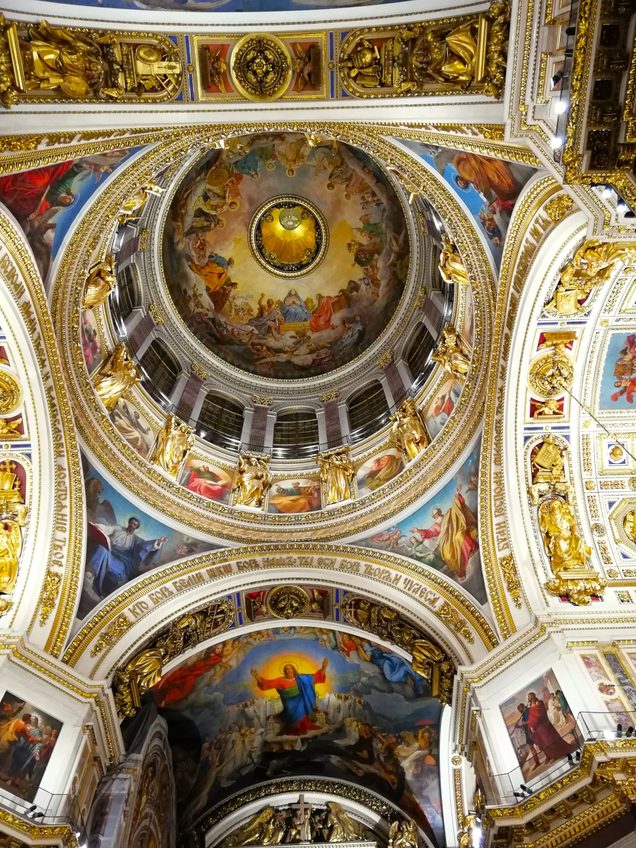
The colonnade
A separate entrance and ticket lead up spiral stairs to the colonnade around the drum of the dome, about 43 metres up. From it you look down on the Admiralty, the Neva, the Hermitage and the Peter and Paul Fortress.

Tickets
Tickets
Tickets are sold at the cathedral and on the museum’s website, which may not accept cards issued abroad. International booking sites such as Booking.com and Viator stopped selling in Russia in 2022, so there are no tour or hotel links on this page.
Don’t miss
- The colonnade The view over the city.
- The malachite columns At the iconostasis.
- The mosaics Paintings turned into stone.
- The dome Inside and out.
- A summer evening Open until 9.30pm, May to September.
Insider tips
Climb in the evening. In summer the colonnade stays open until 9.30pm, and during the white nights of June the light lasts almost all night. Photographs for personal use are allowed, without flash or tripod.
The Bronze Horseman, Falconet’s statue of Peter the Great, stands in Senate Square just north of the cathedral, and the Hermitage is about 12–15 minutes’ walk north-east past the Admiralty.
Common questions
Is it safe to visit St Petersburg?
In October 2026 the UK Foreign Office advised against all travel to Russia, and the US State Department’s advice was “Do not travel”. Read your own government’s current advice; travel insurance may not be valid if you travel against it.
How much does St Isaac’s Cathedral cost?
On the museum’s own Russian-language price list in October 2026: 700 roubles for the cathedral, 700 roubles for the colonnade, and 800 roubles each for the summer evening sessions. The English-language page shows older, lower prices. Cards issued outside Russia do not work.
Is St Isaac’s Cathedral a church or a museum?
Both. It has been a state museum since 1931, and services have been held again since 1990, daily in the side chapels and on great feasts at the main altar. A plan to hand it to the Church in 2017 lapsed in 2018.
Can you climb St Isaac’s Cathedral?
Yes: spiral stairs, a couple of hundred steps with no lift, lead up to the colonnade around the drum of the dome, about 43 metres up, with views over the city. It has its own entrance and ticket.
Which day is St Isaac’s Cathedral closed?
The museum is closed on Wednesdays. The colonnade is open every day from May to September, and from October to April closes on the third Wednesday of the month.
More churches in Russia
- St Basil’s Cathedral — on Red Square, Moscow.
- Church of the Savior on Spilled Blood — run by the same museum, about half an hour’s walk away.