
Church of the Savior on Spilled Blood, St Petersburg
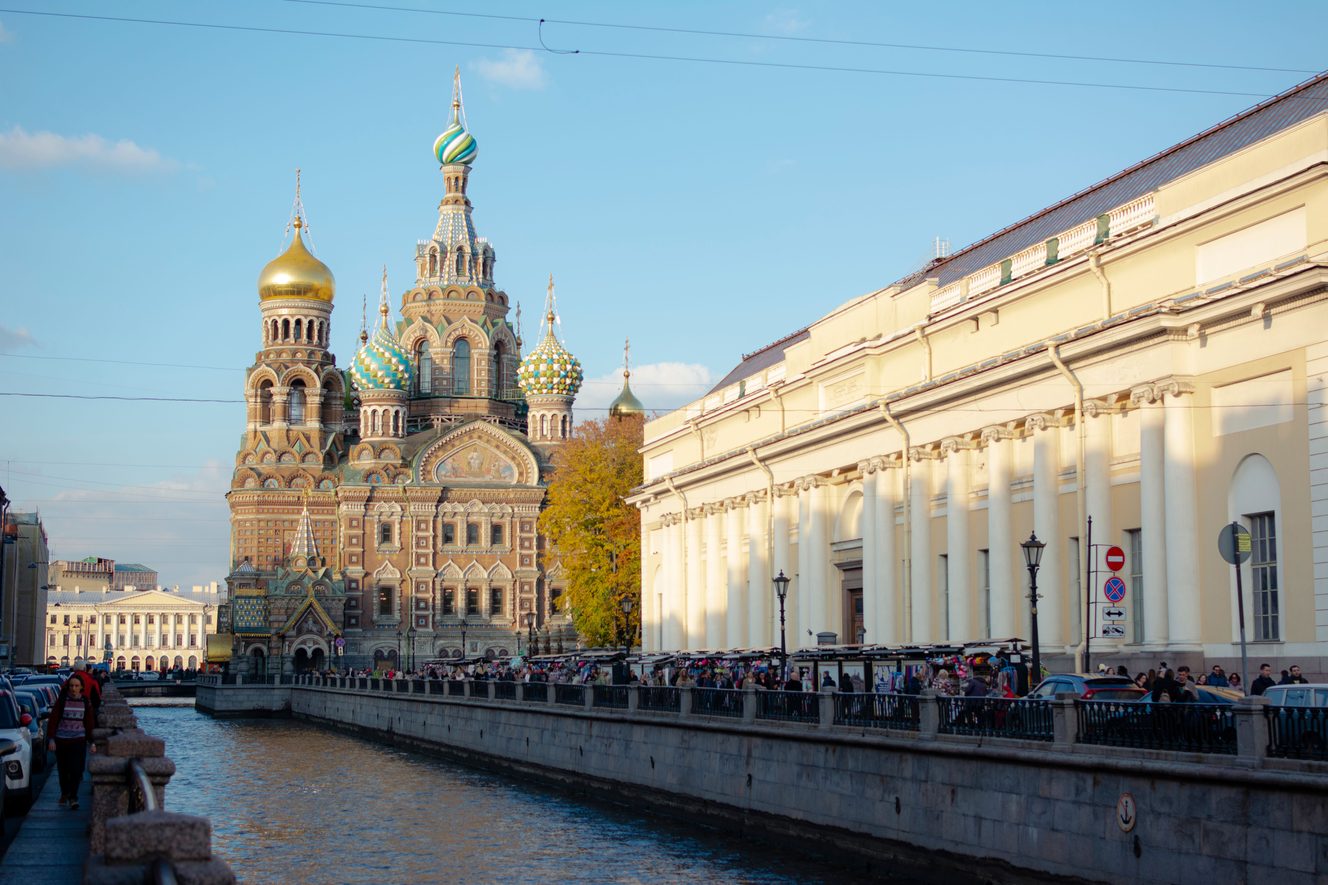
The Church of the Savior on Spilled Blood is the most extravagant building in St Petersburg: a riot of onion domes, enamel and glazed tiles in the Old Russian style, built on the spot where Tsar Alexander II was assassinated in 1881. Inside, almost every surface is covered in mosaic, more than 7,000 square metres of it. It is now a museum in which services are also held. Read the travel advice first: in 2026 the UK and US governments advise against all travel to Russia.
Before you go
Read the travel advice first. In October 2026 the UK Foreign Office advised against all travel to Russia, and the US State Department’s advice was “Do not travel”; travel insurance may not cover you if you go against your government’s advice. British, American and Australian visitors need a full visa, not the e-visa. Visa and Mastercard cards issued abroad do not work in Russia, and international booking sites stopped selling in Russia in 2022, which is why this page has no booking links.
A church on the spot of a murder
On 1 March 1881 Alexander II, the tsar who had freed the serfs, was driving along the Catherine Canal when a member of the revolutionary group People’s Will threw a bomb under his carriage. The tsar was unhurt and got out to see the scene; a second bomber then threw another at his feet. He was carried to the Winter Palace and died that afternoon.
His son, Alexander III, wanted a church on the spot, in the style of late 16th- and 17th-century Moscow and Yaroslavl, with the place where his father fell kept inside it. The design was by the architect Alfred Parland, at first with Archimandrite Ignaty of the Trinity-Sergius Hermitage at Strelna. To bring the spot within the walls, the bell tower was built out into the bed of the canal. The foundation stone was laid in 1883, and the church was consecrated in 1907, in the presence of Nicholas II.
It was never a parish church: it was a memorial, where requiems were said for the murdered tsar. The Soviet authorities closed it in 1930 and planned to demolish it; the war intervened. During the siege of Leningrad it served as a morgue, and afterwards as a store for the scenery of the Maly Opera Theatre. A German shell that had lodged in the central dome during the war was made safe only in 1961. In 1970 the building was handed to the St Isaac’s Cathedral museum to be saved; engineering work took up the 1970s, and the restoration itself, begun in the early 1980s, took so long that the scaffolding became a city joke. The church reopened as a museum in 1997, ninety years after its consecration.
The visitor’s cheat sheet
| Where | Griboedov Canal Embankment 2B, St Petersburg; Nevsky Prospekt metro (Griboedov Canal exit), a few minutes’ walk |
|---|---|
| Travel advice | In October 2026 the UK advised against all travel to Russia and the US said “Do not travel” |
| Opening hours | 10am–6pm (ticket office to 5.30pm); closed Wednesdays, except in school holidays (other than summer) and on public holidays, and closed on 1 January; evening sessions 6–9.30pm (last entry 9pm) from May to September |
| Admission | 700 roubles, evening sessions 800 roubles, audio guide 300 roubles (October 2026, Russian-language price list); under-7s free |
| Money | Visa and Mastercard cards issued outside Russia do not work; bring cash to exchange |
| Services | Saturday and Sunday liturgy at 7.30am, Saturday vigil at 6pm, plus feast days; all outside museum hours |
| How long | Forty-five minutes to an hour |
Hours and admission checked against the official site in October 2026. They change; the official site is always the last word.
Not on Wednesdays. The church is closed on Wednesdays, and the ticket office closes at 5.30pm. The museum’s English-language pages show out-of-date prices; the Russian-language list is the current one. Large bags and rucksacks are not allowed in.
What to see
The outside
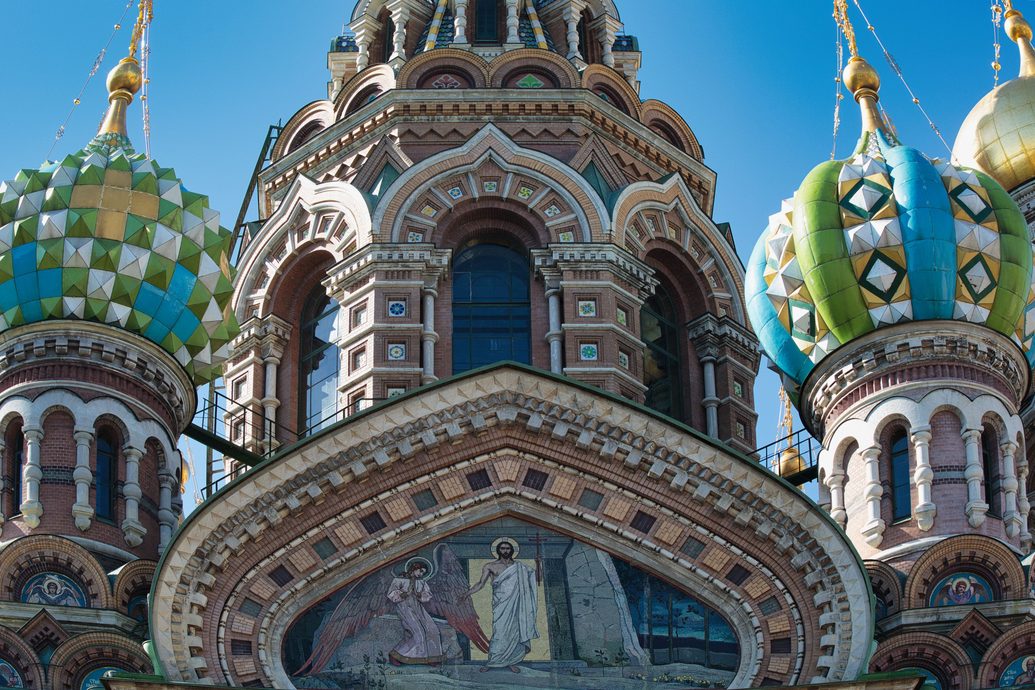
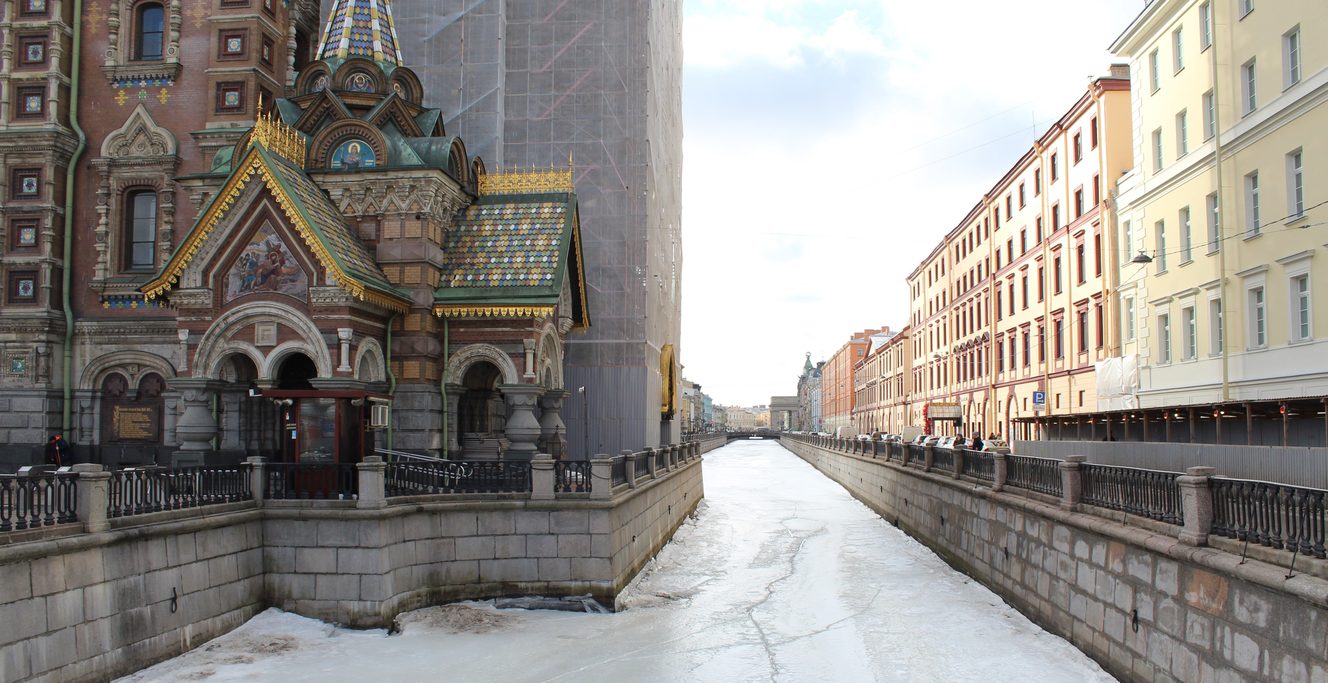
Walk round it before you go in. The five domes over the main body of the church are covered in jewellers’ enamel, which the museum calls unique in church architecture; in all there are nine domes, counting the bell tower and three small gilded domes over the apses. On the bell tower, which juts out into the canal, is a mosaic Crucifixion under a gilded canopy, and round it the coats of arms of the provinces and towns that gave money for the church. Red granite plaques round the base list the deeds of Alexander II’s reign.

The mosaics
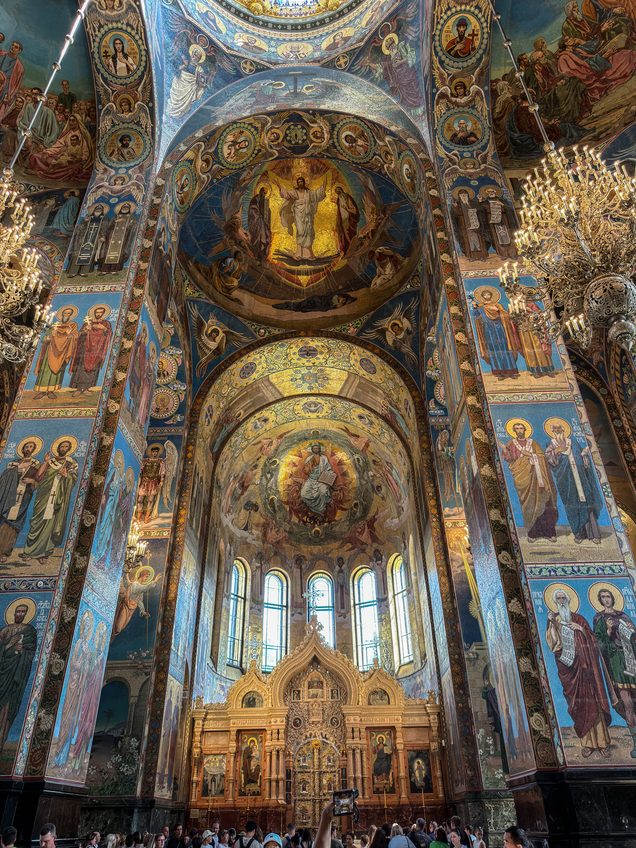
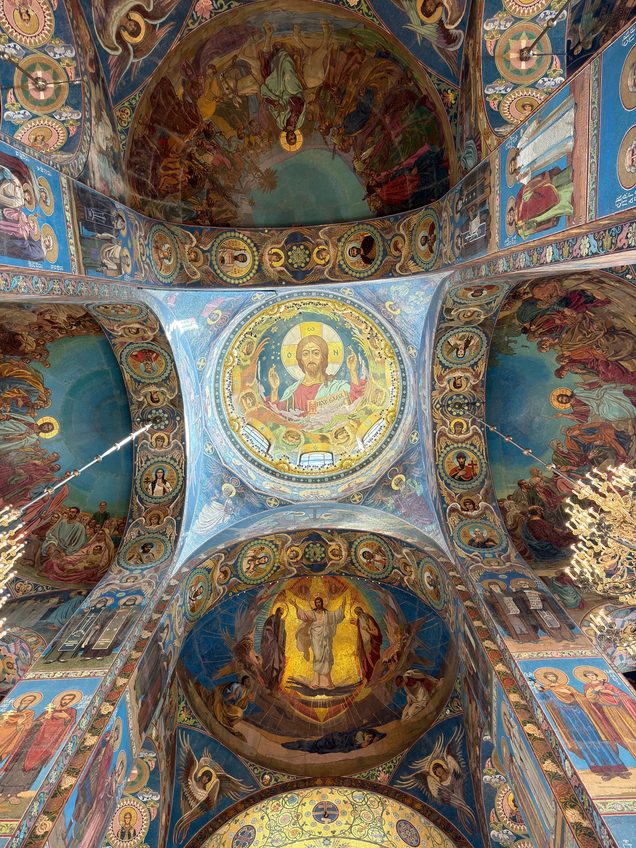
Inside, the walls, pillars and vaults are covered with mosaics made by the Frolov workshop between 1896 and 1907, to designs by 32 artists including Viktor Vasnetsov and Mikhail Nesterov. Christ Pantocrator looks down from the central dome. Below, the lower walls are of Italian serpentine, the floor is of Italian marble, and the icon cases are of Russian jasper and rhodonite.
The place where he fell
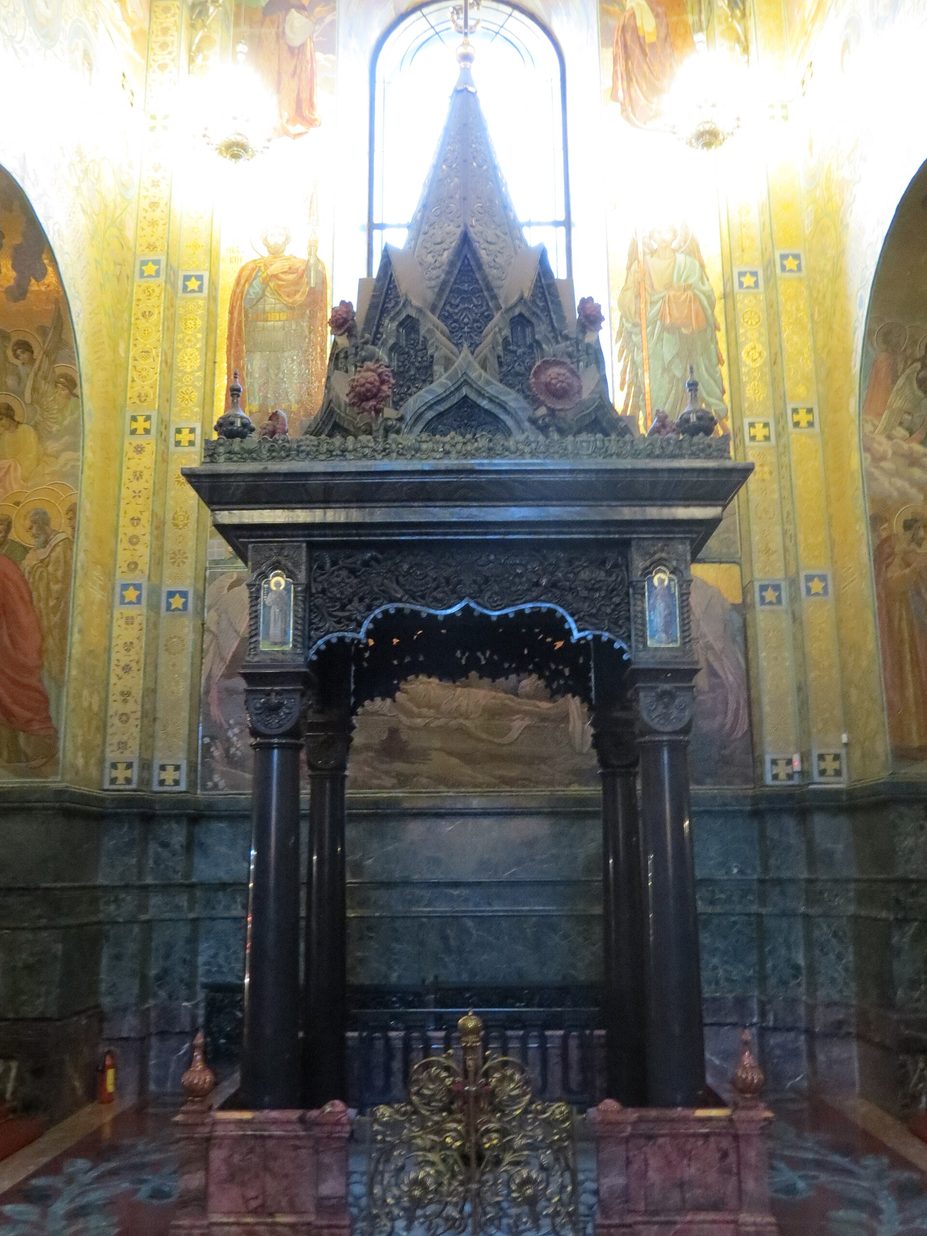
At the west end, under the bell tower, a tented canopy designed by Parland stands over a piece of the old roadway, with its paving slabs, the cobbles on which the tsar fell and a section of the canal railing. Its jasper columns and rhodonite railing are original; the canopy roof, lost in Soviet times, was recreated during the restoration in plaster painted to look like stone.
The iconostasis
The iconostasis, the screen before the altar, is of Italian marble, with mosaic icons of Christ and the Virgin after Vasnetsov. The silver-and-enamel decoration of its Royal Doors was lost in Soviet times; it was recreated in enamel and finished in 2012.

Scaffolding on the bell tower. Restoration of the facades has been going on since 2018. In mid-2026 the bell tower, at the canal end of the church, was still under scaffolding; the museum said it should come down by 1 January 2027. The church stays open.
Tickets
Tickets
Tickets are sold at the church and on the museum’s website, which may not accept cards issued abroad. International booking sites stopped selling in Russia in 2022, so there are no tour or hotel links on this page.
Don’t miss
- The enamel domes Best seen from the canal bridges.
- The Pantocrator In the central dome.
- The canopy Over the cobbles where the tsar fell.
- The iconostasis Marble and mosaic.
- Mikhailovsky Garden Parland’s Art Nouveau railings beside the church.
Insider tips
Come in the evening in summer. From May to September the church stays open until 9.30pm, without guided groups. The mosaics are best seen with the audio guide or a pair of binoculars; personal photographs are allowed, without flash.
The church is a few minutes’ walk up the canal from Nevsky Prospekt. The Russian Museum is just beyond the Mikhailovsky Garden, and the Hermitage about fifteen minutes’ walk away.
Common questions
Is it safe to visit St Petersburg?
In October 2026 the UK Foreign Office advised against all travel to Russia, and the US State Department’s advice was “Do not travel”. Read your own government’s current advice; travel insurance may not be valid if you travel against it.
How much does the Church of the Savior on Spilled Blood cost?
On the museum’s Russian-language price list in October 2026: 700 roubles, or 800 roubles for the summer evening sessions, and 300 roubles for the audio guide. The English-language page shows older, lower prices. Visa and Mastercard cards issued outside Russia do not work.
Which day is the Church of the Savior on Spilled Blood closed?
Wednesdays, and 1 January. It opens every day during the school holidays (except in summer) and on public holidays.
Why is it called the Church on Spilled Blood?
It stands on the spot where Tsar Alexander II was mortally wounded by a bomb on 1 March 1881 (13 March in the modern calendar). Its official name is the Church of the Resurrection of Christ.
Is it a church or a museum?
Both. It has been open as a museum since 1997, run with St Isaac’s Cathedral, and services have been held again since 2004; they take place early on weekend mornings, on Saturday evenings and on feast days, outside museum hours.
More churches in Russia
- St Isaac’s Cathedral — run by the same museum, about half an hour’s walk away.
- St Basil’s Cathedral — the Moscow church it is often compared with.