
Bury St Edmunds Abbey
For five centuries Bury St Edmunds was one of the richest monasteries in England, built around the shrine of a martyred king. Almost all of it has gone: what is left is two magnificent gate towers, the flint cores of the walls standing in a public garden, and houses built into the ruined west front. It is free, it is in the middle of a handsome market town, and it is where the barons are said to have sworn the oath that led to Magna Carta.
The shrine of a king
Edmund, King of the East Angles, was killed by the Danes in 869. His body was brought to the town then called Beodricsworth in the early tenth century, and his shrine became one of the great pilgrimage places of England. In 1020 King Cnut founded a Benedictine abbey here, and over the following centuries it grew into one of the largest and wealthiest monasteries in the country, with a church more than 150 metres long.
The abbey dominated the town, not always happily. In 1327 the townspeople rioted and sacked it, destroying the old gatehouse. It was surrendered to Henry VIII in 1539, and the buildings were stripped for their stone, leaving only the flint and mortar cores of the walls.
The visitor's cheat sheet
| Where | Abbey Gardens, Angel Hill, Bury St Edmunds, Suffolk, IP33 1LS |
|---|---|
| Getting there | Trains from Cambridge and Ipswich, then a walk through the town; pay car park opposite the Abbey Gate |
| Opening hours | Abbey Gate opens 7.30am (Sundays 9am); closes 8pm April–August, 7pm September, 6pm October and March, 5pm November–February |
| Admission | Free |
| How long | An hour for the ruins and gardens; half a day with the cathedral and St Mary’s |
| Best time | A summer afternoon, when the gardens are at their best |
| Dress code | None; paths and grass |
| Tours | Free audio guide on the Bloomberg Connects app; cathedral tours Monday–Saturday at 11.30am (April–October) |
Hours and admission checked against the official site in October 2026. They change; the official site is always the last word.
Cradle of the law. On St Edmund’s Day, 20 November 1214, the rebel barons are said to have gathered at the high altar and sworn to make King John accept their demands. Seven months later he sealed Magna Carta at Runnymede.
What to see, in the order you meet it
The Abbey Gate
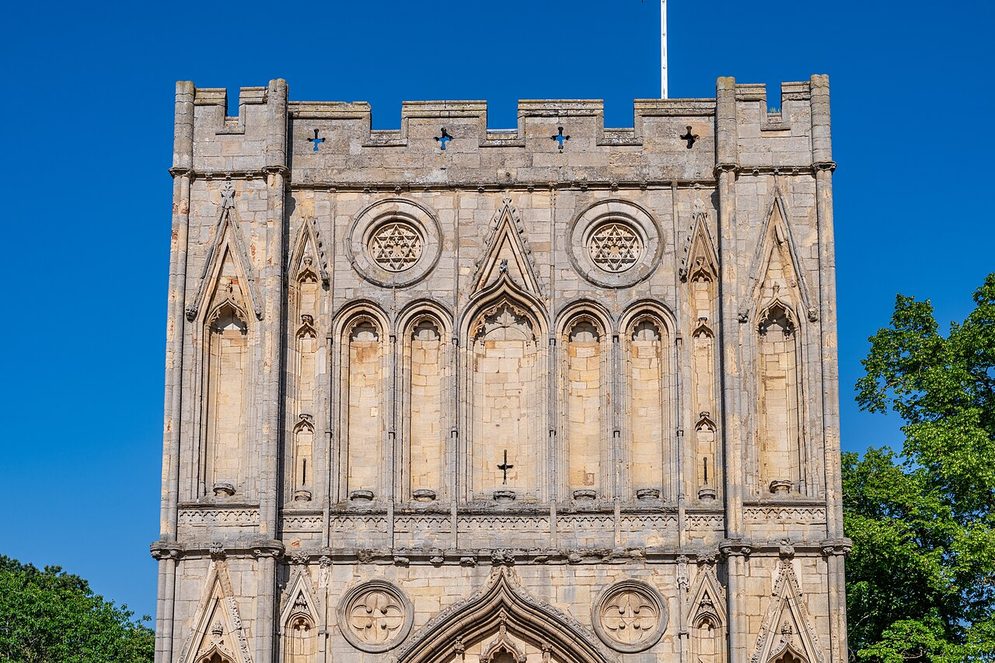
You enter from Angel Hill through the Abbey Gate, built in the fourteenth century to replace the gate destroyed in the riots of 1327, and designed with defence in mind. Its west face is richly decorated with niches and carving.
The Norman Tower
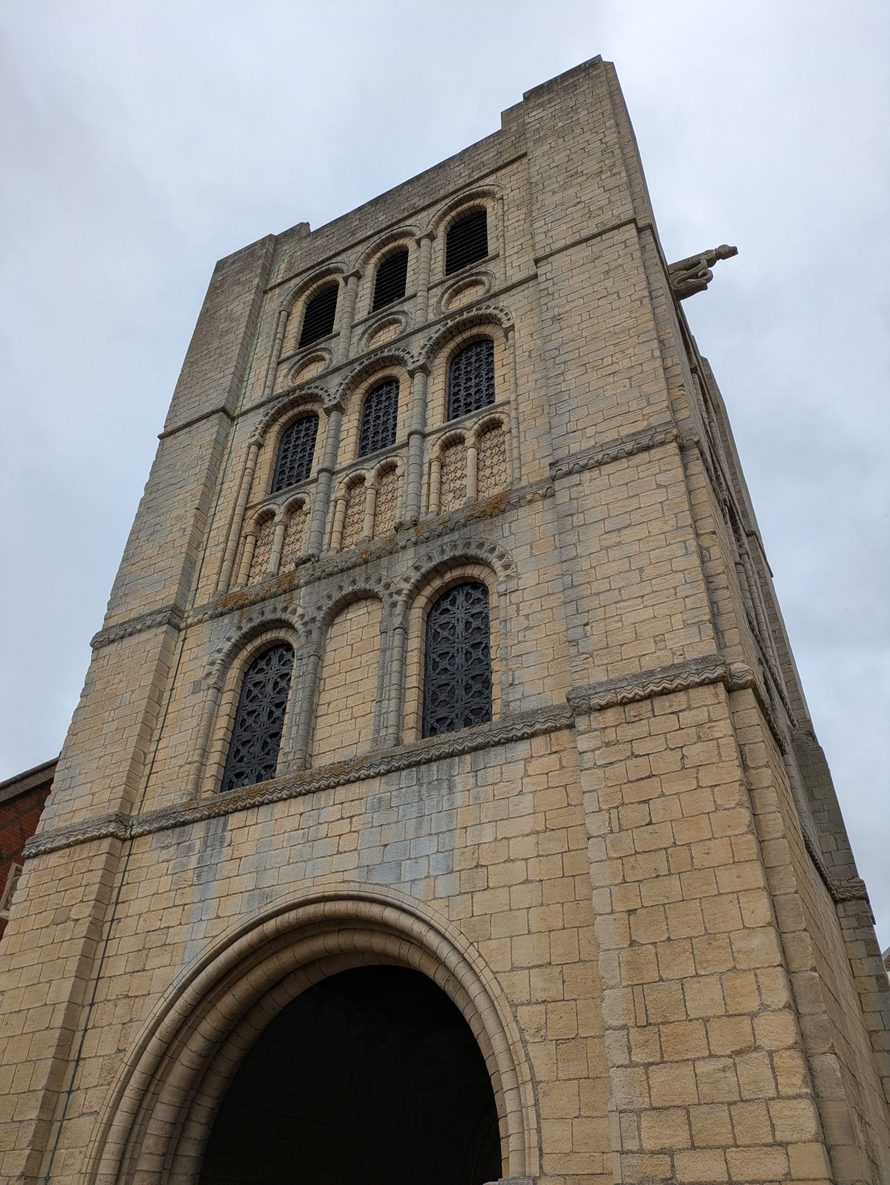
A short walk south, the Norman Tower was built between 1120 and 1148 as the gateway to the abbey church, and now serves as the bell tower of the cathedral next to it.
The ruins of the church
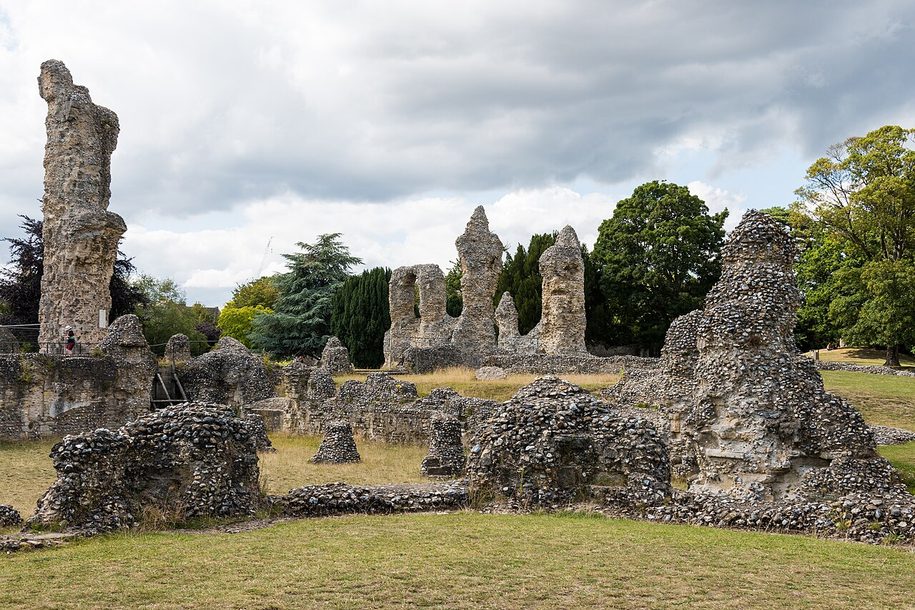
In the gardens are the remains of the abbey church: the crossing, the crypt, and the site of St Edmund’s shrine, along with the cloister and the monks’ buildings. The walls are shapeless now, but their size gives an idea of the vast church that once stood here.
The west front
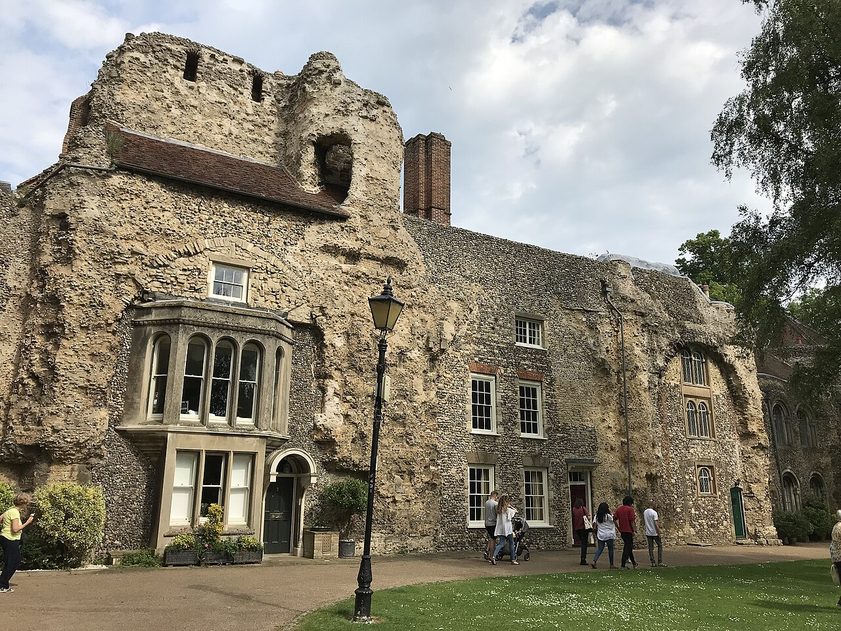
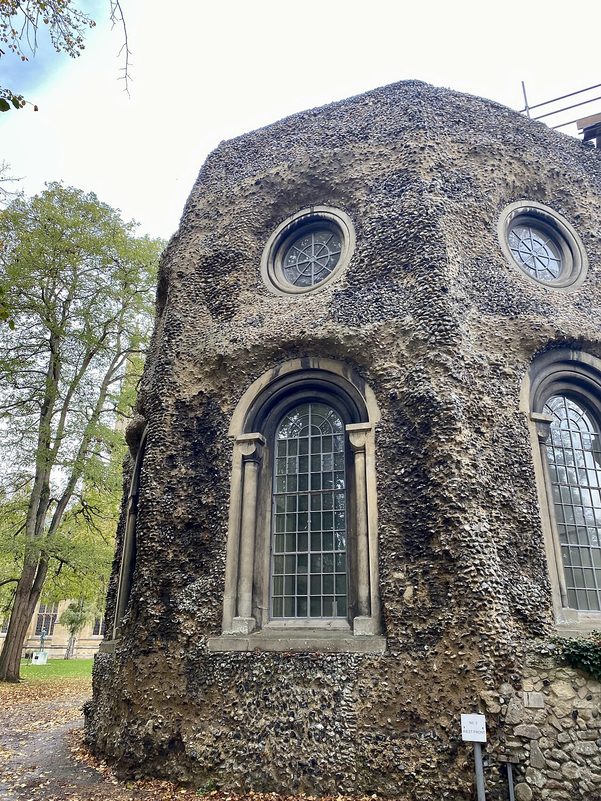
At the west end of the church, houses were built into the ruins of the great west front, begun in the twelfth century. At its southern end is the octagonal Samson’s Tower, named after Abbot Samson, who finished the front around 1200.
The Abbey Gardens
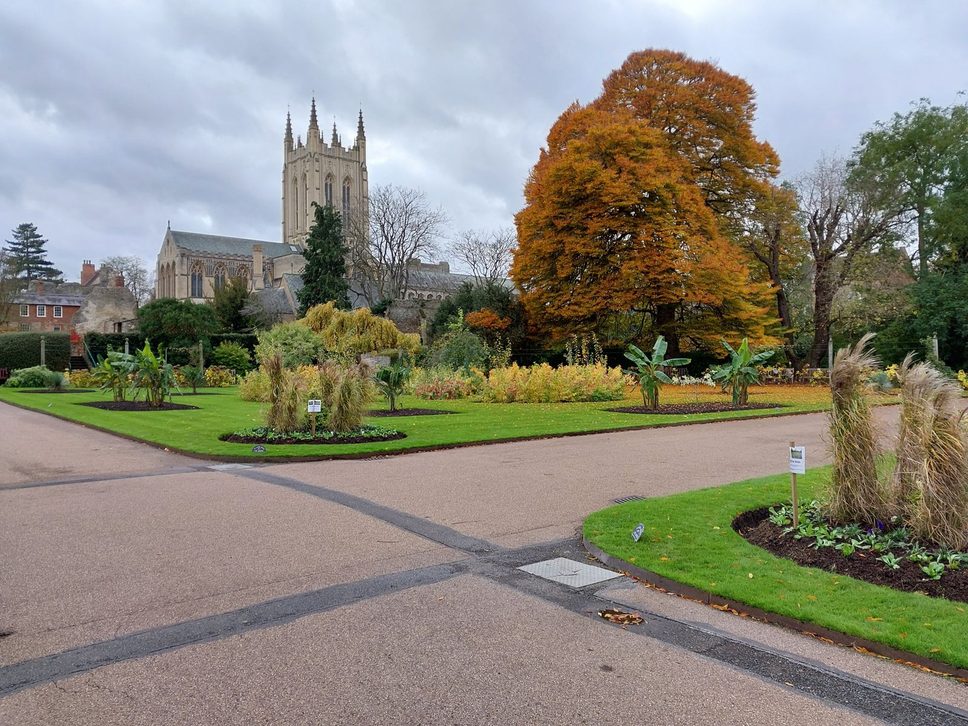
The gardens were laid out here as a botanic garden in 1831 and became a free public park in 1912. Look for the rose garden, the herb garden of medicinal plants, the sensory garden, the aviary and the walk beside the River Lark.
Visiting
Free to visit
No tickets are needed for the ruins or the gardens. Allow time for St Edmundsbury Cathedral and St Mary’s Church, both on the edge of the abbey grounds.
The hotel link goes to Booking.com. This site earns nothing from it at present — it is here because it is the quickest way to check what is actually available.
Don't miss
- The Abbey Gate Rebuilt after the riots of 1327.
- The Norman Tower The twelfth-century gate to the church.
- The shrine site Where St Edmund lay.
- The west front houses Homes inside a ruin.
- St Mary’s Church Angel roof and Mary Tudor’s tomb.
- The cathedral Next door, with its Millennium Tower.
Insider tips
Don’t miss St Mary’s. The great parish church on the south side of the abbey precinct has a hammerbeam roof with carved angels and the tomb of Mary Tudor, Henry VIII’s sister. It is open Monday to Saturday from 10.30am to 3pm, subject to services.
Common questions
Is Bury St Edmunds Abbey free to visit?
Yes. The abbey ruins stand in the Abbey Gardens, a public park run by West Suffolk Council, and both are free. English Heritage looks after the ruins. St Edmundsbury Cathedral next door is also free to enter, with donations welcome.
When are the Abbey Gardens open?
The Abbey Gate opens at 7.30am (9am on Sundays and bank holidays) all year. It closes at 8pm from April to August, 7pm in September, 6pm in October and March, and 5pm from November to February. The other gates close up to 30 minutes earlier.
Why is Bury called the cradle of the law?
On St Edmund’s Day, 20 November 1214, the rebel barons are said to have met in the abbey church and sworn to force King John to accept the charter of liberties that became Magna Carta. The town’s motto is “Shrine of a King, Cradle of the Law”.
Is there building work at the abbey?
English Heritage is repairing the walls and gatehouse in stages, so expect some scaffolding and fenced paths. A new visitor centre and accessible path, funded by the National Lottery Heritage Fund, are due to start construction in 2027; entry will stay free.
How do you get to Bury St Edmunds?
Greater Anglia trains run direct from Cambridge and Ipswich. The station is a short walk from the town centre, and the Abbey Gate is on Angel Hill. There is a pay car park opposite the Abbey Gate.
Where to stay and eat nearby
Bury is a busy market town with hotels, pubs and restaurants around Angel Hill and the Buttermarket.
More English churches
- St Edmundsbury Cathedral — next door
- Lavenham Church — a great Suffolk wool church, half an hour away
- Ely Cathedral — the Ship of the Fens