
Aachen Cathedral
At the heart of Aachen Cathedral is the chapel Charlemagne built for his palace around 800: an octagon of stone and marble under a dome, inspired by the churches of Ravenna and Constantinople, where the emperor was buried in 814. From 936, for six centuries, some thirty German kings were crowned here, on a plain marble throne that still stands in the gallery. It was the first German site on the World Heritage list. The cathedral is free, but the throne, the gallery and the Gothic choir can only be seen on a guided tour.
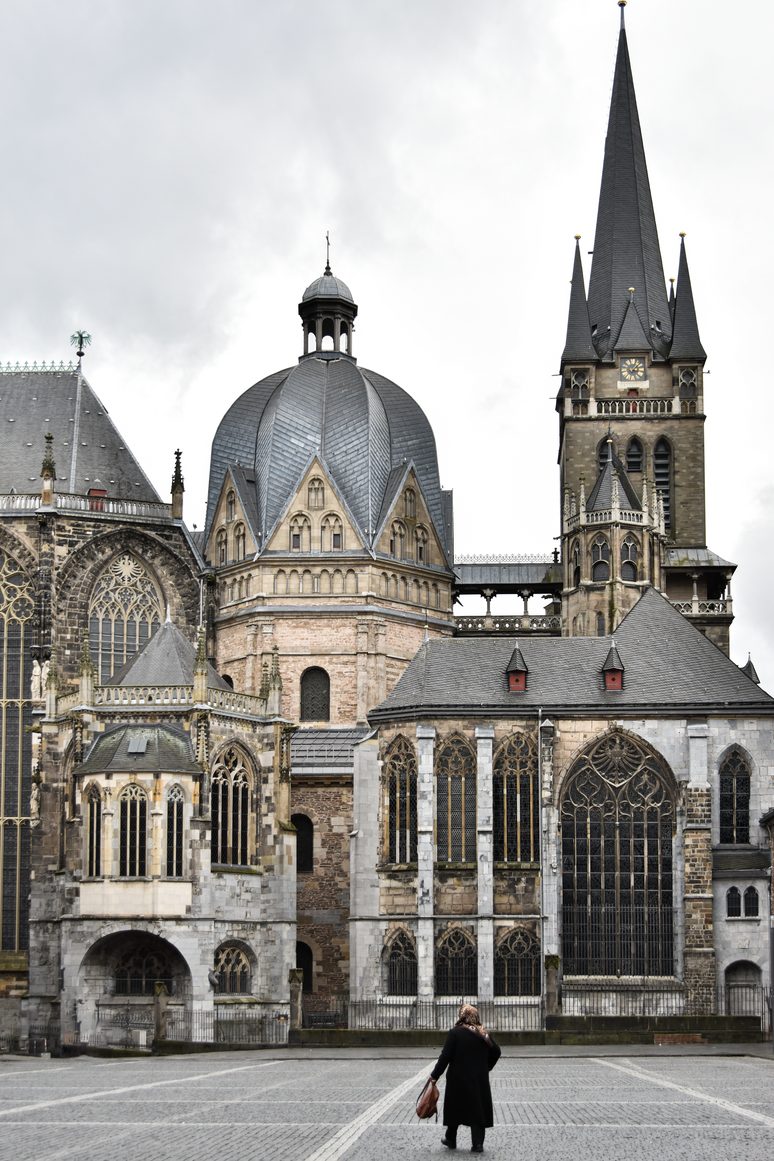
Charlemagne’s chapel
Charlemagne chose Aachen, with its Roman hot springs, as his favourite residence, and from about 796 built a palace there with a chapel at its heart. The chapel, traditionally designed by Odo of Metz, was consecrated, by tradition, by Pope Leo III in 805. It is an octagon ringed by a sixteen-sided ambulatory, with a gallery above, columns brought from Italy, and the largest dome north of the Alps for two centuries. Charlemagne was buried here in 814.
From Otto I in 936 to Ferdinand I in 1531, about thirty German kings were crowned here, and the church filled with their gifts. Frederick Barbarossa had Charlemagne canonised in 1165 and gave the great chandelier; Charlemagne’s remains were placed in a gold shrine in 1215. The Gothic choir, a hall of glass begun in 1355, was completed in 1414 to give pilgrims room to see the relics. In 1978 the cathedral was among the first twelve sites on the World Heritage list, the first in Germany.
The visitor’s cheat sheet
| Where | Domhof 1, 52062 Aachen, in the old town; tours and tickets from the Dom-Information, Johannes-Paul-II.-Straße |
|---|---|
| Opening hours | For visitors Monday–Thursday 11am–6pm, Friday–Saturday 11am–7pm, Sunday and holidays from 1pm to about 5.30pm. No sightseeing during services; later opening on wedding Saturdays |
| Admission | Free. Photo permit €1 |
| Guided tour | The only way into the upper gallery and the Gothic choir: 45 minutes, €8.50 (reduced €4.50). In English daily at 2pm |
| Treasury | Monday 10am–2pm, Tuesday–Sunday 10am–6pm (5pm January–March); €8, reduced €4; tickets only at the Dom-Information |
| Closed | The treasury closes on the main Carnival days, Good Friday and over Christmas and New Year |
| Getting there | About 15 minutes’ walk from Aachen Hauptbahnhof; trains from Cologne in 35 minutes to an hour |
| How long | An hour and a half to two hours with the tour and the treasury |
Hours and admission checked against the official site in October 2026. They change; the official site is always the last word.
Take the guided tour. Without it you see the octagon from the ground floor, with the throne and the choir behind barriers. The 45-minute tour (€8.50) takes you up into the gallery to Charlemagne’s throne and into the Gothic choir to the shrines. Tours in English run daily at 2pm and are small, so book online. Weekday visiting starts only at 11am, and on Sundays at 1pm.
What to see, in the order you meet it
The octagon
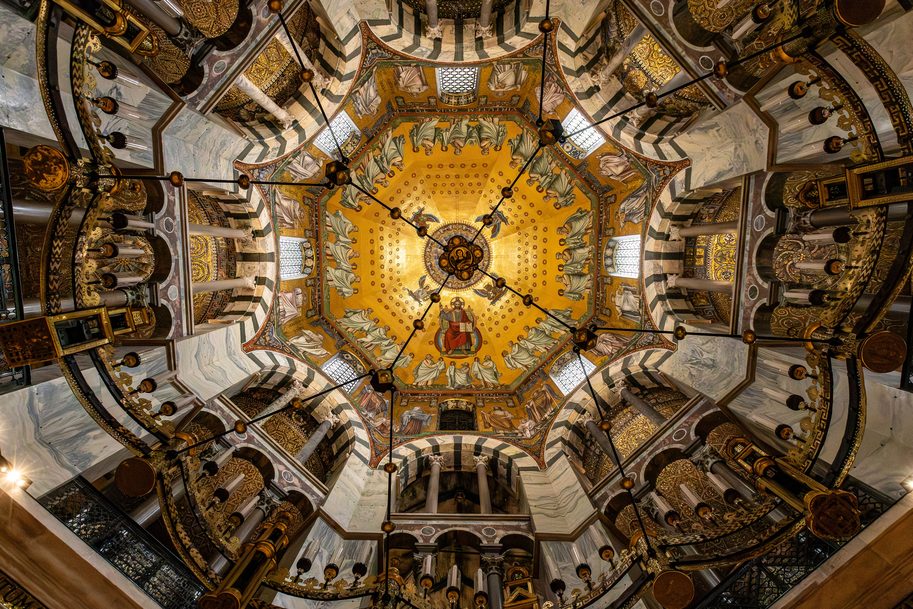
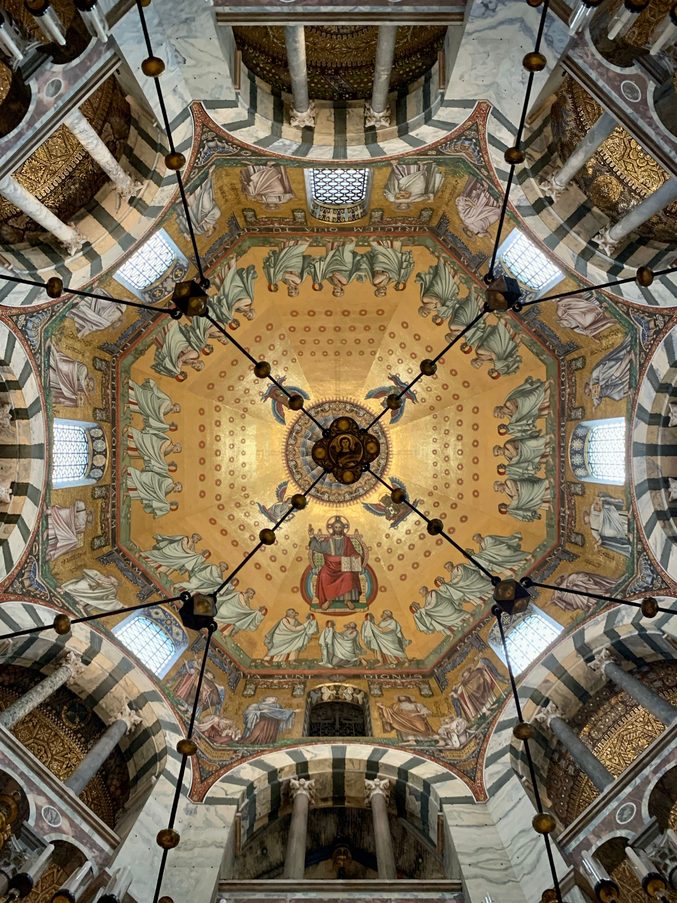
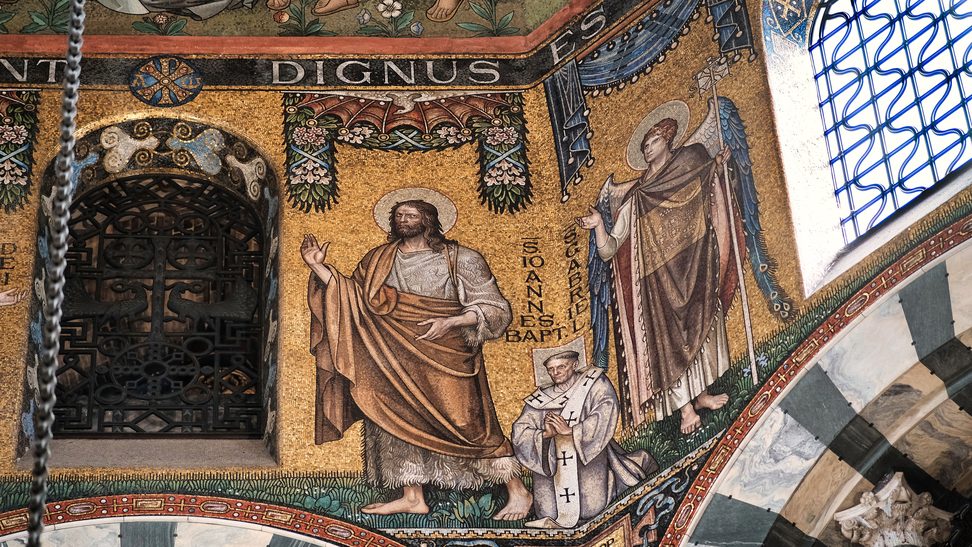
You enter through the west tower by the Wolf’s Door, bronze doors cast in Charlemagne’s time, and step into the octagon. Look up: eight massive piers carry the gallery and the dome, which glitters with a mosaic of Christ enthroned among the twenty-four elders of the Apocalypse, renewed in 1881. The marble and mosaics that cover the walls today were added around 1900; the bones of the building are Carolingian.
The Barbarossa chandelier
Hanging in the middle of the octagon is a great gilded copper wheel, the Barbarossa chandelier, given by Frederick Barbarossa and his wife around 1165–70. Its eight sides, with sixteen towers, stand for the heavenly Jerusalem.
The throne
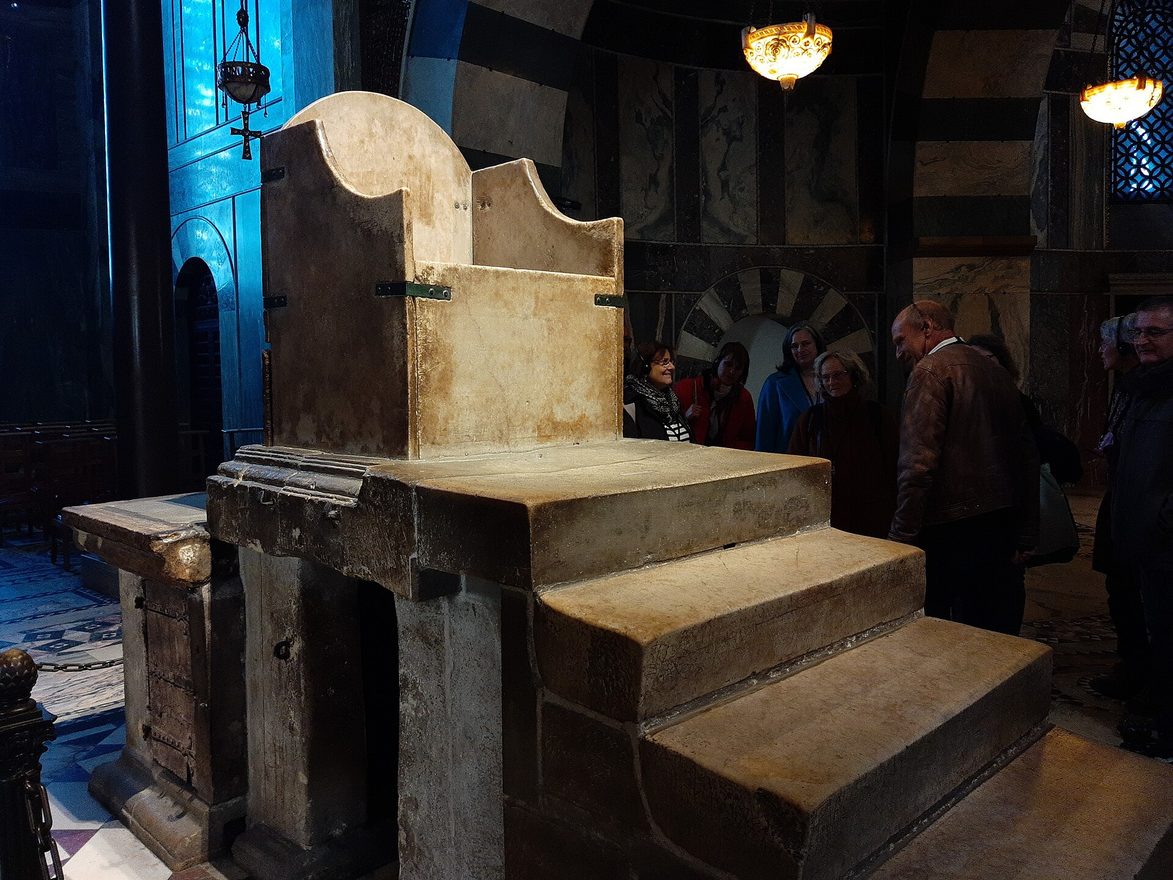
In the gallery opposite the altar stands the throne: four slabs of white marble held with bronze clamps, raised on six steps. Whether it was Charlemagne’s own is uncertain, but German kings were enthroned on it from Otto I’s coronation in 936 onwards. A story that the marble came from the Church of the Holy Sepulchre in Jerusalem is popular but unproven. You can only see it close up on a tour.
The Gothic choir
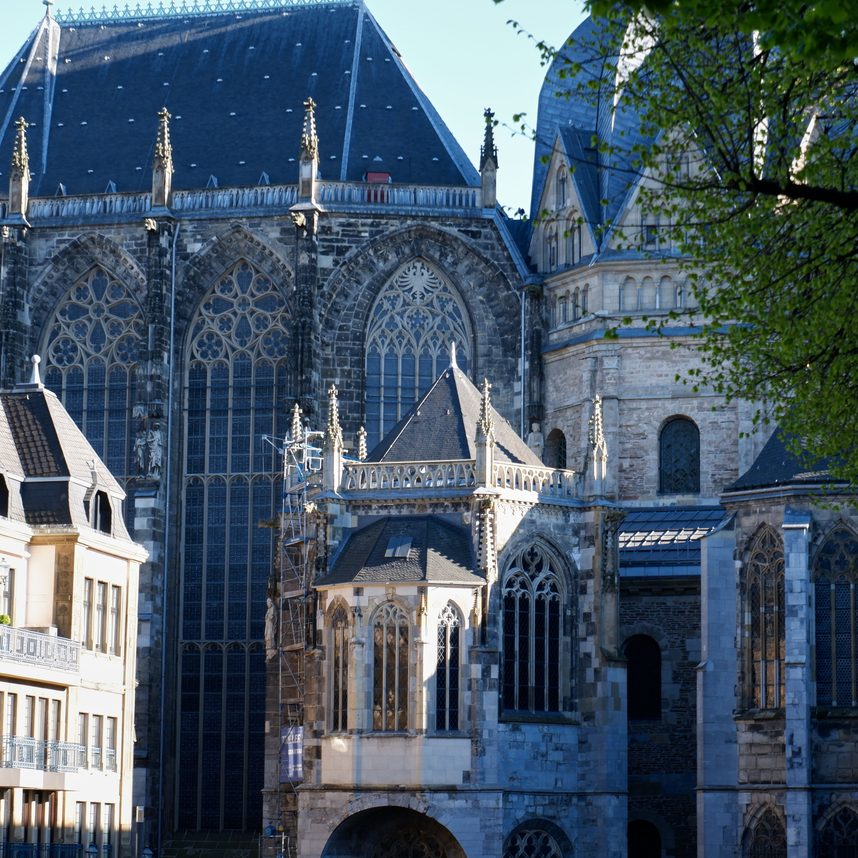
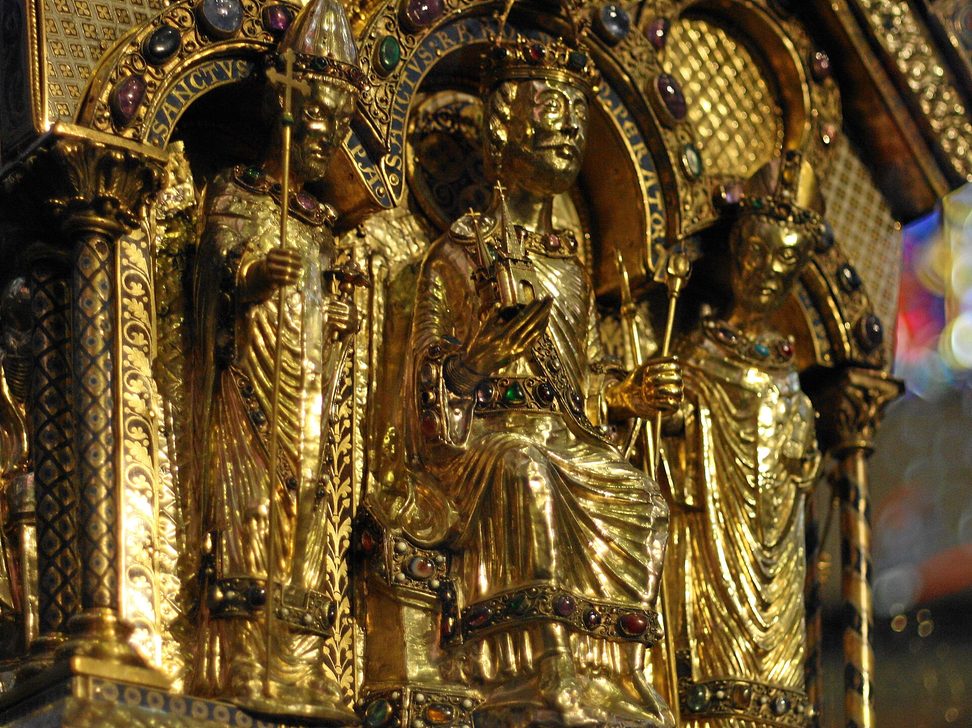
East of the octagon, the choir is almost all glass, its windows about 25 metres high. In it stand the two great shrines: the Shrine of Charlemagne, finished in 1215, and the Shrine of Mary of 1239, which holds the four relics shown to pilgrims every seven years. The high altar is faced with the Pala d’Oro, a gold altar front of around 1020, and on the south side the Ambo of Henry II, a pulpit of gilded copper and ivory given between 1002 and 1014.
The treasury
Round the corner, the treasury is one of the most important in northern Europe: the Cross of Lothair, set with a cameo of the Emperor Augustus; a silver and gold bust of Charlemagne made in the fourteenth century to hold part of his skull; a Roman marble sarcophagus said to have held his body; and ivories, gold book covers and the crown of Margaret of York.
Tickets and tours
Book the guided tour
The cathedral’s own tours are booked online through the Aachen Cathedral website up to a month ahead, or bought at the Dom-Information if places are left. Treasury tickets are sold only at the Dom-Information. Tour operators also run old-town walks that include the cathedral.
Tour and hotel links go to GetYourGuide and Booking.com. This site earns nothing from them at present — they are here because they are the quickest way to check what is actually available.
Don’t miss
- The octagon Charlemagne’s chapel, under its gold dome.
- The throne In the gallery, on the guided tour.
- The Barbarossa chandelier Hanging in the centre of the octagon.
- The Shrine of Charlemagne In the Gothic choir.
- The Pala d’Oro The gold altar front.
- The bust of Charlemagne In the treasury.
Insider tips
Book the 2pm English tour and do the treasury before it. The treasury opens at 10am, before the cathedral opens to visitors, so you can see it first and then join the tour. On Mondays the treasury closes at 2pm.
Have a euro coin ready for the photo permit, which goes to the cathedral attendants. Flash, tripods and selfie sticks are not allowed.
Every seven years the cathedral’s four great relics are shown to pilgrims in the Aachen Pilgrimage, the Heiligtumsfahrt; the next is due in 2028. Avoid the Carnival days in February or early March, when the treasury is shut.
Walk across the Katschhof to the town hall, built on the foundations of Charlemagne’s palace hall, and on to the Elisenbrunnen, where the hot springs that drew him to Aachen still flow.
Common questions
Is Aachen Cathedral free to enter?
Yes, the cathedral is free. Taking photographs inside needs a €1 photo permit. The treasury costs €8, and the upper gallery with Charlemagne’s throne can only be seen on a guided tour, €8.50.
Can I see Charlemagne's throne?
Only on a 45-minute guided tour, which also takes you into the Gothic choir. Tours in English run daily at 2pm; groups are small, and they can be booked online up to a month ahead.
What are the opening hours of Aachen Cathedral?
For visitors, Monday to Thursday 11am to 6pm, Friday and Saturday 11am to 7pm, and Sunday from 1pm until about 5.30pm. There is no sightseeing during services, and opening is later on wedding Saturdays.
Is Charlemagne buried in Aachen Cathedral?
Yes. He was buried in his chapel in 814, though the exact place is not known, and since 1215 his remains have rested in the gold Shrine of Charlemagne in the choir.
Can I buy treasury tickets online?
No. Treasury tickets are sold only at the Dom-Information on Johannes-Paul-II.-Straße, round the corner from the cathedral, which is also where the guided tours start.
How long do I need at Aachen Cathedral?
About an hour and a half to two hours: 45 minutes for the guided tour, and about the same for the treasury.
Where to stay and eat nearby
The cathedral is in the small, walkable old town, between the market square and the station. Aachen is an easy day trip from Cologne, Liège or Maastricht. Try the local Printen, spiced gingerbread, in the shops round the cathedral.
More churches in Germany
- Cologne Cathedral — 35 minutes to an hour away by train.