
Cologne Cathedral
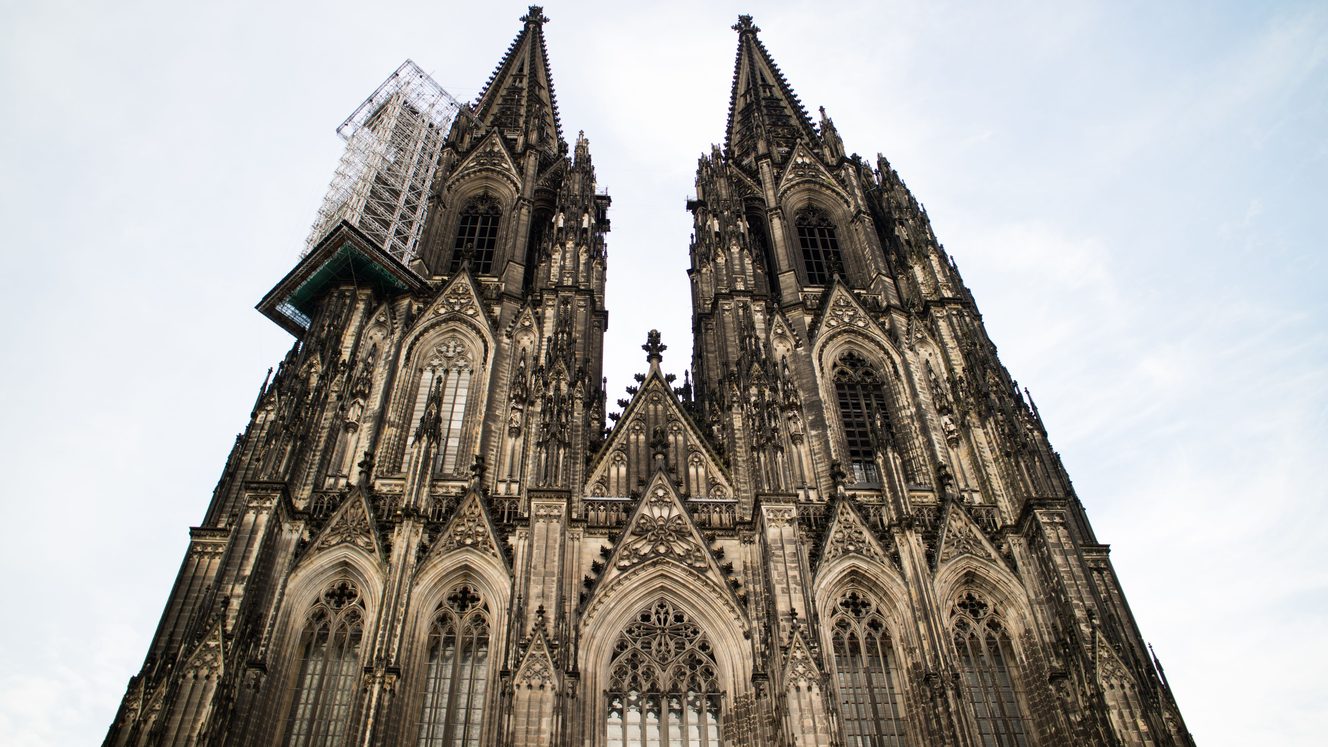
Step out of Cologne’s main station and the cathedral is simply there, a cliff of black-weathered Gothic stone filling the sky. It took 632 years to build, from 1248 to 1880, and for four years it was the tallest building on earth. It was built to house the relics of the Three Kings, which still lie in their gold shrine behind the high altar. One thing has changed: since July 2026 tourists pay to go in. Here is how the new tickets work, what is still free, and what to see.
Six centuries in the making
In 1164 Archbishop Rainald von Dassel brought the relics of the Three Kings to Cologne from Milan, spoils of the Emperor Frederick Barbarossa’s Italian wars. Pilgrims followed in such numbers that the old cathedral could not cope, and on 15 August 1248 Archbishop Konrad von Hochstaden laid the foundation stone of a new one, modelled on the latest French Gothic. The choir was consecrated in 1322. Then the money and the will ran out. Work petered out in the late fifteenth and early sixteenth centuries, and for more than 300 years the south tower stood unfinished at about 56 metres, with a medieval crane on top that became the city’s landmark.
Romantic enthusiasm for the Middle Ages, the rediscovery of the medieval plans and Prussian patronage revived the project. King Friedrich Wilhelm IV laid a new foundation stone in 1842, and the cathedral was completed on 15 October 1880 to the original design, 157 metres tall: the tallest building in the world until the Washington Monument overtook it in 1884. It is still the tallest twin-spired church. In the Second World War it was hit by 14 high-explosive bombs but stayed standing while the city around it was flattened. It has been a World Heritage Site since 1996.
The visitor’s cheat sheet
| Where | Domkloster 4, 50667 Cologne, right beside the main station (Köln Hauptbahnhof). Tickets from the Kurienhaus, Roncalliplatz 2, or online |
|---|---|
| Opening hours | Tourist visits Monday–Saturday 10am–5.45pm, last entry 5.30pm; Sundays and church holidays 1.30pm–4.30pm, last entry 4.15pm. Open for worship 6am–8pm. Times change at short notice for services |
| Admission | €12, reduced €6; under-14s free. Charged since 1 July 2026; services stay free, and so do prayer and candles, through the North Portal |
| Tower | 533 steps, no lift; €8 (reduced €4). March–October 9am–6pm, November–February 9am–4pm, last entry 30 minutes before closing |
| Treasury | Daily 10am–6pm; €8 (reduced €4), or €12 together with the tower |
| Closed | Tower and treasury close on 1 January, the main Carnival days, 11 November, and 24, 25 and 31 December |
| Bags and dress | Bags no bigger than 40 × 35 × 15 cm, and no left luggage; shoulders covered, men remove hats |
| How long | An hour inside; another hour for the tower |
Hours and admission checked against the official site in October 2026. They change; the official site is always the last word.
Cologne Cathedral now charges tourists. Since 1 July 2026 a sightseeing visit costs €12 (reduced €6; children up to 13 free), booked online up to three months ahead or bought at the Kurienhaus ticket office on Roncalliplatz. Ticket holders enter by the main west portal. Services are still free, and so are prayer and lighting a candle, through the North Portal. The KölnCard gives no discount on the interior or the tower, only on the treasury.
What to see, in the order you meet it
The west front
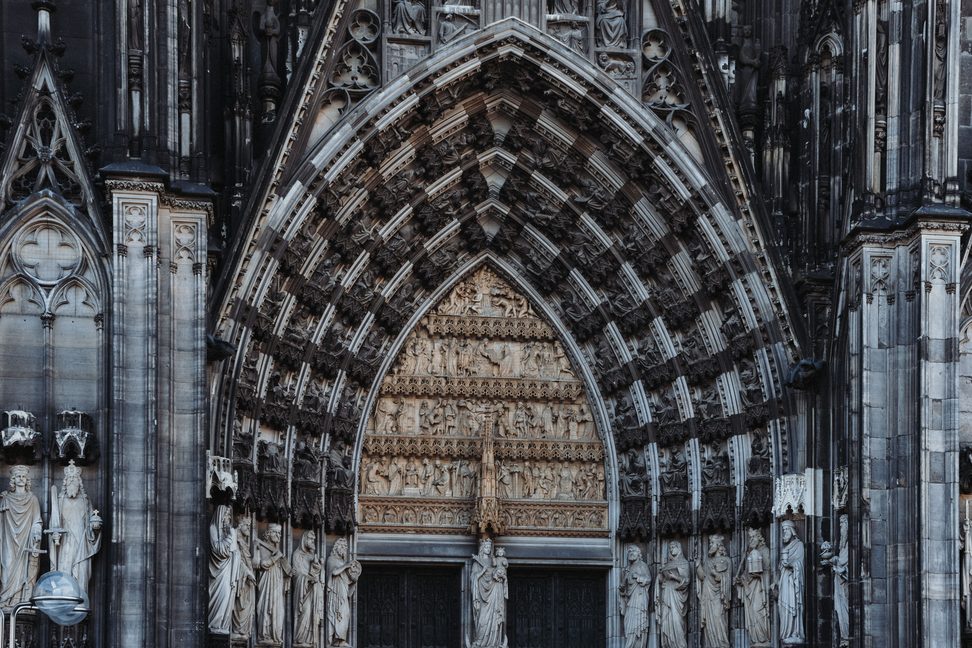
Stand back on the square first, though it is hard to get the whole thing in. The two towers, 157 metres high, rise from a single west front. Almost all of what you see is nineteenth-century work, built faithfully to a medieval drawing; the oldest part of the façade is the lower south tower, on the right. The portals are lined with carved figures, and the stone is dark because the sandstone has weathered almost black.
The nave
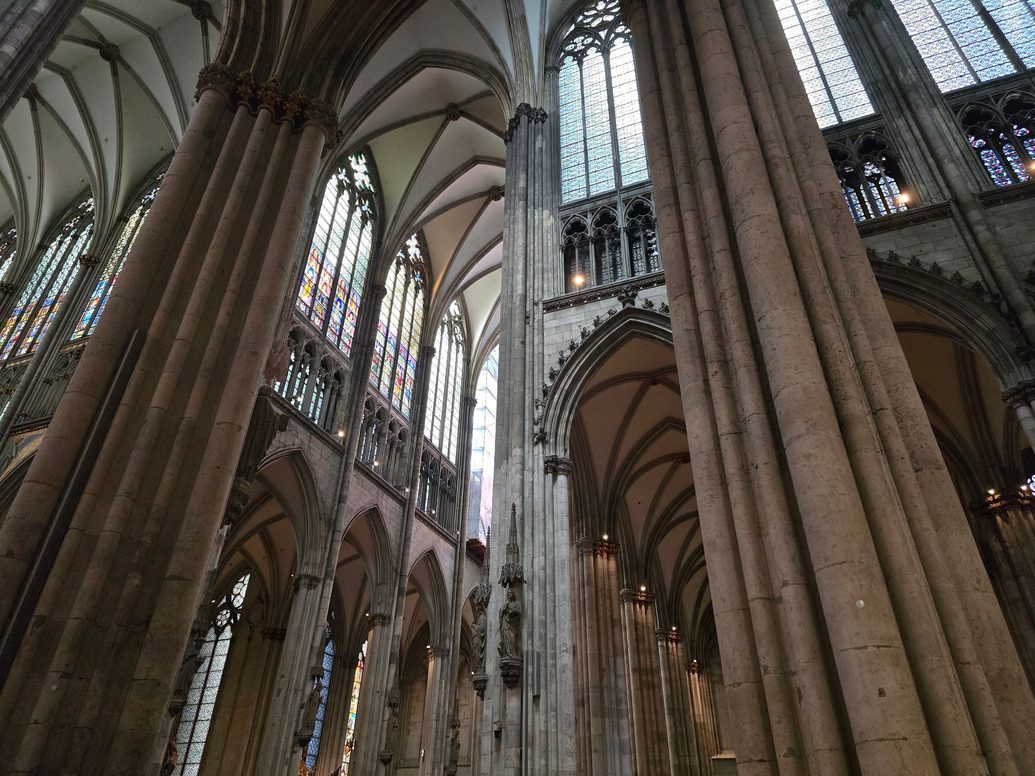
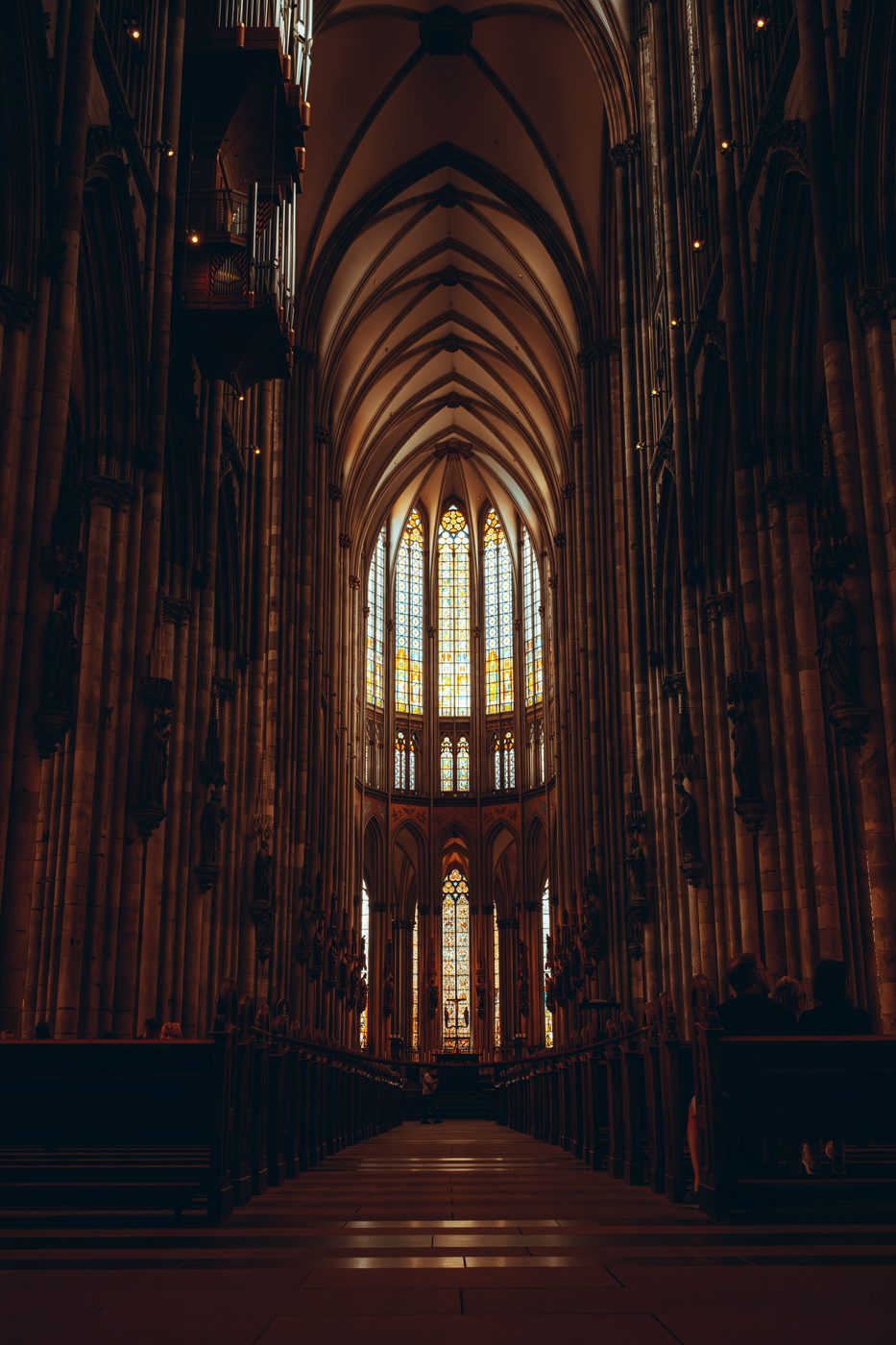
Inside, the scale takes over. The vault of the central nave is more than 43 metres high, and the piers rise unbroken to meet it. The windows of the south aisle were given by King Ludwig I of Bavaria in 1848, and are known as the Bavarian windows. In the chapels round the choir, look for the Altar of the City Patrons, painted by Stefan Lochner around 1442 and one of the finest works of the Cologne school, in the Lady Chapel; the Milan Madonna, a carved figure of around 1290, is in the Sacrament Chapel, in the free prayer area.
The Shrine of the Three Kings
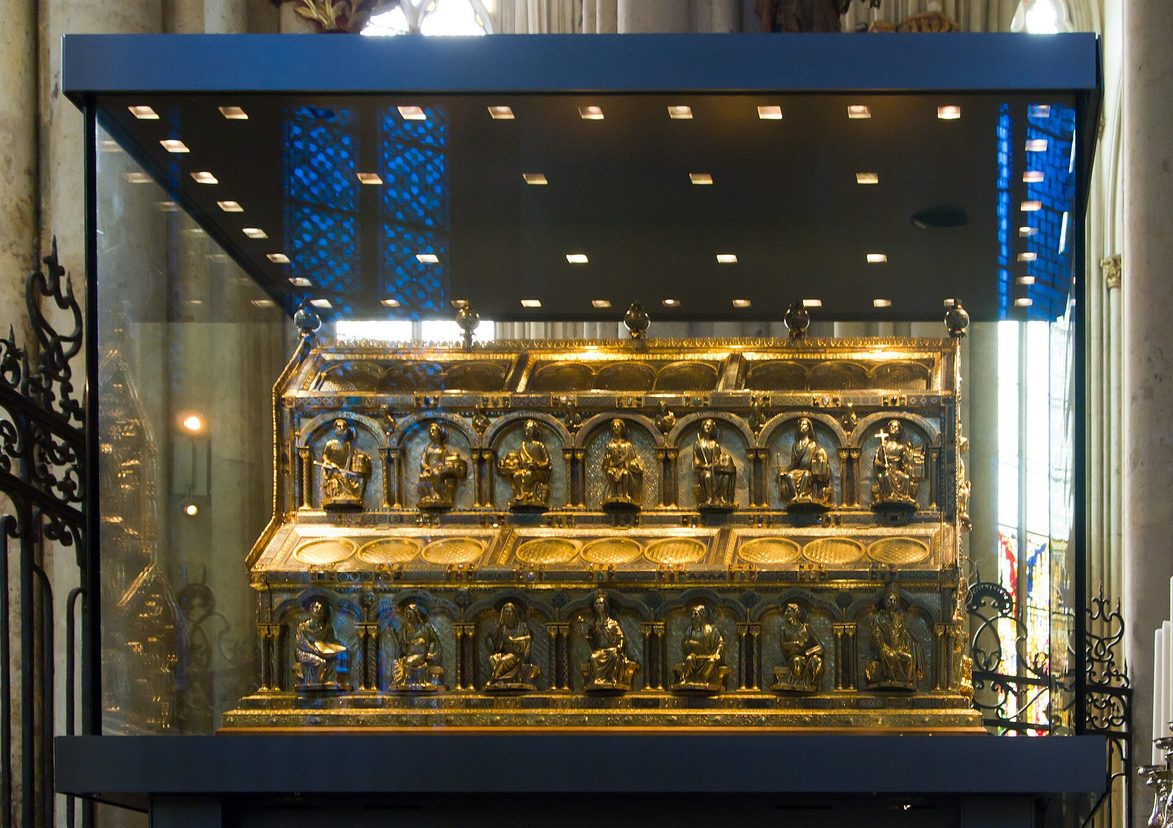
Behind the high altar, in a glass case, is the reason the cathedral exists: the Shrine of the Three Kings, a gilded silver reliquary shaped like a church, covered in enamel, gems and figures of prophets and apostles. It was begun around 1190 by the goldsmith Nicholas of Verdun and finished in the early thirteenth century. It is the largest reliquary of the Middle Ages. The three crowns on the city of Cologne’s coat of arms are theirs.
The Gero Cross
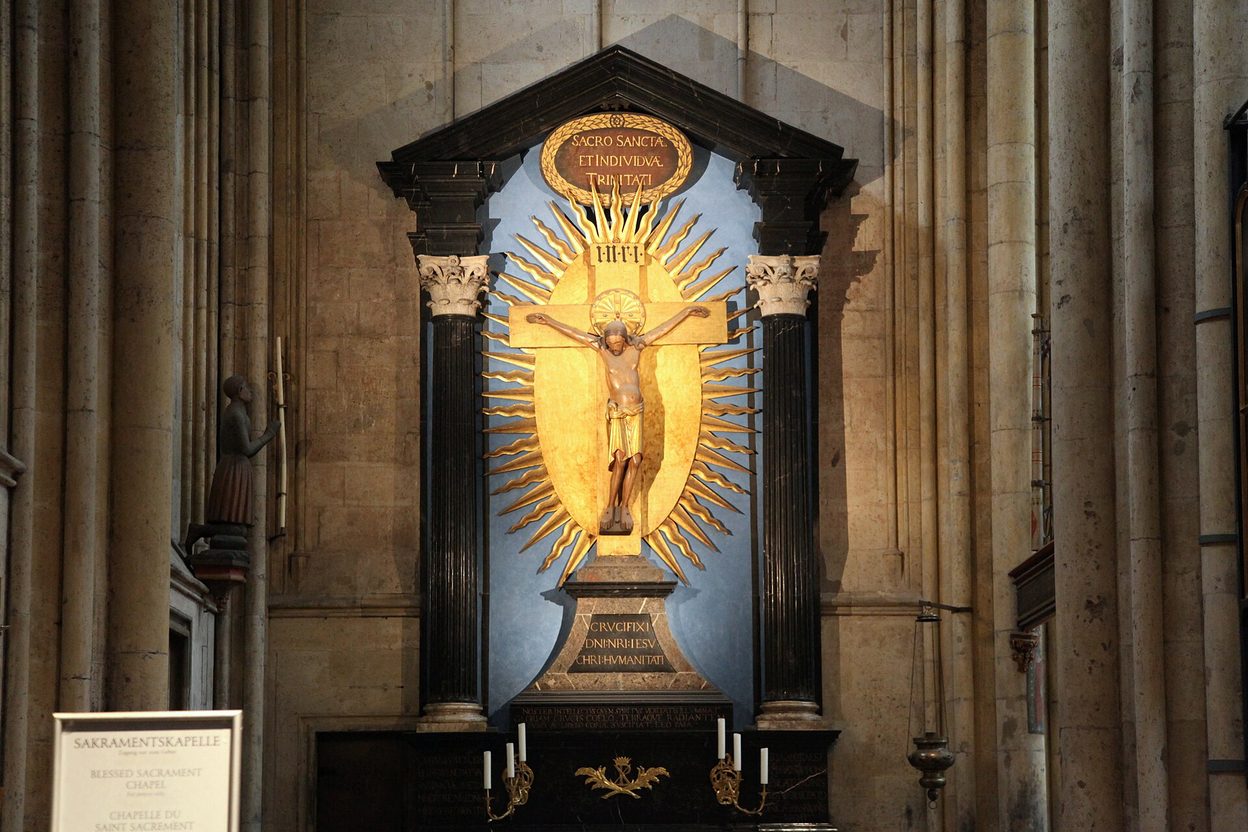
In a chapel off the ambulatory hangs the Gero Cross, carved in oak around 970 for Archbishop Gero. Christ is shown dead, his head dropped and his body sagging, which was new in its day. It is the oldest surviving large crucifix north of the Alps, set in a gilded Baroque sunburst and marble altar added in 1683.
The windows
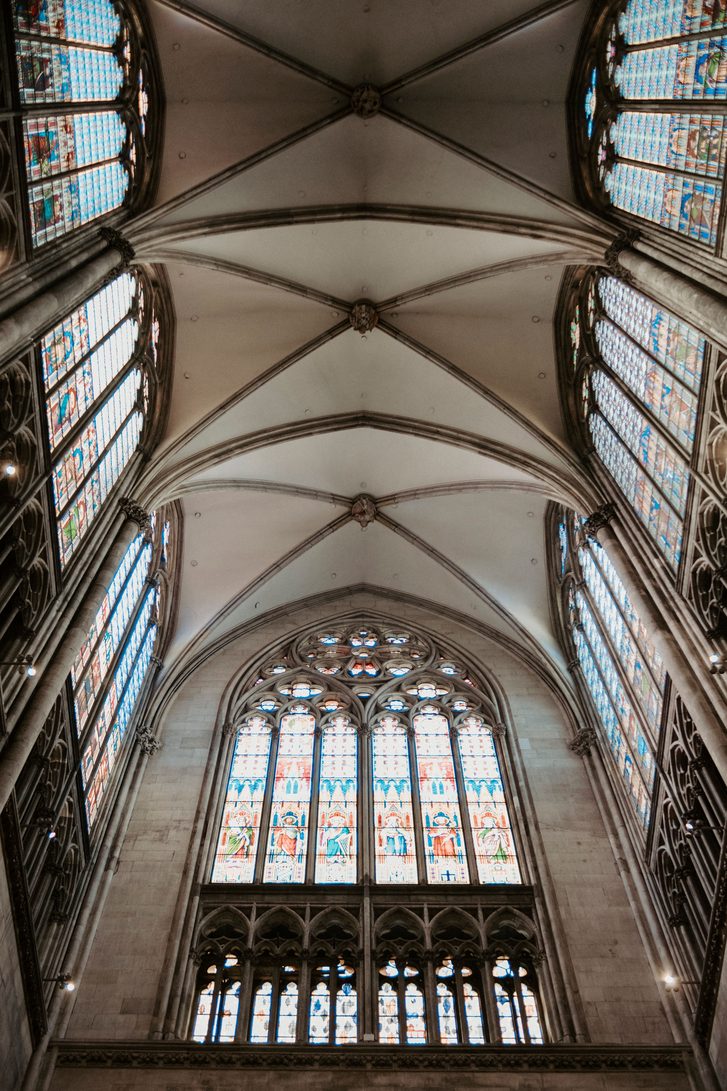
The glass spans more than seven centuries, from the Bible Window of about 1260 in the axial chapel to Gerhard Richter’s window in the south transept, unveiled in 2007: 11,263 squares of glass in 72 colours, arranged partly at random. On a sunny afternoon it throws coloured light across the floor.
The tower
The climb is up the south tower, 533 steps on a narrow spiral stair and then a metal one, past the bell chamber where St Peter’s Bell hangs. Cast in 1923 and weighing about 24 tonnes, it is one of the largest free-swinging bells in the world and is rung only on major feasts. The platform is about 100 metres up, with the Rhine and the whole city below. The bell chamber is closed on Sundays and holidays until 2pm.
Tickets and tours
Book the interior, the tower or a guided tour
Interior tickets are sold online in time slots and at the Kurienhaus on Roncalliplatz; tower and treasury tickets separately. Guided tours, including the roofs and the excavations, are run by the cathedral’s Domforum and need an interior ticket as well. Tour operators also combine the cathedral with a walk round the old town.
Tour and hotel links go to GetYourGuide and Booking.com. This site earns nothing from them at present — they are here because they are the quickest way to check what is actually available.
Don’t miss
- The Shrine of the Three Kings Behind the high altar.
- The Gero Cross In its chapel off the north side of the ambulatory.
- Lochner’s altarpiece The Altar of the City Patrons, in the Lady Chapel.
- The Richter window South transept; best on a sunny afternoon.
- The view from the tower 533 steps, about 100 metres up.
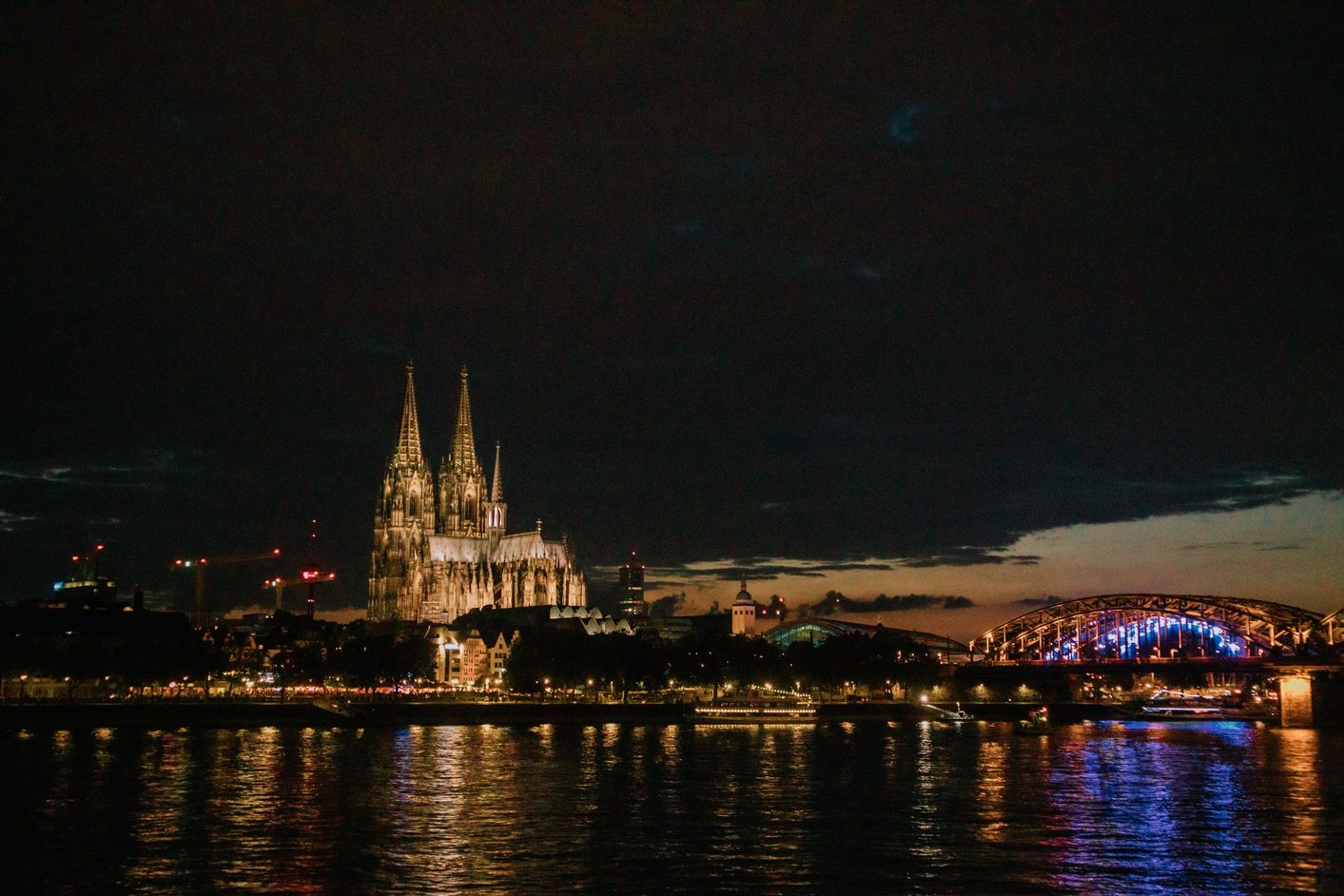
- The view from Deutz Across the Hohenzollern Bridge, especially at dusk.
Insider tips
Book a time slot and come early in the day. Interior tickets are sold in time slots and the Kurienhaus queue can be long. A morning slot on a weekday is the quietest; on Sundays the interior opens to visitors only from 1.30pm to 4.30pm.
To hear the cathedral rather than just see it, go to Mass. The services, with the cathedral choirs and the organ on Sundays, are free; at service times you normally go in by the main portal.
The tower and the treasury are separate tickets, and combine for €12. The treasury, in the medieval vaults beneath the sacristy on the north side, holds reliquaries, liturgical vessels and vestments.
For the photograph everyone wants, walk across the Hohenzollern Bridge, past the thousands of love locks, to the Deutz bank, and look back at sunset.
Common questions
Is Cologne Cathedral free to enter?
Not for sightseeing any more. Since 1 July 2026 tourists pay €12 (reduced €6, under-14s free) to visit the interior. Going to a service, praying or lighting a candle is still free.
How many steps are there to the top of Cologne Cathedral?
533, with no lift. The viewing platform in the south tower is about 100 metres up. The climb costs €8, or €12 with the treasury, and takes 30 to 45 minutes up and down.
What are the opening hours of Cologne Cathedral?
Tourist visits run Monday to Saturday from 10am to 5.45pm and on Sundays and church holidays from 1.30pm to 4.30pm. The building itself is open from 6am to 8pm for services and prayer.
How long did Cologne Cathedral take to build?
632 years. The foundation stone was laid in 1248, work petered out in the late Middle Ages and stopped for about three centuries, and the cathedral was finally completed in 1880.
Who is buried in the Shrine of the Three Kings?
The relics venerated as the Three Kings, or Magi, brought from Milan in 1164. The gold shrine, begun by Nicholas of Verdun around 1190, is behind the high altar, and the cathedral was built to house it.
Can I take luggage into Cologne Cathedral?
Only small bags, no bigger than 40 by 35 by 15 cm. There is no left luggage at the cathedral; use the lockers in the station next door.
Where to stay and eat nearby
The cathedral stands beside the main station, a few minutes from the old town along the Rhine, where the brewery taverns serve Kölsch in small glasses. Hotels round the cathedral square are expensive; Deutz, across the river, is good value and has the view.
More churches in Germany
- Aachen Cathedral — Charlemagne’s chapel, 35 minutes to an hour away by train.