
Sant’Apollinare Nuovo, Ravenna
Sant’Apollinare Nuovo was built by Theodoric, the Gothic king of Italy, as his palace church around 500, and both walls of its long nave are still covered in mosaics: a procession of martyrs on one side and of virgins on the other, Theodoric’s own palace, the port of Classe and one of the oldest picture cycles of Christ’s life. It is part of Ravenna’s UNESCO World Heritage Site, ten minutes from the station, and sold on the same combined ticket as San Vitale.
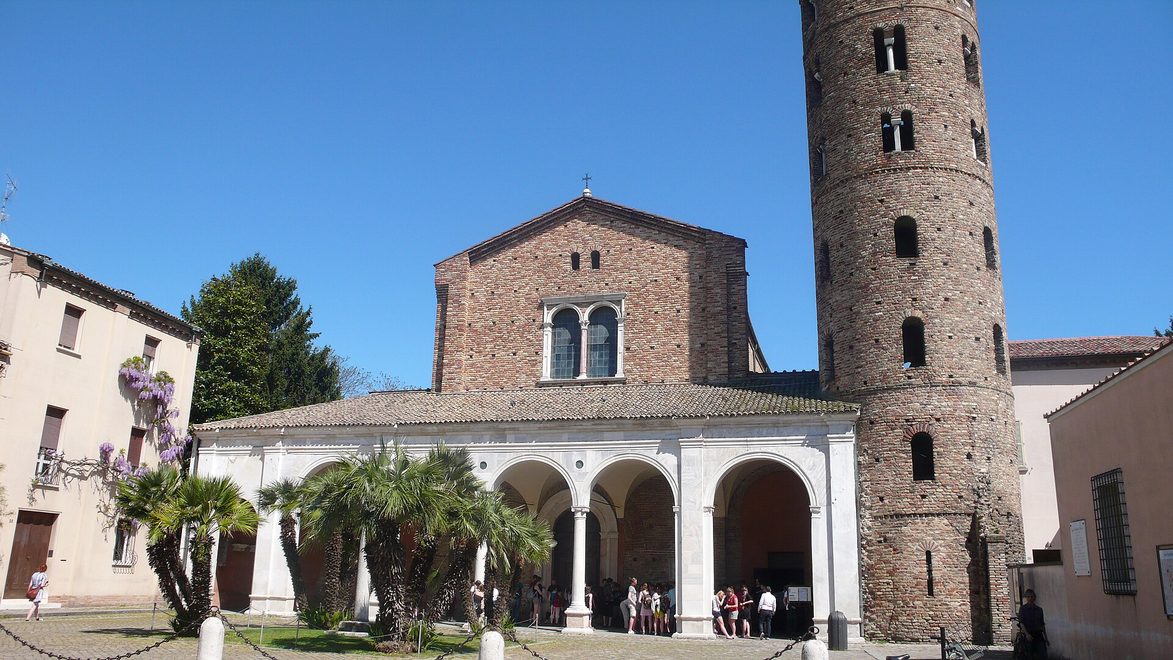
Theodoric’s church, and how it changed
Theodoric the Great, the Ostrogothic king who ruled Italy from Ravenna between 493 and 526, built this basilica beside his palace in the early 6th century, probably around 500–505, for Arian Christians like himself; its dedication inscription named Christ. After Justinian’s armies took Italy, Arian churches passed to the Catholic Church, and around 561 Archbishop Agnellus rededicated it to St Martin of Tours, a saint known for fighting heresy. Its gilded ceiling earned it the name San Martino in Ciel d’Oro, St Martin in the Golden Sky.
Agnellus also had the lowest band of mosaics redone, replacing Theodoric’s court and other figures with the processions of saints we see now. In the 9th century relics believed to be those of St Apollinaris, Ravenna’s first bishop, were brought here from his basilica at Classe, which was exposed to raids, and the church took his name; “Nuovo” distinguishes it from Sant’Apollinare in Classe. The original apse and its mosaics were lost by the 7th or 8th century, probably in an earthquake, and the present apse is a later rebuilding. The marble portico is 16th-century. With seven other early Christian monuments of Ravenna it was made a UNESCO World Heritage Site in 1996.
The visitor’s cheat sheet
| Where | Via di Roma 53, Ravenna; about 10 minutes’ walk from the station |
|---|---|
| Opening hours | 3 November 2026–6 March 2027: daily 10am–5pm, last entry 4.30pm. Summer season (8 March–2 November in 2026): daily 9am–7pm, last entry 6.30pm. Closed 25 December and 1 January |
| Admission | Combined tickets only: two monuments (with San Vitale) €10.50, four €12.50, five €14.50 (reduced €9.50, €11.50, €13.50). Booked for a chosen date; the diocese says valid seven consecutive days. Electronic payment only (no cash) |
| Tickets | Ticket office at the basilica, or online at ravennamosaici.it; no timed slot needed here |
| Photography | Allowed without flash; no tripods or selfie sticks |
| How long | 30–45 minutes |
Hours and admission checked against the official site in October 2026. They change; the official site is always the last word.
What to see
The two walls
The mosaics are in three bands on each side of the nave, above 24 Greek marble columns. They are easiest to read from the middle of the nave, facing the altar: the left wall is the north wall, the right wall the south.

The processions
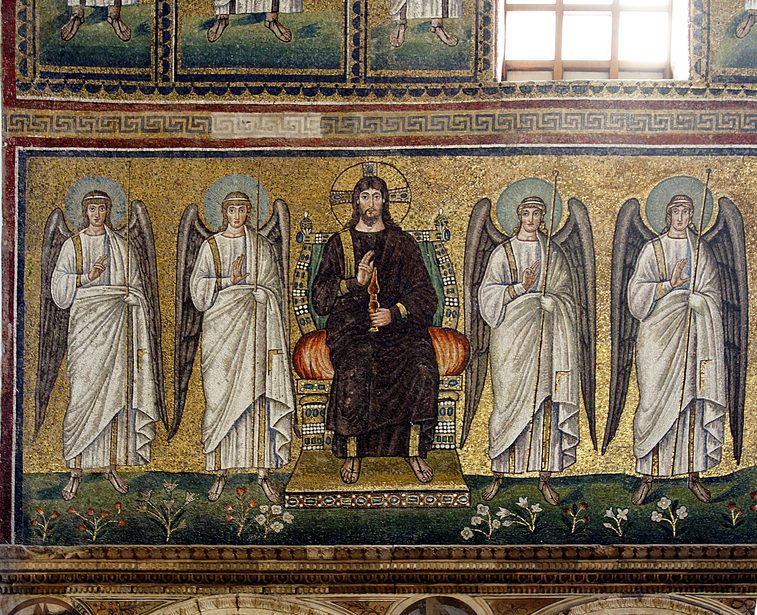
On the south wall, 26 male martyrs, led by St Martin and dressed in white, carry their crowns out of the city of Ravenna towards Christ, enthroned among four angels. Opposite, 22 virgin martyrs walk out of the port of Classe towards the Virgin and Child, led by the Three Magi in Persian trousers and caps, their names written above them — thought to be one of the earliest examples of the names Balthassar, Melchior and Gaspar in art. The saints are Agnellus’s work of around 561; the enthroned Christ and Virgin and the two city scenes survive from Theodoric’s time.



The palace and the port
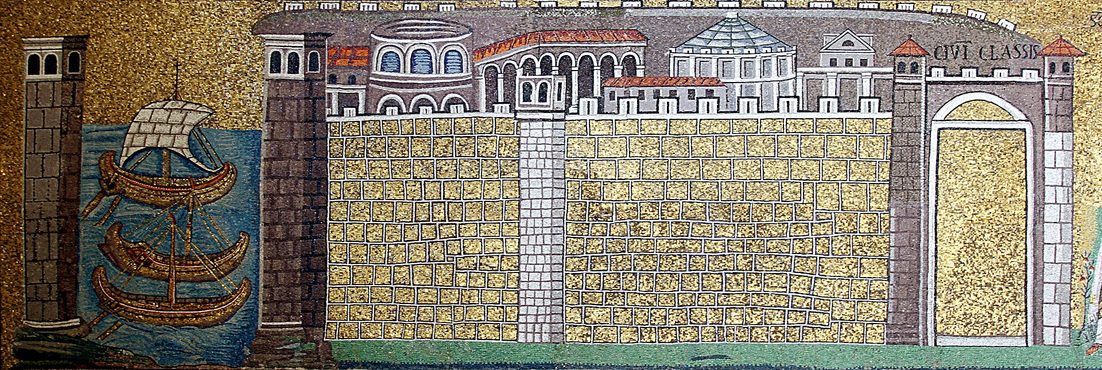
At the west end of the south wall is Theodoric’s palace, labelled PALATIUM. Figures once stood between its columns — almost certainly the king and his court — but they were removed and replaced with curtains when the church passed to the Catholics; look closely and you can still see hands against several columns. On the north wall the matching scene is the walled port of Classe, with three ships in its harbour.

The life of Christ
High up, between the windows, are prophets and saints, and above them, on each wall, 13 small scenes from Theodoric’s time. On the north wall are Christ’s miracles and parables, with a young, beardless Christ; on the south wall the Passion and Resurrection, with Christ bearded. The Last Supper on the south wall, with Christ and the apostles reclining at a semicircular table, is among the oldest surviving pictures of the scene in mosaic. Binoculars help.
The bell tower
The round brick bell tower beside the portico was added in the 9th or 10th century, like several others in Ravenna.

Getting there
The basilica is on Via di Roma, about ten minutes’ walk from Ravenna station and about 15 from San Vitale. Trains from Bologna take about an hour to an hour and a quarter. The ruins called the Palace of Theodoric are a few steps south along the same street. To reach Sant’Apollinare in Classe, 5 km south, take bus 4 (check the Start Romagna timetable) or the train one stop to Classe; it is a state museum with its own ticket (€5), and opens only from 1.30pm on Sundays to Wednesdays.
Tours and where to stay
The ticket office here is one of the two the diocese lists for same-day tickets, so it is a good place to start the round. A night in Ravenna lets you see the mosaics before the day-trippers from Bologna and the coast arrive.
These links go to GetYourGuide and Booking.com. This site earns nothing from them at present — they are here because they are the quickest way to check what is actually available.
Don’t miss
- The Three Magi At the head of the virgins’ procession.
- The hands on the columns In the palace scene, south wall.
- The port of Classe Ships in the harbour, north wall.
- The Last Supper High on the south wall.
- The bell tower Round, brick and over a thousand years old.
Insider tips
Buy here, start here. San Vitale and Galla Placidia draw the queues, while Sant’Apollinare Nuovo is usually quieter and has its own ticket office. Buy the four- or five-monument ticket here, book the timed slots for Galla Placidia and the Neonian Baptistery (and the Archiepiscopal Museum if you take the five-monument ticket), then walk on to San Vitale.
Common questions
Can you buy a ticket for Sant'Apollinare Nuovo alone?
No. It is sold only on the diocese’s combined tickets: €10.50 with San Vitale, €12.50 for four monuments with Galla Placidia and the Neonian Baptistery, or €14.50 for five with the Archiepiscopal Museum. You choose a date when buying; the diocese’s FAQ says tickets are valid for seven consecutive days, one entry per monument.
What are the opening hours?
From 3 November 2026 to 6 March 2027, daily 10am to 5pm, last entry 4.30pm. In the summer season (8 March to 2 November in 2026) it opens 9am to 7pm, last entry 6.30pm. It is closed on Christmas Day and New Year’s Day.
Which wall has which mosaics?
Facing the altar, the left (north) wall has Christ’s miracles, with a young, beardless Christ, above the procession of virgins led by the Magi from the port of Classe. The right (south) wall has the Passion, with a bearded Christ, above the procession of martyrs from Theodoric’s palace.
Can you take photographs inside?
Yes, for personal use and without flash. Tripods, monopods, selfie sticks and professional equipment are not allowed.
How long do you need?
Thirty to forty-five minutes. Bring binoculars, or a camera with a zoom, for the upper rows of mosaics.
More churches in Italy
- San Vitale and Galla Placidia, Ravenna — Justinian and Theodora, on the same ticket.
- St Mark’s Basilica, Venice — another of Italy’s great churches of gold mosaic.
- Monreale Cathedral — Norman Sicily’s answer, six centuries later.