
St Mark’s Basilica
In 828 two Venetian merchants stole the body of St Mark from Alexandria, hid it, the story goes, under a load of pork to get it past the Muslim customs officers, and brought it home. Venice built a church for it beside the doge’s palace, and over the next eight centuries filled it with gold mosaic and the loot of an empire. St Mark’s was the doge’s own chapel, not the cathedral, until 1807. It is the most Byzantine building in western Europe, and visiting it is short and slightly regimented: a timed ticket, a one-way route, no big bags, and on Sunday mornings no tourists at all.
The doge’s church
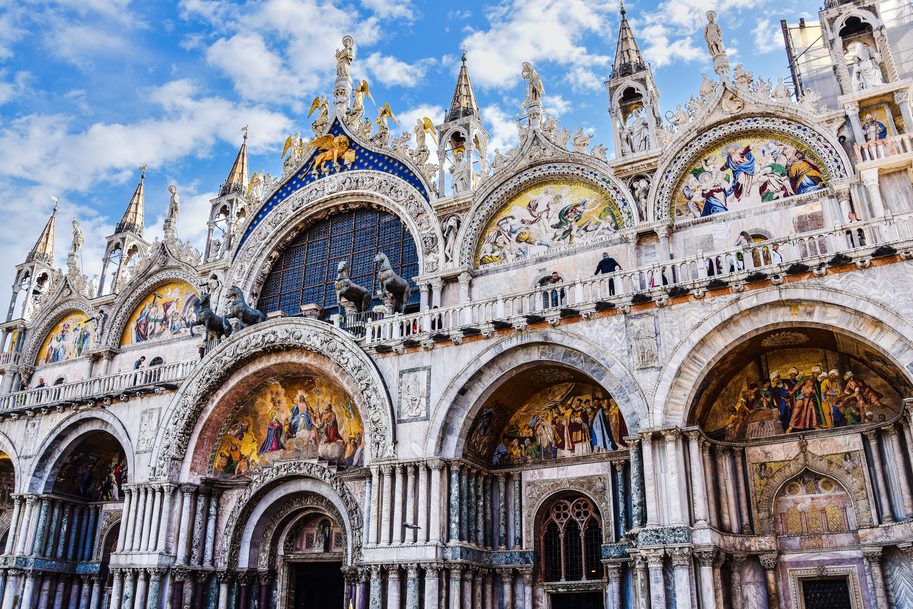
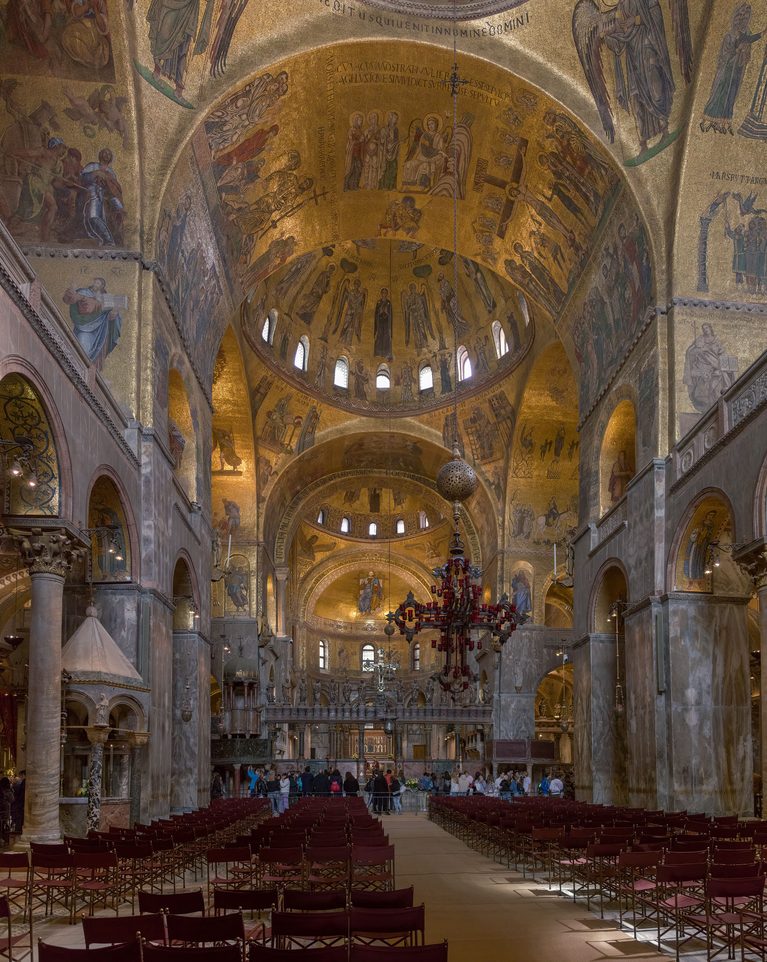
The first church of St Mark was finished by about 836. It burned in a revolt in 976, and the building you see was begun around 1063 under Doge Domenico Contarini and consecrated in 1094. Its model was the Church of the Holy Apostles in Constantinople, the burial church of the emperors: a Greek cross with five domes, one over the crossing and one over each arm. Venice was still half Byzantine in its tastes, and it hired Greek mosaicists.
For the next five centuries the church was a showcase of the Republic. After the Fourth Crusade sacked Constantinople in 1204, the spoils came here: the four horses, columns, carved panels, icons and the treasury of reliquaries. The domes were raised high on timber frames covered in lead, and the Gothic pinnacles went on in the fourteenth and fifteenth centuries. When the Republic fell, Napoleon took the horses to Paris. St Mark’s became the cathedral of Venice in 1807.
The visitor’s cheat sheet
| Where | Piazza San Marco 328, 30124 Venice. Visitors go in by the Porta San Pietro, the second door from the left on the piazza; the Porta dei Fiori on the north side is for those going in to pray |
|---|---|
| Opening hours | Monday–Saturday 9.30am–5.15pm, last entry 4.45pm. Sundays and holy days 2pm–5.15pm. Hours change for services and when the Patriarch is present |
| Admission | €10 for the basilica. Basilica with the Pala d’Oro, or with the museum and loggia, €20; all three €30. Campanile €15, separate. Free for children under 11, disabled visitors with a companion, and residents of Venice and some neighbouring towns; reductions for ages 10–18, students up to 26 and over-65s |
| Tickets | Named, timed tickets on the basilica’s own website. Bring photo ID |
| Dress code | Shoulders and knees covered |
| Bags | No backpacks, luggage or bulky bags. Free deposit at the Ateneo San Basso, on the Piazzetta dei Leoncini beside the north side |
| Photography | Not allowed inside the basilica |
| Sunday mornings | The basilica is closed to visitors for Mass; the museum and loggia open from 9.30am |
| How long | Forty minutes for the basilica; an hour and a half with the Pala d’Oro and the museum |
Hours and admission checked against the official site in October 2026. They change; the official site is always the last word.
Book a timed ticket, and avoid Sunday morning. Tickets are named and sold for a time slot on the basilica’s own website, €10 for the basilica alone; booking saves the long line on the piazza. Paying visitors cannot go in during services, and on Sundays and holy days the basilica does not open to them until 2pm. The Pala d’Oro and the museum are not on the basic ticket: decide before you book.
What to see, in the order you meet it
The façade
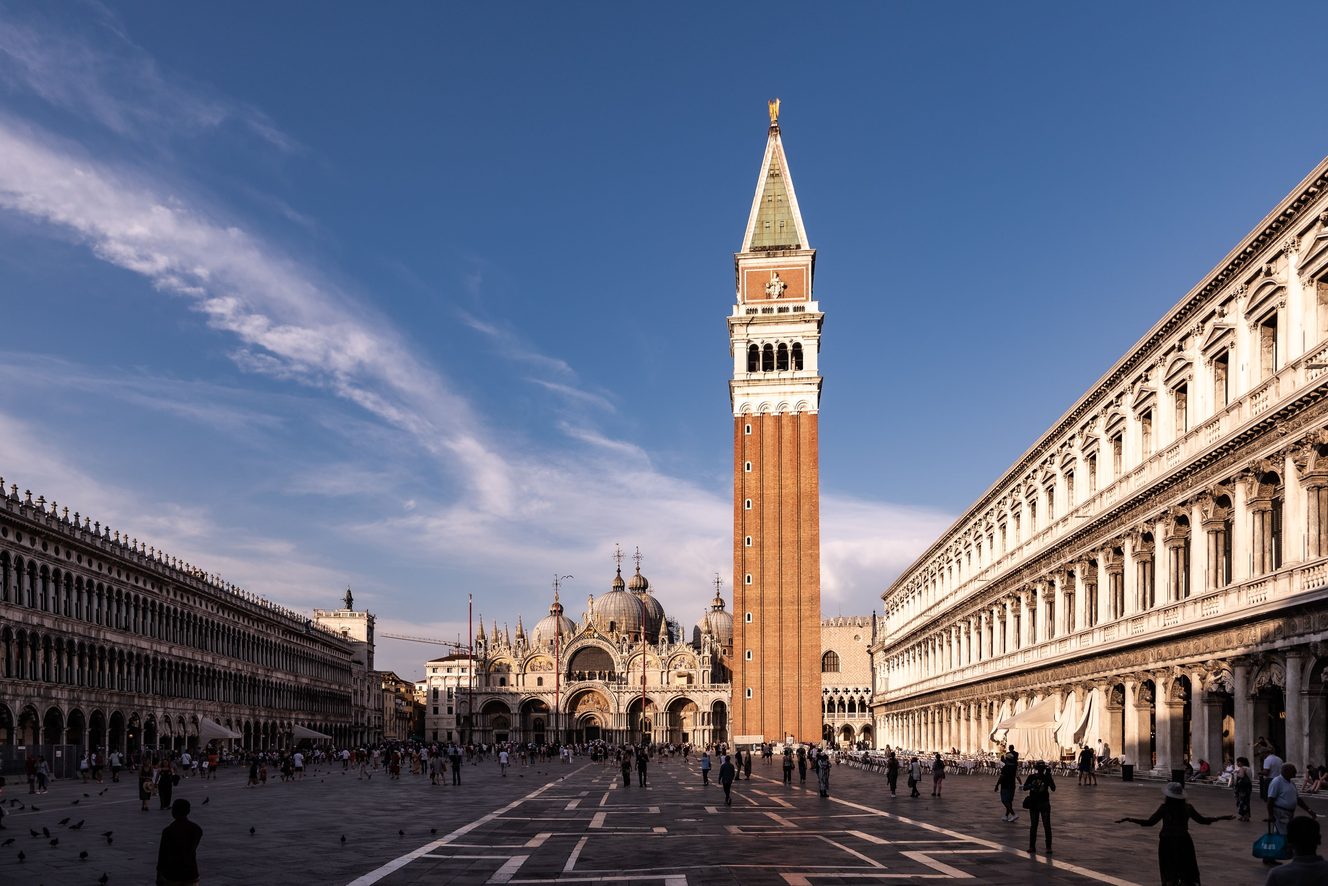
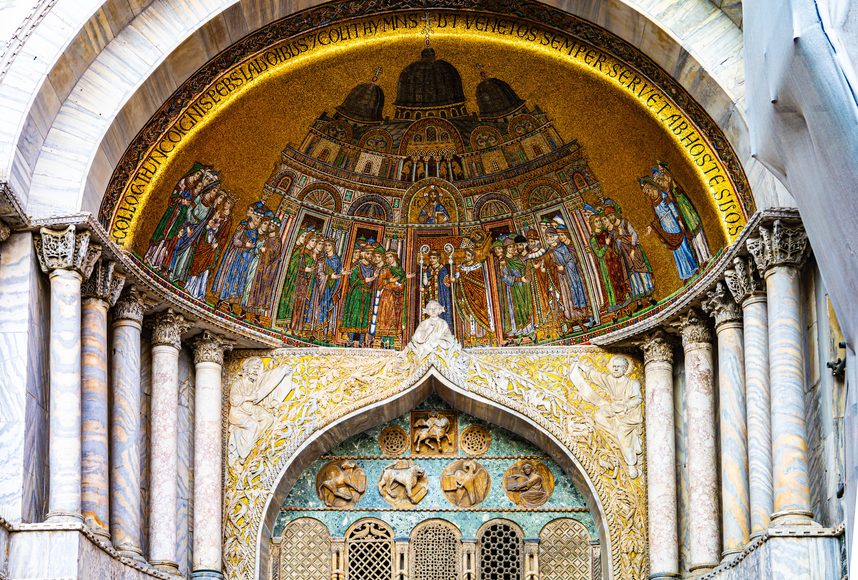
The front is a collage: five great doorways, hundreds of marble columns of every colour brought from the eastern Mediterranean, and gold mosaics in the arches above. Almost all of the mosaics on the front are replacements of the seventeenth century and later. The exception is over the far left door, the Porta di Sant’Alipio: a mosaic of about 1260 showing St Mark’s body being carried into this church, and the church itself as it looked then.
The Tetrarchs
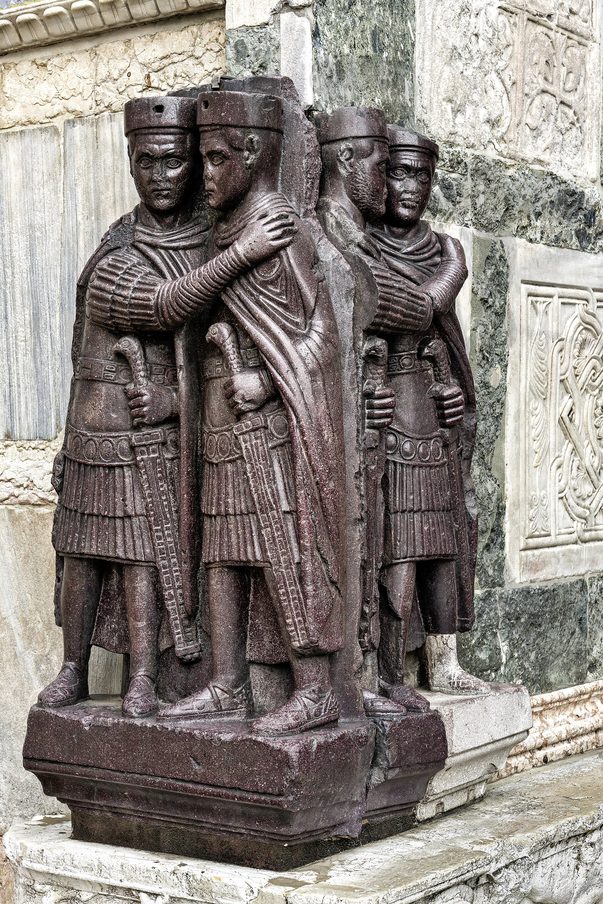
On the corner of the basilica beside the Doge’s Palace, set into the wall, stand four figures in dark red porphyry, clasping each other in pairs: the Tetrarchs, the four emperors who shared the Roman Empire around 300. They were taken from Constantinople after 1204. One of them is missing a foot; the piece was found during excavations in Istanbul in the 1960s, and it is still there, in the Archaeological Museum.
The narthex
You enter through the narthex, the vaulted porch across the front of the church, and the mosaics begin straight away. In the first of the narthex domes is the Creation: God making the world in six days, Adam and Eve, the Fall, worked in the thirteenth century from an early Christian manuscript. The narthex is also the lowest part of the building, the first to flood in high tides; since 2022 glass barriers round the basilica have kept most of them out.
The Golden Church
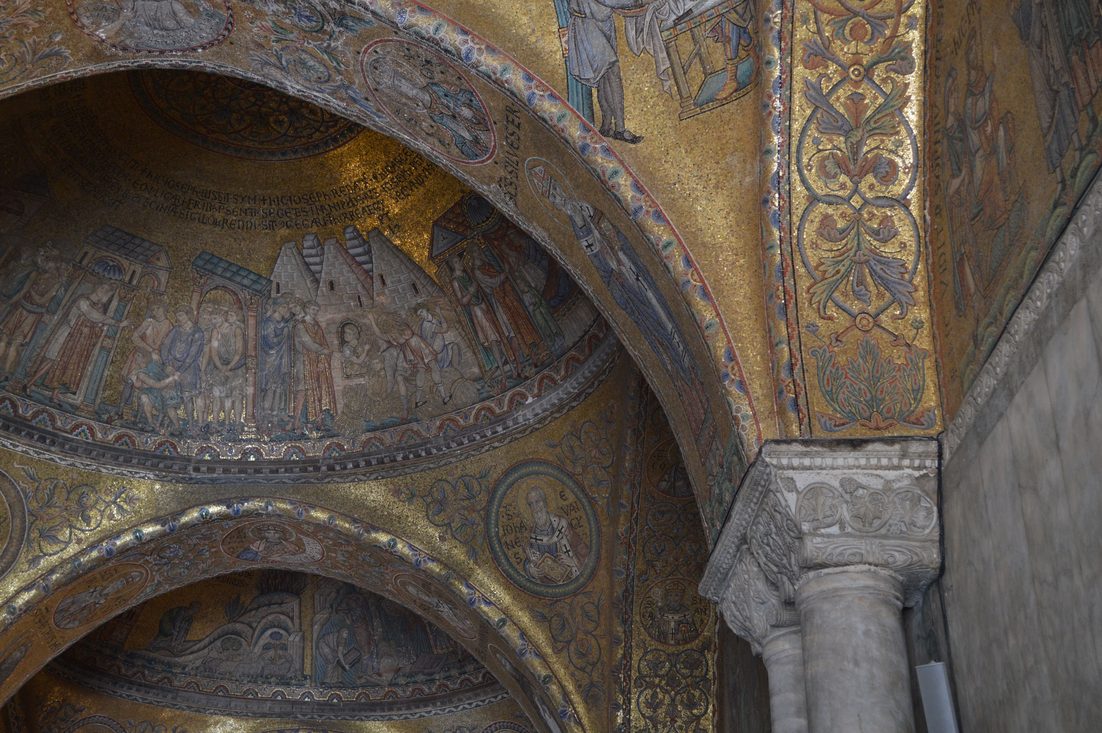
Then the church opens up. Every vault, dome and arch is covered in mosaic on a gold ground, more than 8,000 square metres of it, laid over some eight hundred years, which is why the Venetians called it the Chiesa d’Oro. The light is low and the gold glows from it. The great domes tell the story of the faith: the Pentecost dome over the nave, the Ascension over the crossing, the Emmanuel dome over the altar. Visitors walk a set route on carpet runners laid over the twelfth-century floor, an undulating pavement of marble inlay that has settled into waves over the centuries.

The Nicopeia
On an altar in the left arm of the transept is the Madonna Nicopeia, a Byzantine icon of the Virgin, the “bringer of victory”, which Venice treated as its protector. Like so much here, it probably came from Constantinople.
The Pala d’Oro
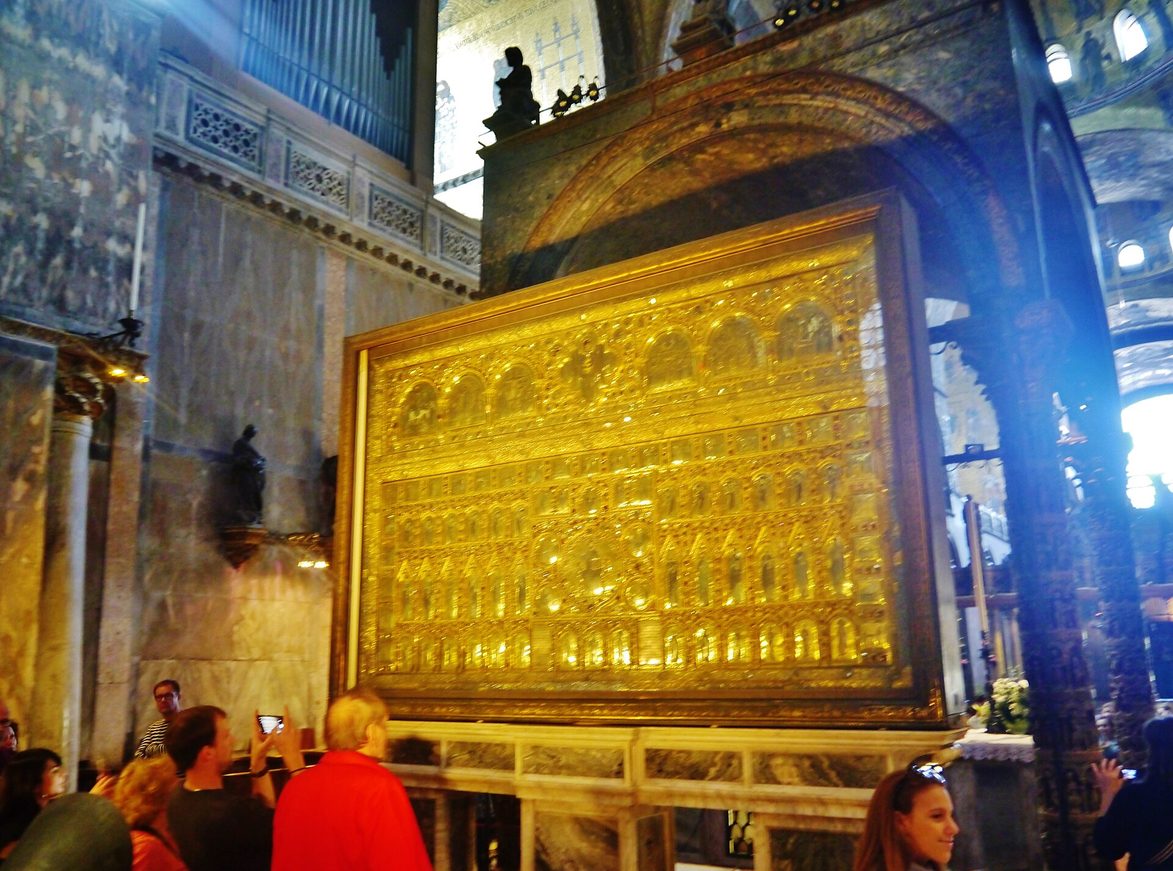
Behind the high altar, under which St Mark’s relics lie, is the Pala d’Oro: a golden altarpiece set with about 250 enamels and close to two thousand precious stones. It was begun in Constantinople, enlarged in the twelfth and thirteenth centuries, and given its present Gothic frame in the 1340s. It needs its own ticket, and it is worth it: you see it close up, from behind the altar.
The museum, the loggia and the horses
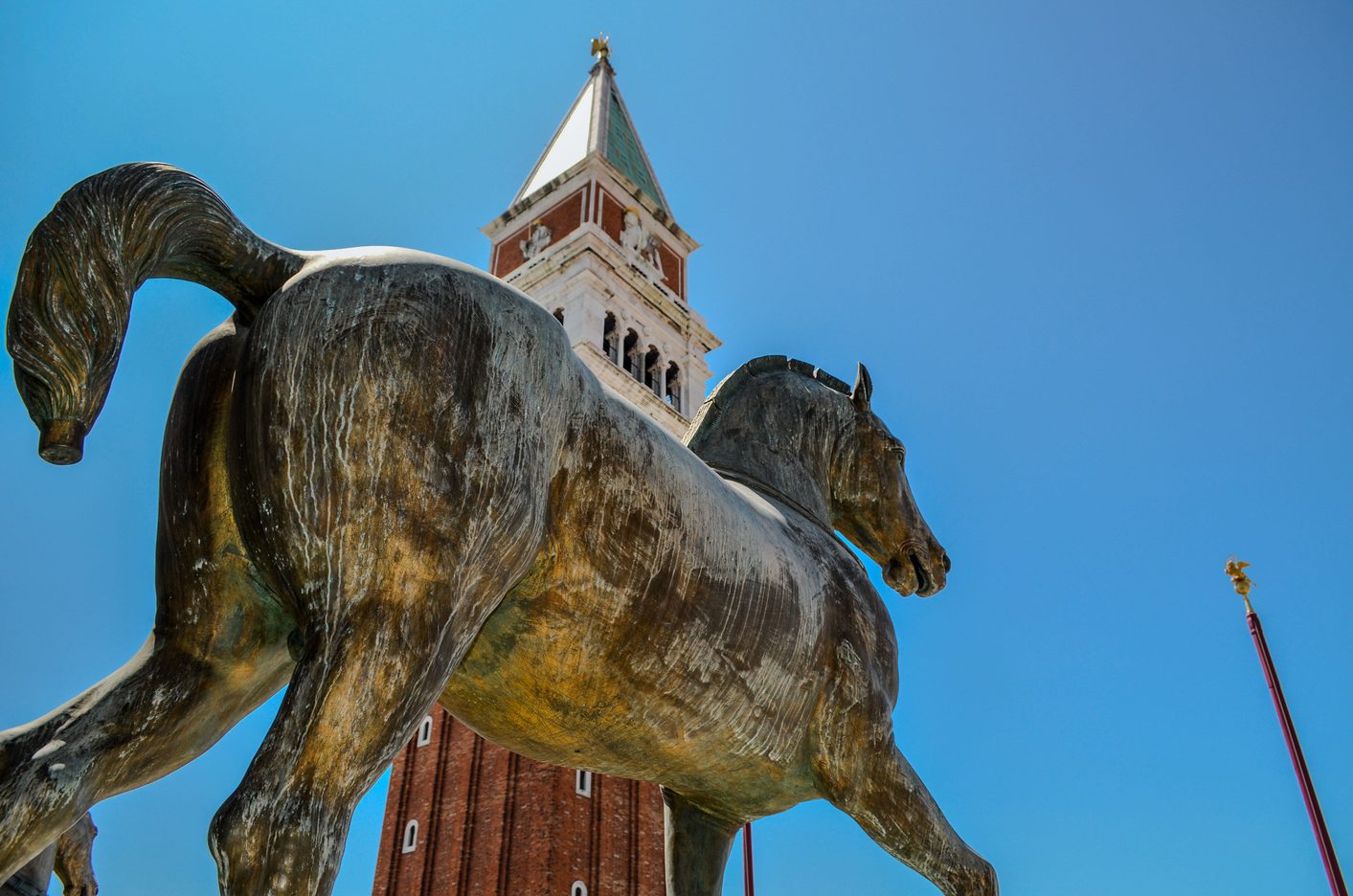
Steep stairs from the narthex lead up to the St Mark’s Museum and the gallery round the inside of the church, where you see the mosaics from close to. The museum holds the four original horses: gilded, copper-alloy, and ancient, though nobody agrees how ancient. They were taken from the Hippodrome of Constantinople in 1204, carried off to Paris by Napoleon in 1797, returned in 1815, and brought indoors in the late twentieth century to save them from pollution. Then you step out onto the loggia, beside their copies, with Piazza San Marco below you: the best view of it there is.


Tickets and tours
Book the basilica online, and decide on the extras first
Buy from the basilica’s own website: €10 for the basilica, €20 with either the Pala d’Oro or the museum and loggia, €30 for everything. Guided tours, including evening visits with the mosaics lit, are sold separately and are the way to see the church without the crowds.
Tour and hotel links go to GetYourGuide and Booking.com. This site earns nothing from them at present — they are here because they are the quickest way to check what is actually available.
Don’t miss
- The Creation dome In the narthex, before you are even inside.
- The Sant’Alipio mosaic The church as it looked in the thirteenth century, over its own door.
- The Pala d’Oro Close up, from behind the altar.
- The horses The originals in the museum, then the copies on the loggia.
- The view from the loggia Piazza San Marco from above.
- The Tetrarchs Four emperors in porphyry, one short of a foot.
Insider tips
Pay for the museum. The basic ticket gives you the floor of the church, which is dim and busy. The museum ticket takes you up to the gallery, level with the mosaics, and out onto the loggia over the piazza. It is the better half of the visit.
Go early in the morning or in the last hour. The cruise and day-trip crowds are thickest from late morning to mid-afternoon.
Sunday morning is Mass, and anyone may attend; you go in to worship, not to look round. The museum is open on Sunday mornings even though the church is not.
Climb the campanile afterwards (separate ticket, and there is a lift). It is the view of the domes from above, and on a very clear day the Alps.
Common questions
How much does it cost to visit St Mark’s Basilica?
The basilica alone is €10. The Pala d’Oro, and the museum with the loggia and the horses, are extra: €20 for the basilica with either, €30 for all three. The campanile is separate, at €15. Children under 11 go free, and there are reductions for ages 10–18, students and over-65s.
Do I need to book St Mark’s Basilica in advance?
It is strongly advised. Tickets are for a timed slot, named, and sold on the basilica’s own website; booking gets you in without joining the long line on the piazza, and in summer the walk-up wait can be long.
What are St Mark’s Basilica’s opening hours?
Monday to Saturday from 9.30am to 5.15pm, last entry 4.45pm. On Sundays and major holy days the basilica opens to visitors only from 2pm; in the morning only the museum is open. Paying visitors cannot go in during services.
What should I wear to St Mark’s Basilica?
Shoulders and knees covered. The rule is enforced at the door. Backpacks, luggage and bulky bags are not allowed either, so leave them at the hotel or at the free deposit beside the basilica.
Are the horses on St Mark’s Basilica real?
The four on the loggia are copies. The originals, gilded copper-alloy horses taken from Constantinople in 1204, were moved indoors to protect them, and are in the St Mark’s Museum upstairs.
Is St Mark really buried in St Mark’s Basilica?
Venice says so. Two Venetian merchants smuggled his body out of Alexandria in 828, and the basilica was built to house it. The relics were lost and, the story goes, miraculously rediscovered in 1094; they now lie under the high altar.
Where to stay and eat nearby
From Santa Lucia station or Piazzale Roma, vaporetto lines 1 and 2 run down the Grand Canal to San Marco Vallaresso and San Zaccaria, both a few minutes’ walk from the basilica; walking takes about 35 to 45 minutes through the lanes. Hotels round the piazza are the most expensive in Venice. Castello, east of San Zaccaria, is quieter and close.
More churches in Italy
- Santa Maria della Salute — the great domed church across the mouth of the Grand Canal.
- Basilica of St Anthony, Padua — half an hour away by train, its domes modelled on St Mark’s.
- Florence Cathedral — two hours by fast train, and Brunelleschi’s dome.
- Milan Cathedral — Gothic marble and 135 spires, two and a half hours west.
- Basilica of San Clemente — Rome’s best medieval mosaic, and three churches stacked underground.
- Santa Maria Maggiore — mosaics a thousand years older than most of St Mark’s.