
Siena Cathedral
Siena’s cathedral is a striped marble Gothic church on the highest hill of the city, with one of the richest interiors in Italy: a floor of inlaid marble pictures, Nicola Pisano’s pulpit, statues by Michelangelo, Donatello and Bernini, and Pinturicchio’s brilliantly coloured library. One pass covers the cathedral, the museum, the crypt and the Baptistery, and in 2026 the floor is uncovered until 15 November.
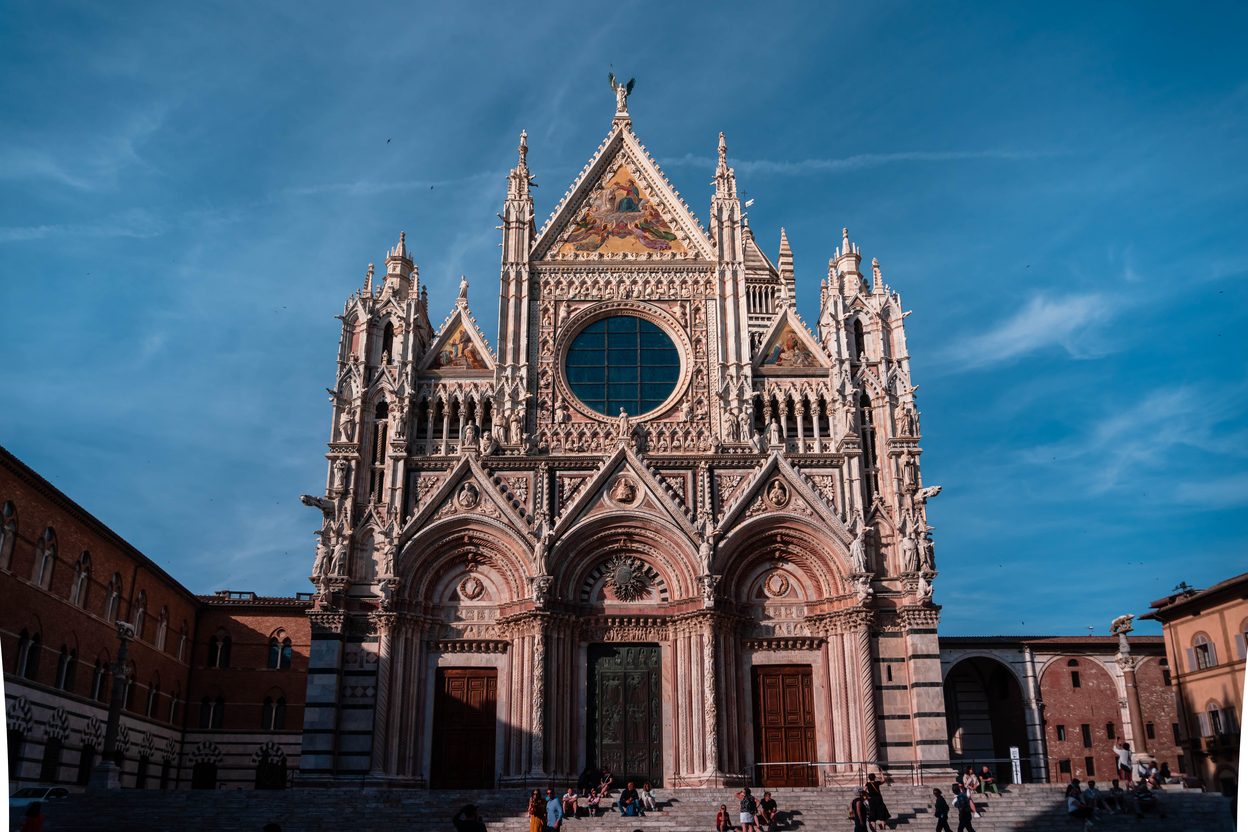
The cathedral that was meant to be bigger
The cathedral of the Assumption was built mostly in the thirteenth century; the dome was finished by the 1260s. The sculptor Giovanni Pisano designed the lower facade in the 1280s and 1290s, with its prophets and philosophers. In 1339, at the height of its wealth and its rivalry with Florence, Siena decided to make the cathedral the transept of a vast new church. Work began, then the Black Death of 1348 killed much of the population; the project was abandoned in 1355, and its unfinished nave and great empty facade still stand beside the cathedral.
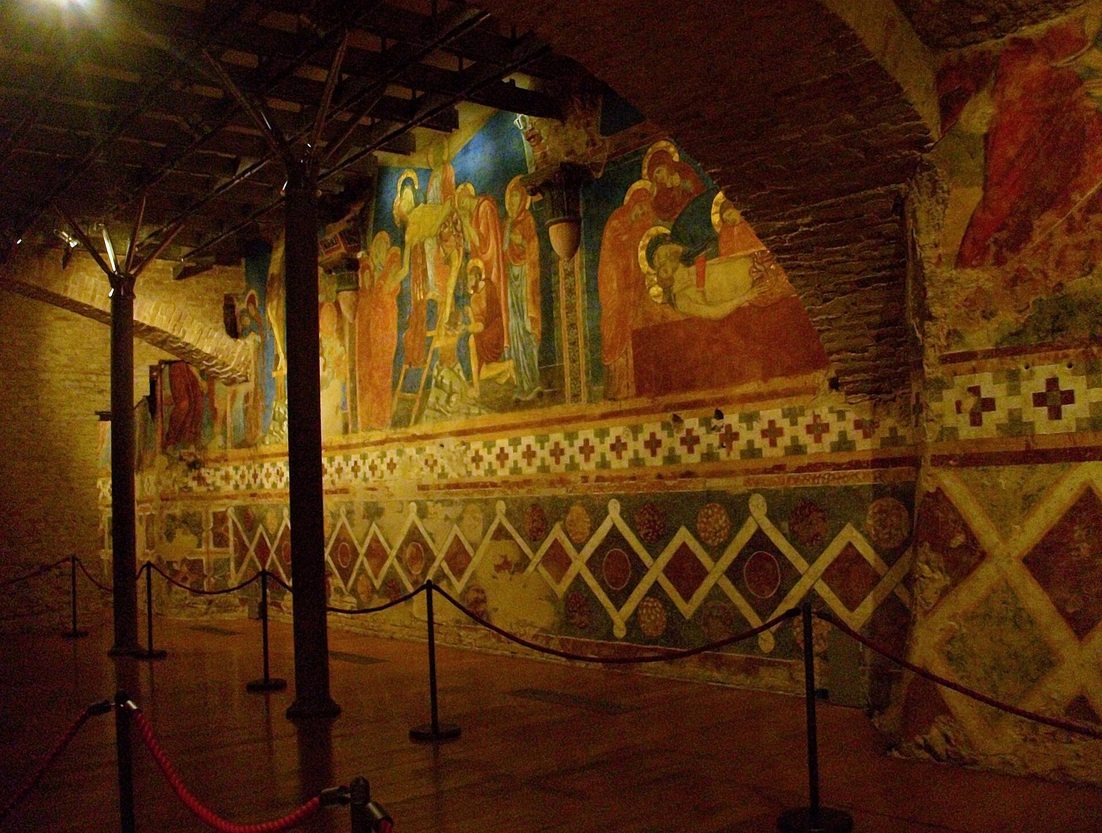
Over the next centuries the city kept adding treasures: the marble floor, laid from the fourteenth to the nineteenth century; the library painted for the Piccolomini family in the early 1500s; and Bernini’s chapel for the Sienese pope Alexander VII, begun in 1659. In 1999, during building works, a room under the cathedral was found full of thirteenth-century frescoes, now known as the crypt.
The visitor’s cheat sheet
| Where | Piazza del Duomo, 53100 Siena; ticket office at Piazza del Duomo 7 |
|---|---|
| Opening hours | April–October 10am–7pm; November–March 10.30am–5.30pm; last entry 30 minutes before closing. On Sundays and holidays the cathedral opens only in the afternoon, from 1.30pm, except while the floor is uncovered. Some days close earlier, and hours change for services: check the official site |
| Admission | OPA SI Pass €14 (€16 while the floor is uncovered), valid three days; Porta del Cielo with the roof walk €21; cathedral alone €10 while the floor is uncovered; ages 7–11 €3 (€6 with the roof); under-7s free. Free for worship |
| Floor uncovered | 27 June–31 July and 18 August–15 November 2026 |
| Booking | Online, by phone (+39 0577 286300) or at the ticket office; book the roof walk ahead |
| Dress code | Shoulders and knees covered |
| Getting there | Bus from Florence about 1¼ hours, or train about 1½ hours; from Siena station a city bus, or 30–40 minutes on foot, partly by escalator. Il Duomo car park is closest; the centre is closed to cars |
| How long | About two hours; half a day with the roof walk |
Hours and admission checked against the official site in October 2026. They change; the official site is always the last word.
Time your visit to the floor, and mind Sundays. Most of the marble floor is covered for its protection for much of the year; in 2026 it is on show from 27 June to 31 July and from 18 August to 15 November, when the pass costs €16. On Sundays and holidays the cathedral itself opens only in the afternoon, except during the floor period.
What to see, in the order you meet it
The facade and the interior
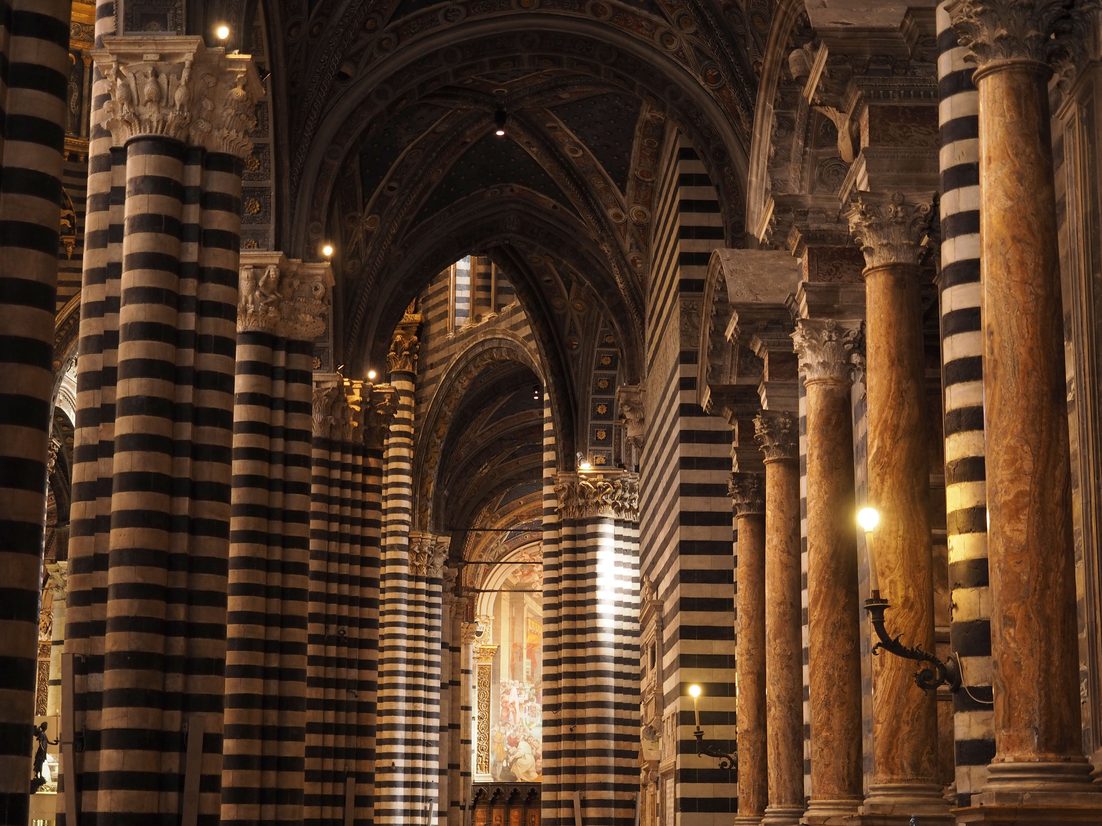
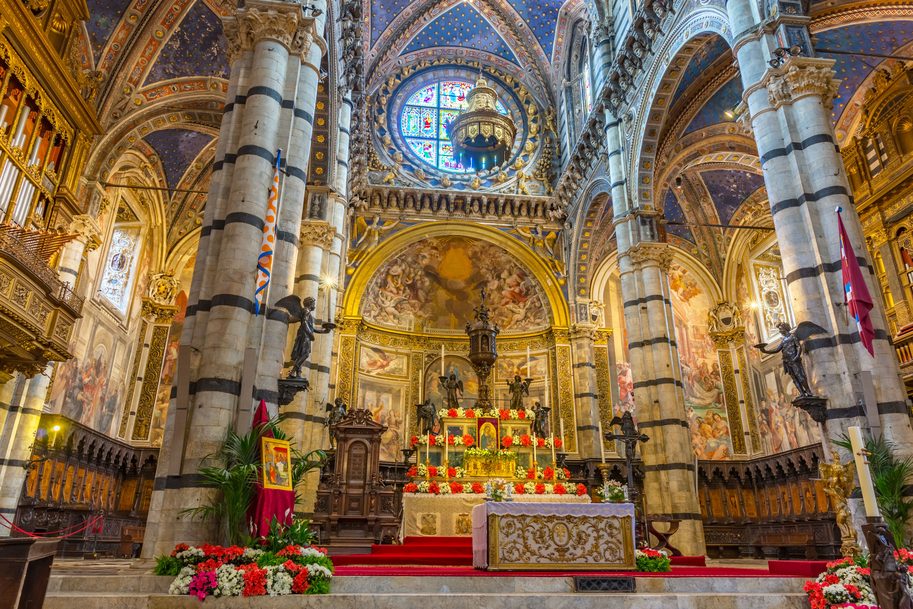
Giovanni Pisano’s lower facade is crowded with carving; the statues are copies, the originals being in the museum. Inside, the black and white stripes of the columns and walls, the colours of the city, run all the way to the apse. Along the walls above the arches is a row of 172 painted plaster heads of popes.

The marble floor
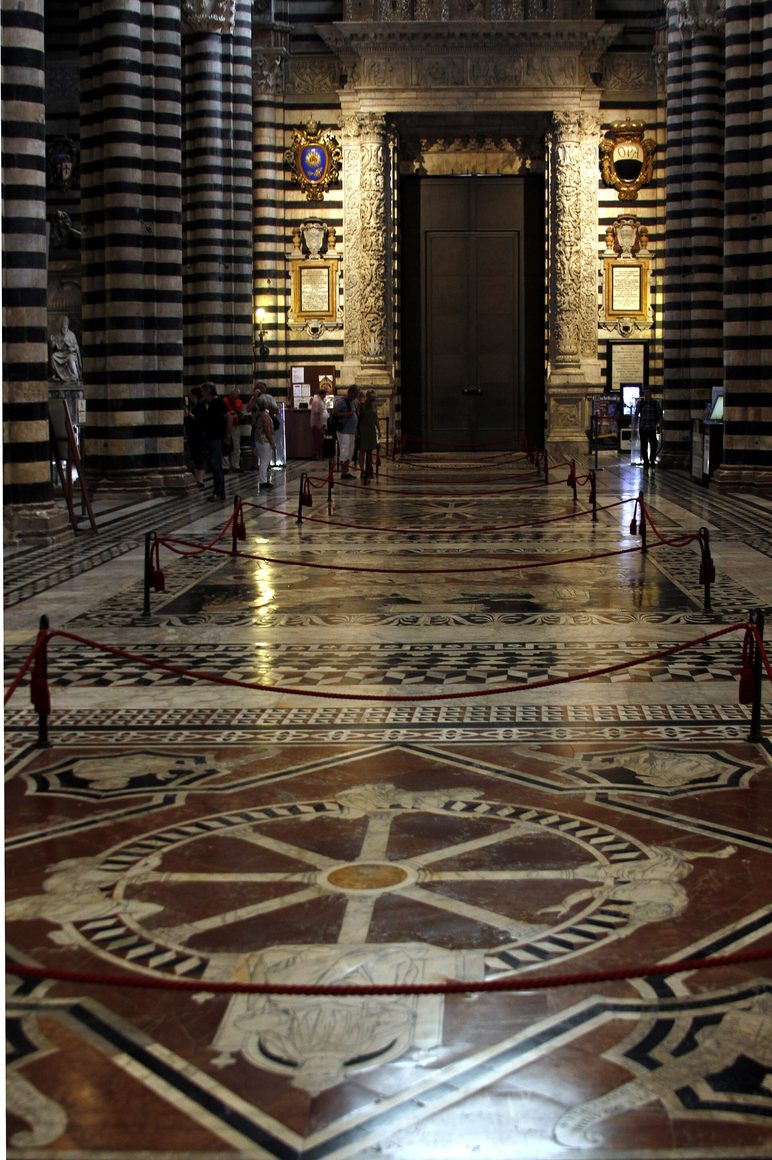
The floor is made of fifty-six panels of inlaid and engraved marble, made between the fourteenth and nineteenth centuries by some forty artists. Near the entrance are Hermes Trismegistus, of 1488, and the she-wolf of Siena; in the aisles, ten Sibyls of the 1480s; in the nave, the Wheel of Fortune and Pinturicchio’s Hill of Wisdom. Towards the altar are Matteo di Giovanni’s Massacre of the Innocents and the great scenes of the life of Elijah and Moses designed by Beccafumi.
The pulpit and the chapels
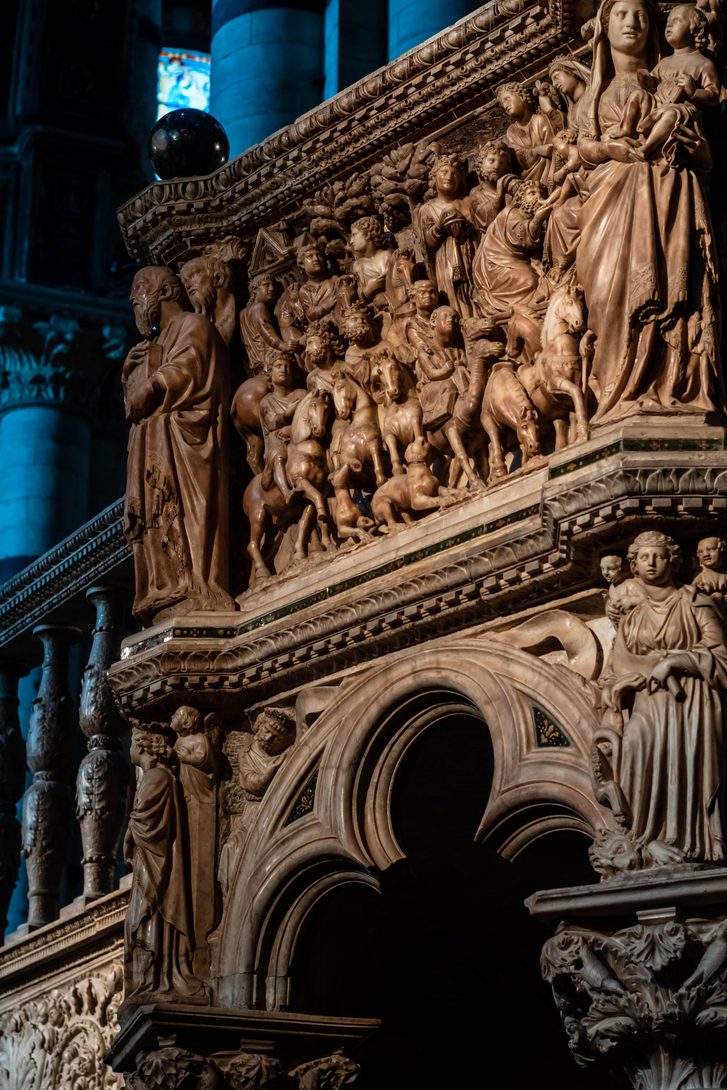
In the left transept stands Nicola Pisano’s marble pulpit, carved with his son Giovanni and Arnolfo di Cambio in 1265–68, its panels packed with figures. In the left aisle, the Piccolomini altar has four statues of saints attributed to the young Michelangelo. In the chapel of St John the Baptist is Donatello’s bronze St John, and opposite, in the right transept, Bernini’s Chapel of the Madonna del Voto has his statues of St Jerome and Mary Magdalene. The round window in the apse is a copy of the glass designed by Duccio in 1287–88; the original is in the museum.
The Piccolomini Library
Off the left aisle, the library built for the books of Pope Pius II is covered with Pinturicchio’s frescoes of the pope’s life, painted in the first years of the sixteenth century, as bright as the day they were finished. In the middle stands a Roman marble group of the Three Graces.

The crypt, the Baptistery and the museum
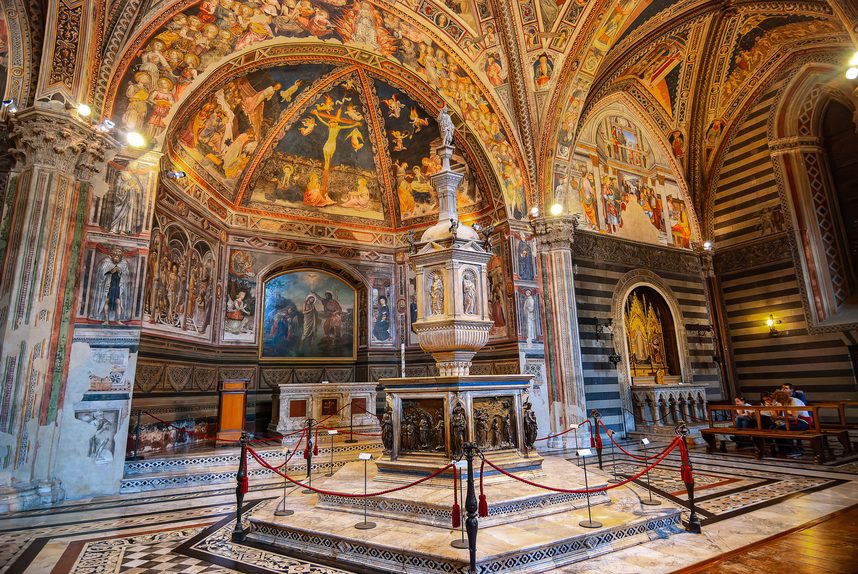
Outside and down the steps, the crypt has wall paintings of the second half of the thirteenth century, among the earliest of the Sienese school. Below it, under the east end of the cathedral, the Baptistery has a font of 1417–31 with bronze panels by artists including Jacopo della Quercia, Ghiberti and Donatello. The Museo dell’Opera, in the bays of the unfinished new cathedral, holds Duccio’s Maestà, the great altarpiece of 1308–11, Duccio’s original window and Giovanni Pisano’s statues; from it you climb to the top of the Facciatone, the unfinished facade, for the best view in Siena.

Tickets and where to stay
Tickets and hotels
OPA SI and Porta del Cielo tickets are sold on the cathedral’s own ticket site, by phone and at the ticket office on the piazza. The roof walk is in small groups and sells out in summer, so book it ahead. Siena is a long day trip from Florence; staying a night lets you see the cathedral early, before the day visitors arrive.
The hotel link goes to Booking.com. This site earns nothing from it at present — it is here because it is the quickest way to check what is actually available.
Don’t miss
- The marble floor Uncovered until 15 November 2026.
- Nicola Pisano’s pulpit In the left transept.
- The Piccolomini Library Pinturicchio’s frescoes, off the left aisle.
- Duccio’s Maestà In the Museo dell’Opera.
- The Facciatone The view from the top of the unfinished facade.
Insider tips
Go early on a weekday. The tour groups from Florence arrive from late morning. Start at the cathedral at opening time, then do the museum and the Facciatone climb, whose narrow stairs queue in the middle of the day. Keep your pass: it is valid for three days.
From the Santa Caterina car park, the Costone escalator climbs to within a few minutes of the cathedral. The Campo, Siena’s great shell-shaped square, is five minutes’ walk away.
Common questions
How much does Siena Cathedral cost?
The OPA SI Pass, which covers the cathedral, the Piccolomini Library, the museum, the Facciatone panorama, the crypt and the Baptistery for three days, costs €14, or €16 while the marble floor is uncovered. The Porta del Cielo ticket adds the roof walk for €21. Children aged 7–11 pay €3; under-7s are free.
When is the floor of Siena Cathedral uncovered?
In 2026, from 27 June to 31 July and from 18 August to 15 November. For the rest of the year much of the floor is covered with protective boards. Dates for 2027 have not yet been announced.
What is the Porta del Cielo?
The “Gate of Heaven”: a guided walk in small groups through the roof spaces and along galleries high above the nave, with views down into the cathedral. It runs from 1 March to 6 January, and the ticket includes everything in the OPA SI Pass. Book ahead.
Can I go into Siena Cathedral for free?
Yes, to pray or for Mass, through a separate entrance; sightseeing needs a ticket. Under-7s and residents of Siena are free.
Is there a dress code?
Yes: shoulders and knees must be covered, and the rule is enforced at the door.
How long does a visit take?
About two hours for everything on the OPA SI Pass; half a day if you add the roof walk and take your time in the museum.
Where to stay and eat nearby
Siena’s old centre is compact and full of small hotels and trattorias; everything is within walking distance of the cathedral and the Campo. It is about an hour and a quarter from Florence by bus.
More churches in Italy
- Florence Cathedral — Siena’s old rival, about an hour and a quarter away.
- Basilica of St Francis, Assisi — in Umbria, about two hours by road.