
Basilica of Santa Croce, Florence
Santa Croce is where Florence buries its great men. Michelangelo, Galileo, Machiavelli and Rossini lie here, and Dante has a monument; the walls of its chapels were painted by Giotto, and Brunelleschi built the Pazzi Chapel off its cloister. It calls itself the largest Franciscan church in the world, and was begun in the 1290s. Entry is by a timed ticket from the north side of the church, and Giotto’s Bardi Chapel has just emerged from four years of restoration.
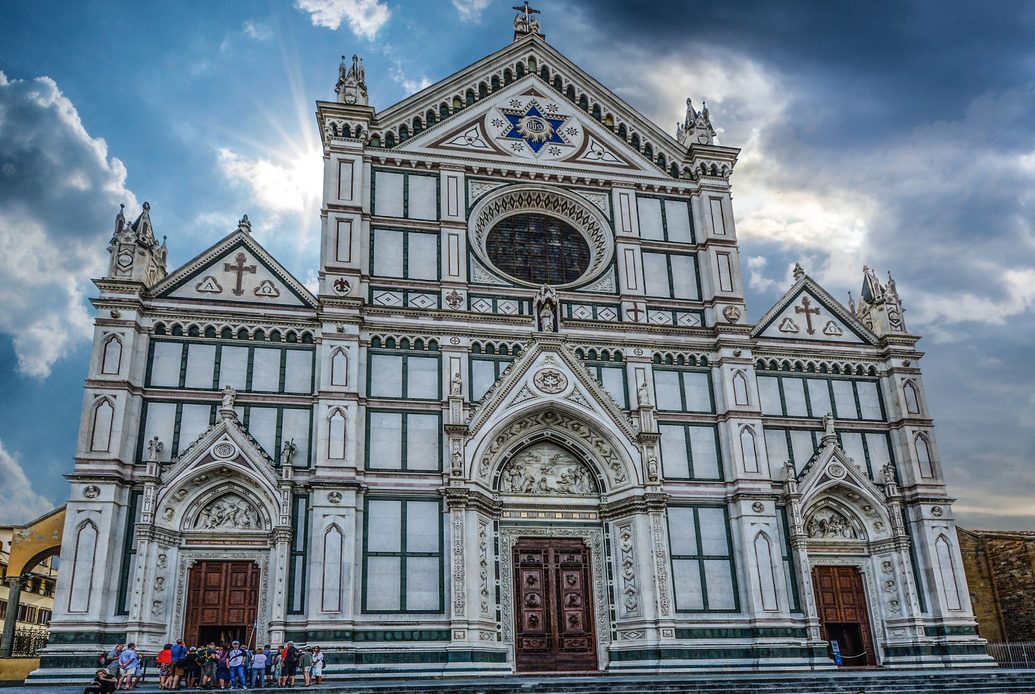
The Franciscans’ church
The Franciscans came to Florence early in the thirteenth century and settled in the poor, flood-prone district by the river. The present church was begun in 1294 or 1295, in all likelihood to a design by Arnolfo di Cambio, the architect of the cathedral, and was largely finished by the end of the fourteenth century. Rich Florentine families, the Bardi, Peruzzi and Baroncelli among them, paid for its chapels and had them painted by Giotto and his followers. Pope Eugene IV consecrated it in 1443.
In 1564 Michelangelo was buried here, and the church became Florence’s pantheon. In the 1560s Vasari remodelled the interior for Cosimo I, tearing down the screen across the nave and whitewashing many frescoes. The bell tower followed in 1847 and the marble facade, by Niccolò Matas, was finished in 1865. On 4 November 1966 the Arno flooded the church, and Cimabue’s great Crucifix lost much of its paint.
The visitor’s cheat sheet
| Where | Piazza di Santa Croce 16, 50122 Florence; visitor entrance and ticket office on the north side, Largo Piero Bargellini |
|---|---|
| Opening hours | Monday–Saturday 9.30am–5.20pm; Sundays and religious holidays 2–5.20pm. Last entry 5pm (4.30pm on free-entry days). Closed 25 December |
| Admission | Adults €10 (plus €1 booking fee online); €6 for ages 12–17 and university students; under-12s free, and under-18s free with paying parents. Free for prayer and Mass |
| Free-entry days | 1 January, the second Sunday of February, Easter, 13 June, 15 August, 14 September, European Heritage Days, 4 October, the second Sunday of November, the Sunday before Christmas and 26 December; free tickets are issued at the ticket office |
| Booking | Timed tickets online (€1 booking fee); arrive on time for your slot |
| Dress code | Shoulders and legs covered; free wraps at the ticket office |
| Getting there | About 15 minutes’ walk from the Duomo, 25–30 from Santa Maria Novella station |
| How long | An hour and a half to two hours with the cloisters and Pazzi Chapel |
Hours and admission checked against the official site in October 2026. They change; the official site is always the last word.
Go to the side, not the front. The visitor entrance and ticket office are on the north side of the church, in Largo Bargellini, not through the facade. Tickets are for a timed slot, and if you are more than 15 minutes late, staff decide whether to let you into the next one. Shoulders and legs must be covered, and on Sundays the church opens only at 2pm.
What to see, in the order you meet it
The nave and the tombs
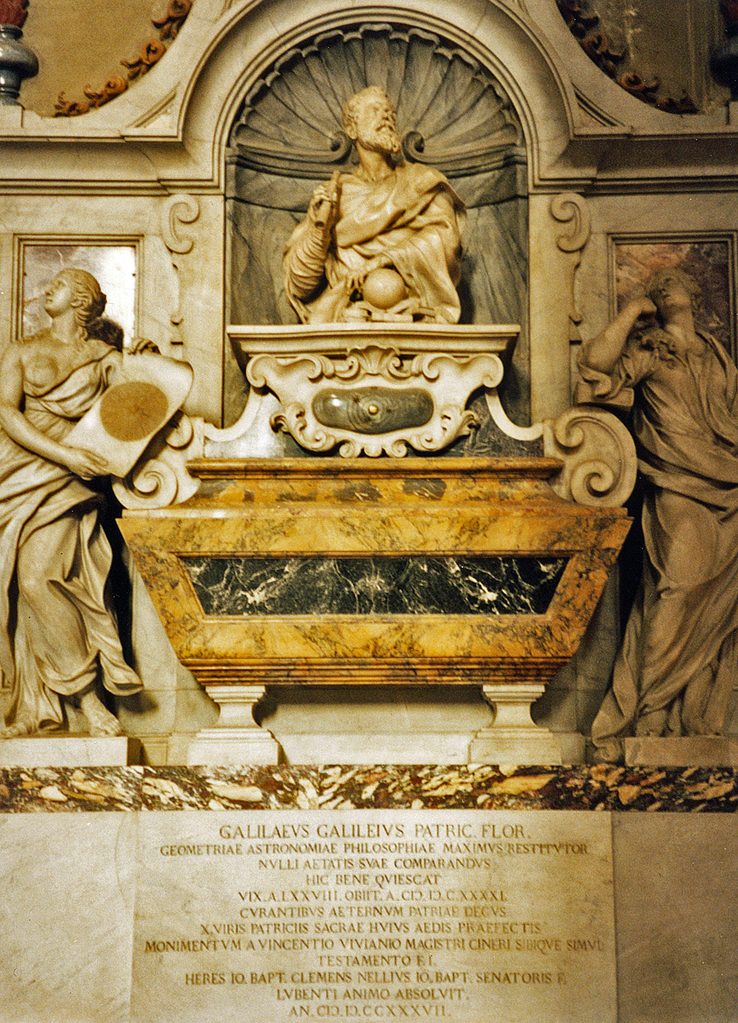
The nave is vast and plain, with a painted timber roof and slender octagonal pillars. Along the right aisle, from the entrance end, come Michelangelo’s tomb, designed by Vasari and finished in 1576; the cenotaph of Dante, unveiled in 1830; Canova’s monument to the poet Vittorio Alfieri; Machiavelli’s tomb of 1787; Donatello’s gilded stone Annunciation; then, past the door to the cloisters, the tomb of the humanist Leonardo Bruni by Bernardo Rossellino, a model for Renaissance tombs, and Rossini’s. Across the nave, in the left aisle, Galileo lies opposite Michelangelo in a tomb of 1737.


The Baroncelli Chapel
At the end of the right transept, Taddeo Gaddi, Giotto’s pupil, painted the life of the Virgin around 1328–30, including one of the earliest night scenes in Italian painting: the angel appearing to the shepherds.
The Sacristy
A doorway in the right transept leads into the novices’ corridor, built in 1435–45 at Cosimo de’ Medici’s expense, and on to the Sacristy, where Cimabue’s Crucifix, painted before 1288 and badly damaged in the 1966 flood, has hung high on the wall since 2013, out of reach of any future flood.
Giotto’s chapels
To the right of the high altar are two chapels painted by Giotto. The Peruzzi Chapel, of about 1310–11, tells the stories of St John the Baptist and St John the Evangelist; painted largely on dry plaster, it is faded. Next to it, the Bardi Chapel has the life of St Francis, painted after 1317, including his death among the friars. Its four-year restoration was unveiled in September 2026, and the chapel is fully visible again.
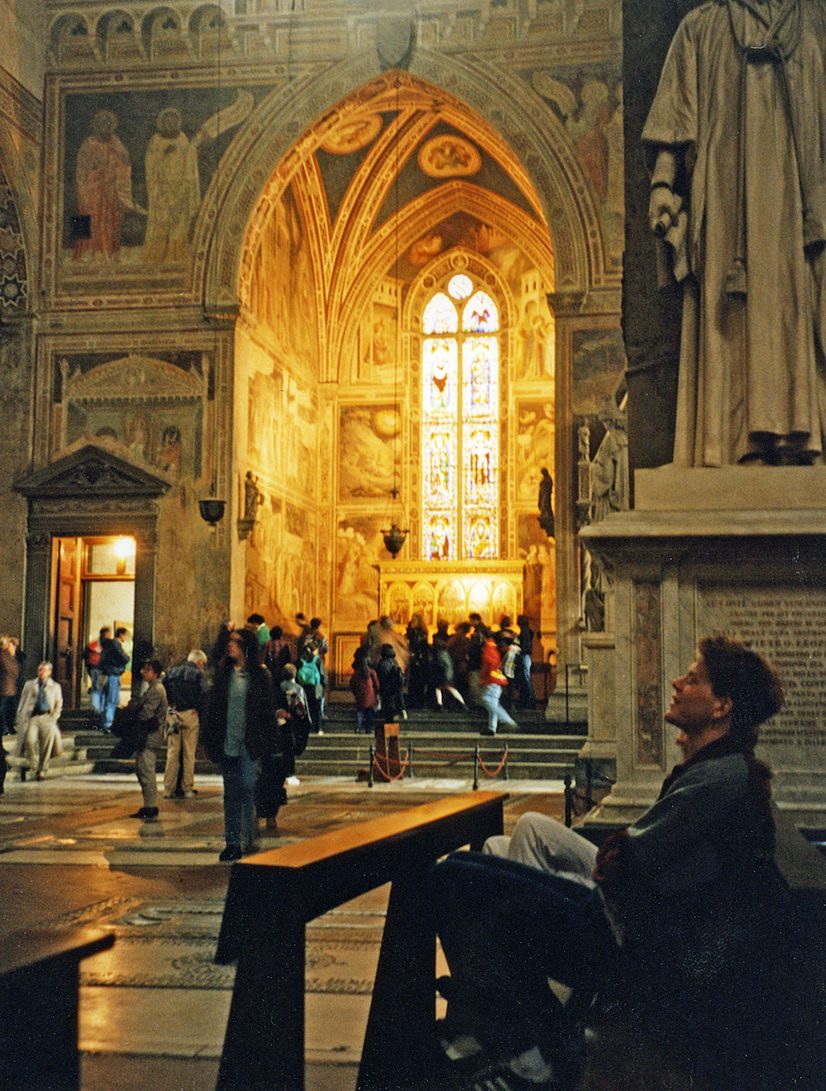

The main chapel and Donatello’s Crucifix
The main chapel is covered with Agnolo Gaddi’s Legend of the True Cross of about 1388–90, telling the story of the wood of Christ’s cross. In the left transept, in the Bardi di Vernio chapel, hangs Donatello’s wooden Crucifix of about 1408–09, which, according to Vasari, Brunelleschi mocked as a peasant on the cross.
The Pazzi Chapel and the cloisters
From the church you go out into the first cloister. On its far side is the Pazzi Chapel, designed by Brunelleschi and built from the 1440s as the family chapel and chapter house: a calm grey and white space, with roundels of the apostles by Luca and Andrea della Robbia. The little dome over the altar shows the sky over Florence on 4 July 1442. Beyond is a second cloister, probably designed by Bernardo Rossellino.

The refectory
The old refectory, now the museum, has Taddeo Gaddi’s Tree of Life and Last Supper of about 1345–50, fragments of Orcagna’s Triumph of Death, and Donatello’s gilded bronze St Louis of Toulouse. The museum is being redesigned, but the refectory can still be visited.
Tickets and tours
Tickets and guided tours
Timed tickets are sold on the basilica’s own ticket site, with a €1 booking fee, and at the ticket office in Largo Bargellini. A guide makes sense of the tombs and the chapels; many tours include the Pazzi Chapel and the cloisters.
Tour and hotel links go to GetYourGuide and Booking.com. This site earns nothing from them at present — they are here because they are the quickest way to check what is actually available.
Don’t miss
- Michelangelo’s tomb The first on the right as you enter.
- Galileo’s tomb Opposite, in the left aisle.
- Giotto’s Bardi Chapel Newly restored, right of the high altar.
- Donatello’s Annunciation Gilded stone, in the right aisle.
- Cimabue’s Crucifix High on the wall of the Sacristy.
- The Pazzi Chapel Brunelleschi, off the first cloister.
Insider tips
Come at 9.30am on a weekday. Opening time is quietest; weekends and the free-entry days are the busiest. Book online in spring and summer, and keep your ticket: it gives reduced entry at Casa Buonarroti, Michelangelo’s family house, and at the Museo Galileo.
It was at Santa Croce that the French writer Stendhal, in a book published in 1817, described feeling so overwhelmed by the art that his heart pounded as he left; the Florentine psychiatrist Graziella Magherini later named “Stendhal syndrome” after him.
In June the piazza is taken over by the Calcio Storico, a violent sixteenth-century form of football played on sand, with stands that hide much of the facade. The final is on 24 June.
The Leather School behind the church has its own entrance in Via San Giuseppe and is not part of the visit.
Common questions
Is Michelangelo buried in Santa Croce?
Yes. He died in Rome in February 1564, and his body was brought back to Florence in March. His tomb, designed by Giorgio Vasari, is the first on the right as you walk up the nave.
Is Dante buried in Santa Croce?
No. The monument to Dante in the right aisle, unveiled in 1830, is a cenotaph: Dante died in exile and is buried in Ravenna.
Where is the entrance to Santa Croce?
On the north side of the church, in Largo Piero Bargellini, to the left as you face the facade. The doors in the facade are not the visitor entrance.
Can I go in for free to pray or for Mass?
Yes. Entry is free for prayer and services; staff direct worshippers to a separate entrance, and the Niccolini Chapel is kept for prayer. Mass on the high altar is at 6pm on weekdays and at 11am and 6pm on Sundays and holidays.
Is there a dress code at Santa Croce?
Yes: shoulders and legs must be covered. Free disposable wraps are handed out at the ticket office if you need one.
How long does a visit to Santa Croce take?
The basilica officially reckons about 50 minutes. Allow an hour and a half to two hours to see the church, the Pazzi Chapel, the cloisters and the refectory without rushing.
Where to stay and eat nearby
The Santa Croce district, east of the Duomo, is full of trattorias and wine bars and a little quieter than the centre; the Sant’Ambrogio market is a few minutes away. Everything in central Florence is within walking distance.
More churches in Italy
- Florence Cathedral — Brunelleschi’s dome, 15 minutes’ walk away.
- San Vitale, Ravenna — in the city where Dante is buried.