
Florence Cathedral
Santa Maria del Fiore was begun in 1296 to be the grandest church in Tuscany, and for more than a century it stood with a hole in the roof forty-odd metres across, because nobody knew how to cover it. Filippo Brunelleschi did, and his dome is still the largest ever built in brick and stone. The cathedral underneath is free. The dome is not, and it is the part most visitors get wrong: you need one particular pass, and a timed slot that can sell out weeks ahead.

A hole in the roof for a hundred years
The Florentines laid the first stone in 1296, to a design by Arnolfo di Cambio, on the site of an older and smaller cathedral dedicated to Santa Reparata. The city was rich on wool and banking and meant to outbuild Siena and Pisa. The plan fixed an octagonal crossing so wide that no wooden centring could be built to hold up a vault over it while the mortar set, and as the nave went up through the fourteenth century the problem was simply left for later.
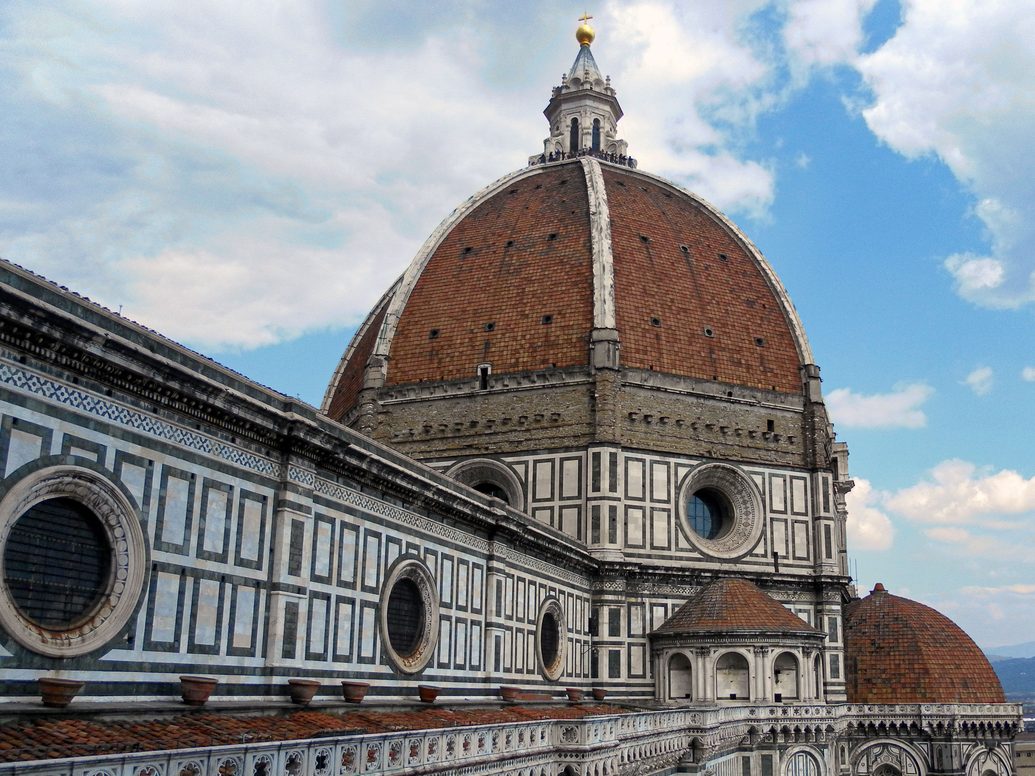
In 1418 the Opera del Duomo held a competition. Brunelleschi, a goldsmith by training, won it with a scheme that needed no centring at all: two shells, one inside the other, laid in rings of brick that locked together as they rose. Work began in 1420 and the dome was closed in 1436, the year Pope Eugene IV consecrated the cathedral on 25 March. It has no flying buttresses. The lantern on top was finished after Brunelleschi’s death, and the gilded copper ball was raised in 1471.
The visitor’s cheat sheet
| Where | Piazza del Duomo, 50122 Florence. The cathedral entrance is the west front; passes are sold online and at the ticket office at Piazza San Giovanni 7 |
|---|---|
| Opening hours | Cathedral: Monday–Saturday 10.15am–3.45pm, closed to visitors on Sundays and religious holidays. Dome slots: Monday–Friday 8.15am–6.45pm, Saturday to 4.30pm, Sunday 12.45–4.30pm. Bell tower 8.15am–6.45pm daily. Baptistery 8.30am–7.30pm (to 1.30pm on the first Sunday of the month). Museum 8.30am–7pm, closed the first Tuesday of the month. Everything is closed on 25 December, 1 January and Easter Sunday |
| Admission | Free to the cathedral. Passes for the rest, valid three days: Brunelleschi Pass €30 (dome, bell tower, Baptistery, crypt, museum); Giotto Pass €20 (all but the dome); Ghiberti Pass €15 (Baptistery, crypt, museum). Ages 7–14 €12, €7 and €5; under-7s free |
| Timed slots | The dome slot is compulsory, chosen for the first day of the pass and not changeable; names are printed on the ticket and ID is checked. Dome slots sell out weeks ahead in season. The Giotto Pass also has a timed bell-tower slot |
| Steps | Dome 463, bell tower 414. No lifts on either. The museum has a lift |
| Dress and bags | Shoulders and knees covered in the cathedral, Baptistery and crypt. Medium and large bags go to the left-luggage office at Piazza del Duomo 38/r |
| Works in 2026 | The bell tower is under restoration, with scaffolding that may cut some of the view. The Baptistery vault mosaics are being restored. The bell tower closes 9–13 November and the dome 16–20 November 2026 for maintenance |
| How long | Half an hour for the cathedral; a full day for everything on the Brunelleschi Pass |
Hours and admission checked against the official site in October 2026. They change; the official site is always the last word.
Only one pass climbs the dome, and it comes with a fixed time. The Brunelleschi Pass, €30, is the only ticket that includes Brunelleschi’s dome. You pick the dome slot when you book, on the first day of the pass, and it cannot be moved or cancelled; staff allow only a few minutes’ lateness and check ID against the name on the ticket. In season the slots go weeks in advance. If the dome is sold out, the Giotto Pass still takes you up the bell tower, which has the better view of the dome itself.
What to see, in the order you meet it
The façade
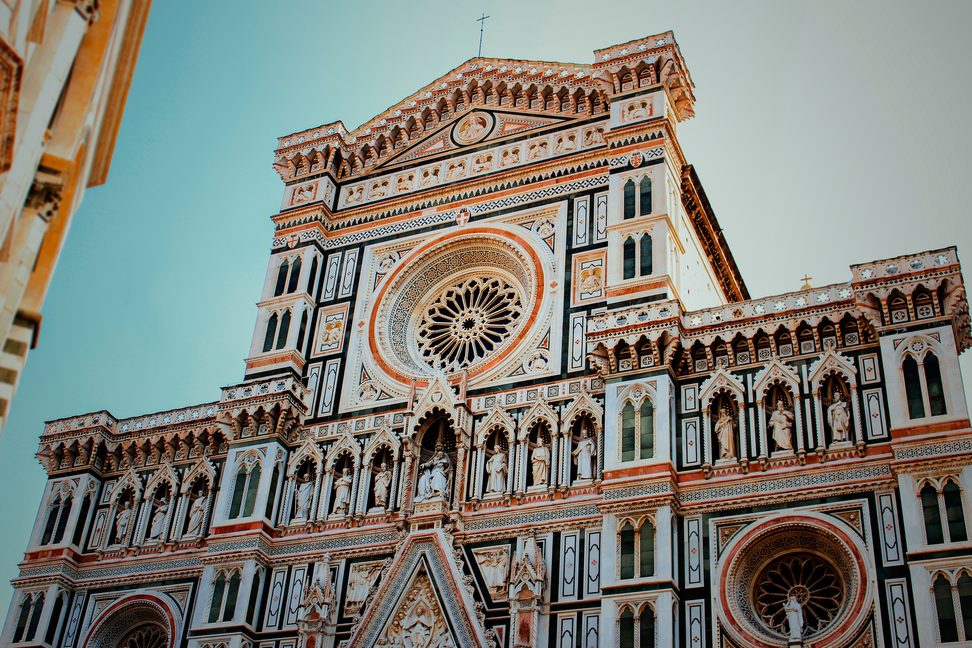
Most people assume the front is medieval. It is not. Arnolfo’s façade was left unfinished, and in 1587 it was torn down to make way for a modern one that was never built. For three centuries the cathedral had a plain front, painted for festivals. The present marble façade, in the white of Carrara, the green of Prato and the red of the Maremma, was designed by Emilio De Fabris after a competition of 1864, and completed in 1887 in a Gothic Revival style meant to match the flanks.

The nave
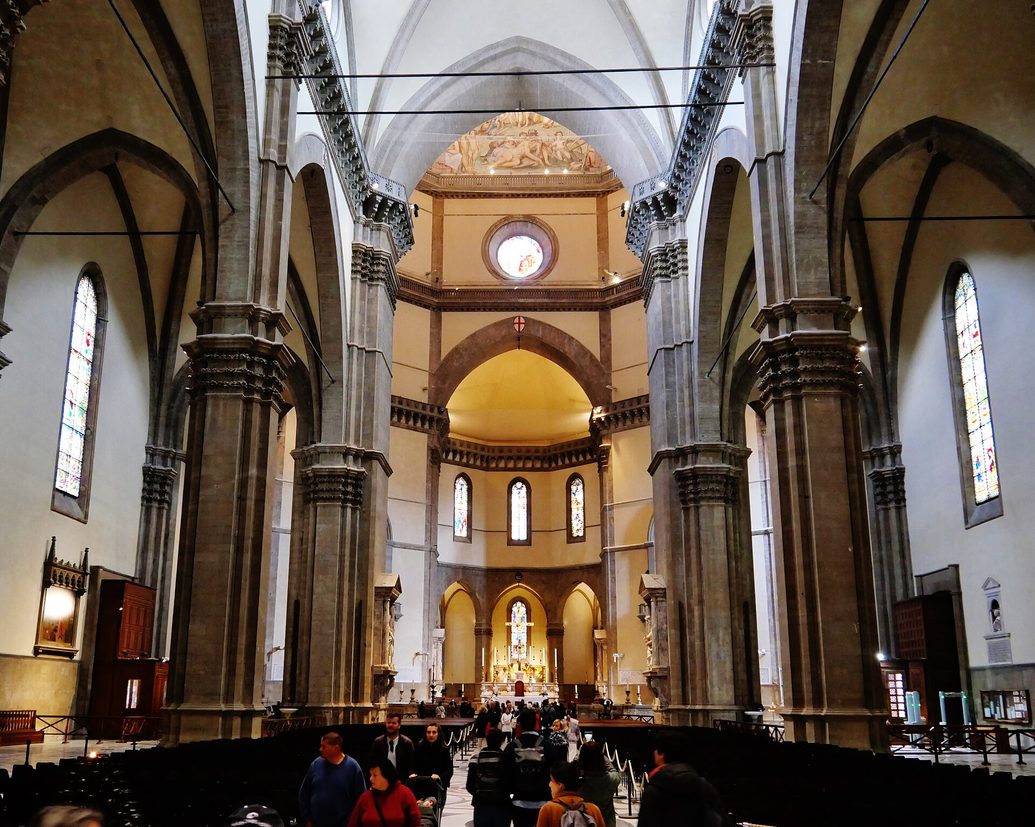
Inside, the contrast is startling. After the crowded marble outside, the nave is broad, grey and spare, with four huge bays and very little furniture. The Florentines spent their money on the building rather than on filling it, and much of what did fill it is now in the museum across the road. Give your eyes a minute, then look at the walls.
Uccello’s clock
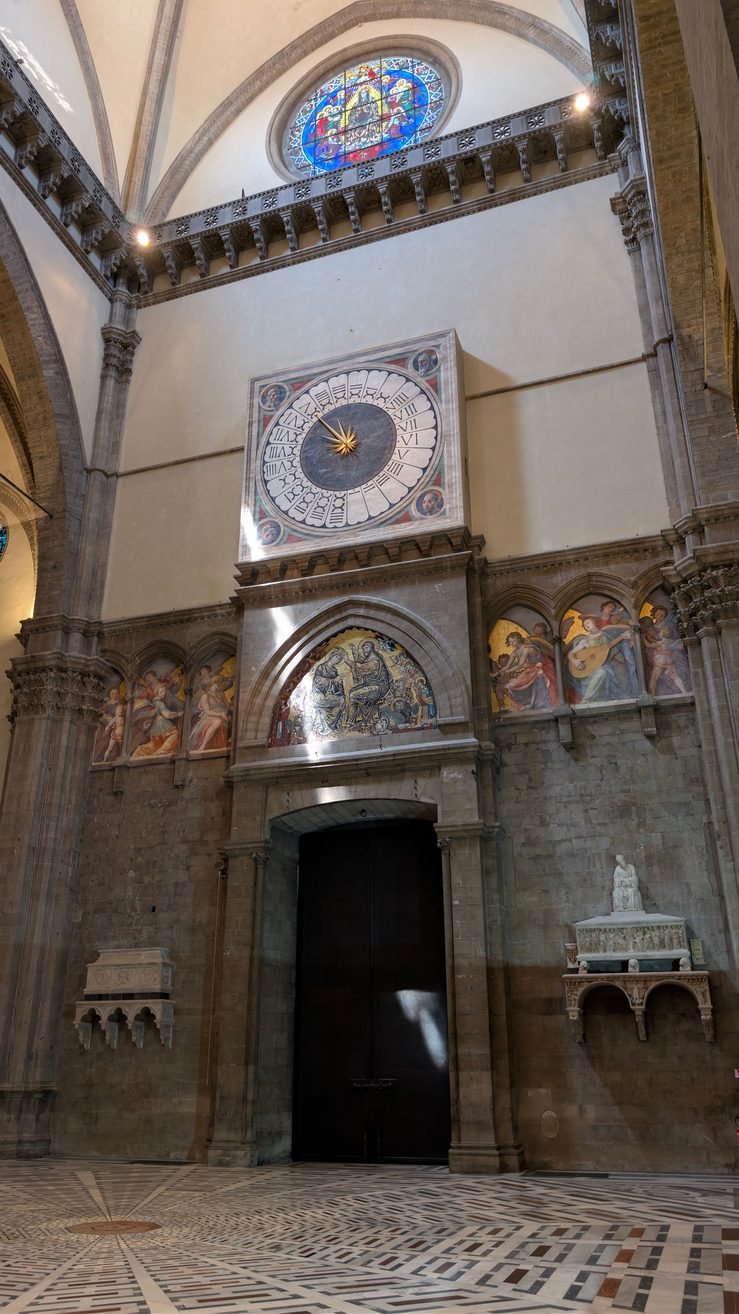
Turn round. High on the inside of the west wall is the clock Paolo Uccello painted in 1443, with four heads of prophets in the corners. It has one hand, which moves anticlockwise round twenty-four hours, and the twenty-fourth hour falls at sunset: this is hora italica, Italian time, by which the day ended when the light did.
Two horsemen who are not statues
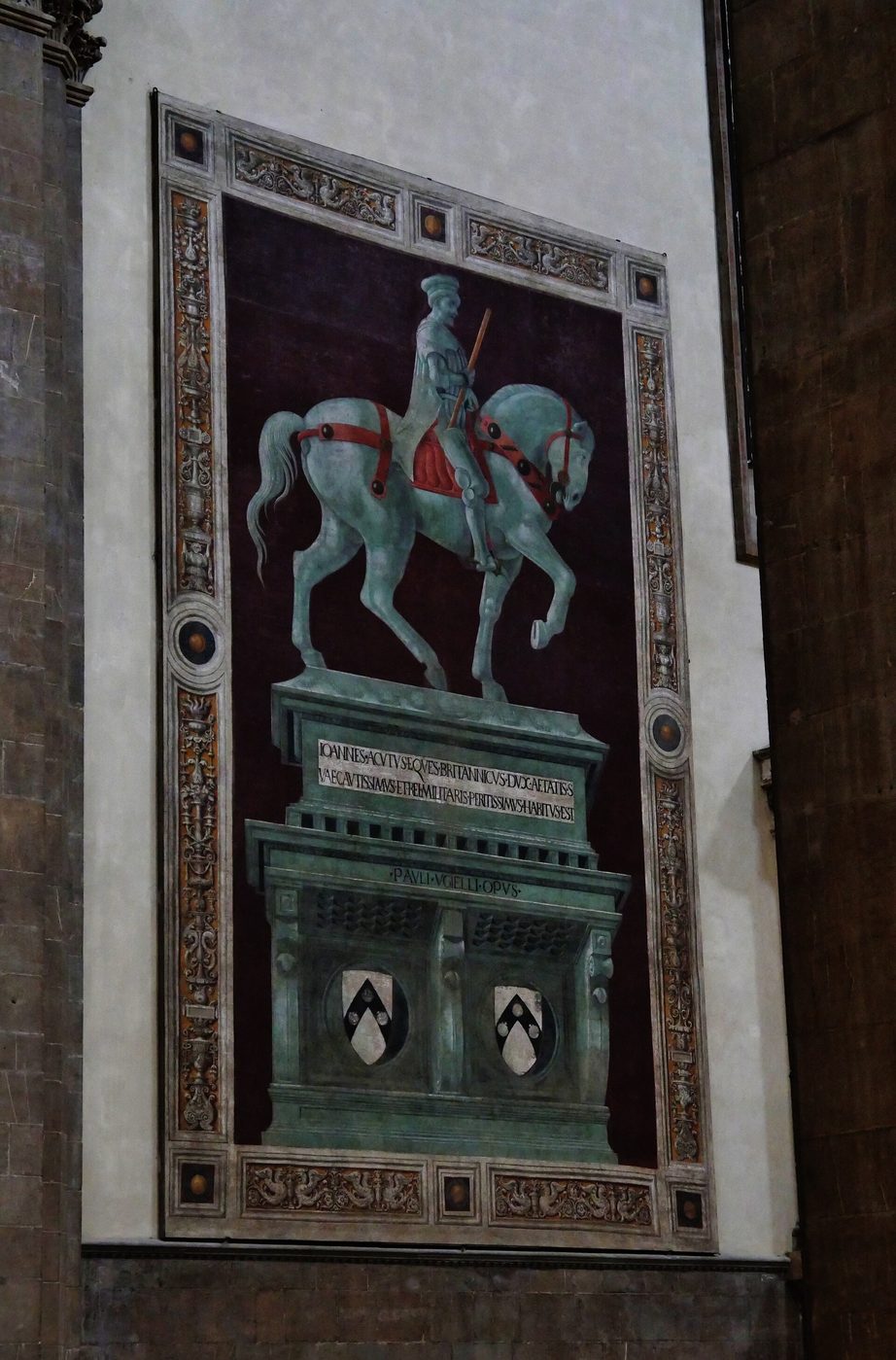
On the north wall of the nave are two mounted commanders. Both look like bronze or marble monuments; both are painted on the plaster. One is Sir John Hawkwood, an English mercenary who led Florence’s armies and died in 1394. The city had promised him a marble statue, and in 1436 settled for a fresco by Paolo Uccello, in green earth to imitate bronze. Beside him is Niccolò da Tolentino, painted by Andrea del Castagno in 1456 to match.
Dante and the city
Further along the north aisle hangs Domenico di Michelino’s painting of 1465: Dante, who was exiled from Florence and never came back, holding the Divine Comedy outside the city walls, with hell behind him and, rather anachronistically, this cathedral with its finished dome beside him.
The Last Judgment in the dome
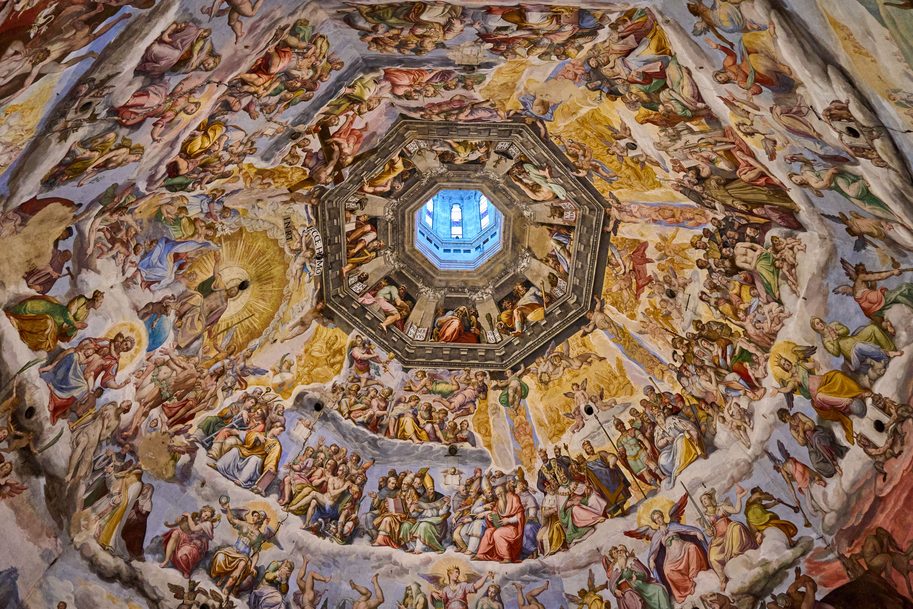
Stand under the crossing and look up. The inside of the dome is covered by the largest fresco in Florence, a Last Judgment begun by Giorgio Vasari in 1572 and finished after his death by Federico Zuccari in 1579. Florentines have argued about it ever since; plenty of them would rather have Brunelleschi’s brickwork. You will see it twice: from the floor, and much closer from the gallery round its base on the way up the dome.
Santa Reparata
Steps from the nave lead down to the excavated remains of the earlier cathedral, Santa Reparata, with parts of its floor mosaics and later tombs. The excavations of the 1960s and 1970s also found the tomb of Brunelleschi himself, buried under the dome he built. The crypt is on all three passes.
Climbing the dome
The climb starts at the Porta della Mandorla on the north side. The 463 steps run up between the two shells of the dome, so you see how it was built: the brick laid in herringbone courses that lock each ring in place, the passages narrowing and the walls curving over your head as you near the top. Halfway up you walk round the inside of the drum, a few metres from Vasari’s painted devils. Then you come out at the lantern, with all of Florence below you.
Giotto’s campanile
The bell tower beside the cathedral was begun by Giotto in 1334, continued by Andrea Pisano and finished by Francesco Talenti, faced in the same three marbles. Its 414 steps are a little easier than the dome’s, with landings to rest on, and from the top the dome is in front of you rather than under your feet. In 2026 the tower is being restored, and scaffolding may cut part of the view.

The Baptistery
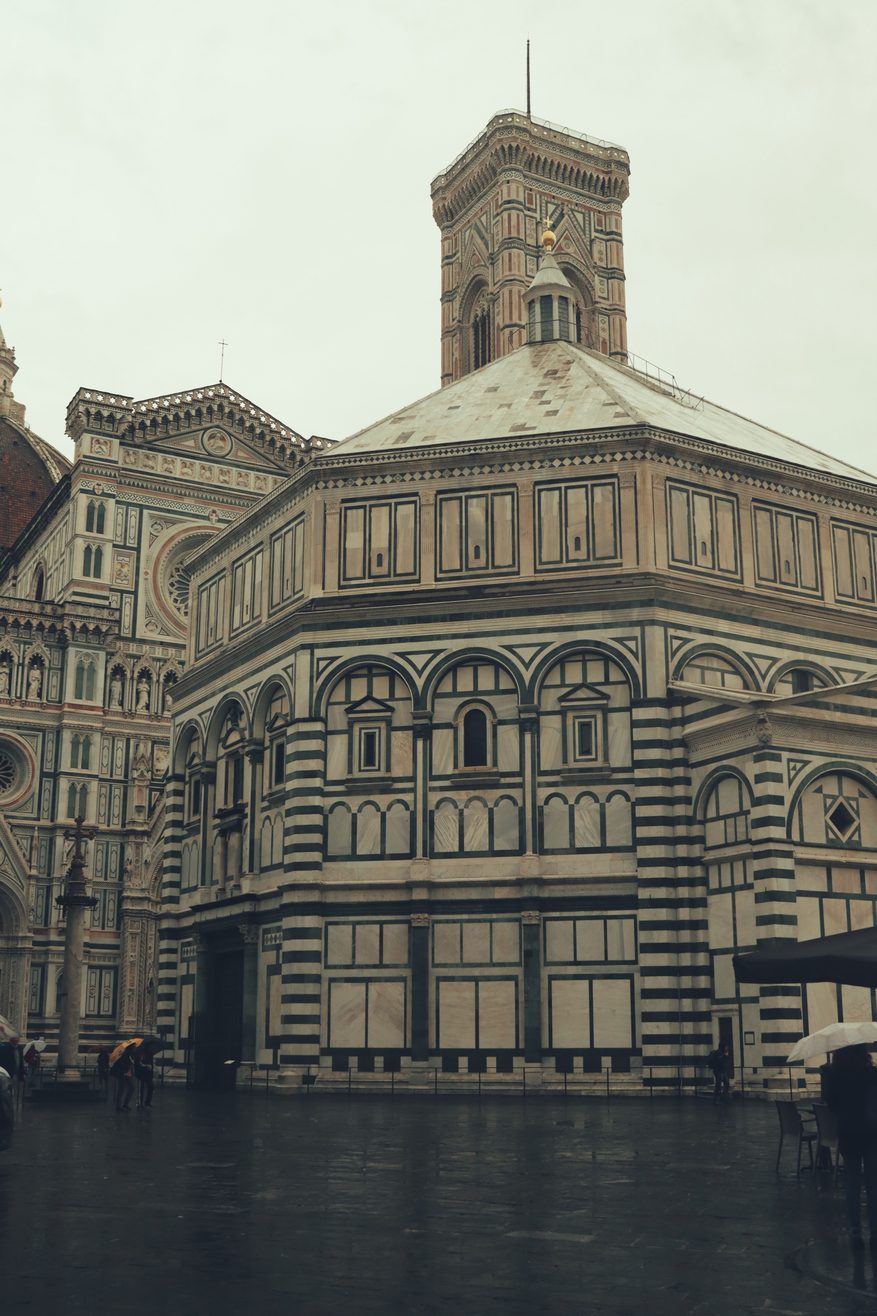
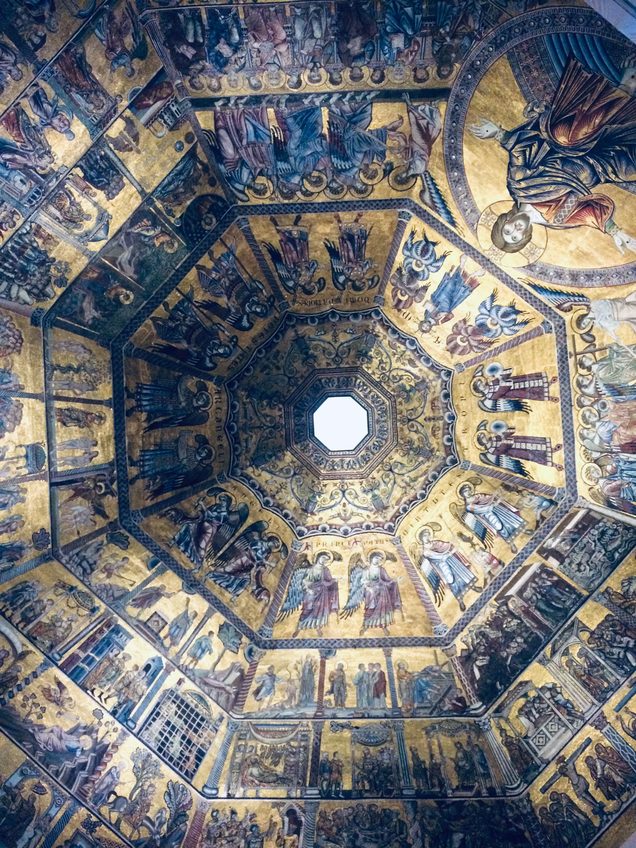
Opposite the façade stands the octagonal Baptistery of San Giovanni, in green and white marble, which the Florentines believed was a Roman temple. It is Romanesque, and older than the cathedral; Dante was baptised in it. Its vault is covered in thirteenth-century gold mosaics with a huge Christ in judgement. They are being restored, and parts may be screened while the work goes on.
The Opera del Duomo Museum
Do not skip the museum. It holds the originals of almost everything that has been taken down from the buildings outside: Lorenzo Ghiberti’s gilded bronze doors for the Baptistery, which Michelangelo is said to have called the Gates of Paradise (the doors on the Baptistery are copies); Michelangelo’s late Pietà, which he carved for his own tomb and then attacked with a hammer; Donatello’s wooden Mary Magdalene; and a full-size reconstruction of Arnolfo’s unfinished façade, with its original statues. It is on every pass, and it is open when the cathedral is not.

Tickets and tours
Book the Brunelleschi Pass early, or settle for the tower
The cathedral is free and needs no ticket. For everything else buy a pass from the Opera di Santa Maria del Fiore’s own website: €30 with the dome, €20 without, €15 for the Baptistery, crypt and museum only. Each is valid for three days. Guided tours with skip-the-line entry are worth considering when the dome slots have gone.
Tour and hotel links go to GetYourGuide and Booking.com. This site earns nothing from them at present — they are here because they are the quickest way to check what is actually available.
Don’t miss
- The inside of the dome From the gallery on the way up, a few metres from Vasari’s Last Judgment.
- Brunelleschi’s herringbone brick Visible between the shells as you climb.
- Uccello’s clock One hand, anticlockwise, and the day ending at sunset.
- Sir John Hawkwood An Englishman on horseback, painted to look like bronze.
- The Gates of Paradise The originals, in the museum, at eye level.
- Michelangelo’s Pietà Carved for his own tomb, broken by his own hand.
- Brunelleschi’s tomb In the crypt, under the dome he built.
Insider tips
Do the free cathedral first thing, and the museum when it shuts. The cathedral opens at 10.15am and closes at 3.45pm, and not at all to visitors on Sundays; the museum is open until 7pm every day except the first Tuesday of the month. Plan the day round the dome slot and fill the rest from that.
If the dome is sold out for your dates, do not pay a reseller a large premium without checking what you are buying: the Giotto Pass and the bell tower are a fine second best, and the tower’s view has the dome in it.
Wear shoes with grip and leave the big bag at the hotel. Neither climb has a lift, and medium and large bags have to go to the left-luggage office on the piazza.
Look at the outside of the dome from somewhere else as well. The terrace of Piazzale Michelangelo, across the Arno, shows how it sits over the whole city, which is the point of it.
Common questions
Is Florence Cathedral free to enter?
Yes. The cathedral itself is free, with no ticket or booking. Everything else in the complex — the dome, Giotto’s bell tower, the Baptistery, the crypt of Santa Reparata and the museum — is on a paid pass. The free queue can be long at busy times, so go when the doors open.
Which ticket do I need to climb the dome?
Only the Brunelleschi Pass, €30, includes the dome. You choose a timed slot for the dome when you book, on the first day of the pass, and it cannot be changed. The cheaper Giotto Pass (€20) gets you up the bell tower instead.
How many steps are there to the top of Brunelleschi’s dome?
463, with no lift. Some passages are narrow and steep, and the official advice is to skip it with heart problems, vertigo or claustrophobia. Giotto’s bell tower has 414 steps.
Is Florence Cathedral open on Sundays?
Not for visits. The cathedral is closed to visitors on Sundays and religious holidays; on other days it opens from 10.15am to 3.45pm. The dome does open on Sunday afternoons, and the Baptistery, bell tower and museum open every day.
How long is a Duomo pass valid?
Three calendar days from the first day of your visit, with one entry to each monument. Use the three days: the museum alone deserves an hour and a half.
Is the facade of Florence Cathedral medieval?
No. The medieval façade was never finished and was pulled down in 1587. The marble front you see was designed by Emilio De Fabris and completed in 1887.
Where to stay and eat nearby
The Duomo is ten minutes’ walk from Santa Maria Novella station, straight up Via Panzani and Via de’ Cerretani, and the tram from the airport stops beside the station. Anywhere in the centre is within walking distance; the streets just east of the cathedral, round Borgo degli Albizi, are quieter in the evening than the piazza itself.
More churches in Italy
- Milan Cathedral — the other great Italian cathedral of the same century, all marble and spires.
- St Mark’s Basilica — two hours away by fast train, gold mosaic instead of marble.
- St Peter’s Basilica — whose dome Michelangelo designed with Brunelleschi’s in mind.
- The Pantheon — the Roman dome Brunelleschi went to Rome to study.