
Orvieto Cathedral
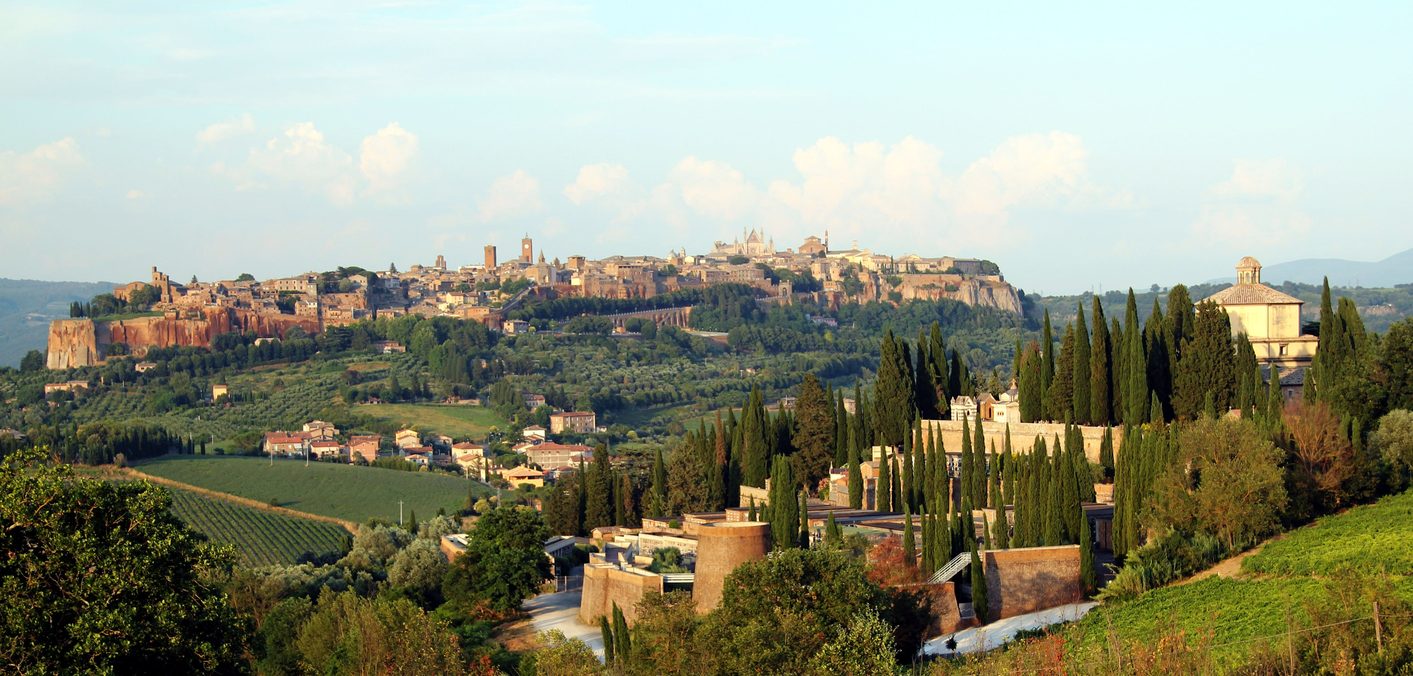
Orvieto Cathedral stands on a rock of volcanic tuff above the Umbrian countryside, and its facade, a wall of gold mosaic, carved marble and bronze, is one of the great sights of Italian Gothic. It is the home of a relic of a eucharistic miracle, and inside it is one of the masterpieces of the Renaissance: Luca Signorelli’s frescoes of the end of the world in the San Brizio Chapel.
A cathedral for a miracle
In 1263, so the story goes, a priest from Prague who doubted that the bread and wine of the Mass became the body and blood of Christ was saying Mass at Bolsena, near Orvieto, when blood fell from the Host onto the corporal, the linen cloth on the altar. Pope Urban IV, who was living in Orvieto, had the cloth brought to the city, and in 1264 he instituted the feast of Corpus Christi for the whole Church.
The new cathedral, which became the home of the relic, was begun in 1290 in the presence of Pope Nicholas IV. Its design is traditionally attributed to Arnolfo di Cambio; the first master mason was Fra Bevignate of Perugia. In 1309 the Sienese sculptor and architect Lorenzo Maitani took charge; he strengthened the walls and began the facade around 1310. Work went on for three centuries, and the facade was not complete until the 16th.
The visitor’s cheat sheet
| Where | Piazza del Duomo, Orvieto; ticket office opposite, at Piazza del Duomo 25 |
|---|---|
| Opening hours | Daily from 9.30am; closes 5pm Nov–Feb, 7pm Mar–May and Oct, 8pm Jun–Sep. Sundays and holy days 10–11am and 1pm–4.30pm (to 5.30pm Mar–Oct). Closed to visits on 1 January 2027 and on Corpus Christi (Sunday 30 May 2027) |
| Admission | €8, with the San Brizio Chapel, Museo Emilio Greco and the underground rooms; €11 with the Museo Faina; children up to 10 free (2026) |
| Audio guide | Free, on the “Opera del Duomo di Orvieto” app |
| Mass | Weekdays 9am in the Chapel of the Corporal; Sundays and holy days 9am, 11.30am and 5pm (6pm Mar–Oct) |
| How long | An hour and a half, with the San Brizio Chapel |
Hours and admission checked against the official site in October 2026. They change; the official site is always the last word.
Mind Sunday. On Sundays and holy days sightseeing is allowed only from 10 to 11am and from 1pm to 4.30pm (5.30pm from March to October). On weekdays come early or late, when it is quieter.
What to see
The facade
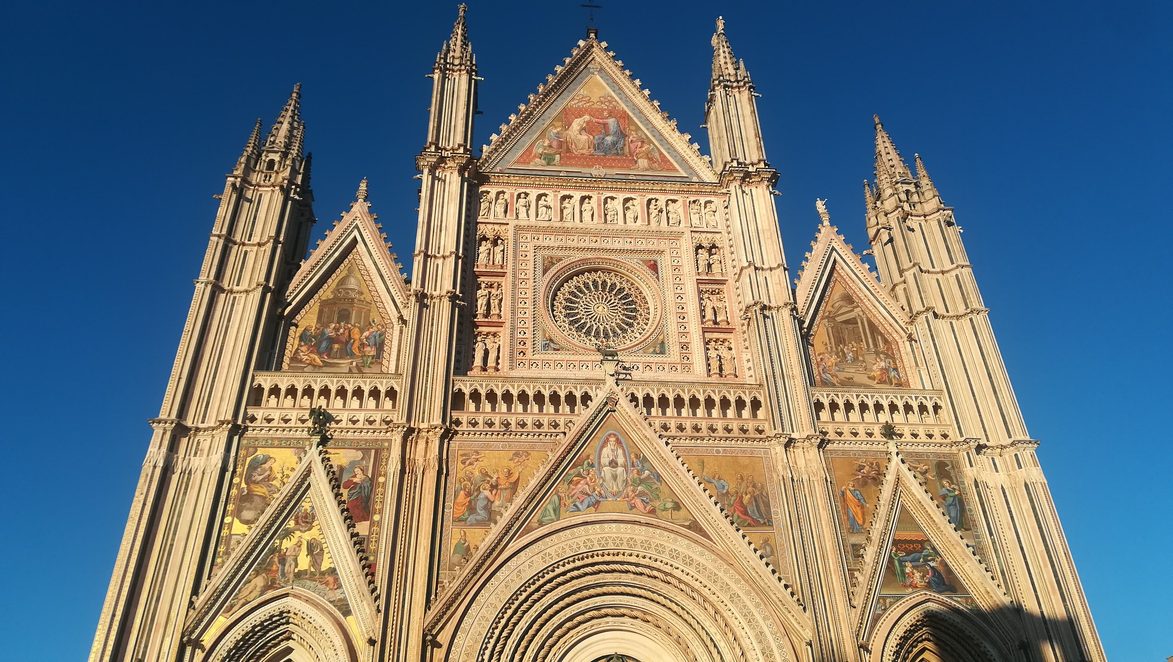
The facade, to Maitani’s design, rises in three gables, with gold-ground mosaics of the life of the Virgin, much restored and remade over the centuries, and in the middle the rose window by Andrea di Cione, known as Orcagna, with the head of Christ at its centre. Above the carved pillars stand bronze symbols of the four Evangelists by Maitani and his workshop, of 1325–30. The bronze doors are modern, by Emilio Greco, and were hung in 1970.

Look closely at the four marble pillars flanking the doors. Carved in the early 14th century by several masters, Maitani probably among them, they tell the story of the world from the Creation, through the Old Testament and the life of Christ, to the Last Judgement, with the dead climbing out of their tombs and the damned dragged off by demons.

The nave
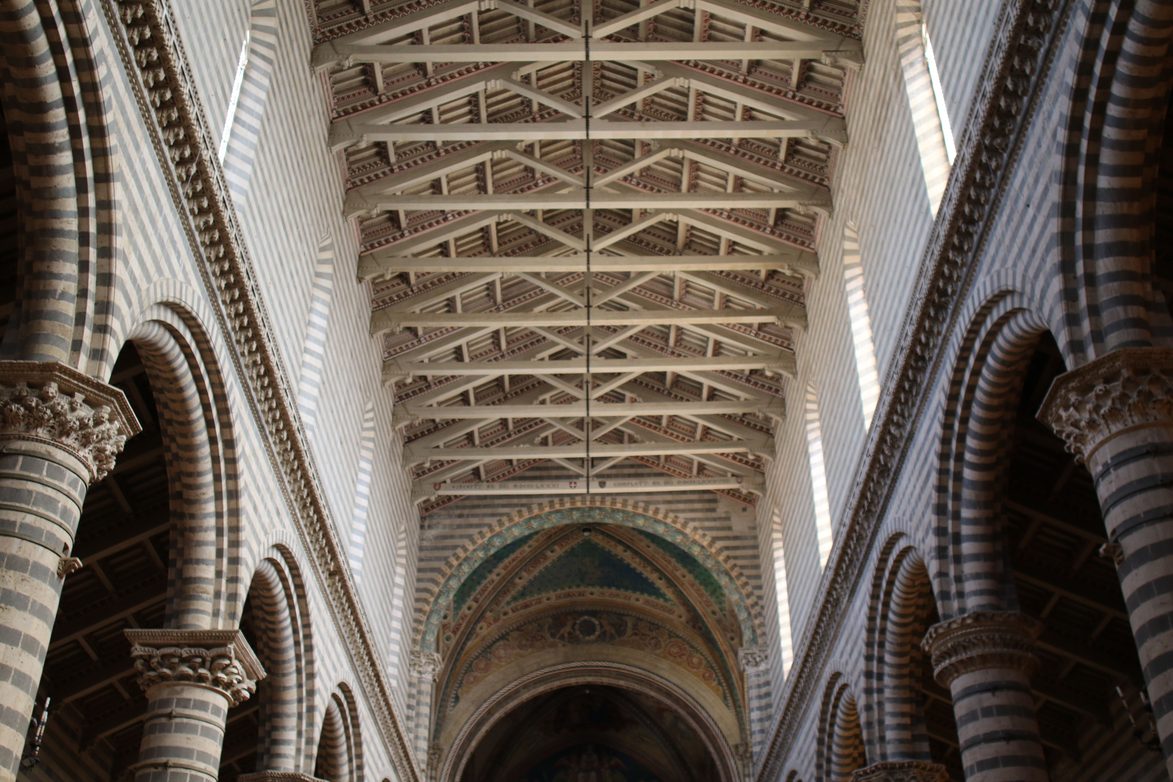
Inside, the bands of dark basalt and pale travertine are the cathedral’s signature. The columns are banded in real stone, but on the walls only the lowest courses, about a metre and a half, are real; the stripes above were painted in the late 19th century. The lower windows are filled with thin sheets of alabaster. The apse is painted with the life of the Virgin by Ugolino di Prete Ilario and his assistants.
The San Brizio Chapel
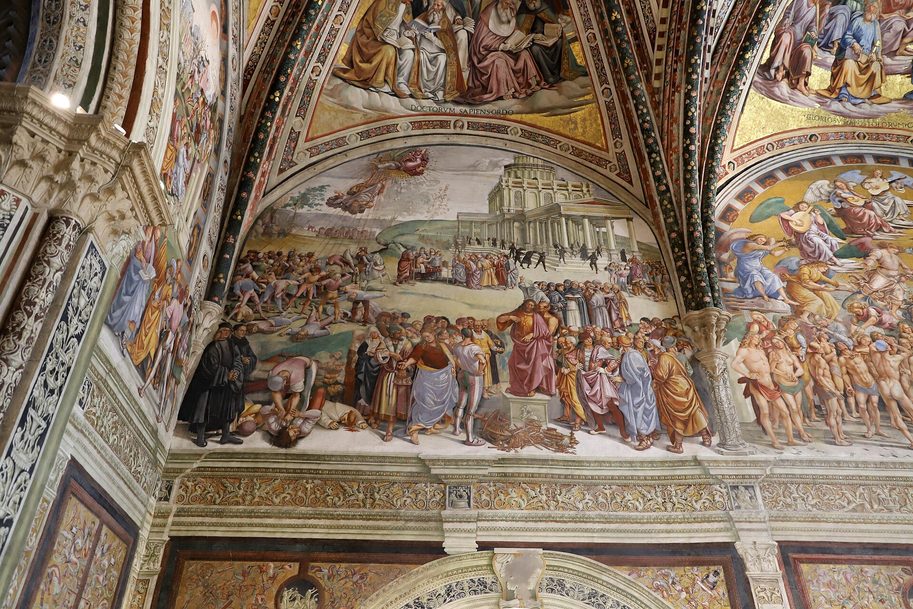
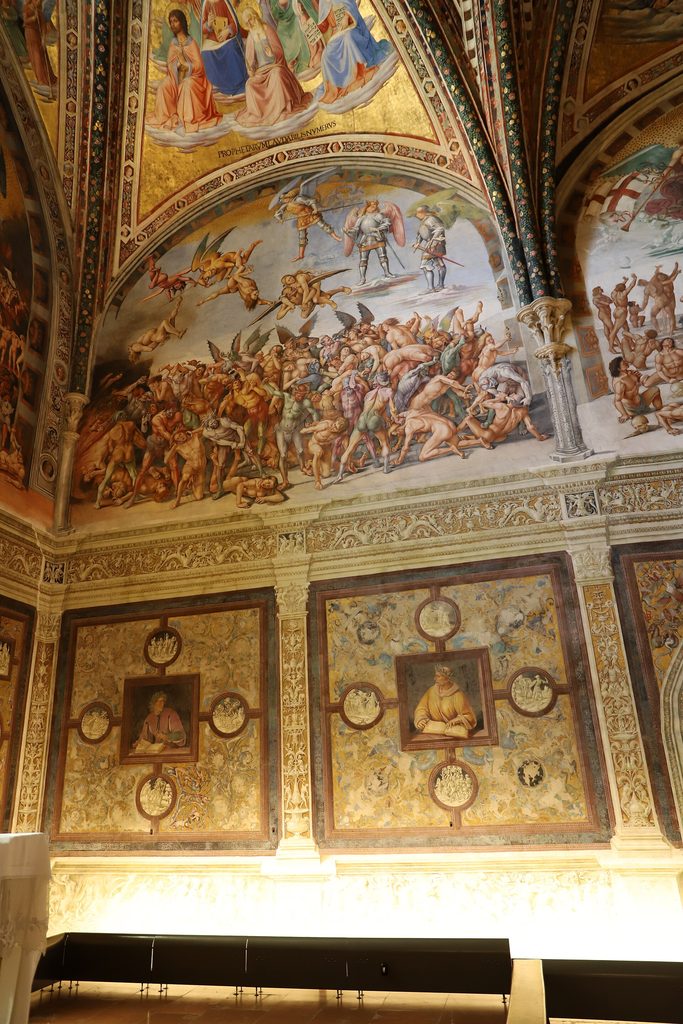
In 1447 Fra Angelico began to paint a Last Judgement in the chapel in the right transept. He finished only part of the vault, with Christ the Judge and the prophets, before Pope Nicholas V called him to Rome. More than fifty years later, from 1499 to 1504, Luca Signorelli completed the vault and covered the walls with the end of the world: the preaching of the Antichrist, the end of the world, the resurrection of the dead, the damned and the blessed. His crowded, muscular nudes are among the most powerful paintings of the Renaissance, and are often seen as a forerunner of Michelangelo’s Last Judgement. In the Antichrist scene, the figure in black at the lower left is traditionally identified as Signorelli himself.

The Chapel of the Corporal
Opposite, in the left transept, is the chapel built in the mid-14th century for the relic, painted with the miracle of Bolsena and other eucharistic miracles by Ugolino di Prete Ilario and his team. The corporal is kept in a marble tabernacle and shown only from Christmas to Epiphany, from Easter to Pentecost, at Corpus Christi and on 15 August. The chapel is kept for prayer, and is closed to visitors during services.

The museum is closed. The cathedral museum in the Papal Palaces has been closed for refurbishment since September 2024. Some of its paintings, including Simone Martini’s polyptych, are on show at the Museo Faina, on the other side of the square, which the €11 ticket includes.
Corpus Christi
Corpus Christi is still Orvieto’s great feast, with a procession of the relic and a historical parade in medieval costume. In 2027 it falls on Sunday 30 May, and the cathedral is closed to visitors all day.
Tours and where to stay
Tickets are sold at the office opposite the cathedral or online. Orvieto is a little over an hour from Rome by train, and many day trips from Rome combine it with Civita di Bagnoregio; staying the night lets you see the facade at sunset, when it glows.
These links go to GetYourGuide and Booking.com. This site earns nothing from them at present — they are here because they are the quickest way to check what is actually available.
Don’t miss
- The facade at sunset The mosaics catch the light.
- The four pillars From the Creation to the Last Judgement.
- Signorelli The end of the world, in the San Brizio Chapel.
- The painted stripes Real stone only at the bottom of the walls.
- The underground rooms Included in the ticket.
Insider tips
Getting up the rock. The funicular from the station has been closed since June 2026; a shuttle bus replaces it, every ten minutes on weekdays, and bus A runs on from Piazza Cahen to the cathedral on the same €1.30 ticket. Drivers should leave the car at the Campo della Fiera car park and take the escalators up.
Common questions
How much does it cost to visit Orvieto Cathedral?
€8 in 2026. There is no cathedral-only ticket: the €8 ticket covers the cathedral, the San Brizio Chapel with Signorelli’s frescoes, the Museo Emilio Greco and the underground rooms beneath the cathedral. For €11 it also includes the Museo Faina. Children up to 10 go free.
When is Orvieto Cathedral open?
From 9.30am every day, closing at 5pm from November to February, 7pm in March, April, May and October, and 8pm from June to September. On Sundays and holy days visits are allowed only from 10 to 11am and from 1pm to 4.30pm (5.30pm from March to October).
What is the Corporal of Bolsena?
The linen cloth on which, by tradition, drops of blood fell from the Host as a doubting priest said Mass at Bolsena in 1263. Pope Urban IV, then living in Orvieto, had it brought to the city and instituted the feast of Corpus Christi the next year. It has been kept in the cathedral, in its own chapel, since the 14th century, and is shown from Christmas to Epiphany, from Easter to Pentecost, at Corpus Christi and on 15 August.
Did Signorelli's frescoes inspire Michelangelo?
It is widely held that they did: Signorelli’s muscular nudes in the San Brizio Chapel are often seen as a forerunner of Michelangelo’s Last Judgement in the Sistine Chapel. That Michelangelo came to Orvieto to study them is a tradition rather than a documented fact.
How do you get from the station up to Orvieto?
The funicular from the station to Piazza Cahen has been closed since June 2026 and replaced by a shuttle bus, every 10 minutes on weekdays; from Piazza Cahen the cathedral is about 15 minutes’ walk, or a short ride on bus A. A ticket costs €1.30 and is valid for 90 minutes on both.
More churches in Italy
- Basilica of St Francis, Assisi — another Umbrian hill town, about an hour and a half away.
- Siena Cathedral — the striped cathedral that Orvieto’s most resembles.