
Karlskirche, Vienna
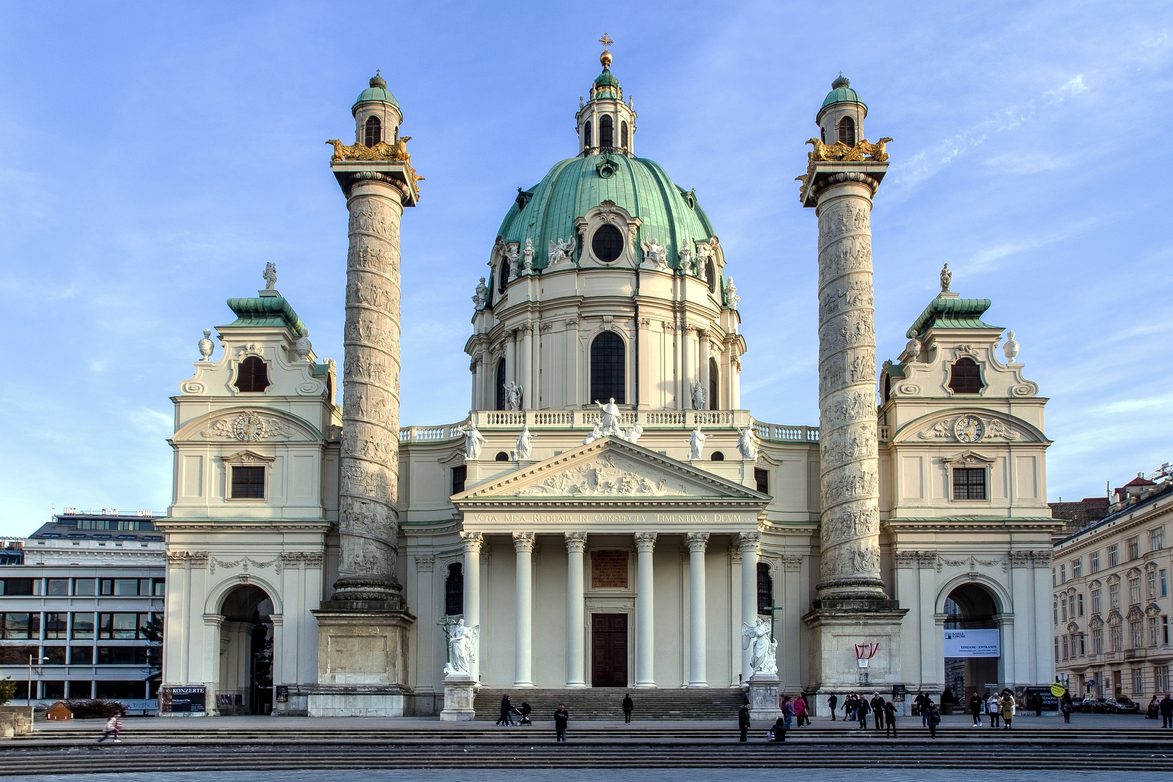
The Karlskirche is the finest baroque church in Vienna: a great oval dome flanked by two columns modelled on Trajan’s Column in Rome, built by an emperor to give thanks for the end of a plague. It stands on Karlsplatz, a few minutes south of the Opera. Inside are painted ceilings, a gilded high altar and a terrace with views across the city, and on many evenings there are concerts of Vivaldi.
A plague church for an emperor
In 1713, as plague swept Vienna, Emperor Charles VI vowed to build a church to his patron saint, Charles Borromeo, the archbishop of Milan who had nursed the sick during the plague of 1576. The design competition was won by Johann Bernhard Fischer von Erlach, and the foundation stone was laid in 1716. After his death in 1723 his son Joseph Emanuel finished the work; the church was consecrated in 1737.
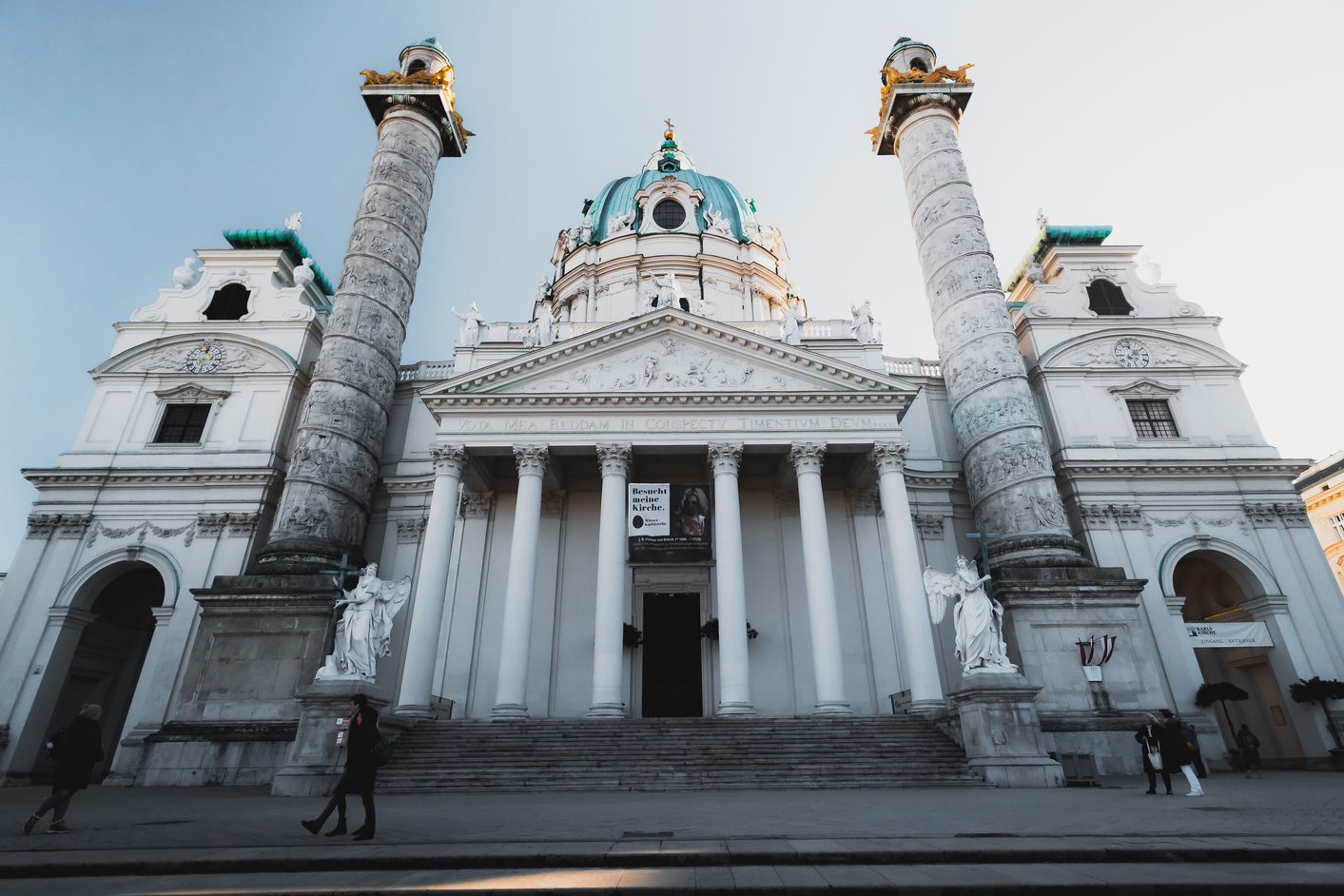
Fischer von Erlach mixed every grand idea he could find: a Greek temple front, a Roman dome, and two columns spiralling with reliefs of the saint’s life, like the columns of Trajan and Marcus Aurelius. The church is looked after by the Knights of the Cross with the Red Star, a religious order.
The visitor’s cheat sheet
| Where | Karlsplatz, Vienna (4th district); Karlsplatz U-Bahn station, U1, U2 and U4 |
|---|---|
| Opening hours | Monday–Saturday 9am–6pm; Sundays and holidays from about 11.45am to 7.15pm, after the morning Masses |
| Admission | €9.50, students €6, young people €5, children up to 10 free (2026); includes terrace, organ gallery, treasury, model and audio guide |
| Services | Mass Monday–Saturday 6pm; Sunday 9am (Latin) and 10.30am |
| Concerts | Baroque concerts on many evenings at 8.15pm, from about €46 |
| How long | Forty-five minutes to an hour |
Hours and admission checked against the official site in October 2026. They change; the official site is always the last word.
No more lift. Older guides describe a lift up into the dome to see the frescoes close up. It was a scaffold lift put up for the restoration, kept for years afterwards, and dismantled at the end of 2022. Today stairs lead to a panoramic terrace instead.
What to see
The facade and the columns
The two columns, each about 47 metres high, are carved with scenes from the life of St Charles Borromeo; the angels on the pediment above the portico show the city being saved from the plague. In the pool in front of the church is a bronze sculpture by Henry Moore.
The interior
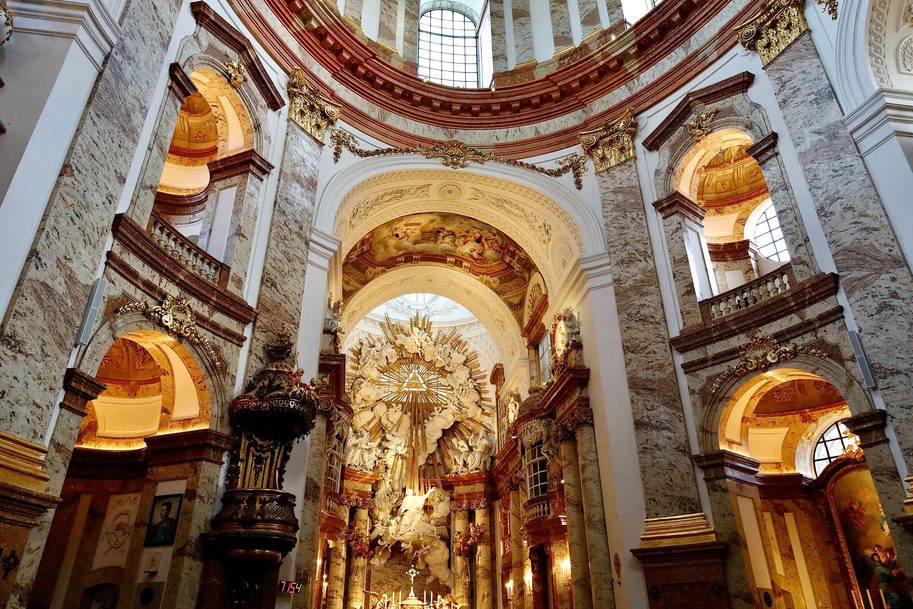
Inside, the church is an oval under a dome that rises about 70 metres outside, painted by Johann Michael Rottmayr with St Charles Borromeo, supported by the Virgin, pleading with God to end the plague. The high altar shows the saint carried up to heaven on clouds into a burst of gilded rays. Side altars hold paintings by some of the best painters of the time.

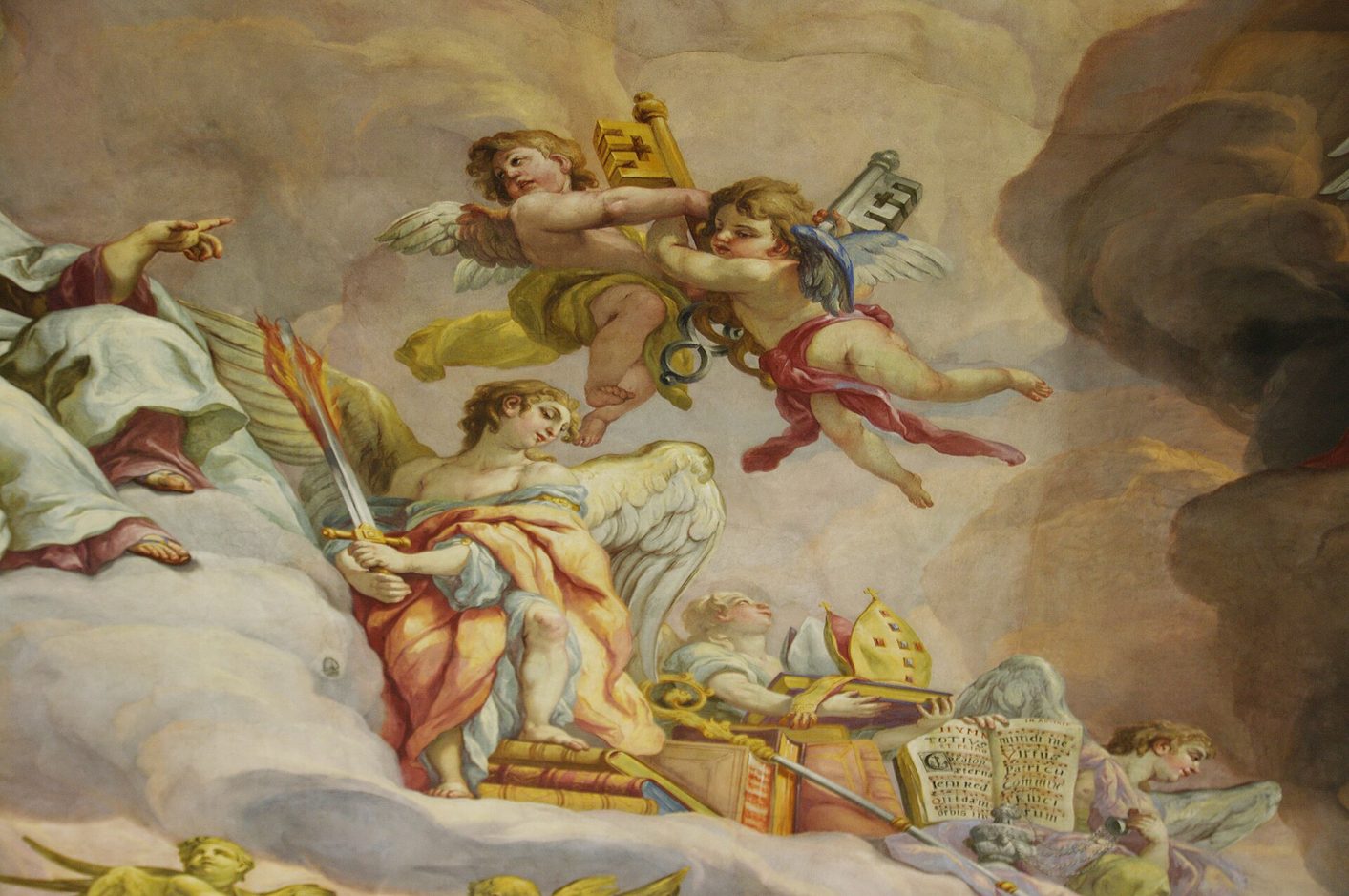
The terrace, organ gallery and treasury
Stairs lead up past the organ gallery to a panoramic terrace with a view over Karlsplatz and the city. The small treasury, the Museo Borromeo, holds vestments and relics of the saint, and there is a model of the church.
Tickets, concerts and tours
Tickets, tours and hotels
Sightseeing tickets are sold at the church. Concert tickets are sold separately, at the church and online. Walking tours of Vienna often include Karlsplatz.
Tour and hotel links go to GetYourGuide and Booking.com. This site earns nothing from them at present — they are here because they are the quickest way to check what is actually available.
Don’t miss
- The columns Carved with the saint’s life.
- The dome fresco Rottmayr’s plague saint.
- The high altar Gilded rays and clouds.
- The terrace The view over Karlsplatz.
- An evening concert Vivaldi under the dome.
Insider tips
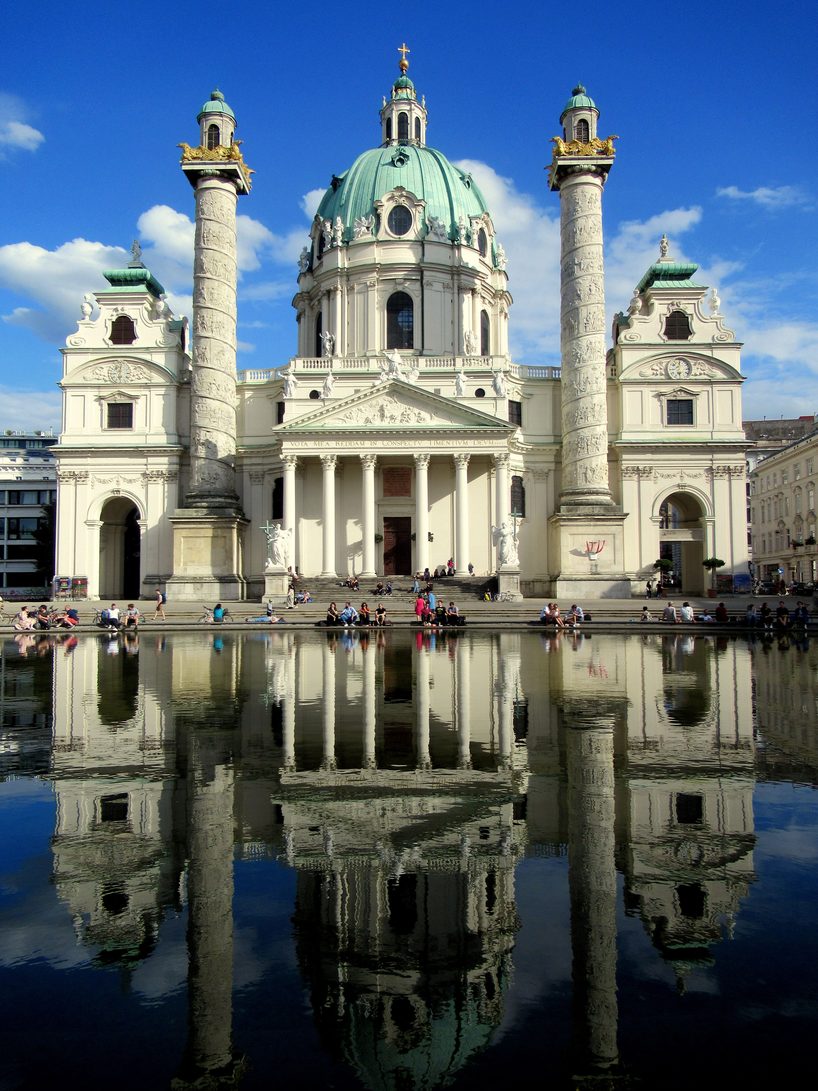
Look from across the square. The best view of the church is from the far side of the pool on Karlsplatz, especially at dusk when it is floodlit and reflected in the water.
The Musikverein, the Secession building and the Naschmarkt are all within a few minutes’ walk; St Stephen’s Cathedral is about 15 minutes north through the old town.
Common questions
How much does it cost to go into the Karlskirche?
€9.50 for adults, €6 for students and €5 for young people, and free for children up to ten (2026). The ticket includes the panoramic terrace, the organ gallery, the treasury and an audio guide.
Is there still a lift up into the dome of the Karlskirche?
No. The panoramic lift that took visitors up to the dome frescoes was dismantled at the end of 2022, when its permit ran out. Instead, stairs lead past the organ gallery to a panoramic terrace with views over Vienna.
Can you hear concerts in the Karlskirche?
Yes. Vivaldi’s Four Seasons and other baroque music are played on many evenings, usually at 8.15pm, with tickets from about €46. They are sold separately from the sightseeing ticket.
When is Mass at the Karlskirche?
Monday to Saturday at 6pm, and on Sundays at 9am (in Latin) and 10.30am. Sightseeing stops during services.
Why was the Karlskirche built?
Emperor Charles VI vowed to build it during the plague of 1713, and dedicated it to St Charles Borromeo, the archbishop of Milan who had cared for the sick during an earlier plague.
More churches in Austria
- St Stephen’s Cathedral — Vienna’s Gothic cathedral.
- Melk Abbey — baroque abbey on the Danube, an hour by train.