
Salzburg Cathedral
Salzburg Cathedral, dedicated to St Rupert and St Virgil, is the great early Baroque church at the heart of the old town: a marble front between twin towers on the Domplatz, and inside a white and gold nave under a high dome. Mozart was baptised at its medieval font and played its organs; the Jedermann play is staged in front of it every summer. Sightseeing costs €7, and the DomQuartier museum route runs through its galleries.
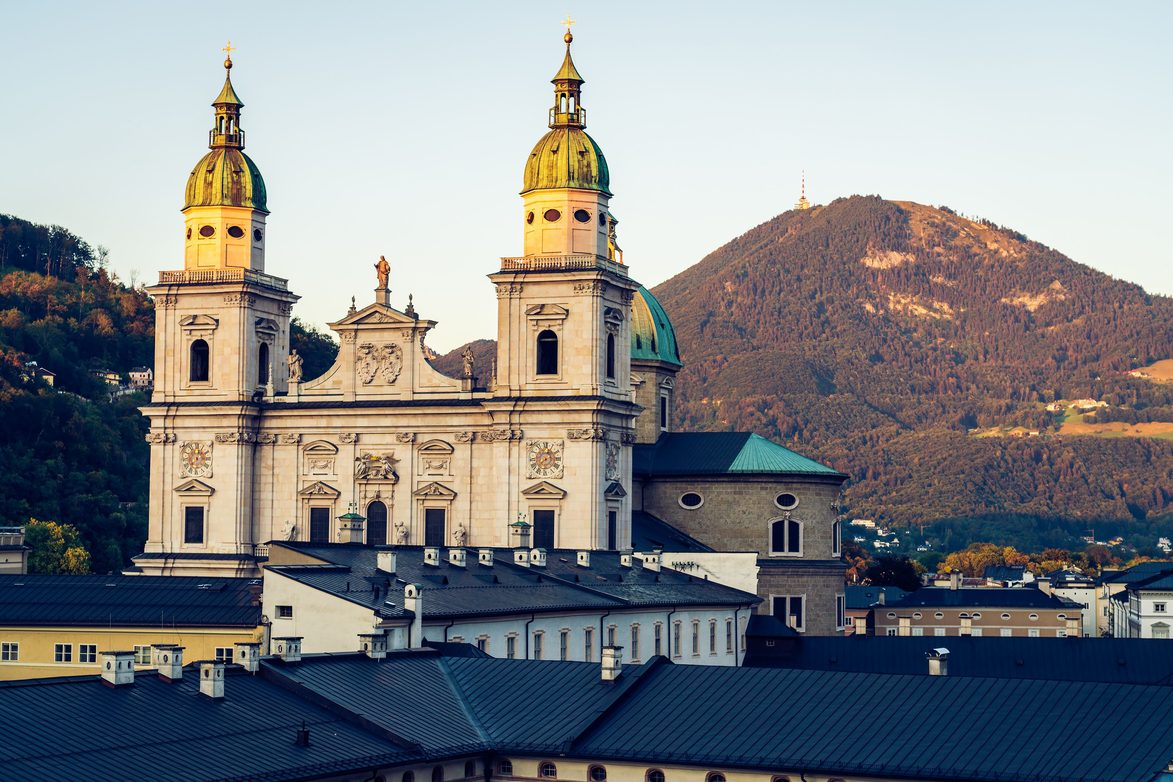
Three cathedrals on one site
The first cathedral here was built by St Virgil, the Irish-born bishop of Salzburg, and consecrated in 774. It burned and was rebuilt more than once, becoming a great Romanesque cathedral in the late 12th century. After a fire in December 1598 Prince-Archbishop Wolf Dietrich von Raitenau had what was left torn down, clearing space for the squares around it.
Vincenzo Scamozzi drew the first plans for a new cathedral; Santino Solari built a reduced version for Archbishop Markus Sittikus from 1614, and Archbishop Paris Lodron consecrated it in September 1628, in the middle of the Thirty Years’ War. It is often described as one of the first Baroque churches north of the Alps. On 16 October 1944, in the first air raid on Salzburg, a bomb crashed through the dome; the church was rebuilt and reconsecrated in 1959. The three bronze doors, Faith, Love and Hope, by Toni Schneider-Manzell, Giacomo Manzù and Ewald Mataré, were added in 1958.
The visitor’s cheat sheet
| Where | Domplatz 1a, Salzburg old town; 20–25 minutes’ walk from the station, or trolleybus to Rathaus |
|---|---|
| Opening hours | Mon–Sat from 9am, Sun and holidays from 1pm; closes 5pm in November, January and February, 7pm in August, 6pm otherwise. No sightseeing during services |
| Admission | Adults €7, ages 14–18 €3.50, up to 13 free; Salzburg Card €5.50; free for worship. Audio guide €3 |
| Tours and music | German tours weekends and holidays at 2pm, €12. “Musik zu Mittag” organ music Mon–Sat at noon (not on holidays), €12 |
| DomQuartier | Residenz, organ gallery, terrace and Cathedral Museum: €12 while the Residenzgalerie is closed; free with the Salzburg Card; 10am–5pm (6pm in July and August), closed Tuesdays except July, August and 1 December–6 January; closed 24 December |
| Access | Step-free except the crypt; induction loop |
| How long | Forty-five minutes; two hours or more with the DomQuartier |
Hours and admission checked against the official site in October 2026. They change; the official site is always the last word.
What to see
The Domplatz and the facade
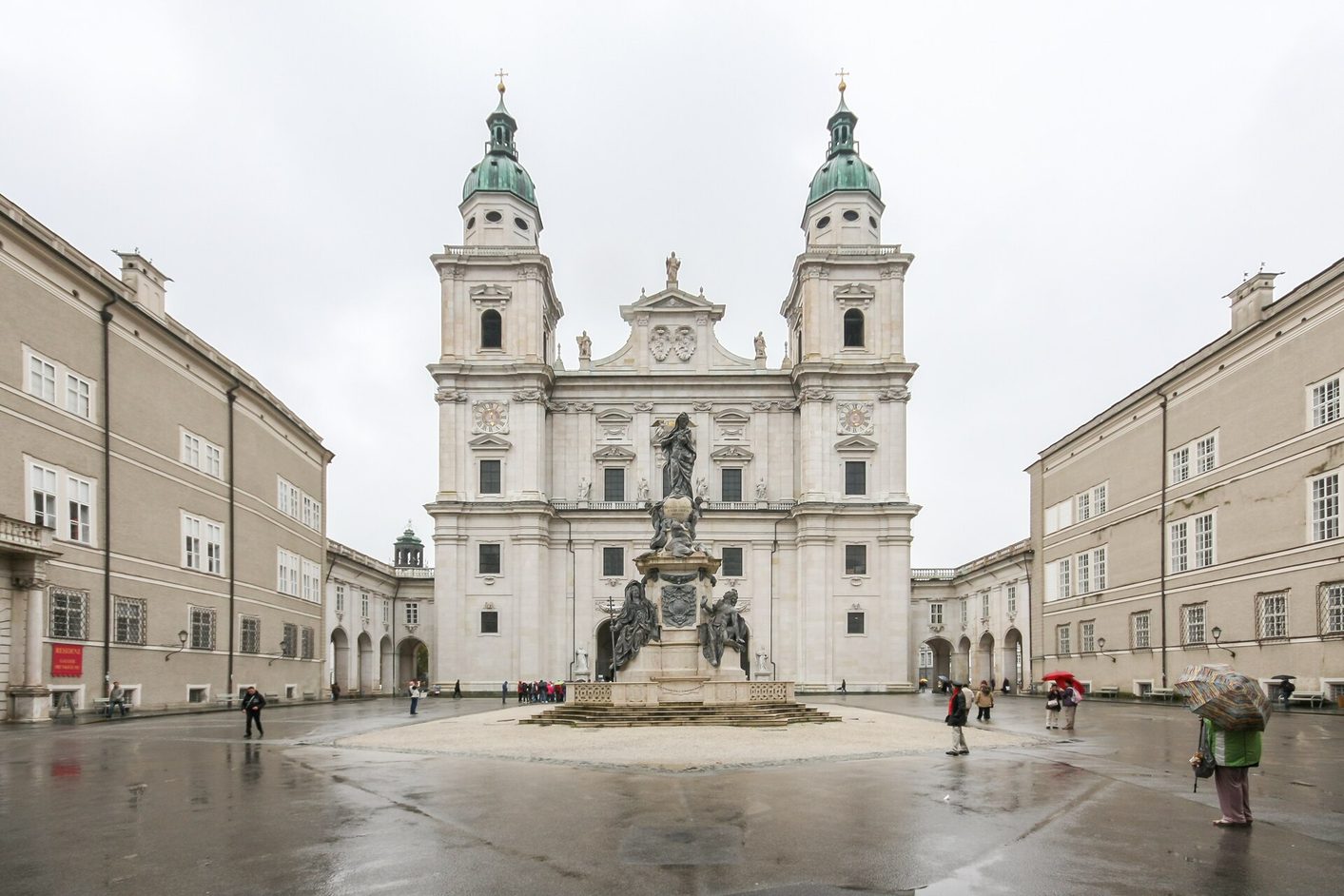
The cathedral closes the east side of the Domplatz, framed by arcades on either side. The facade, in pale Untersberg marble, carries statues of Rupert and Virgil and of Peter and Paul, and a Transfiguration at the top. In the middle of the square stands the Marian column made by the Hagenauer brothers in 1766–71: walk to the arcade on the Franziskanergasse side and look back, and the crown held by angels on the facade appears to sit on Mary’s head. In summer the stage for Jedermann is built in front of the doors, and from late November the Christmas market fills the square.
The nave and the dome
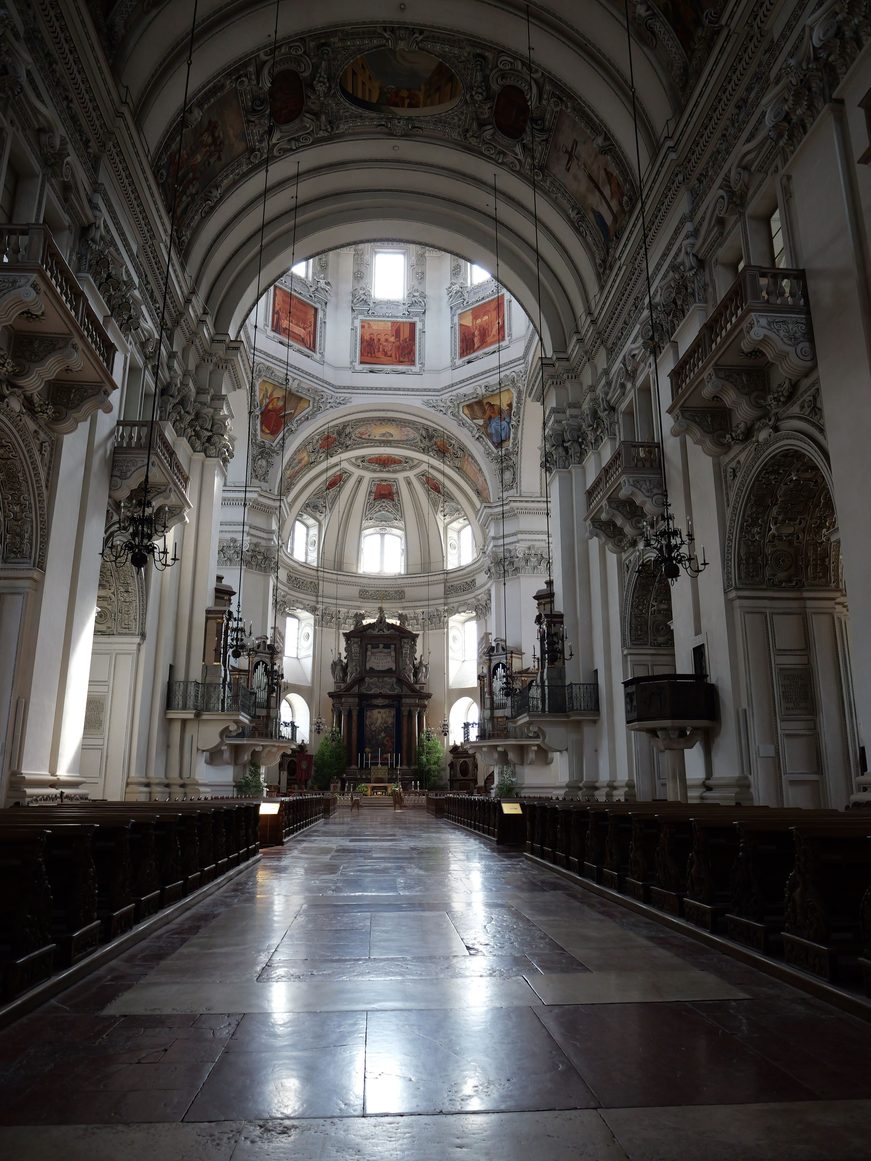
Inside, everything is white stucco and painted panels, with the light falling from the dome over the crossing. The high altar, with its Resurrection, dates from 1628. Look up into the dome, rebuilt after 1944; the pictures around the nave vault are scenes from the life and Passion of Christ.

The organs
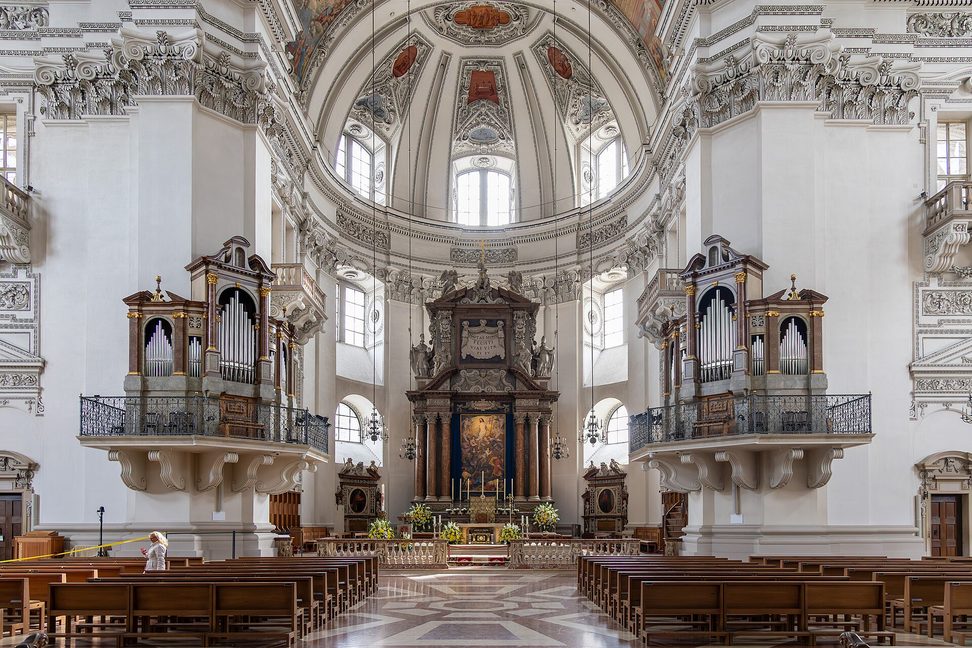
The cathedral has seven organs: the great west organ of 1988 and, in galleries on the four piers of the crossing, four restored instruments, where two new organs were played at the consecration of 1628. Mozart, appointed court and cathedral organist in 1779, would have played here; his Coronation Mass was probably first performed in the cathedral that year. The lunchtime “Musik zu Mittag” recitals, Monday to Saturday at noon except holidays, are the easiest way to hear them.
The font
In the first side chapel on the left (north) as you enter is the bronze font, cast in 1321 and set on four bronze lions of around 1200 from the Romanesque cathedral. Mozart was baptised in it the day after his birth, on 28 January 1756; so was Joseph Mohr, who wrote the words of “Silent Night”.

The crypt and the DomQuartier
The crypt holds the tombs of the archbishops of Salzburg; it is reached by steps. The DomQuartier joins the archbishops’ state rooms in the Residenz to the cathedral by way of the arches over the square, so you can look down into the nave from the organ gallery and walk out onto the terrace above the Domplatz, before ending in the Cathedral Museum with its treasury. The excavations under the square, with the remains of the earlier cathedrals, are closed for renovation until about 2028.

Getting there
The cathedral is in the pedestrian old town, on the left bank of the Salzach. From the main station it is a 20–25 minute walk, or take trolleybus 1, 3, 5, 6 or 25 to Rathaus or Hanuschplatz and walk five minutes. Trains from Munich take from about 1 hour 40 minutes, and from Vienna from about 2 hours 25 minutes. The funicular up to the Hohensalzburg fortress leaves from the Festungsgasse, a few minutes away.

Tours and where to stay
Buy cathedral tickets in the entrance hall; the Salzburg Card gives a reduction here and free entry to the DomQuartier. Old-town walking tours usually include the Domplatz.
These links go to GetYourGuide and Booking.com. This site earns nothing from them at present — they are here because they are the quickest way to check what is actually available.
Don’t miss
- The font Where Mozart was baptised.
- The dome Rebuilt after the bomb of 1944.
- Musik zu Mittag The organs at noon.
- The Marian column Find the spot where Mary is crowned.
- The DomQuartier terrace Above the Domplatz.
Insider tips
Go in the morning on weekdays. On Sundays sightseeing begins only at 1pm, and the noon organ music closes the church to other visitors for half an hour. From late June to August the Jedermann stage blocks the front, and the cathedral’s hours can change on performance days. The Christmas market on the Domplatz runs from 19 November 2026 to 1 January 2027.
Common questions
Do you have to pay to go into Salzburg Cathedral?
Yes, for sightseeing. Since 2021 visitors have paid a contribution to the building’s upkeep: €7 for adults, €3.50 for 14–18s, free for children up to 13, and €5.50 with the Salzburg Card. People coming to pray do not pay.
When is Salzburg Cathedral open?
From 9am on weekdays and Saturdays and from 1pm on Sundays and public holidays. It closes at 5pm in November, January and February, 7pm in August and 6pm in the other months. There is no sightseeing during services or the lunchtime organ music.
Was Mozart baptised here?
Yes. He was born on 27 January 1756 and baptised in the cathedral the next day, at the bronze font of 1321 that still stands near the entrance. Later he worked for the archbishop as court and cathedral organist.
What is the DomQuartier?
A single museum route through the archbishops’ Residenz, across the arches to the cathedral’s organ gallery and terrace, and into the Cathedral Museum. While the Residenzgalerie is closed the ticket is €12; it is free with the Salzburg Card. It is closed on Tuesdays, except in July, August and from December to 6 January.
Are there guided tours?
Public tours in German at 2pm on weekends and holidays, about 40 minutes, €12. Tours in English are for booked groups.
More churches in Austria
- Melk Abbey — the Baroque abbey above the Danube.
- Hallstatt Charnel House — about an hour and a quarter by car into the Salzkammergut.
- St Stephen’s Cathedral, Vienna — the Gothic cathedral of the capital.