
St Michael’s Church, Brent Knoll
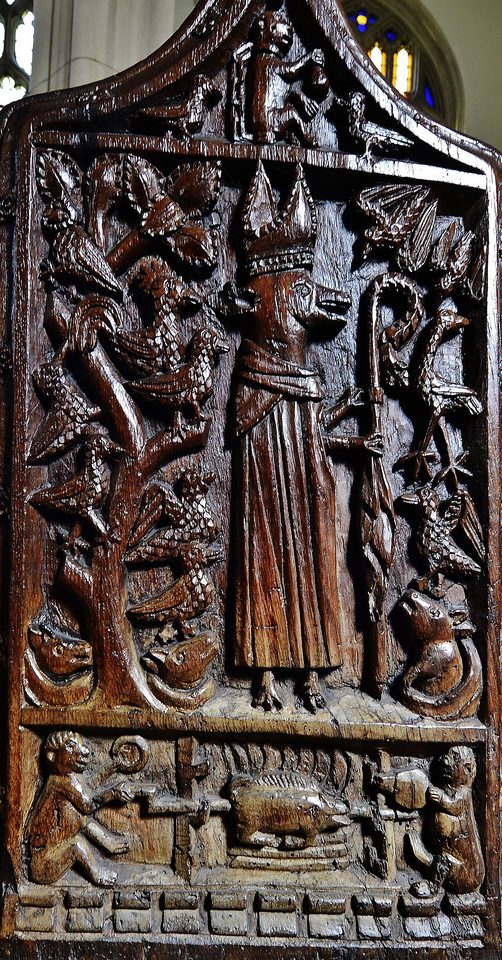
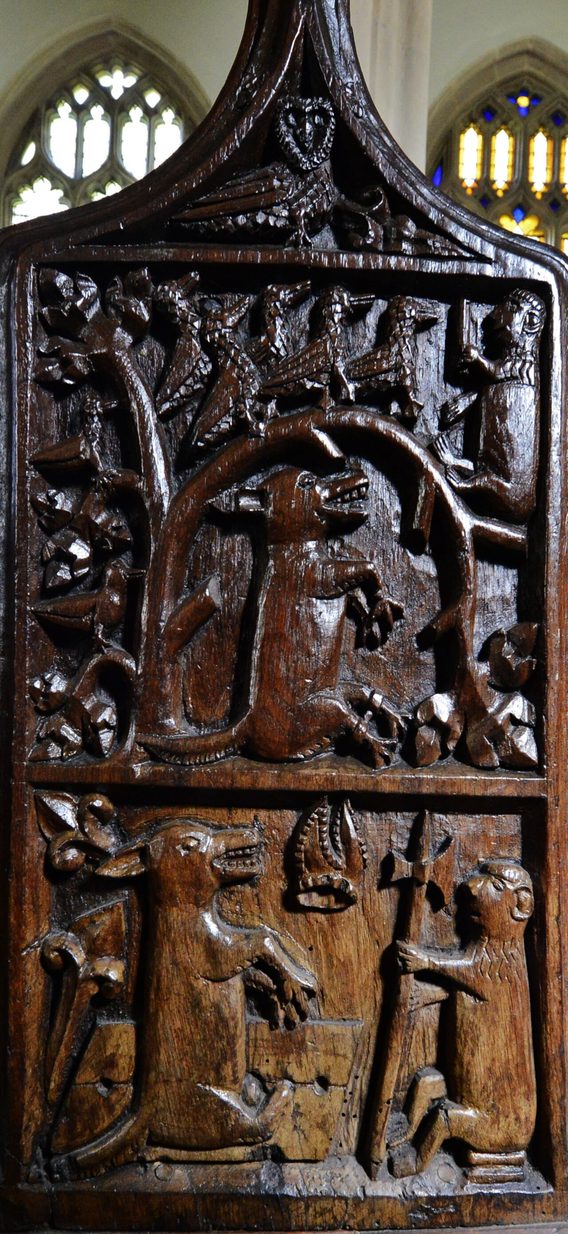
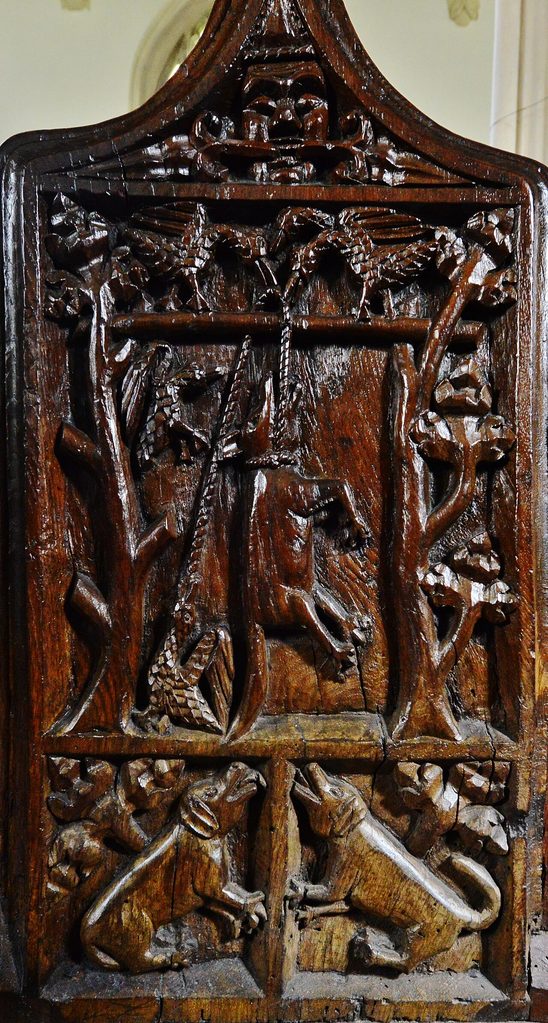
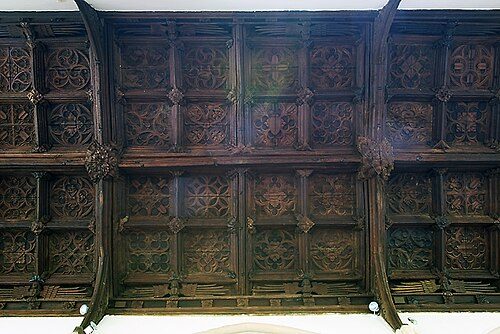
On the lower slopes of the Knoll, the isolated hill that rises from the Somerset Levels by the M5, St Michael’s is famous for a medieval cartoon in oak: three bench ends in which a fox dressed as a churchman preaches to geese, is put in the stocks and is finally hanged by the geese. Above the north aisle is a ceiling of ninety-six carved panels.
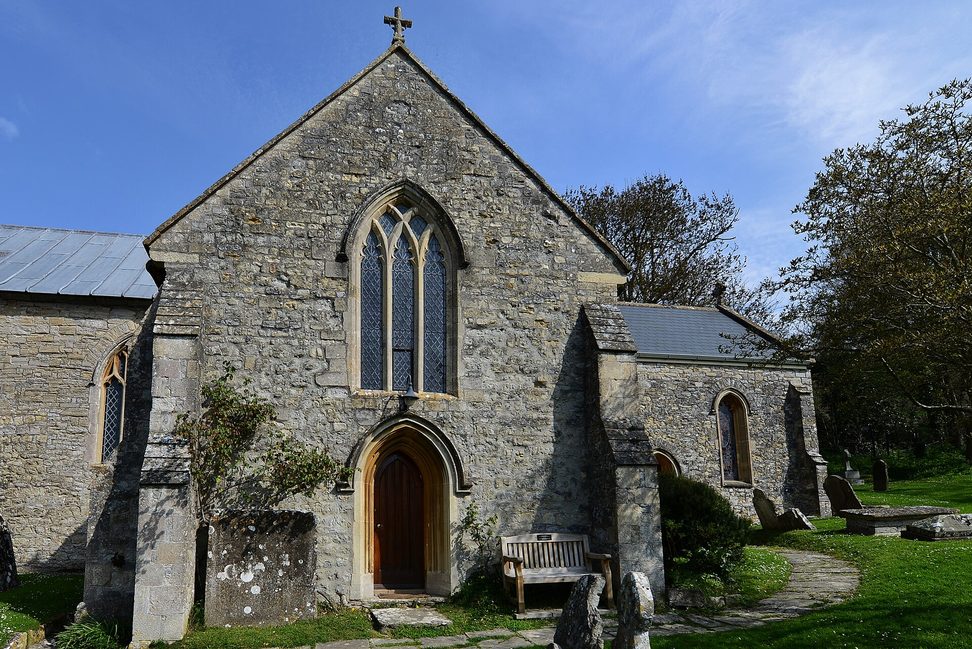
A church under the Knoll
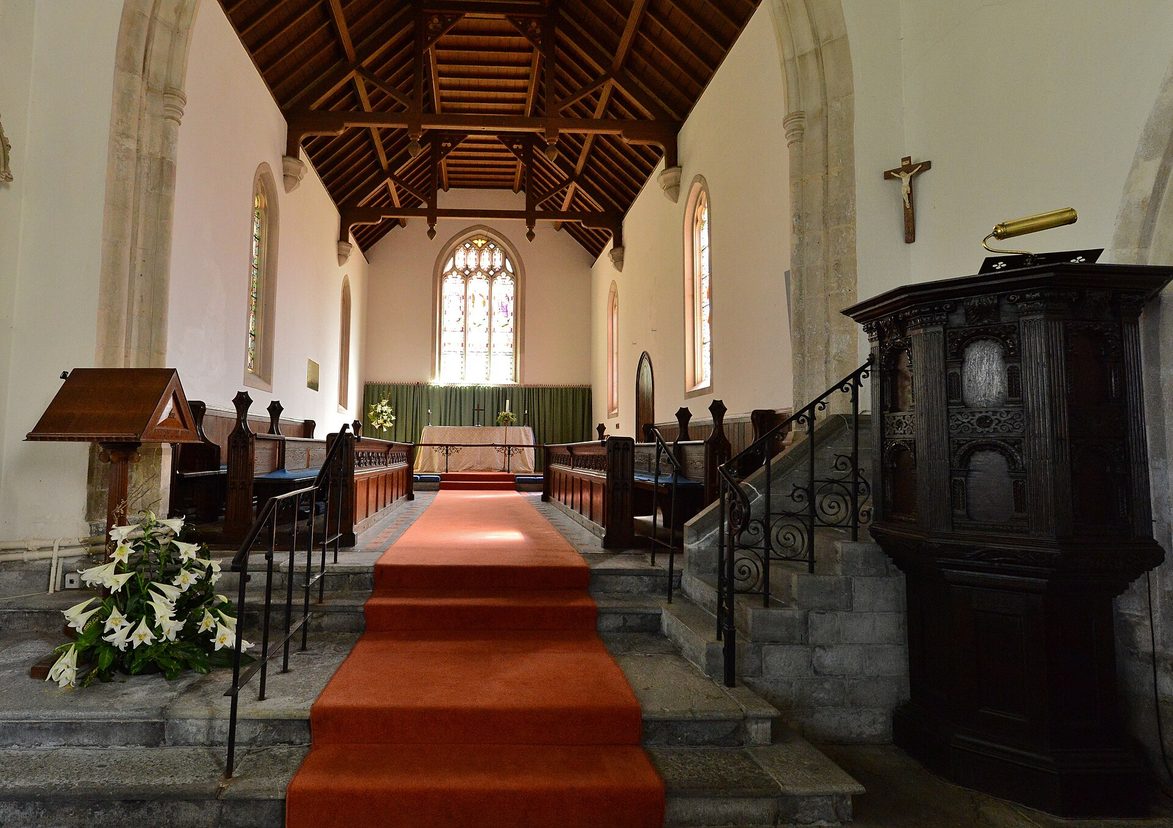
Tradition says King Ine of Wessex gave South Brent to Glastonbury Abbey in the seventh century, though the documents are thought to be later forgeries, and the abbey held land here for much of the Middle Ages. The stone church was begun early in the twelfth century, and its Norman south doorway survives. Early in the fourteenth century the nave was rebuilt in blue lias, and of that work the south wall, the porch and the south transept, now the vestry, remain. The west tower followed in about 1400, and the richly finished north aisle in the late fifteenth century. The chancel was rebuilt in the 1850s. The church is listed Grade I.
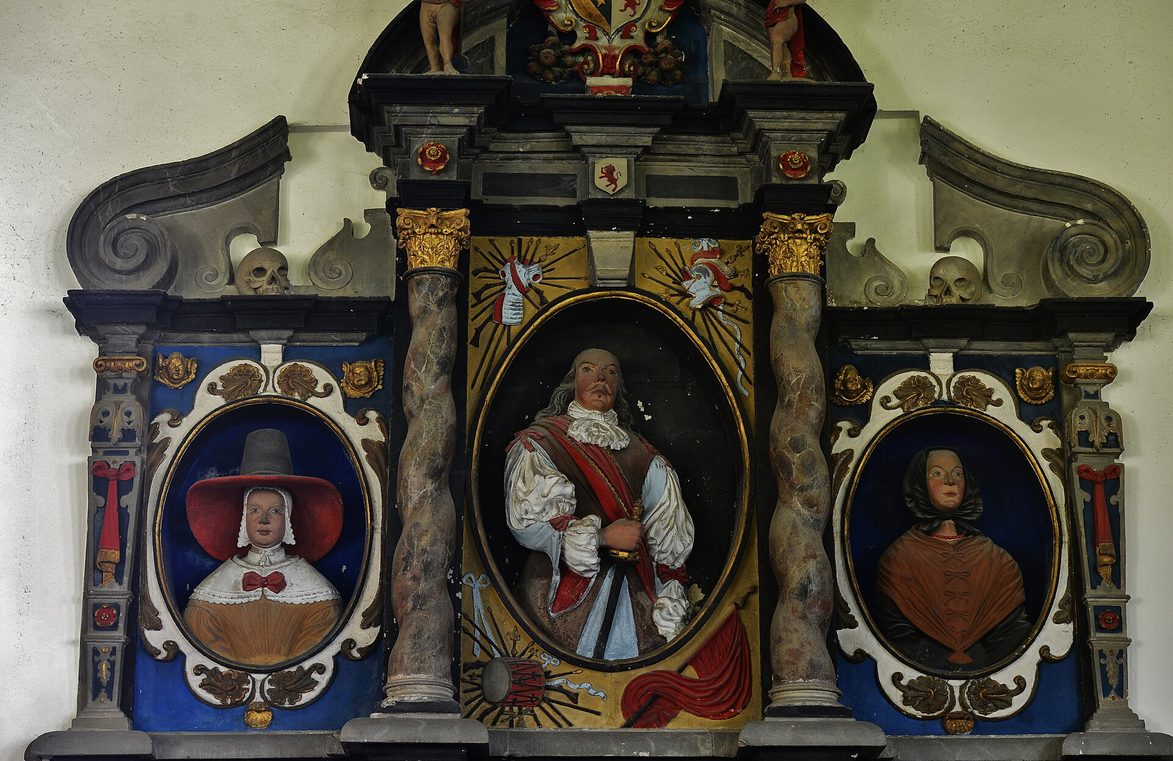
In the Civil War a parishioner, John Somerset, and Thomas Gilling were arrested in 1645 after trying to quell a Royalist riot in the village; Somerset’s painted monument of 1663 is one of the treasures of the church.
The visitor’s cheat sheet
| Where | Church Lane, Brent Knoll, Highbridge, Somerset TA9 4DG; up the lane opposite the primary school |
|---|---|
| Opening hours | Aims to open daily, 9am–5pm (the National Churches Trust says 9am–4pm); volunteer-opened, so not guaranteed |
| Admission | Free |
| Services | Sunday 10am Holy Communion, held in one of the three churches of the parish; check the Parish of Three Saints calendar |
| Access | Ramp and hearing loop listed |
| Parking | Limited, between the church entrance and the lychgate, or at the bottom of the lane |
| Toilets | Listed by the church, including an accessible toilet; check on the day |
| How long | Three-quarters of an hour; longer with a walk up the Knoll |
Hours and admission checked against the official site in November 2026. They change; the official site is always the last word.
What to see
The tower and the north aisle
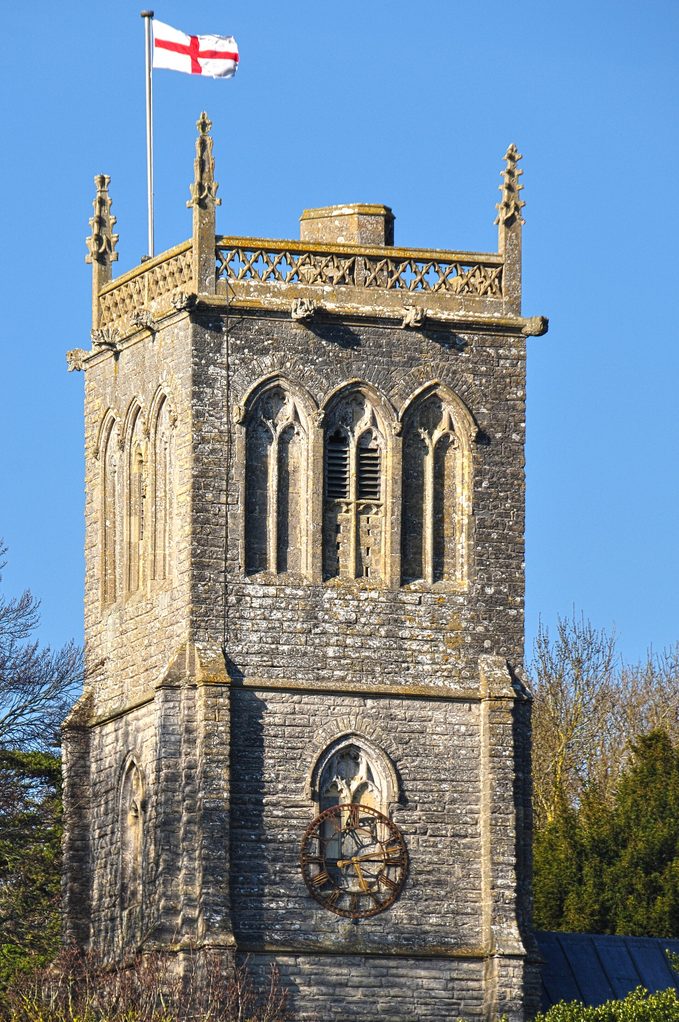
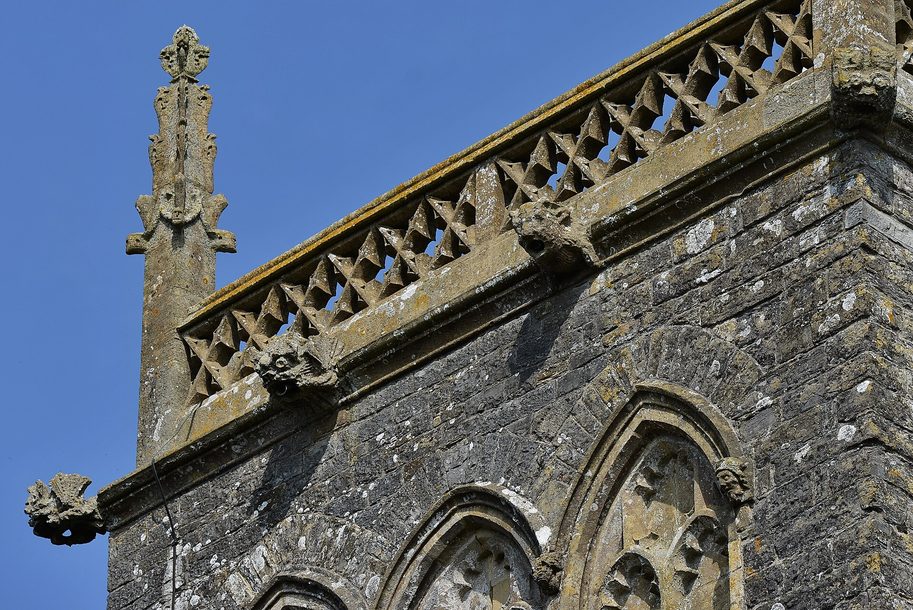
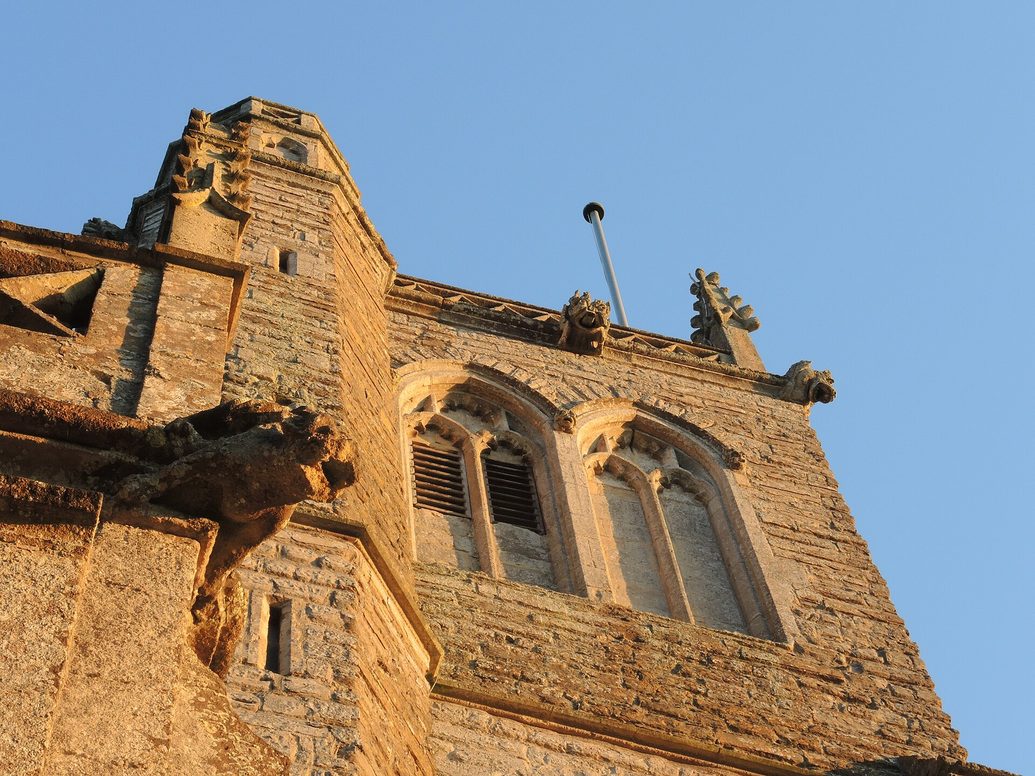
Walk up Church Lane to the lychgate. The tower, about 75 feet high, has a pierced parapet, pinnacles, a stair turret and gargoyles, including a contorted “hunky punk” monster; the empty niches beside the west door lost their figures at the Reformation. The church says its old clock mechanism, which struck the hours without a dial, resembled the clocks of Wells and Salisbury; it was replaced by an electric movement in 1979, and the old works are kept in the tower. Walk round to the north aisle, of the late fifteenth century, built of freestone with a pierced parapet, pinnacles and gargoyles: very elaborate for a village church.
The porch and the Norman doorway
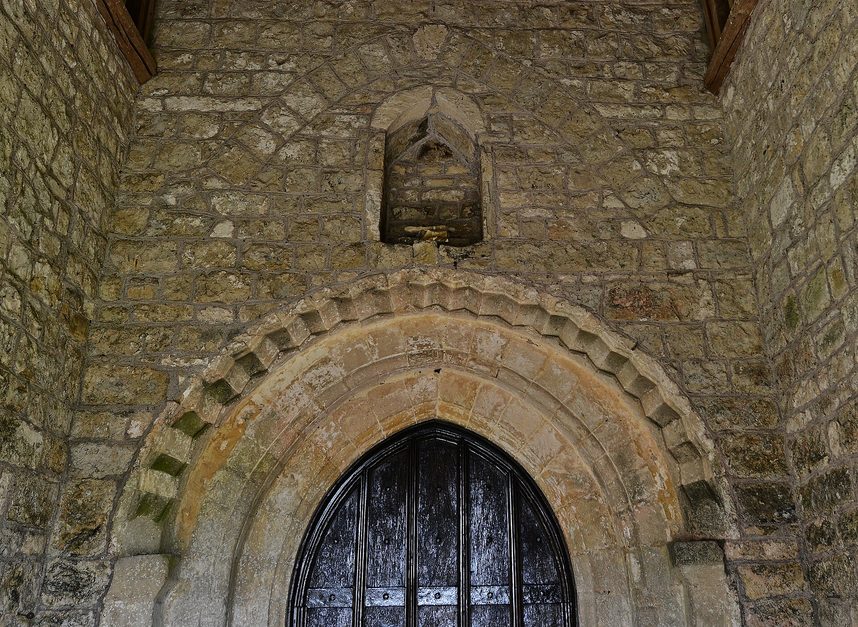
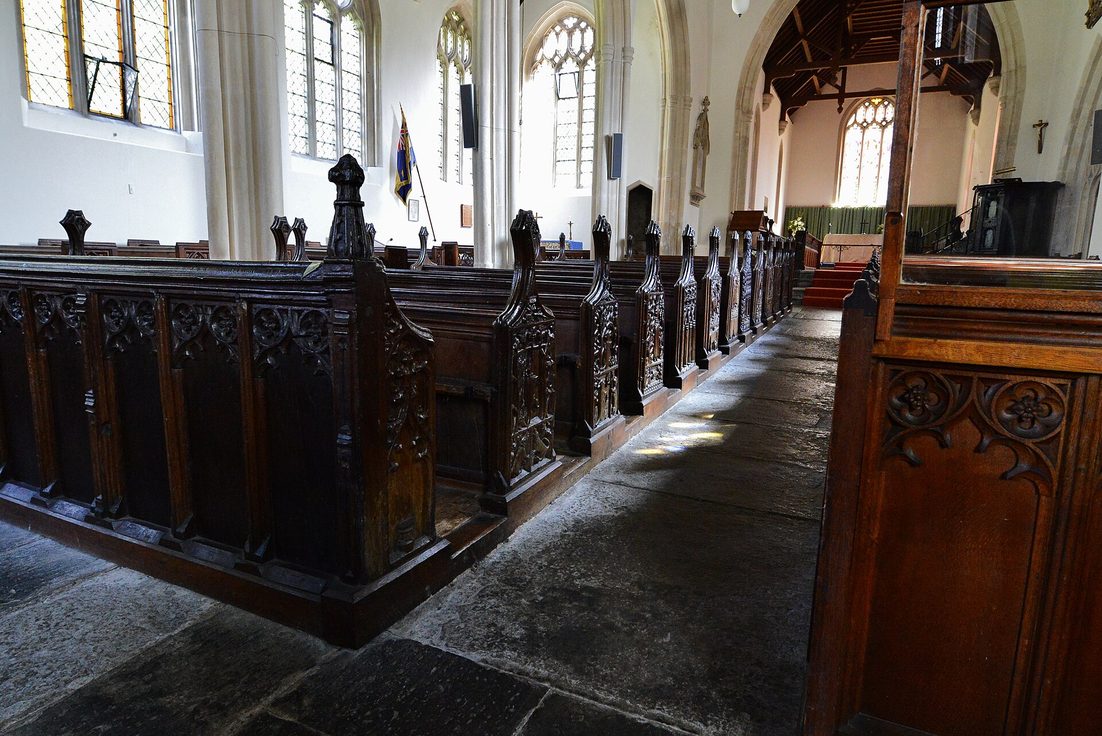
The south porch is of the early fourteenth century. Inside it is the twelfth-century doorway, with zigzag carving; the carver of the pulpit, in 1637, copied its pattern. Once inside, notice that the floor rises: the east end of the nave is about two feet higher than the west.
The fox and the geese
The bench ends on the south side of the nave are the reason most visitors come. Read them in order. In the first, a fox in a mitre and robes, with a crozier, preaches to a flock of geese; around him a chained ape holds a moneybag and monkeys roast a pig on a spit. In the second, the fox sits with his feet in the stocks, guarded by a monkey. In the third the geese have their revenge and hang him from a gallows, while dogs bark below. The church dates the carving to about 1460–70. It is usually read as satire on an abbot of Glastonbury, but its target is uncertain.
The other benches and the pulpit
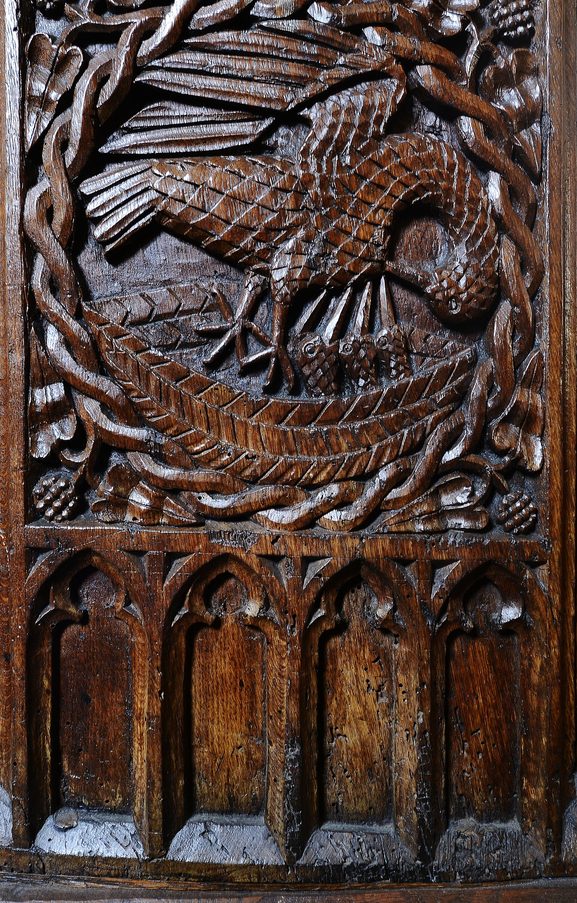
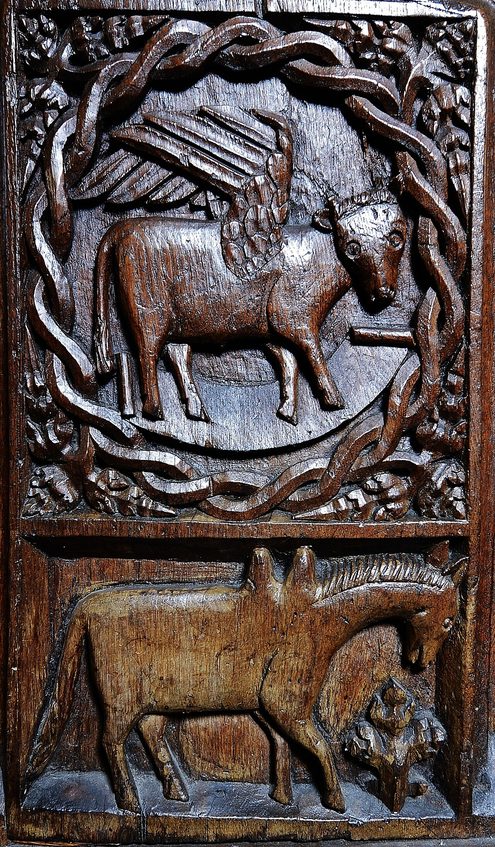
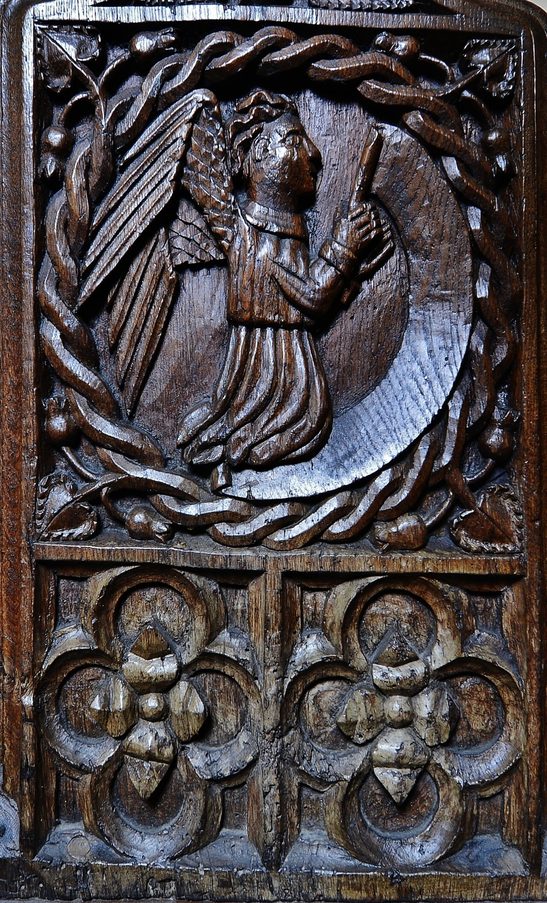
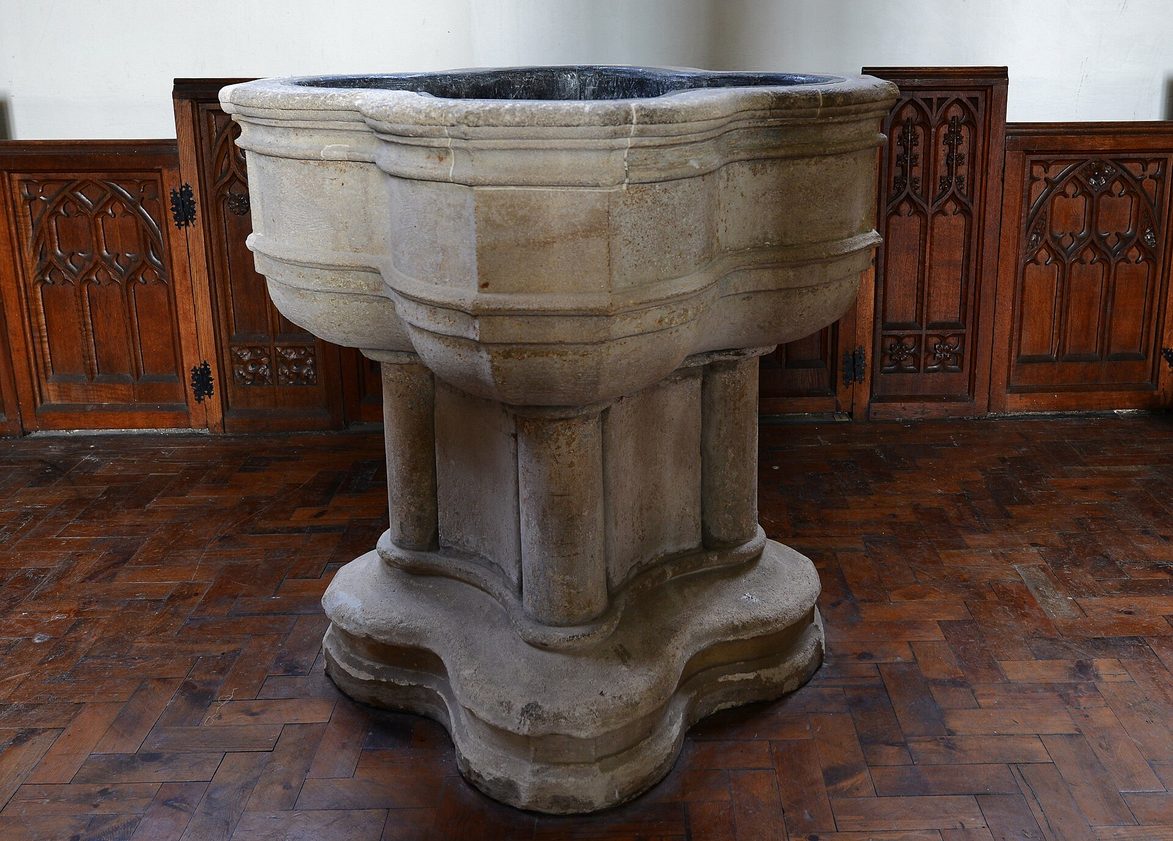
The other medieval bench ends have tracery, poppyheads and carved figures, among them a pelican pecking her breast to feed her young and several Green Men. The Jacobean pulpit is dated 1637, and the Royal Arms of the time of Charles II hang over the vestry door. The quatrefoil font, with a nineteenth-century cover, is dated by Historic England to the eleventh century, although others think it later.
The north aisle ceiling
Look up in the north aisle. Tie beams divide its panelled roof into six compartments of sixteen squares each, ninety-six panels in all, said to differ from one another; carved angels with outstretched wings line the wall plates. Death-watch beetle was found here in 1978, the roof was re-leaded in 2020, and the church is now appealing to save the ceiling. The pews were taken out of this aisle after the roof work, and changes to its floor are planned. At its east end, in the Memorial Chapel, a fifteenth-century angel corbel holds the instruments of the Passion, and at the east end of the north aisle is a twisted Norman column.
The Somerset monument, the chancel and the bells
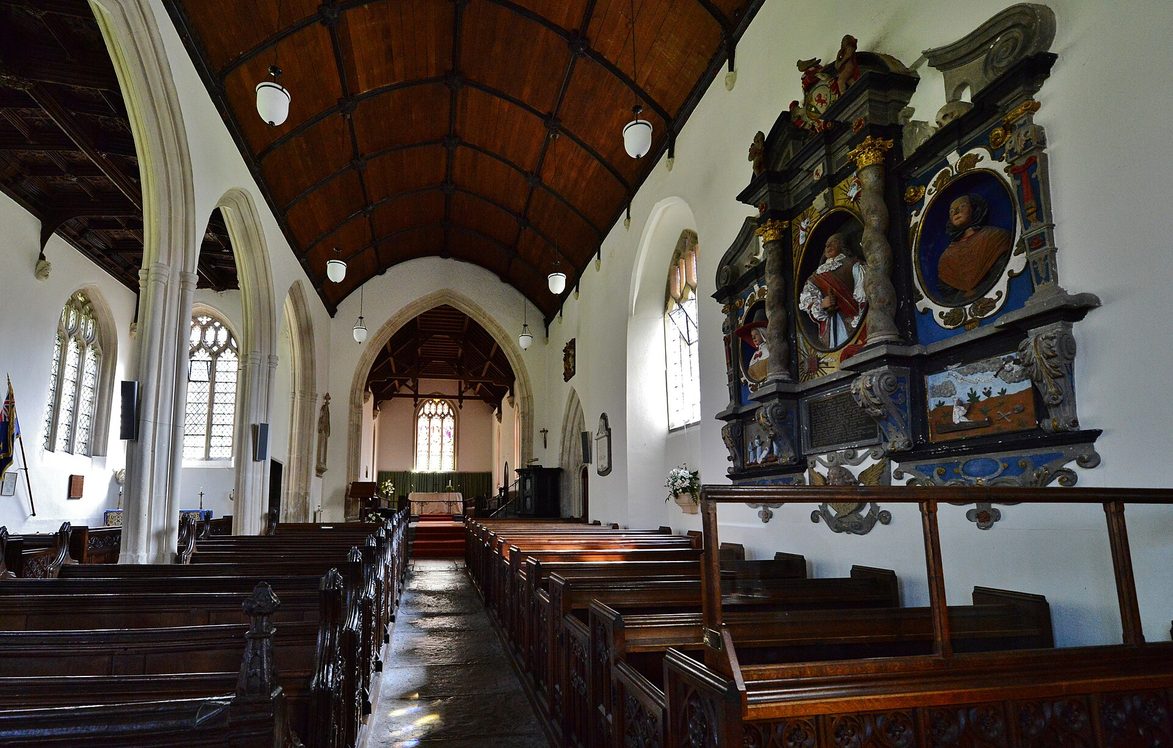
On the south wall of the nave is the painted monument to John Somerset, of 1663, with his figure in an oval niche between his two wives, twisted columns and a pediment, and reliefs of the family at prayer and of Somerset rising from his tomb. The Victorian chancel keeps a door to the stair of the lost rood loft; on its north wall a brass remembers George Norcote, who brought piped water to the village shortly before the First World War, and his standpipe still stands in the main street. Fragments of medieval glass survive in the south windows. The six bells include one of 1635 given by John Somerset and a tenor of 1777 by William Bilbie of Chew Stoke.
Getting there
Brent Knoll is close to junction 22 of the M5, about three miles from Burnham-on-Sea. The church is up Church Lane, opposite the primary school in Brent Street; parking by the church is difficult. The nearest station is Highbridge and Burnham, on the line to Taunton, a few miles south, with taxis at the station. A few local buses stop in the village, but services are sparse (check times). The Fox and Goose Inn on Bristol Road serves food. The church at East Brent, the next village, has more fifteenth-century bench ends, a nave ceiling of 1637 and a medieval wooden lectern.
Where to stay
Burnham-on-Sea, about three miles away, is the nearest town with places to stay; Weston-super-Mare, further north, has more.
This link goes to Booking.com. This site earns nothing from it at present — it is here because it is the quickest way to check what is actually available.
Don’t miss
- The fox bench ends A medieval satire in three scenes.
- The north aisle ceiling Ninety-six carved panels.
- The Somerset monument Painted, of 1663.
- The Knoll An Iron Age hillfort above the church.
Insider tips
Climb the Knoll. Footpaths lead from the village to the National Trust hillfort on the summit, with wide views over the Levels.
Support the ceiling. The church is appealing for money to save the north aisle ceiling; donations are welcome.
Common questions
What do the fox bench ends show?
In the first, a fox in a mitre and robes preaches to a flock of geese, with apes and monkeys around him; in the second he is put in the stocks; in the third the geese hang him while dogs bark below. They are usually read as satire on an abbot of Glastonbury, whose abbey held land here, but no one knows for certain who was meant.
When were they carved?
The church dates them to about 1460–70; other sources give the fourteenth or fifteenth century, so treat the date as approximate.
Is the church open?
The church aims to be open daily from 9am to 5pm, opened by volunteers, so opening is not guaranteed; the National Churches Trust gives 9am to 4pm.
Is it free?
Yes. The church is raising money to save the north aisle ceiling, so donations are welcome.
Can I climb the Knoll?
Yes. Brent Knoll, 137 metres high, is crowned by an Iron Age hillfort owned by the National Trust, and footpaths lead up from the village.
More English churches
- Glastonbury Abbey — the abbey that owned the manor
- Wells Cathedral — the cathedral of the diocese
- Stoke-sub-Hamdon Church — a Norman church in south Somerset
See all the cathedrals and churches worth visiting in England →