
Toledo Cathedral
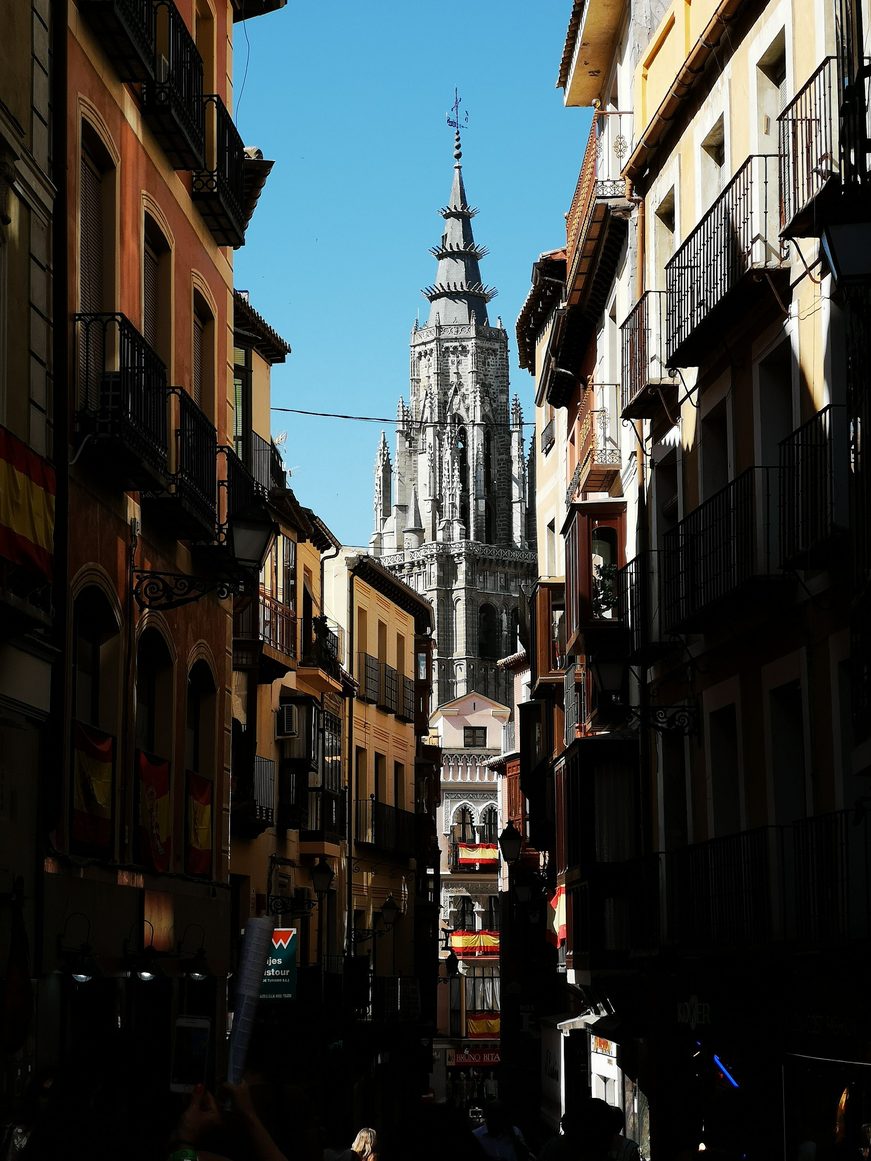
Toledo Cathedral is the seat of the Primate of Spain and one of the greatest Gothic cathedrals in Europe, begun in 1226 on the site of the city’s great mosque and 800 years old in 2026. Inside are some of the finest choir stalls anywhere, a gilded altarpiece that fills the main chapel, the Baroque Transparente, and a sacristy hung with El Greco. Allow two hours, and leave the camera in your pocket: photography is not allowed.
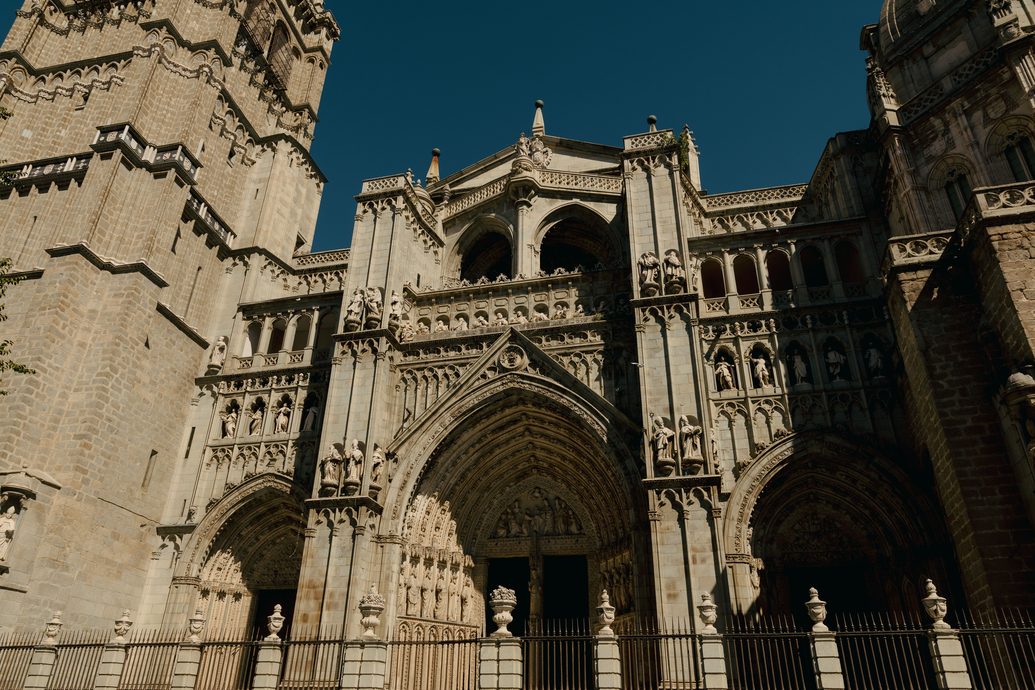
From mosque to cathedral
Toledo was the capital of Visigothic Spain, and the site had held a church of the Virgin before the Moorish conquest; then the city’s main mosque, which became the cathedral soon after Christian Castile took Toledo in 1085. In 1226 or 1227, under Archbishop Rodrigo Jiménez de Rada and with King Ferdinand III present, the foundation stone of a new Gothic cathedral was laid, on the model of the French cathedrals. Master Martín and then Petrus Petri led the work, and the last vaults were closed in 1493.
For centuries the archbishops of Toledo were the richest churchmen in Spain, and they filled the cathedral with art: Cardinal Cisneros commissioned the great altarpiece and the silver Custodia, and founded the Mozarabic Chapel, where the old Spanish rite of the Mass is still said every day. The cathedral marked its 800th anniversary in 2026.
The visitor’s cheat sheet
| Where | Calle Cardenal Cisneros 1, 45002 Toledo; visitor entrance by the Puerta Llana |
|---|---|
| Opening hours | Monday–Saturday 10am–6.30pm; Sunday 2–6.30pm; last entry 30 minutes before closing. Special hours on feast days; closed 1 January and 25 December |
| Admission | Basic ticket €12; reduced €8; ages 8–14 €6; under-8s, Toledo residents and some others free, with proof |
| Rules | No photography or filming inside; phones off; dress appropriately |
| Getting there | Avant train from Madrid Atocha, about 33 minutes; from Toledo station, a bus or the escalators up to the old town |
| How long | Two hours |
Hours and admission checked against the official site in October 2026. They change; the official site is always the last word.
Enter by the Puerta Llana, and not on Sunday mornings. Visitors go in only by the Puerta Llana on the south side; tickets are sold online and at the cathedral shop opposite. On Sundays the cathedral opens to visitors only at 2pm. Photography and filming are forbidden inside, and the rule is enforced.
What to see, in the order you meet it
The nave and the choir
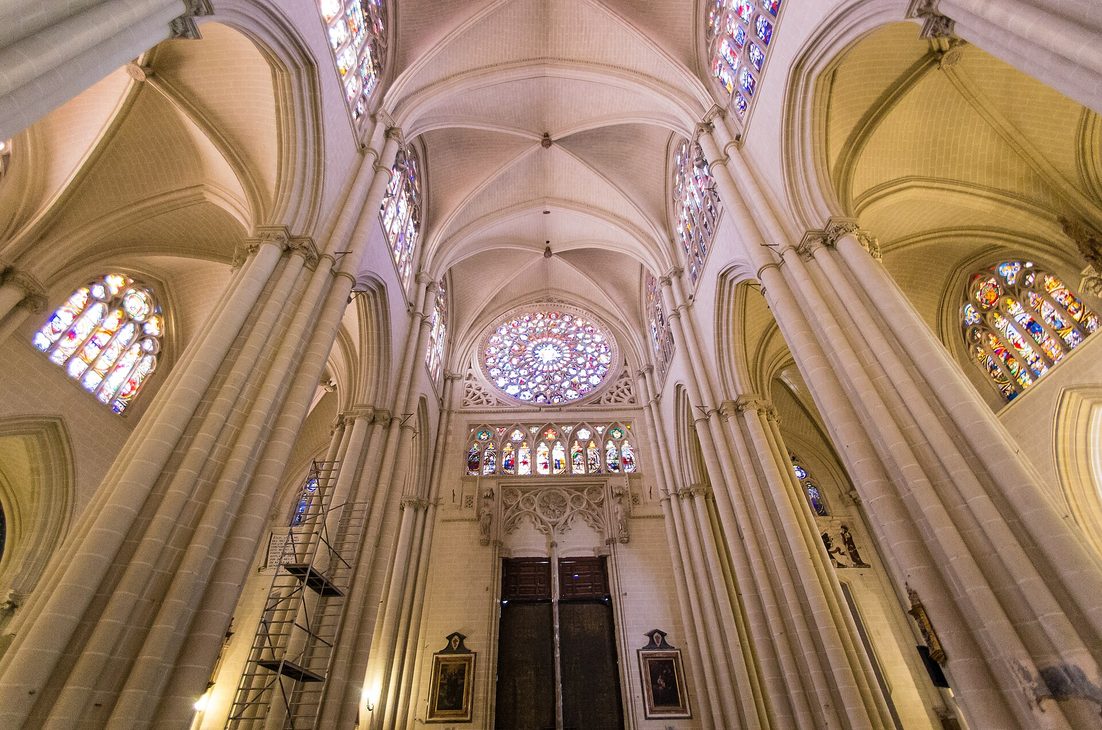
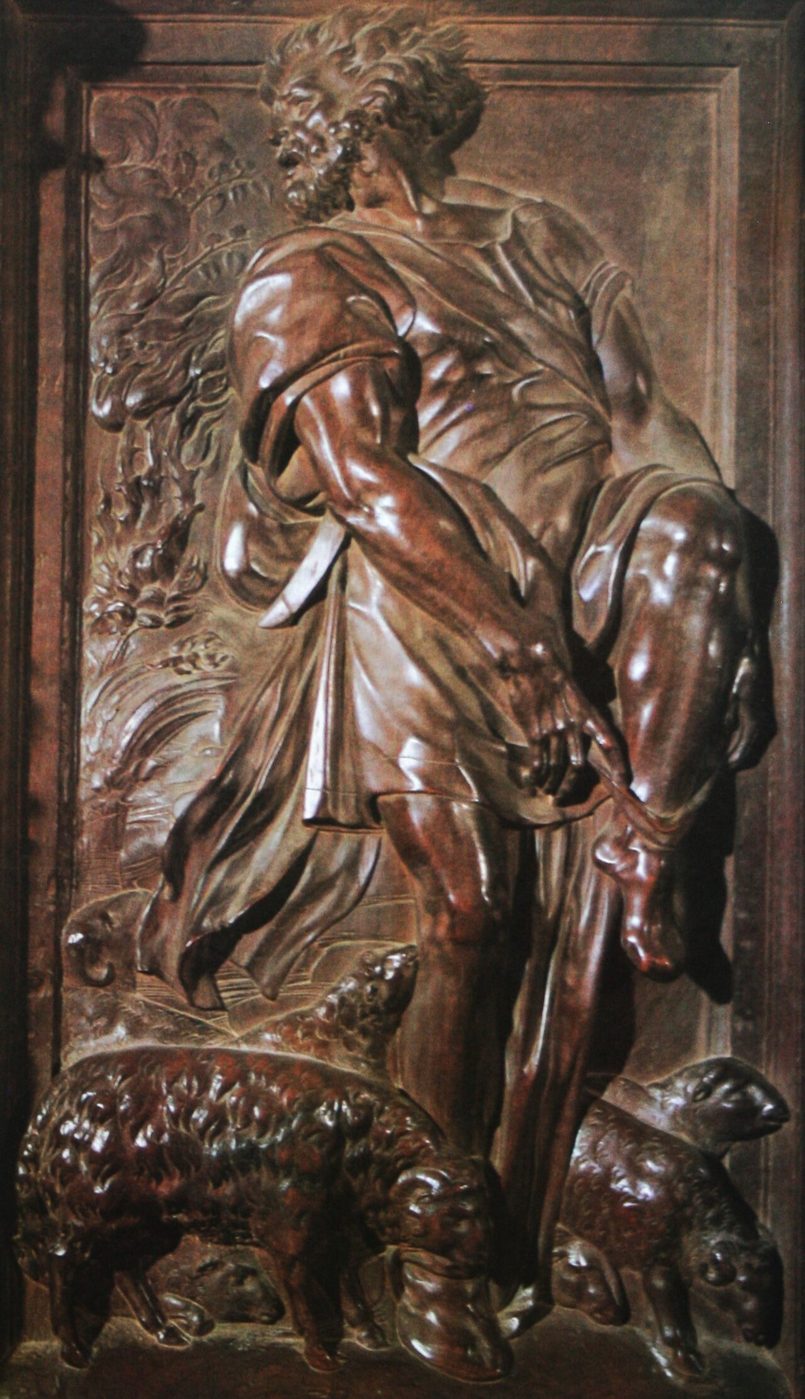
The interior has five aisles, with tall Gothic piers and stained glass of the fourteenth to seventeenth centuries. In the middle of the nave is the choir, closed by an iron grille. Its lower stalls, carved by Rodrigo Alemán in 1489–95, show the campaigns of the conquest of Granada, town by town; the upper stalls are by Alonso Berruguete and Felipe Bigarny, with Berruguete’s Transfiguration above the archbishop’s throne.
The main chapel
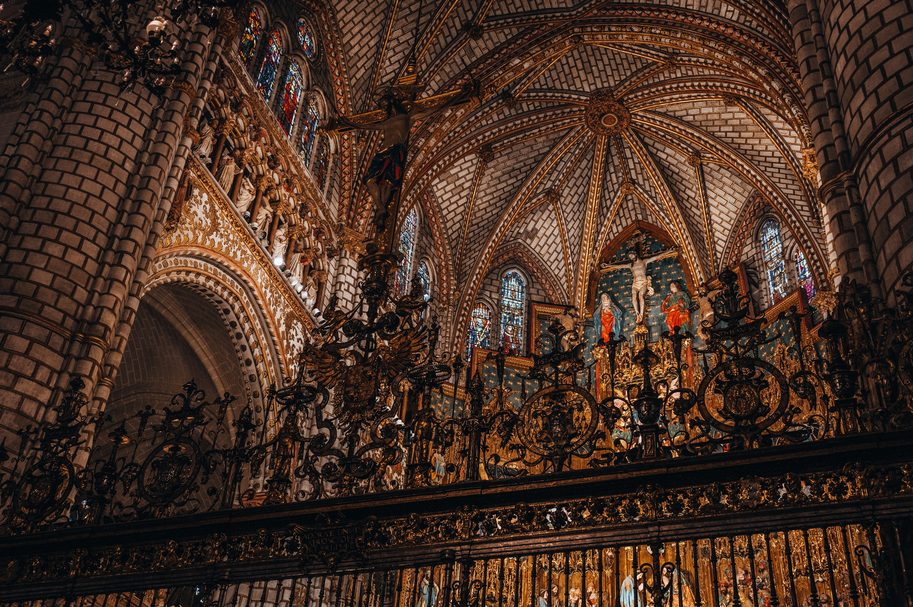
Opposite the choir, behind another great grille, the main chapel is filled by a gilded and painted wooden altarpiece of the early sixteenth century, telling the life of Christ in tiers of carved scenes, commissioned by Cardinal Cisneros.

The Transparente
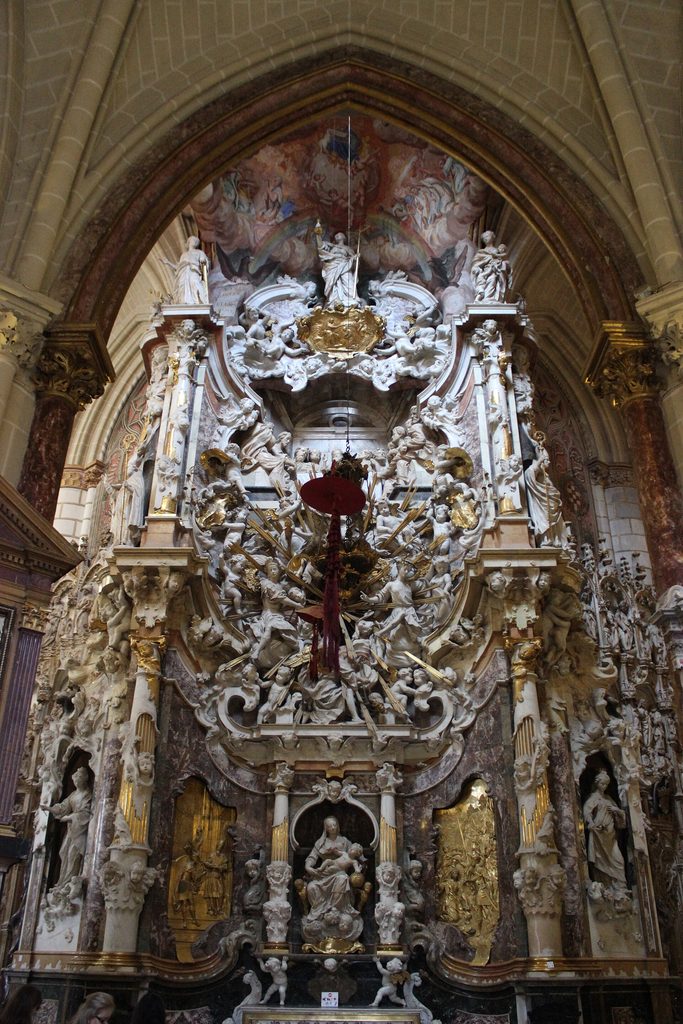
In the ambulatory behind the main chapel is the Transparente, made by Narciso Tomé and his sons in 1729–32: a Baroque altar of marble, bronze and clouds of angels, lit through an opening cut in the Gothic vault above, so that light falls on it from the sky.
The sacristy and the treasury
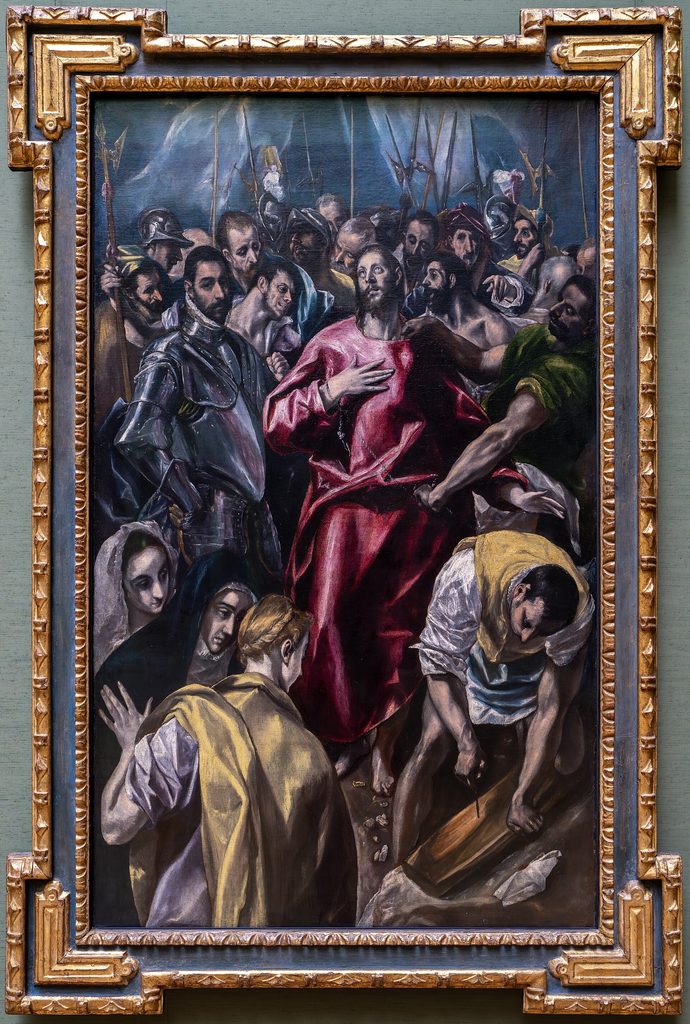
The sacristy is a picture gallery. Over its altar hangs El Greco’s Disrobing of Christ, painted for this room in 1577–79, and around it are his apostles and works by Goya, Titian, Van Dyck and Caravaggio. The chapter house has frescoes by Juan de Borgoña and portraits of every archbishop of Toledo. In the treasury is the Custodia of Enrique de Arfe, a Gothic tower of silver and gold made in 1517–24, carried through the streets at Corpus Christi.
Tours and where to stay
Tickets, tours and hotels
Tickets are sold on the cathedral’s website and at the shop opposite the Puerta Llana. Many day tours from Madrid include the cathedral; Toledo is at its best in the evening, after the day visitors have gone.
Tour and hotel links go to GetYourGuide and Booking.com. This site earns nothing from them at present — they are here because they are the quickest way to check what is actually available.
Don’t miss
- The choir stalls The conquest of Granada in walnut.
- The Transparente Light from a hole in the vault.
- El Greco’s Disrobing of Christ In the sacristy.
- The Custodia In the treasury.
- The main altarpiece Gilded, painted, enormous.
Insider tips
Use the escalators. Toledo stands on a steep hill. From the station, take a bus or walk to the Safont escalators, which climb most of the way up to the old town. Leave the car below the walls: parking in the centre is practically impossible.
The cathedral is a few minutes’ walk from the Plaza de Zocodover. El Greco’s Burial of the Count of Orgaz is in the church of Santo Tomé, ten minutes away.
Common questions
How much does Toledo Cathedral cost?
The basic ticket is €12, including the church, the cloister, the chapter house and the sacristy with its paintings. Reduced tickets are €8 and children aged 8–14 pay €6; under-8s with a relative, people born in or living in Toledo, and some others are free, with proof.
Which door do I use?
The visitor entrance is always the Puerta Llana, on the south side; tickets are sold online and at the cathedral shop opposite it.
Can I take photographs inside Toledo Cathedral?
No: the cathedral’s own rules forbid photography and filming inside. Phones must be switched off too.
When is the cathedral open?
Monday to Saturday 10am–6.30pm, Sunday 2–6.30pm, with last entry half an hour before closing. Hours change in Holy Week, at Corpus Christi and on other feasts, and it is closed on 1 January and 25 December.
Can I hear the Mozarabic Mass?
Yes: Mass in the ancient Mozarabic rite is said in the Mozarabic Chapel at 9am from Monday to Saturday and at 9.45am on Sundays and holidays, before the cathedral opens to visitors.
Where to stay and eat nearby
The old town has hotels in converted palaces and convents, and restaurants serving Castilian food; Toledo is known for marzipan.
More churches in Spain
- El Escorial — the other great day trip from Madrid.
- Seville Cathedral — the largest Gothic cathedral in the world.
- Burgos Cathedral — another great Gothic cathedral of Castile.