
Valencia Cathedral
Valencia Cathedral stands in the heart of the old city with a door on each of three squares — Romanesque, Gothic and Baroque — and the octagonal Micalet tower beside it. Inside is the Holy Chalice, venerated as the cup of the Last Supper, Renaissance angels rediscovered in 2004 after three centuries hidden above a false vault, and two paintings by Goya. The visit costs €12 with an audio guide; the tower is €3 more.
From mosque to cathedral
The site has been sacred since Roman times, and tradition puts a temple here; under the cathedral are a Roman street and houses, and next door, in the Almoina, the remains of the Visigothic cathedral. The main mosque of Muslim Valencia stood here, and after James I of Aragon took the city in 1238 it served as the cathedral. On 22 June 1262 Bishop Andrés de Albalat laid the first stone of the present building, and the mosque was pulled down as the new church rose.
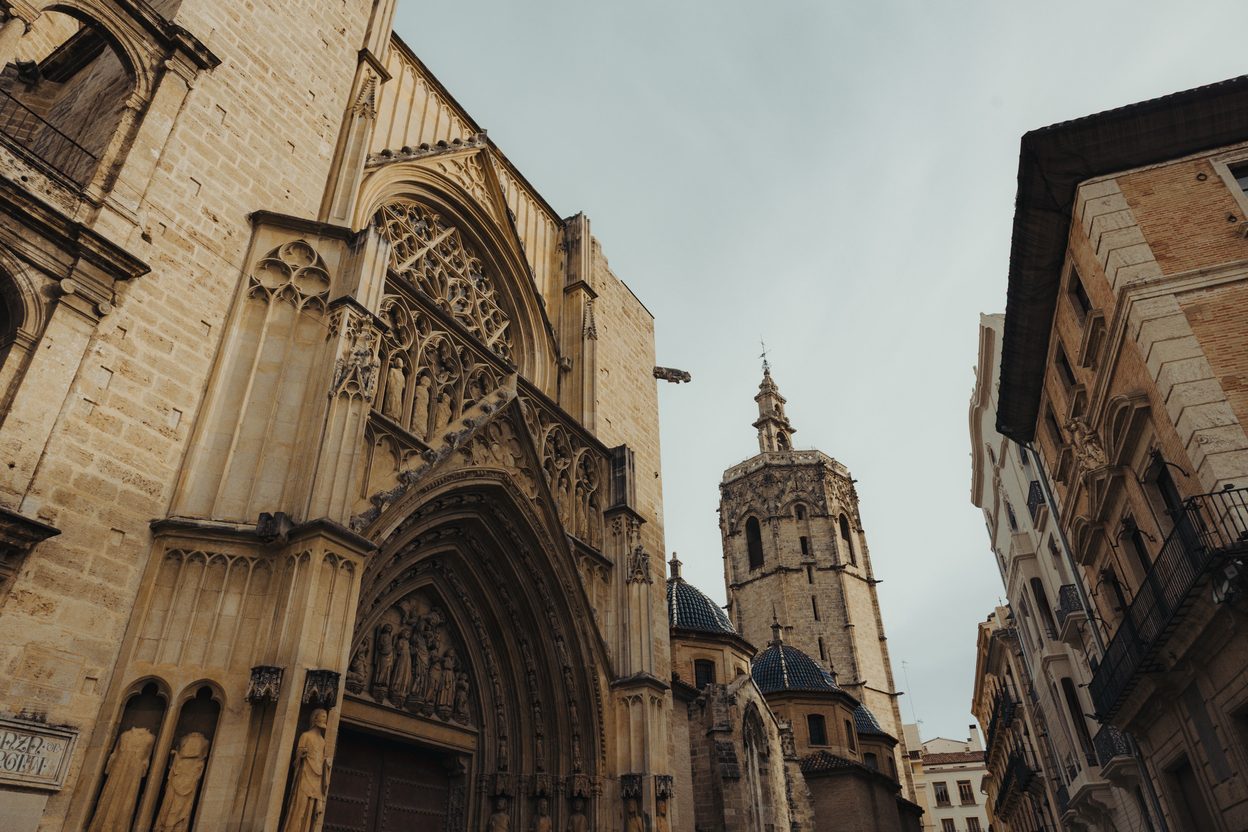
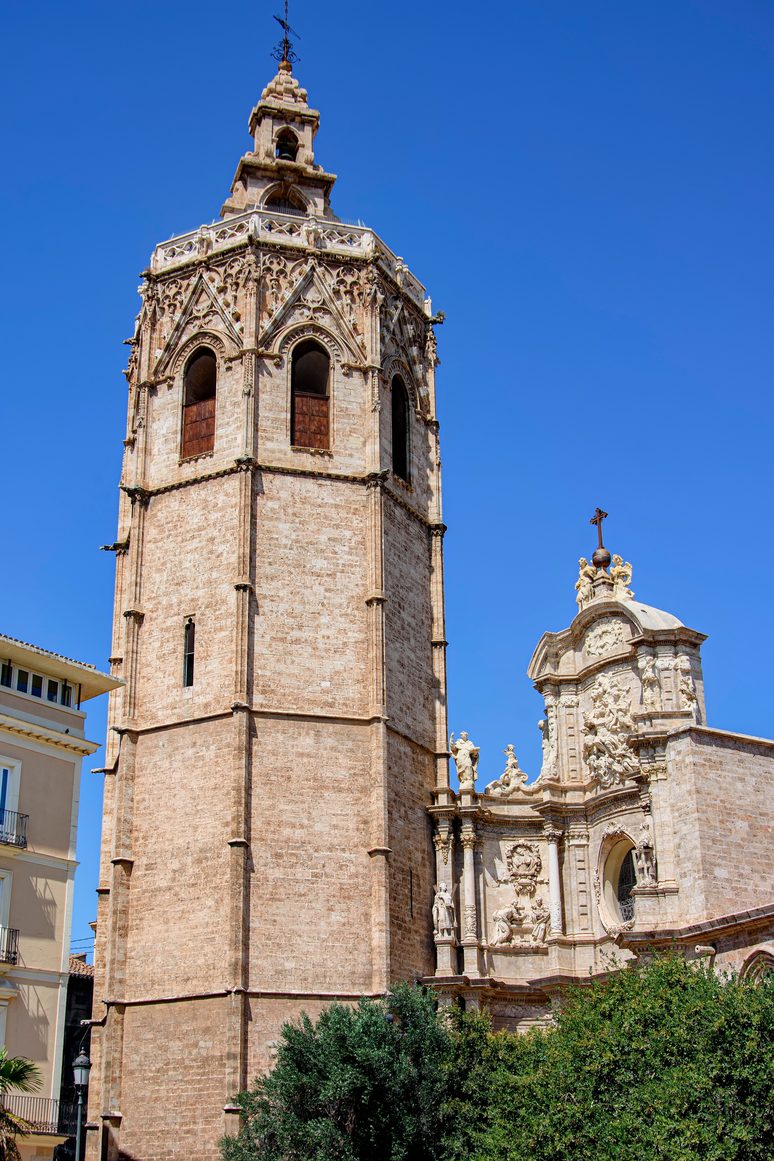
Most of the cathedral is Gothic: the Apostles’ Door, finished by 1354; the lantern over the crossing; the chapter house, now the chapel of the Holy Chalice; and the Micalet, begun in 1381 and joined to the church when the nave was lengthened in the late 15th century. After a fire in 1469, Cardinal Rodrigo Borgia, the future Pope Alexander VI, brought two Italian painters to decorate the apse. The Baroque Door of the Irons was added in the 18th century, and from 1774 the interior was given a Neoclassical skin, most of it stripped away again in the 1970s. The cathedral was declared a national monument in 1931.
The visitor’s cheat sheet
| Where | Plaza de la Almoina, Valencia; visitors enter by the Door of the Irons on Plaza de la Reina |
|---|---|
| Opening hours | October–June: Monday–Friday 10.30am–6.30pm, Saturday 10.30am–5.30pm, Sunday 2–5.30pm. July–September: Monday–Saturday 10.30am–6.30pm, Sunday 2–6.30pm. Last entry an hour before closing; subject to services |
| Admission | €12 with museum and audio guide; reduced €6; family €22; under-8s free |
| Micalet tower | Separate ticket €3 (reduced €2); daily 10am–6.45pm; 207 steps |
| No visits | 1 and 6 January, 19 March, Palm Sunday, Good Friday, 9 October, 8 and 25 December |
| Mass | October–June: Monday–Friday 8am, 8.45am, 9.30am (sung by the canons), 7pm and 8pm; Saturdays add 6pm; Sundays also 11am, noon, 1pm and 6pm. Fewer Masses July–September |
| How long | An hour to an hour and a half; 30–45 minutes more for the tower |
Hours and admission checked against the official site in October 2026. They change; the official site is always the last word.
Free for worship. The paid visit runs on weekdays, Saturdays and Sunday afternoons. Early in the morning and in the evening, and on Sunday mornings, you can enter free for Mass or prayer, but not to sightsee. The 9.30am Mass is sung in Gregorian chant by the canons.
What to see
The three doors
Visitors go in by the Door of the Irons on Plaza de la Reina, named after the iron railing in front of it. It was designed by the German Konrad Rudolf and built from 1703 to 1741, a curving Baroque front over 36 metres high, meant to be seen up the narrow street opposite. On Plaza de la Virgen is the Gothic Apostles’ Door, with statues of the twelve apostles (the originals are in the museum) and a rose window shaped as a six-pointed star. Round the corner, on Plaza de la Almoina, the Romanesque Palau or Almoina Door, the oldest of the three, has fourteen heads above its arch which, tradition says, are the seven couples from Lleida who resettled the city.
The nave and the lantern
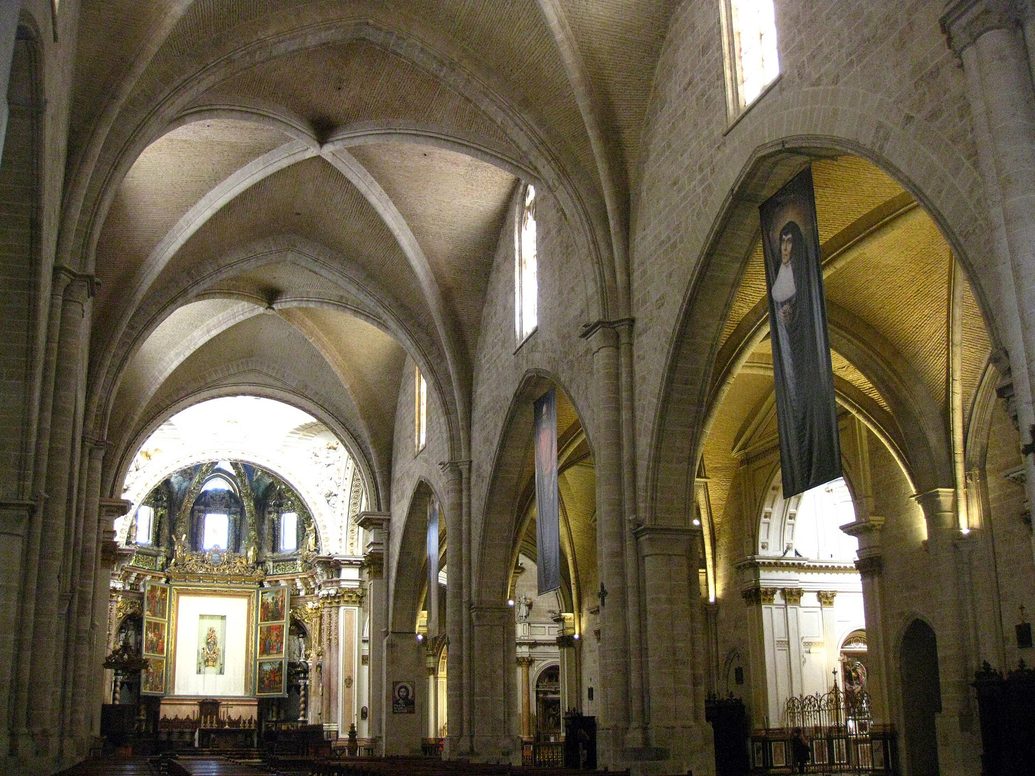
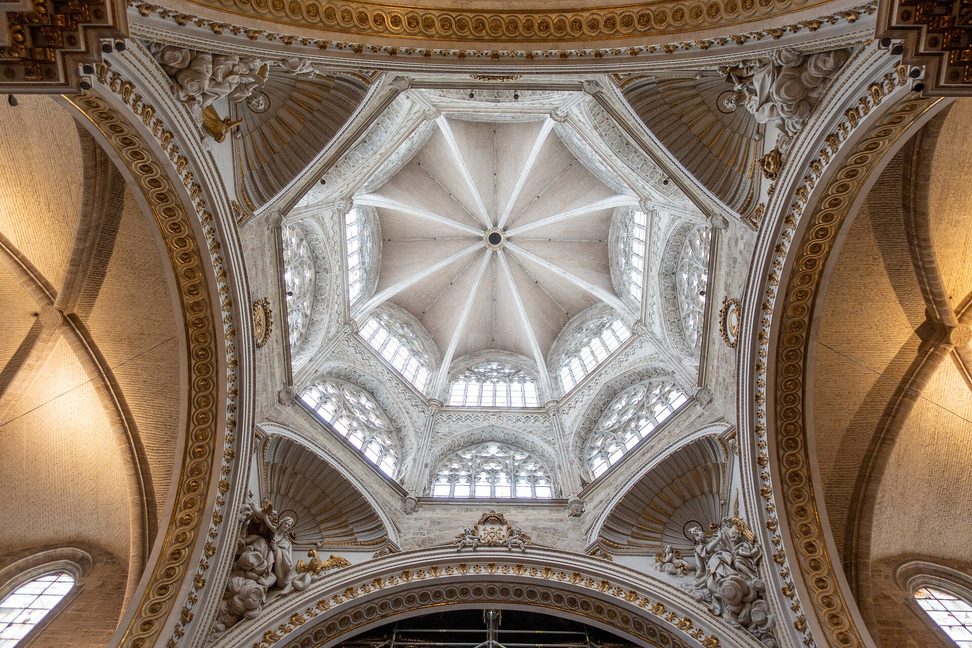
Inside, the Gothic nave was uncovered again in the 1970s, when most of the Neoclassical stucco came off. Over the crossing rises the octagonal lantern, about 40 metres high, its windows filled with thin sheets of alabaster rather than glass. Expectant mothers traditionally walk nine times round the inside of the church, a custom the cathedral still mentions.
The angels of the high altar
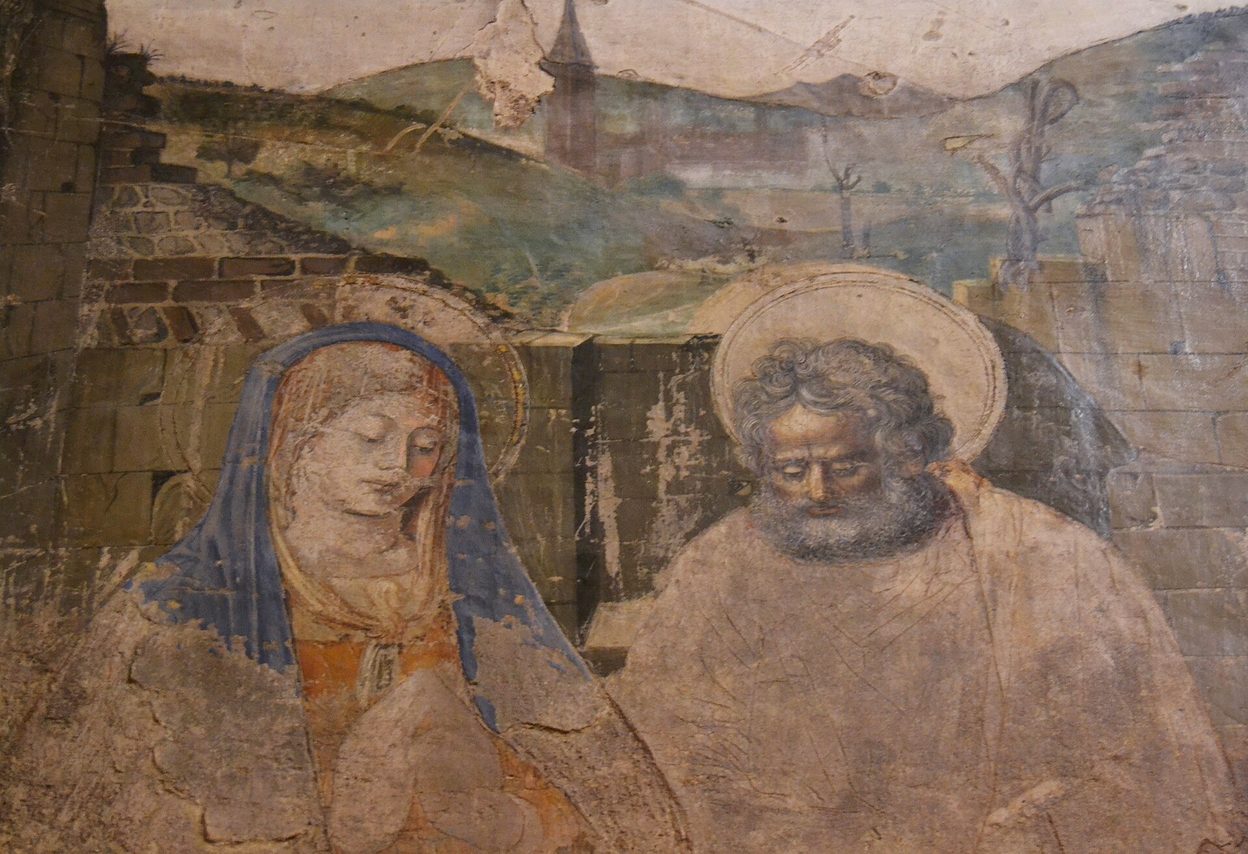
In 1472 Rodrigo Borgia hired Paolo da San Leocadio and Francesco Pagano to paint the apse, and they had finished by 1481, by most accounts: some of the earliest Renaissance painting in Spain. Two centuries later a Baroque vault was built below them and they were forgotten, until restorers found them in June 2004. Ten angels playing musical instruments circle the vault above the high altar.
The Goyas
In the chapel of St Francis Borgia hang two canvases painted by Goya in 1788: St Francis taking leave of his family at Gandía to join the Jesuits, and the saint at the bedside of a dying man who refuses repentance, with demons waiting for his soul.
The Holy Chalice
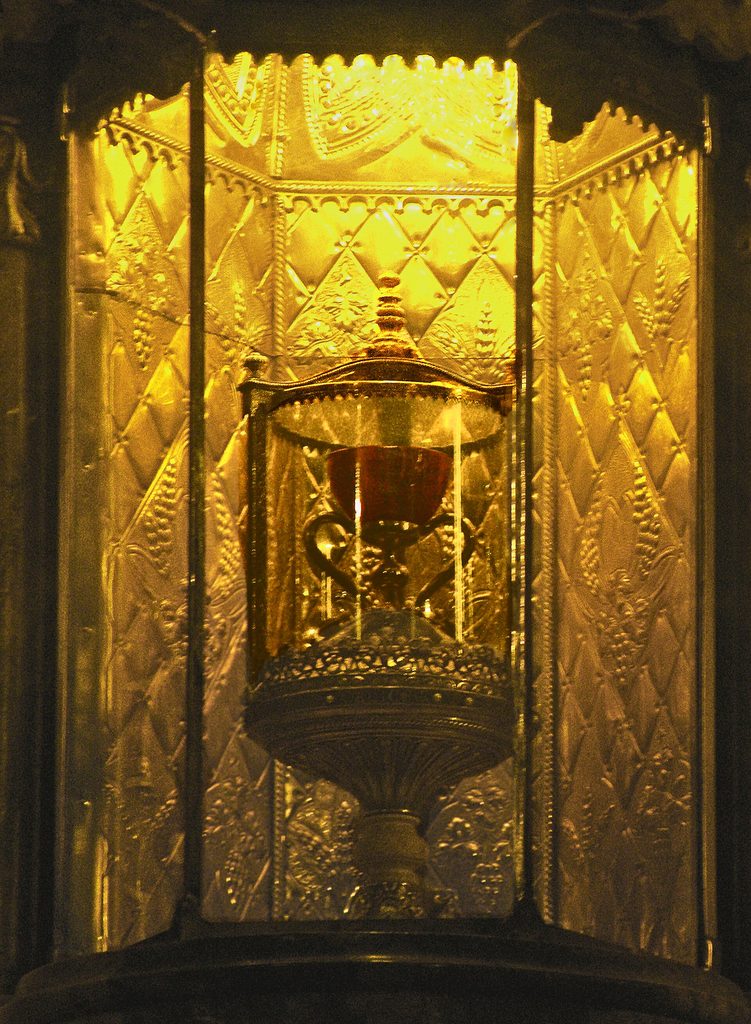
The visit ends in the chapel of the Holy Chalice, the old chapter house of the 14th century, under a star vault, with an alabaster altarpiece by the Florentine Giuliano di Nofri and the chains of the harbour of Marseille, carried off by Alfonso V. In a case in the middle is the chalice: an agate cup some 2,000 years old on a medieval gold stem and base set with pearls and stones. Tradition says it is the cup of the Last Supper, taken to Rome by St Peter and to Spain by St Lawrence; its documented history begins at San Juan de la Peña in 1399, and Alfonso V deposited it with the cathedral in 1437. Two popes, John Paul II and Benedict XVI, have said Mass with it. The museum, on the route before it, holds the cathedral’s treasures and the Roman remains under its floor.
The Micalet
The bell tower takes its name from its great hour bell, the Micalet, dedicated to St Michael. Its 207 steps climb past the bell chamber to a terrace 51 metres up, with views over the old town to the sea; only 50 people are allowed up at a time. Tickets are separate, at the foot of the tower.
The Water Tribunal
Every Thursday at noon (on the Wednesday if Thursday is a public holiday), eight farmers in black smocks sit in a ring outside the Apostles’ Door. This is the Tribunal de las Aguas, which settles disputes over water among the irrigation communities of the plain of Valencia; its rulings are given out loud, in Valencian, and are final. Tradition traces it to Muslim Valencia, before the cathedral was built, and UNESCO added it to the intangible heritage of humanity in 2009. Often there is no case and it is over in minutes, so arrive a few minutes before noon.
Tours and where to stay
Tickets are sold at the cathedral; the Valencia Tourist Card gives a discount. The old town, the Ciutat Vella, is the best place to stay, with the cathedral, the Lonja and the Central Market all on foot.
These links go to GetYourGuide and Booking.com. This site earns nothing from them at present — they are here because they are the quickest way to check what is actually available.
Don’t miss
- The Holy Chalice In the old chapter house.
- The musician angels Renaissance frescoes over the high altar.
- The Goyas In the chapel of St Francis Borgia.
- The Micalet 207 steps to the best view in Valencia.
- Thursday noon The Water Tribunal at the Apostles’ Door.
Insider tips
Plan for Sunday. On Sundays the paid visit only starts at 2pm, so do the tower or the Basilica of the Virgen de los Desamparados, the city’s patroness, next door on Plaza de la Virgen, in the morning. The cathedral’s Holy Years of the Holy Chalice come every five years: the latest ran from 30 October 2025 to 29 October 2026, and the next is due in 2030.
Common questions
How much does it cost to visit Valencia Cathedral?
€12, including the museum and an audio guide in ten languages; €6 reduced (ages 8–17, students, pensioners and others); €22 for a family of two adults and up to three children; under-8s free. Climbing the Micalet tower is a separate €3 ticket.
When is Valencia Cathedral open to visitors?
From October to June: Monday–Friday 10.30am–6.30pm, Saturday 10.30am–5.30pm, Sunday 2–5.30pm. From July to September: Monday–Saturday 10.30am–6.30pm and Sunday 2–6.30pm. Last entry is an hour before closing. There are no visits on a handful of feast days.
Is the Holy Grail really in Valencia Cathedral?
The cathedral keeps the Holy Chalice, an agate cup carved in the eastern Mediterranean around the turn of the eras and set in a medieval gold mount, which tradition holds is the cup used at the Last Supper. It is documented from 1399, when the monastery of San Juan de la Peña gave it to King Martin I of Aragon, and has belonged to the cathedral since 1437. The cathedral calls the tradition entirely plausible; it cannot be proved.
How many steps are there up the Micalet?
207, up a narrow spiral stair, to a terrace 51 metres up with views over the whole city. It is open daily 10am–6.45pm, €3 (€2 reduced), and the terrace holds 50 people at a time.
When does the Water Tribunal meet?
Every Thursday at noon, outside the Apostles’ Door on Plaza de la Virgen, as it has for centuries: the elected judges of the irrigation channels of the Valencia plain settle disputes over water, in Valencian and by word of mouth. It is free to watch, often takes only a few minutes, and was recognised by UNESCO in 2009.
More churches in Spain
- Barcelona Cathedral — the Gothic cathedral of the other great Catalan-speaking city.
- Toledo Cathedral — the primate cathedral of Spain, and its treasury.
- Palma Cathedral — La Seu, the Gothic cathedral of Majorca, another conquest of James I.