
Barcelona Cathedral
Barcelona’s cathedral is not the Sagrada Família, a confusion that sends a good number of visitors to the wrong side of the city. It is the Gothic cathedral of the Holy Cross and St Eulalia, begun in 1298 in the heart of the Gothic Quarter: a dark, tall church with a crypt for the city’s girl martyr, a choir painted with the arms of the Golden Fleece, a roof you can walk on, and a cloister where thirteen white geese live. It is no longer a free walk-in. The cultural visit costs €16, and on Sundays it opens only in the afternoon.
From the Roman city to the Gothic Quarter
The cathedral stands on the high ground of the Roman town, and there has been a church here since the fourth century: excavations here and under the neighbouring streets have found an early Christian baptistery, a basilica and a bishop’s palace. A Romanesque cathedral, begun under Count Ramon Berenguer I and his countess Almodis, was consecrated in 1058.
The Gothic rebuilding began on 1 May 1298, under Bishop Bernat Pelegrí and King James II of Aragon, in the years when Barcelona ruled a Mediterranean trading empire. The nave and chapels were largely finished by the mid-fifteenth century, and the cloister in 1448. The front was not: for more than four hundred years the cathedral had a plain wall where its façade should have been.
The visitor’s cheat sheet
| Where | Pla de la Seu, 08002 Barcelona, in the Gothic Quarter. Three doors: the main door on the square, the Santa Eulàlia door on Carrer del Bisbe (the access for reduced mobility) and the Sant Iu door |
|---|---|
| Opening hours | Cultural visit: Monday–Friday 9.30am–6.30pm (last entry 5.45pm); Saturdays and the eves of feasts 9.30am–5.15pm (last entry 4.30pm); Sundays and religious holidays 2pm–5pm (last entry 4.30pm) |
| Admission | €16 for the cultural visit, including the roof, choir, cloister and chapter house museum. €14 for students up to 25 and large or single-parent families. Free with a disability of 33% or more. Tickets online at tickets.catedralbcn.org or at the cathedral |
| Mass | Worshippers may go in free for Mass, but not to look round; check the cathedral’s Mass times. The choir closes during services |
| Works in 2026 | Two vaults in the transept are being restored, so expect some scaffolding |
| Getting there | Metro L4 to Jaume I, five minutes’ walk; or L3 to Liceu. About ten minutes on foot from Plaça de Catalunya down Portal de l’Àngel |
| Dress | As for any working church: shoulders covered, no beachwear |
| How long | About an hour and a half for the cathedral, roof and cloister |
| Best time | A weekday morning, when the light comes into the cloister and the roof is quiet |
Hours and admission checked against the official site in October 2026. They change; the official site is always the last word.
It is €16, it includes the roof, and Sunday is afternoon only. Older guides and blogs describe free entry or a small donation; that changed. Sightseeing is now a ticketed cultural visit, and the ticket covers the roof by lift, the choir, the cloister and the chapter house museum. On Sundays and religious holidays the visit runs only from 2pm to 5pm. You can go in free for Mass, but to worship, not to look round.
What to see, in the order you meet it
The façade
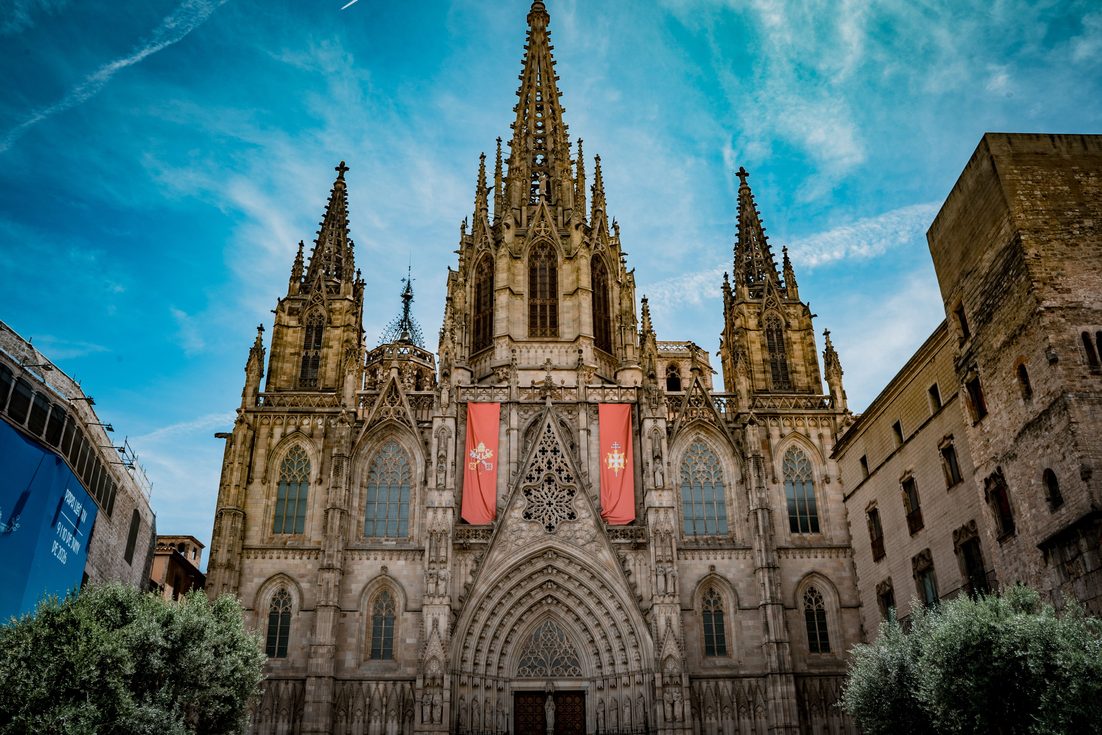
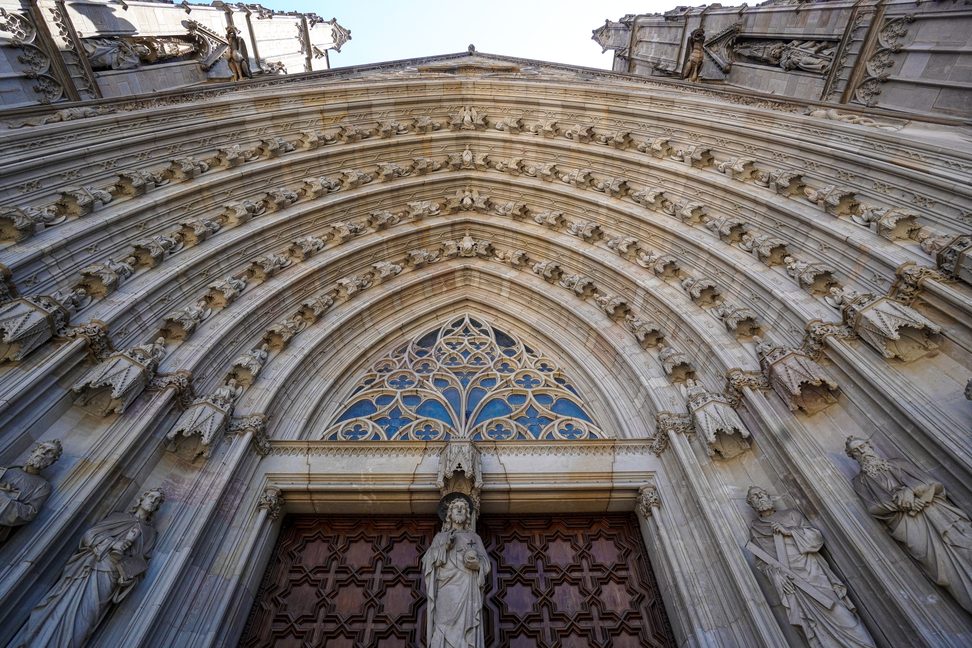
The spiky front that fills every photograph looks as old as the rest of the building. It is nineteenth-century. In 1882 the architect Josep Oriol Mestres won a competition to build it, working from plans that a master from Rouen, Carles Galtés, had drawn up in 1408. The banker Manuel Girona paid for the work, and his children completed it with the central tower in 1913.
The nave
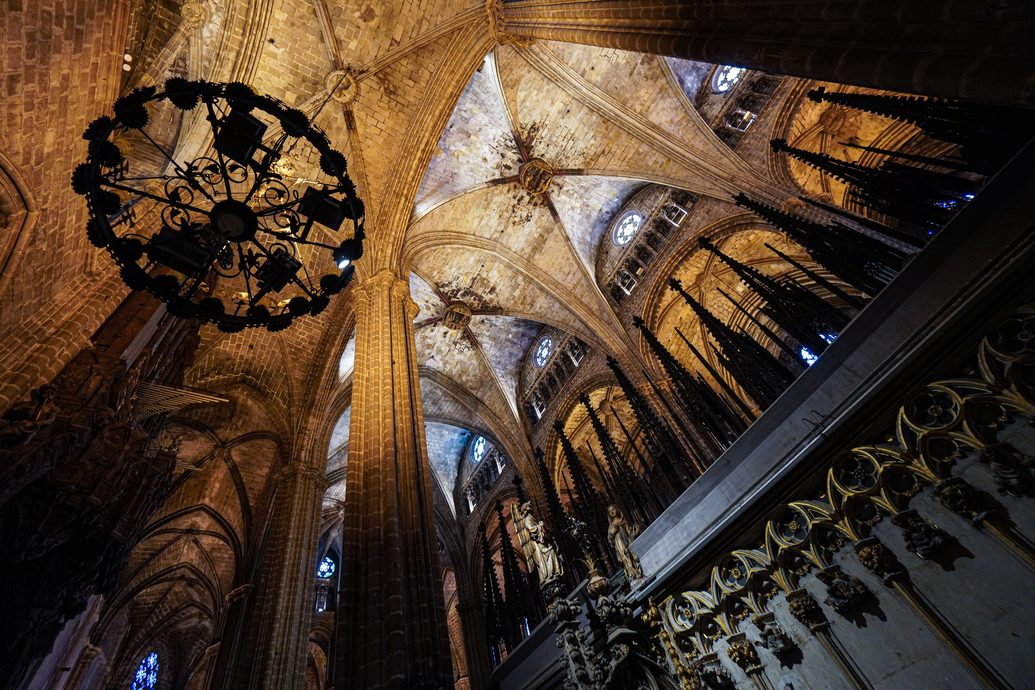
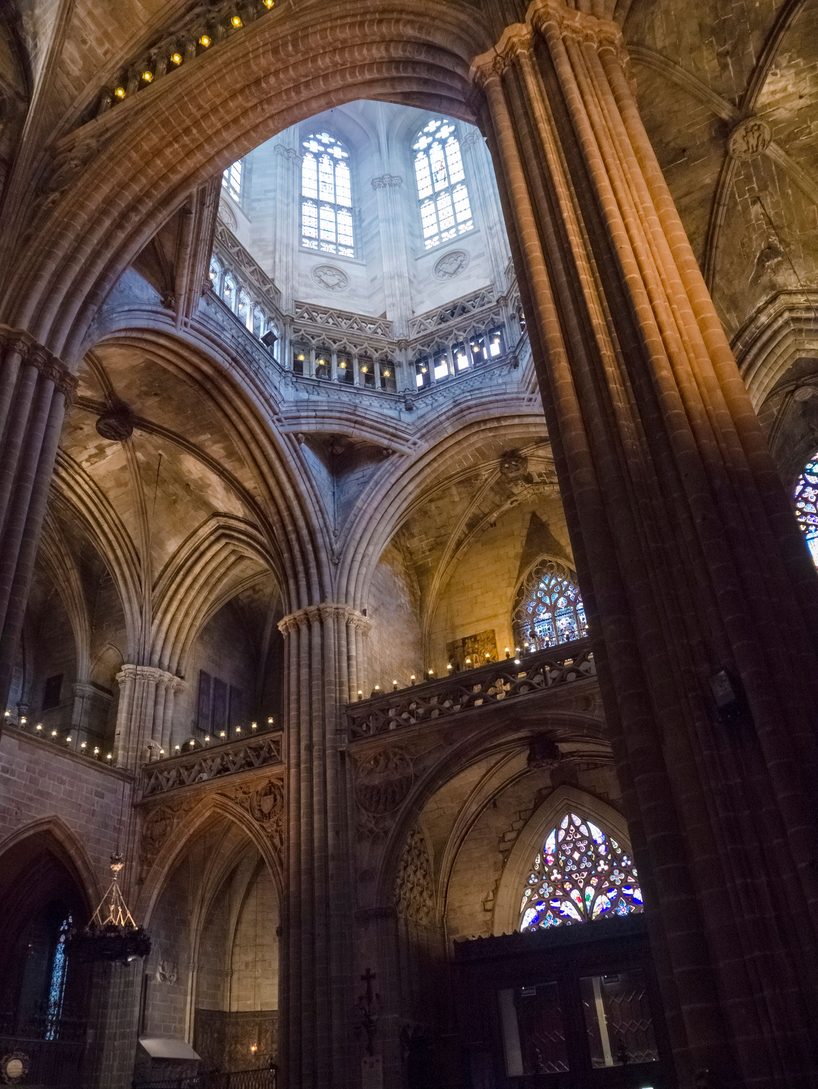
Inside, the building is genuinely medieval, and much darker than the façade suggests. It is Catalan Gothic: tall, with slim piers and chapels tucked between the buttresses, each with its own altarpiece and grille. Look up at the bosses where the vault ribs meet, carved and painted, and at the octagonal lantern high over the west end.

The choir
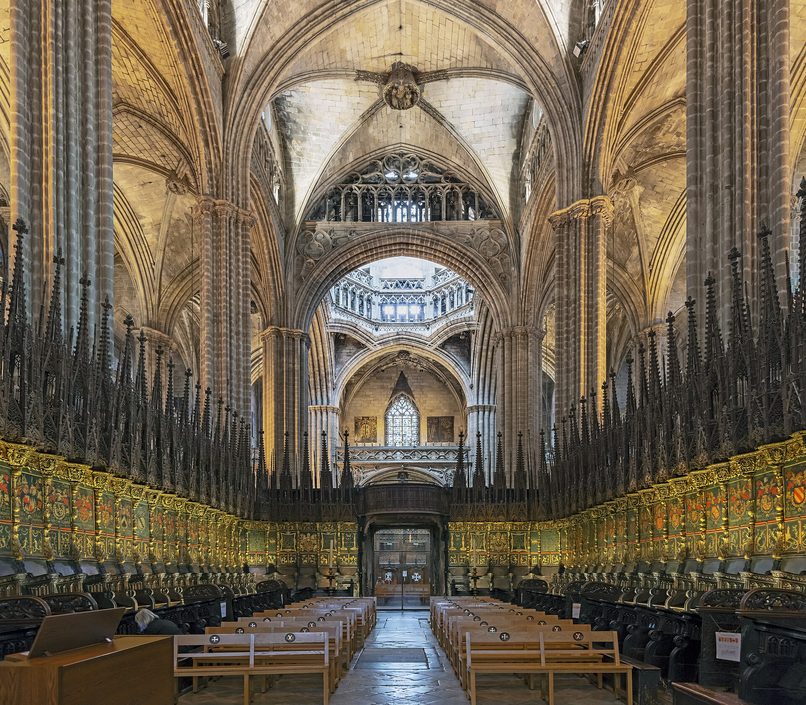
In the middle of the nave, as in most Spanish cathedrals, stands the enclosed choir. Its carved wooden stalls are medieval, and above them are painted coats of arms: in 1519 the young Charles V held a chapter of the Order of the Golden Fleece here, and the painter Joan de Borgonya decorated the stalls with the arms of each knight. Many of the monarchs and princes of Europe are represented, among them the kings of France and England.
The crypt of St Eulalia
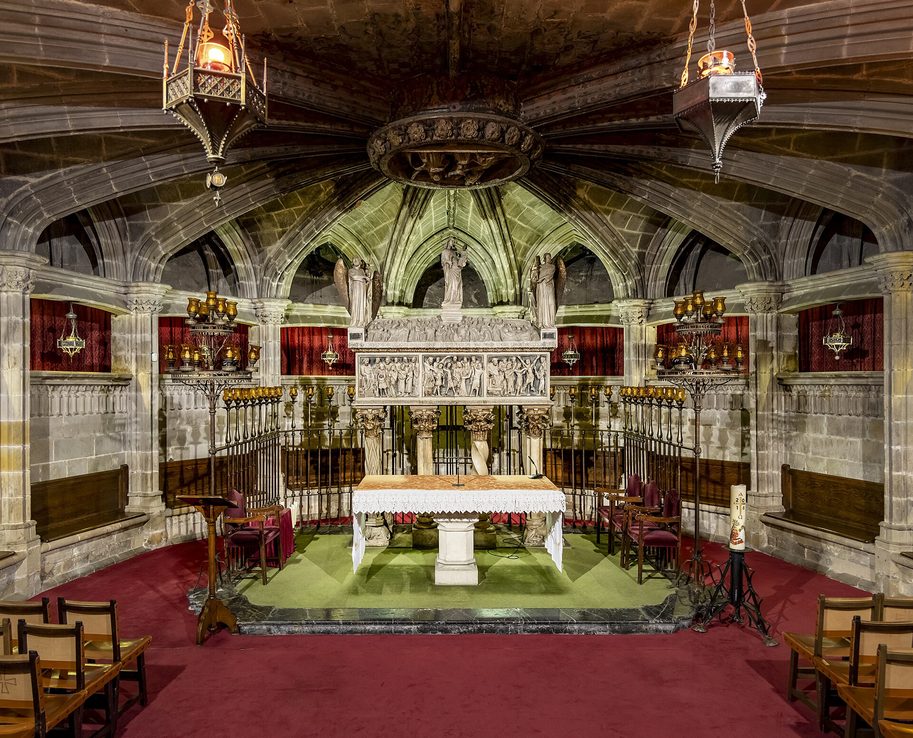
Steps under the high altar lead down to the crypt of St Eulalia, the city’s co-patron. By tradition she was a girl of thirteen from Sarrià, martyred in 304 under Diocletian for refusing to renounce her faith; her story is close to that of Eulalia of Mérida, and historians argue over whether the two are one. Her relics, found in 878, were laid here in 1339 in a carved sarcophagus by the Pisan sculptor Lupo di Francesco.
The Christ of Lepanto
In the chapel of the Blessed Sacrament, off the cloister, hangs a large crucifix with a strangely bent body. It is said to have been on the flagship of Don John of Austria at the Battle of Lepanto in 1571, and to have swerved aside to dodge a cannonball. It is a legend, but the chapel is kept for prayer: go in quietly, and no photographs.
The roof
A lift from the chapel of the Holy Innocents takes you up to the roof, where walkways run along the ridge between the pinnacles. It is not high by Barcelona standards, but you are in the middle of the Gothic Quarter, at the height of the bell towers, with the city and the hills all round.

The cloister and the geese
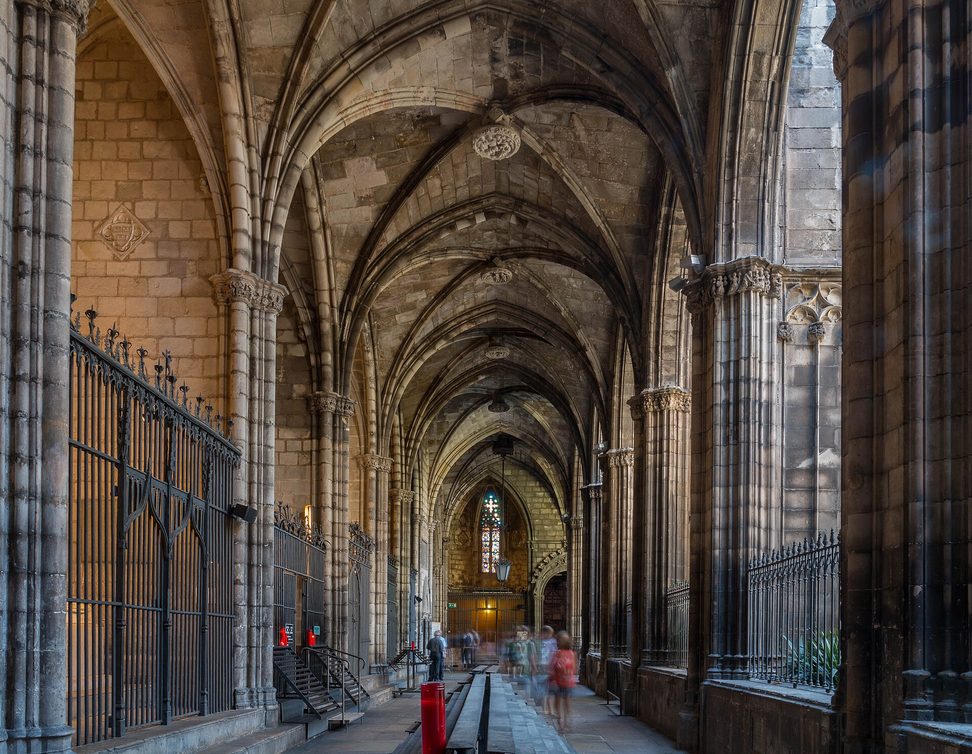
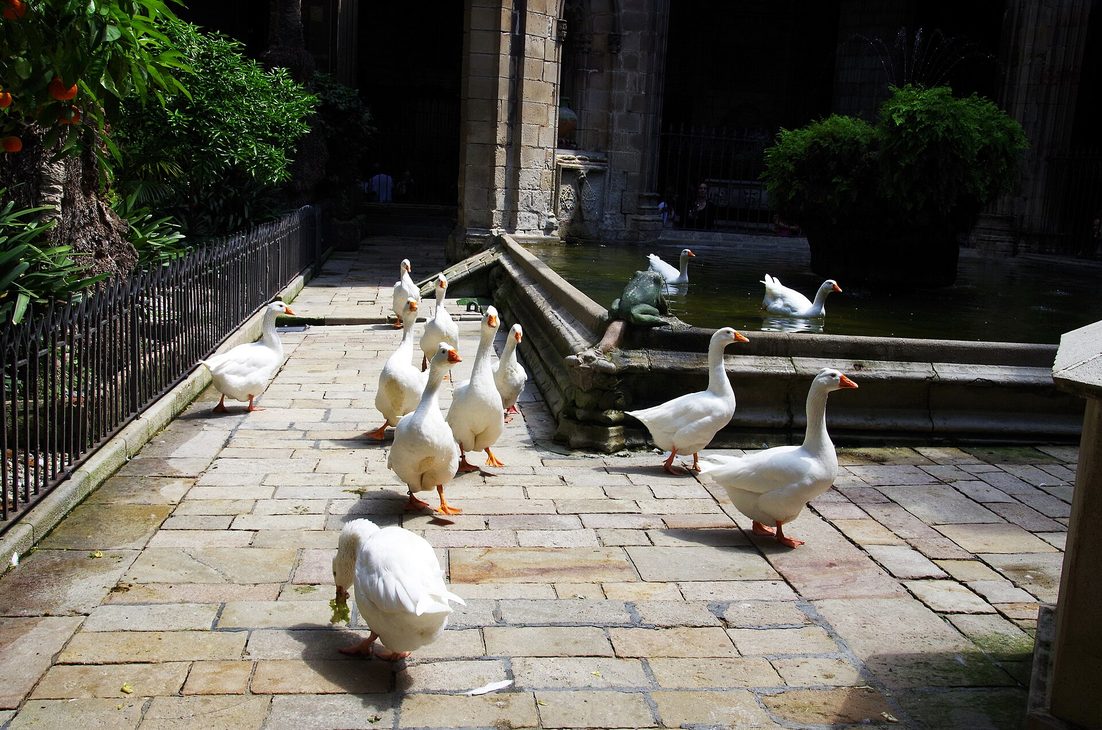
Then go out into the cloister, finished in 1448: a shady square of arcades round a garden of palm trees, magnolias and a pond. Thirteen white geese live here, one for each year of Eulalia’s life, a tradition centuries old. At Corpus Christi the cloister fountain is decked with flowers and an egg is set to bob on its jet of water, the custom called l’ou com balla, “the dancing egg”, recorded here since at least the sixteenth century.
The chapter house museum
Off the cloister, the chapter house holds the cathedral’s small museum. Its greatest treasure is Bartolomé Bermejo’s Pietà of 1490, painted for Canon Lluís Desplà, who kneels beside the dead Christ in a landscape of extraordinary detail. It is one of the masterpieces of Spanish painting of the fifteenth century, and few visitors find it.
Tickets and tours
Buy the cultural visit, and leave time for the cloister
The €16 ticket is sold online and at the cathedral, and it covers everything open to visitors: the cathedral, roof, choir, cloister and chapter house. Guided walks of the Gothic Quarter often include the cathedral and are worth it for the Roman walls and squares round about.
Tour and hotel links go to GetYourGuide and Booking.com. This site earns nothing from them at present — they are here because they are the quickest way to check what is actually available.
Don’t miss
- The geese Thirteen of them, in the cloister.
- The roof By lift, among the pinnacles of the Gothic Quarter.
- The Golden Fleece choir The arms of the knights of 1519, kings among them.
- Eulalia’s crypt Under the high altar, her tomb of 1339.
- Bermejo’s Pietà In the chapter house, and easily missed.
- The Christ of Lepanto And the cannonball it is said to have dodged.
Insider tips
Go on a weekday. On Saturdays the visit closes at 5.15pm and on Sundays it runs only from 2pm to 5pm. Weekday mornings are also when the cloister is in sunlight and the roof is quietest.
If you only want to see the inside of the church, go to Mass. It is free, and nobody will mind; but you sit through the service and do not wander about.
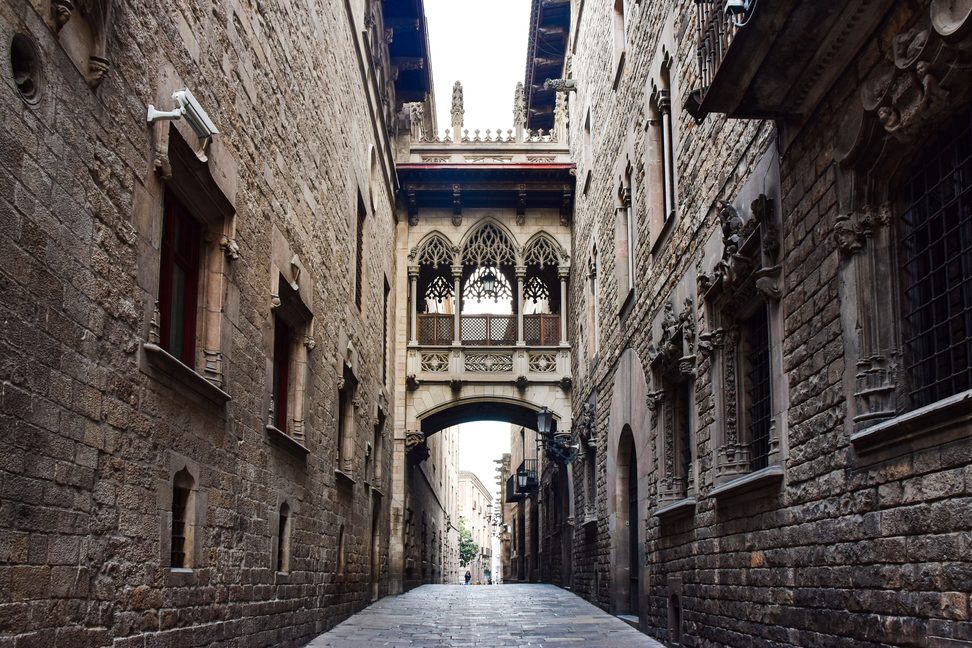
Walk round the outside afterwards. Carrer del Bisbe, along the side of the cathedral, has the bridge that every visitor photographs; it looks medieval and was built in 1928. Plaça Sant Felip Neri, two minutes away, still has shrapnel scars from a bombing in the Civil War.
Common questions
Is Barcelona Cathedral free to enter?
Not for sightseeing. The cultural visit costs €16, or €14 for students up to 25 and large families, and it includes the roof, the choir, the cloister and the chapter house. The cathedral is free for Mass, but you go in to worship, not to look round.
Is Barcelona Cathedral the same as the Sagrada Família?
No. Barcelona Cathedral is the medieval Gothic cathedral of the city, begun in 1298, in the Gothic Quarter. The Sagrada Família is Gaudí’s basilica, begun in 1882, about half an hour’s walk north. They need separate tickets.
Does the Barcelona Cathedral ticket include the roof?
Yes. A lift from inside the cathedral takes you up to the roof terraces, and it is part of the €16 cultural visit, along with the choir, the cloister and the chapter house museum.
Why are there geese in Barcelona Cathedral?
There are thirteen white geese in the cloister, one for each year of the life of St Eulalia, the girl martyr to whom the cathedral is dedicated. Geese have been kept there for centuries.
What are the opening hours of Barcelona Cathedral?
For the cultural visit: Monday to Friday 9.30am to 6.30pm, Saturdays and the eves of feasts 9.30am to 5.15pm, and Sundays and religious holidays 2pm to 5pm. The last entry is 45 minutes before closing on weekdays and Saturdays, and 30 minutes on Sundays.
Where to stay and eat nearby
The cathedral is in the middle of the Gothic Quarter, between the Rambla and the Born. Both are full of places to eat, though the closer you are to the cathedral steps the more tourist-priced the menus. Santa Maria del Mar, Barcelona’s other great Gothic church, is ten minutes’ walk east in the Born.
More churches in Spain
- Sagrada Família — Gaudí’s basilica, half an hour’s walk north, and the other half of any church trip to Barcelona.
- Seville Cathedral — Spain’s largest Gothic cathedral, begun a century later.
- Santiago de Compostela Cathedral — the pilgrims’ cathedral at the end of the Camino.
- El Escorial — Philip II’s monastery-palace near Madrid.