
Rouen Cathedral
Claude Monet painted the west front of Rouen Cathedral more than thirty times, watching the light dissolve its stone from dawn to dusk. You can stand where he worked, opposite the façade, and see why. Behind that lace of Gothic stone is a cathedral with the tallest spire in France, the heart of Richard the Lionheart and the tomb of Rollo, the Viking who founded Normandy. It is free and open every day, an easy day trip from Paris, but it opens late on Mondays and keeps its best corners for guided tours.

Normandy’s cathedral
There has been a cathedral here since the fourth century, and Rollo, the Viking leader granted the land that became Normandy in 911, was baptised in it soon afterwards. The present building was begun after a fire at Easter 1200, in the early Gothic style, and was rebuilt, extended and decorated for the next four hundred years. The north tower, the Tour Saint-Romain, is older: it was begun in 1145. Its southern counterpart, the Tour de Beurre of 1485–1506, is called the Butter Tower because it was paid for partly by donations from the faithful for permission to eat butter in Lent.
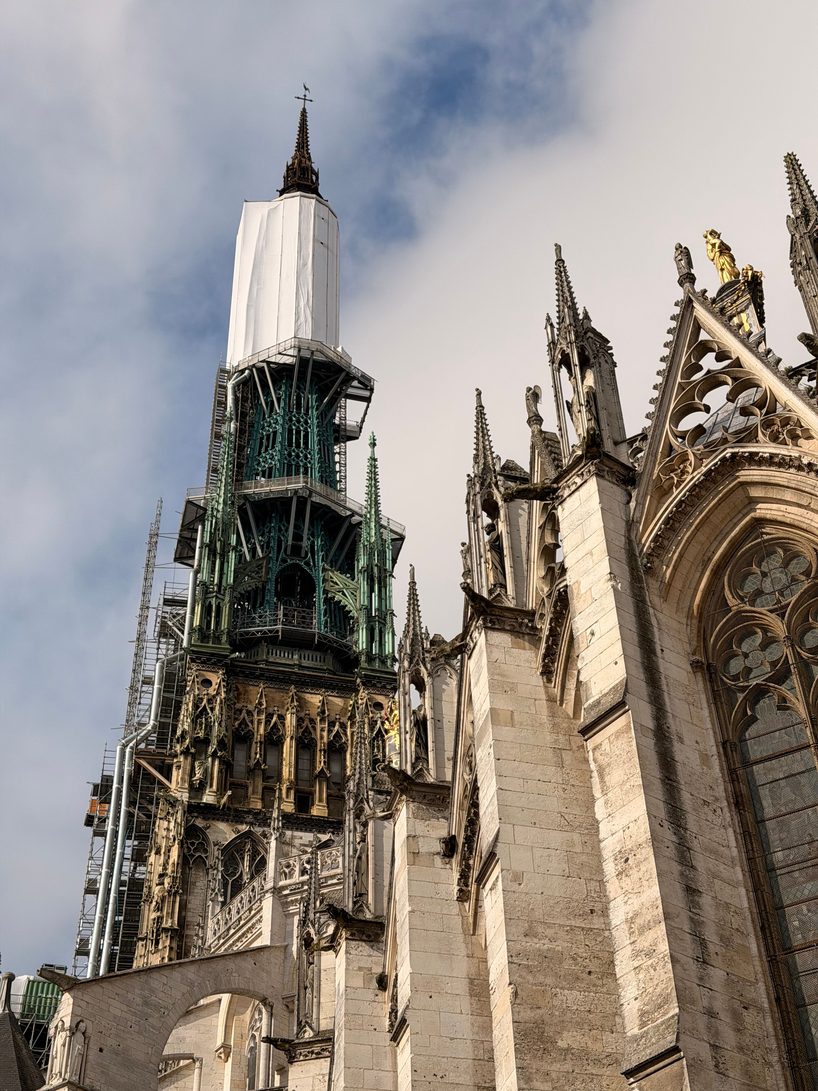
In 1822 lightning destroyed the old wooden spire over the crossing. Its replacement, designed by Jean-Antoine Alavoine in cast iron, reached its full 151 metres in 1876, making the cathedral for four years the tallest building in the world, and was finished, with its four corner turrets, in 1884. Flaubert called it the dream of a delirious boilermaker. Allied bombs hit the cathedral in April 1944, and the Tour Saint-Romain burned that June; a storm in 1999 sent one of the spire’s corner turrets crashing through the choir vault. Restoration has been almost continuous since.
The visitor’s cheat sheet
| Where | Place de la Cathédrale, 76000 Rouen, in the old town; about 15 minutes’ walk from Rouen Rive Droite station |
|---|---|
| Opening hours | Monday 2pm–7pm; Tuesday–Saturday 9am–7pm; Sundays and feast days 8am–6pm. Visits may be limited during services |
| Admission | Free, no booking |
| Guided tours | Free tour in French, Saturdays and Sundays at 2.30pm, including the crypt and the Lady Chapel; the tourist office runs paid themed tours |
| Light show | Cathédrale de lumière, free, projected on the west front after dark from late May to late September |
| Getting there | Train from Paris Saint-Lazare to Rouen Rive Droite, about 1 hour 15 minutes at fastest |
| Rules | No food, drink or pets (not even carried); hats off |
| How long | An hour; longer with a tour |
Hours and admission checked against the official site in October 2026. They change; the official site is always the last word.
Free every day, but not on Monday mornings. The cathedral opens at 2pm on Mondays, which catches out day-trippers from Paris. The crypt, the Lady Chapel with the Amboise tombs and the baptistery are open only on guided tours: the free one, in French, runs on Saturdays and Sundays at 2.30pm. The spire is visible again after years under wraps, but the top stays under scaffolding until about 2028.
What to see, in the order you meet it
The west front
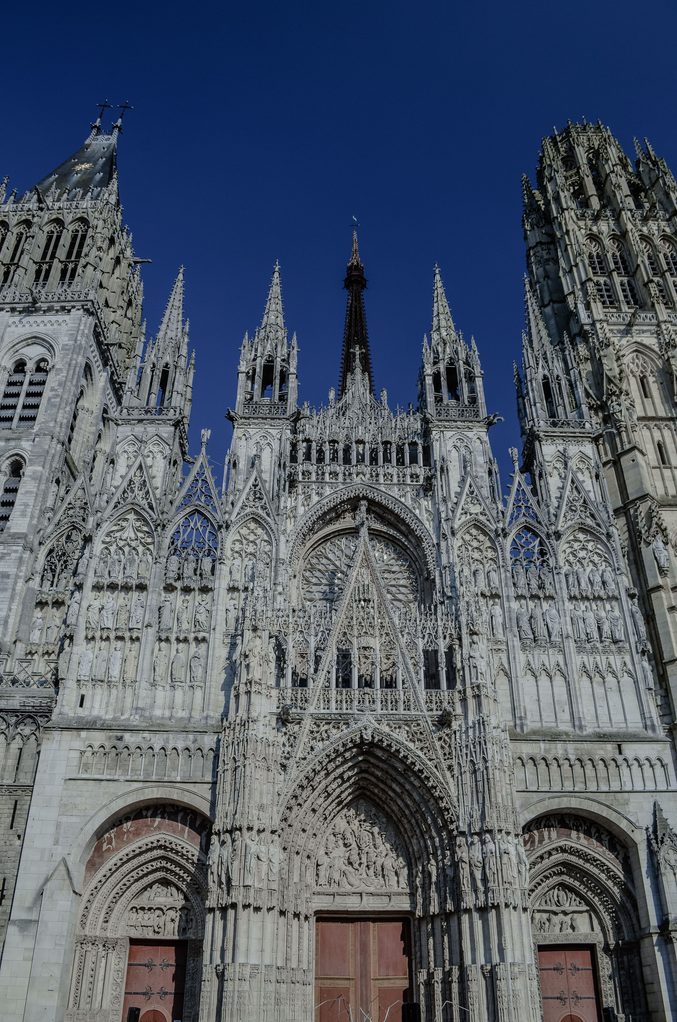
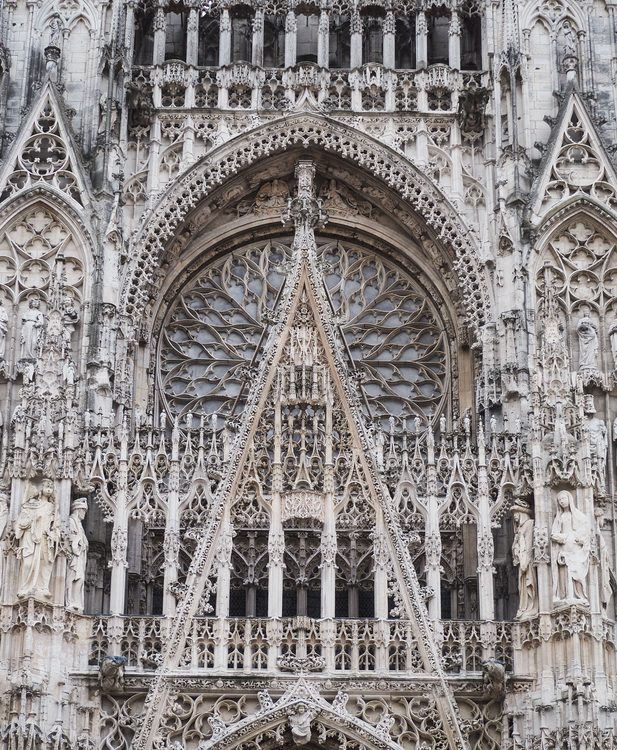
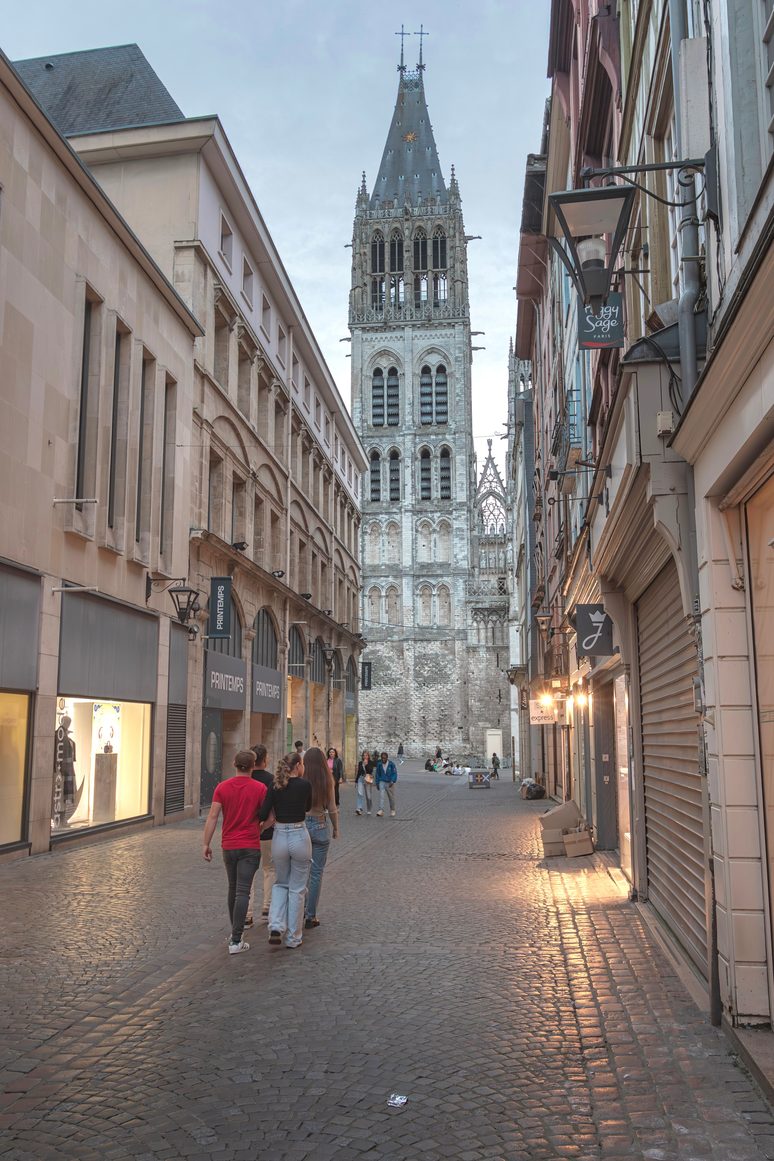
The façade is a screen of pinnacles, gables and statues that took four centuries to build, flanked by the two unmatched towers: the plainer Tour Saint-Romain on the left, the ornate Tour de Beurre on the right. The central portal and its openwork gable were rebuilt in the Flamboyant style from 1508, begun under Cardinal Georges d’Amboise. Monet painted it from rooms across the square, one of them in the building now used by the tourist office.

The nave and the crossing
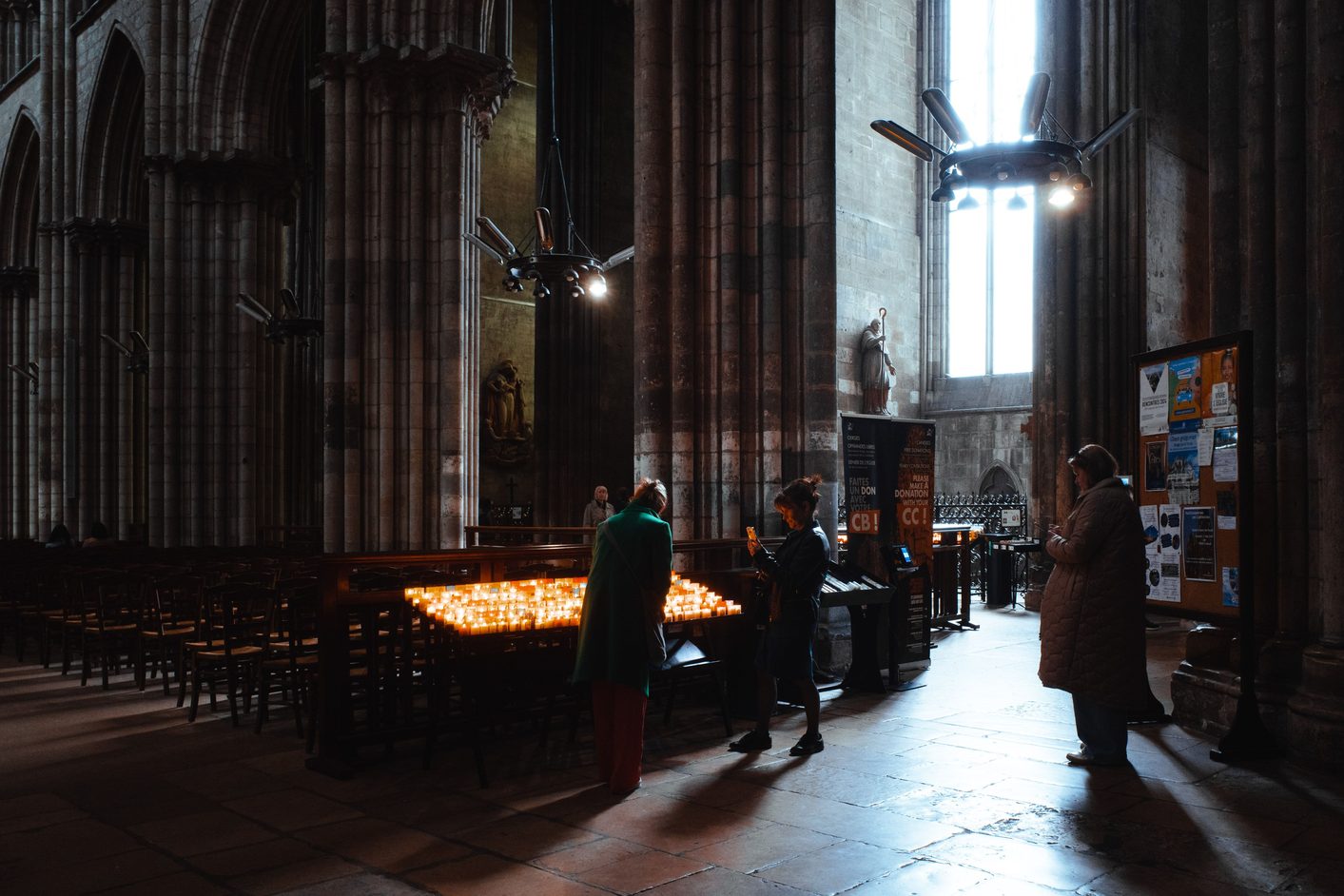
The nave is early Gothic, of the thirteenth century, with an unusual false gallery between the arcades. Stand at the crossing and look up into the lantern tower, which rises 51 metres above the floor, beneath the iron spire.

The library staircase
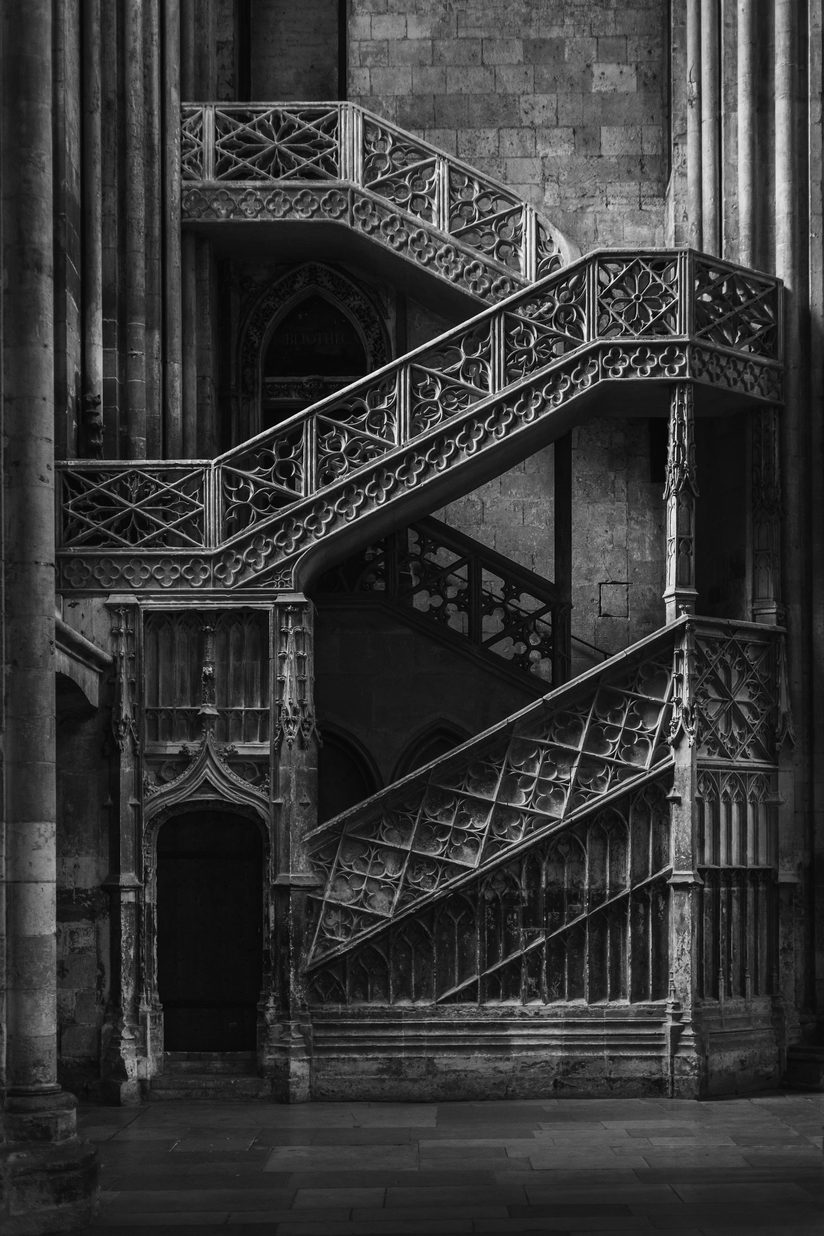
In the north transept, a carved stone staircase climbs the wall to a door high up: the escalier de la librairie of 1479, built to reach the chapter library. Next to it, outside, is the Booksellers’ Portal, the Portail des Libraires, named after the booksellers whose stalls once filled its courtyard.
The choir and the tombs
In side chapels lie the founders of Normandy: Rollo, whose tomb is a copy, modelled on the effigy of Henry the Young King, replacing the original destroyed in 1944, and his son William Longsword. In the choir is the tomb of the heart of Richard the Lionheart, who asked for his heart to be buried in Rouen; his body is at Fontevraud. In the Lady Chapel at the east end, seen on tours, is the great Renaissance tomb of the Cardinals of Amboise.
Tickets and tours
Free to enter; tours from the tourist office
No ticket is needed for the cathedral. Besides the free weekend tour, the tourist office opposite runs paid themed tours, including the carillon in the Tour Saint-Romain, and guided walks round the old town that take in the cathedral.
Tour and hotel links go to GetYourGuide and Booking.com. This site earns nothing from them at present — they are here because they are the quickest way to check what is actually available.
Don’t miss
- Monet’s view Stand outside the tourist office and face the west front.
- The lantern tower Look up from the crossing.
- The library staircase In the north transept.
- The Booksellers’ Portal Round the north side, through the Cour des Libraires.
- Richard the Lionheart’s heart Its tomb is in the choir.
- The Butter Tower The right-hand tower of the west front.
Insider tips
See the west front twice. Come in the morning, when the façade is in shade, and again in the late afternoon, when the sun turns it gold. That change of light is exactly what Monet spent two springs painting.
From late May to late September the free light show, Cathédrale de lumière, plays on the west front after dark, which in June and July means 11pm. Stay the night to see it.
Joan of Arc was tried in Rouen and burned in the Place du Vieux-Marché, ten minutes’ walk west of the cathedral, in 1431. Her story is told in the Historial Jeanne d’Arc, in the old archbishop’s palace beside the cathedral.
One of Monet’s cathedral paintings hangs in Rouen’s Musée des Beaux-Arts, a short walk north.
Common questions
Is Rouen Cathedral free to visit?
Yes. Entry is free, with no booking, every day. The free guided tour at 2.30pm on Saturdays and Sundays, in French, also needs no booking and takes you into the crypt and the Lady Chapel.
What are the opening hours of Rouen Cathedral?
Monday 2pm to 7pm, Tuesday to Saturday 9am to 7pm, and Sundays and feast days 8am to 6pm. Visits may be limited during Mass.
Is Rouen Cathedral the tallest church in France?
Yes. Its cast-iron spire is 151 metres tall, the highest of any church in France, and from 1876 to 1880 it made Rouen Cathedral the tallest building in the world, until Cologne Cathedral was completed.
Is the spire still under scaffolding after the fire?
The fire on the spire’s scaffolding on 11 July 2024 was put out the same day and did not damage the structure. Most of the spire was uncovered in April 2026, but the top is still under restoration until about 2028. The cathedral is open as normal.
Where did Monet paint Rouen Cathedral?
From rented rooms facing the west front in 1892 and 1893, most famously the building that is now the tourist office on the Place de la Cathédrale. He painted the façade more than thirty times, at different times of day and in different weather.
Is Richard the Lionheart buried in Rouen Cathedral?
His heart is, in a tomb in the choir; his body lies at Fontevraud Abbey. Rollo, the first ruler of Normandy, is also buried in the cathedral.
Where to stay and eat nearby
The cathedral is in the heart of the old town, among half-timbered streets full of restaurants; the rue du Gros-Horloge, with its gilded clock, runs from the cathedral square to the Vieux-Marché. Rouen makes an easy day trip from Paris, but staying lets you see the light show and the façade at dawn.
More churches in France
- Notre-Dame de Paris — about an hour and a quarter away by train.
- Chartres Cathedral — for medieval glass, as Rouen is for stone.
- Basilica of Saint-Denis — where Gothic began.
- Mont-Saint-Michel Abbey — Normandy’s abbey on the rock, at the far end of the region.