
The Wieskirche
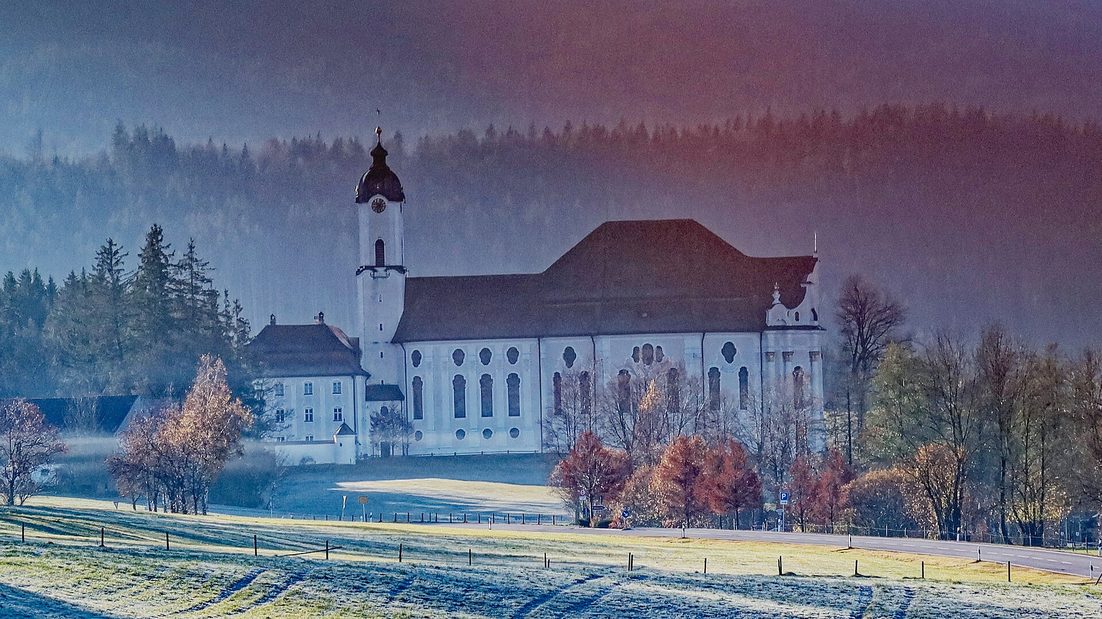
From outside it is a plain white church alone in a meadow at the foot of the Bavarian Alps. Inside, the Wieskirche, the pilgrimage church of the Scourged Saviour at Wies, is a vision of white and gold and painted sky: the masterpiece of the Zimmermann brothers and one of the most perfect Rococo interiors in the world. It is a UNESCO World Heritage Site, entry is free, and it is half an hour from Neuschwanstein.
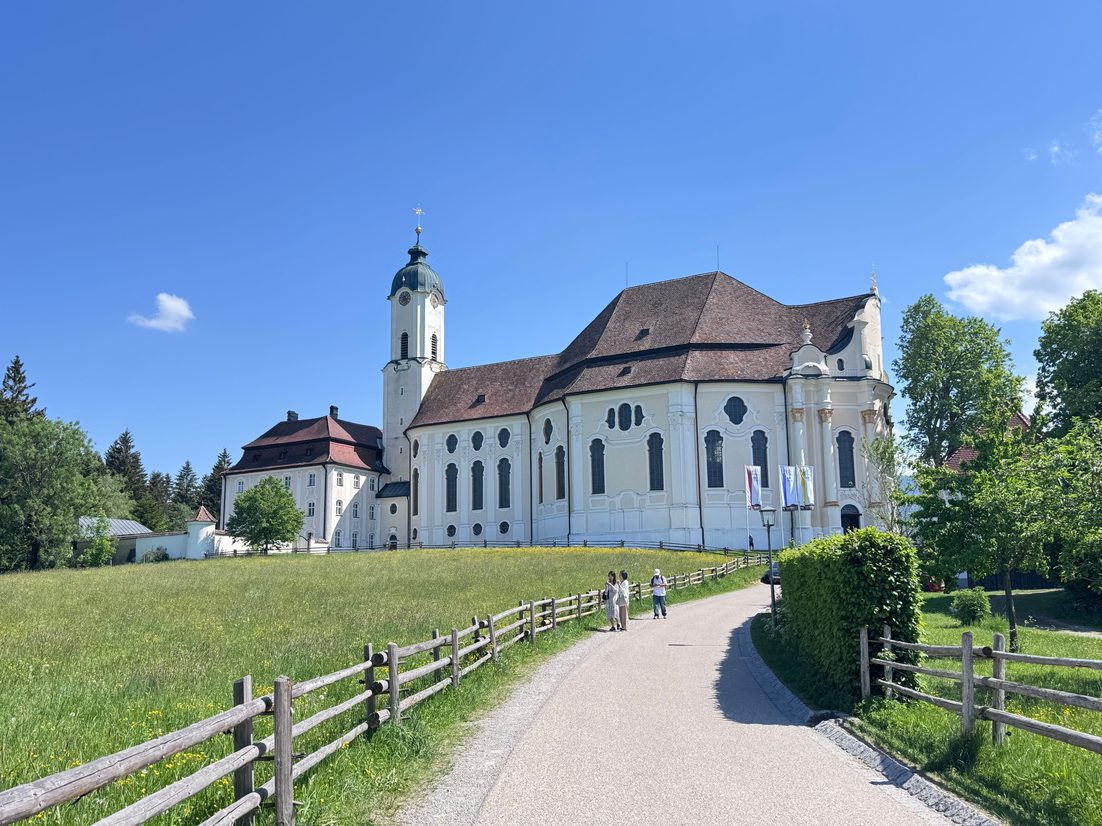
A figure that wept
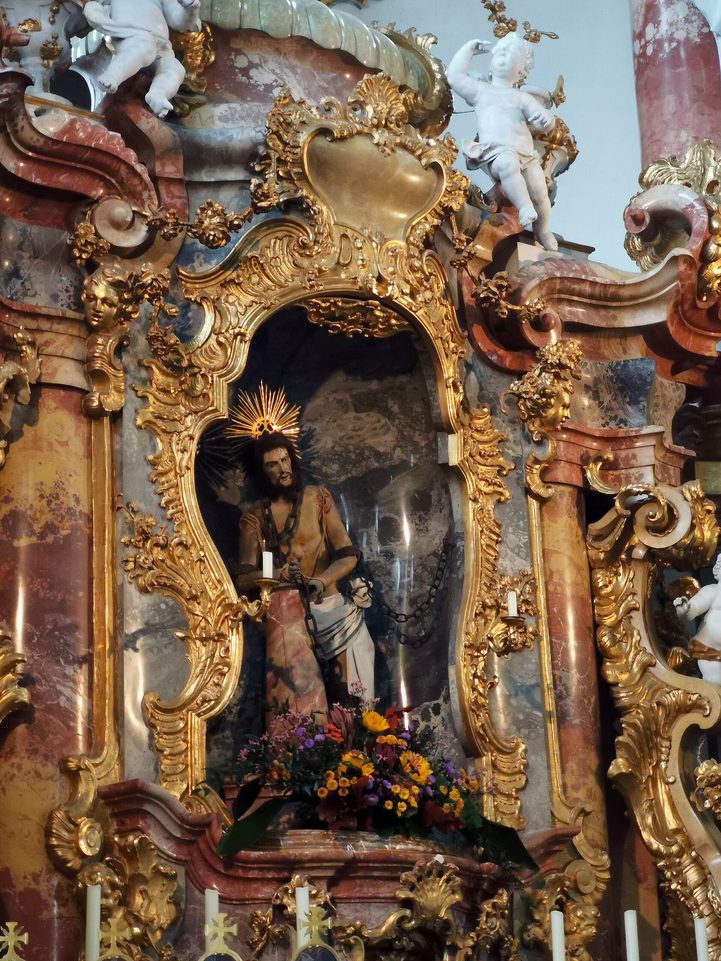
In 1730 the monks of nearby Steingaden Abbey made a figure of the scourged Christ for their Good Friday procession, assembled from parts of old statues and covered in painted linen. After a few years it was put away. In 1738 a farmer’s wife, Maria Lory, took it home to her farm “auf der Wies”, in the meadow, and on the evening of 14 June she saw what she took to be tears on its face. Pilgrims began to come, first to a small chapel and then in such numbers that the abbey decided to build a great church.
The abbot commissioned the architect Dominikus Zimmermann in 1743, and the church was built in 1745–54, with ceiling frescoes by his brother Johann Baptist Zimmermann, painter to the Bavarian court. Dominikus spent his last years in a house beside the church and died there in 1766. After the abbey was dissolved in 1803, local tradition says that the farmers of the area saved the church from demolition. It became a UNESCO World Heritage Site in 1983 and was restored in 1985–91.
The visitor’s cheat sheet
| Where | Wies 12, 86989 Steingaden, in open country about 6 km from Steingaden village |
|---|---|
| Opening hours | Daily from 8am: until 7pm April–October, until 5pm November–March. Closed during concerts (from 1 hour before); no sightseeing during services or tours |
| Admission | Free; donations welcome. Car park €2 for two hours, then €0.50 an hour |
| Mass | Sundays and holy days 8.30am and 11am; Wednesday–Saturday 10am |
| Tours | In German for groups of 12 or more, Tuesday–Saturday, €6 per person aged 18+ (minimum €72); tours in English through Tourist Information Schongau |
| Photography | Private use only; no flash or tripod; not during services or tours |
| Access | Step-free south entrance, with drop-off by car; two blue-badge spaces (phone ahead) |
| How long | Half an hour to an hour |
Hours and admission checked against the official site in October 2026. They change; the official site is always the last word.
What to see
The nave and the ceiling
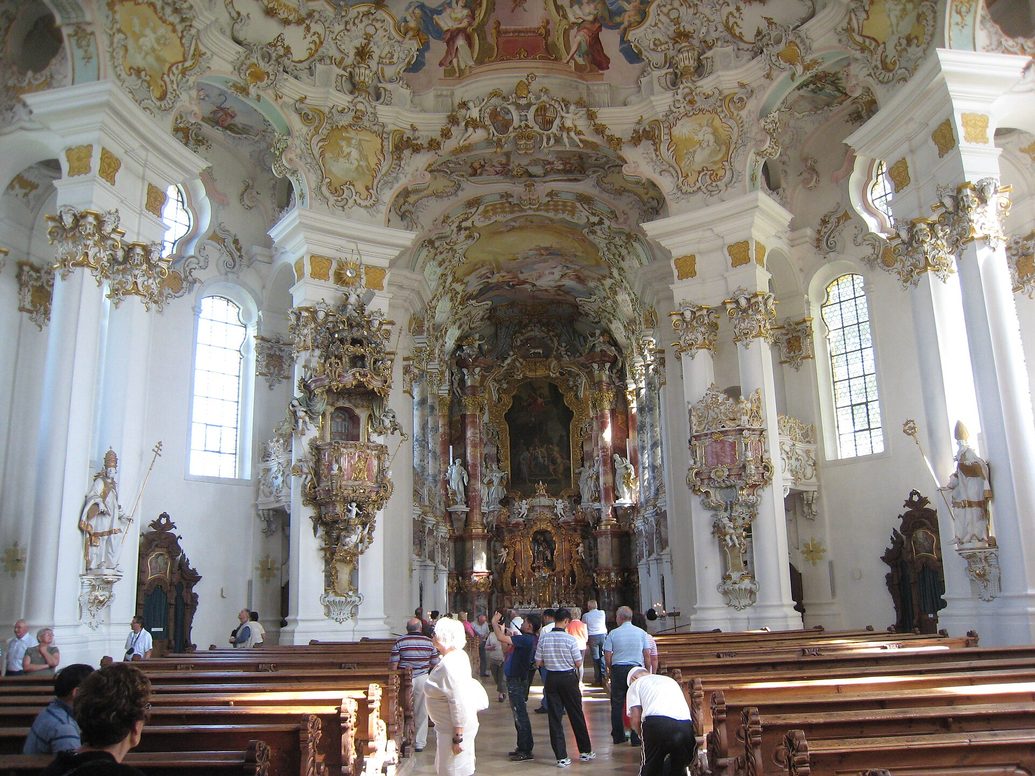
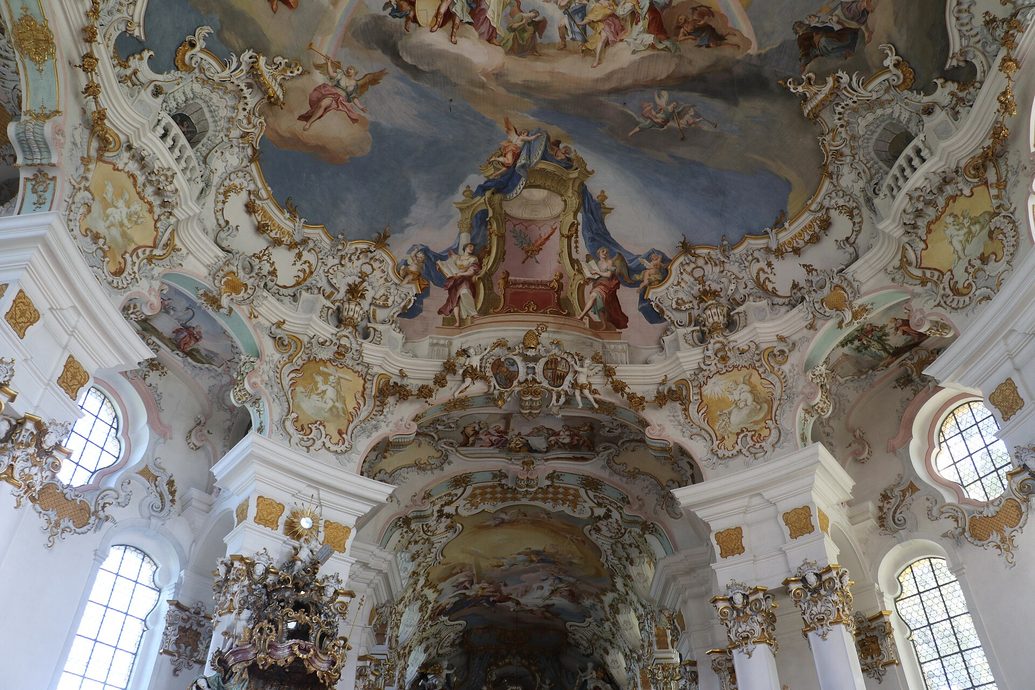
The nave is an oval, ringed by pairs of white columns, with light pouring in through windows of every shape. Above, Johann Baptist Zimmermann painted Christ’s return as judge, before the Last Judgement begins: Christ sits on a rainbow, with the throne of judgement still empty and the door of eternity still closed. The stucco, the gilding and the colour are, almost entirely, as the Zimmermanns left them.
The high altar and the Scourged Saviour
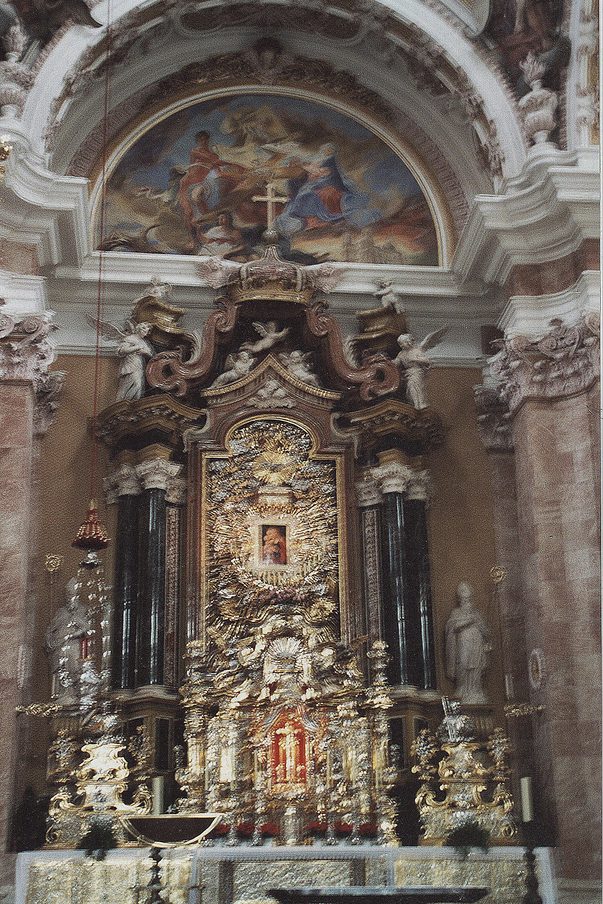
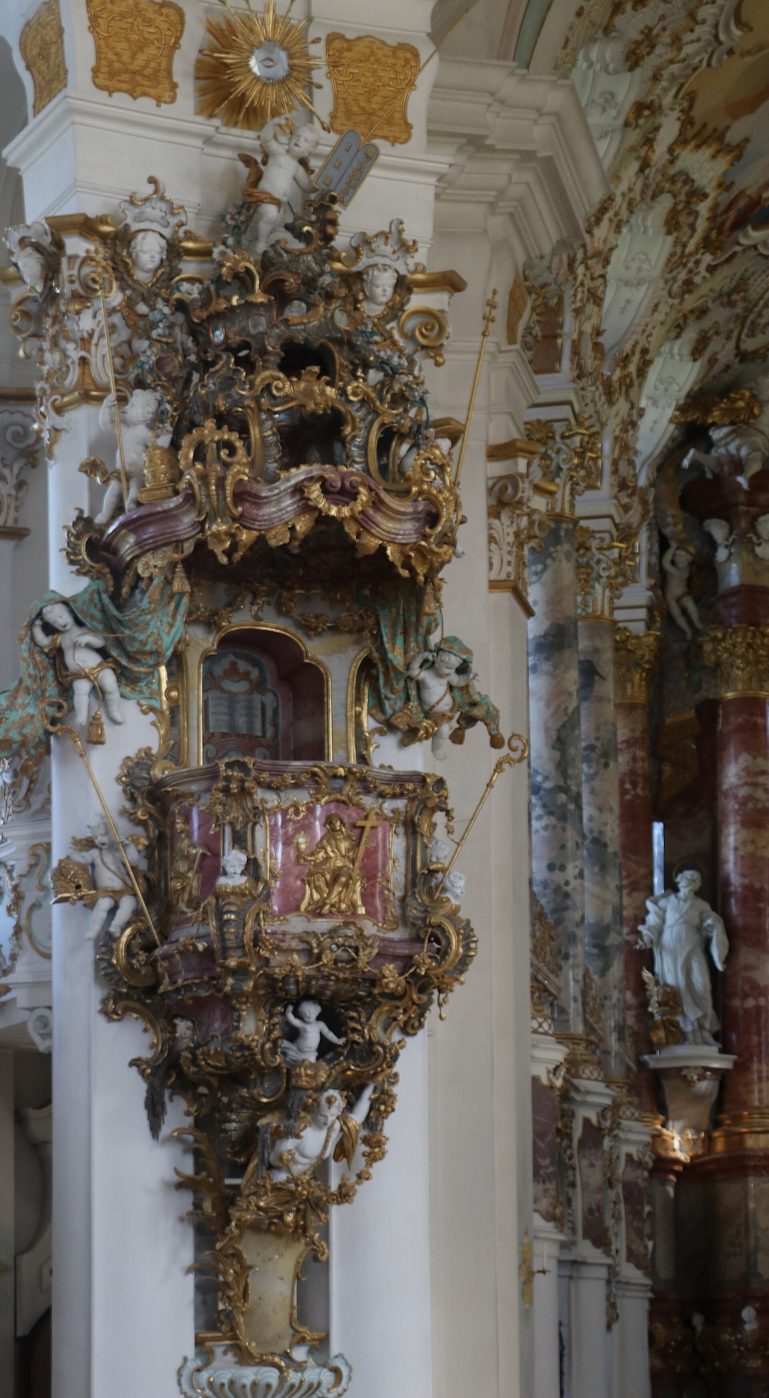
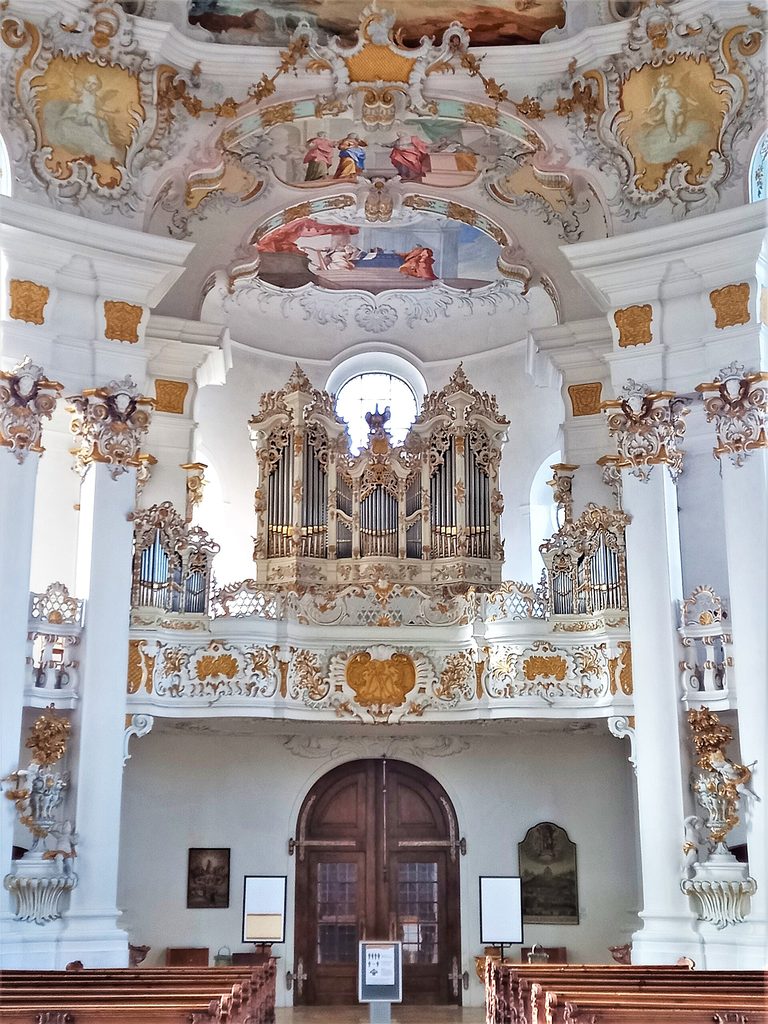
The long, deep choir is the most richly decorated part of the church. On the high altar, in a gilded shrine, stands the small figure of the Scourged Saviour that started it all. The pulpit, on the left where the nave meets the choir, is a cascade of gilded carving, and over the west door the organ gallery holds a new organ of 2010 that keeps pipes from the original instrument of 1757.
The pilgrimage
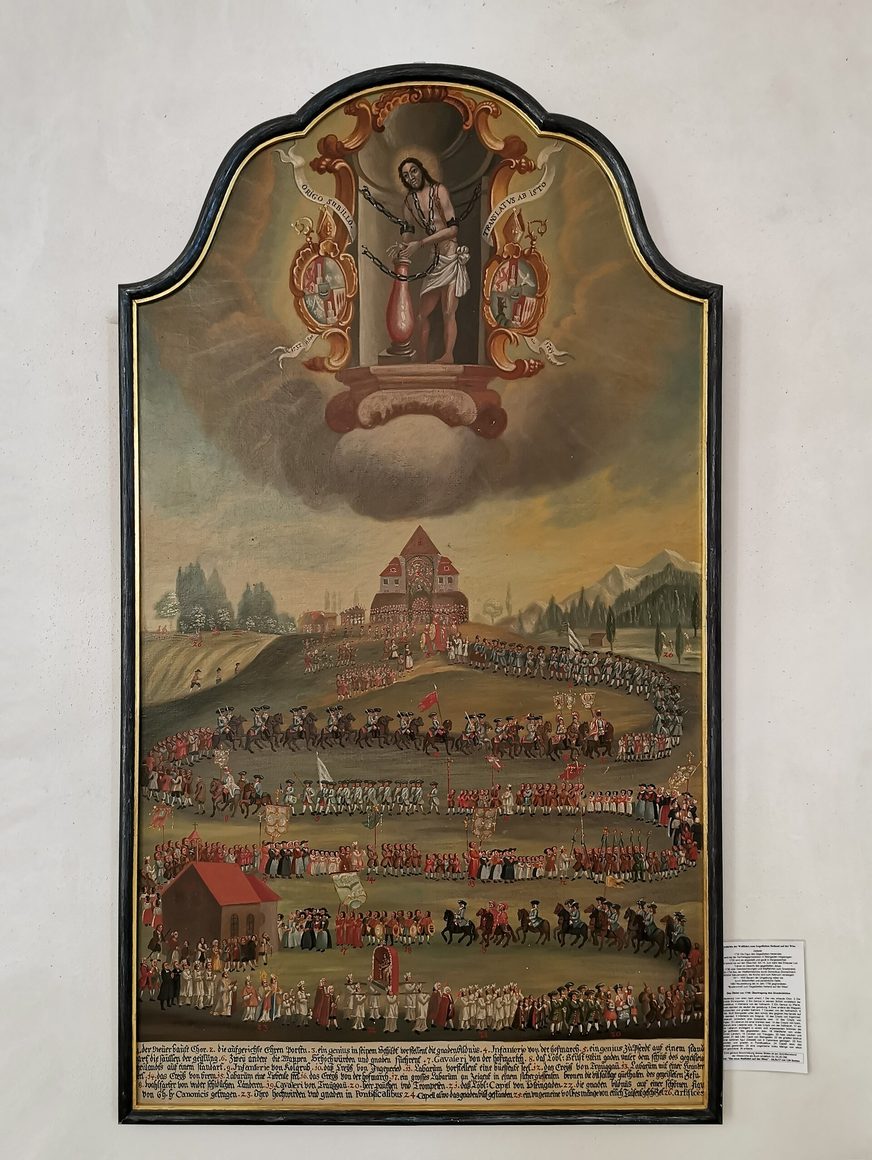
The Wies is still a working shrine. The three great feasts are the Feast of the Tears of Christ, on 14 June or the Sunday after; the anniversary of the consecration, on the first Sunday in September; and the feast of the confraternity, on the second Sunday in October. The story of the pilgrimage is told in the small pilgrimage museum, which holds Dominikus Zimmermann’s votive picture of 1757 and is shown only on guided visits.
Getting there
The Wieskirche is in the countryside of the Pfaffenwinkel, near the Romantic Road, about 6 km from Steingaden. By car it is about an hour and a half from Munich and half an hour from Füssen and Neuschwanstein; the car park is about 200 metres north of the church. Buses are limited: regional buses run from Füssen and, at times, from Garmisch-Partenkirchen and Oberammergau, so check bahn.de before you go. Some day tours from Munich to the castles stop here.
Tours and where to stay
Entry is free, so there is nothing to book for the church itself. Some day tours to Neuschwanstein and the Bavarian castles include a stop at the Wies; for those, and for hotels in Füssen or Steingaden, try these.
These links go to GetYourGuide and Booking.com. This site earns nothing from them at present — they are here because they are the quickest way to check what is actually available.
Don’t miss
- The ceiling Sit in a pew and look up.
- The Scourged Saviour On the high altar.
- The choir The richest part of the church.
- The pulpit Rococo carving at its most exuberant.
- The meadow Walk out a little way for the view of the church against the mountains.
Insider tips
Come early or late. Coach tours from Munich and the castles arrive from mid-morning to mid-afternoon. At 8am, or in the last hour before closing, you may have the church almost to yourself. Avoid the Mass times if you want to walk around, and look up the summer concert programme: hearing music under that ceiling is unforgettable.
Common questions
Is the Wieskirche free?
Yes. Entry is free, and donations are welcome because the upkeep depends on them. The car park, a few minutes’ walk from the church, costs €2 for two hours.
When is the Wieskirche open?
Every day from 8am: until 7pm from April to October, and until 5pm from November to March. The church closes during concerts (from an hour before they start) and during very busy services; during services and guided tours you cannot walk around, but you are welcome to sit in the pews.
When is Mass at the Wieskirche?
Sundays and holy days at 8.30am and 11am, and Wednesday to Saturday at 10am. On the great feast days there is a single Mass at 10am.
How far is the Wieskirche from Neuschwanstein?
About 27 km, or half an hour by car, so it is easy to combine with a visit to the castles. From Munich it is about an hour and a half by road. Buses are limited.
Can you take photos inside?
Yes, for private use, without flash or tripod, and not during services or guided tours.
More churches in Germany
- Bamberg Cathedral — the imperial cathedral of Franconia, emptied of its Baroque fittings.
- Regensburg Cathedral — Bavaria’s great Gothic cathedral on the Danube.
- Dresden Frauenkirche — the Baroque domed church of Saxony, rebuilt after the war.