
Jasna Góra, Częstochowa
On a limestone hill at the end of a long avenue in Częstochowa stands Jasna Góra, the “Bright Mountain”, a fortified monastery of the Pauline Fathers with a tower over 100 metres high. In its chapel hangs the Black Madonna of Częstochowa, the most venerated image in Poland, with two sword cuts on her cheek. Millions come every year, many of them on foot; each August whole towns walk here for the feast of the Assumption.

The monastery restricts the use of photographs taken within its walls, so this guide shows Jasna Góra in old photographs, prints and paintings.
The Pauline monastery
In 1382 Duke Władysław of Opole brought monks of the Order of St Paul the First Hermit, the Paulines, from Hungary and settled them on the hill. Two years later, tradition says, he gave them the icon of the Virgin and Child. A brick Gothic church followed in the fifteenth century. From about 1620, on the initiative of King Sigismund III, the hill was fortified, and by the 1640s bastions ringed the monastery. The great tower, 106 metres high, took its present form after a fire in 1900 and was finished in 1906.


The visitor’s cheat sheet
| Where | ul. o. A. Kordeckiego 2, 42-225 Częstochowa |
|---|---|
| Admission | Free to the basilica, the Chapel of Our Lady and the grounds; museums and tower by donation (ask at the Information Centre); guided tours 150 zloty for up to five people, 30 zloty a person for larger groups |
| Monastery | Open from about 5.30am to 9.30pm |
| The icon | Unveiled at 6am daily; covered at noon (1.30pm at weekends and on feasts) and uncovered again at 1.30pm (2pm). Jasna Góra Appeal daily at 9pm |
| Museums | March–October 9am–5pm; November–February 9am–4pm; shorter hours on some feast days |
| Tower | April–November, 8am–4pm, weather permitting; no lift |
| Photography | Not in the museums or treasury without a permit; no flash, and not during services |
| Dress | Shoulders and knees covered |
| Getting there | Train to Częstochowa (about 1½ hours from Kraków), then 25–30 minutes’ walk up the avenue |
| How long | Two to three hours; longer on a pilgrimage day |
Hours and admission checked against the official site in November 2026. They change; the official site is always the last word.
The Black Madonna
The icon is painted on a wooden panel about 122 by 82 centimetres. Legend says St Luke painted it on a table top from the house of the Holy Family; many art historians see it as an Italo-Byzantine panel of the thirteenth or fourteenth century, heavily repainted in the fifteenth, though its date is still disputed. The Virgin’s dark face gives the image its name.
In 1430 raiders, traditionally described as Hussites, plundered the monastery, tore the icon from its altar and slashed it. It was restored in Kraków on the orders of King Władysław Jagiełło, and the two cuts on her right cheek were left visible. In 1717, by decree of Pope Clement XI, it became one of the first Marian images outside Italy to be crowned by papal authority.
The icon hangs above the altar of the Chapel of Our Lady, behind a silver screen of 1723. The screen is raised at 6am every day to music, lowered at midday and raised again in the afternoon; at 9pm the Jasna Góra Appeal, a short prayer service with hymns before the icon, is held every evening. Pilgrims often go round the altar on their knees. The icon is usually dressed in one of several jewelled “robes”, among them one of pearls.

The siege of 1655
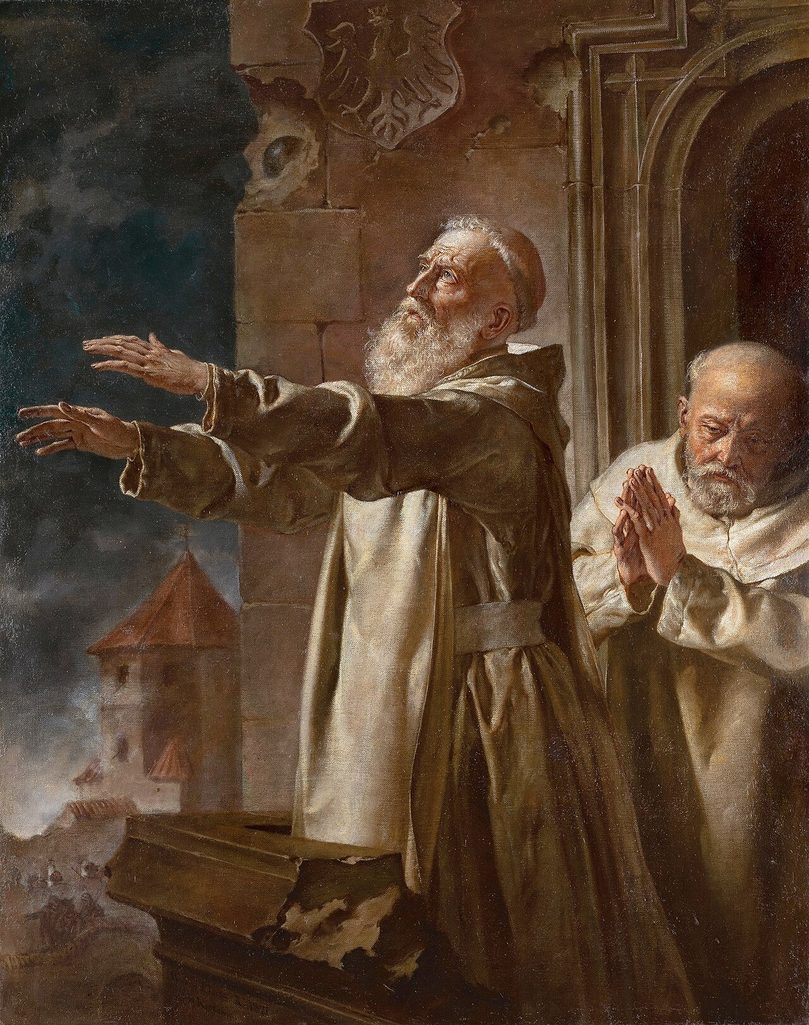
During the Swedish invasion of Poland, the Deluge, a Swedish army laid siege to the monastery in November 1655. The prior, Augustyn Kordecki, with about 160 soldiers, fewer than a hundred monks and a few nobles, held out until the Swedes withdrew at the end of December. The defence became a national legend, and in April 1656 King John Casimir placed his kingdom under the protection of the Virgin, proclaiming her Queen of Poland.

What to see
The Chapel of Our Lady
The chapel of the icon is the heart of the shrine, in near-constant use for Masses from early morning to evening. Its walls are hung with votive offerings, and the black-and-silver altar frames the icon.
The basilica
Next to the chapel, the basilica was rebuilt after a fire in 1690 as a three-aisled Baroque church, its vaults painted and its altars gilded. Its interior was restored between 2008 and 2012.

The Knights’ Hall, treasury and museums
The Knights’ Hall of the 1640s is hung with paintings of the monastery’s history and with military banners. The treasury above the sacristy holds centuries of gifts to the Virgin: royal monstrances and chalices, rosaries of Polish queens, and the silver of King Jan III Sobieski. The 600th Anniversary Museum tells the story of the order and the icon, and the St Roch Bastion holds military gifts, including, according to the monastery’s collections, Lech Wałęsa’s Nobel Peace Prize medal; parts of its displays have been closed recently.
The tower and the walls
From April to November you can climb the tower to two viewing terraces, by stairs only. The walk round the ramparts is open all year, and the Stations of the Cross in the gardens of the old moat lead round the walls.


Pilgrimages
Pilgrims have walked to Jasna Góra for centuries. The Warsaw walking pilgrimage has set out every year since 1711, and in August groups from all over Poland arrive on foot for the Assumption on 15 August and the feast of Our Lady of Częstochowa on 26 August. On 3 May the shrine keeps the feast of the Virgin as Queen of Poland. On those days the monastery is crowded from dawn; for a quiet visit, come on a weekday out of season.

Getting there
Częstochowa is on the main line between Warsaw and Katowice. Direct trains take about 1½ hours from Kraków and 2 to 2½ hours from Warsaw; some Warsaw trains stop at Częstochowa Stradom instead of the main station. From the main station walk to Aleja Najświętszej Maryi Panny, the broad avenue that runs straight up to the monastery; the walk takes about 25 to 30 minutes. From Katowice airport, buses take about 45 minutes.
Where to stay
Most visitors come for the day from Kraków, but staying in Częstochowa lets you see the icon unveiled at 6am or hear the evening Appeal.
This link goes to Booking.com. This site earns nothing from it at present — it is here because it is the quickest way to check what is actually available.
Don’t miss
- The unveiling of the icon At 6am, or again in the early afternoon.
- The Jasna Góra Appeal Every evening at 9pm.
- The treasury Six centuries of gifts to the Virgin.
- The tower In season, for the view over the town.
Insider tips
Time your visit to the icon. The screen is down from midday until the early afternoon (1.30pm on weekdays, 2pm at weekends). Arrive in the morning or mid-afternoon to see the Madonna uncovered.
Start at the Information Centre. The Jasna Góra Information Centre can tell you which museums are open that day and book an English-speaking guide.
Common questions
Is it free to visit Jasna Góra?
Yes. The basilica, the Chapel of Our Lady with the icon and the grounds are free. The monastery publishes no admission prices for its museums or the tower, which have traditionally asked only for a donation; ask at the Information Centre when you arrive. Guided tours from the Information Centre cost 150 zloty for a group of up to five, or 30 zloty a person for larger groups, including entry to the rooms visited.
When is the Black Madonna unveiled?
The icon is unveiled at 6am every day. It is covered again at noon on weekdays and at 1.30pm on Saturdays, Sundays and great feasts, and uncovered again at 1.30pm on weekdays and 2pm at weekends and on feasts. The Jasna Góra Appeal, an evening prayer before the icon, is held every day at 9pm.
What are the opening hours?
The monastery is open from about 5.30am to 9.30pm. The museums open 9am to 5pm from March to October and 9am to 4pm from November to February, with shorter hours on a few great feast days. The tower can be climbed from April to November, 8am to 4pm, weather permitting.
Why does the Black Madonna have scars on her face?
In 1430 raiders, traditionally called Hussites, plundered the monastery and slashed the icon with swords. When it was restored in Kraków the cuts on the Virgin’s cheek were kept visible, and they have been part of the image ever since.
Can you take photographs?
Photography is banned in the museums and the treasury without a permit, and you should not photograph during services or with flash. The monastery also restricts any commercial use of photographs taken within its walls, which is why this guide shows it in old photographs and paintings.
How do you get to Częstochowa?
Direct trains take about 1½ hours from Kraków and about 2 to 2½ hours from Warsaw. From Częstochowa station, walk to the end of Aleja Najświętszej Maryi Panny, the long avenue that runs straight to the monastery: about 25 to 30 minutes on foot.
More churches nearby
- Wawel Cathedral, Kraków — the coronation church of the kings of Poland, about 1½ hours away by train.
- St Mary’s Basilica, Kraków — Veit Stoss’s great altarpiece.